Babies Everywhere

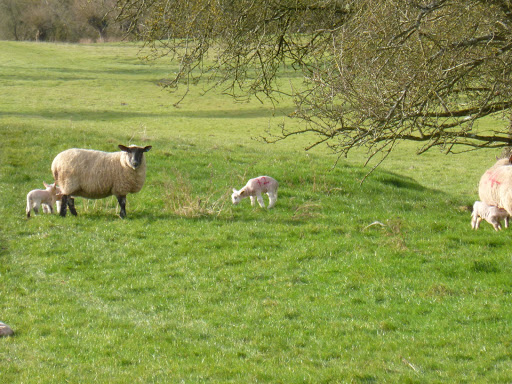
Everywhere I  look at the moment there are babies – it’s that time of year.  I’m not talking human babies although quite a lot of my friends seem to be having new grandchildren, yet another sign of our ageing.  In the secret valley animals outnumber humans by dozens to one so it isn’t surprising that all around us there are signs of new life.

Lambing starts later here than in many places, for the spring grass is also later, so it is with impatience that we wait to see them skipping in the fields and chasing one another up and down the  river banks.  Of course, that was some weeks ago – now they are grown quite large and, as I write this, very noisy as they call for their mothers who have been separated for shearing. It will be a few hours before they have all found one another and normality returns again; the sound of contented and playful bleating telling us that all is well.
Calves can be born in spring or autumn.  Beyond the secret valley is a beautiful herd of Red Devon cattle and they make good mothers.  I first came across this gentle breed when I worked on a farm as a teenager on Exmoor and they have been a firm favourite ever since.  Bred for beef, we used to hand milk a few for the farm’s own use and the milk was very rich and creamy.   Large enamel basins of it would be placed on top of the Rayburn stove (fired by the peat turves I have recently written about, click here)  and I would watch fascinated as the cream would rise in large clots to be skimmed off  to be eaten with afternoon tea, that most traditional of West Country meals.

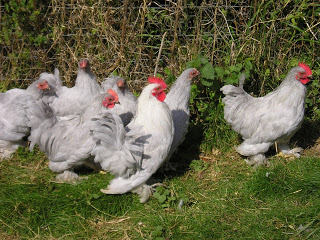
The bantams – Lavender Pekins (Cochins) – are all rapidly going broody.  I find that they are only good layers in spring, the rest of the year they lay fewer eggs.  We always set some of these under them so that we have a new supply of youngsters: if we get too many there is always a ready home for them but mostly they are there as ready-made meals for Mr Fox who is a far too regular visitor.  I’d rather see the bantams having a short but very lovely time wandering about the place than cooped up in a pen somewhere.  When left to free range it is amazing just how far they travel up and down the field which does make them rather vulnerable.  As the fox usually visits in the early hours of the morning I try to always remember to shut them away safely for the night.  In the cold weather earlier in the year a fox visited the garden regularly during the day – at one time actually peering through the glass garden door at us.

 
We don’t keep duck but that doesn’t stop us from seeing them in the garden.  Usually one raises a brood of ducklings somewhere secluded: often under a large clump of oat grass or, before it rotted away completely, a few feet up on top of a rotten tree stump at the foot of a hedge. As soon as they hatch, she leads them away down the field to the river below the house.

Every year, there are many pheasants that survive the shooting season.  Last spring we had one nest in a planting trough beside our kitchen door.  Despite the constant activity, she sat tight and none of the dogs, visiting or resident, discovered her.  I have read that, when sitting on eggs, the hen pheasant can supress any scent so as to avoid predators.  No sooner had the chicks hatched than every dog in the neighbourhood was investigating the planter but by then, of course, she had led them all to safety.

Partridge also visit the garden but are much more wary.  When their eggs hatch the chicks are not much bigger than bumble bees and swarm about their mother.  They are so tiny they appear to have no legs moving as if somehow they are fitted with wheels instead!

I almost certainly won’t find it necessary to blog about the next ‘hatching’ for an eagerly waited event is the royal birth.  When Kate has her baby it will make world news – you won’t need to see a photo of it here!

Add to Technorati Favorites

Turf Cutting on Exmoor

A few weeks ago I blogged about cutting peat – or ‘turf’ as it is known on Exmoor – for burning.  It is an ancient tradition, now past.  You can read that post by clicking on the link here.

When I first visited Exmoor forty-five years ago one of the first tasks I was given was to ‘turn’ the turf, literally just turning it over and over so that the wind dried it.  In many ways it was a boring and monotonous job but it had to be done for it was the provider of heat for the farm, both water and cooking.  Being alone, high up on the moors, was never lonely for the isolation, even for a lad, was awe-inspiring.  I loved it.

Recently, I was flicking through the pages of a book that has been in our possession for as long as I can remember and came across a photograph of an Exmoor turf cutter.  I’d never noticed it before.  The book is called ‘People of all Nations’ and was written about 1920.  The photographs are wonderful and show a way of life long gone.  

click on the photo to enlarge

With the benefit of hindsight, it is a pity that I took so few photos of my early days on Exmoor.  At the time, it seemed that the unchanged life of the moors would go on for ever.  Little did I realise that I was witnessing its passing and  I feel very privileged to have been a (very tiny) part of it.  What has endured has been its influence: my arrival quite by chance on Exmoor and being taken into its heart has been a subject of discussion recently with Phil Gayle on BBC Oxford.

The caption below the photograph reads:

Cutting Turf on the Rolling Heights of Exmoor. With his primitive cutter this Devon labourer is procuring long strips of turf at the opening of the shearing season.  The turf is stacked into barns in which the sheep are herded on the eve of shearing.  They rub against it and lie on it, thus ridding their wool of much dirt and grease which would detract from the value of their fleece were it present when shearing began.

Add to Technorati Favorites

BBC Oxford Interview with Phil Gayle

I’m being interviewed on BBC Oxford  on Tuesday 21st May. 

Talking to Phil Gayle about career changes and the people that influence them – in my case the change from fashions to flowers.

“What or who changed your life? Phil Gayle hears from someone who got lost on a bike ride and it changed the direction of their life” – this refers to my eventual arrival on a remote hill farm on Exmoor at the age of 16.

To listen to the interview click here

Add to Technorati Favorites

Turf Burning

For gardeners, peat is a well-known, although less used than before, mainstay of seed and potting composts.  It’s ability to absorb large quantities of moisture and to retain nutrients plus being very light when dry, thereby reducing transportation costs, made it the perfect growing medium.  In recent times, the environmental impact of industrial scale peat extraction has given rise to concern leading to the development of alternative composts becoming available.

Exmoor’s rolling moorland: a wild, windswept and boggy place

In the areas where peat is found – mostly in the temperate regions of the northern hemisphere – it was also a common fuel source and is still used for this purpose today.  On a non-commercial scale peat for burning is also in decline as the hand digging of the bogs, the drying out process and the carting all takes time for very little financial gain.  The days of the ‘turf cutter’ being paid sixpence a load have long passed.

Turf cutting creates deep trenches across the bogs

On Exmoor, in England’s West Country, peat is always referred to as ‘turf’, a dialect word, that means something very different from the velvety, green sward of gardeners.  Turf was still being cut there into the 1970’s and was one of the very first tasks I was given when arriving as a lad to work on a remote hill farm.  It was back breaking labour turning the individually cut pieces over and over to allow the wind to dry them before stacking them in heaps which later would be carried back to the farm to supply the fires that were needed all year for both heating and cooking.

 Cut turf in Ireland’s Connemara

Despite the backache, it was an enjoyable time being up on the moors all day with just the sound of the wind and the curlews mournful cry for company.  The native Exmoor ponies and the wild Red Deer all would appear from time to time for you became part of the moorland scenery too. Returning to the farm tired after a hard day’s work to be greeted by the sweetly fragrant smoke from the turf fires within was reassurance enough that it was all worthwhile.


Curlew and Red Deer on Exmoor


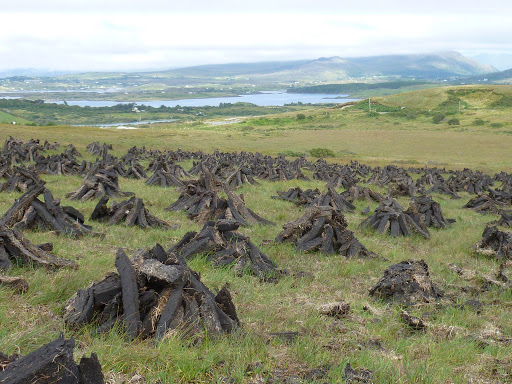
Last summer a visit to Connemara, on the west coast of Ireland, brought back all these memories for there turf burning is still commonplace.  There were the rows of turf lying on the ground waiting to be wind-dried, there were the stacks of turf waiting to be carted.  And, best of all, there was the heady smell of dozens of peat fires wafting over the landscape. 

Connemara turf stacked ready for carting – cut to a very different shape to Exmoor

Recently, on Exmoor, it has been realised that turf cutting kept the bogs ‘open’ providing a valuable wildlife resource and although not reinstating the practice the National Park has instigated the Exmoor Mire Restoration Project. This has involved blocking old drainage systems and re-wetting over 300 hectares; the project is on-going.  Visit there website by clicking here to find out more.

The trenches fill with water creating a very special and rare wildlife habitat


Exmoor is still as beautiful as ever and my love for it never diminishes but, without the scent of the turf fires, there is that little ‘something’ missing.  However hope may be around the corner: the entrepreneurial Irish are selling peat incense blocks by mail order so that you can have the scent anywhere.  I may even take a few blocks and light them on Exmoor for old times’ sake.

Add to Technorati Favorites

The Day I Became a Mother!

I have kept poultry since childhood ever since returning with my parents from a farm on Exmoor with a box containing half a dozen bantams smuggled into the back of their car. When one laid an egg en route and started cackling, my mother was furious. Fortunately we were too far into our journey for them to be taken back.  In time, she became equally fond of them and even allowed them to wander into the house to be given scraps of food.

The original bantams were farmyard mongrels but since I came to live in the secret valley I have kept Lavender Pekins.  These are allowed to wander the fields, even though they become supper for the fox, for there is nothing more delightful than to see happy hens striding down to the river or up the valley and (hopefully) back again. 

Bantams – or Cochins, as they are called in Canada and the USA – are ideal as garden birds for they do very little damage unlike their full sized relatives.  We keep those too but they are – with difficulty – kept firmly beyond the fence. I have written about the bantams in an earlier post and this can be seen by clicking here.

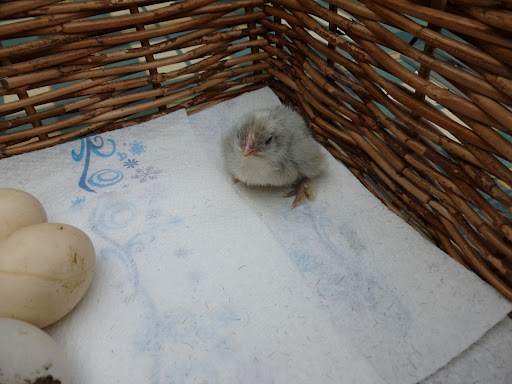
The other day I came across a couple of abandoned bantam eggs put them into a basket, kept them warm and waited to see what happened.

What a result!  An hour later it was dry and fluffy ….. and making even more noise!

Add to Technorati Favorites

The Constant Drip

When I was a small child I was traumatised by the sound of water, even a dripping tap would trigger nightmares of drowning.  This was not because my life had ever been at risk, although it could be argued that my afterlife was: it was down to baptism by total immersion.  My soul might have been saved by water but it was years before water became something that I would delight in, rather a problem for a lad that was brought up on the banks of the Thames, that great English river that flows sluggishly from its source to London and the North Sea beyond, a distance of 215 miles.

                                        
                                                   The River Thames at Marlow

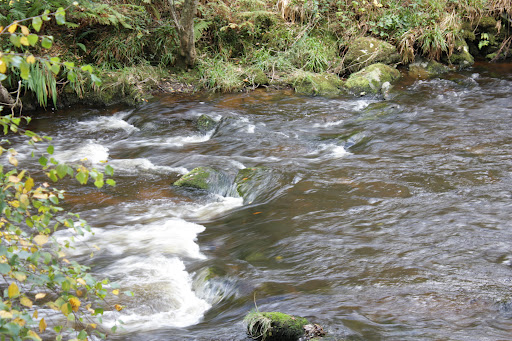
It was not until, as a young teenager visiting the West Country, I came across clear, rocky bottomed streams that were so unlike the silty bottomed, muddy waters of the Thames and the smaller brooks back home.  At first the sight and the sound of their fast flow rather unnerved me but there was a swift and dramatic change once I discovered the joys of splashing about, ‘tickling’ for trout and generally getting soaked. Not only could I not get enough of them, I ended up living beside one here in the secret valley.  Our river, to be truthful, is a compromise: it likes to believe it is of world class comparable with the Amazon or the Zambezi as it winds through the landscape in great (or in reality, miniature) curves and sweeps.  Sometimes it is slow moving half hidden by lush foliage that spills over its banks but in other places it is as fast running and noisy as a Devon stream as it gurgle and clinks its way over rock and pebble.
Our little river in the secret valley


    In winter, our river doesn’t look quite so inviting!

Recently I was staying high in the mountains of Snowdonia.  The house that we were in had to its right, a larger river crashing noisily downwards and, to its left, a much smaller gully with an equally fast flow.  ‘Our’ house, which inreality belongs to a friend, is not exactly standing on an island; more it is the solid filling of a watery sandwich. The main river, the term is used loosely for it is even more jumpable over than the one back in the secret valley, tumbles down the mountainside in a series of rocky chasms interspersed with quieter small pools.

One of the nicest aspects of returning to a place time after time is that certain things become so familiar, whether it is buildings or the wider scenery does not matter.  This is good for once you stop looking at the overall picture, the detail becomes more noticeable and things that would be overlooked if you only ever visited once begin to stand out.  Here there is little in the way of buildings, apart from the numerous ruins that stand as ghosts to a time when the hills were more densely populated with miners and farm workers.  On my morning walk and musing on how terrified I had once been by the sound of water, I began to notice the change in pitch and volume which alters constantly as you pass by.  Where the water falls several feet, not surprisingly the noise is at its greatest but, even there, it can be a deep sound or a lighter one, depending on the rate of flow and whether it lands on rock, water or pebble.

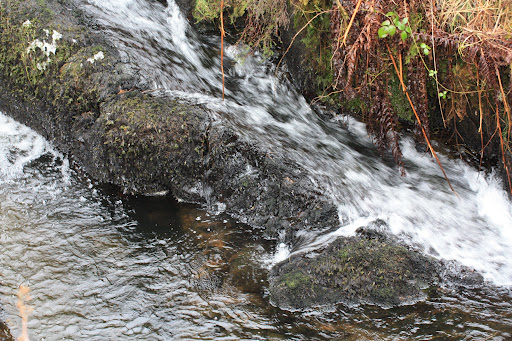
Then there are the waterslides: these can be steep or barely inclined, narrow or wide, fast or slow flowing.  Whichever they are, for me they are the most visually exciting of all with their water moving effortlessly, literally sliding along the surface and their ‘shushing’ sound building up to a more dramatic crescendo as the rock bed alters in character once more.

       A massive waterslide on Exmoor …..

                                                            ….. and a smaller one in Snowdonia

And then, of course, there is the sound that once traumatised me but that I now find the most fascinating of all, perhaps because they entice you to explore: they draw you further into their world, often a secret one.  The sound of dripping.  Sometimes it is obvious where it is coming from and where it is landing but often it is a sound that demands you to seek it out and then, not infrequently, only one half of the equation can be solved, if you can find the source you cannot find the landing place or vice versa.

Higher up the mountain is an old disused slate mine, long abandoned and with its shaft open for all to explore. Little natural light enters the low tunnel entrance and unable to see far inside there is only the sound of water seeping through the roof landing in the shallow water that collects in the passage below.  Here the sounds are as varied as those of a xylophone, the music made being both enchanting and unnerving; it is both welcoming and threatening at the same time. 

Not a place for the faint-hearted!

I may have got over my old phobia of scary water sounds but, I have to admit there is still one place that makes me shudder.  Just up the track beyond the mine there is a patch of grass and moss that has to be crossed and here, if you pause, you can hear the sound of fast moving water and the crash of a waterfall but there are none in sight.  The sound comes from below ground under your feet – childhood anxieties rise if I loiter here and as I continue my walk I notice, with wry amusement, that it is at an increased pace.

Add to Technorati Favorites

First Build Your Bank ….

Some time ago I was asked if I could plant a hedge.  Straightforward enough, I thought and as it was to be a native hedge, I was especially keen to do it.  Using only native species is always a pleasure for not only are you maintaining a tradition that is centuries old, it is also excellent cover for twentyfirst century birds and animals.

It was only when I went to visit the site that it was mentioned that it would be rather nice if the hedge could be planted on top of a bank, reminiscent of those that are found in the West Country counties of Devon and Cornwall.

West Country banks use large amounts of stone in their construction and were built to protect livestock from the gales and snowstorms that sweep in from the Atlantic.  Over time they become encrusted in lichens and mosses with ferns, primroses and other wild flowers sprouting from every crevice.  They are usually topped with a beech hedge or, sometimes, gorse (or furze, as they call it on Exmoor).

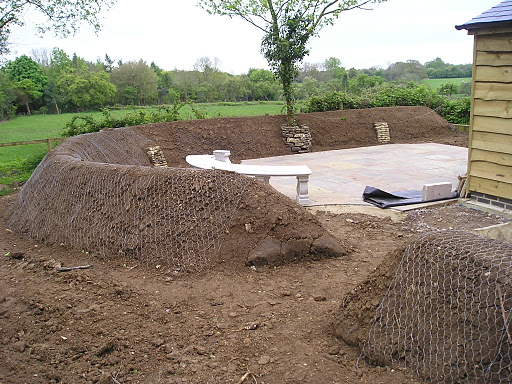
The bank that I had to build was to be similar but faced with turf which would not be as strong. As it was to divide two halves of a garden and (hopefully) not have to keep out determined sheep or cattle, this didn’t matter.  The thing that did matter was that I had to build it in a way that would prevent it from falling down …..

I’ve always found that if you want to create an impression bring in a digger.  There is a morbid fascination in watching a digger at work for the destruction can be immediate and swift.  It certainly would have been if I had been in charge of the controls but, as is so often the case, when you need an expert it is better to bring one in.  I know where I am when it comes to shovels and forks and trowels but it is best not to let me loose with all those knobs and levers.

The ground cleared we were then able to lay out and start building the bank.  We imported the rubble and clod for the base which after being well rammed and compacted could then have a top layer of better quality topsoil spread over the surface.  All was held in place by large mesh chicken wire netting.

Next came the turf and this was laid direct onto the netting and held in place with hazel twig ‘pegs’.  These would gradually rot but not before the turf had grown its roots through the wire.   The netting, too would quite quickly rot (we didn’t use galvanised for we didn’t want it to last for years) and, by then and fingers crossed, the bank would be quite stable and self supporting.

It was with some trepidation when, a few weeks later we cut the top of the turf and the wire out so that we were able to prepare the bank for planting the hedgerow; especially so as we had had some torrential downpours giving me anxious moments about landslips and mudslides.  All, fortunately was well.

Having plants delivered, I find, is always an exciting moment.  It reminds me of when, as a child, I waited for Christmas morning and couldn’t wait any longer to open my presents.  Despite knowing what is coming out of the van, each plant or variety is met with little gasps of delight.   The thrill of knowing that, with luck, they will thrive and continue to grow for many years and may even be there long after I’ve been buried and forgotten is great.

The hedgerow was not the easiest thing to plant but the end result was pleasing.  The final combination was Hawthorn, Field Maple, Wayfaring Tree, Hazel, Dog Rose, Spindle and Hornbeam  with an occasional Honeysuckle to fill the evening air with perfume.  The birds took to it straight away and, in my imagination at least, mice and voles shelter amongst the trunks hiding from mirauding stoats and weasels.  Best of all is the knowledge that, a few years on, the bank is still standing!

Add to Technorati Favorites

A Royal Invitation

Like most people, I wait with eager anticipation for the postman to deliver the mail each day and, each day, I find that, if it isn’t bills he’s put through the letter box, it’s circulars that go straight into the recycling bin.  So when a card sized envelope arrived with a nicer quality about it than most – and especially as it wasn’t my birthday – I was intrigued.  Why do we always feel envelopes and squint at postmarks to try and work out what is inside when all we have to do is open them and take a look?

My first reaction upon finding I’d received an invitation from the Duke of Edinburgh to attend Windsor Castle was to think that a friend was playing a practical joke.  But the more I read it the more real it looked:

His Royal Highness The Duke of Edinburgh, K.G., K.T
requests the pleasure of your company
at a Reception to be held in the State Apartments, Windsor Castle

How extraordinary!  Why me?  Why should I be drinking and eating one evening soon with Royalty?  The answer was, of course, it wasn’t me at all, it was my partner who has spent a lifetime working with and competing horses.

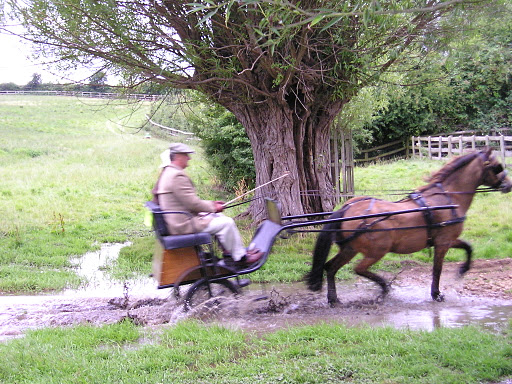
Horses have always been close to the Royal Family and both the Queen and the Duke of Edinburgh are knowledgable and skilled horsemen.  Carriage driving at top competition level had, until recently, been a regular part of the Duke’s regime and we had often been to watch him race at Windsor Great Park.  We too, have also participated in driving although my competition level is still at the most basic.  My partner is much more skilled and fearless and I always marvel when a neurotic and potentially lethal animal becomes calm and pliable under his control.  The photo below is of us just out for a quiet afternoons drive – although the pony did have his moment a little later when we careered out of control amongst the trees.  Thomas could become quite exciteable at times!

I realised with dismay that the date on the invitation was the day that we would be on Exmoor for a couple of weeks holiday, 150 miles away.  Working on the theory that we’d never likely receive another invitation we postponed the trip by a day.  And so, that early evening we drove up to the closed gates of Windsor Castle, showed our credentials and passed through to be further security checked.  Once this had taken place we were driven by an offical to the Quadrangle and the State Entrance.  Thie entrance, as it’s name implies, is used on State occcasions and the Quadrangle is used for military parades, including the regular Changing of the Guard.  From here is a panoramic view of the castle buildings, the oldest of which date from the 11th century (making Windsor the world’s oldest inhabited castle), and the Long Walk: a tree lined vista that cuts across the Great Park for a distance of over two and a half miles.


We entered the building by the Grand Staircase, with it’s fine displays of armour and firearms.  Here we were able to see the musket ball that killed Lord Nelson which had been presented to Queen Victoria.  Queen Charlotte’s sedan chairs were also here, remarkably small, I thought.

The reception was held in St George’s Hall, which was at the centre of the fire in the 1990’s and completely destroyed.  As a consequence, the restoration work has made the green oak, hammer beam roof the largest to be constructed in that century.  The craftsmanship and colours are extraordinary: set into the roof are the shields of every Knight of the Garter with some shields being blank.  These, I discovered, were not reserved for future knights but were of those that had fallen from Royal favour. 

Nothing prepares you for the sheer magnificence and size of this room as you enter – it measures 185 x 30 feet.  Here we met other guests – there were only about two hundred  – and, finally, the Duke who arrived with little pomp or ceremony.  The Duke made a short speech before joining us informally to champagne and canapes.  I was impressed not just by his energy (he is now over 90) but also by his wit.  He really is very funny, indeed.  I wondered how many other people of his age could carry out all these duties day in, day out and still make you feel as if you were of interest to them.  Both he and the Queen – who works equally hard – may live in splendour with aides and courtiers but I wouldn’t exchange places with them: I will be more than content just to still be able to hear, see, think and garden!

Access was also granted to The Grand Reception Room and The Waterloo Chamber, where the immense and seamless, two ton carpet took fifty soldiers to lift to a place of safety during the fire.  What I found surprising was that we were given free access to wander around these rooms at will, although I’m certain that if we had attempted to go elsewhere we would have found our way blocked!  Sadly, because we were attending a royal event, we were not allowed to take photgraphs, so I am unable to show you the splendours of these rooms.  You will find them, however, if you look in a search engine.

The evening came to a close after two and a half hours and, as we stepped back out into the autumn air in the Quadrangle, I was struck by the realisation why it is traditional to say, upon the death of a monarch, “The King is dead, long live the King”:  for all the affection that the current Queen has in the hearts of many of her subjects, the Office is greater than the individual.  The institution of monarchy has worked well for this country, long may it remain so.

Add to Technorati Favorites

A Walk in the Doone Valley

Exmoor is one of England’s smaller National Parks and it is also has one of the most varied landscapes: heather moorland, grass moorland, wooded combes, rushing streams and waterfalls, the lush farmland of the Porlock Vale, high cliffs and sea views.

The moor is especially beautiful at this time of year now the heather flowers, which in midsummer had turned hundreds of acres purple, have changed to a golden bronze. The bracken, also yellowing as the autumn progresses, helps to make the landscape a combination of coppers, oranges, golds, browns and greens.

I had returned to my spiritual home to refresh my soul, as well as my body – for I was pretty knackered after a hard summer of gardening – hence the lack of posts recently. I always stay at the Blue Ball Inn, a traditional pub with rooms, where you can be certain of a warm welcome from the blazing log fire in the 13th century inglenook and an even warmer welcome from the owners, Phil, Jackie and Nick. An added bonus of being on Exmoor is that my mobile phone does not pick up a signal for miles so I am isolated from the world.

For an English holiday at this time of year, I couldn’t have been luckier with the weather either: day after day pleasantly mild and with only a couple of days rain. Perfect conditions for walking and, because it is now ‘out of season’ with the summer visitors long departed, the moor was even more empty of people than usual.

There must be many people that have read R D Blackmore’s great Victorian novel, set in the 1600’s, or seen the film ‘Lorna Doone’, yet never visited the area where the action took place or, perhaps, realise that it is an actual place. It is a tale of the Doone’s of Badgworthy (pronounced Badgery), wicked outlaws terrorising a remote rural community, of kidnap, love and, best of all, it has a happy ending. It is questionable how much is fact and how much is fiction but the places exist and, even now, there are Ridd’s (the hero’s family name) living on the moor. The Doone’s, if they existed at all, are all long gone.

One day, the Doone Valley, their remote moorland stronghold beckoned, a walk of some 15 miles. There are two ways into the valley, the easiest is at Malmsmead, a pretty little place with a couple of houses, farms and coffee shop. I chose the more difficult – and to my mind, more exciting, way across some of the wildest moor, Exmoor can offer. Parking the car at Brendon Two Gates (there isn’t a gate in sight – I’ll explain how it got it’s name another time!), my choice proved wise for I was met by the sound of the wild red deer stags calling, for this was the start of their breeding or ‘rutting’ season. Standing on the skyline a stag roared, keeping his herd of hinds close and to fend off rivals. As I took a photograph, a flock of curlew flew past, a lucky coincidence and a great start to the walk. The photo is rather small but I doubt if I will have the chance to take a second, larger one!

The moorland here, is a vast, open and empty space, full of bogs to catch the unwary. Although not dangerous in themselves, it is unpleasant, to say the least, to be up to your knees in cold, black, peaty water. A minor injury such as a twisted ankle in bad weather, or as dusk falls, could become potentially life threatening. Squelching my way along, my strong, waterproof boots made light work of this first stage and after an hour or so the first fold of the combe appeared – I had reached the head of the Doone Valley.

The path from here is well marked, yet even in midsummer, few but the intrepid walk as far. The only sounds are of water rushing over rocks and the occasional calls of sheep, ravens and buzzards. The walk is now downhill all the way as the path follows the river back to Malmsmead although it is still far from an easy stroll. As the walk continues, more and more side streams meet the main river and Badgworthy Water becomes faster flowing and wider, although two or three bounds and you would be across it. This time it was gentle and the sound relaxing: after heavy rains it will become thunderous and capable of sweeping you away.
A third of the way down the Doone Valley, Hoccombe Combe is reached, said to be the site of the Doone’s village although the ‘waterslide’ that John Ridd climbed to reach Lorna is not here. Some say that it is based on the river that runs through Lank Combe a little further to the north.

The photograph below is of the waterslide at Watersmeet some miles further west and not part of the Doone country.

Soon the valley becomes more gentle and lush although the hills of the moor still tower above. There are trees too: larch, beech and rhododendron. Soon the river will run through farmland and to Malmsead itself, a good place for a rest and a coffee. It is also a place where the walk could stop if another car was available to take you back to your starting point. However, I was only halfway and so turned up the steep lane making my way back to the open moorland.

It was a long and tiring walk back across the heather. In the distance a small group of the wild Exmoor ponies, the oldest native breed in the UK and virtually unchanged from pre-history. Athough free to roam the moors they tend to keep to their own territories and are quite tolerant of strangers approaching. Only those that live in the tourist ‘hotspots’ will allow themselves to be touched and these ones soon galloped off once I got too close.

By the time I reached Brendon Two Gates, a pint of ale at the Blue Ball and a hot bath beckoned. It was almost dark when I returned to be greeted by a spectacular sunset, the perfect end to a very satisying day.

Add to Technorati Favorites

Exmoor: The Blue Ball Inn

Autumn has been at its best the last week or so with blue skies and warm sunshine by day, the perfect weather for long walks. And afterwards, as the evening chill sets in, what can be better than to laze contentedly in front of a blazing log fire, losing your thoughts in the flickering flames? This is what I have been doing the past ten days.
.
And where better than to do this than on Exmoor, the 270 square mile national park in England’s West Country? I have known this place for over 40 years and it’s dramatic scenery never tires with the passing years. The coastal area between Lynmouth and Porlock, where the open moorland meets clifftop and plunges 800 feet to the sea is the most dramatic of all. And the tiny village of Countisbury can lay claim, in my opinion, to have the best views on Exmoor.
.

..
I made a decision when I started this blog that I would not go commercial – either for my own garden based business or for anyone else. Somehow, it just seems to put a different slant on your writing. However, I am always being asked where I stay on my Exmoor visits and I am more than happy to break the rule on this occasion. There can be no better place to spend your time than at the Blue Ball Inn, situated in the heart of the village.

.

.

The Blue Ball Inn, which dates back to the 13th century, was originally a coaching inn where horses and travellers rested after the exhausting 1 in 4 climb up Countisbury Hill from Lynmouth. Today it still welcomes travellers, whether it is for just a drink, a meal or to stay in one of their sixteen bedrooms.

.

.
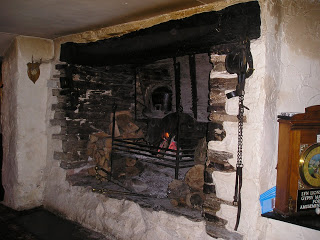
The building both inside and out is dominated by a vast and ancient inglenook fireplace and chimney, so big that you can look up it and see daylight. It is a great place to relax and unwind with a pint of locally brewed ale and is the hub of the inn.
.

.

.
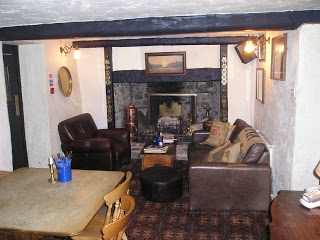
The bar, with its low ceilings, blackened beams and loads of character, is a busy area but there are also several other places to sit. Each has its own fireplace and comfortable chairs, ideal if you want to find a quieter space to read or plan the next day’s walks.
.

. .

It is not just the beer that is produced locally. The restaurant, which serves food all day, is committed to offering a wide choice of menu, much of it sourced from the area – they even rear their own rare breed pork. During my stay, I never once had the same meal twice (although I wish it would have been possible to have forced down a second helping of their spare ribs they were so delicious). The chips are the best in Britain. By the time dinner was over, I was usually too tired to continue drinking in the bar and would disappear to bed. The bedrooms, which have all the usual facilities, are comfortable and clean and, after so much exercise and fresh air, sleep guaranteed.

.

.
Awake and refreshed and after a hearty breakfast, walks can start from the door and can vary in both their length and the steepness of hill. Ours varied from twenty minutes to five or six hours. With instant access to heather moorland, ancient woodlands, rushing rivers and the spectacular clifftop walks with its views across the sea to Wales, you are spoilt for choice. (Exmoor is, of course, great dog walking country and the Blue Ball welcomes them too). If you are lucky and walk quietly, there is a very good chance that you will see the wild Exmoor ponies or the herds of Red Deer – we saw both within a mile of the pub.
.
.
.

But it is not just good food and drink, comfortable rooms or amazing views that make a good holiday. It is people. Phil, Jackie and son Nick, the owners of the Blue Ball, and all of their staff without exception, do everything possible to ensure that your stay is memorable. The ‘locals’ too, for this is still very much the village pub, are very welcoming and friendly – where else would you meet someone who lends you a book to return “when you next come down”? And I have never spent such a riotous evening as with them all at the Harvest auction, held in the pub. Apart from bidding for a crate of the local beer, I also have managed to get a days hawking on neighbouring Dartmoor. I was too slow to get a day’s salmon fishing on the local Lyn river – but that, of course, gives me an excuse to visit again next year. I have already booked!
.

.
.
.
.