SKANSEN – Sweden’s Pioneering Conservation Village

The Swedes have always had a reputation for innovation and design and so it is not surprising that Stockholm is home to the world’s first open air museum founded by Artur Hazelius. The surprise is that it opened as early as 1873.   When he opened his second open air museum, Skansen, on the nearby island of Djurgården it was the first to incorporate a zoo.
8  Sweden. Skansen   copyright.jpg

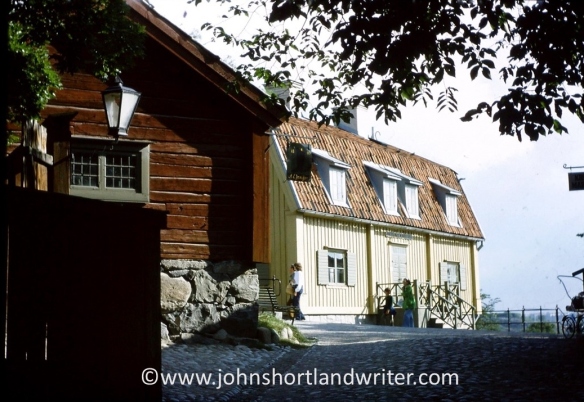
From its earliest days, the aim of Skansen was to preserve Sweden’s rapidly changing rural way of life. One hundred and fifty buildings were purchased, dismantled and rebuilt and over the years more buildings have been added; the museum now has a complete nineteenth century township as well as buildings of the Sami peoples of the north.

The zoo specialises in native Scandinavian animals, both wild and farm, and by 1918 held the few remaining European Bison that had been reduced to extinction in the wild. Since then, a breeding programme has seen them successfully reintroduced to Polish and Romanian forests.

Wolf  copyright .jpg

Wolf at Skansen


Vakt Stugan – literally translated ‘Guard Room’ was one of the original buildings purchased in 1891 and placed by the entrance to the museum. It dates from the 1880s and is used as an information centre.

10  Sweden.  Skansen   copyright.jpg

True to its origins, farm buildings, many with traditional living roofs feature throughout the museum. The oldest dates back to the fourteenth century.

11 Sweden.  Skansen   copyright.jpg

12 Sweden.  Skansen   copyright.jpg

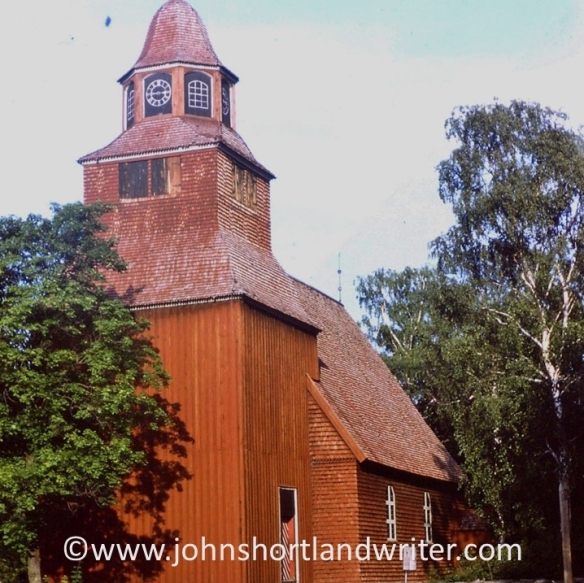
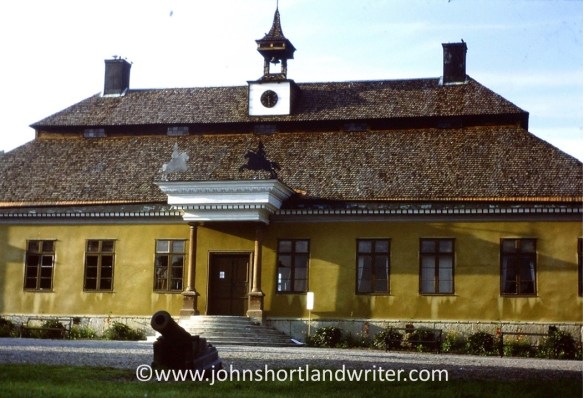
A village would not be complete without its church and manor house and Skansen has several examples. Seglora church dates from the early 1700s, made entirely of wood came from the western provence of Västergötland. It is still in regular use for services as well as weddings and christenings.  Skogaholm Manor built in 1680 developed into a sizeable mansion with beautifully painted ceilings and wall decorations. The kitchens and library are equally well preserved.
13 Sweden.  Skansen   copyright.jpg

Seglora Church, Skansen


Skansen is open to the public all year round with numerous events to help illustrate the story of the buildings and the people that lived in them. Details of admission times and other information can be found here. To see photographs of the interior of Skogaholm Manor click here.
14 Sweden.  Skansen   copyright

Skogaholm Manor, Skansen

A Year in Review: Jan- Jun 2015

So another year has gone by and as New Year’s Eve fast approaches it is time to reflect on the one past and look forward to the one to come.

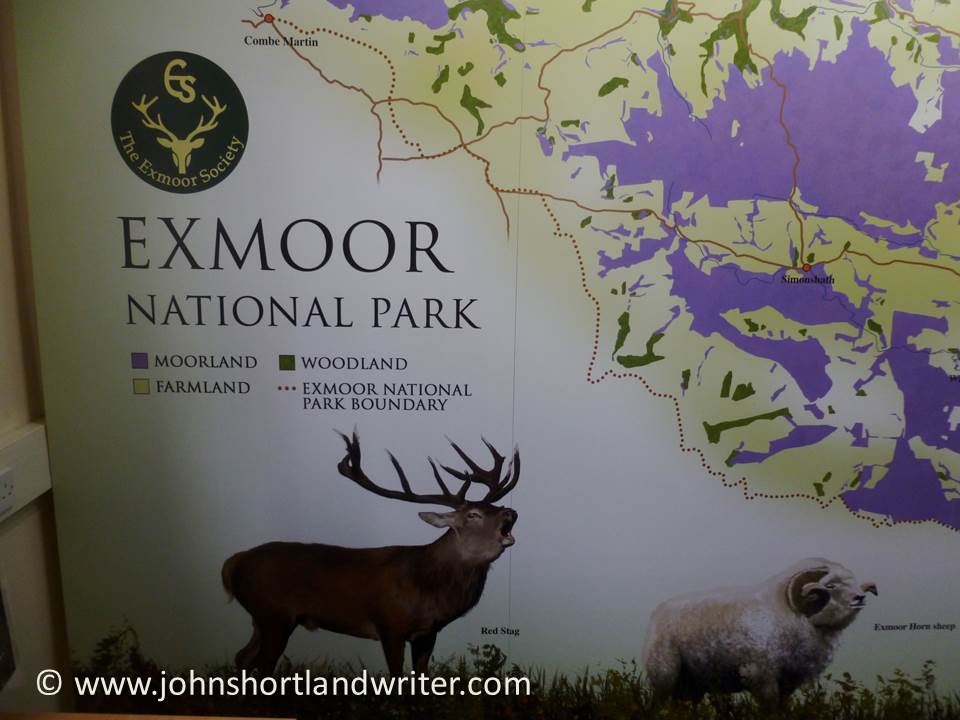
I try to visit Exmoor National Park as often as possible for I consider it to be “home from home”.  I spent a lot of my youth and early adulthood there on a remote farm not realising that I was witnessing a way of life now gone.  With the benefit of hindsight I wish I’d taken many more photographs but, in the days before digital, films were both precious and expensive.

binder copyright

In January, I made a special trip to take a look at the new headquarters of the Exmoor Society in the pretty, little town of Dulverton. The enlarged space that they now have has meant that they it is now much easier to access the archives and seek information.  If you are planning a holiday on the moor, it is well worth visiting.  Click here to find out more about my day there.

Exmoor Society HQ (3)   copyright

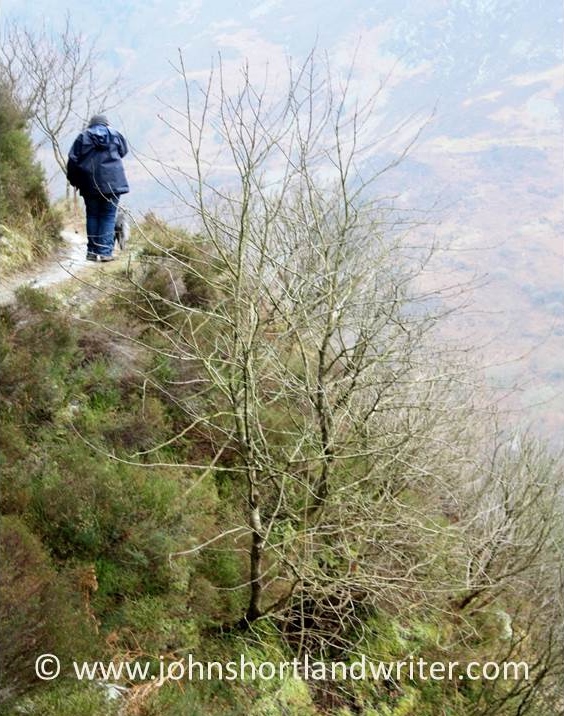
February found me walking along the edge of a precipice and seeking an elderly great-aunt, fortunately not at the same time.  I met Ba-ba (how she got this name is still a complete mystery) once as a boy when she was in her late nineties and she left a lasting impression on me.  With everyone else that knew her now dead (I’m now the ‘old’ generation) I’ve been trying to research her.  Despite the post creating a lot of interest it ended sadly without much success.  Perhaps, this post might reach someone who knows who she was.  To check out the detective work so far take a look here.

Gt Aunt Baba (Frances White) 90th bithday about 1965

The Precipice Walk in Snowdonia, although not overly strenuous, is not to be attempted by the faint-hearted.  Travelling clockwise, the path clings to the edge of the drop before turning back on itself alongside a more gentle and peaceful lake.  If you’re afraid of heights go anti-clockwise for a delightful, if somewhat short, walk and turn around when you dare go no further.  Alternatively, sit back in your armchair and take a look at the photos here.

Precipice Walk (8)   copyright

A much longer walk, completely different in character, was described in two March posts.   Dartmoor is another national park in the West Country but much harsher than Exmoor.  Despite its bleakness now, in the past the climate was kinder, confirmed by the large number of Neolithic remains there.

Beehive Hut (2)   copyright

The walk starts at  a pub where according to tradition the fire has never been allowed to go out in the past two hundred years.  Our path crosses the moor to the village of Postbridge, home of the famous medieval stone clapper bridge.    The second part of the walk follows the river before continuing across the moor, taking in beehive huts dating back to 1500AD before arriving at the Grey Wethers stone circles.  The twin circles are about two thousand years old.  Reaching the stones is described here.Grey Wethers Stone Circle (2)   copyright

The history of the United States and Ireland are intertwined by mass emigration.  In April I visited New Ross in the south of Ireland and the birthplace of John F Kennedy’s great-grandfather.  Fifty years after JFK’s visit his sister came to light…  Well, read here to find out exactly what she did.  The image below might give you a clue.New Ross (6)   copyright

I stayed with the Irish theme in May and wrote about the lovely village of Castlelyons where a friend spent her early childhood.  Well off the tourist trail when you red about the place you’ll wonder why.  In the meantime, we had the place to ourselves.

Castlelyons (5)   copyright

June is a lovely month both for walking and also for garden lovers, with hedgerows and gardens smothered in rose blossom.  Continuing the theme of elderly ladies and ancient times the month’s post explored the history of Rosa de Rescht – fascinating for the mystery it holds.  Incidentally, even if you a hopeless gardener (and no-one is completely so) this is the simplest of roses to grow…

Rosa 'de Resht'   copyright

GROW YOUR OWN MISTLETOE

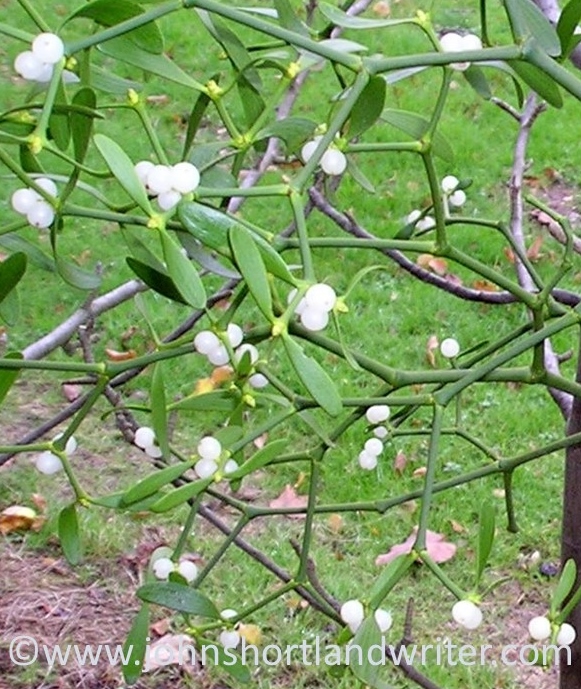
With Christmas almost upon us one of the most traditional of purchases along with the tree, goose or turkey will be sprigs and bunches of mistletoe. Placed carefully above a doorway where passing under it is unavoidable many of us will be subjected to the torture of being kissed by those we’d rather not and disappointed by those that we would have liked to have been but ignored.Mistletoe (5)   copyright.jpg

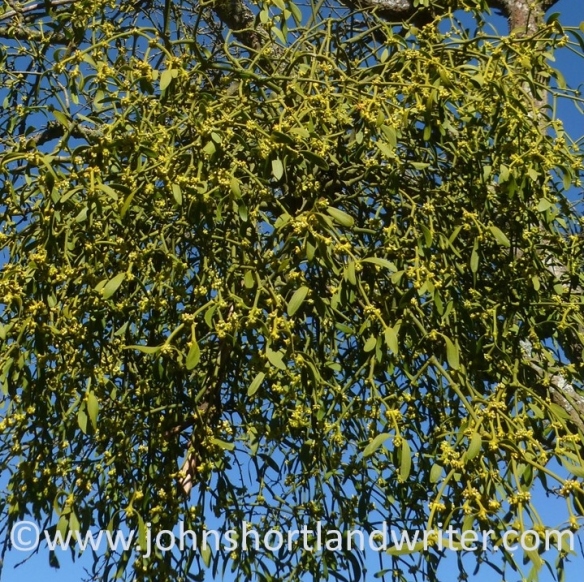
The tradition of kissing beneath mistletoe is very much a British one although it is rapidly gaining popularity (and why not?!) around the world. Our own mistletoe, Viscum album, (European Mistletoe) grows throughout much of Europe but is decidedly fickle as to its requirements. The majority of British mistletoe grows to the west of the Cotswolds, especially amongst cider orchards found in the counties of Gloucestershire, Herefordshire and Worcestershire. However, in other areas in the south, there are isolated populations where it can grow locally abundantly – the photos for this blog, for example, were taken in a garden in the Chiltern Hills. The further north, the rarer mistletoe is, being absent from much of northern England, Scotland, the Low Countries and Scandinavia.Mistletoe (2)   copyright.jpg

Mistletoe is a parasitic plant – or to be more accurate hemiparasitic – attaching itself to its host tree, most commonly cultivated apple or lime. Strangely, mistletoe rarely is found on the wild crab apple, perhaps due to its more congested growth. Likewise, it is rarely found in woodland where the density of trees probably reduces the amount of light and air circulation required. Although mistletoe, being green, carries out some photosynthesis this is limited and where it grows in abundance on one tree, it can weaken the host plant and reduce fruiting potential.

Mistletoe flower   copyright.jpg

European Mistletoe in flower

In the past, mistletoe has been very much associated with fertility and winter solstice rituals and its use as a decoration is still sometimes banned in churches. The Druids held the plant sacred, especially if it was found to be growing on oak (which it rarely does). Modern-day Druids now hold a festival each December at Tenbury Wells to celebrate the plant.Mistletoe (7)  copyright


Growing your own mistletoe is relatively easy for most of the difficulties commonly associated with germination are false. Ideally, fresh berries should be ‘sown’ in February. These can be gathered or purchased or you may prefer to store those from Christmas. If choosing the latter option, store them in a cool, light, airy place and rehydrate in a little water before use. Squeeze the seeds out of the berries and remove as much of the stickiness as possible; they will still attach easily to the bark. Choose young branches away from the trunk and fix to their underside. There is no need to nick the bark or cover the seeds although it is probably advisable to mark the branch in some way to identify it in the future. The seeds germinate quite quickly but it will be four years or more before any real growth is apparent.   Mistletoe (like holly) have separate male and female plants so it will be necessary to have several plants to ensure cross-fertilisation and berry production.

Mistletoe Anchor Point   copyright.jpg

European Mistletoe: anchor point (haustorium)


There are over 1500 different species of mistletoe growing throughout the world. In America the native mistletoe looks very different to our own – one of the reasons why, to British eyes, plastic mistletoe sold in the shops looks so unreal: it is modelled on the American species.

For a huge amount of fascinating information on folklore and medicinal use, advice on conservation and purchase of mistletoe seed do visit The Mistletoe Pages website where much of the above information has been gleaned.

For those interested in Druidry: The Mistletoe Foundation

Guest Blogging

My guest blog for the Chipping Norton Literary Festival:

Gardening author John Shortland has put his green-fingers to the keyboard to tell us all about his ChipLit event…

Are you sometimes disappointed with the look of your garden? Unsure what to grow where? Or just never seem to have enough hours in the day to get outside?  What happens when you can’t recognise one plant from another?  These are just some of the issues I’ll be considering in my informal, illustrated discussion.

‘Why Can’t My Garden Look Like That?’ is a question I’ve been asked many times during my career as Head Gardener to some of the most exclusive country gardens in Oxfordshire.  I have also been an adviser at the Chelsea Flower Show and worked for Channel 4 television alongside designer Dan Pearson. I’ll be drawing upon my wealth of practical experience to answer this often-asked question.
Most people these days have to juggle careers and a host of other things, leaving little time for gardening. But there are many ways that it is possible to still have a great looking garden without having to spend every waking hour in it.

In my talk (and book of the same title) I’ll look at simple, jargon-free and straightforward methods to improve the layout of your garden.  I’ll also look at different plant combinations and offer tips on how to make your garden one that others will envy.  A short walk will take you to see a garden in the heart of the town where some of these ideas can be put to the test.  Don’t worry – it doesn’t involve getting your hands or shoes dirty!

As the session ends with an opportunity to ask me questions over a cup of tea and a scone, it is quite probable that this event will run over its scheduled time.

John Shortland

Tickets for this event are limited and are already selling fast: Why Can’t My Garden Look Like That? The Vintage Sports Car Club, Sunday 27th April, 1.30pm

Add to Technorati Favorites

Frogs: Sex, Mayhem & Confusion

So it is now officially spring, yet the weather is still cold – much colder than is usual.  We even had a blizzard a couple of days ago turning the secret valley white once again for several hours. The snow turned to rain and was washed away.  At least we have longer hours of daylight to look forward to.  On the rare occasions when the weather brightens, the strengthening warmth of the sun on the skin lifts the spirits after months of grey, cold dampness.

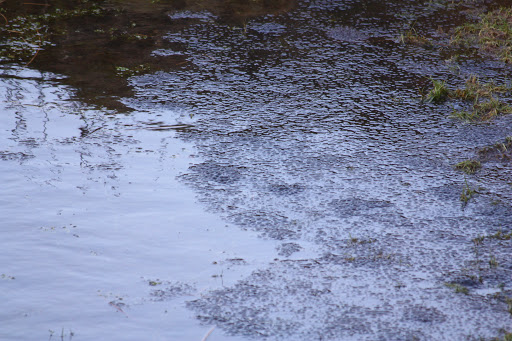
Some years, the surface of the pond is covered in spawn

It is that time of year when the local frog populations’ spirits are also lifted as they emerge from hibernation and crawl out from under the leaf litter and fallen twigs of the old hedgerow above the little stone cottage.  Under cover of darkness they cross the lane, all making their way towards the pond two fields away.  For some reason they don’t take a direct route but detour to our garden door (and if open), march through the sitting room, into the kitchen and out through the back door.  If the door is shut the sound of tapping on the glass panels as they attempt to jump through is continuous.

In other years there can be very little

But not this year.  There have been no signs of the frogs on the road and no-one has come a-knockin’. The weather seems to have got the better of them: they are as confused and, perhaps as depressed, as we humans after twelve months of cold and wet.

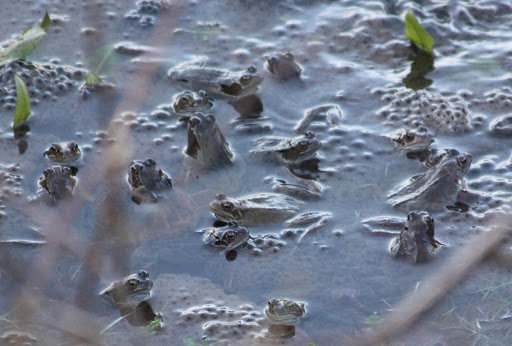
Trying to look innocent…

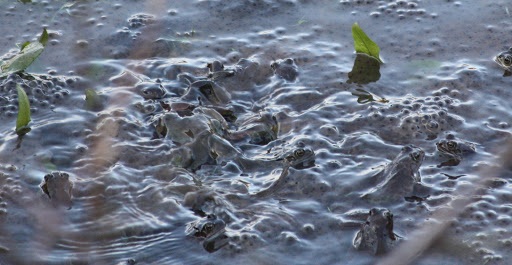
In normal springs the culmination of their journey is celebrated in a frenzied orgy in the calm water of the pond.  If you creep up on them, their presence betrayed by a carcophany of croaking, they become still and gaze up at you with a degree of embarrassment.  Trying to look innocent they sit willing you to believe that they wouldn’t do anything so vulgar (or exciting, depending on your outlook) as sex in public.  As soon as they think the coast is clear they return to their shenanigans making the pond look like a whirlpool bathtub.

Caught in the act!

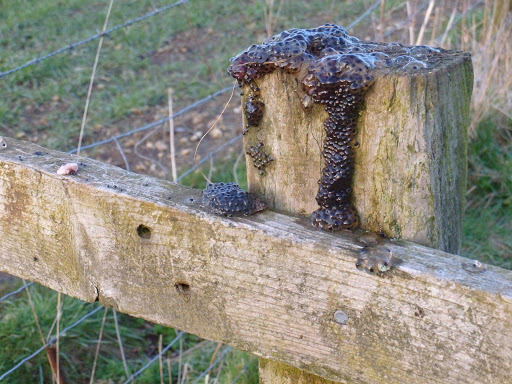
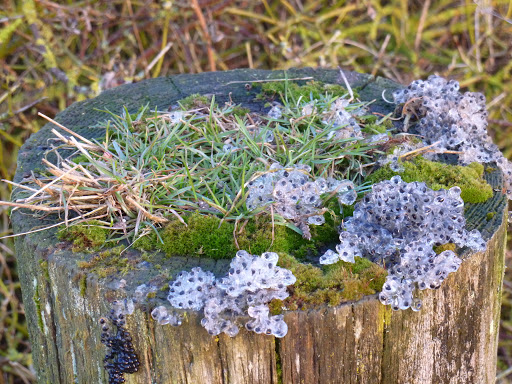
This year the frogs have returned silently.  There is no sign of them in the water or of their frogspawn floating like oil slicks on the surface.  In the confusion of the weather, where every surface is as wet as any other, the frogs have spawned on top of the fence posts that protects the pond.  The larger posts wear a crown of spawn, the smaller ones cannot hold it and it slides off, dripping to the ground.  It is a strange and  unsettling sight: something that we have never seen before.

Frogspawn falling and decaying from every fence post

What does this mean for the frogs?  The eggs cannot survive and if they do not lay more in the water the population must surely crash.  We already miss seeing their heads turn toward us as we walk past; we miss their visits to the cottage even more.  It will be sad if that becomes a thing of the past as has the song of the cuckoo and the churr of the nightjar, both summer visitors to the secret valley not so many years ago.

Sadly, there is no chance of this spawn hatching successfully

Add to Technorati Favorites

 
 Wishing you all a very
 
 Happy Christmas
  
Best wishes for the holidays from a very mild, wet and flooded ‘secret’ valley – no snow , so far, this year…
 
Johnson

Add to Technorati Favorites

Warm Christmas Wishes

Wishing you and your family a very happy & peaceful Christmas

Warmest Christmas wishes from the secret valley

Add to Technorati Favorites