First Signs of Autumn

To quote from the Keats poem ‘To Autumn’, is rather cliched I know but it really is becoming the “season of mists and mellow fruitfulness” here in the secret valley. I have to admit until I decided upon the theme for this post that, although I had heard this line so many times before, I’d never read the poem. I suspect a large number of people would admit the same so I have included it here, in full, at the end.
.
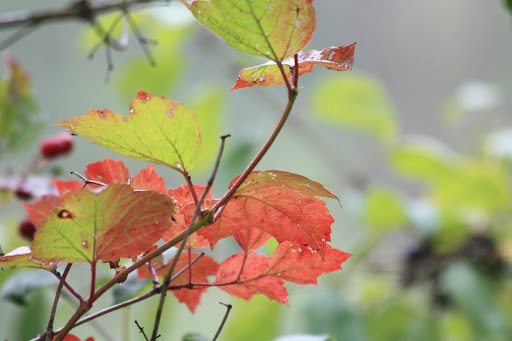
Almost imperceptably, the leaves have started to turn colour although they are still more green than yellow, orange or red. The most noticeable sign of the new season has been the berries and other fruits. Despite the heavy, late spring frosts we had, it seems to be a bumper crop this year although I have heard that commercial crops of apples are down by 30%.
..

The river a few hundred yards downstream from our little stone cottage broadens to become a small lake, created 100 years ago to attract duck and fish for the pot. Invisible throughout the summer months because of the leafy shrubs that shield it, it gradually comes into view as the foliage withers and falls and the water levels rise with the winter rain. Then it gives us what one of our friends describes as “the best view from any bath(wash)room in England” – and it is! What can be more decadent than lying in the bath with a glass of wine in hand, watching the wild geese and swans flying in from who knows where, for we rarely see them during the summer months?
.
.

And it is the river and lake that tends to give us the mists on cool mornings. There is such a subtle difference between these mists and the fogs that are much more widespread across the country. We can recognise the difference instantly but how do we describe it in meaningful words? Perhaps mists drift to rise and fall as strands of it are caught on the slightest breeze, an uplifting experience for the soul, whereas fogs sit heavily both on the ground and on our spirits?
.
.

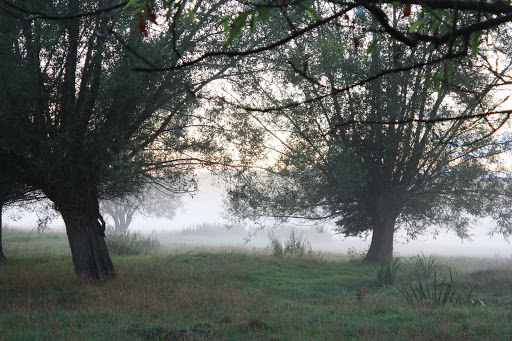
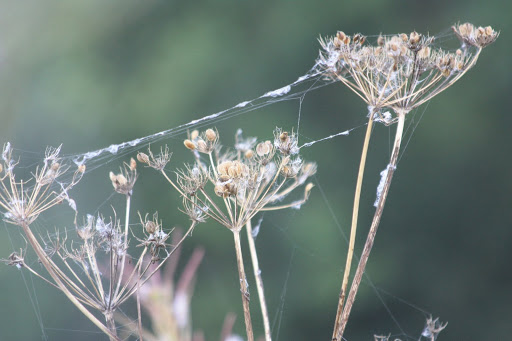
A few days ago, on such a misty morning, it was cool enough for a heavy dew to form transforming the scenery with its silver frosting. Cobwebs hung from every available perch: strands of wire, branches and twigs, even the dying flower stems of the wild plants were draped with them. The scene was of silence and stillness, no bird sang and even the brook seemed to gurgle and babble more quietly than normal, as if reluctant to wake the slumbering countryside.
.
.

.

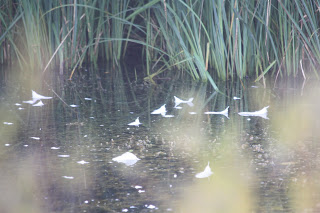
As if to confirm the silence and emptiness of the landscape, even the new seasons swan, that I had admired on the lake the day before, had gone. Heavily in moult, all there was to confirm its arrival were white feathers slowly drifting on the surface saying “Hush! Be still. All is calm”.
.
.

To Autumn
.
Season of mists and mellow fruitfulness
Close bosom-friend of the maturing sun
Conspiring with him how to load and bless
With fruit the vines that round the thatch-eaves run;
To bend with apples the moss’d cottage-trees,
And fill all fruit with ripeness to the core;
To swell the gourd, and plump the hazel shells
With a sweet kernal; to set budding more,
And still more, later flowers for the bees,
Until they think warm days will never cease.
For Summer has o’er-brimm’d their clammy cells.
.
Who hath not seen thee oft amid thy store?
Sometimes whoever seeks abroad may find
Thee sitting careless on a granary floor,
Thy hair soft-lifted by the winnowing wind;
Or on a half-reap’d furrow sound asleep,
Drows’d with the fume of poppies, while thy hook
Spares the next swath and all its twined flowers:
And sometimes like a gleaner thou dost keep
Steady thy laden head across a brook
Or by a cider-press, with patient look,
Thou watchest the last oozings hours by hours.
.
Where are the songs of Spring? Ay, where are they?
Think not of them, thou hast thy music too –
While barred clouds bloom the soft-dying day,
And touch the stubble-plains with rosy hue;
Then in a wailful choir the small gnats mourn
Among the river sallows, borne aloft
Or sinking as the light wind lives or dies;
And full-grown lambs loud bleat from hilly bourn;
Hedge-crickets sing; and now with treble soft
The red-breast whistles from a garden-croft;
And gathering swallows twitter in the skies.
.
.
Add to Technorati Favorites

A Walk Along the River Otter: Part 2

The lower reaches of the river Otter turn from fresh water to brackish as the river joins the sea. At low tide, mud and salt flats are exposed creating a safe habitat for the hundreds of seabirds and waders that feed, breed or rest on migration there. This area, including its wildlife, I have written about earlier – it can be found by clicking here.
.

This post describes a walk a little further upstream where the river flows through fertile fields of wheat and where cattle and sheep graze in lush riverside meadows.
.

.

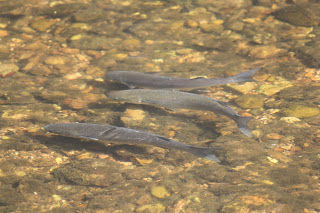
The river – which like our river in the secret valley – is really little more than a stream (or ‘brook’ as we say where I originate from – English dialect is another fascinating subject that I might write about one day!). One moment fast flowing, the next slow, but always crystal clear, the view is one of steep banks and stony bottom. It is here, in the shallower water, that the trout – huge in comparison with our tiny ones at home – sway in the current, waiting for food to be swept down towards them and their ever open mouths. At one place where the river runs across a steeply shelved weir, a salmon run has been built: a series of steps for the salmon to leap to reach the upper levels of the river for spawning after their long migration. Whether they still do, I do not know, for salmon stocks in England are dwindling fast.
.

.
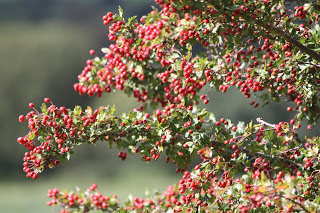
Wood and water, just nothing but water and wood, for the crowds of visitors that explore the river close to the beach and form long queues at the ice cream stalls have all been left far behind. Now the sights, sounds and smells are only those of nature on this glorious late summer’s day. The trees are only just beginning to show a hint of the autumn to come but, somehow, their berries have already stamped their mark on the autumn landscape, glowing in and reflecting the sun’s warmth.
.
.
.
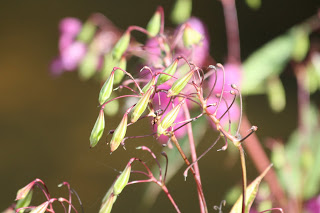
Along the river bank, swamping much of the native flora, the Himalayan Balsam is giving a final explosion of colour before the first frosts destroy them for another year. And explosion is the correct description of their bursting seed heads which throw the seed far and wide as they split open. Found in many damp places throughout the country, for its seeds are also dispersed by the movement of the water, the Himalyan Balsam is an unwelcome immigrant to Britain which is virtually impossible to control. A member of the Impatien family, its seedheads are similar to those of our familiar garden Busy Lizzie.
.

.

.

Along the final stretch of our walk, the river is backed by the same red sandstone cliffs that can be seen by the coast. How many millenia did it take for this gentle stream to cut its way through to its present level? My photography skills – or perhaps my patience – did not allow me to get shots of the kingfishers that darted up and down as a flash of azure along this reach of the river. High up in the rock face, their nesting holes (or were they the breeding sites of the sand martins that had already begun their long flight south to winter in Africa?) were more easily photographed.

.

..

The ten mile walk to the source of the Otter will have to wait for another visit to the West Country. Oh, and I nearly forgot to mention, otters can be found – but rarely seen – along the whole length of the river.

.

.

Add to Technorati Favorites

A Walk Along the River Otter: part 1

The River Otter although not long in length – barely 20 miles from its source in the Blackdown Hills to the sea – is rich in wildlife. Mostly flowing through Devon, in Britain’s West Country, it rises just over the border in the county of Somerset. Passing through rich and fertile farmland it enters the English Channel at Budleigh Salterton where its estuary is protected from the sea by a large pebble bank. It is here that this walk begins.
.
The mudflats, reedbeds and adjoining fields are all part of a relatively small nature reserve, backed by the town on one side and high red sandstone cliffs to the other. The whole area forms part of a World Heritage site for it is part of the English coastline known as the Jurassic Coast, famous for its rock formations, clear water and abundant fossils. The underlying stone of the Otter valley holds one of the most important aquifers in England supplying drinking water to 200,000 people (source: Wikipedia, where else do we go for this sort of infortmation?!).
..
The birdlife, especially at this time of year as migration takes place, is spectacular. In my excitement in trying out my new telephoto lens, I forgot to take general views of the coastline and town. However, as tourism plays such an important part of the Devon economy, it is easy to visit and stay locally – it is well worth adding to your ‘places to visit’ list.
.
There is no public access to the mudflats which means that the birds are relatively undisturbed. However, there are good footpaths along the edges and also hides, where it is possible to view the wildlife with the aid of good binoculars or camera. The Little Egret, below, was a rare visitor to England until very recently. Now, although still not often seen, they are more frequent and breed here. We have even had them occasionally visit us in the secret valley. The Canada Goose also was once a rare escapee from wildfowl collections – now they are seen everywhere and are one of our commonest geese.
.
.

.
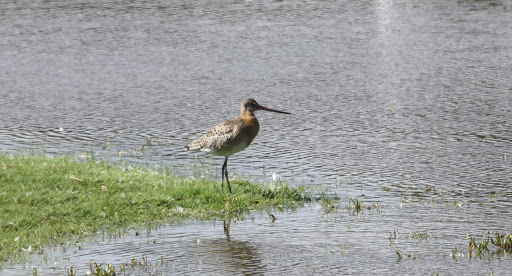
Glossy Ibis are an extreme rarity and thirteen had arrived here earlier a few days ago. If they were about they remained hidden from view. Strutting about – and unaware of how comical they look when away from water were a pair of Bar-tailed Godwits. These birds breed in Scandinavia and the Arctic and thousands pass through Britain on the migration back south with a few staying all year round but never breeding. Despite their numbers they are easily missed so being able to photograph this one was a real treat!
.
.

.
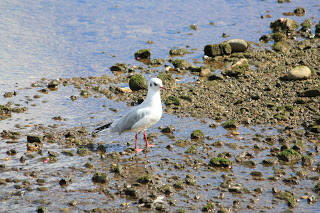
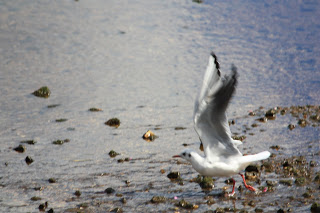
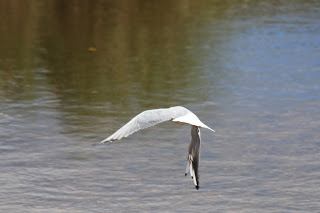
Of all the birds to be seen that day, none were so plentiful yet so beautiful as this Mediterranean Gull. Or, at least, that is what I think it is. Living as I do, as far inland as is possible in the British Isles, my seabird identification skills are not as good as they might be. No matter, it had a grace unlike the majority of the gull family, yet I don’t think it was a tern. I wait to be corrected.
..

.
.

Add to Technorati Favorites

Richard Long’s Extraordinary Land Art

2I have found that there are no shades of grey when appreciation – or lack of it – of Richard Long’s art is discussed. It seems that either, like me, you are swept away by it or you just cannot see the point of it at all. Whilst respecting this latter point of view, I ask myself, “Does art have to have a point”? For me, of all art forms , Richard Long’s work demonstrates that beauty can be appreciated just for it’s own sake.
.
British born (in Bristol, where he still lives and works), Richard Long studied art in both Bristol and London, giving his first solo exhibition in Germany in 1968, as he completed his studies. I imagine this is quite an achievement in itself. Since then he has exhibited regularly throughout the world.
.

.
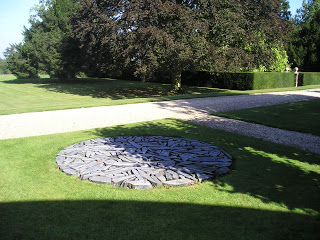
In the grounds of my ‘reincarnation’ house, I was fortunate to be involved in the placing of one of his slate circles (photo above). Sadly, I never met the great man himself, for I would have loved to have sat quietly and watched the stones being laid in place. My contribution was extremely modest: I only removed the turf and put down the base ready for the circle to be put in position. However, this did mean that the circle appeared as if by magic – and it has remained mysterious and magical ever since. And, as if by magic, the gaps between the stones have filled with leaves and debris and yellow lichens have started to colonise their surface.
.
.

.
Regular readers of this blog will know of my fascination for stone in all its forms, whether it is the earliest standing stones (and we have our own ancient stone circle here in the Cotswolds, the Rollright Stones), the dry stone walls of the secret valley or placing stone in the garden. But Richard Long’s stone work is different to all of these for each piece is meticulously shaped and honed – or left in its natural state – and crafted into position. To really appreciate it, you have to become part of the landscape yourself. When you lie on the ground looking across the surface of his work, it takes on a completely new appearance and meaning.
.

.

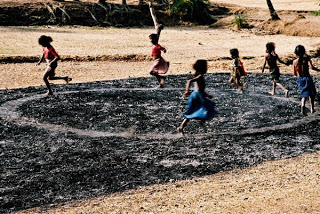
When I first came to know and love Richard Long’s work, I little dreamt that one day it would inspire me to incorporate land art into one of my own designs. Attached to a beautiful old farmhouse, belonging to a client, is a small, almost bottle shaped, raised area of land surrounded by the remains of a twelfth century moat and mill stream. It is too wild an area in which to create a conventional garden so the plan is to keep it as a simple wild flower area. A very low serpentine turf coverd bank will draw the eye – and, hopefully, the visitor – towards the bottle neck. Careful planting will bring you unwittingly into a living willow tunnel and, at the far end where the land broadens once again, will be a circle. Not a stone circle this time but a meditation circle inspired by the photograph below of children playing. This photograph is from the artist’s (or is it sculptor’s?) website; all the remaining photo’s are mine taken at the reincarnation house. To be redirected there just click and make sure you look at both the Exhibitions and the Sculptures pages.

.
.

As for my new design, work is due to commence at the end of this month and I shall report on progress some time in the future. One thing I am quite certain of is that I will not be asked to hold any exhibitions either in the UK or abroad!
.
.
.
2018 Update:   to see more of Richard Long’s work or to view the latest exhibition venues visit his page on Artsy by clicking on the link here
.
.
.
Add to Technorati Favorites

The Large Skipper and a Comma

As far as butterflies go, the Large Skipper is not particularly uncommon but I don’t recall seeing them in quite the numbers that I have this summer. They are active butterflies, frequently on the move and fast flying but eventually come to rest to feed or bask in the warmth of the sun.
.
.
The Large Skipper lays its eggs on a variety of grasses and so can be found in many habitats, particularly the edge of woodlands and along woodland rides. The photo below, taken in the deeply wooded Chiltern Hills, may look like a woodland ride but it is an ancient Saxon field or ‘assart’. Assarting – the destruction of forest for agriculture – was considered to be one of the gravest crimes of all when carried out in any of the Royal Forests. This field still has remains of old coppiced or possibly of layed hedge – there is one Field Maple, Acer campestre that probably dates back a 1000 years to Saxon days. It now consists of a series of smallish trees around the space where the original trunk would have been.
. .
.
Despite its name, the Large Skipper is quite a small butterfly. The females, which are slightly larger than the males, have a wingspread of less than one and a half inches. Their diminutive size has not prevented them from spreading far and wide globally: they can be found from England in the west of Europe, right across the continents, to Japan in the Far East. For some reason they are not found in Ireland or most of the Mediterranean islands. However, their range is still spreading so perhaps they will colonise these places too one day.
.
.
The golden glow of these butterflies gives them a certain charm but they can not be described as pretty, especially with their huge, bulbous eyes. This glow is also present in the underside of the wing which shows up faint spots and helps to distinguish them from the Small Skipper and the Silver Spotted Skipper, both of which are to be found in Britain but far less frequently. The latter, incidentally, is also found in parts of North America.
. .
Another golden butterfly, but this time a very attractive one, is the Comma. It is everything the Large Skipper isn’t – delicate, attractively marked and large. This butterfly was rare when I was a child but numbers have increased rapidly in recent years and it is now no longer considered endangered.
.
.
.
.
Add to Technorati Favorites

Searching for Granny ….

….. well, great-Granny actually. I hadn’t exactly lost her for I had ‘discovered’ her in old census records when researching our family history. I also remembered being told, as a child, that “Granny used to live there”. What I hadn’t realised was that Granny and my more distant ancestors were some of the most important mill owners on the River Thames, the premier river of England. The family owned Marlow Mills, which they converted from corn to paper production in the early 1800’s.
.
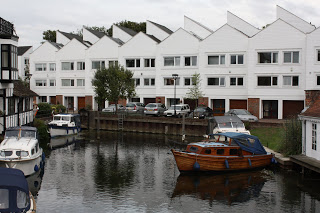
Marlow Mills survived many mishaps ranging from a very destructive fire to withstanding the riots that were a spill-over from the agricultural riots of the 1830’s. Other mills in the area had their machinery destroyed – the ancestors were obviously made of tougher stuff, for they surrounded the mill with vicious man traps. The traps could still be seen hanging in their offices in the early 1900’s – perhaps as a warning to any other miscreants! What it didn’t survive was the craze for redevelopment and in the 1960’s they were bulldozed and luxury riverside homes built in their place. Sadly, we no longer owned the mill by then: if we had I might be living in luxury for the 17 properties on the site sell now for around one million pounds each.
.
.
Yesterday, I found myself in Marlow on business but, with time to spare, decided to explore. How odd it felt walking these once familiar roads and riverside walks now knowing that two hundred years ago my family were doing the same. This street view probably hasn’t changed much although, as the family were so religious, I can’t imagine that they sat outside the local pub drinking alcohol in the warm, summer sunshine!
.

.
The view of the river, the church and the bridge must have changed even less, although they would have watched with interest the suspension bridge, designed by William Tierney Clark, being built in the 1830’s (the old wooden bridge collapsed into the river in 1828). Ten years later, he designed and built a larger version of the bridge in Budapest, with which Marlow is twinned.
. .
This old post box must be one of the very earliest ones made for, even in Victoria’s reign, the design became more elaborate. This one looks ancient but is still in everyday use – the VR stands for Victoria Regina, she reigned from 1837 – 1901 and is our longest reigning monarch. If it is one of the earliest it could date back to 1853, the year that post boxes were first introduced. Incidentally, by tradition, all British post boxes bear the initials in Latin of the reigning monarch at time of manufacture. I wonder how many of my family had posted letters here?
.
.
.
I knew, from an old record found on the internet, that Joseph Wright – my great-great grandfather – had been instrumental in building a free church in the town. To my delight, not only did I find the church still thriving, I was able to speak with a senior member of the congregation who, by chance, happened to be there. I was shown a history of the church but there was no mention whatsoever of the Wright family connection, a name not even known to them. Had I got the right place?
. .
Searching through old gravestones, I first came across one with the initials J W and M A D carved in the base. The initials turned out to be for Mary Ann Downing (not for death by insanity!), a name I’d not heard of and, frustratingly, the husband’s name had been damaged and was barely legible – I could just make out the name Joseph. However, it had obviously been a smart grave once for there were the signs that it had been surrounded by iron railings. But why Downing and why J W?
.
.
.
.
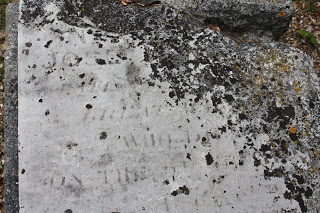
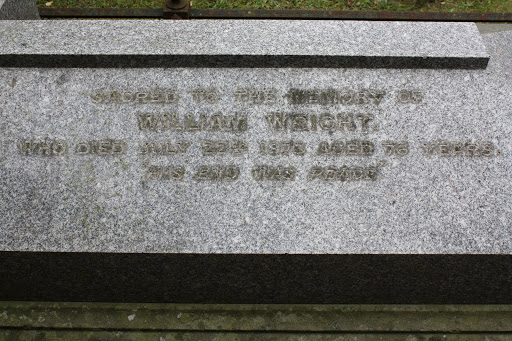
Then I came across the grave, below, that looked so recent. To my amazement it wasn’t new at all but over 130 years old. The marble and the railings of such high quality that they showed no sign of wear. Here the names were clear – they were of William, Joseph Wright’s brother and partner in the milling business, and his wife.
.

.

.
Further along was another grave in good condition, although more modest. It was unusal for it was very long and narrow. Almost overlooked in my excitement, this was the grave of Ellen Wright my ‘own’ grandmother’s mother. I had found great-Granny! I knew of Ellen for she had been born in Finland, which had always been something of a mystery. I found that she had been born there because her father was, for a few years, at a paper mill there before returning to the mill at Marlow. Was he learning new techniques or was he there advising?
.

.
The final pieces of the jigsaw came into place when, at home, I found that after Joseph’s death, Mary Ann had remarried (hence the Downing surname). Her widowed husband obviously agreed to her wishes and she was laid to rest with Joseph, her first love.
.
Feeling extraordinarily emotional (strange, really, for I did not know them in the true sense), I reported back my discoveries to the gentleman in the church who was equally delighted to discover that these unknown benefactors were still present within the church they had helped to create.
.
Now all that is left to close the circle of 200 years is for me to attend a service, something I hope to do in the very near future.
.

Add to Technorati Favorites

An Unexpected Downpour

The heatwave may have ended a good number of days ago but the dry weather hasn’t and the gardens are desparate for water. Digging down to plant some large shrubs the other day, there was no sign of moisture in the soil, nor earthworms for that matter, no matter how deep I dug. It is tedious to water with a hosepipe and, for some inexplicable reason, (perhaps it’s the chemicals in tap water), plants react so much better to a drop of rain.
.
Today the skies were grey but, as none had been forecast, it came as a surprise when I thought I could smell rain in the air. And was that a distant roll of thunder or was it just wishful thinking? With no further warning, the heavens opened, the rain bouncing off the surface of the lane and the leaves of the plants. By the time I had reached my camera, it was already beginning to ease.
.
.

.
They must have had more rain than us, further up the secret valley, for water continued to rush down the lane in its haste to reach the river. Just past the bend its route took a sharp right turn to tumble down the steep banks to enter the meanders – the ones that feature on the header of this blog – just above the road bridge.

.
.
It’s a novelty to see puddles once again!
.

.
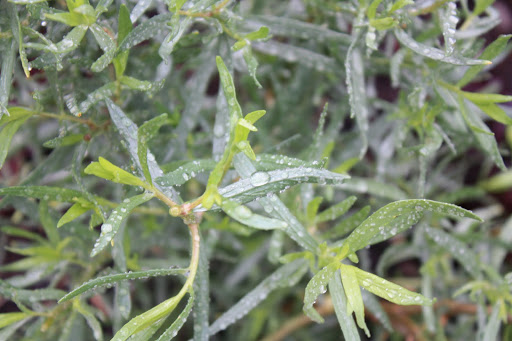
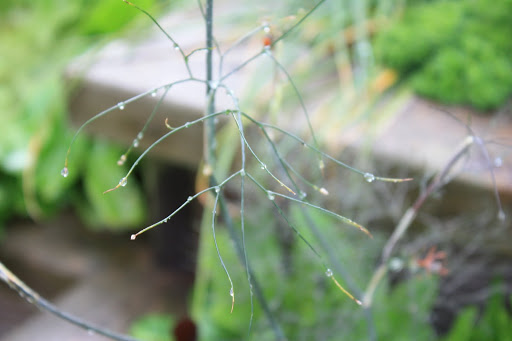
I couldn’t resist catching these images of the herbs cloaked in moisture. The French Tarragon seems to be greedier than most and holds water all over the surface of its leaves. The bronze Fennel, however, holds its drops in a very much more refined way as befits such a graceful plant.
.

.

.
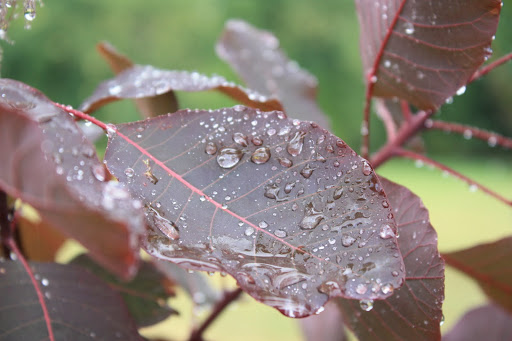
Cotinus – this is the variety called ‘Grace’ – appeared splattered with rain, as if it had been flicked with paintbrushes. It held its drops in different sizes, some so large I wondered how they could remain in place and keep separate from the smaller sized ones alongside.
.

.
The old fountain head of a cherub and dolphin sits at the top of a flight of steps leading to the garden, for many years no longer used for its original purpose. Did the rain bring a slight smile to its lips and was that a tear that rolled down its cheek to its chin as it recalled its real purpose in life?
.
.
If above is the picture of innocence, what is this next one? A single raindrop on each barb transforms the fence but it can only partially disguise its wickededness. We are not that easily fooled …
.

.
Thirty minutes after the rain stopped the secret valley was shrouded in mist as the cooled air reacted with the warm earth. A short battle for supremacy ensued but, along with a slash of blue sky came a winning dart of sunlight and the mist fell to the ground, disappearing as quickly as the rain.
.
.

"A Massive Piece of Granite"

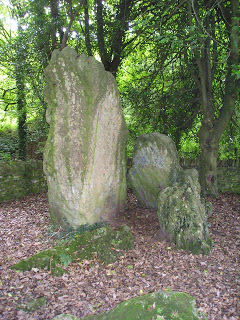
It is a family joke that whenever a large piece of stone is seen, one person asks “What is it?” and the other answers – slowly and after much deliberation and head scratching – “well, it’s a massive piece of granite”. For, many years ago, this was the only answer we got from an old countryman at an ancient stone burial chamber that towered above us.
.
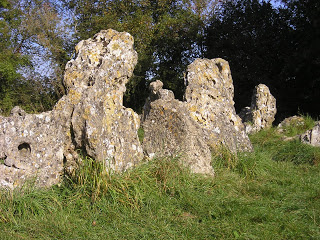
Burial chambers, stone circles and other standing stones, which mostly date back 5000 years or so are reasonably common around Britain,and a surprising number of them are quite impressive. There are several scattered around the Cotswolds and I have written about our little known and little visited Old Soldier and also the very well known and very much visited stone circle, the Rollright Stones.
.
.
The Old Soldier
.

.
The Rollright Stones
.
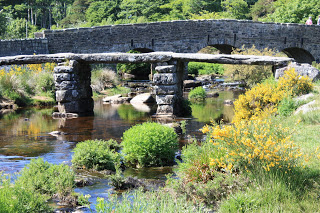
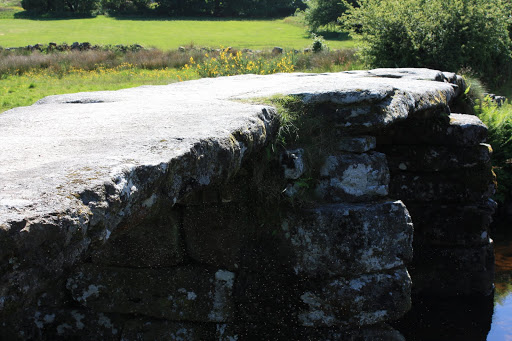
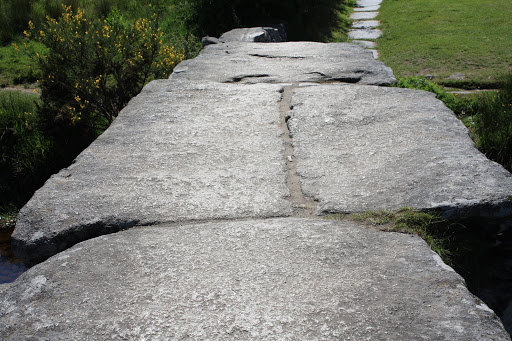
Far more scarce and, perhaps even more impressive, are the stone ‘clapper’ bridges. These are often not as old as they look although, even these, were probably built the best part of a 1000 years ago. I find these bridges, which are mostly in the West Country on Dartmoor and Exmoor, just as impressive as Stonehenge, England’s world famous ancient stone monument. The clapper bridge in the photoographs below is at Postbridge, on Dartmoor, in the county of Devon. This clapper bridge was built to aid the transport of tin from moorland mines about 1200AD.
.
.
The ‘new’ bridge in the background, which carries the road and car traffic over the East Dart river is a mere upstart, having been built about 1780. In the photo below, I love the way the arch of the new bridge is framed by the ‘arch’ of the old one.
.
.
The granite slabs measure over 4 metres (13ft) long and are over 2 metres (6ft 6in) wide and weigh over 8 tons each. Despite this, over the centuries they have been swept away downstream by floods. Some have been rebuilt many times, others lost forever. However did they, without modern technology, transport them?
.

.
.
The bridge just invites you to step onto it and it can be the starting point of many walks that lead across the open moorland. It was for me, a couple of months ago. On that walk, I found deserted settlements and the most incredible stone circle – unusual in that there were two circles side by side. I shall write more of this soon.
.
.
Even now, when a special occasion needs to be commemorated it is to stone that we often turn to. To my knowledge, no modern material is in common use to mark the burial place of a loved one: we mark our graves in a very similar way as our most distant ancestors, with stone slabs.
.
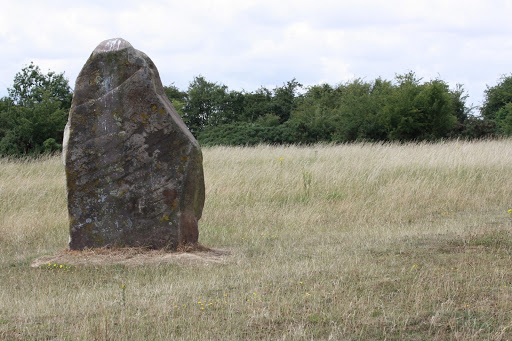
We also use stone to mark more joyous occasions. This standing stone was placed on Ibstone Common, high in the Chiltern Hills, to commemorate the millenium. A small thread that unites us through 5000 years of history and far into the future – a comforting thought.
.
.

Add to Technorati Favorites

Anatomy of a Flower Arrangement

How often does a garden plan go awry only to find that you have something equally as good, if not better, instead? This is what happened to one of my designs, a large area taking up almost one quarter of a walled kitchen garden.
.

.
Formal beds, surrounded by box(wood) hedging and topiary, were planted to create what was to be a tisane, or herbal tea, garden. All the plants were supposed to be suitable for making infusions for either medicinal or culinary use. Something went wrong and, for reasons unknown, half the plants either died or refused to flourish. In desperation, we turned it into a cutting garden where flowers could be harvested for arrangements for the big house – actually, the mystery house I used to dream of as a child. I have written about this house before and the tale of my arriving there two hundred years after I had died….

. .

Concentrating on those plants that survived the initial planting, I decided to see how they would cope with being used as cut flowers and the result was much better than expected. The flowers were cut in the middle of the hottest day of this year so far – not ideal conditions – and then plunged up to their necks in water for the rest of the afternoon. They looked poorly and drooping when first arranged but perked up overnight and now, ten days later, look as fresh as ever.

.

.
Much of the structure is created with a framework of Artemisia ‘Powis Castle’. I find that to get the best results it is necessary to prune this shrub down to ground level each spring. They then produce long wands of stunning silvery foliage. A bitter herb used for all sorts of ailments, I would have to feel very ill before I would consider drinking a tea made from this!
.
At this point, I should stress, that I am no herbalist so I do not recommend that you try out any of these plants without deciding for yourself whether they will do you good or kill you instead.
.
.
Hemp Agrimony, Eupatorium cannabinum, is a British native plant, normally found growing in damp places but quite happy in the garden border. The Joe Pye of America, it is claimed that it is good for many different ailments but especially good for gout.
.
.
A big surprise, was this Spearmint. In the cutting garden it has grown exceptionally tall (and like all mints, proving rather invasive) with attractive, fine flowers. This is, of course, one that I can safely recommend for use as a culinary herbal tea, very refreshing on a hot summers day and good if you suffer with indigestion.
.
.
Lavender needs no introduction. Oddly enough, because of soil conditions, I thought they would struggle in this garden. Instead, they have thrived.
.
.
Marjoram, another common herb that grows wild in England on sunny banks, also needs no description from me. It is our best bee and butterfly plant in the garden, even outrivalling Buddleias. We grow it in huge patches throughout the garden.
.

.
Leaving the best to last and the biggest surprise of the lot! Marsh-mallow, Althaea officinalis, another UK native. This was the first time I had grown it and it is now one of my ‘signature’ plants that I try to incorporate into every design. Related to Hollyhocks but only about half their height and very much more delicate in every way, except one – they are as tough as old boots!
.
.
Beautiful, downy, soft-as-velvet leaves and the merest hint of pink flowers, they require no staking, suffer from no pests or diseases and grow year after year, getting ever stronger. And, of course, you can always make marshmallow sweets to eat from their dried, powdered roots.
.
.
This recipe comes from my old herbal, although I have never tried to make them:
2oz marsh mallow root, 14oz fine sugar mixed with gum tragacanth and enough orange flower water to bind altogether. Quite what you do after that I have no idea – perhaps just eat them?
.
Add to Technorati Favorites

Blogging One Year On….

Greetings from the secret valley! Today is a special day for it is exactly one year since my very first post.
.
.
the secret valley
.
When I began blogging, it occurred to me that, as what I was writing would be in the ‘public domain’, that someone might read it. However, deep down, I didn’t think that anyone would. It is a constant surprise that it is read and that the number of viewings is in the thousands rather than just half a dozen or so. Thank you so much.
.
Like many of you, I write for my own pleasure but, knowing that the words are read, I do make some effort to write coherently and, hopefully, interestingly – not always, I fear, with success. The secret valley is always a source of inspiration and, sitting at my computer, I look out across the fields to the trees and the little, winding river. The photo below is what I see every day and never forget just how lucky I am.
.
.
view of the secret valley from my desk
.
And so, one year on, you have followed me through the seasons:
.

.

in the cold

.

.
and as the weather warms
.
You have followed me on my travels:
.

.

Grafton Street, Dublin, Ireland

.

.

Lee Bay, Exmoor

.

You have met my family:

.

.

The old nags

..

and the very special She-dog

.
And you have witnessed my gardening:

.


.
my successes….
.
.
….and my failures
.
But best of all, through blogging, I have met interesting people from all over the world, from all walks of life and I am all the richer for it.
.

.

and sometimes I still can’t get the spacing right between paragraphs – is it me or is it Blogger?!

Add to Technorati Favorites