Cooking: Cherries and a Tongue Twister

It has been a good year for cherries. Despite the hard and late frosts, which continued well into May, there has been a bumper crop. And, for some reason, the birds have been kind enough to leave them for us humans to harvest. There is the appearance of something exotic, or even of decadence, in the cherry’s shining, red orbs hanging in profusion. Perhaps because we see it all to rarely.
. .
One rather plump bird has developed the taste for cherries. Henrietta, the tamest of our Lavender Pekin bantams just can’t get enough of them! Fortunately, the others show no interest and, not being the brightest of creatures, Henrietta hasn’t considered flying into the trees to eat even more.
.

.
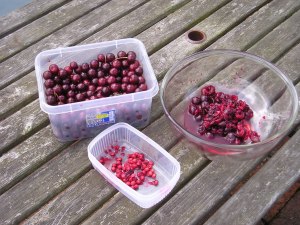
Today was a cooking day – I love cooking but have no patience when it comes to following recipes, occasionally with unfortunate consequences. Luckily, today was one of the better days. Having picked the cherries, I had no idea what to do with them, so sat outside in the sunshine stoning them, waiting for inspiration.
.
.
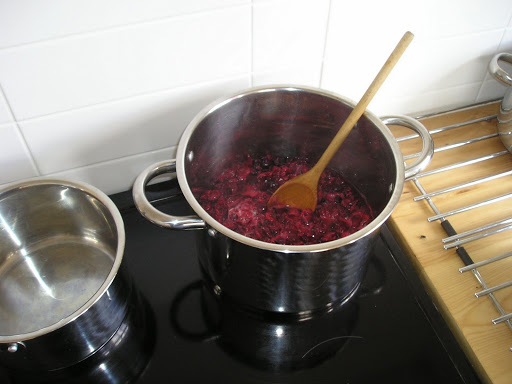
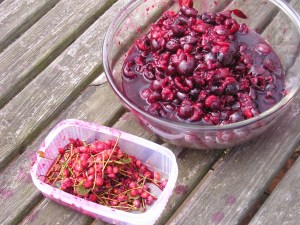
So much juice came from the fruit that it was necessary to strain it off. I thought of jam and other weird and wonderful ingredients to add to them. In the end, I just cooked them gently until their skins were tender, then added sugar and stirred in some mixed spice and some cinnamon. It made a pulp that will go down a treat with vanilla ice cream or with some natural yoghurt for breakfast tomorrow.
.

.
So what to do with the juice? First thought was to throw it away but, apart from the waste, I knew that Rhonda from down…to…earth, would not approve. Her blog is so inspirational, I highly recommend it to all that want to try and live -even just a tad – more simply. Warmed through with sugar, a few chilli flakes (I only wanted it to have a slight kick, not blow my head off) and some vanilla essence, it has become the basis for several potential options. Below it was poured over crushed ice and topped up with chilled tonic water to make a beautifully, refreshing drink for a hot, summers day. The colours were an unexpected and added bonus.
.
.
Next, the tongue twister: Geviklte Kichlach. I have had the great fortune of having a Jewish grandmother – if you have never had one, I suggest you find one that you can adopt. For apart from spoiling their grandchildren rotten, they are the most superb cooks. Geviklte Kichlach, which translates approximately, to ‘twisted little cakes’, Grandma would make for my every visit.
.
The recipe is more a pastry one than a cake recipe and it is very simple. I use spelt flour and baking powder as my partner has a wheat intolerance – spelt, despite being a type of wheat, is often ok for people with digestive problems.
.
.
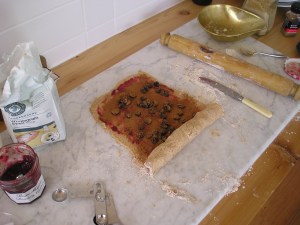
Mix 4 oz butter with 4 oz curd cheese and 6 oz flour (if not using self raising, add two teaspoons of baking powder). Roll out thinly to an oblong and spread with jam. Then sprinkle currants over the top and some ground cinnamon and roll into a sausage shape.
.
.
You can elongate the sausage, if need be, by rolling it with your hands like plastacene. Cut into thinnish slices. Place on an ungreased baking sheet and bake at 190 until golden – about 10 minutes. Once cool, dust with icing sugar (it does need this additional sweetness, so don’t be tempted to leave it out). The undusted, currant free version, sitting on the marble slab is a special treat for She-dog!
.
.
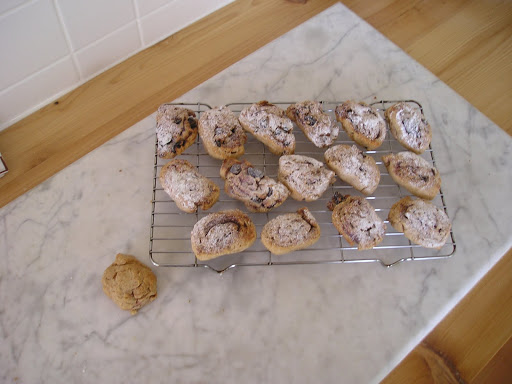
You don’t like it? Well, as Grandma would have said, “You will like mine – now eat!”.
.
.
Please remember, overseas visitors, that the measurements are in British ounces and the oven temperature is in Centigrade.

Add to Technorati Favorites

A Sting in the Tail

This year is proving to be one of extremes. Weather wise, first it was snow, then late frosts, then rain, more recently drought and scorching temperatures. And it also seemed to be a similar situation with wildlife. The tree blossom and wild flowers have been amazing with every month some new blooms outrivalling those of the previous month’s.
.

.
Now it seems July is to be the month of wasps. There are hundreds in the garden, indeed probably thousands, and they are everywhere. And if that isn’t bad enough, the very hot weather we’ve been having seems to have made them far more aggressive. Normally they do not prove to be troublesome until the fruit ripens in late summer, this year it’s different. And I’ve already been stung once this week which is very bad news for me – I suffer from a severe reaction, although never yet been hospitalised, fortunately. I keep my drugs and sprays with me – and a mobile phone, in case help is needed – and also keep my fingers tightly crossed. This, like the recent advice from a doctor to stay indoors, is not too much help for someone who earns their living by gardening.
.
.
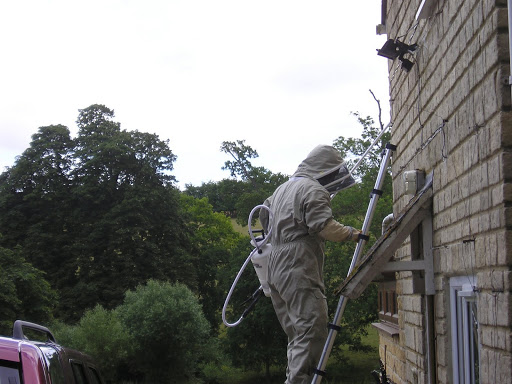
Fifteen wasp nests in four days has surely got to be a record and so I have been keeping the pest control man busy. It’s a pity to destroy them but better I get them first than the other way round! I remind myself that during the spring they live on aphids and the like and are, therefore, valuable pest controllers themselves. Then I remind myself of the pain, discomfort and swelling, and sometimes injections I get, and they have to go.
.
.
I commended myself on my bravery, taking these photos, as the wasps went into the attack as the chemical jet entered their nest. But such is my devotion to get a new post out – I’m becoing a true blogger news hound!

. . .

My heightend awareness of wasps this week made me also notice these holes in a deserted timber garage. They were the homes of a small colony of wood wasps. Unlike the common wasp which live communally in their hundreds (the largest of our nests turned out to be the size of a football), wood wasps are more solitary, each one occupying their own chamber.

. .

They are quite placid compared to their aggressive cousins and, I believe, unable to sting a human being. The largest ones look terrifying but this species was small, about half the size of the common wasp. There are about 500 species of solitary wasp in Britain and I can’t identify any of them. I felt totally at ease photographing them inches away and they completely ignored me. Perhaps word had got round what I did to them further down the secret valley!
.

. ..

I’m now looking forward to the first frosts and a wasp free winter!

Add to Technorati Favorites

Scabious: Wild and Tame

Regular readers of this blog will know that I am very fond of garden plants that have not been messed around with too much. By that, I mean I generally prefer the simpler flowers. So-called ‘improvement’ is so often just another word for vulgar, blousy and big – although there are occasions when I have a need for both the blousy and vulgar!
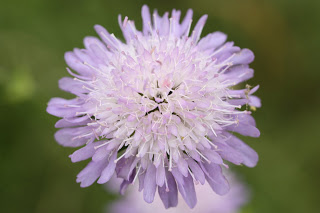
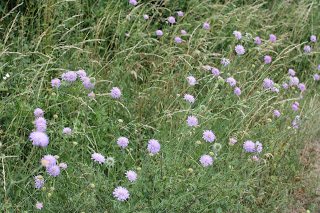
Scabious are a delight regardless, whether they are growing in the hedgerow or the border.
.
The secret valley is awash with scabious, as well as other wild flowers, at the moment. The dry weather seems to suit them for they are looking just perfect. They seem to be everywhere – they especially like roadside verges but also grow in odd pockets of wasteland on very poor soil. But it is not just the secret valley where they are found, for the whole of the Cotswolds seems to be a haze of powder blue. In fact, they grow pretty well throughout the British Isles although they are much more scarce in Scotland.
.
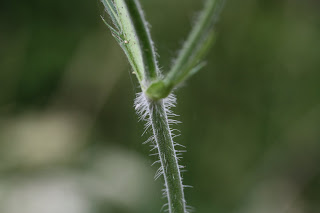
I have found photography and blogging has improved my powers of observation for it is only recently that I noticed that the scabious has quite hairy stems. These feel quite soft to the touch, so it was with some surprise that I learnt that they are closely related to teasels, whose hairs have been modified into sharp, protective spines.
.
However, it was only when looking at these pictures that I noticed how the flowers open from the outer edge and then work there way inwards. Obviously, my powers of observation have still some way to go!
.
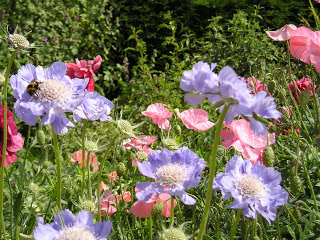
As garden plants, in my opinion, they are superb. Always tidy, never need staking and, with regular dead heading, flower continuously from mid June onwards. In the photos below, scabious is being grown in a cottage garden border (this is Scabiosa caucasica but still pretty!) amongst pale pink Icelandic poppies. The scabious is perennial and will grow again every year, the poppies are annuals. I just threw some poppy seed down amongst them and, as the poppies were mixed colours, removed any that turned out not to be pink. Simple!
.
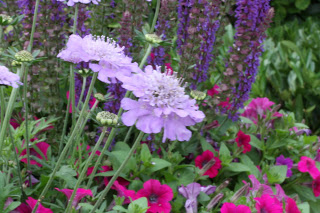
As an ingredient for containers they are unrivalled, too. Here, in huge one metre square pots, they form an underplanting with Salvia nemerosa and small flowered petunias beneath the (very) light shade of Cornus controversa ‘Variegata’. This scabious is an improved form of our wild flower – it is dwarfer than the type.
.
.
The Five Spot Burnet moth flies in daylight and is everywhere at the moment. They especially seem to like feeding on the scabious, choosing these above the profusion of other wild flowers. They are very pretty and when the light catches them at the right angle, the black ground of their wings become irradescent, similar to the ‘black’ feathers of the magpie and farmyard cockeral.
.
.
Going…..
.
Going…….
.

Gone!
.
Like many plants, occasionally a ‘sport’ arises. Driving home today, I noticed just two white flowered scabious growing by the side of a country lane. Beautiful!


Add to Technorati Favorites

No Time For Growing? A Recipe For Guaranteed Success

We all lead busy lives these days and often don’t have time to sow seeds, despite our best intentions. I garden for my living and, in the tradition of cobbler’s children, my own garden is, more often than not, far from text book perfect. I simply do not have the time for all that seed sowing and pricking out even though I spend all day encouraging others to do it!

Raised beds are often described as labour and space saving and, indeed, they are. They are hugely productive and can look lovely, as the many posts and photographs by fellow Bloggers prove. But what if you don’t have the time even for that?

Here is my recipe for growing summer suppers…..

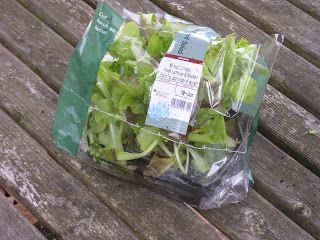
1. Purchase a box of lettuce. No, not joking! Supermarkets sell a wide range of salad ingredients including growing pots of near full grown lettuce. Recently they have started to sell mixed leaves as seedlings, the idea being to keep them fresh for a few extra days.


2. Carefully remove all wrappers and tip out of their packaging. There is quite a good root system already started.


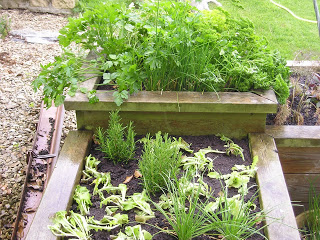
3. Divide carefully and, just by using your fingers, plant direct into your soil or compost. Water well. In the photo below, for even more speed, I just pinched a few plants out of the growing medium and planted together in one hole. I ended up with about twenty groups – planted separately I would probably have had nearer a hundred. Note the herbs behind the lettuce, all grown the same way.


4. The lettuce in the photo above may have looked a little sad but within a day, the seedlings perked up. Ten days later here are some of them again below. Enjoy!

Recently I have been taking the idea of raised beds a stage further and creating much higher raised beds that avoid the hardship of bending. I use them as ‘walls’ to separate different levels of a garden, I use them on the flat and I use them where the client is elderly or has a disability.

Made from chunky timber so they won’t rot for years, I also make them bottomless as that is always the first place to go. They require less watering that way too. Lining them with black plastic prevents water seeping through and disfiguring the boards which is important if they have been painted or stained. And the boxes just seem to be getting ever bigger!

This box separates the lower dining terrace from the house level and creates a sense of enclosure when seated below. As it is situated close to the kitchen door, the box is planted with a mix of herbs as well as garden flowers. The twisted stemmed bay gives a degree of formality as well as height.

Exotic planting works well in this square box. A hardy palm is underplanted with coleus, the magenta splashes of the leaves are emphasised by the identical colour of the petunias and of this favourite plant of mine, Lythrum. Lythrum is native to the British Isles and grows besides streams and in boggy places. This variety, ‘Robert’, is identical in every way except for its shorter height and is a great garden plant. I’ve found that it grows in quite ordinary soil in the border and it certainly thrived here in these conditions.


PS I’ve just remembered! Spring Onions (Scallions) bought as bunches from the supermarket: when planted out early in the year, grow to become reasonable sized onions. They don’t store well but help to bridge the gap that occurs before those grown from sets are ready for harvest. Try some in your boxes!

Watercress works as well: eat most of the stems you buy and plant just the last 2 – 3 inches in ordinary compost. Keep moist and it will provide food up until the first frosts.

Add to Technorati Favorites

Archbishop Desmond Tutu in Oxford

Last May, Archbishop Desmond Tutu gave the Bynum Tudor Lecture at Kellogg College, University of Oxford in the historic Sheldonian Theatre.

The lecture, “Lessons from the truth & reconciliation process for 21st century challenges”, was thought provoking and fascinating. Although I have written of the lecture at the time – the post and photographs of the Sheldonian Theatre can be seen here – it is only now that the video of the lecture has become available.

For those of you that would like to view it, click on this link to Kellogg College, here.

Add to Technorati Favorites

Mad Dogs and Englishman…

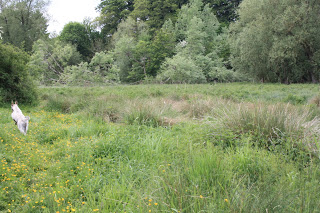
…go out in the midday sun, according to the song sung by Noel Coward. But I don’t think it was the noon heat that made She-Dog behave more like a deranged She-Devil, I think it was an extremely herb scented and squelchy bog that got her all worked up. Although she does certainly looks completely mad in this photo!

I had gone to investigate the wetland that is below the fields where we keep the horses. The horses have access to this area too and, like She-Dog, become totally hyper when they have been grazing it. It is necessary to keep your wits, as well as your nerve, when Henry, Barney and Rambo come galloping and bucking and rearing their way up to you after they have spent time in there. The overwhelming scent is of water mint but meadowsweet is also very dominant – perhaps it is one of these that gives them all this burst of energy. If so, I should try eating some too.
.

The purpose of the visit was to photograph dragonflies but, needless to say, thanks to She-Dog, it proved virtually impossible. She turned what is usually a peaceful, rarely visited by humans, wildlife haven into a race track. However, I did manage to get this photo of the Common Blue Damselfly, Enallagma cyathigerum. It is found near water everywhere. In fact, it is one of those few species in the animal kingdom that is found virtually throughout the northern hemisphere.

A lurcher and part whippet, She-Dog can run pretty fast but I have never seen her move so rapidly and for as long as this day. Back and forth, round and round – even when we came to the river she couldn’t stop galloping through it. It reminded me of when we had deep snow, the first she had ever seen, earlier this year.
.

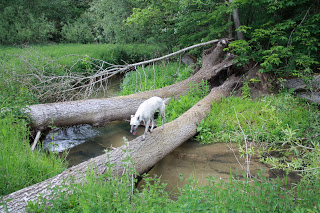
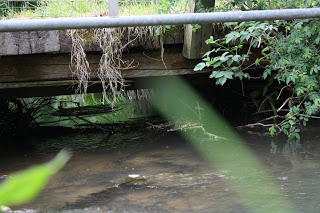
A fallen tree brough about another burst of energy, just when I thought she had settled down. Ignoring her as she investigated the bridge that it had created, I was surprised and somewhat alarmed to discover her seven foot up in the canopy. Before she could be rescued she took a flying leap to the ground below, landing in a heap, before accelerating into the distance.

She-Dog’s madness meant that very little in the way of wildlife was seen. I had to content myself with being in peaceful surroundings on a warm summer’s day, listening to the brown trout rising for mayfly. I spent some time trying to catch both trout and fly on camera and just about managed to get a trout breaking the surface of the water.

It was only when I returned to the car I was able to get a picture of the elusive mayfly – there was one resting on the door. The vagaries and frustrations of being a wildlfe photographer, I suppose. I think I shall stick to gardening for a living!

Add to Technorati Favorites

A Day’s Plant Hunting

One of the pleasures of living on a small island is that you are never far from anywhere – except another country (apologies to Wales and Scotland, I know that you are proud of your separate identities and rightly so).

So last Friday I spent at home in the Cotswolds – limestone country, wide open views and rolling pastures. Saturday I spent walking across Dartmoor (post to follow) – granite country of bleak, open moorland and few trees. Today I spent walking in the Chiltern Hills, my birthplace, a chalk country, densely wooded and secretive. All are beautiful in their own way.


And today was especially special for I was on a mission: looking for rare plants. And with some success, although just as much delight was found in the more common ones, for seeking pleasure from rarity for rarity’s sake is a poor emotion. What could be more charming a discovery than this group of foxgloves in a woodland glade? A common enough plant: I prefer the wild to the garden varieties, that have been bred to have ever larger ‘cups’. Here, the wild plants have a grace and delicacy that is so unlike their brasher relatives.


The group of thistles didn’t seem to be of special interest other than for the pleasure of watching the bumble bees feed from their flowers. But when seen in close detail the flowers really are quite spectacular. Most of these were purple but some that, from a distance, appeared to have prematurely gone to seed turned out to be a variant – they had white flowers. How glad I was that I had dawdled and not just rushed past without giving them a second glance!


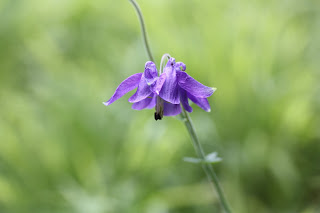
Further into the woodland and growing in dappled shade was the first of the ‘finds’. Our native Columbine (Aquilegia vulgaris) is not often seen. Many that appear wild are garden escapes and are usually close to roads or houses but these were a long way from either. And, again, the flowers have a delicacy and lightness about them. Ladies Bonnets is another country name for them – it is easy to see why.


The Narrow Leaved Helleborine (Cephalanthera longifolia) is also uncommon and it was only after this one was found that we realised that there were over forty plants scattered over the area. Like the Columbine, where the plants were not sheltered by scrub or ferns, the deer had eaten the tops off. The flowers remain closed, making them unavailable to insects so, I assume, the plants self pollinate – perhaps that is why they are not at all common.


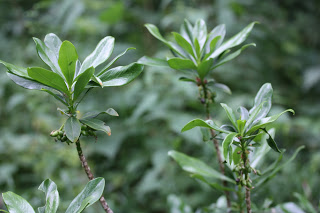
Further still along the path, was this solitary speciman of Daphne laureola, the Spurge Laurel. Although this plant grows quite widely in the Chilterns, this was the only specimen seen today. It flowers in late winter, it’s greenish-yellow flowers lacking the sweet scent of its garden cousins. Already the berry seedheads are forming, these will turn black later in the year. The Mezereon, a popular garden shrub in the past but not grown so widely these days, is also a native but extremely rare. It is known to grow in the Chilterns although I’ve never found one.


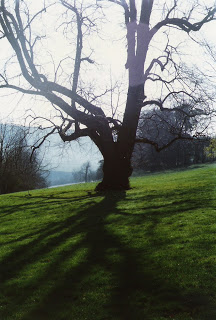
Returning once more to open meadows the woodland gave one last surprise: tall Field Maples, Acer campestre, usually grown as a hedging plant. And this is how it would have started out: one trunk, coppiced and layed to create sturdy, stockproof fencing. The original trunk has long disappeared and the ‘new’ stems from around its base have grown to be trees in their own right. For a maple to be of this size – and they rarely are – it would have been planted in Medieval times and it is known that the field that it borders was first created by the Saxons, 1000 years ago.


And as a grand finale, the meadow gave us dozens of Common Spotted Orchids – only common in favoured places, the spots refer to those on their leaves. The Chilterns are a great place for orchids and are home to some of the rarest species – their sites a closely guarded secret.
A most successful and satisying day!

Add to Technorati Favorites

When Greens Defeat the Blues……

We all go through periods of our lives when plans are thwarted, futures unravelled and forgotten pasts unfortunately remembered. It is something we have to come to terms with for, after all, if there were no ‘lows’, we couldn’t have ‘highs’ either.

It has been a difficult couple of weeks although, in the grand scheme of things, I should not complain too much. My partner, who has suffered considerably and silently with a debilitating heart problem the past two years, has finally had the op long waited for. And it seems, a great success with glimpses, already, of the old energy that was there before.

At the same time, the first anniversary of my mother’s death has weighed far more heavily than I expected. We were close and talked frequently about all sorts of things and, in her last few months, of dying. As she often said, she had a great and happy life and reached 94 despite hating being old (“it’s no fun being in your 90’s, you know”). She was ready to go.


So here I am, feeling a bit ‘blue’ and why? My partner is recovering, my mother is at peace. And suddenly, I have no need to be rushing hither and thither. I am like a train that has run out of steam or, if you want to be less kind, moping about like a wet rag, if they can mope and I can mix metaphors.

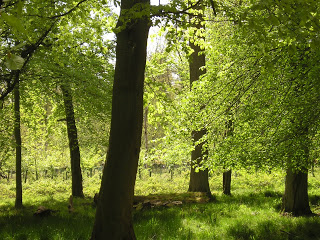
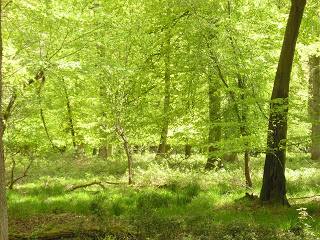
Without love there can be no loss and without illness there can be no recovery. And without fall there can be no spring. And it is the spring that renews, not just our gardens and the landscapes that surround us, it renews the spirit inside us. And so it was back to the Chiltern Hills, where I grew up and spent most of my life, that I returned to be revived by the extraordinary lushness of their beautiful beechwoods.


The Chilterns are barely 30 miles from the Cotswolds, the two being separated by the low lying Oxford vale. So close yet so different in character. The Cotwolds is a landscape of gently rolling hills, little rivers, big vistas and skyscapes. The Chilterns is a secretive land of steep combes – the beech woodlands clinging precariously to the valley walls. Few rivers, for this is a chalk land, a dry place with few views and no large skies for the forest hides them all. Yet the light is magical and nothing is as blinding as the intense greens of the unfurling beech leaves.


How can one walk here without being uplifted spiritually and mentally, whether holding religious belief or not? And if the beech is struggling to kick start you then the sight of the tens of thousands of bluebells, with their gentle scent, cleanse the body and renews the energy within.


Life is good and I’ve only got one attempt at it. I feel refreshed. I’d better get on with it.


Yes, life is good. No complaints. Honest!

Add to Technorati Favorites

Sunshine and Laughter

I always feel better when the sun is shining. I have more energy and achieve far more, whether working in the garden or even doing indoor chores. And sitting outside feeling the warmth on bare bits of body (not much on show these days after a bout of skin cancer), preferably with a glass of a good, chilled, white wine, makes me feel that all is right with the world.

And when I was in Grafton Street, the main ‘drag’ in Dublin, Ireland on a glorious spring day, I found that it wasn’t only me revelling in the long awaited heat. The road filled with people all intent on rushing at speed but instead ending up relaxing and enjoying themselves. It was good to see.

Magicians and entertainers did what they said: not only did they entertain but they worked their magic on the crowds and the street came to a standstill. All around people stood and laughed and clapped and cheered. A picture, so the saying goes, is worth a thousand words. These photos speak for themselves.

Musicians played and, quite spontaneously, there was dancing.

And if the heat became too much, continue laughing in Bewley’s cafe…..

…..or just bask in the sun down a side street….


I love these photographs for the warmth that radiates from them – and I don’t mean sunshine. Having just been fortunate enough to hear Archbishop Desmond Tutu speak in Oxford, for me, these are confirmation of his viewpoint that, if you look for it, you will find that the natural goodness in people shines out.

Let’s hope we all have a warm, happy and laughter filled summer.

Add to Technorati Favorites

There’s no Business like Sloe Blusiness…..

…..or should it be There’s no Blossom like Sloe Blossom?

This winter was long and cold and, by the standards of southern England, very snowy. Spring has not been much better with little in the way of warmth for, even on sunny days, there has been a chill wind blowing from the north or east. Frosts have been commonplace and are still occurring – our last one, a hard one, was only a couple of days ago: in recent years we have had our last frosts in early April. This was the view of the entrance to the secret valley not so very long ago.

Now, just a few weeks later – and despite the efforts of our friend Jack (Frost) – the secret valley has been transformed by the best blossom for many years. Whether any fruit will set is another matter altogether.

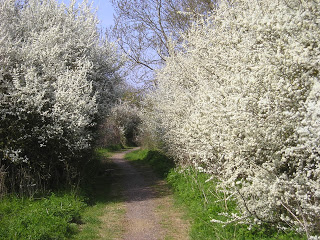
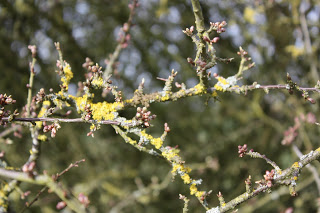
One of the first trees to bloom is the Sloe, Prunus spinosa. The second half of its Latin name gives a hint of its nasty thorns, as does its other common name, Blackthorn. These thorns break off as you touch the plant, entering the skin and festering readily. The old country folk talk of “Blackthorn Winters” as, when it blooms, the weather always turns very cold once again. This year the tree has been caught out: it is flowering five weeks later than normal and the weather has been cold all the time with no warmer spells to fool us into thinking summer has come.

The Sloe is one of those remarkable species which flowers on bare wood in such profusion it gives the plant the appearance of being snow covered (photos above and below).

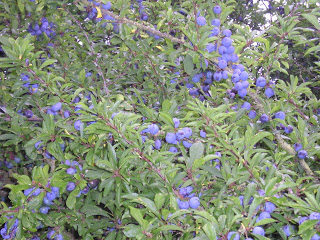
However, country people hold it in affection not for its early blossom or for making impenetrable, stockproof hedges. They even have a reason to forgive it for all the painful splinters it inflicts upon them, year in, year out. And that reason is alcohol. For despite being incredibly bitter when picked, its blue-black fruits, the size of a marble and equally hard, give rise to that most delicious and sweetest of drinks, Sloe Gin. Traditionally, the drink of hip flasks to be passed around amongst friends on a frosty shooting or hunting day, it is a good drink at all times – which is why I have none left to show you here. I have had to make do with a picture ‘lifted’ from one of the commercial makers of Sloe Gin, for it really is a business venture for some .

Nothing beats home brewed and our recipe, made each year, is below. The Sloes are picked after the first frosts, which softens them and brings out their flavour, although a couple of days in the freezer works just as well. And if Sloes aren’t available where you are, don’t despair: damsons or plums would be just as potent. Cheers!

Recipe:
* Frosted or frozen, then thawed, sloes – weight not too important, probably about a pound.
* Place in a bottle/bowl and cover with gin (or vodka)
* Add a similar quantity of sugar
* Shake well every day until sugar has completely dissolved
* Top up with more gin (we add, at this stage, a quarter bottle of brandy as well – our secret weapon for making fellow imbibers ‘legless’. It also helps to give much needed courage when jumping a big hedge on Barney!
* Leave for several weeks, then strain and enjoy

PS. The fruit will now be sweet and full of alcohol – absolutely delicious eaten with vanilla ice cream.

Add to Technorati Favorites

.