Butterflies are the most extraordinary creatures – so delicate to look at, yet they must be as tough as old boots to cope with the rigours of an English summer. For weeks now they have had to endure cool days and heavy rain but, with every burst of sunshine, out they come. And this year there seem to be more than ever.
 And it’s offical: it started in Spring when the BBC reported (so it must be true!) that clouds of Painted Ladies had been seen off the English coast, soon to arrive from annual migration from Africa. And sure enough, just a few days later, the hedgerows of the secret valley suddenly had dozens of them resting on the fresh new leaves and, every so often, stretching their wings to absorb what warmth there was.
Then just as suddenly they were gone! They had laid their eggs and, I assume died, their purpose in life over. Now they are back, or if I’m correct, their offspring are, feeding on the late summer nectar of the wild flowers and, in the garden, on the lavender and buddleia bushes.
The Peacocks, too, are plentiful but these we see all year round, for in the winter they come into the cottage and hibernate in between the folds of the curtains or some other dark place. Periodically, when the log burner is set on high and the house warms up, they fly around before settling down again for another long sleep. The one below is feeding in the garden on Phlox ‘Hesperis’, so called because of its similarity to the Dame’s Violet – and just as beautifully fragrant.

It is the smaller butterflies that I especially like, the subdued markings of the Speckled Wood have the loveliest ‘eye spots’ on their wings, the colour of Devonshire clotted cream. The Gatekeeper is a much livelier and brighter coloured one, the one in the photo conveniently stopped for a moment on a wild scabious.


The ‘blues’ are the trickiest to identify. The two photographs below are of the Small Blue (I think), the female not looking very blue at all!


And soon all will be gone! Some migrating back to Africa or hibernating in a log pile or other sheltered place but the majority dying with the frosts,their species overwintering as pupa below the leaf litter to emerge as adults in the spring – which is, perhaps, the biggest test of ‘as tough as old boots’ of them all.


 So sit back, enjoy the summer warmth while you can and relax……
 Or find a place in the shade….
  Or lie amongst the corn and gaze at the sky…..


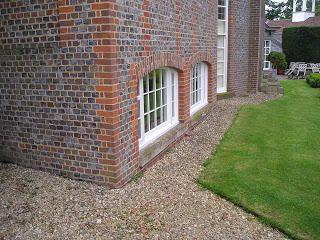

 The house won’t let go. Several weeks later I am asked to return on a regular basis as an adviser and I have been travelling there ever since – the last time to supervise the planting of lavender hedges and, when I return, I still get that warm, contented and happy feeling. Do I believe in reincarnation? I’m far too much a sceptic to say ‘yes’ but there are too many coincidences to give an emphatic ‘no’…..

 The layout of this garden near the village of Oddington is beautifully illustrated from the air – I wonder if the owners were ever so fortunate to see it from above?
 The walled, organic gardens at Daylesford, too, are shown to be quite an unusual shape: the intricate design of the parterre giving way to a less formal area uses this to its advantage – a study in good design.
 Saxon ridge and furrow field systems are also shown in sharp relief. There are a lot of these around the Cotswolds and they can originate from as far back as a thousand years although many were worked up until a couple of hundred years ago. Now preserved and retained as pasture, often the drier, warmer ridges have quite different wild flowers growing compared with the damper furrows.
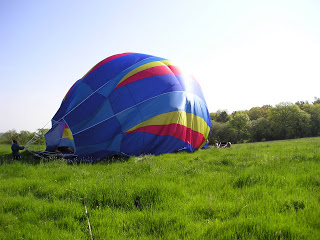
 We ‘touched down’ in a field not far from the small town of Stow-on-the-Wold, shown in the photo below. Stow is famed for its twice annual Gypsy Horse Fair where travellers gather from all over the UK to buy and sell ponies and catch up with news. It is also well known for its exposed climate as in the local saying “Stow-on-the-Wold where the wind blows cold”.
 The balloon’s shadow chasing us is a favourite photo as also is this one of the burners in full flame!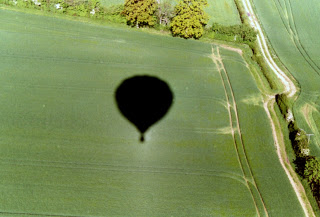



 All the rain we have had this July – the wettest since the late 1800’s – has held up the start of the harvest and the machines have sat idle while the farmers have watched their golden corn, (in England we call wheat ‘corn’), turn black with moulds and the price fall, along with the quality. With modern drying techniques and machinery the crop can be salvaged but how terrifying it must have been, just a few centuries ago, knowing that hunger and possibly starvation was the only certain outcome.
 Now the rape is safe in the barns, the wheat is on its way and the barley, still to cut, hopefully before it is lost completely to the weather.

 The practice of stubble burning is also lost but this is due its being made illegal, except under special circumstances. Used mostly to get rid of pests and diseases and excess straw, it was an exciting if somewhat frightening sight. Occasionally these fires would get out of control but our changeable climate meant that there was no risk of the ‘wild’ fires of elsewhere in the world, with the
  Fingers crossed for a few more dry days and the harvest safely in – then we can all celebrate with the Harvest Home.
 Dressage, Show Jumping and Cross Country make up the three phases of the test and it is the Cross Country that is the most eagerly awaited for both its excitement and, sometimes, drama.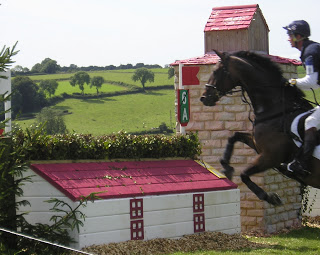
 Dressage is all about concentration, putting the pair through the technical aspects of riding – very elegant to watch but not when it all goes horribly wrong! The Show Jumping course tests the skill of the rider and the agility of the horse.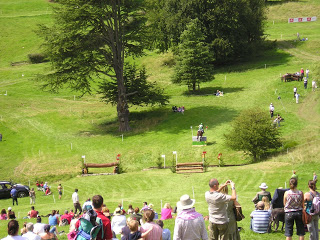





 Life in the English Cotswolds