A Good Walk Home

Both my partner and I like walking but, more often than not, we walk alone.  Somehow it just works out like that and there is no doubt about it, that when you walk without company you do see and hear so much more.  It isn’t that we chatter away non-stop – we’ve been together for  far too long for that!!  It’s just that with no-one to speak to, or alongside, one becomes far more aware of all that’s around you.  And with only the sound from one pair of walking boots the wild creatures are less aware or concerned of your presence.

Walking quietly it’s possible to get quite close to wildlife

Usually, from necessity, our walks are circular – either back to the car or back to the house if we’ve started from home.  Recently I cadged a lift to Duns Tew, just outside the Cotswolds but still in Oxfordshire and not that far from home and the secret valley.  The village is an interesting mix of houses and makes use of their local ironstone as well as the Cotswold limestone.  I find it fascinating knowing that I live on the edge of two quite different rock formations, 0ne literally as hard as iron and the other, soft and easily worked.  The photo below shows the pretty church built of yellow ironstone and banded with paler limestone – a familiar pattern in the locality.

The thousand year-old Church of St Mary Magdalen, Duns Tew

The houses vary in style and age as well as building materials.  Some have thatched roofs; others slate and some stone tiles.  The traditional village pub has a stone tile roof made from Cotswold stone split into thin tiles.  Just to confuse the unknowing, these tiles are known locally as slates even though they are not made of slate!  The craft of making these roof tiles is centuries old – they have even been found by archaeologists when excavating Roman villas (of which there are quite a few in the Cotswolds) which means the manufacture of them has remained unchanged for the best part of two thousand years.  The pub also has a drystone garden wall, also made from Cotswold stone for which it is so ideal and makes such a memorable feature of the Cotswold Hills.

Village houses: contrasting style and stonework. The thatched house was built in the early 1600s. There are a number of these old signposts still standing locally
The village pub: this dates from the late 1600s. Note the stone ‘slate’ roof

One of the great things about walking in England is that we have a huge network of public footpaths, many of which date back to pre-history.  Now that I realise (thanks to my overseas readers) that being able to walk across privately-owned land by right is almost unique I intend to write specifically about them at a later date.  Suffice to say here, is that it is possible to walk from one end of the country to the other over thousands of miles of paths that must not, by ancient law, be obstructed.  This path is beautifully maintained by the owner. Just outside the village, partly hidden in undergrowth, were the remains of old pony carts.

A well-maintained public right of way that is also a driveway to the owner’s house
Half-hidden at the back of a semi-derelict shed

The path opened onto cornfields, the wheat harvested and the remaining stubble giving a real autumnal look to the countryside.  The hedgerow is also offering its autumnal fruits for the picking – crab apples, elderberries and blackberries; the sloes although looking good won’t be ready to collect until after the first frosts.  The squirrels have taken all the hazelnuts (you have to be quick to get them before they do – but already the embryo catkins, the male flowers, are beginning to appear.  It will be early February before they show the familiar ‘lamb’s tails’ that release clouds of yellow pollen with the slightest breeze.

The path is now gras covered passes ‘twixt hedgerow and cornfield
Crab apples, blackberries, elderberries. Tiny catkins are just forming amongst the blackberries

Although the path, now a wider track, looks obstructed here, the farmer/landowner has to leave the gate unlocked so that people on foot or on horseback can pass.  Crossing the lane it returns to being a path, this time skirting a large wood.  Now hidden by high hedgerows in the spring when the leaves are all bare, the woodland floor is carpeted with bluebells.  In the centre of the field is a stand of mature oaks.  Why were they left there?  For me, they always have a mystical look about them; stepping into their midst the atmosphere changes as if its centuries old story is being told to those that might listen.  Perhaps it’s just my imagination but the fancy is palpable.

As this is a public right of way, one of the gates must be kept unlocked by law
The copse in the middle of the fieldwas it once a sacred site?

Once again the path changes character.  Now a track crossing a small stream, the movement of a young coot searching for food catches my eye and we watch one another for a while before it decides that food is far more important than me.  At such close range I see it snatch a small water beetle before it disappears into the undergrowth.  For a while the path becomes woodland again and then opens up onto a concrete track.  The concrete is all that remains of a WW2 airfield, far inland to be out of the range of German bombers.  I stop to listen and am met with silence.  How different the scene would have been eighty years ago.

The baby coot carried on about its business…
The old wartime concrete paths make easy walking

Finally back home.  Being an Englishman through and through (if you ignore the foreign bits of me!) I sit on the old stone bench in the garden with a refreshing cup of tea and lean back against the walls of our own stone-built house built 170 years ago.  Looking out beyond the garden I can’t help feeling how privileged I am to be seeing the best views of the whole walk!

Not too bad a view from home!

.

.

.

Moving Into Autumn

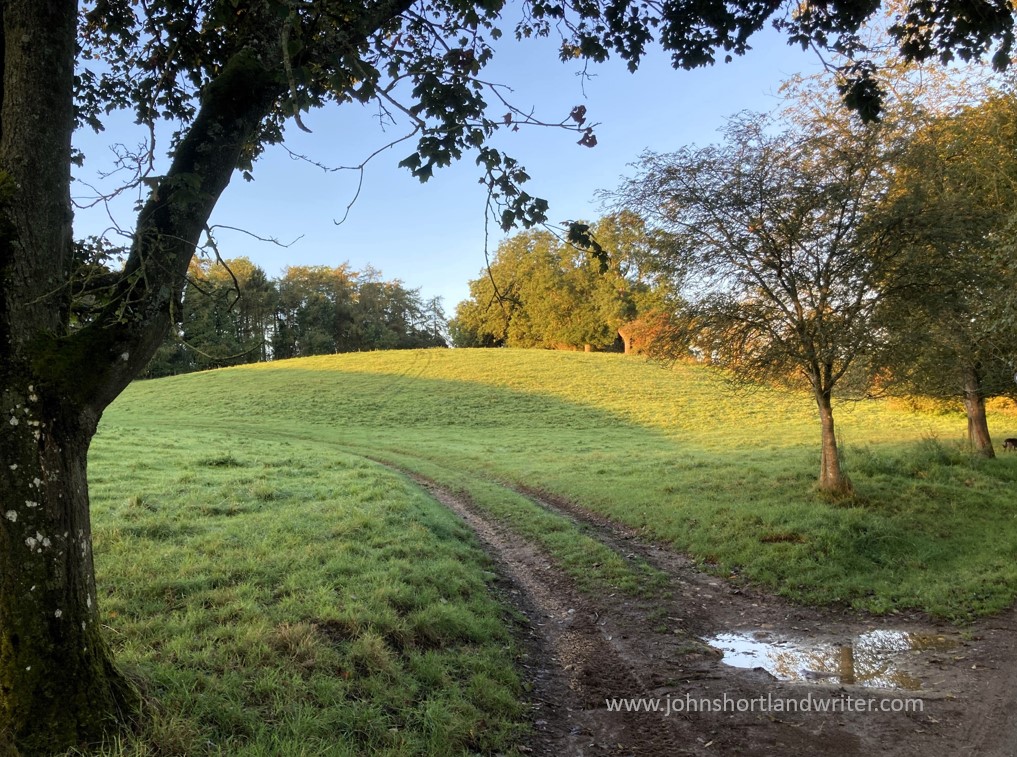
The autumnal equinox has just past and with it comes those rare, clear and sunny days when the outdoors beckons, and your senses become alive to every detail.  Perhaps it is because you’re all too aware that soon there will be many days when the countryside is shrouded in a clinging, wet mist that takes hours to lift, if it does at all.  An early-start walk is all the better for several reasons: the light is extraordinary, the air clear, and there are few, if any, people out and about. Perhaps, best of all, with the shortening days, early isn’t at some God-forsaken hour 😉

Early morning sunshine…

From our little, Cotswold stone-built house it is only a matter of yards to the river.  Unlike the true days of Autumn, the river is also clear.  All too soon, the warmth mixing with the cool will see the vapours rise, often hiding the surface and sometimes blanketing the whole valley.  Today, despite the frequent rain showers we’ve been having the water levels are low, there are no birds singing and I have only a sentinel heron to share it with.  Dismayed at my appearance, he flies off lazily with a scolding, harsh croak only to settle a few yards further away to watch me as I pass.  No sooner have I done so than he returns to his favoured spot to continue his hunt for crayfish.

The heron rose with a harsh croak…

Although the sun is shining, it is still set low in the sky, casting lengthy shadows and intensifying the first changes of colour in the trees.  As it climbs higher, so the colours will appear to fade and the shadows shorten, and another part of the early-morn magic will be lost for another day.

First hints of autumn…
The long shadows of early morn…

Reaching the plantation, the sun filters through the still-densely clothed branches, diffusing the light and giving it the look of an Impressionist painting.  Perhaps this is how Monet got his inspiration when looking at his waterlily pool.  The path stretching ahead just invites you to walk onwards.  At its end, where it meets the lane, the first of the stone houses in the nearby village remain silent, as do they all, for their occupants are still either asleep or not yet venturing out.  They are missing so much but I relish the silence and glad that it isn’t disturbed by the sounds of civilisation.

Almost, if not quite, an Impressionist painting!
Cotswold stone cottages

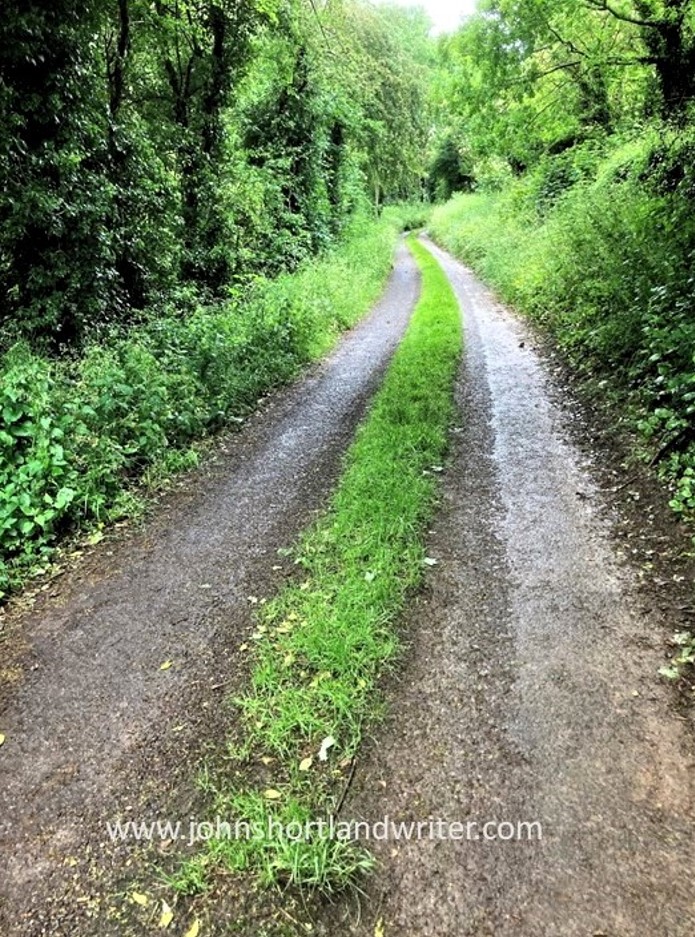
There are four lanes that lead into the secret valley.  The one that I now take is little used and the grass grows thickly in its centre.  Another is similar and, with no passing places for a mile should you meet another vehicle, only those with good reversing skills tend to use it.  Occasionally a ‘lost’ driver attempts it, thinking it will be a short cut to their intended route, only to end up traumatised by the experience.

One of the little-use lanes out of the secret valley…

All along the lanes, the banks and hedgerows are thick with berries and the fading flowers of summer.  Every year I intend to make a note of what I see but, although I never do, I can be fairly certain of seeing the same late bloomers, sometimes right though to Christmas.  These single flowers are extra-special, as they cling onto life reminding us of their glories past and giving us hope for the following year.

l-r top: hawthorn berries, crab apples, campion
l-r bottom: cranes-bill, prickly sow-thistle

I have reached the cattle sheds now at the top of the hill above my cottage.  Large and airy, they are empty and silent now for the livestock is still out in the fields and making the most of the last of the summer grazing.  By Christmas if the season is reasonably mild and dry, or sooner if not, they will be brought in to be kept dry, warm and fed.  The barns surrounding the sheds are stacked high with straw and hay, their bedding and feed – in a good year, there will be enough to last the winter however long it maybe; in poor summers extra will need be purchased for they will not be returned to the valley’s water-meadows until they have calved and the weather is right.

Enjoying the last of the good weather…

It is a short downhill walk to home now.  Within minutes I will be back, the kettle on and looking forward to a well-deserved breakfast.

Home sweet home…and breakfast!

.

.

.