2024: A Year in Review – part 1

As we enter the new year it’s always a good time to reflect on the past twelve months as well as to look forward to what 2025 may bring. For me, 2024 has been a busy year. I remember many years ago an ‘old boy’ telling me that when you reach the age of sixty, life is downhill all the way. I was in my thirties at the time and so believed him. I’m now in my early seventies and I can’t say that I agree with his pessimism. Funnily enough, he lived well into his nineties and, for most of that time, enjoyed rude health so he proved himself wrong too! The only way to tackle ageing, I’ve decided, is to embrace its positive aspects – no mortgage, wisdom (ha-ha!) and more time to do the things that matter to you. Of course, good health is important and maintaining balance and staying active helps no end. One of the reasons why I’ve not retired completely.

John Shortland, summer 2024

Tewkesbury, a town in Gloucestershire on the River Severn – the UK’s longest river – is just a few miles from the edge of the Cotswolds. It’s an ancient town that I have driven through dozens of times but early in the year I made the effort to actually stop and explore its narrow streets and abbey church. I hadn’t realised that when entering the church I would be staring at a suspended globe which, when standing 211 metres away from it, is the exact size and view of Planet Earth you would see if standing on the moon. When I first saw it ‘suitable’ music was being played but it was only after that had stopped that I found the exhibit strangely moving as it rotated slowly in total silence. That’s another thing I’ve noticed as I’ve grown older – how much I enjoy silence! The church is well worth visiting for it is now almost one thousand years since it was built and is one of the finest examples of early Norman architecture in Britain. Unable to visit? Then click on the link here to see lots of photos.

The abbey church looms over the ancient houses and narrow streets of Tewkesbury
Planet Earth, mysteriously beautiful

In March, we travelled north to the county of Yorkshire to watch a friend take part in the oldest horse race in the country. The Kiplingcotes Derby has been run annually since 1519. Tradition sys that if it ever stops taking place it will never happen again so all through the Covid restrictions only one horse took part! For this race, the 505th, dozens of riders took part for it is a horse race like no other: no finely maintained racecourse but a series of roads, lanes, field margins and tracks, a real test of endurance for both horse and rider. Our friend, who had never raced before was taking part to raise money in support of the local hospice. She reached the finishing post in good time and raised over ten thousand pounds in memory of a close friend. The race has one other completely bizarre quirk which makes it unique in the world of horse racing – to find out what that is you’ll need to click on this link here!

The oldest, continuously-run horse race in the UK
Safely past the winning post!

Later, in early summer we returned to Yorkshire for a week’s holiday spent in the pretty village of Austwick. We had planned to spend our time walking for it is excellent hiking country. However, my partner was nursing a broken foot and, later, during a hill walk on my own there, I hurt my knee badly so we were both hobbling about instead (what was I saying about staying active?!) There is always a positive outcome to everything, I find, and so we explored by car instead where we discovered the Courtyard Dairy. To misquote Paul Whitehouse, “if you like cheese, you’ll like these” for we’d stumbled across one of the top, award-winning artisan cheese makers in the country. With a restaurant, small museum, ice-cream and wine shops as well as a huge selection of cheeses, we were in our element. For lots of photos of the trip – and not just of blocks of cheese, click here.

The Courtyard Dairy – one of England’s finest artisan cheese shops
There are beautiful walks around the Yorkshire village of Austwick

I have been very fortunate in not just living in a beautiful part of the country but also being able to make my living from being in the midst of it. However, that hasn’t always been the case for before I embarked on my horticultural career I spent twenty years in the world of retail fashions. When I left school I spent some months on a sheep farm on Exmoor – the remote, hill country, now a National Park, in the West Country. That short time farming changed my life for I met some wonderful and inspirational people there who left me with a yearning for the outdoor life, However, I was dragged away by my parents to work in the small department store which had been central to my family for the best part of a hundred years. Fortunately, I had a happy time there but the desire to be spending my days outdoors never left me. This spring it was thirty years since I sold the business to follow my dream and so it seemed a good time to reflect on those retailing years.

How the family store began in 1904
The family store in 1994 when it was sold

A few months later the blog post (link here) had developed into a full-blown illustrated talk to over seventy people followed by press interviews and a printed history of the store which had been started by my great-grandfather. I am delighted that the story of the family’s endeavour has now been recorded for posterity. By complete coincidence, I was also contacted by Exmoor Magazine and my memories of farming at Brendon Barton have been included in an article on Dick and Lorna French who were the couple who welcomed me into their lives – and changing mine by doing so.

Recorded for posterity – the history of my family’s department store

At the age of 42 I took myself off to study landscape and estate management for two years at agricultural college. It was a huge gamble and one that fortunately came off for I found employment as Head Gardener to the European Youth Parliament, an educational charity that brought teenagers from all over Europe to debate world affairs. With some Polish blood in me I liked the idea of being part of the organisation. Next, and still in England, I spent some happy years working for a delightful Swedish family – even after my role as Head Gardener had ended I maintained contact with them as Consultant overseeing projects such as the creation of a lake and an arboretum. My next move was to the Cotswolds to manage an historic garden, Kiddington Hall, designed by the architect who had created the Houses of Parliament. It was after that, that I decided to go freelance which culminated in the career in designing and creating gardens as well as the commission to write the gardening book.
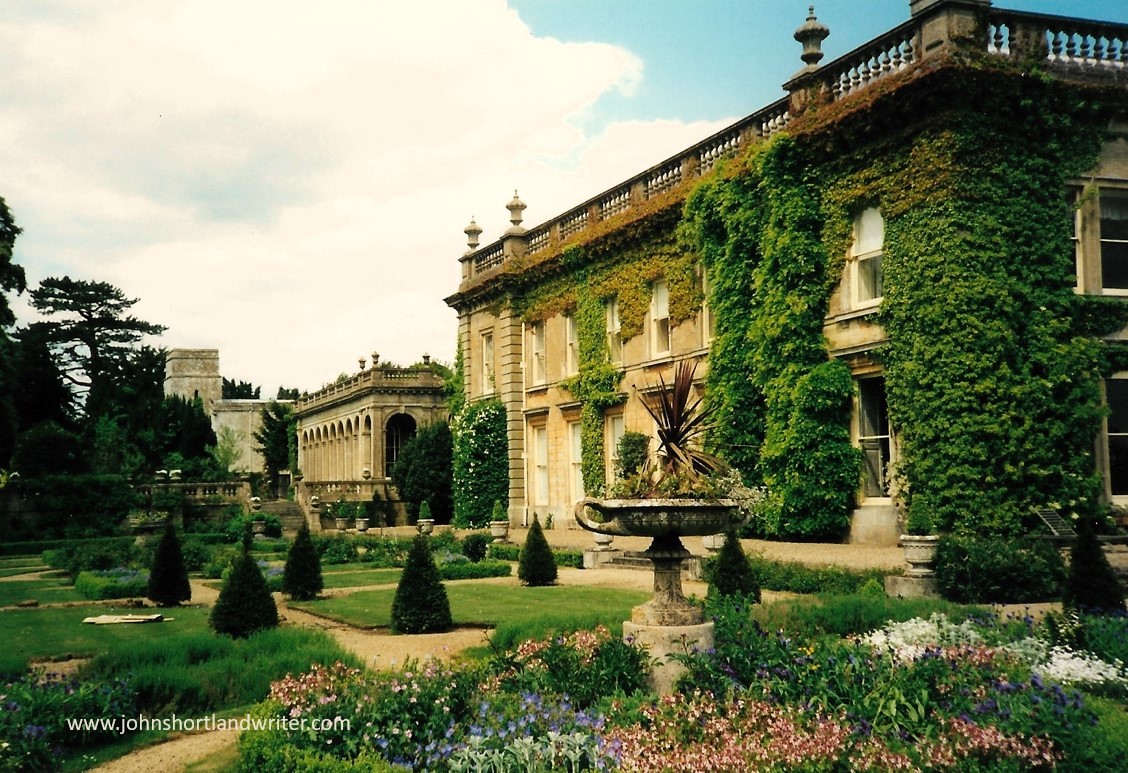
The historic gardens at Kiddington Hall

Little did I think, when I began college that my career would include a stint at the Chelsea Flower Show, Channel 4 Television, creating a new literary festival and a study tour of Hungary. My latest – and final – garden project has been the most exciting to date. How fortunate have I been?! As before, the press picked up on the thirty year career change and a double-page spread in the Bucks Free Press newspaper followed. To read more about the gardens I’ve created, or just to enjoy the photos, click on the link here.

The newspaper article

Related links/websites

Tewkesbury Abbey Church
Gaia
The Courtyard Dairy, Settle, Yorkshire
Yorkshire Dales National Park
Exmoor Magazine
Exmoor National Park
John Shortland
Berkshire College of Agriculture
European Youth Parliament

A Naughty Boy?

I wonder when Henry started going ‘off the rails.’  Was it down to his parentage?  Perhaps living in the small, Thames-side village of Medmenham, where everyone knew one another and so would have known the story behind his birth, may have been a factor.  Or was this considered too shameful to be ever spoken of openly again.  Whatever, the cause, by 1838 he already had a string of petty offences under his belt when once again he found himself standing in front of the Buckinghamshire Assizes for larceny.

The River Thames near Medmenham

Poor Henry’s troubles really began before he was even born.  His mother, Ann Chown, planned to marry local lad Thomas Burridge in the village church in the May of 1809 but on the 14th, halfway through the Banns being called, Thomas had them cancelled.  He had discovered that Ann was pregnant with Henry, the father being another village boy, Elias Nibbs.  Ann had very nearly got away with her deception for Henry had been born and baptised by 4th June.  Ann and Elias never married nor, it seems, lived together, for within a short time they had both married others. 

The village church at Medmenham

Henry couldn’t have been a clever thief for, on the 4th April 1838, he was sentenced to six months imprisonment with hard labour for the theft of an axe and mattock from William Chown, his uncle, and a billhook from John Rockall, his stepfather.  He was even less clever when he tried his hand at burglary again despite travelling four miles to the local town of Marlow for his crime.  This time he stole a shovel, the property of William Brangwin and so, within weeks of being freed from jail, in November he was back before the bench once again.

Standing before the magistrate, Squire Robert Hammond, Henry heard how the shovel was readily identified by Brangwin’s initials being burnt into the handle.  Richard Ayres testified that he had been using it on the day of the theft and Thomas Wright, the local pawnbroker told how Henry (using the alias Beaver) pawned it for one shilling – 5p in modern coinage.  Hammond was not prepared to give Henry another chance.  For this crime he was sentenced to seven years transportation to Australia.  It would be interesting to know how the family and villagers reacted to the sentence.  Perhaps it was relief for most but more likely, for his mother Ann, it was harrowing.

Henry was taken from prison on 13th May 1839 to Sheerness, a port east of London, where he boarded Convict Ship Parkfield.  There were already one hundred prisoners aboard and now it was filled to capacity with the addition of one hundred and forty more men.  A military guard of over thirty kept order and six women and nine children also boarded – as this was a male convict ship, one assumes they were planning to join loved ones or just hoping to seek a better life.  The voyage was better than normal; with no storms the sea remained calm.  When they arrived at Port Jackson, New South Wales, on 1st September, the ship’s Surgeon, Alexander Neill was commended for the cleanliness of the ship and the health of the men for there had been no deaths.  Interestingly, in his Journal he mentions that he had rejected one prisoner with scurvy: “one of the worst cases I’ve ever seen and him, not yet at sea.”  The convicts were taken ashore to Hyde Park Barracks for processing.  We hear nothing more of Henry until the 29th May 1840 – a simple entry in the register: Henry Chown, drowned, Sydney.  No further details were given.

Details of Henry’s, and others, crimes listed in the 1838 Register


What became of Ann, Thomas Burridge and Elias Nibbs?  Ann married John Rockall in 1811 and had nine children, dying in 1872, aged 85.  Elias married in 1813 and had one known child, Richard, before he disappears from the scene.  Interestingly, a Richard Nibbs was also transported on the same ship as Henry – were they half-brothers in crime?  And Thomas Burridge?  He obviously recovered from the upset for within eight months he had married Ann’s younger sister Mary.  They had seven children before Mary died in 1828.  He later married again and fathered three more children.  For such a small place, Medmenham, had its fair share of scandal and excitement!

Henry Chown – drowned. The last entry in the Convict Deaths Register

I have been researching my family history for many years and have uncovered all sorts of stories.  There seems to be a disproportionate number of ancestors that had illustrious careers, reaching both fame and wealth.  How very exciting to find, at last, a real black sheep in the family! 

Henry Chown, my ancestral 1st cousin born 9th May 1809 Medmenham, Buckinghamshire, England died 29th May 1840 Sydney, New South Wales, Australia, aged 31


Sources:

The National Archive British Newspaper Archive Wikipedia Convict Records, Australia Ancestry UK


Thirty Years On – Sadness & Celebration (part one)

How time flies by.  I know that’s a bit of a cliché to open with but, even so, it hardly seems possible that thirty years could have passed since that early spring day in 1994 when I locked the door of Shortlands clothing and footwear store for the very last time, and wondering where my career would go to next.  I was in my early forties and knew that I would have to do something to earn my keep and pay the mortgage but what?  It was a time of great sadness, not just for me and my family but also for our loyal staff some of whom had been with us for many years.  Thirty years on it seems time to write the shop’s story to celebrate it having been at the centre of community life for the best part of a hundred years.

Shortlands in the 1990s

The shop that was to become Shortlands began with my great-grandfather, William Bradby Langston, who had already established shops in Marlow High Street and in nearby Lane End. He was quite entrepreneurial, something he and his brothers inherited from their mother.  Poor Sophia, widowed in 1863 at the age of 34 with five children under the age of 13 and a baby due at any time needed to provide for herself and her family.  She set up a shop in her front living room which later expanded to become Langstons Department Store in Reading, Berkshire.  As well as those already mentioned, she and her sons between them also had shops in Boscombe (Hampshire) and Ilford (Essex).  Unsurprisingly, she is remembered as being rather a force to be reckoned with – you can read her life story, Rebel in the Family, by clicking here.

The first generations of retailers
l to r: My great-great grandmother Sophia Langston (nee Bradby); my great-grandfather William Bradby Langston; my grandfather Arthur Shortland

William opened his ‘Boot and Shoe Warehouse’ in Marlow in 1884 at the age of 22.  Seven years later he opened another, opposite the first, specialising in boating and tennis shoes as well as other sporting footwear.  When a newly built parade of shops became available in Bourne End in 1899 he established what was to become Shortlands.  At first the shop was tiny but by 1904 he had expanded to sell not just shoes but also mens and boys clothing.   Four years later William’s daughter, Nellie, married Arthur Shortland who had come to Marlow to work for William a few years earlier.  The newly married couple came to Bourne End and by 1915 Arthur was listed as the owner in Kelly’s Directory.

Langstons – the Bourne End branch c1910

The shop continued to prosper and during the 1920s the adjoining shop was purchased and ladies clothing and footwear as well as carpets, haberdashery, dress fabrics and knitting wools, soft furnishings, household linens and luggage were added to create Bourne End’s own department store.  The 1920s photo below shows my grandfather Arthur using the steam (clothes) press although it was a (much hated!) task given to my father Hedley as soon as he returned from school.

Langstons, now expanded and with my grandfather’s name on the fascia 1920s

My grandfather, Arthur Shortland using the steam press,1920s

With the outset of WW2 my father joined the army and it was left to the older generation, including my great-aunt Edith Shortland, to run the business.  Both the Langstons and the Shortlands were deeply religious and scrupulous in the way they behaved towards others.  My mother would tell the story of how when some silk stockings arrived (which were rationed and in short supply) she rather assumed that she would have a pair. She was told quite firmly that her name would go on the bottom of the list like anyone else – she never did get her stockings.  Aunt Edie was quite diminutive but with a voice that belied her stature.  One day she spotted a lady conceal some goods inside her coat.  “Jesus saw you do that” came a thundering voice from nowhere; the woman screamed, dropped the goods and her shopping and was last seen running down the street fearing the wrath of God was upon her!  After the war, my father returned to the business along with his brother Jack, later to be joined by their cousin Maurice Phipps.

A retailing family : four generations

During the 1960s the shop expanded again.  The garden and old shoe repair workshops at the rear of the property were built over and a new shopfront installed.  Made of aluminium, it was considerably ahead of its time and was featured in several design magazines both here and on the Continent.  By the late 1970s both my father and my uncle Jack had died and soon after the shop was due for another major refit.  The interior, as well as the fascia, was modernised and the displays became more open and accessible to customers.  Until that time stock was kept hidden away in drawers and boxes – if you wanted to buy something it was necessary to ask and an assistant would show what was available.  Personal service, nowadays a rarity, was the norm back then.  How times have changed!  To make space for the improved selection of clothing, all of the other departments closed and the shop concentrated on mens and womens fashions and footwear for all the family.  The toiletries and gift department was retained; the soaps and potpourri helping to make the shop always smell rather nice!

The ‘new and modern’ shopfront in 1969 featured in design magazines of the timeby the 1990s it was looking tired and old-fashioned
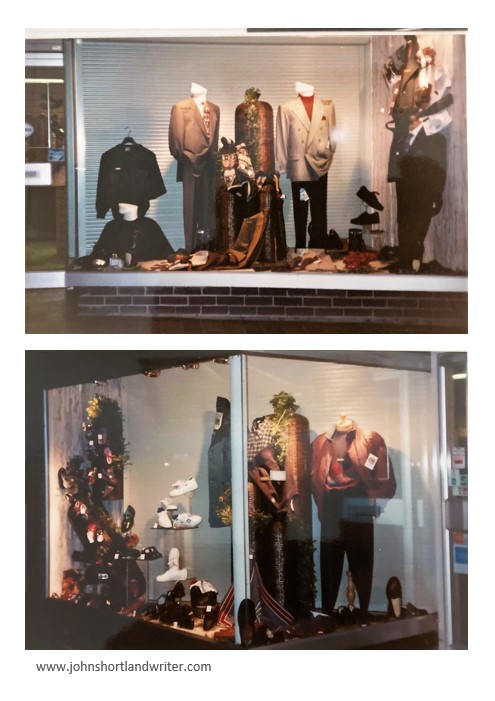
By the 1990s the displays were brighter and (to use 2020s speak) more ‘on trend’

I suppose it was because the shop was ‘always there’ that we have no photographs of the shop interior through the decades which is rather sad.  Fortunately, I did take a few in the early 1990s and these will probably trigger some memories for local people.  The 1990s brought new challenges for the business with recession and changing shopping habits sounding the death knell for businesses like ours.  I had joined the firm in 1971 and my business partner, John Pheby had begun even earlier, as a lad, working for the family.  It was a hard but inevitable decision that we decided to close and were fortunate to find a buyer almost immediately.  They converted the property to three shops and the accommodation and stockrooms above to flats.  Since that time Bourne End has changed quite considerably and most of the old shop names (and several of the buildings too) have disappeared.   I believe that there must be photos of the interior held by local people somewhere – it would be wonderful to see them.  I seem to recall Jean Peasley taking photos during our last few days…

Menswear Department, 1990
a small section of the Ladies Fashions Department 1990

So, what happened to our employees?  In the early days of my tenure there was Ivy Taplin (Akela to us cubs of the late 50s!), Yvonne Ludgate, June Charlton (later to become June Billinghurst), Cissy Hyde, Mrs Faulkner, Liz Hill and Diana Spokes.  Later, Pauline Harvey, Marjorie Kane, Wendy Manley, David and Marian Bratter, Diane Douneen, Kath Bowdrey, Iris Halstead and Cissy Vickers. I’m afraid I can’t remember the names of them all but some of those listed will be familiar to Bourne End locals – please don’t be offended if I have left you out, you were all valued!  The younger generation I purposely have not named but they aren’t forgotten either – I still keep in touch with several of them thanks to social media.  It was thanks to a succession of great staff through the years that the business was so successful.  It seems appropriate to thank our loyal customers too – I can still picture many of them and the frequent kind comments that I still receive on social media shows that they haven’t forgotten Shortlands either which, after all this time, is rather humbling as well as very special.

Ladies Shoe Department display 1990

And what have I been doing the past thirty years?  Retailing had been a passion for my family for generations but I decided to follow another of the Shortland passions and forge a new and very different career – you’ll have to wait a short while for part two to find out what but the photo below may give a clue!


Part Two of this blog focussing on the last thirty years is now published and can be found by clicking on the link here

Mother’s Hero: Arthur Rainsford Mowlem

When I published my article on ‘The Man Who Never Was’, the story of Operation Mincemeat, a year ago, I hadn’t realised that a film was to be released in May 2022.  Perhaps, if I had I would have delayed the publication by a few months!  In it, I described the rather tenuous connection with my father’s cousin, HAL Fisher.  The interest and comments I received made me explore deception used as a weapon during World War II.  It was this that led me to learn about the use of plastic surgery to change people’s appearance for the purpose of espionage. 

Arthur Rainsford Mowlem 1902-1986

Although surgery to alter appearance has been carried out to a limited extent throughout history it was during the Second World War that it began to be developed in earnest.   A popular reason given for this was the desire to treat badly injured pilots who had survived their aircraft being shot down.  However, there was a far more secret purpose being carried out too – to assist the SOE (the UK’s Special Operations Executive) in their missions behind enemy lines.  In released official documents, the procedures – known euphemistically as ‘permanent make-up’ – are listed as casually as one might write a shopping list: ‘plastic operations to forehead’, ‘surgical operations to ears’, and so on.  Once war was over some of the recipients began to talk about their treatment which, although disapproved of by the Government, were not silenced.

“An excellent agent and a dependable officer” – before and after surgery

Arthur Rainsford Mowlem, born in New Zealand in 1902, came to England in the late ‘20s to further his development as a medic.  In 1936 he joined the practice of Sir Harold Gillies, also a New Zealander and described as ‘the father of modern plastic surgery’.  Here they worked alongside pioneering new methods of treatment.  It is unknown when or how Mowlem and other surgeons were enlisted to help the SOE and Mowlem never spoke of it during his lifetime.  However, in correspondence between him and the SOE he discusses the prospect of surgery to alter the appearance of a French agent.  How Mowlem felt about operating on these healthy men is unknown but an un-named surgeon tells of how the work now required of them “was a mockery of all that they had trained for”.

My mother, Rachel Oberzanek: 21st birthday portrait

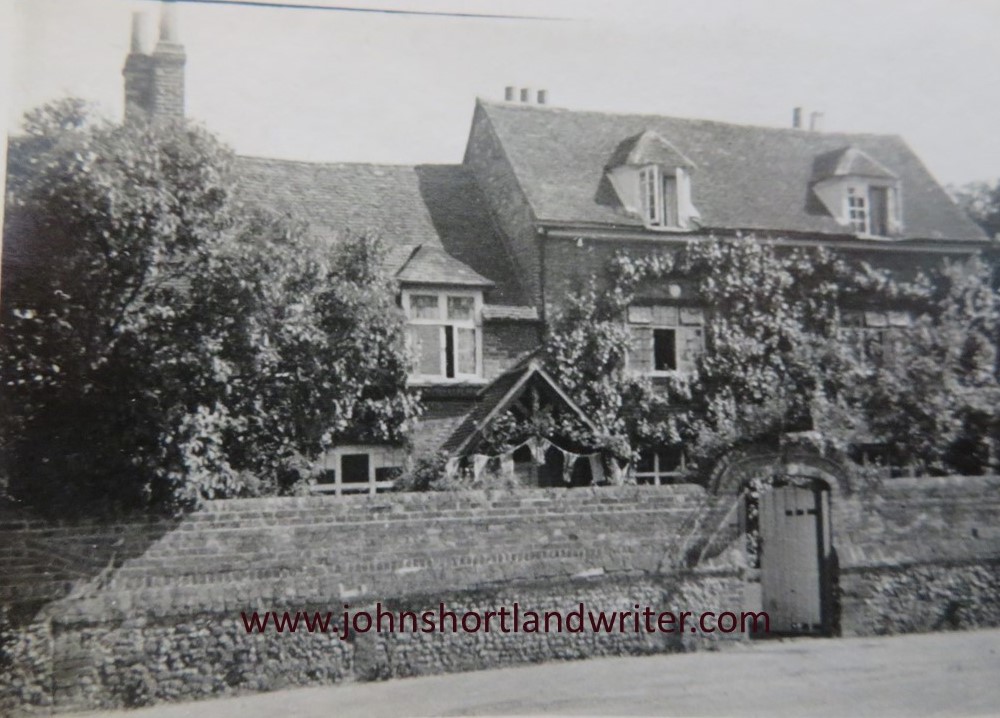
My mother’s career with Odeon Cinemas had progressed rapidly throughout the war and by 1944 she was heading the Licencing Department with a team of assistants.  Odeon had, by then, evacuated their offices from London to the small, riverside town of Marlow in Buckinghamshire.  She was accommodated in a lovely and old country house in the nearby village of Well End.  Living at the Old Malt House must have seemed a different world from the London’s West End where she had been brought up and she would tell of how she would lean out of her bedroom window to pick fruit from the grapevine that grew on the house walls.  With extensive grounds, a cook and a housekeeper and the use of a chauffeured car it must have been a life of relative luxury that she would have been unused to.  It was here that she also met her future husband – my father – so a very happy and untroubled time for her.  All that changed in an instance when, on the first day of December 1945 during the black-out, her car was involved in a head-on accident. 

The Old Malt House, Well End – grapevines cover the front of the building – c1943

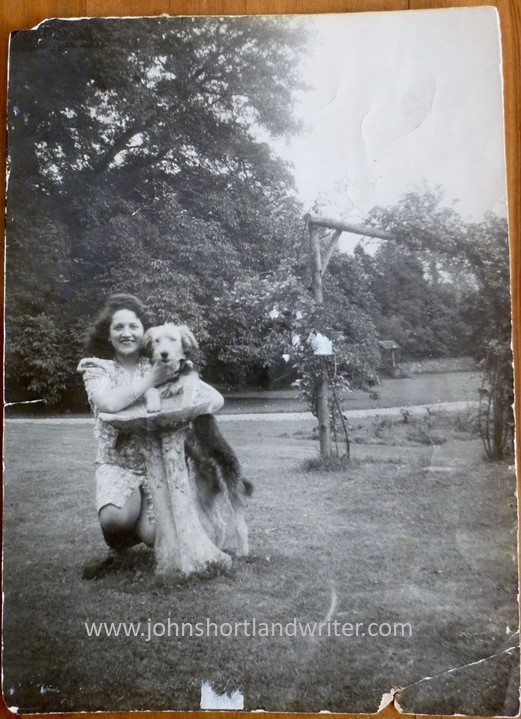
In those days of cars with no seat belts, my mother had taken the full force of the crash and had been catapulted through the windscreen.  Unconscious, she was taken by ambulance to Wycombe Hospital and with multiple facial and head injuries unexpected to survive the night. Fortunately, Odeon proved to be excellent and supportive employers, driving her parents down from London and accommodating them so that they were able to visit her regularly.  On Christmas Day she came out of the coma unaware of what had happened over the past month.  She would tell of how she had first heard singing and, opening her eyes, saw a blurred vision of people dressed in white that she though must be angels.  They were, of course, her nurses singing a carol!  Badly scarred and with broken nose and cheekbones she was finally released from hospital unable to work and embarrassed about being seen in public.  In her memoir, she described the first day she had to enter a crowded room and how it fell silent when she appeared, a humiliating and distressing moment. 

My mother, in the grounds of The Old Malt House, and looking so happy, just before the accident that changed her life – and her appearance

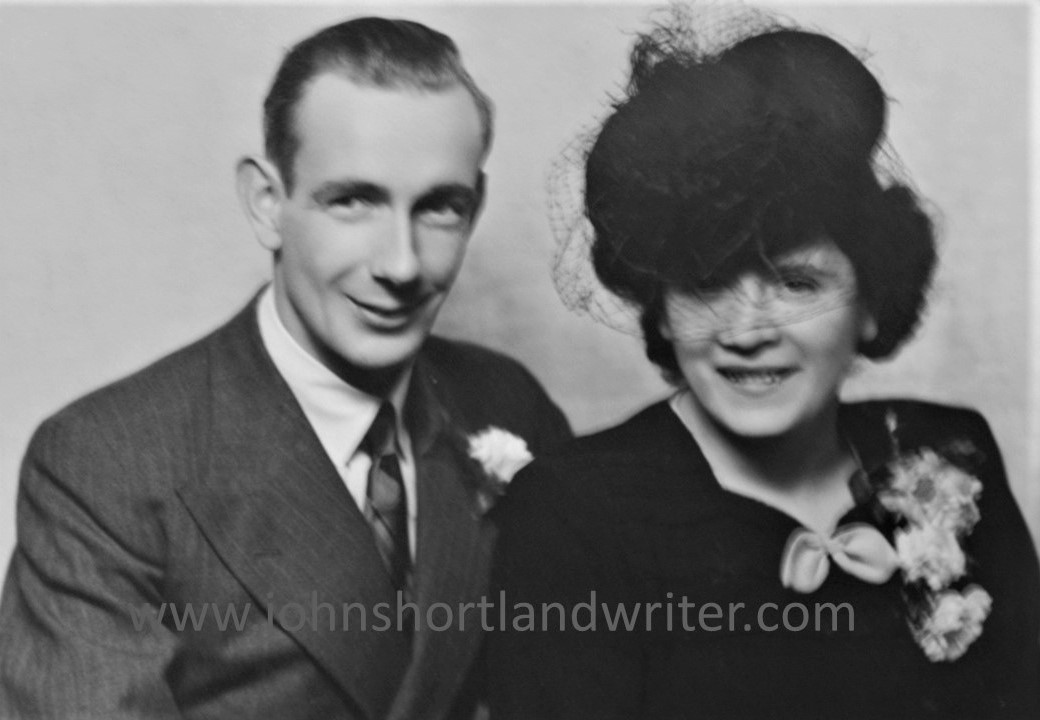
Six months after her accident, Odeon who had been caring for her as well as paying her salary all this time arranged for her to be taken to London to see a doctor at The London Clinic in Harley Street.  The doctor was surgeon Arthur Rainsford Mowlem; in mother’s words, “a charming man who promised me he would do all he could.”   There followed a series of operations over many weeks where he reconstructed the badly damaged side of her face, repaired the cheekbones, and rebuilt her badly broken nose using part of her hipbone.   Looking at her wedding photograph, taken such a short time after in the autumn of 1946, his skilful work is quite extraordinary although my mother kept the picture hidden away; all she could see was a face that didn’t quite belong to her.  Nowadays, I imagine, she would have received some sort of counselling but then it was just a case of ‘getting on with it’.

My parents on their wedding day – just weeks after her face had been reconstructed

Living well into her 90s, mother’s issues with discomfort in her neck and head waned over time only to be replaced by a later source of (bemused) irritation.  When visiting hospitals there would be a succession of doctors and nurses wanting to look at her facial surgery for none had seen such early reconstruction and to see how it had fared over seventy years.  She had been told that she was the first civilian to receive plastic surgery and for the remainder of her long life she was eternally grateful to Odeon Cinemas who had cared for her and paid for her treatment.  Most of all, she was grateful to Rainsford Mowlem, without whom she would have had a lifetime of disfigurement; to her he was, indeed a hero.

Mum on her 90th birthday – and seventy years after the facial reconstruction

To read the story of Operation Mincemeat and The Man Who Never Was click here

References:
Wikipedia   Arthur Rainsford Mowlem

Amin, Kavit   Rainsford Mowlem: An unsung father of reconstructive surgery

Bailey, Roderick.   Special Operations: a hidden chapter in the histories of facial surgery and human enhancement    (CC BY 4.0) 

EDIT: Today, 21st June, I was delighted to receive this lovely email in response to this blog post from The London Clinic where my mother received her revolutionary treatment 70 years ago. They are happy for me to share it with you – you may need to click on the image of the email to make the typeface clearer

Discovering the Five Senses in Lockdown

It sometimes takes a crisis to make us re-evaluate what is of importance in our lives and the present one of Coronavirus/Corvid-19 surely has to be the greatest that we will collectively face. Now, several weeks into lockdown we have all been developing new patterns to our daily regime, one of which may well be taking more exercise. Never before have we placed so much value on fresh air and being able to walk freely whether it be in our parks, gardens or open countryside.

Marlow watermark

                           Riverside path, Higginson Park, Marlow (before social distancing).                                 The river is the River Thames in Buckinghamshire

Living where I do in the Cotswolds surrounded by fields and with woodlands and the river close by it is relatively easy for me to enjoy the open space. For others able to take advantage of their enforced free time, it may involve a longer walk and I have certainly noticed an increase in the numbers of walkers and cyclists here in the valley. I have also noticed that for many of them one aspect of their lives hasn’t changed: as they walk their eyes are glued to the screen of their mobiles and headphones are clamped to their ears, seemingly unaware of their surroundings. It has made me think all the more of our five senses and how we use (or should use) each one of them when out exercising.

Nr Fingest copyright

Cycling in the Chiltern Hills

SIGHT For those of us blessed with the gift of vision, perhaps sight is the most important sense we use and perhaps the one we most take for granted.  Without it, it is still possible to enjoy one’s surroundings for the other senses become heightened but I doubt if anyone would deny the pleasure of seeing the beauty that surrounds us on our daily walks. Even within cities there is much nature to be enjoyed although I admit that sometimes it has to be sought with more vigour and awareness.

Viola watermark

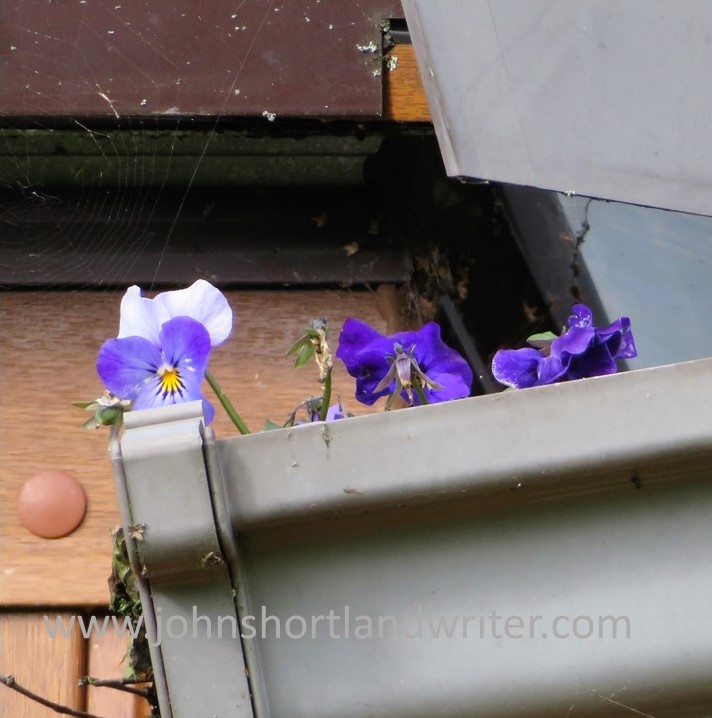
Look everywhere – self-sown violas peep out from overhead guttering!

At this time of year, more than any other season, there is much to see. Tight leaf buds unfurl into an explosion of vivid green foliage, iridescent wherever sunlight filters through; young ducklings tumbling into the park pond to take their first swim. But it isn’t just the natural world to be seen anew, there are other things too. Although it had been there for more than a hundred and forty years (and I’d walked past it very day for twenty) the date scratched into the stone on this wall had gone unnoticed.

Date stone watermark

Who scratched this date into the old stone wall and why?

HEARING Along with sight the second most important sense we use on our daily amble. Apart from the glory of birdsong there are other sounds that bombard us when out walking. The wind flurry that makes the catkins tremble and shed their pollen, the stronger breeze that make the twigs and branches clatter gently against one another. Then there’s the rustle in the undergrowth. Stop and wait silently and with patience you may be rewarded by the sight of a little field mouse going about its daily chores or a rabbit venturing out to feed.

Field Mouse watermark

patience was rewarded when this little field mouse ventured into the open

Altamont Gardens (8) watermark

… and also this rabbit

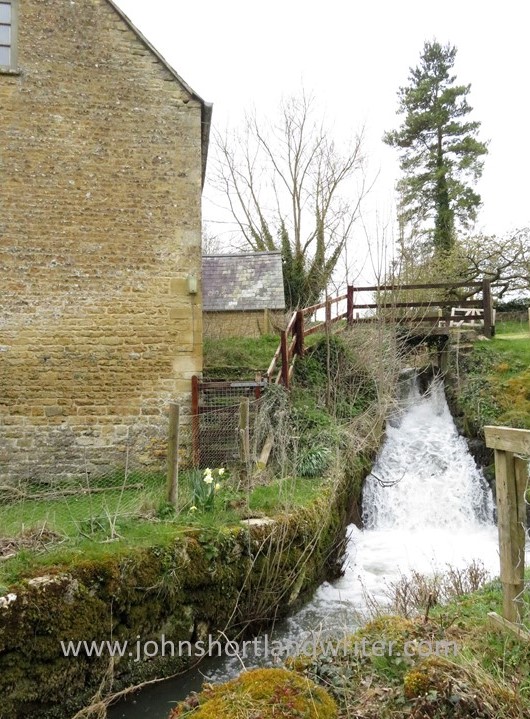
The sound of the river alters constantly. The smooth, barely audible glide of the water changes to a tinkling of soft musical sounds, its flow interrupted by a fallen branch. A few yards further downstream they rise to a crescendo as they crash and tumble over the old millrace before returning to silence as the flow stills in the calm of the millpond.

Radford Mill (1) watermark

The old millrace 

Radford Mill watermark

the calm of the millpond

TOUCH   In the present crisis we are sensibly being discouraged from touching things unnecessarily. Out on walks perhaps care may be advisable when opening gates or climbing stiles but, if you do, take a moment to think about what you feel. Heed the cold steel of the metal five-bar gate and the way it slowly warms beneath your hand; feel the rough timbers of a stile worn smooth from much use over the years. Of less concern health-wise – and all the more pleasurable for that – become aware of the softness of new horse chestnut leaves; later in the year they will become as harsh as sandpaper. Run your fingers across the twisted, grooved bark of the sweet chestnut tree and stroke the furry softness of the aptly named ‘Lamb’s Ears’, the favourite garden herbaceous plant Stachys byzantina.

Sweet Chestnut 4 watermark

The deeply grooved bark of the Sweet Chestnut tree

Stachys byzantina  Lamb’s Ears

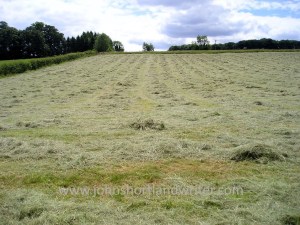
SMELL   The scent of spring is everywhere at the moment and to be delighted in. However, the sense of smell is also a powerful trigger of long-forgotten memories. In a few weeks’ time the sweet scent of drying hay in the meadows may recall childhood farm holidays but for now there is the unique smell of new-mown lawns. Both start off as freshly cut grass yet their scent is so surprisingly different. Likewise, compare the subtly differing fragrance of apple and cherry blossom, both in their full-blown glory right now.

Drying hay before baling

The smell of freshly-mown grass…

Without even leaving home, squeeze the leaves of the herbs on the kitchen sill and notice their variation in scent, their colours and textures too. Early morn in the woodland, especially after warm rain, the delicate perfume of bluebells quickly disappears as the sun becomes stronger. Half-close your eyes and glory in their colour, in the silence and in their perfume and leave all cares behind you – if only for a while.

discover the different textures & scents of herbs

The vivid greens & blues of an English beechwood in spring

In town, the scents are also there just waiting to be noticed. Rain falling on roads and pavements or scorched by hot sun both produce delightfully tarry smells, one mild, the other strong. In the formal beds of the local park flowering bulbs stand in regimental rows; each have a unique scent which rises in the air to mingle with the vanilla fragrance of wallflowers. The wallflowers, their dull green foliage barely noticeable throughout the winter, now shout out the arrival of spring through the colours of their flowers of brick red, orange and yellow.

Tulips & wallflowers – a favourite park bedding combination

TASTE   In shaded places where the soil stays moist you may be greeted – even before you arrive – by the pungent scent of wild garlic. A prolific carpeter of the woodland floor its leaves and flowers make a useful ingredient to spring salads. Wild garlic or Ramsons to give it it’s country name, is fickle where it will grow. In some places that would seem suitable, not a single plant can be found. A less common member of the onion family to be found in the wild are the chives of our gardens, they grow along road edges and field boundaries locally. It is thought that they were spread by the old drovers of centuries ago so that they could harvest them along the way to liven up a bland meal. There is no doubting its identification, disturb the tubular green leaves and the familiar scent is immediately released.

Ramsons grow in damp, shaded places

It is not only the onion family that can be nibbled en route. Richard Mabey in his book Food for Free, published many years before foraging became a ‘craze’, suggests nibbling on the half-open buds of hawthorn. Many a country child has done so over countless generations and perhaps that is how they got their old name of Bread and Cheese. To me, they only have a slightly nutty taste and texture.

Hawthorn leaf buds are not really worth eating!

As a boy, brought up close to the River Thames, the hollow stems of the common reed were a regular source of pleasure for the soft pithy centre could be drawn out by pulling the stems through clenched teeth. Close to my present home there is also a small reedbed. These tall reeds have something to offer every one of the other senses too: sight – the pleasure of watching petrol-blue damsel-flies sunbathing on the stems; hearing – as they sway and rustle with the slightest breeze; touch – the coarseness of the leaves, a contrast to their smooth stems; smell – those of the river as it seeps around the roots, a heady mix of wet mud and wet greenery.

Only the male of the Beautiful Demoiselle damsel-fly has petrol-blue wings & body

So, within the bounds and restraints of the Covid-19 advice when out on your daily exercise, remove the earphones, place the phone in your pocket and use, really use, every one of your senses. Not only will you notice more, you will wonder how you never managed to notice them before. Stay safe, stay alert and take this unique opportunity to discover a new world on your doorstep.

Finally, one word of warning. Only try tasting wild plants if you are confident they have been identified correctly. If you decide to forage, do so responsibly and only pick a few leaves at a time. Make sure that all plants for consumption are free of pesticides and other contaminants, especially those growing in or near water.