Hide That Ugly Wall

We nearly all have one – or, at least, if we haven’t, we have an unwanted view that needs disguising.  Now is the perfect time to deal with it for, if you decide to plant some screening, the soil is moist and still retains some stored summer warmth.  Wait until spring – which you can do – and you run the risk of summer drought and the need for more careful and regular watering.  In the perfect conditions of late autumn/early winter the plant’s roots begin to establish even if you’re unaware of anything happening above ground.

However difficult the position, there is almost always a way to enhance an ugly wall

There are several questions to ask before rushing to the garden centre.  The first is to decide which way the wall faces for the amount of sunlight hitting it will influence the choice of plant – more about that later.  Other factors to consider are will the plants need to be tied into place with strings and wire, and will they need regular maintenance to keep them looking nice and within bounds?  If you’re already beginning to think this sounds like too much hard work or is too complicated, don’t despair – there’s a list of planting options below.  Still baulking at the thought?  An alternative question is, would some sort of decorative screen do the job instead?

A decorative screen masks this unwanted view

One more option to consider is planting in front of the wall, rather than against it.  If there’s room a low maintenance shrub border might be possible.  If space is really tight, then one or two well-chosen plants may work just as well.  For example, trees trained to grow flat against a wall are readily available and can make a statement without hiding the wall completely. Some shrubs will also do this; they are a much cheaper option and usually grow quite rapidly.  In the photo below forsythia, an unusual choice, has been grown against an ugly garage constructed from concrete blocks.  Although it loses its leaves in the winter its dense network of twigs continues to disguise the wall.  For a few weeks in the spring, it looks both exotic and stunning.

Flowering forsythia suddenly looks exotic grown against this ugly garage wall
The Judas Tree (Cercis) flowers on bare wood, its leaves will appear shortly. It has been fan-trained to remain flat against the wall
If space allows, a low maintenance shrub border can work well

For most people, the decision made is to grow a plant that will climb as well as cover the wall.  The plants available can be broken down into two groups – the true climbers (that will need wires on the wall for support), or the ‘clingers’.  These attach themselves to the wall by little sucker-like pads or by hair-like roots.  With the latter it is essential that the wall is in good condition although it is rare for serious damage to happen.  Both types can be sub-divided into deciduous (lose their leaves in winter) or evergreen.  I have found that the majority of clingers benefit from having some wall ties when first establishing to keep them in close contact to the wall.  Once they start climbing they’ll cling without help.

The climbing hydrangea clings to the wall by tiny hair-like roots
Honeysuckle is an example of a climber that needs wires to support it

One option often recommended, is to fix trellis to a wall and it does sound like a quick fix.  My experience is that the plants weave through it – which is, of course, the idea – but that makes for difficult pruning when it is required for it can be tricky to work out which stems need removing and even trickier to disentangle them.  Worse still, trellis has a tendency to rot or break after some years, usually just when the climber has reached its prime.  Replacing it involves cutting the plant back very hard or replacing it along with the trellis.  However, decorative trellis may be an alternative form of wall disguise to consider with, perhaps, just a large pot of plants standing in front of it.

Trellis helps mask this unwanted view. By creating a focal point of the attractive tree, the trellis becomes a feature in its own right and so no plants are being grown on it

Wires are normally very straight forward to fit providing it is done before planting.  I prefer to use a screw-in ‘eye’ rather than the hammer-in ‘vine eyes’ that are the traditional method of fixing.  All that is needed is a drill and a rawlplug and some very basic handyman skills.  The wires should be fitted horizontally and there is no need to create a network of wires heading off in all directions.  The golden rule is to stretch the wire taut and make the plant grow to the wire, don’t add random wires that follow the growth.  Stems should always be tied to the wire rather than pushed behind it and use ties that will stretch or perish in time otherwise they will become strangled as they grow.  It is all much easier in practice – writing down every step makes it sound more difficult than it really is!

A well-trained rose growing on supporting wires. I have enhanced these for clarity they want to be stretched horizontally and spaced about 18″ (45cms) apart
This poor plant has been strangled by its tie; all the upper growth has died

When it comes to planting, whatever the type of plant it is, make a generous planting hole and mix a good quality compost in with the soil.  Often the ground by a wall is dry and full of builder’s rubble or compacted so having a good planting medium around the new plant will set it off on a good start.  At planting, keep the base of the plant at least a foot (30cms) away from the wall if there’s room.  That way it will receive more water when it rains.  One major cause of failure is planting too deep – make sure that the soil is at the same level as the top of the compost that the plant is growing in.  Standing the plant pot in water for a few hours before planting is a good idea too so that the plant is well-watered before it is disturbed – and, if you’re a real beginner to gardening, don’t forget to remove the plant from its pot keeping its soil intact around it.

Solanum crispum (blue) & Clematis montana (white) hiding a garden shed

A list of plant suggestions:
E=evergreen, CL=clinger, N=will cope with north facing wall, Sh=shrub, T=tree

Large walls:
Carpinus (Hornbeam) – N, T, buy pleached or ready shaped
Cercis- T, more tricky to find and you may have to train it yourself but lovely flowers in pink or white and good autumn leaf colour – see photo
Clematis montana – clip back the growth immediately after flowering to keep tidy and within bounds
Ficus (Fig) – N (but won’t fruit), if you like Figs to eat, Ficus is worth considering
Fremontodendron – E, Sh, colourful yellow saucer-like blooms
Garrya – N, Sh, dark green leaves with long green catkins in late winter
Hedera (Ivy) – Cl, E, N, easy to keep under control and provides late nectar sauce for bees and other insects.  Make sure that wall mortar is sound before planting
Hydrangea petiolaris – Cl, Sh, prune after flowering if necessary
Jasminum (Jasmine) – both evergreen and deciduous types are available with scented flowers.  The evergreen (sold as Trachelospermum) needs a warm wall for best results
Magnolia grandiflora – E,Sh, for a high, warm wall.  They need lots of space to thrive
Parthenocissus (Virginia Creeper) – Cl, magnificent autumn color
Prunus lusitanica (Portuguese Laurel) – E, Sh, T, can be grown as a shrub or purchased as a trained tree (see photo)
Solanum crispum – blue or white clusters of flowers.  Vigorous but easily pruned
Vines – prune in winter if necessary
Wisteria – prune twice yearly, midsummer and midwinter

Medium walls:
Actinidia kolomikta – Sh, pretty multi-cloloured leaves best when avoiding strong sunshine
Azara – E, Sh, for a warm wall
Berberis – E, N, Sh, very spiny branches are a good reason for not growing it!  Magnificent red or yellow berries in autumn, much loved by birds
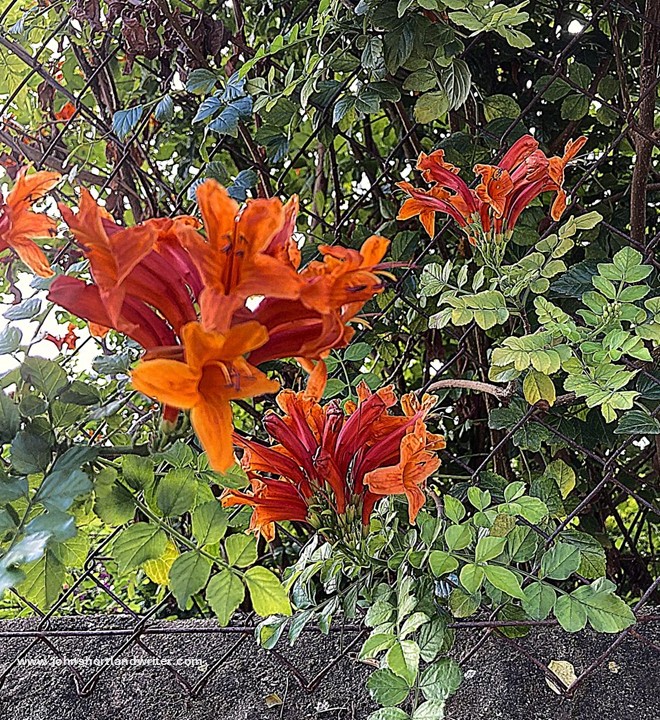
Campsis (Trumpet Vine) – orange trumpet flowers and attractive leaves for a sunny wall
Ceonothus – E, Sh,  smothered in powder-blue flowers during summer
Chaenomoles – E, Sh, white or pink flowers in late winter/early spring
Clematis – plenty of varieties to choose from including evergreen ones – check labels for size as some can require a lot of space
Forsythia – Sh, prune after flowering which takes place in early spring – see photo
Jasminum nudiflorum (Winter Jasmine) – N, Sh, flowers throughout winter
Osmanthus – E, Sh, early-flowering, scented – clip immediately after flowering ends to keep flat against wall
Rhamnus ‘Argenteovariegata’ – E, Sh, variegated foliage, prune to keep flat against wall in spring

Low Walls:
Daphne – E, Sh, very scented flowers but very slow growing
Euonymus – E, N, Sh, Cl, can be grown a sa shrub or clipped flat against a wall, some are self-clinging
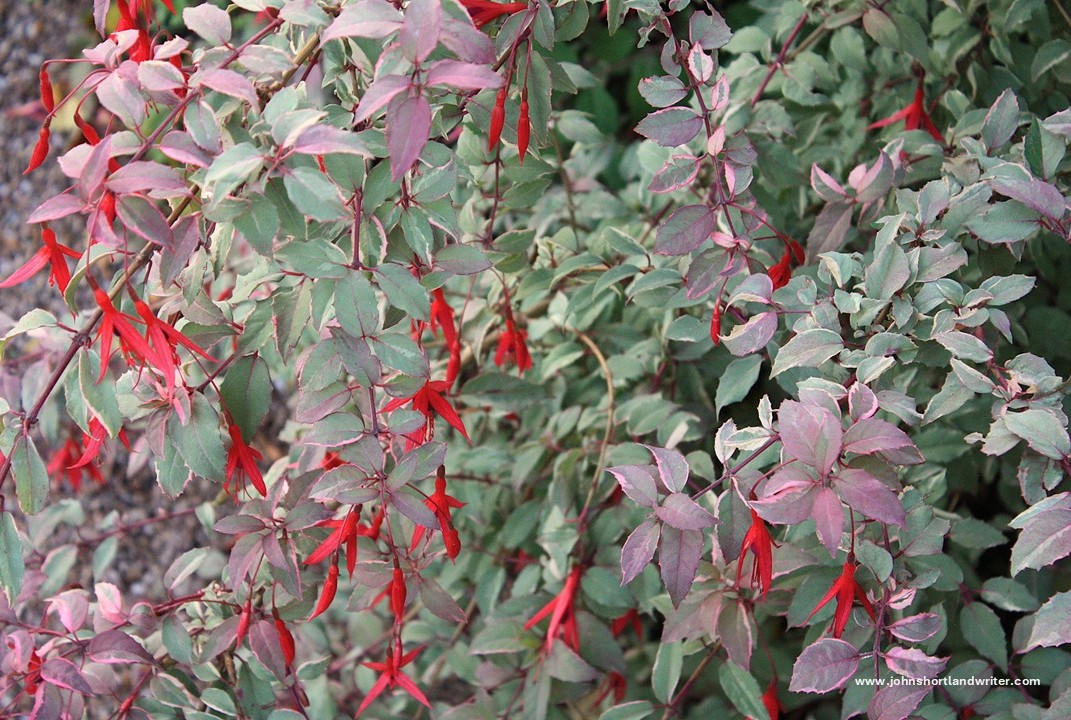
Fuschia – Sh, varying heights, the smaller-flowered varieties are more suited for growing against walls
Helianthemum – E,Sh, very low growing but smothered in flowers through summer, clip after flowers to keep tidy
Lavender – E, Sh,likes sunshine for best flowering
Nandina – E, N, Sh – trouble-free, needs no  pruning
Perovskia (Russian Sage) – Sh, silvery foliage and blue spires of flowers from mid-summer.  I’ve grown it successfully on a shady wall although not usually recommend for this.  Prune back by half in late autumn and then again in early spring to keep bushy
Potentilla – E, Sh, bushy long-flowering plants in varying colours

I recommend looking up these plants on Google to see more detail.  Also, there are many roses that can be considered including some that are fine for north walls.  Apples, pears and plums fruit well when grown against walls of any aspect, as do apricots and peaches if the wall is warm and sunny enough.

For similar information on how to make both your garden and gardening more pleasurable, why not take a look at my book Why Can’t My Garden Look Like That? It’s written for newbie gardeners as well as those with more experience and covers everything from design to planting and maintenance.  In it, I reveal some of the secrets that I used when Head Gardener to large, country estates with gardens open to the public, where the garden had to look great all the time.  All written in an informal, no-nonsense approach.  Makes a great gift and is available from bookshops and, of course, Amazon.


The Chelsea Chop

Despite its name, the Chelsea Chop isn’t the latest trend in hair styling although trimming the unruly and the straggly certainly is involved. It is a very simple and straightforward method of cutting back herbaceous* plants which, for some reason, terrifies even the most confident of gardeners.

Sedums (foreground) growing at Lytes Cary Manor

The only skills required are courage and the knowledge of exactly when to carry out the chop. The latter is simple to calculate and is hinted at by the title of the deed – the week of the Chelsea Flower Show or thereabouts. This year, there have been two hiccups in using this rule: firstly, the show has been moved to autumn because of Covid restrictions and secondly, because spring has been so slow in coming that plants are behind with their growth. As a general rule of thumb, the time for cutting is around the third week of May.

The flat flowerheads of sedum are made up of hundreds of tiny star-like florets

Beloved by bees and butterflies, Sedum – also known as Ice Plants on account of their fleshy, cool-to-the-touch leaves – are the ideal candidate for the chop and one of the most satisfying to do. Inevitably, when left to their own devices, the large, flat flowerheads are too weighty for their stems and they topple over to sprawl across the ground and spoiling an otherwise impressive display.

Sedum, the Ice Plant, frequently collapses & looks ugly just as it flowers

To make the chop all that has to be done is to cut through every growing stem, thereby reducing the plant’s overall height by half to one-third. Clear away the prunings (which can be added to the compost heap) so as not to attract slugs. There, I told you it was simple!

Sedum given the chop. Don’t forget to pick up all the prunings!

Although the method sounds and looks drastic the plants quickly recover and make new growth. The end result will be a plant that doesn’t collapse and doesn’t require staking. Admittedly, the flowerheads will be smaller than before but they produce so many more than they would have done left unpruned that the effect is in no way diminished.

Numerous flowerheads appearing on the now tight growth of Sedum two months after the Chelsea Chop

This simple pruning technique can be used on a number of other plants too in exactly the same way. The taller achillea, phlox, campanula, asters (michaelmas daisies) and rudbeckias are all good candidates. I have heard of its use on echinacea (cone flower), penstemon and helenium but, in my experience, these are trouble-free plants anyway, so why bother? The secret to good, stress-free gardening practice is to find the balance of what suits you and what suits the plant. The Chelsea Chop on sedum in May prevents an awful lot of stress later in the year!

top left – clockwise: achillea, campanula, aster, rudbeckia. They can all be given the Chelsea Chop

*herbaceous – a non-woody plant that dies back and becomes dormant in winter to regrow each spring

Going Round in Circles

Designing your own garden is, I think, far trickier than designing someone else’s. One of the problems is that emotion gets in the way. I’m not suggesting that there shouldn’t be passion in design but far too often one is tempted to hang onto things that have no place in the new design, whether it is a plant or a pot – or in this example, far too many pots!Garden Makeover 3a copyright

The garden shown here was quite a good size but difficult for it was on a gentle slope and there was need for a central path to lead to sheds at the far, and lower, end. To avoid splitting the garden in half, large circular stepping stones had been randomly placed but the result was a confusing mish-mash of shapes and plants. The only place the eye focused on was the rotary washing line!Garden Makeover 1c copyright

You don’t need to be a great artist to design a garden. A simple method is to take photographs, turn them into black and white (for colour confuses the eye) and pencil sketch over them. Here, we were quite keen to improve on the circular theme.
The final result was a series of circles, each with a low retaining wall and a step down to allow for the change in level. Trellis was used to screen the sheds. Although the hard landscaping took up more of the garden than before, the remaining planting area was far more useful and could be crammed with plants. The little walls made perfect low seats.Garden Makeover 2c copyrightGarden Makeover 1b copyright

And what happened to all the pots? Most of these were discarded in favour of a large, custom-made, L-shaped timber box. This gave a better space for planting as well as making a feature in its own right. Water-retaining gel crystals were added to the planting soil reducing the need for regular watering.Garden Makeover 3d copyright

You can find more ideas on all aspects of easy, trouble-free design, plants and gardening techniques in my book, Why Can’t My Garden Look Like That?  To take a peek inside the covers click on the link here.

BOOK COVER

We Built a Pond – you can too!

Winter is an ideal time to create a pond and with it fast approaching now is the time to start planning.  Quite probably you have an idea where you want to place it but do think about its position carefully.  Falling leaves from trees is an obvious issue but some others aren’t until it is too late. Water always collects at the given lowest point; a pond perched on top of a mound will look ridiculous so check where the lowest point in your garden is and create the pond there, remodelling other sections of the garden, if need be, to tie in. bulrush-copyright

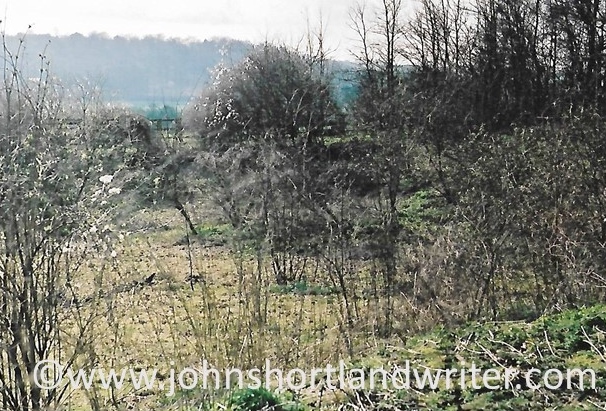
With our proposed pond site, we already had a large depression where garden rubbish and junk had been thrown for years.  Now overgrown with scrub, it needed careful clearing, including roots that may have punctured the lining.  If space is tight, the pond should have a planting shelf set several inches below water level, around at least one third of its edge; if space permits a graduated slope to the pond encourages plants to spread more naturally and, to my mind, is preferable.pond-build-1-copyright

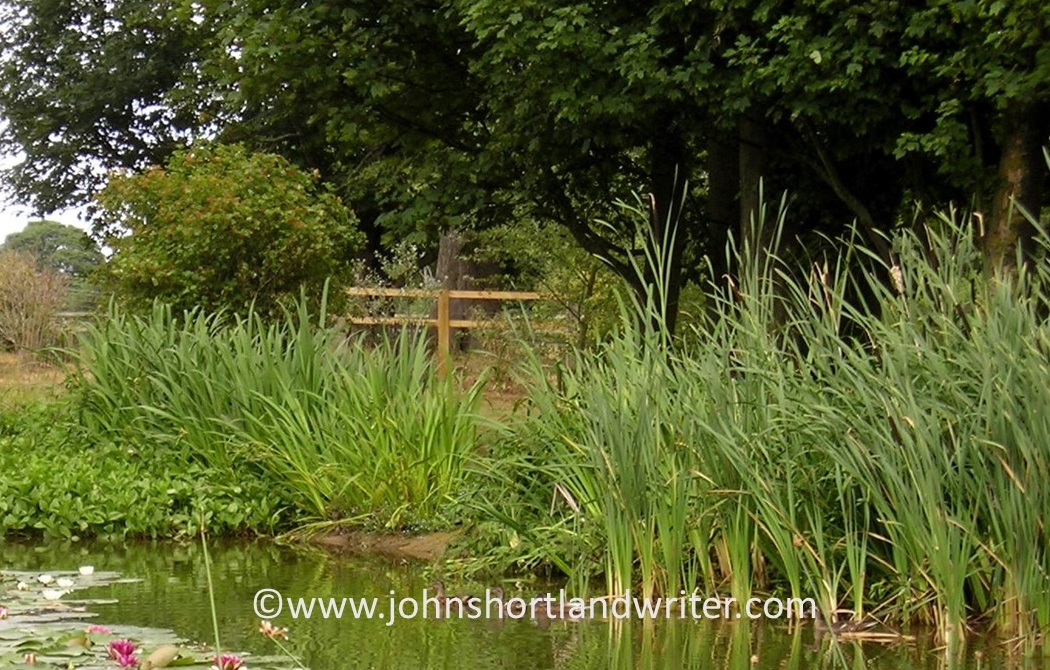
If access allows, it is sensible to hire a digger to create the pond for even a small one involves a lot of digging and moving of soil.  In the past, the mound was often left behind with a few rocks, or even worse, bits of broken concrete, to create a rockery.  This very rarely works well and it looks far better to have lawn leading down to the pond with possibly shrubs or other plants surrounding it.  Whatever the choice, it is important to have a seamless transition from water to garden.  Iris work well for this as there are varieties that will grow in shallow water and on the moist soil surrounding it; some reeds, too, will colonise the bank giving the pond that natural look.pond-build-3-copyright

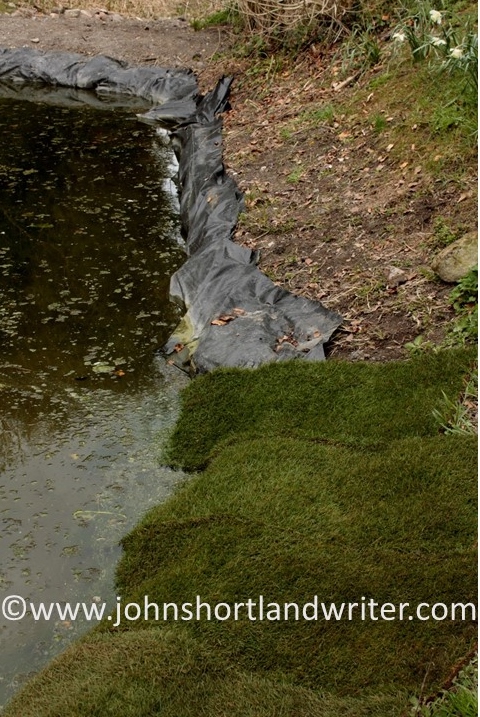
When using a lining it is important to allow a decent overhang onto dry land.  In this photo, the lining has been cut a little on the tight side – the weight of the water pulled the liner down into position; it is better to trim the liner after the pond has filled.  Once that has been done the liner can be disguised by laying turf down the sides to just below water level.  Once grown, it creates a beautifully natural appearance to the pool.pond-lining-2-copyright

pond-build-4-copyright

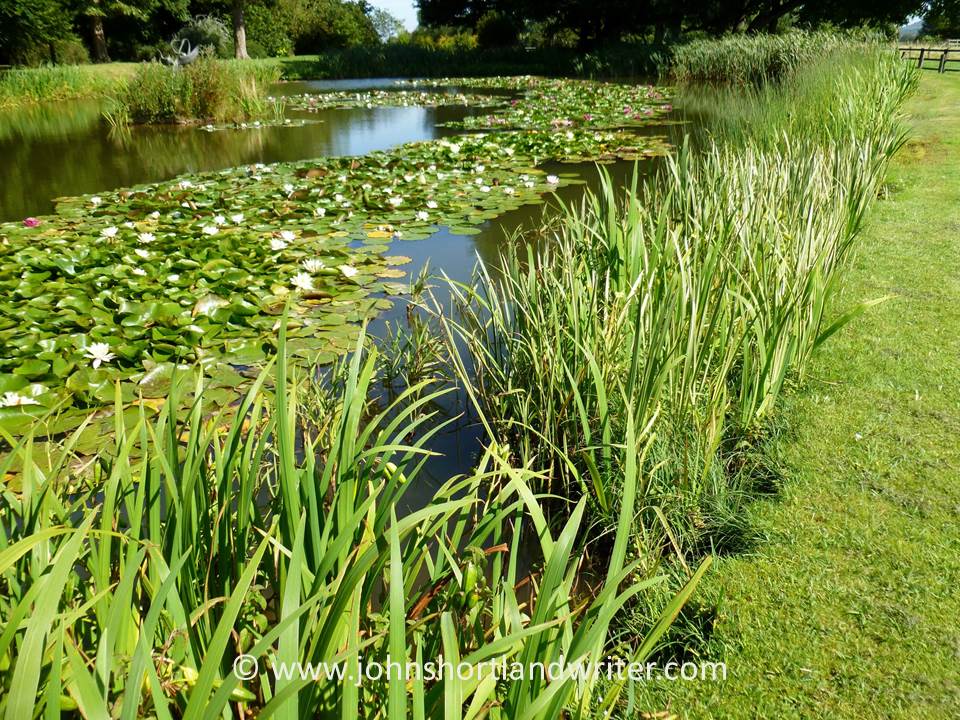
In the spring, aquatic plants can be planted.  Oxygenating plants grow below water level and apart from being essential, make good cover for fish and insects from predators.  Marginal plants grow in shallow water and are used for lining the edges of the pool.  A thick planting of these are a good safety measure if small children are likely to visit, although they should never be allowed to do so unsupervised.  Water lilies grow in different depths of water so do make sure that the variety you choose is suitable for the depth of the pond. pond-5-copyright


Ponds, however large, never need to be exceptionally deep, rarely more than a metre and can be as little as 50cms.  Smaller ponds benefit from a deeper ‘hole’ so that fish can take shelter from the coldest weather.  It is worth remembering that the larger the pond the easier it is to maintain and keep healthy.  Finally, once the plants have established, fish can be added.  For a wildlife pond, ornamental goldfish should be avoided although some of our smaller native fish can be included.

koi-copyright

Koi Carp are best kept by enthusiasts!


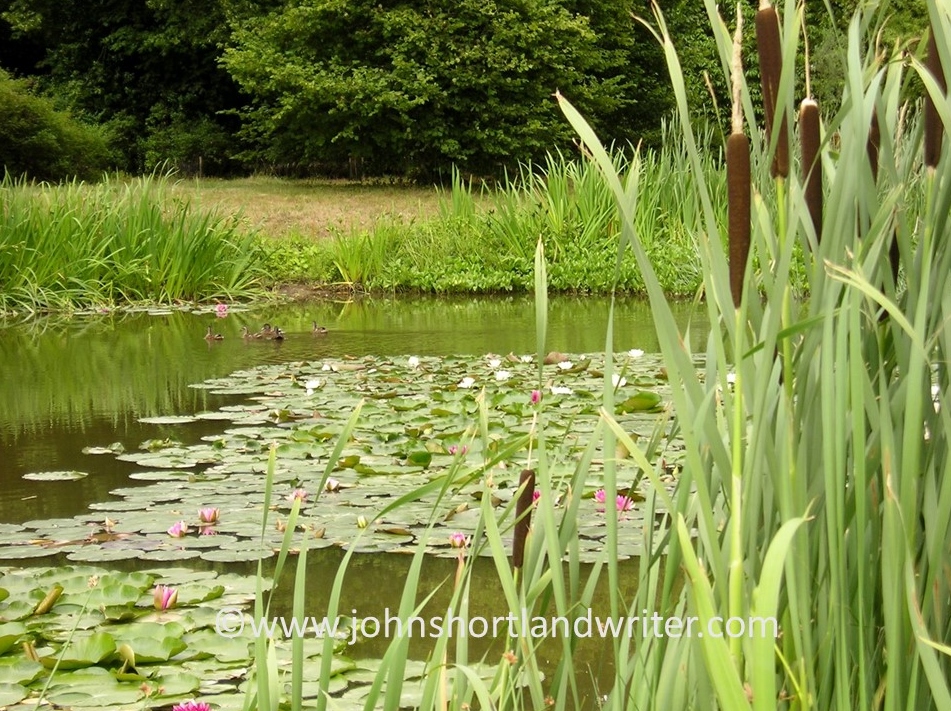
It is always a surprise at how quickly new plantings grow in a garden and the pond is no exception.  The scars of our pond had healed within months and even after just a couple of years ponds can look as if they have been there for ever.  Now twenty years later, visitors to our garden find it hard to believe that the pond isn’t natural; it abounds with wildlife and there isn’t an inch of black butyl liner to be seen.pond-2-copyright

The pond featured here was built in the large garden of the house that I claim to be my birthright (joke).  Correspondingly, the pond also had to be large but the principles of pond design and placement are the same whatever their size.

To read about the bizarre coincidences that cause me to ‘claim’ the house click on these links:

The House My Parents Built – 200 Years Ago

Reincarnation – or just Coincidence?