In Praise of Bluebells

Can there be a more delightful spot to linger than a bluebell wood in spring?  The intensity of their colour when seen growing in their tens of thousands would hurt the eyes if not offset by the citrus green of the beech trees they favour growing under.  With early morning sunlight filtering through the branches to strike the woodland floor below, both leaves of beech and ‘bell shimmer and sparkle in the clear light.  As the forest warms the bluebells release their scent but not the heavy, redolent perfume that one might expect. Instead, a fragrance so soft and gentle that for a moment it seems to come from elsewhere; all too quickly it melts away, dispersed by the increasing heat.

Bluebells are one of the key indicator plants of ancient woodland, a term that refers to woodland that pre-dates AD1600, for their bulbs prefer to remain undisturbed where they can slowly establish huge colonies.   Here, in the secret valley where they grow in hedge banks, they can be used to trace the line of an equally ancient drove road for it is thought that the hedgerows and trees that line it are remnants of Wychwood Forest.  Over centuries, the boundaries of the Forest have shrunk as fields were created and the trees cleared for arable land or pasture.  By leaving the field edges untouched the early farmers saved themselves both time and labour and in doing so preserved the bluebells that give me so much pleasure each spring.  The drove road – primarily used for herding livestock long distances to market – passes our little stone-built cottage before diverting across open country.  It is still used as a public right of way.

Bluebells line the old drove road that passes my house

Unsurprisingly for a plant that has been around from time immemorial, the bluebell has numerous regional names – Common Bluebell, English Bluebell, Fairy Bell, Wild Hyacinth to name a few.  Perhaps the best has to be Granfer Giggles.  In Scotland they are known as harebells although to an Englishman harebell would be a completely different plant that grows later in the summer when the bluebells have long ended.  Even the Latin name which is supposed to prevent confusion has changed over time – it is now known as Hyacinthoides non-scripta.  I much prefer the earlier name of Endymion non-sciptus, it sounds more attractive as well as having a romantic Greek legend attached to it.  Illegal to dig up plants from the wild, bluebells are sometimes offered for sale from cultivated stock under either of these names.

Occasionally you may find a white, or even a pink bluebell

For such a well-loved plant – it has been voted England’s unofficial national flower – bluebells do not seem to feature much in poetry.  They are frequently mentioned by name but no-one, as far as I can tell, seems to have written poems specifically about the plant.  Perhaps it is because they are such a common sight and have none of the delicacy of the wild rose, the scent of the honeysuckle or the diminuity of wild thyme. Shakespeare, who seems to have written about absolutely everything (including thyme), only mentions it once: “the azur’d harebell” in Cymbeline.  The Brontë sisters both wrote of bluebells but I’m not sure they weren’t describing later flowering harebells. Emily’s description “waves in summer air”, and Ann talks of a single flower and of its trembling.  Bluebells are quite a stiff flower that don’t wave or tremble that readily whereas Campanula harebells fit the description nicely. I can’t recall even my beloved Richard Jefferies, the Victorian naturalist, waxing lyrical over them as he did over so many other things.  I may be wrong about this for I can hardly call myself a Jefferies’ scholar, more an enthusiast. However, Cicely Mary Baker created a delightful illustration of the flower in her set of Flower Fairies published in 1923 where she describes the bluebell as the king of flowers.

The less-common Harebell – Campanula rotundifolia
It flowers later in the summer and in more open places

It is to the Georgians that I have turned to illustrate our love of bluebells for I have found frequent references to them in old newspapers and periodicals not just in published poetry but also in their fashions.  This description of the sumptuous gown worn by the Princess of Wales when attending the King’s Birthday in 1795 is worth reproducing here: “A gown of superb, embroidered crepe imitating the rays of the sun and intertwined with embroidered white lilies.  Over which a cape of Venetian net embroidered with laurels and Diana’s (presumably the Goddess) crescent”.  Finally, there was another over-cape “embroidered with bluebells (yes!) and held in place by rich cords and tassels”.  As if this wasn’t splendid enough there was “a long train of silver gauze bordered in purple and silver”.  Having spent twenty years in the world of fashion (before I switched careers to horticulture) this has sent me into overdrive!  Sadly, I haven’t found any illustrations for this ensemble but I do have photos of the ‘draft’ for equally exquisite embroidery designed by Norman Hartnell for a robe for Queen Elizabeth II.

Embroidery design by Norman Hartnell for Queen Elizabeth II

Even earlier, in 1786, Mrs Charlotte Smith was publishing her sonnets.  A remarkable woman for the age, she left an unhappy and violent marriage and campaigned for women’s rights and the abolition of slavery.  She wrote fiction and poetry to financially support herself and her children.  This sonnet reminds me so much of my youth where I roamed the bluebell beechwoods of the Chiltern Hills, for which they are renowned.

“Ah, Hills belov’d!  where once a happy child,
Your beechen shades, your turf, your flowers among,
I wove your bluebells into garlands wild,
And woke your echoes with my artless song.
Ah! Hills, belov’d! your turf, your flowers remain;
But can they peace to this fad’ breast restore?
For one poor moment soothe the sense of pain,
And teach a breaking heart to throb no more?

I’m glad to say that my heart is no longer breaking so perhaps the bluebells worked their magic!

A very old photo (hence the strange colour!) of me and my two deerhounds in a Chilterns beechwood at bluebell time

.
.
.

Voyage of Discovery – part 2

The Ex-Empress Eugenie (Bonaparte) was so concerned about the men keeping their heads warm that she had made for the sailors of the British Arctic Expedition of 1875 “special woollen wigs” to wear.  Nellie, the ship’s Labrador Retriever, would have preferred the same concern for her welfare.  It was only when Captain Nares, the leader of the Expedition, enquired further that he realised that the “Esquimaux” [sic] chief wanted her as a gift.  Nellie’s black coat had grown thick and luxurious in the freezing temperatures –a jacket made from it would be the most perfect present for his wife.  He assured the captain that the meat wouldn’t go to waste either.  The image below, shows Nellie rescued and safely returned to England the following year. 

Her Majesty’s Ships, HMS Alert and Discovery had left England to rapturous applause.  The Expedition to reach the North Pole had captured the imagination, not just of Queen Victoria and the British people but was causing a sensation world-wide.  The newspapers had explored every detail of the ships from their build to the foodstuffs they would be carrying, their planned route, the sailors, and the most exciting prospect of all: finding a sub-tropical paradise hidden beyond the ice packs.  (To read the story about the ships departure and the build-up leading to it can be read by clicking this link here). The journey would, of course, discover little else other than ice.  Sailing away from port in May 1875 to the sound of cheering and gun salutes the men were in high spirits.  These must have given way to deep trepidation when the two ships parted company from one another to sit out the Arctic winter separately amongst the ice floes.

Sitting out the Arctic winter

The ships had followed the coastline of Greenland northwards before crossing the sea in fine weather to Cape Isabella.  Here the weather changed and they picked their way through floating ice in thick fog.  Reaching Lady Franklin Bay, in the northernmost tip of Arctic Canada on 27th August, the Discovery set anchor for the winter, the Alert continuing its journey for another five days before being unable to progress further.  When the sun finally disappeared below the horizon on October 12th they would be in total darkness for 142 days.  For the sailors, hearing only the sounds of wind and creaking ice, the sense of isolation must have felt all-encompassing.  To make matters worse, the sledging crew that had been dispatched to reach the Discovery to give word of the Alert’s position had returned defeated by the weather.  They had been out on the ice for twenty days, the last two of which they had travelled in total darkness.  Riven with scurvy and affected by frostbite, several of the men needed amputations.  To make matters worse, they reported they had seen no land whatsoever.

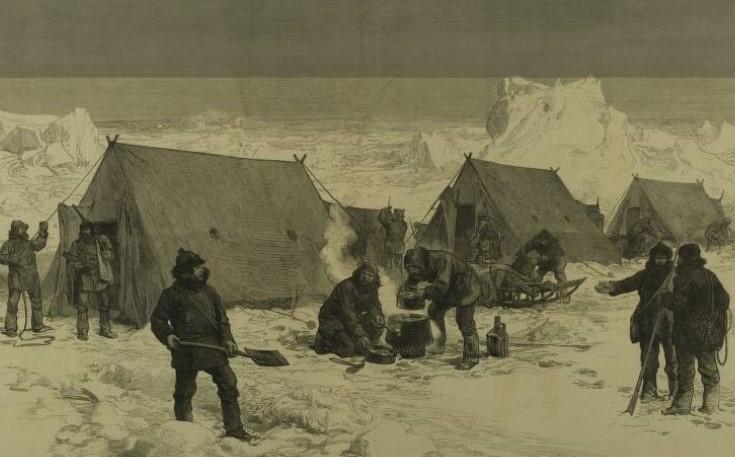
Camping overnight on the ice

It would be interesting to know the feelings of sailor John Langston Saggers during this time and whether he was selected to be one of the sledging party.  Saggers – who is my ancestral first cousin – was aged 18 when he joined the Royal Navy and his conduct had been exemplary.  Five years later he would be aboard the Discovery sailing for the Arctic, perhaps chosen for both his military record and because he had served on Victoria’s royal yacht, HMY Osborne, the ship he would return to in later years.  One can only imagine the tales he must have told in his later years of his Arctic adventure.

Extract from the naval Register for John Langston Saggers [Source: Ancestry UK]

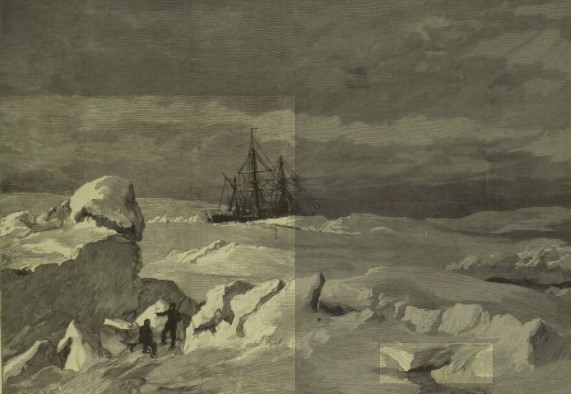
Great care had been taken prior to departure over the welfare of the men.  Apart from warm clothing and adequate food provisions, the sailors were given facilities and equipment to keep them amused during the long winter months.  The ships both had theatres for the men to stage plays and they also had equipment to enable them to venture outdoors.  The men of the Discovery built a theatre on the ice with a 60ft x 27ft stage which they named after Alexandra, the Princess of Wales. They opened it on her birthday, 1st December with a farce, ‘My Turn Next.’  They also created a skating rink by pouring melted water over the ice which refroze to form a smooth surface.  The image below shows the skating rink with HMS Discovery locked in the ice in the background.

The sun reappeared on February 29th and plans were immediately put in place for further sledging expeditions.  With over one hundred degrees of frost recorded, one officer was badly affected by the cold.  He was returned to the Alert, his comrades taking turns to lie alongside him in an attempt to maintain his body temperature.  Although he survived the journey, he died soon after his two badly frostbitten feet had been amputated.  A week later, a small party of men led by Lieutenant Rawson reached the Discovery to tell them all was well.  The newspapers on hearing of it, reported with special pride that as the men’s frostbitten noses, cheeks and fingers were being treated Rawson jovially said, “at least the cheers from Southsea beach [on their departure from England] have now been fairly earned.”

Inevitably, there were a number of deaths amongst the sledging parties

In April the sledging parties started in earnest with small groups of men travelling in every direction.  On board the ships only the chaplains, medical officers and the sick remained alongside half a dozen essential crew members.  Exploring further north than any previous expedition, yet separated from one another, the groups remained unaware of the suffering and deaths of one another.  Although unsuccessful in reaching the North Pole they brought home with them detail of the birds and animals that they found along their way.  Of greater importance for future expeditions, they confirmed for the first time that there was “no open sea” or “an ocean teeming with life” or any “Elysian Fields”, only “an icy desert where all life ends.”  Finally, at the end of July 1876, the Alert broke free of the ice to rejoin the Discovery and together they began their battle through the slowly thawing sea on the start of their long journey home.

The sledging parties prepare to leave

The return of HMS Alert and HMS Discovery to England on Thursday 9th November 1876 was greeted with as much excitement as their departure.  Sailing into Portsmouth they were greeted by the Commander-in-Chief of the Fleet, the Lord Mayor, cheering crowds and massed bands.  The crew were allowed on shore that evening; the papers reporting proudly that “their behaviour has been excellent.”  The following day, back aboard ship, the men received three weeks’ leave and a month’s advance of pay. Over the following weeks the public continued to arrive in the town to visit the ships and an exhibition of the trip. 

This image has an empty alt attribute; its file name is 1876-saggers-john-langston-s173-arctic-expedition-iln-5j-alert.jpg
HMS Alert icebound as well as homeward bound

For the sailors of the Expedition there was still more celebration to come.  In early December the Lord Mayor of London entertained the officers and crews to a banquet at the Mansion House.  The newspapers noted that “all kinds of wines, and pheasants and plover were served, just as if Her Majesty’s Ministers were present.”  The wives and children watched the proceedings from the galleries of the ‘sumptuous” surroundings of the Egyptian Room.  At the end of the evening, the men were presented with gifts of pipes and tobacco.  Queen Victoria also relayed her gratitude to the men, thanking them for their dedication to service, their heroism and commiserating for the loss of life.  She also commanded that “… a medal be granted to all persons of every rank and class who were serving on the Alert and Discovery during the Arctic Expedition of 1875-76…”  For the ordinary seaman and his family, it must have been a sight so beyond their usual experience and one that would never be forgotten.   Records show that Cousin John Langston Saggers received his medal, albeit with an error engraved into the spelling.  Whether it is now in a private collection or still held by a member of his family or has been lost is unknown.

This image has an empty alt attribute; its file name is 1876-saggers-john-langston-s173-arctic-expedition-iln-14.jpg
Mid-day, Thursday, 9th November 1876: HMS Alert & HMS Discovery enter Portsmouth Harbour

*

Of special interest to my American readers

Captain Nares of the Alert stopped at Polaris Bay, Canada to hoist the American ensign and fire a gun salute.  He also erected a brass tablet the expedition had brought with them which read, “Sacred to the memory of Captain F C Hall of the U.S. ship Polaris, who sacrificed his life in the advancement of science on Nov, 8th 1871.  This tablet has been erected by the British Arctic Expedition of 1875, who, following in his footsteps, have profited by his experience.”

*

Over the years there would be many more attempts to reach the North Pole.  It would not be until 12th  May 1926 that Roald Amundsen scientifically proved that he had succeeded.

*

Sources

Ancestry UK

Royal Navy Registers of Seamen’s Services 1848-1939

British Newspaper Archive: The Norwich Mercury, The South London Chronicle, Shetland Times, Fife Herald, The Illustrated London News, Luton Times & Advertiser, The Graphic

British Polar Exploration and Research: A Historical and Medallic Record with Biographies 1818-1999

Wikipedia