Hide That Ugly Wall

We nearly all have one – or, at least, if we haven’t, we have an unwanted view that needs disguising.  Now is the perfect time to deal with it for, if you decide to plant some screening, the soil is moist and still retains some stored summer warmth.  Wait until spring – which you can do – and you run the risk of summer drought and the need for more careful and regular watering.  In the perfect conditions of late autumn/early winter the plant’s roots begin to establish even if you’re unaware of anything happening above ground.

However difficult the position, there is almost always a way to enhance an ugly wall

There are several questions to ask before rushing to the garden centre.  The first is to decide which way the wall faces for the amount of sunlight hitting it will influence the choice of plant – more about that later.  Other factors to consider are will the plants need to be tied into place with strings and wire, and will they need regular maintenance to keep them looking nice and within bounds?  If you’re already beginning to think this sounds like too much hard work or is too complicated, don’t despair – there’s a list of planting options below.  Still baulking at the thought?  An alternative question is, would some sort of decorative screen do the job instead?

A decorative screen masks this unwanted view

One more option to consider is planting in front of the wall, rather than against it.  If there’s room a low maintenance shrub border might be possible.  If space is really tight, then one or two well-chosen plants may work just as well.  For example, trees trained to grow flat against a wall are readily available and can make a statement without hiding the wall completely. Some shrubs will also do this; they are a much cheaper option and usually grow quite rapidly.  In the photo below forsythia, an unusual choice, has been grown against an ugly garage constructed from concrete blocks.  Although it loses its leaves in the winter its dense network of twigs continues to disguise the wall.  For a few weeks in the spring, it looks both exotic and stunning.

Flowering forsythia suddenly looks exotic grown against this ugly garage wall
The Judas Tree (Cercis) flowers on bare wood, its leaves will appear shortly. It has been fan-trained to remain flat against the wall
If space allows, a low maintenance shrub border can work well

For most people, the decision made is to grow a plant that will climb as well as cover the wall.  The plants available can be broken down into two groups – the true climbers (that will need wires on the wall for support), or the ‘clingers’.  These attach themselves to the wall by little sucker-like pads or by hair-like roots.  With the latter it is essential that the wall is in good condition although it is rare for serious damage to happen.  Both types can be sub-divided into deciduous (lose their leaves in winter) or evergreen.  I have found that the majority of clingers benefit from having some wall ties when first establishing to keep them in close contact to the wall.  Once they start climbing they’ll cling without help.

The climbing hydrangea clings to the wall by tiny hair-like roots
Honeysuckle is an example of a climber that needs wires to support it

One option often recommended, is to fix trellis to a wall and it does sound like a quick fix.  My experience is that the plants weave through it – which is, of course, the idea – but that makes for difficult pruning when it is required for it can be tricky to work out which stems need removing and even trickier to disentangle them.  Worse still, trellis has a tendency to rot or break after some years, usually just when the climber has reached its prime.  Replacing it involves cutting the plant back very hard or replacing it along with the trellis.  However, decorative trellis may be an alternative form of wall disguise to consider with, perhaps, just a large pot of plants standing in front of it.

Trellis helps mask this unwanted view. By creating a focal point of the attractive tree, the trellis becomes a feature in its own right and so no plants are being grown on it

Wires are normally very straight forward to fit providing it is done before planting.  I prefer to use a screw-in ‘eye’ rather than the hammer-in ‘vine eyes’ that are the traditional method of fixing.  All that is needed is a drill and a rawlplug and some very basic handyman skills.  The wires should be fitted horizontally and there is no need to create a network of wires heading off in all directions.  The golden rule is to stretch the wire taut and make the plant grow to the wire, don’t add random wires that follow the growth.  Stems should always be tied to the wire rather than pushed behind it and use ties that will stretch or perish in time otherwise they will become strangled as they grow.  It is all much easier in practice – writing down every step makes it sound more difficult than it really is!

A well-trained rose growing on supporting wires. I have enhanced these for clarity they want to be stretched horizontally and spaced about 18″ (45cms) apart
This poor plant has been strangled by its tie; all the upper growth has died

When it comes to planting, whatever the type of plant it is, make a generous planting hole and mix a good quality compost in with the soil.  Often the ground by a wall is dry and full of builder’s rubble or compacted so having a good planting medium around the new plant will set it off on a good start.  At planting, keep the base of the plant at least a foot (30cms) away from the wall if there’s room.  That way it will receive more water when it rains.  One major cause of failure is planting too deep – make sure that the soil is at the same level as the top of the compost that the plant is growing in.  Standing the plant pot in water for a few hours before planting is a good idea too so that the plant is well-watered before it is disturbed – and, if you’re a real beginner to gardening, don’t forget to remove the plant from its pot keeping its soil intact around it.

Solanum crispum (blue) & Clematis montana (white) hiding a garden shed

A list of plant suggestions:
E=evergreen, CL=clinger, N=will cope with north facing wall, Sh=shrub, T=tree

Large walls:
Carpinus (Hornbeam) – N, T, buy pleached or ready shaped
Cercis- T, more tricky to find and you may have to train it yourself but lovely flowers in pink or white and good autumn leaf colour – see photo
Clematis montana – clip back the growth immediately after flowering to keep tidy and within bounds
Ficus (Fig) – N (but won’t fruit), if you like Figs to eat, Ficus is worth considering
Fremontodendron – E, Sh, colourful yellow saucer-like blooms
Garrya – N, Sh, dark green leaves with long green catkins in late winter
Hedera (Ivy) – Cl, E, N, easy to keep under control and provides late nectar sauce for bees and other insects.  Make sure that wall mortar is sound before planting
Hydrangea petiolaris – Cl, Sh, prune after flowering if necessary
Jasminum (Jasmine) – both evergreen and deciduous types are available with scented flowers.  The evergreen (sold as Trachelospermum) needs a warm wall for best results
Magnolia grandiflora – E,Sh, for a high, warm wall.  They need lots of space to thrive
Parthenocissus (Virginia Creeper) – Cl, magnificent autumn color
Prunus lusitanica (Portuguese Laurel) – E, Sh, T, can be grown as a shrub or purchased as a trained tree (see photo)
Solanum crispum – blue or white clusters of flowers.  Vigorous but easily pruned
Vines – prune in winter if necessary
Wisteria – prune twice yearly, midsummer and midwinter

Medium walls:
Actinidia kolomikta – Sh, pretty multi-cloloured leaves best when avoiding strong sunshine
Azara – E, Sh, for a warm wall
Berberis – E, N, Sh, very spiny branches are a good reason for not growing it!  Magnificent red or yellow berries in autumn, much loved by birds
Campsis (Trumpet Vine) – orange trumpet flowers and attractive leaves for a sunny wall
Ceonothus – E, Sh,  smothered in powder-blue flowers during summer
Chaenomoles – E, Sh, white or pink flowers in late winter/early spring
Clematis – plenty of varieties to choose from including evergreen ones – check labels for size as some can require a lot of space
Forsythia – Sh, prune after flowering which takes place in early spring – see photo
Jasminum nudiflorum (Winter Jasmine) – N, Sh, flowers throughout winter
Osmanthus – E, Sh, early-flowering, scented – clip immediately after flowering ends to keep flat against wall
Rhamnus ‘Argenteovariegata’ – E, Sh, variegated foliage, prune to keep flat against wall in spring

Low Walls:
Daphne – E, Sh, very scented flowers but very slow growing
Euonymus – E, N, Sh, Cl, can be grown a sa shrub or clipped flat against a wall, some are self-clinging
Fuschia – Sh, varying heights, the smaller-flowered varieties are more suited for growing against walls
Helianthemum – E,Sh, very low growing but smothered in flowers through summer, clip after flowers to keep tidy
Lavender – E, Sh,likes sunshine for best flowering
Nandina – E, N, Sh – trouble-free, needs no  pruning
Perovskia (Russian Sage) – Sh, silvery foliage and blue spires of flowers from mid-summer.  I’ve grown it successfully on a shady wall although not usually recommend for this.  Prune back by half in late autumn and then again in early spring to keep bushy
Potentilla – E, Sh, bushy long-flowering plants in varying colours

I recommend looking up these plants on Google to see more detail.  Also, there are many roses that can be considered including some that are fine for north walls.  Apples, pears and plums fruit well when grown against walls of any aspect, as do apricots and peaches if the wall is warm and sunny enough.

For similar information on how to make both your garden and gardening more pleasurable, why not take a look at my book Why Can’t My Garden Look Like That? It’s written for newbie gardeners as well as those with more experience and covers everything from design to planting and maintenance.  In it, I reveal some of the secrets that I used when Head Gardener to large, country estates with gardens open to the public, where the garden had to look great all the time.  All written in an informal, no-nonsense approach.  Makes a great gift and is available from bookshops and, of course, Amazon.


30 Years On – Sadness & Celebration (part two)

Earlier I wrote about the sadness felt within my family, as well as the wider community, at the closure of our small department store that bore the family name, Shortlands.  It had spanned the generations for almost one hundred years, firstly as Langstons – my great-grandfather’s surname, and then, after one of his sales assistants married the boss’s daughter, renamed Arthur Shortland.  Clever chap, my grandad!  Later still, during my tenure, the ‘Arthur’ was dropped.  I locked the doors for the final time thirty years ago this spring.  Last month seemed an appropriate time to celebrate its history and tell the story, not just of our family connection, but also of the incredible people that worked there over the decades.  It can be read in Part One by clicking on the link here.  I found the response to that blog incredible with so many people contacting me through my website or social media.  It was lovely, as well as humbling, to hear their memories and to know that Shortlands had not been forgotten after such a length of time.  Although I gave a hint in the blog, I was also asked what have I been doing since 1994.  In this post, Part Two, I bring the story up to the present date.

Shortlands Department Store 1994

A reaction to my choice of careers that I receive quite regularly is one of surprise.  Surprise that I once worked in the world of fashion, and wearing a suit and tie each day, or surprise that I am now working outdoors and wearing jeans and a t-shirt – although, I do have to look smarter on occasion [laughs].  When my retail career of twenty-five years ended, I was in my early forties and my future looked uncertain.  I toyed with various career plans, none of which appealed very much.  Unsure of what to do next, I decided to take a night class at our local agricultural college, Hall Place at Burchett’s Green.  Little did I realise, on the evening of my enrolment, that I would soon be working at the Chelsea Flower Show, working on a gardening series for Channel 4 television or travelling to Hungary, only recently free from Russian occupation, on a horticultural study tour.

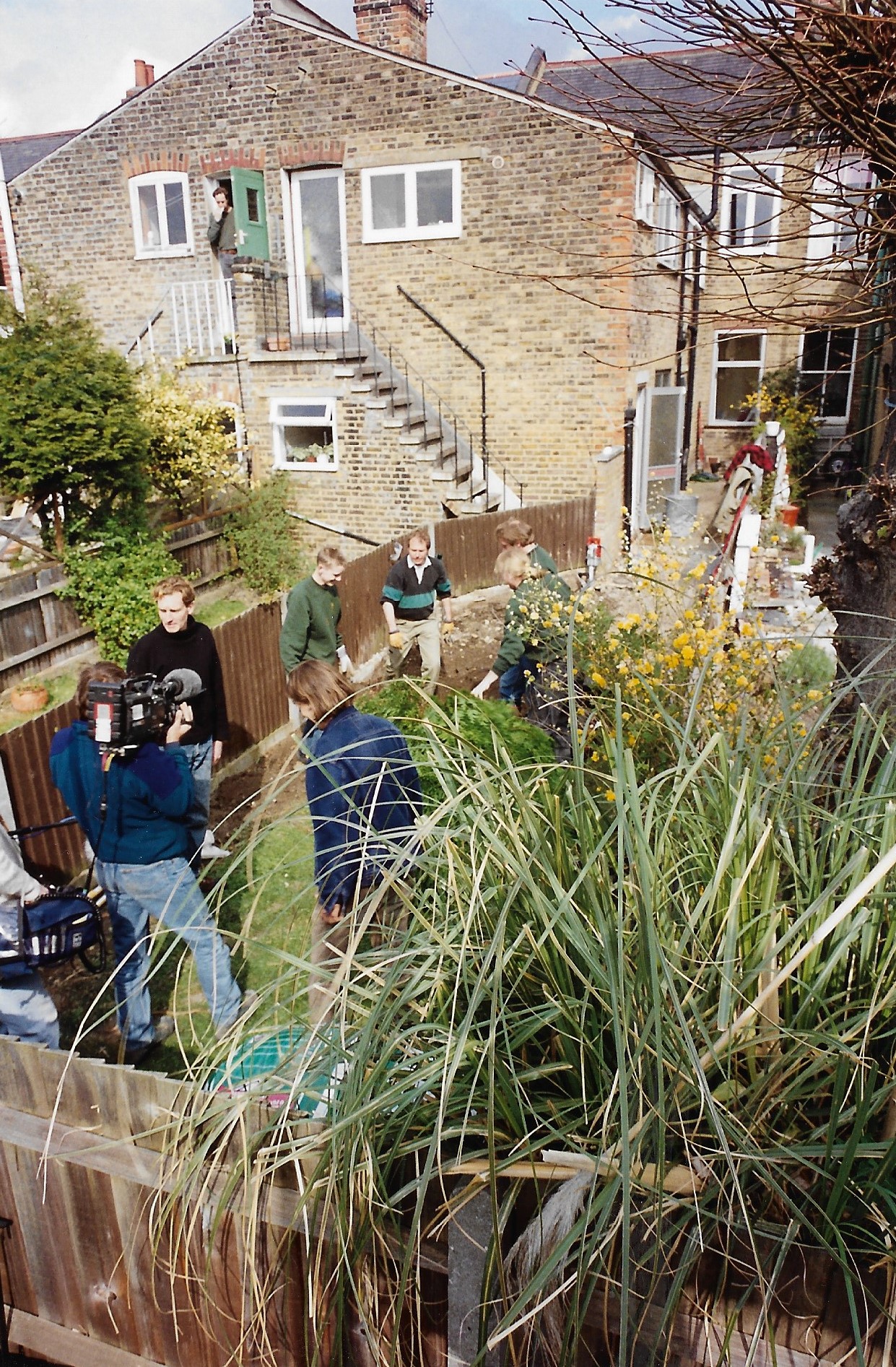
Filming with Channel 4 Television


My visit to Hall Place had ended not with a night class but a two-year, full-time crammer course in Horticulture where I studied Landscape & Estate Management.  Gardening had been the major hobby across the Shortland family for generations; I was the first in modern times to try and make a career of it.   Knowing I still had a mortgage to pay, and therefore failure wasn’t an option, I studied hard in a way that I had never managed in my school days and came away with a good qualification.  By then, I knew that I wanted to run gardens for large country estates.  I had the good fortune to be offered, during my training, a work placement with the Getty family, then the wealthiest in the world.  Their Head Gardener, Andrew Banbury, gave me various tasks and projects to carry out, frequently pushing me beyond my comfort zone.  I have a lot to be grateful to Andrew for.  When it was time for me to leave, I stepped straight into the role of managing gardens for a Swedish family who, again, were keen for me to develop further skills as well as their garden.  Over the next few years, I had the opportunity to develop an arboretum, create a lake and, best of all, to manage and develop a one-acre walled kitchen garden.

The new lake two years after construction

The Millennium saw a change once again for I left the Chilterns and the area I had known all my life and moved to the Cotswolds, there to manage an historic, Italianate Garden, Kiddington Hall.  This had new challenges but, although I enjoyed it enormously, the call of working for myself once again beckoned.  In 2005 I set up a design and landscaping business which, I am glad to say, flourished; now I have virtually retired.

Kiddington Hall

One of my last projects had been designing and overseeing a garden that has many elements to it:  a 50 metre ha-ha, a cottage garden, formal lawns, terraces, topiary, wildflower meadows and kitchen garden, most of which have been created from scratch.  As I watched the garden come to shape, with all the hard work being carried out by the owner’s own team of builders and gardeners, how grateful I was that I could now ‘pull the age card’ and let others do the physical tasks!

A section of the terraced rose garden
The Rose Terrace a few months earlier

When I moved to the Cotswolds in 2001, for the first time in my life I was no longer ‘a local’ and knew no-one.  Hearing that Oxfordshire was one of the few counties without a Gardens Trust and that one was being formed, I volunteered and for several years organised talks and visits to gardens which introduced me to many new people.  One, hearing of my attempts at writing suggested I joined the local writers group.  Feeling very out-of-place I did and before long the talk of ‘doing something big’ with books came about.  From those very casual thoughts I found myself part of a small team that created the Chipping Norton Literary Festival.  My title of Author, Agent and Publisher Liaison brought me into contact with many people in the literary world and soon I was commissioned by one to write a book on gardening.  Three years later it was me being interviewed and giving talks on stage and the radio, a surreal experience.

Being interviewed at the Chipping Norton Literary Festival

Looking back over the past thirty years I realise just what a chance I took with my career choice and how fortunate I was for it to have ended well.  It has taken me on the most incredible of journeys and given me the opportunity to meet/work with some very special people and places.  It has had both tearful and joyful moments – it has also had bizarre and funny ones too: being invited to play in a ‘friendly’ cricket match only to find myself bowled out for two by the Captain of South Africa, or sharing an ice cream with American model, and ex-wife of Mick Jagger, Jerry Hall, these being just two of them.  As with the shop, it has been a mix of celebration and sadness. I am so grateful that I have had the privilege of two careers both of which I can look back on with pleasure and a certain degree of pride.

A Secret Garden

I have noticed that even those that don’t show the slightest interest in things horticultural love exploring walled gardens, especially if they are overgrown and forgotten.  Perhaps it stirs memories of the children’s novel by Frances Hodgson Burnett published in 1911 in which she shows that when something unloved is cherished and cared for it can become beautiful and healthy, be it a plant or the human spirit.

Houghton_AC85_B9345_911s_-_Secret_Garden,_1911_-_cover

Photo Credit: AC85 B9345 911s, Houghton Library, Harvard University

I have been fortunate over the years in caring for a number of walled gardens in different stages of development yet, regardless of their state, there is something magical in placing the key in the lock and pushing open the door – as nasty, little Mary Lennox discovered in the novel.  As she returned the garden to its former glory so, she too, grew into a loving and loveable child.

Garden Border (4) watermark

Perhaps even more so than the plants and trees within, the beauty of a walled garden comes from the walls themselves.  The brickwork over time has mellowed and seems to release the warmth of a hundred or more summers, even on the greyest of days.  Search the walls and they reveal secrets – a date scratched into a stone, old lead labels revealing the varieties of long-disappeared fruit trees or, occasionally, the name of a much-loved pet buried at its feet.

Walled Garden watermark

The walls in this deserted garden date back to the late 17th/early 18th centuries

Old Plant Tag watermark

Recorded for posterity: the trees may have disappeared but the record of the varieties remain

One of the most rewarding to explore yet emptiest of walled gardens has to be that of Dunmore Park.  The house no longer stands but the garden walls remain crowned by that most eccentric of British garden room follies, the Pineapple.  Here the walls are hollow, fires were lit at its feet and the walls warmed to promote early growth.  Sliding stone blocks could be opened to release the smoke which, filling the garden at night helped to keep frosts at bay.  Clever, those early gardeners.

The Pineapple (11) watermarkThe Pineapple (31) watermarkThe Pineapple (34) watermark

Walled gardens when not open to visitors are more often a place of silence, the only sound to accompany the gardener is that of birdsong and the hum of insects.  It can be a place where your mind can be free from the everyday cares of the outside world.  It can also be a place where your design ideas can run riot either in your head or, if lucky enough, in reality.  The images below show before and after photos of a border I created many years ago, the idea for the colour palette coming from an Imari plate belonging to the owner of the garden.  The border is living proof of an imagination run riot!

Blue & White Border - before watermarkImari Plate   watermark.jpgBlue & White Border - after watermark

A Year in Review: Jan- Jun 2015

So another year has gone by and as New Year’s Eve fast approaches it is time to reflect on the one past and look forward to the one to come.

I try to visit Exmoor National Park as often as possible for I consider it to be “home from home”.  I spent a lot of my youth and early adulthood there on a remote farm not realising that I was witnessing a way of life now gone.  With the benefit of hindsight I wish I’d taken many more photographs but, in the days before digital, films were both precious and expensive.

binder copyright

In January, I made a special trip to take a look at the new headquarters of the Exmoor Society in the pretty, little town of Dulverton. The enlarged space that they now have has meant that they it is now much easier to access the archives and seek information.  If you are planning a holiday on the moor, it is well worth visiting.  Click here to find out more about my day there.

Exmoor Society HQ (3)   copyright

February found me walking along the edge of a precipice and seeking an elderly great-aunt, fortunately not at the same time.  I met Ba-ba (how she got this name is still a complete mystery) once as a boy when she was in her late nineties and she left a lasting impression on me.  With everyone else that knew her now dead (I’m now the ‘old’ generation) I’ve been trying to research her.  Despite the post creating a lot of interest it ended sadly without much success.  Perhaps, this post might reach someone who knows who she was.  To check out the detective work so far take a look here.

Gt Aunt Baba (Frances White) 90th bithday about 1965

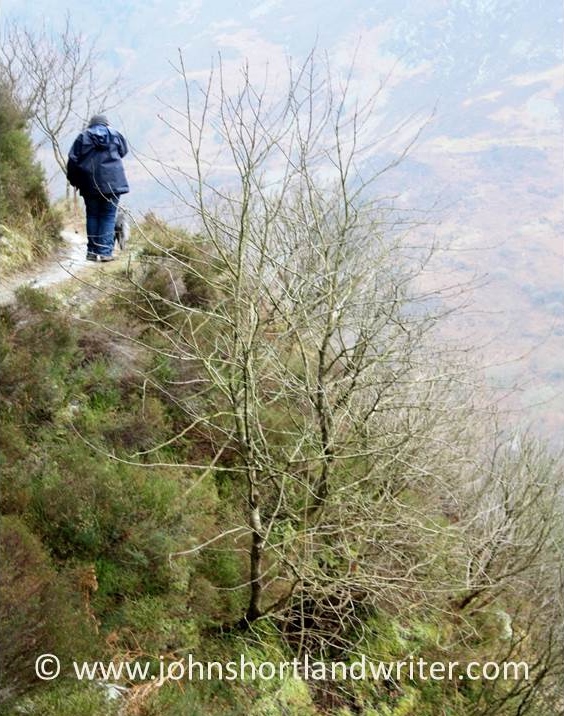
The Precipice Walk in Snowdonia, although not overly strenuous, is not to be attempted by the faint-hearted.  Travelling clockwise, the path clings to the edge of the drop before turning back on itself alongside a more gentle and peaceful lake.  If you’re afraid of heights go anti-clockwise for a delightful, if somewhat short, walk and turn around when you dare go no further.  Alternatively, sit back in your armchair and take a look at the photos here.

Precipice Walk (8)   copyright

A much longer walk, completely different in character, was described in two March posts.   Dartmoor is another national park in the West Country but much harsher than Exmoor.  Despite its bleakness now, in the past the climate was kinder, confirmed by the large number of Neolithic remains there.

Beehive Hut (2)   copyright

The walk starts at  a pub where according to tradition the fire has never been allowed to go out in the past two hundred years.  Our path crosses the moor to the village of Postbridge, home of the famous medieval stone clapper bridge.    The second part of the walk follows the river before continuing across the moor, taking in beehive huts dating back to 1500AD before arriving at the Grey Wethers stone circles.  The twin circles are about two thousand years old.  Reaching the stones is described here.Grey Wethers Stone Circle (2)   copyright

The history of the United States and Ireland are intertwined by mass emigration.  In April I visited New Ross in the south of Ireland and the birthplace of John F Kennedy’s great-grandfather.  Fifty years after JFK’s visit his sister came to light…  Well, read here to find out exactly what she did.  The image below might give you a clue.New Ross (6)   copyright

I stayed with the Irish theme in May and wrote about the lovely village of Castlelyons where a friend spent her early childhood.  Well off the tourist trail when you red about the place you’ll wonder why.  In the meantime, we had the place to ourselves.

Castlelyons (5)   copyright

June is a lovely month both for walking and also for garden lovers, with hedgerows and gardens smothered in rose blossom.  Continuing the theme of elderly ladies and ancient times the month’s post explored the history of Rosa de Rescht – fascinating for the mystery it holds.  Incidentally, even if you a hopeless gardener (and no-one is completely so) this is the simplest of roses to grow…

Rosa 'de Resht'   copyright