Eighteen months ago I was contacted by a gallery in Cheltenham about their researching an artist for they had acquired four watercolours of London street scenes painted during a ten-year period from 1885. They were by Edward Angell Roberts who had lived with Mary Ann Shortland, an ancestral cousin of mine. Although they described themselves as husband and wife in official documents, Edward was already married to the exotically named Josephine Bartolozzi Vestry Anderson.
NewStreet, Spring Gardens Edward Angell Roberts, 1885
Edward was born in Kennington in the English county of Surrey in1836. His father was a tea merchant and aspiring gentleman which presumably he became for by the age of fifteen, Edward was being educated at Christ Church Hospital, a school for sons of clergy and gentlemen. It was a good springboard for Edward for in 1855 he was promoted to Deputy-assistant to the Commissary of the Inland Revenue before proceeding to becoming Clerk to the War Office. In his spare time, he painted.
Old Wooden Houses, The Strand Edward Angell Roberts, 1887
The four watercolours show great artistic detail of places within a stone’s throw of the War Office, in London’s Pall Mall. They are New Street, Spring Gardens (1885), Old Wooden Houses, The Strand (1887), Garden House, Clements Inn (1895) and Pump Court, Temple (1895). They have since been sold at auction to a buyer in the United States.
Garden House, Clements Inn Edward Angell Roberts, 1897
Edward had married Josephine in 1858 and the census, three years later shows them living apart. Whether that was a temporary separation is not known for shortly after they had two children, a girl in 1864 who died in infancy and a boy in 1866. However, by 1871 he was living with Mary Ann and Josephine and the son disappear from record. It is thought that they may have moved to Ireland for the son reappears in the English 1901 census return and claimed to have spent time there. As for Edward and Mary Ann, they never married (or had children) for in his will, Edward leaves his estate to Mary Ann Shortland, spinster.
Pump Court, Temple Edward Angell Roberts, 1897
I began to wonder if we had other artists in the family for several of my cousins, my sister and my father were all artistic, I always felt that the skill had passed me by until some kind person exclaimed that through my career as a garden designer, I paint with flowers, a description I rather hold onto. It is true that there are some similarities for a new garden is a blank canvas waiting to be given a backwash of green and then daubed with the colour shapes and textures of flowers. Below is a rather poor quality photo of one of my early designs inspired by a Japanese Imari plate which was, I suppose, quite any arty approach to take!!
Garden design inspired by Japanese Imari Plate John Shortland, 1999
Another ancestral cousin painted and illustrated books on the town of Rye. Marian Eleanor Granville Bradley was the granddaughter of the Dean of Westminster Abbey, George Granville Bradley. Mostly remembered for her line drawings, occasionally they or paintings of hers are available for sale at auction. An only child, born in the United States, she returned to England sometime during the 1880s. She never married and died in 1951. Her pencil sketches of Rye appear very simple at first sight and, like Edward Angell Roberts, belie the attention to detail that is executed. Interestingly, a couple of her close relatives are described as ‘oil and colour merchants’ so it seems that art provided a living for my family in more ways than one…
Ship and Anchor, Rye Marion Eleanor Granville Bradley,1920
And finally, there is Uncle Les – not my uncle at all but (yet another) cousin of my father and, in the convention of the time, known to me as Uncle. I only met Les the once for he died quite suddenly when I was young. However, I did get to know his widow well, so it came as rather a surprise when I was sent this little pen and ink drawing of (I think) a house in Kingston-upon-Thames many years after her death.
Edwardian House Arthur Leslie Shortland, 1935
A few lines on Josephine. With a name like hers, curiosity got the better of me and so enquiries were made and she turned out, as hoped, to be ‘interesting’. She was a close relative of Madame Vestris, a famous, if not infamous actress, contralto opera singer and theatre manager. Madame Vestris probably deserves a full article of her own!
Madame Vestris, c1831 [Wikipedia]
Family history research is always uncovering something fascinating, puzzling or new – I wonder what it will turn up next?
With thanks to Andy Shield of Brave Fine Art , Cheltenham www.bravefineart.com }for sending me copies of the four paintings
Just occasionally nothing prepares you for a visual and emotional onslaught however much you might have read or seen images of it. I had been planning my first visit to Warwick for a few years. Perhaps it is because it is so close to home – about an hour’s drive north from my part of the Cotswolds – that it had taken me so long to actually go there for, when a place is on your doorstep, you feel you can go at any time and so put it off for another day. As it happened, I finally arrived in the town on the first warm, sunny day of spring when the ancient black and white timbered buildings really stood out against the blue sky.
Warwick is even older than those medieval buildings for it has been inhabited since the 5th century. However, it came to prominence when William the Conqueror built Warwick Castle in AD1068. Today, it is possible to visit the castle and even stay there but this was not the purpose of my visit. I had come to see a later building – the Collegiate Chapel of St Mary, most of which is only a mere three hundred years old. A great fire had swept through the town in 1694 destroying much of it as well as the greater part of the original church. Miraculously, the fire was extinguished saving the chancel and the Beauchamp Chapel built during the 14th and 15th centuries. The crypt is all that is left of an even earlier church built over 900 years ago.
The Collegiate Church of St Mary, WarwickThe 900 year-old crypt – all that is left from the earlier church
I had only been standing in the church a few moments when the organ began to play; the timing could not have been better for it set the mood for the whole visit. Lovely as it was, I moved on quite quickly to the chancel dominated by the tomb and effigies of Thomas Beauchamp and Katherine Mortimer. Both died within a few months of one another in 1369 and their effigies are unusual for they lie there holding hands, signifying not just their undying love but also their equal status for Katherine had brought land and wealth to the marriage. The chancel is also unique for its light and graceful ‘skeleton rib’ vaulted roof simply adorned with the Beauchamp coat of arms clasped by angels.
The tomb of Thomas Beauchamp & Katherine Mortimer who died in 1369 – my ancestral grandparentsThe ‘skeleton rib’ vaulting & Beauchamp crest held by an angel
From the chancel it is possible to glimpse into the Beauchamp Chapel where Thomas’ grandson Richard’s tomb stands. I purposely avoided doing so for I wanted to enter the chapel and to see it for the first time in its full glory. As I mentioned in this blog post’s opening sentence, I was completely unprepared for the visual feast that stood before me. The colour, the light, the opulence, the sun-kissed, bronzed effigy of Richard lying there centre stage was pure theatre – just the effect Richard had planned when he left detailed instructions for the building of the chapel all those centuries earlier. With the organ still playing behind me, I stood in the entrance transfixed, feeling slightly silly for being so moved before descending the steps to explore further. I had finally come to see the burial place of my ancestral grandfather.
Richard’s dramatic tomb lying in the Beauchamp Chapel
A short (but necessary!) history of Richard’s life: Richard Beauchamp was born in England in early 1382, the son of the 12th Earl of Warwick. His godfather was King Richard II although within a very few years Richard’s father, also a Thomas, had fallen out of favour and imprisoned in the Tower of London for treason. Fortunately for him at least, the King was deposed and replaced on the throne by Henry IV; Thomas was released and his titles and land restored. During the King’s coronation in 1399, Richard was knighted and later succeeded to the title of 13th Earl of Warwick at his father’s death in 1401. When Henry V succeeded to the throne in 1413 Richard became one of the new King’s most trusted advisers and given responsibility for the education of his young son, later to become Henry VI. Richard then spent much of his time in France, part of which had been annexed during the Hundred Years War and he died there in Rouen on 30th April 1439.
Richard’s armour is captured in fine detailThe bear and the griffin are Beauchamp heraldic emblems
Richard’s body was brought back to England and buried in a temporary grave in the church, for in his Will of 1437 he leaves detailed instructions for the construction of the new chapel to house his tomb. No expense was to be spared for he wanted it to become one of the finest in England, in which he more than succeeded. The creation of the chapel as one complete and new entity, using only the finest materials and highest quality craftsmanship makes it unique – all the more so, for its surviving almost unscathed by the later Reformation, attempted destruction during the Civil War, as well as the great fire. He was finally laid to rest there in 1475.
The Great Fire of 1694 stopped behind the chapel wall destroying the lower part of the wall paintings
The tomb is, of course, the central feature of the chapel as well as its purpose. Richard lies on an intricately carved and highly coloured marble chest set with fourteen gilded ‘weepers’, namely his children and their spouses. There had been a dispute after Richard’s death within the family over inheritance for Richard had been married twice with children from each. It was Ann that finally inherited the title and estates, a daughter from the second marriage (my ancestor was Eleanor, the second daughter from the first marriage) and so it was she that oversaw the completion of the chapel. Richard’s effigy is of a younger man, his eyes open, his hands outreaching, and dressed in full armour, showing the world that he is ready to enter the Kingdom of Heaven. He gazes upon the stained glass that confirms this story.
Richard’s daughters, some of the fourteen ‘weepers’ that surround the tombAnn, who became the 16th Countess of Warwick in thoughtful pose
The stained glass is another miracle of survival for it is mostly complete. During the English Civil War (mid-1600s) many of the country’s churches and religious icons were damaged or destroyed with the Protestant dogma that followed. The Beauchamp Chapel’s glass was spared much of this with only its lower parts damaged. Although it cannot be seen in my photograph, it was hastily repaired – perhaps a little too hastily for Richard’s head and hands were replaced with those of a woman. The imagery depicts saints and angels in glowing colours, produced at huge expense. Musicians are shown with their instruments and a banner of sheet music runs across the entire window. The notations can be clearly seen and, as instructed by Richard, this is sung in the chapel each September with prayers said for his soul, a practice of huge significance in medieval times. There is a short YouTube video of the choir singing this original music in the chapel, as well as a brief history of the windows which can be found here.
Richard, reborn, raises his arms towards HeavenSection of the East Window surrounded by statues of saints
Within the chapel are many other delights although none overshadow Richard. Tombs of his descendants, the Dudleys (through his eldest daughter Margaret), were placed there. They are resplendent in their own right but do not form a part of this blog. Even the prayer stalls, quite modest compared to other features of the chapel deserve close attention with their heraldic emblems carved into their timbers; they are fine in quality as well as detail. They can more briefly be shown by photos but deserve inclusion.
The tomb of Robert Dudley and Lettice KnollysBeautifully carved prayer stalls, now almost 600 years old
My family connection to the Beauchamps. When you travel back through so many centuries from the present day you are bound to uncover many ancestral grandparents. The problem is the discovering of them for in most families, as in the rest of mine, they lived very ordinary lives that were not well recorded if at all. Just occasionally, it is possible to find one that has risen to fame and this is the case with my paternal grandmother’s family. Granny Shortland’s relatives had been well-known up to the early-1900s for they held high positions within the Church of England and Government. A friend of Tennyson, the Reverend George Bradley had risen to become the Dean of Westminster Abbey. His brothers and sisters had also risen to fame in their spheres of work. These connections, known as ‘gateway ancestors’ enabled the research to progress relatively easily through time to Thomas Bradley – my 8th great-grandfather – who had been Chaplain to King Charles I and later, after the restoration of the monarchy, Charles II. From there the connections to the Beauchamps and even further back are well-researched by historians. It had always been whispered that Granny Shortland had married ‘beneath herself’ – now I know the reasons why!
Granny Nellie Shortland c 1945
Visiting: The Collegiate Church of St Mary and The Beauchamp Chapel is open to visitors free of charge. Guided tours (which are well worth doing) are available at a modest cost, as is a climb to the top of the tower to view the town and beyond. Details can be found on their website here.
Warwick Castle is impressive and a popular attraction. It was the home of the Beauchamps but was built in the 11th century by command of William the Conqueror. It is possible to stay in the castle for short breaks. More details can be found here
There is a useful website (click here) if you are planning a visit to Warwick, which is situated a few miles south of the city of Birmingham and north-west of London.
In Part 1 of my review I began by saying words to the effect of life is for living – and when you become older there’s even less time to waste! The result of following my own advice is that part 2 of the review is a couple of weeks late in being published. than I would have liked
Keeping active was also part of the theme of a couple of my blog posts last year, specifically about England’s network of public footpaths. Although we Brits just accept them as part of our historic right to walk across privately-owned land, it seems that for a great part of the world, this would not be an option. My American friends and readers in particular find it hard to comprehend that we can walk across someone else’s property at will (assuming a public footpath crosses it) without confrontation. Many of our footpaths link villages and farms and so, on occasion, you may find yourself walking through someone’s garden or farmyard. The history behind the right to walk and what you can and can’t do was discussed in November’s post which can be found by clicking the link here.
Walking on designated footpaths across privately-owned land is a basic right in England and Wales
A few month’s earlier in August, I wrote of a walk that I had taken across fields, through woods and down country lanes back to my home in the secret valley. It was a lovely walk with the first signs of autumn colouring the trees and hedgerows which were laden with wild fruits and berries. After the noise and bustle of harvest, the fields were quiet and I met no-one for much of the walk. I prefer it that way for it is then, walking in silence, that you are likely to come across the wild birds and animals that also share this space, To follow the route that I took and to see the beautiful creatures I encountered click here.
When walking quietly you come across the wild creatures that live there
I have lived in the country all my life and my father was very much the epitome of the ‘English country gent’. My mother remained a ‘townie’ all her life (she had been brought up in the West End of London) and we both teased her mercilessly about her lack of knowledge of country ways. When she met and married my father it must have come as quite a culture shock to find herself living in a small, close-knit community where everyone knew one another and one another’s business. Neither of my parents were walkers but as a child they would drive my sister and I out to Turville Heath. Over time the heath became my place of refuge whenever I was in need of comfort or in need of re-charging the batteries. It would also be the place for summer walks, playing cricket and picnics. Of equal importance as the heath itself was the car journey out to it – past miniature farm and other magic moments that we children couldn’t get enough of. Click October’s link here to find out more.
My father, very much the country gent despite not liking guns!
Looking back even further in time, I explored the lives of ancestral aunts, uncles and cousins. They had been born, married and died in a village very close to the where I had been raised for our family have lived in the area for at least five hundred years. Discovering their stories had been quite a revelation – for my 3rd great-grandaunt had been about to marry in the local church when she gave birth to a child. The repercussion of this – for the child was obviously not that of the grooms – was far-reaching. Devastated Thomas cancelled the wedding and did something rather surprising shortly afterward, as told in September’s blog post. What happened to disgraced Ann? And what happened to poor Henry, the baby boy, who lived with the stigma of his birth? Was it this that took him down the path of self-destruction and a young death many thousands of miles from home in ….. – well, you’ll need to click on the link to find out what, when and where!
The village church where Thomas & Ann were to wed in 1809
So, what will 2025 bring, I wonder? World politics seems to be on the news with constant and often seemingly bizarre twists and turns unsettling many of us. I’m quite good at not getting too worked up about things that I have no control over. Fortunately, I live and work in stunningly beautiful countryside and my interest in family history has taught me that life carries on regardless of turmoil all around us. I shall continue to write about my adventures (if that isn’t too strong a word to describe them). I also have a couple of writing projects to see to, and of course, there are my garden projects too. In dues course, they may appear on these pages. As with all my blogs, there are lots of photos to view so why not take a look and please do comment as appropriate.
As we enter the new year it’s always a good time to reflect on the past twelve months as well as to look forward to what 2025 may bring. For me, 2024 has been a busy year. I remember many years ago an ‘old boy’ telling me that when you reach the age of sixty, life is downhill all the way. I was in my thirties at the time and so believed him. I’m now in my early seventies and I can’t say that I agree with his pessimism. Funnily enough, he lived well into his nineties and, for most of that time, enjoyed rude health so he proved himself wrong too! The only way to tackle ageing, I’ve decided, is to embrace its positive aspects – no mortgage, wisdom (ha-ha!) and more time to do the things that matter to you. Of course, good health is important and maintaining balance and staying active helps no end. One of the reasons why I’ve not retired completely.
John Shortland, summer 2024
Tewkesbury, a town in Gloucestershire on the River Severn – the UK’s longest river – is just a few miles from the edge of the Cotswolds. It’s an ancient town that I have driven through dozens of times but early in the year I made the effort to actually stop and explore its narrow streets and abbey church. I hadn’t realised that when entering the church I would be staring at a suspended globe which, when standing 211 metres away from it, is the exact size and view of Planet Earth you would see if standing on the moon. When I first saw it ‘suitable’ music was being played but it was only after that had stopped that I found the exhibit strangely moving as it rotated slowly in total silence. That’s another thing I’ve noticed as I’ve grown older – how much I enjoy silence! The church is well worth visiting for it is now almost one thousand years since it was built and is one of the finest examples of early Norman architecture in Britain. Unable to visit? Then click on the link here to see lots of photos.
The abbey church looms over the ancient houses and narrow streets of TewkesburyPlanet Earth, mysteriously beautiful
In March, we travelled north to the county of Yorkshire to watch a friend take part in the oldest horse race in the country. The Kiplingcotes Derby has been run annually since 1519. Tradition sys that if it ever stops taking place it will never happen again so all through the Covid restrictions only one horse took part! For this race, the 505th, dozens of riders took part for it is a horse race like no other: no finely maintained racecourse but a series of roads, lanes, field margins and tracks, a real test of endurance for both horse and rider. Our friend, who had never raced before was taking part to raise money in support of the local hospice. She reached the finishing post in good time and raised over ten thousand pounds in memory of a close friend. The race has one other completely bizarre quirk which makes it unique in the world of horse racing – to find out what that is you’ll need to click on this link here!
The oldest, continuously-run horse race in the UKSafely past the winning post!
Later, in early summer we returned to Yorkshire for a week’s holiday spent in the pretty village of Austwick. We had planned to spend our time walking for it is excellent hiking country. However, my partner was nursing a broken foot and, later, during a hill walk on my own there, I hurt my knee badly so we were both hobbling about instead (what was I saying about staying active?!) There is always a positive outcome to everything, I find, and so we explored by car instead where we discovered the Courtyard Dairy. To misquote Paul Whitehouse, “if you like cheese, you’ll like these” for we’d stumbled across one of the top, award-winning artisan cheese makers in the country. With a restaurant, small museum, ice-cream and wine shops as well as a huge selection of cheeses, we were in our element. For lots of photos of the trip – and not just of blocks of cheese, click here.
The Courtyard Dairy – one of England’s finest artisan cheese shopsThere are beautiful walks around the Yorkshire village of Austwick
I have been very fortunate in not just living in a beautiful part of the country but also being able to make my living from being in the midst of it. However, that hasn’t always been the case for before I embarked on my horticultural career I spent twenty years in the world of retail fashions. When I left school I spent some months on a sheep farm on Exmoor – the remote, hill country, now a National Park, in the West Country. That short time farming changed my life for I met some wonderful and inspirational people there who left me with a yearning for the outdoor life, However, I was dragged away by my parents to work in the small department store which had been central to my family for the best part of a hundred years. Fortunately, I had a happy time there but the desire to be spending my days outdoors never left me. This spring it was thirty years since I sold the business to follow my dream and so it seemed a good time to reflect on those retailing years.
How the family store began in 1904The family store in 1994 when it was sold
A few months later the blog post (link here) had developed into a full-blown illustrated talk to over seventy people followed by press interviews and a printed history of the store which had been started by my great-grandfather. I am delighted that the story of the family’s endeavour has now been recorded for posterity. By complete coincidence, I was also contacted by Exmoor Magazine and my memories of farming at Brendon Barton have been included in an article on Dick and Lorna French who were the couple who welcomed me into their lives – and changing mine by doing so.
Recorded for posterity – the history of my family’s department store
At the age of 42 I took myself off to study landscape and estate management for two years at agricultural college. It was a huge gamble and one that fortunately came off for I found employment as Head Gardener to the European Youth Parliament, an educational charity that brought teenagers from all over Europe to debate world affairs. With some Polish blood in me I liked the idea of being part of the organisation. Next, and still in England, I spent some happy years working for a delightful Swedish family – even after my role as Head Gardener had ended I maintained contact with them as Consultant overseeing projects such as the creation of a lake and an arboretum. My next move was to the Cotswolds to manage an historic garden, Kiddington Hall, designed by the architect who had created the Houses of Parliament. It was after that, that I decided to go freelance which culminated in the career in designing and creating gardens as well as the commission to write the gardening book.
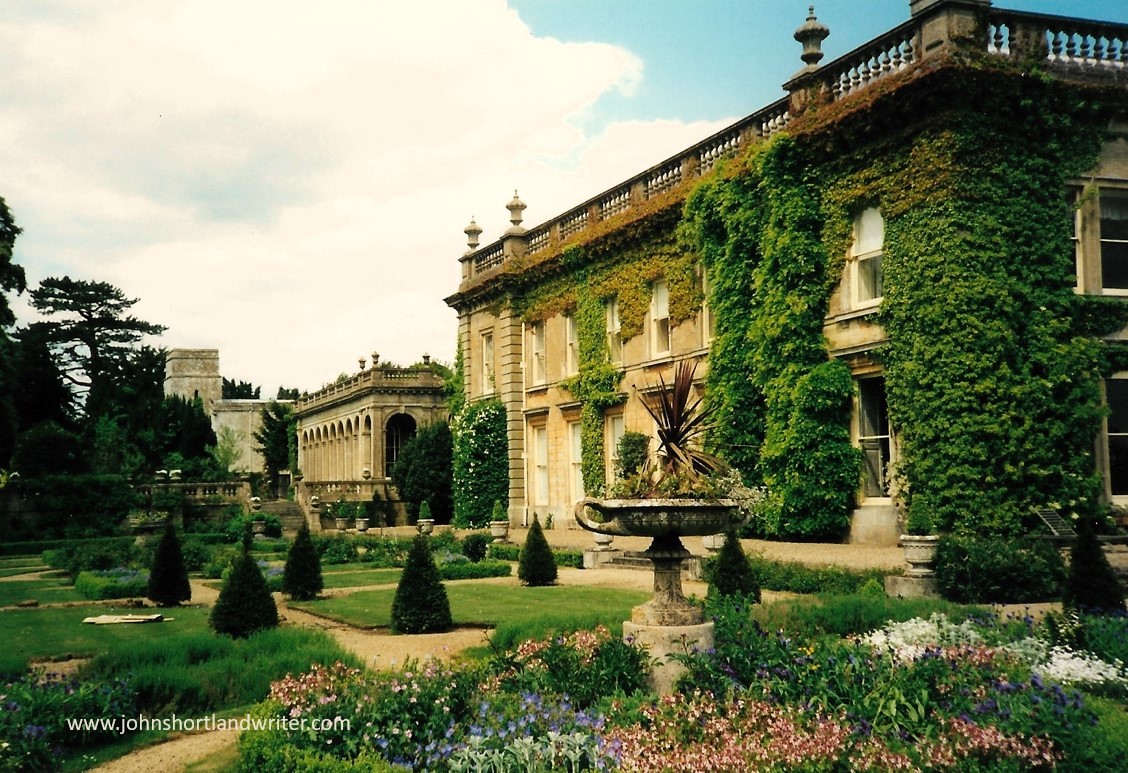
The historic gardens at Kiddington Hall
Little did I think, when I began college that my career would include a stint at the Chelsea Flower Show, Channel 4 Television, creating a new literary festival and a study tour of Hungary. My latest – and final – garden project has been the most exciting to date. How fortunate have I been?! As before, the press picked up on the thirty year career change and a double-page spread in the Bucks Free Press newspaper followed. To read more about the gardens I’ve created, or just to enjoy the photos, click on the link here.
I wonder when Henry started going ‘off the rails.’ Was it down to his parentage? Perhaps living in the small, Thames-side village of Medmenham, where everyone knew one another and so would have known the story behind his birth, may have been a factor. Or was this considered too shameful to be ever spoken of openly again. Whatever, the cause, by 1838 he already had a string of petty offences under his belt when once again he found himself standing in front of the Buckinghamshire Assizes for larceny.
The River Thames near Medmenham
Poor Henry’s troubles really began before he was even born. His mother, Ann Chown, planned to marry local lad Thomas Burridge in the village church in the May of 1809 but on the 14th, halfway through the Banns being called, Thomas had them cancelled. He had discovered that Ann was pregnant with Henry, the father being another village boy, Elias Nibbs. Ann had very nearly got away with her deception for Henry had been born and baptised by 4th June. Ann and Elias never married nor, it seems, lived together, for within a short time they had both married others.
The village church at Medmenham
Henry couldn’t have been a clever thief for, on the 4th April 1838, he was sentenced to six months imprisonment with hard labour for the theft of an axe and mattock from William Chown, his uncle, and a billhook from John Rockall, his stepfather. He was even less clever when he tried his hand at burglary again despite travelling four miles to the local town of Marlow for his crime. This time he stole a shovel, the property of William Brangwin and so, within weeks of being freed from jail, in November he was back before the bench once again.
Standing before the magistrate, Squire Robert Hammond, Henry heard how the shovel was readily identified by Brangwin’s initials being burnt into the handle. Richard Ayres testified that he had been using it on the day of the theft and Thomas Wright, the local pawnbroker told how Henry (using the alias Beaver) pawned it for one shilling – 5p in modern coinage. Hammond was not prepared to give Henry another chance. For this crime he was sentenced to seven years transportation to Australia. It would be interesting to know how the family and villagers reacted to the sentence. Perhaps it was relief for most but more likely, for his mother Ann, it was harrowing.
Henry was taken from prison on 13th May 1839 to Sheerness, a port east of London, where he boarded Convict Ship Parkfield. There were already one hundred prisoners aboard and now it was filled to capacity with the addition of one hundred and forty more men. A military guard of over thirty kept order and six women and nine children also boarded – as this was a male convict ship, one assumes they were planning to join loved ones or just hoping to seek a better life. The voyage was better than normal; with no storms the sea remained calm. When they arrived at Port Jackson, New South Wales, on 1st September, the ship’s Surgeon, Alexander Neill was commended for the cleanliness of the ship and the health of the men for there had been no deaths. Interestingly, in his Journal he mentions that he had rejected one prisoner with scurvy: “one of the worst cases I’ve ever seen and him, not yet at sea.” The convicts were taken ashore to Hyde Park Barracks for processing. We hear nothing more of Henry until the 29th May 1840 – a simple entry in the register: Henry Chown, drowned, Sydney. No further details were given.
Details of Henry’s, and others, crimes listed in the 1838 Register
What became of Ann, Thomas Burridge and Elias Nibbs? Ann married John Rockall in 1811 and had nine children, dying in 1872, aged 85. Elias married in 1813 and had one known child, Richard, before he disappears from the scene. Interestingly, a Richard Nibbs was also transported on the same ship as Henry – were they half-brothers in crime? And Thomas Burridge? He obviously recovered from the upset for within eight months he had married Ann’s younger sister Mary. They had seven children before Mary died in 1828. He later married again and fathered three more children. For such a small place, Medmenham, had its fair share of scandal and excitement!
Henry Chown – drowned. The last entry in the Convict Deaths Register
I have been researching my family history for many years and have uncovered all sorts of stories. There seems to be a disproportionate number of ancestors that had illustrious careers, reaching both fame and wealth. How very exciting to find, at last, a real black sheep in the family!
Henry Chown, my ancestral 1st cousin born 9th May 1809 Medmenham, Buckinghamshire, England died 29th May 1840 Sydney, New South Wales, Australia, aged 31
Sources:
The National Archive British Newspaper Archive Wikipedia Convict Records, Australia Ancestry UK
How time flies by. I know that’s a bit of a cliché to open with but, even so, it hardly seems possible that thirty years could have passed since that early spring day in 1994 when I locked the door of Shortlands clothing and footwear store for the very last time, and wondering where my career would go to next. I was in my early forties and knew that I would have to do something to earn my keep and pay the mortgage but what? It was a time of great sadness, not just for me and my family but also for our loyal staff some of whom had been with us for many years. Thirty years on it seems time to write the shop’s story to celebrate it having been at the centre of community life for the best part of a hundred years.
Shortlands in the 1990s
The shop that was to become Shortlands began with my great-grandfather, William Bradby Langston, who had already established shops in Marlow High Street and in nearby Lane End. He was quite entrepreneurial, something he and his brothers inherited from their mother. Poor Sophia, widowed in 1863 at the age of 34 with five children under the age of 13 and a baby due at any time needed to provide for herself and her family. She set up a shop in her front living room which later expanded to become Langstons Department Store in Reading, Berkshire. As well as those already mentioned, she and her sons between them also had shops in Boscombe (Hampshire) and Ilford (Essex). Unsurprisingly, she is remembered as being rather a force to be reckoned with – you can read her life story, Rebel in the Family, by clicking here.
The first generations of retailers l to r: My great-great grandmother Sophia Langston (nee Bradby); my great-grandfather William Bradby Langston; my grandfather Arthur Shortland
William opened his ‘Boot and Shoe Warehouse’ in Marlow in 1884 at the age of 22. Seven years later he opened another, opposite the first, specialising in boating and tennis shoes as well as other sporting footwear. When a newly built parade of shops became available in Bourne End in 1899 he established what was to become Shortlands. At first the shop was tiny but by 1904 he had expanded to sell not just shoes but also mens and boys clothing. Four years later William’s daughter, Nellie, married Arthur Shortland who had come to Marlow to work for William a few years earlier. The newly married couple came to Bourne End and by 1915 Arthur was listed as the owner in Kelly’s Directory.
Langstons – the Bourne End branch c1910
The shop continued to prosper and during the 1920s the adjoining shop was purchased and ladies clothing and footwear as well as carpets, haberdashery, dress fabrics and knitting wools, soft furnishings, household linens and luggage were added to create Bourne End’s own department store. The 1920s photo below shows my grandfather Arthur using the steam (clothes) press although it was a (much hated!) task given to my father Hedley as soon as he returned from school.
Langstons, now expanded and with my grandfather’s name on the fascia 1920sMy grandfather, Arthur Shortland using the steam press,1920s
With the outset of WW2 my father joined the army and it was left to the older generation, including my great-aunt Edith Shortland, to run the business. Both the Langstons and the Shortlands were deeply religious and scrupulous in the way they behaved towards others. My mother would tell the story of how when some silk stockings arrived (which were rationed and in short supply) she rather assumed that she would have a pair. She was told quite firmly that her name would go on the bottom of the list like anyone else – she never did get her stockings. Aunt Edie was quite diminutive but with a voice that belied her stature. One day she spotted a lady conceal some goods inside her coat. “Jesus saw you do that” came a thundering voice from nowhere; the woman screamed, dropped the goods and her shopping and was last seen running down the street fearing the wrath of God was upon her! After the war, my father returned to the business along with his brother Jack, later to be joined by their cousin Maurice Phipps.
A retailing family : four generations
During the 1960s the shop expanded again. The garden and old shoe repair workshops at the rear of the property were built over and a new shopfront installed. Made of aluminium, it was considerably ahead of its time and was featured in several design magazines both here and on the Continent. By the late 1970s both my father and my uncle Jack had died and soon after the shop was due for another major refit. The interior, as well as the fascia, was modernised and the displays became more open and accessible to customers. Until that time stock was kept hidden away in drawers and boxes – if you wanted to buy something it was necessary to ask and an assistant would show what was available. Personal service, nowadays a rarity, was the norm back then. How times have changed! To make space for the improved selection of clothing, all of the other departments closed and the shop concentrated on mens and womens fashions and footwear for all the family. The toiletries and gift department was retained; the soaps and potpourri helping to make the shop always smell rather nice!
The ‘new and modern’ shopfront in 1969 featured in design magazinesof the time – by the 1990s it was looking tired and old-fashionedBy the 1990s the displays were brighter and (to use 2020s speak) more ‘on trend’
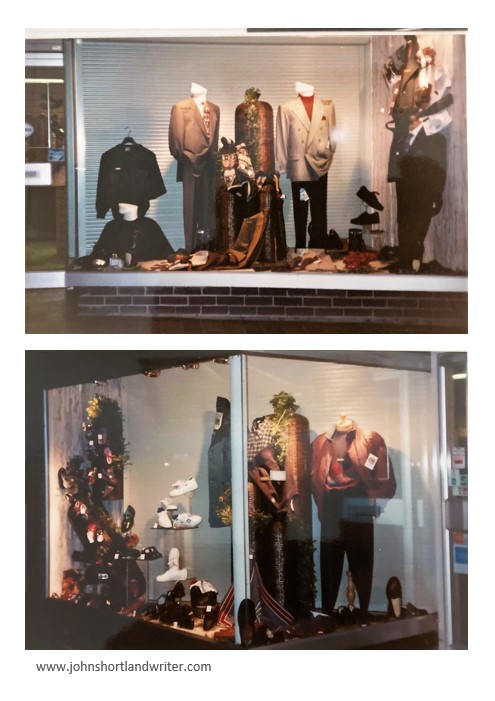
I suppose it was because the shop was ‘always there’ that we have no photographs of the shop interior through the decades which is rather sad. Fortunately, I did take a few in the early 1990s and these will probably trigger some memories for local people. The 1990s brought new challenges for the business with recession and changing shopping habits sounding the death knell for businesses like ours. I had joined the firm in 1971 and my business partner, John Pheby had begun even earlier, as a lad, working for the family. It was a hard but inevitable decision that we decided to close and were fortunate to find a buyer almost immediately. They converted the property to three shops and the accommodation and stockrooms above to flats. Since that time Bourne End has changed quite considerably and most of the old shop names (and several of the buildings too) have disappeared. I believe that there must be photos of the interior held by local people somewhere – it would be wonderful to see them. I seem to recall Jean Peasley taking photos during our last few days…
Menswear Department, 1990a small section of theLadies Fashions Department1990
So, what happened to our employees? In the early days of my tenure there was Ivy Taplin (Akela to us cubs of the late 50s!), Yvonne Ludgate, June Charlton (later to become June Billinghurst), Cissy Hyde, Mrs Faulkner, Liz Hill and Diana Spokes. Later, Pauline Harvey, Marjorie Kane, Wendy Manley, David and Marian Bratter, Diane Douneen, Kath Bowdrey, Iris Halstead and Cissy Vickers. I’m afraid I can’t remember the names of them all but some of those listed will be familiar to Bourne End locals – please don’t be offended if I have left you out, you were all valued! The younger generation I purposely have not named but they aren’t forgotten either – I still keep in touch with several of them thanks to social media. It was thanks to a succession of great staff through the years that the business was so successful. It seems appropriate to thank our loyal customers too – I can still picture many of them and the frequent kind comments that I still receive on social media shows that they haven’t forgotten Shortlands either which, after all this time, is rather humbling as well as very special.
Ladies Shoe Department display 1990
And what have I been doing the past thirty years? Retailing had been a passion for my family for generations but I decided to follow another of the Shortland passions and forge a new and very different career – you’ll have to wait a short while for part two to find out what but the photo below may give a clue!
Part Two of this blog focussing on the last thirty years is now published and can be found by clicking on the link here
I think it would be fair to say that the chances of my viewing Earth from the Moon is so improbable that I have never even considered it. That changed when, with an hour to spare en route elsewhere, I decided to explore the Abbey Church of Tewkesbury, little knowing that I would leave having had an out-of-space experience.
Tewkesbury Abbey
The name Tewkesbury Abbey, as it is usually called, is really a misnomer for the church has been the Parish Church of the Gloucestershire town of Tewkesbury for centuries. When, in 1087, Robert Fitzhamon was gifted Tewkesbury by his cousin William the Conqueror, there had already been a monastery on the site for four hundred years. However, in 1102 the building of the present church commenced, its stone coming from Caen in Normandy, France and floated up the River Severn which passes just yards from the door. For the next four hundred years, as part of the Benedictine monastery, it really was Tewkesbury Abbey.
Ancient buildings line the streets that lead to Tewkesbury Abbey
I’ve driven through Tewkesbury dozens of times. It’s an interesting town with some beautiful old buildings and I’d always intended to stop and explore. With limited time, the town would have to wait for another day. I entered the Abbey church expecting to be overawed by it for it for several reasons: it is now almost a thousand years old, it is one of the finest Norman buildings in England, it has the largest Romanesque cross-tower in Europe and contains more medieval monuments than any other church apart from Westminster Abbey in London. I hadn’t however expected to be be confronted, upon entering, by a large, hanging globe – our Planet Earth.
Planet Earth as seen from the Moon
Rotating slowly, the seven metre diameter Earth sculpture is as seen from the Moon. As Luke Jerram, who created this Gaia exhibit states, “man has been gazing at the moon for Millenia but it was only in 1972, with the Apollo 17 mission, that man was able to see our planet floating through space – a sight that changed our perception of Earth forever.” When standing 211 metres away from the globe, viewers see the Earth to scale, exactly as it was viewed from the Moon.
The Abbey, of course, has many wonders of its own to be viewed. For me, an unexpected delight was the chantry chapel built as a memorial to Isabella, Countess of Warwick and her two husbands, Richard Beauchamp, Earl of Worcester and, later, (another) Richard Beauchamp, Earl of Warwick. Erected in 1430, Isabella’s first husband was killed during the Battle of Mieux and she died in 1439. It was her second husband, the Earl of Warwick, that excited me the most. For his first marriage to Elizabeth de Berkeley (who died in 1422) is part of a long line that I can trace back to in my family tree: Richard and Elizabeth were my 15x great-grandparents. Over the generations, the women in my ancestry have often been rebellious and married against their parent’s wishes (see A Rebel in the Family for an example) – hence the fact that I am just a plain old commoner! Grandfather Richard commissioned another, more splendid brass tomb for himself in Warwick – another place on my list of ‘must visits’.
The Beauchamp Chantry ChapelBronze effigy of Richard Beauchamp who died in 1439 [Wikipedia: Robin Stevenson]
So what caused the Abbey Church to become just a Parish Church? It was, of course, due to the desire of Henry VIII to divorce and remarry brought about his separation from the Church of Rome. His subsequent Dissolution of the Monasteries swept away the buildings and created the spectacular ruins that we find dotted around the English countryside today. A similar fate would have happened to the church in Tewkesbury if it had not been for the argument, fortunately won, that to demolish the church would leave town without a place of worship. How fortunate for us today, for the architecture, history and splendour of the building makes it an almost unique example of early Norman ecclesiastical buildings.
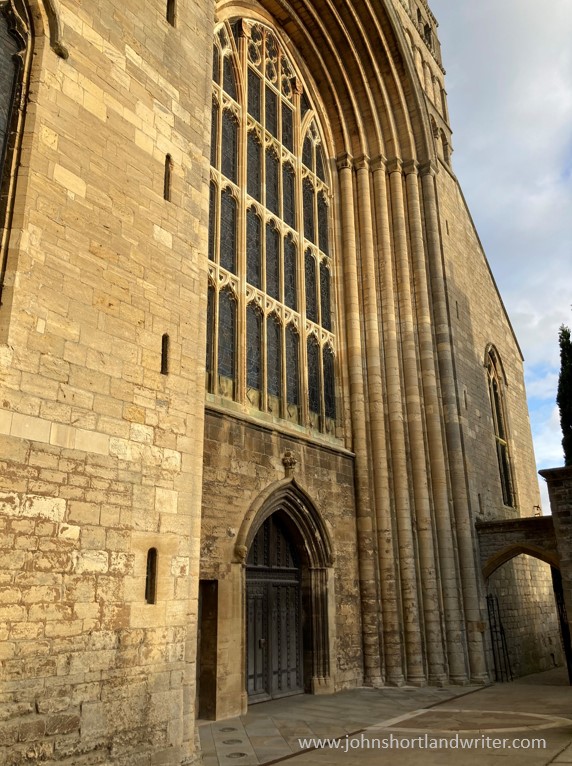
The tall Norman arch is unmatched for size in England
Tewkesbury, as has been stated, is built along the banks of the River Severn, England’s longest river which is subject to tidal bores and rapid changes in it’s flow height. As a result, the town is often flooded. Despite being built so close to the river, the floodwaters have only entered the church on two occasions, in 1760 and, more recently, in 2007. It is often shown in news features totally surrounded by the flood waters.
Modern stained glass at Tewkesbury Abbey
The Gaia exhibit has now ended at Tewkesbury. It is being shown as an ongoing exhibition in the UK at UCL, London; International Centre for Life, Newcastle; Dynamic Earth, Scotland. In Ireland: Trinity College, Dublin. In Canada: Canadian Museum of Nature, Ontario. American readers have the opportunity of seeing it in the USA at Houston Museum of Natural Sciences 12-28 April 2024.
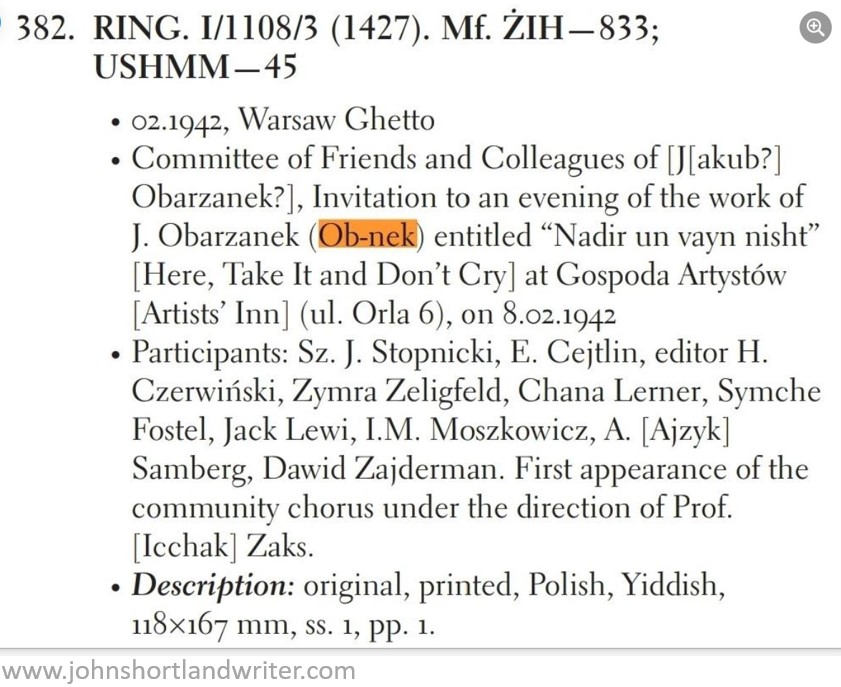
The evening of Sunday 8th February 1942 saw an elite group of actors, writers and singers come together to celebrate the work of their friend and colleague, Jakub Obarzanek, then at the height of his fame as an editor, comic writer and satirist. Within months all of them would be dead, shot or gassed in the concentration camps of Poland, executed because of their Jewish heritage or political comment, or both.
Invitation for the evening performance celebrating the work of Jakub Obarzanek, 1942
Jakub was born on 15th January 1891, probably in the city of Lodz where he lived for much of his life. The first son born to Samuel & Gitla, and into a comfortably off family, he would have been expected to follow in his father’s footsteps and work in the family business as a wholesale cloth merchant. However, Jakub had always wanted to write and in 1918 he published his first pieces of work – humorous songs and verses in the Lodzier Togblat, one of the premier Polish Jewish newspapers.
Jakub Obarzanek standing left with three workmates, 1930s
Writing always in Yiddish, and under the pen name ‘Ob-nek’, Jakub very quickly developed a following amongst his readers and soon joined the permanent staff, editing and writing for the Friday edition. As his talent develops, he begins writing sketches satirising everyday Jewish Street life which, again is eagerly read by a public wanting more. During this time, he also begins collaborating with various revue theatres writing witty sketches, songs and monologues. All was going well until 1939 when the Germans invaded Poland, arriving in Lodz on September 8th.
Najer Folksblat newspaper, one of the publications Josef wrote for
One of the first moves the Gestapo made was to arrest Jewish writers and intelligentsia and Jakub along with others was taken to Radogoszcz, a factory now being used as a prison. It had no baths or kitchens. Almost immediately the killings began with the intelligentsia taken into nearby woods and shot. For reasons unknown, Jakub was freed in early 1940, possibly because a ransom of 150 marks would permit prisoners to be relocated to the Lodz Ghetto. However, sometime during 1940 he had made his way – or perhaps been taken – to Warsaw. Here, confined in the Ghetto he continues with his writing, helps to create a new revue theatre and providing them with material. The last we hear of Jakub is the evening performance celebrating his work.
The Radogoszczfactory where Jakub was imprisoned and now a museum [Wikipedia]
It is not known whether Jakub was present for the performance. My feeling is probably not. What we do know is that he was once again arrested and was finally executed during April 1943. Married to Mala, Jakub had a daughter, name sadly unknown, and two sons, Moshe and Simon. Mala and the girl perished in the death camps. Whether they died alongside Jakub is also unknown, or even if they were with him after he moved to Warsaw. Both Moshe and Simon survived the concentration camps but were very badly traumatised by their childhood suffering. They ended their days in Israel but I have little knowledge of whether they were able to lead a full and fulfilling life.
Translated description of the invitation, 1942
The performers at the celebration of Jakub’s work were, as mentioned celebrated artists of their day.
Zymra Zeligfeld – a famous singer of Yiddish folk songs – murdered in Treblinka Death Camp, 1942 Chana Lerner – actress and wife of Dawid Zajderman, tenor – murdered together 3rd November 1943, Majdanek Death Camp Symche Fostel – comic actor of International renown – murdered in Pontiatowa Death Camp, 1943 Jack Lewi – actor of International renown & close friend of Franz Kafka – murdered in Treblinka Death Camp, 1942
A(jzyk) Samberg – famous Jewish actor – murdered in Poniatowa Death Camp 1943 Prof (Icchak) Zaks – founded the Internationally renowned, 120-strong Icchak Zaks Chorus; researcher and translator of opera into Yiddish, and music teacher – murdered in Treblinka Death Camp, 1942
l-r: Zymra Zeligfeld, Chana Lerner, Symche Fostel (centre), Icchak Zaks all had been executed by the end of 1943[Wikipedia]
Jakub, as has been shown, was a popular man, much admired by his friends and colleagues; he must have been a brave man too and not only with his satirical writing and working knowing that he was unlikely to survive the war. Earlier, just prior to WW1, my grandfather, Harry Obarzanek, Jakub’s younger brother had been living in England when he was conscripted into the Russian army (Poland at that time was part-under Russian control). Now in army camp in Ukraine, he wrote to Jakub telling of his anxiety of being away from his wife for three years. Jakub arrived bringing false papers, civilian clothes and a ticket to England and helped Harry abscond whilst on duty. If they had been caught both would have been shot. If it hadn’t been for my great-uncle Jakub’s help, perhaps my own family would have suffered the same terrible fate as Jakub’s. A humbling thought. I hope that with my writing, I have given Jakub the voice that was so very nearly lost, and that it is an adequate tribute to our brave and witty family hero.
Brothers: my grandfather, Harry (left) & my great-uncle Jakub Obarzanek
How appropriate it seems that I am able to write about Jakub’s life and publish it on the 80th anniversary of his death. A very special thanks to Chaya Bercovici who saw my initial Facebook plea for information relating to Jakub and, by some miracle, remembered hearing of my grandfather’s escape from Poland. Is it too fanciful that Jakub, knowing of this, might have said, “Nadir un vayn nisht”, “Here, take it, and don’t cry”, the words used as the title to his tribute evening?
Nearly all of us have family stories passed down to us through the generations but gradually some element of the story, if not all of it, becomes lost. Over the past twenty years or so our family have written down not only these tales but also a detailed account of our own lives to pass onto future generations. Whether, of course, they will be that interested who can tell but it is quite likely that someone one day will be.
When the family first began to write their life history it felt self-indulgent and embarrassing, and these emotions must be overcome if it is to be successful. Then, of course, there are decisions to be made as to what to include and what to leave out, after all, we all have moments in our lives that we’d rather forget. So, a decision needs to be made whether to go for the ‘warts and all’ approach or to be a little more restrictive in what you have to say. I think it’s important to be cautious, for no-one wants to intentionally hurt others through careless writing or cause a family rift – unless, of course, you seek revenge! If it is selective memories you decide to write about it is equally important to include the lows as well as the highs, otherwise the writing will not sound genuine. None of us, sadly, just sail through life, after all.
My first big low – the death of my girlfriend, Carolyn, aged 14
Your life hasn’t just been one of relationships with people. It has included the places where you have lived, where you studied, where you worked, where you holidayed. I was 37 when I first wrote my story, now aged 70 it’s time for an update. In that thirty-three-year gap I have moved westwards from the Chiltern Hills, where I had lived all my life, to the Cotswolds. I changed careers from the indoor world of retail fashion to my present one of designing and managing gardens. It also includes a two-year stint studying as a full-time student at horticultural college, a couple of years of being involved with the Chelsea Flower Show and working on one of the first garden makeover programmes, Garden Doctors, for Channel 4 television. You and I have lived through a Covid epidemic, witnessed the recent death and funeral of Queen Elizabeth, and part of Europe is at war – all proof that we don’t need to be in our dotage to write down our history. There is no shortage of things to write about!
College days – which one is me?!!
It was my sister who first persuaded my mother and then me to write our life stories. Strangely, she was surprisingly reticent when it came to writing her own and took some persuading to take part! However, what we have now is a potted history not only of our lives, but also social conditions and changes that span well over one hundred years. An aunt and an older cousin have both added some of their memories too and now that some years have passed since their deaths, as well as my mother’s, these documents become more interesting and more precious with each passing year.
Extract from my mother’s memoir detailing the moment in 1945 when she regained consciousness from a coma– for the full story of the pioneering treatment she received, click here
One of the stories that had been passed down from my paternal grandmother was the tale of the family’s friendship with a famous poet. The bulk of the story was lost, and we had always assumed that the connection must be with Shelley as the poet’s mother had lived in Marlow, where my grandparents also lived. It was only relatively recently, when researching the family history, that the connection became clear. My grandmother’s cousins had been a close friend of Alfred, Lord Tennyson, the Victorian Poet Laureate. I discovered through this research that our generations weren’t the only ones with lives documented for their friendship with Tennyson, as well as several letters between them, survived in the National Archives. Even better, a memoir had been written by the cousin, later published, which gave delightful insights into their lives: “…there was a constant coming and going between the children of each house, all being equally at home in the other…”
The start of a friendship – to read more about our family connection with Tennyson click here
Regular readers of my blog will know that I spent a lot of my time as a very young man (and now as an old one!) on Exmoor staying and working on a remote hill farm. Although so very different to my own home background and upbringing, I loved the traditional, farming life despite it being such hard work, sometimes in very bleak weather. Now, much of that lifestyle has gone which makes a written record of it all the more valuable – and it is all included as part of my life story. I hadn’t anticipated discovering yet another ancestral cousin had written about his teenage life on Exmoor a hundred years earlier. I also discovered that his sister married and emigrated to New Mexico and published a memoir of her life there in 1898. It seems that writing life histories is a long-established tradition in our family after all! I hadn’t known of the New Mexico connection when I visited there in 1994 – visiting a cousin from another branch of the family who had also emigrated there – even more to go into my updated memoir.
A memoir from an earlier generation
So now that you’re going to write your own historical record what is the best way to preserve it for posterity? A blog, such as this one is a possibility, and it is an easy way to record events along with appropriate photographs. It may not survive long-term as it depends upon the blog hosting company continuing indefinitely to exist. The same applies to any form of digital storage: in my lifetime we’ve gone from reel-to-reel tape recording to cassette tape recording. Then we became computerised, and storage moved from floppy disk to cd-rom to memory stick. Now only the latter is in common use (how many younger people even know what a floppy disk is?) and that is almost certainly to change. I shall continue to type my memoir with photos attached although hand-written would be even better for it gives a deeper insight into someone’s character as well as looking nicer on the page. Part of the pleasure of reading my mother’s story is that it is in her own handwriting, and it is easier on the eye. We have digitally copied it which means that it can be shared easily amongst the family. Publishing it in book form, as my ancestral cousins did (for it was their only option) is a good way to preserve it. These days it is much harder to find a publisher that is interested although self-publishing could be an option. Lastly, a copy lodged with your local museum or County archive should ensure its survival and many are very interested in receiving a record of everyday life and lives. Go ahead and do it!
Include photos, newspaper cuttings, invitations – anything that helps to tell the story
When I published my article on ‘The Man Who Never Was’, the story of Operation Mincemeat, a year ago, I hadn’t realised that a film was to be released in May 2022. Perhaps, if I had I would have delayed the publication by a few months! In it, I described the rather tenuous connection with my father’s cousin, HAL Fisher. The interest and comments I received made me explore deception used as a weapon during World War II. It was this that led me to learn about the use of plastic surgery to change people’s appearance for the purpose of espionage.
Arthur Rainsford Mowlem 1902-1986
Although surgery to alter appearance has been carried out to a limited extent throughout history it was during the Second World War that it began to be developed in earnest. A popular reason given for this was the desire to treat badly injured pilots who had survived their aircraft being shot down. However, there was a far more secret purpose being carried out too – to assist the SOE (the UK’s Special Operations Executive) in their missions behind enemy lines. In released official documents, the procedures – known euphemistically as ‘permanent make-up’ – are listed as casually as one might write a shopping list: ‘plastic operations to forehead’, ‘surgical operations to ears’, and so on. Once war was over some of the recipients began to talk about their treatment which, although disapproved of by the Government, were not silenced.
“An excellent agent and a dependable officer” – before and after surgery
Arthur Rainsford Mowlem, born in New Zealand in 1902, came to England in the late ‘20s to further his development as a medic. In 1936 he joined the practice of Sir Harold Gillies, also a New Zealander and described as ‘the father of modern plastic surgery’. Here they worked alongside pioneering new methods of treatment. It is unknown when or how Mowlem and other surgeons were enlisted to help the SOE and Mowlem never spoke of it during his lifetime. However, in correspondence between him and the SOE he discusses the prospect of surgery to alter the appearance of a French agent. How Mowlem felt about operating on these healthy men is unknown but an un-named surgeon tells of how the work now required of them “was a mockery of all that they had trained for”.
My mother, Rachel Oberzanek: 21st birthday portrait
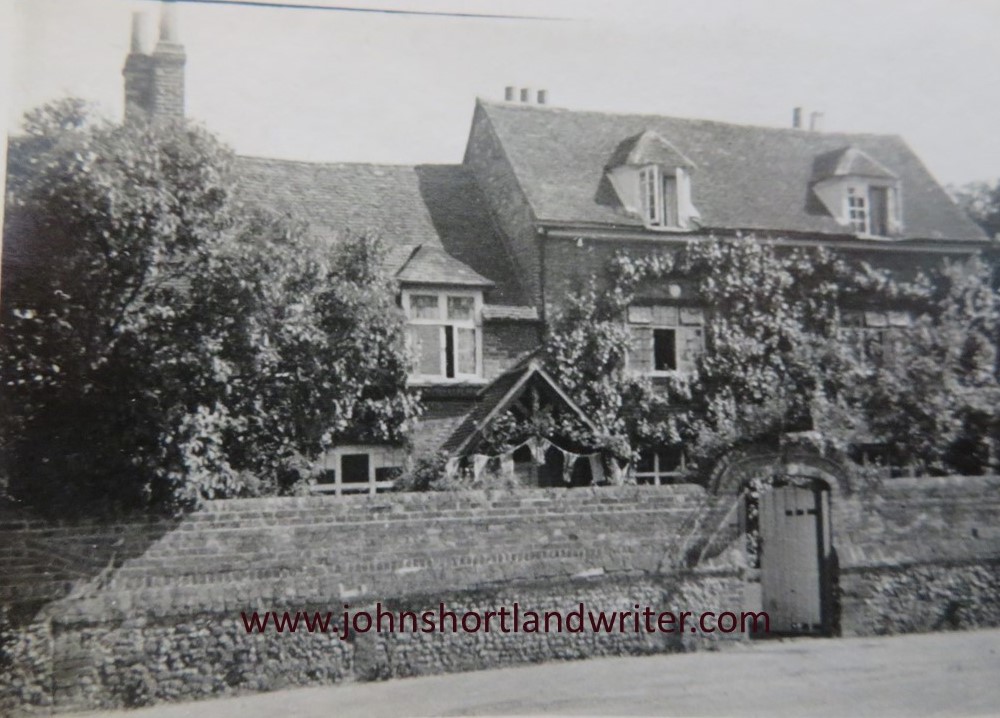
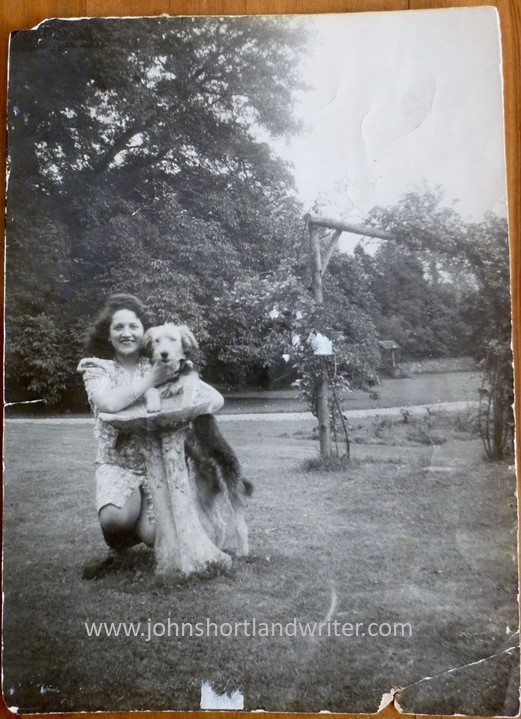
My mother’s career with Odeon Cinemas had progressed rapidly throughout the war and by 1944 she was heading the Licencing Department with a team of assistants. Odeon had, by then, evacuated their offices from London to the small, riverside town of Marlow in Buckinghamshire. She was accommodated in a lovely and old country house in the nearby village of Well End. Living at the Old Malt House must have seemed a different world from the London’s West End where she had been brought up and she would tell of how she would lean out of her bedroom window to pick fruit from the grapevine that grew on the house walls. With extensive grounds, a cook and a housekeeper and the use of a chauffeured car it must have been a life of relative luxury that she would have been unused to. It was here that she also met her future husband – my father – so a very happy and untroubled time for her. All that changed in an instance when, on the first day of December 1945 during the black-out, her car was involved in a head-on accident.
The Old Malt House, Well End – grapevines cover the front of the building – c1943
In those days of cars with no seat belts, my mother had taken the full force of the crash and had been catapulted through the windscreen. Unconscious, she was taken by ambulance to Wycombe Hospital and with multiple facial and head injuries unexpected to survive the night. Fortunately, Odeon proved to be excellent and supportive employers, driving her parents down from London and accommodating them so that they were able to visit her regularly. On Christmas Day she came out of the coma unaware of what had happened over the past month. She would tell of how she had first heard singing and, opening her eyes, saw a blurred vision of people dressed in white that she though must be angels. They were, of course, her nurses singing a carol! Badly scarred and with broken nose and cheekbones she was finally released from hospital unable to work and embarrassed about being seen in public. In her memoir, she described the first day she had to enter a crowded room and how it fell silent when she appeared, a humiliating and distressing moment.
My mother, in the grounds of The Old Malt House, and looking so happy, just before the accident that changed her life – and her appearance
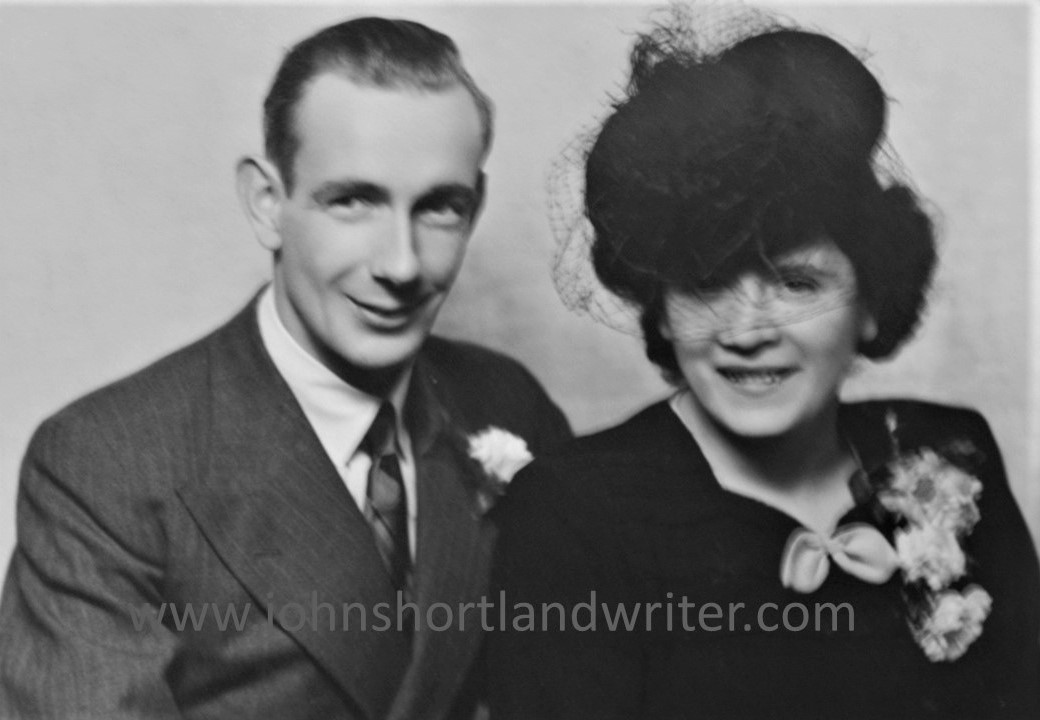
Six months after her accident, Odeon who had been caring for her as well as paying her salary all this time arranged for her to be taken to London to see a doctor at The London Clinic in Harley Street. The doctor was surgeon Arthur Rainsford Mowlem; in mother’s words, “a charming man who promised me he would do all he could.” There followed a series of operations over many weeks where he reconstructed the badly damaged side of her face, repaired the cheekbones, and rebuilt her badly broken nose using part of her hipbone. Looking at her wedding photograph, taken such a short time after in the autumn of 1946, his skilful work is quite extraordinary although my mother kept the picture hidden away; all she could see was a face that didn’t quite belong to her. Nowadays, I imagine, she would have received some sort of counselling but then it was just a case of ‘getting on with it’.
My parents on their wedding day – just weeks after her face had been reconstructed
Living well into her 90s, mother’s issues with discomfort in her neck and head waned over time only to be replaced by a later source of (bemused) irritation. When visiting hospitals there would be a succession of doctors and nurses wanting to look at her facial surgery for none had seen such early reconstruction and to see how it had fared over seventy years. She had been told that she was the first civilian to receive plastic surgery and for the remainder of her long life she was eternally grateful to Odeon Cinemas who had cared for her and paid for her treatment. Most of all, she was grateful to Rainsford Mowlem, without whom she would have had a lifetime of disfigurement; to her he was, indeed a hero.
Mum on her 90th birthday – and seventy years after the facial reconstruction
To read the story of Operation Mincemeat and The Man Who Never Wasclick here
EDIT: Today, 21st June, I was delighted to receive this lovely email in response to this blog post from The London Clinic where my mother received her revolutionary treatment 70 years ago. They are happy for me to share it with you– you may need to click on the image of the email to make the typeface clearer…












 Life in the English Cotswolds