Woodstock and Blenheim Palace

Woodstock, a small town in the Oxfordshire Cotswolds, has a long history.  The Domesday Book, a survey of England & Wales completed in 1086, describes it as a Royal Forest – a hunting preserve for nobility.  Fifty years later the area was enclosed by a high wall, a shooting lodge built, and exotic animals, lions and leopards kept within. Just short of a century later, in 1179, King Henry II built Woodstock Palace and granted a Royal Charter that established a market on its boundary.  From thereon, the town developed and prospered.  The palace witnessed several important moments in English history including the imprisonment of the then Princess Elizabeth who became Queen Elizabeth the First, and later, it sheltered King James I who had fled London during a plague.  By 1653 the Palace had been destroyed by the Roundheads (Parliamentarians) during the English Civil War.

The original palace at Woodstock built by Henry II in 1179 [Source:Wikipedia]

The ruins of the palace and its parkland were gifted by the nation to the 1st Duke of Marlborough in recognition of his military triumphs that climaxed with the Battle of Blenheim in 1704.  Blenheim Palace, for which Woodstock is now justly famed and visited annually by thousands from all over the world, was built in its place and, with over 180 rooms, it is one of the largest privately-owned houses in England.  The birthplace (in 1874) and ancestral home of wartime leader, Sir Winston Churchill, the splendour and history of the Palace was recognised as an UNESCO World Heritage Site in 1987.

Blenheim Palace, one of the largest private houses in England

With mixed financial fortunes over the centuries, the Palace has seen many changes both internally and externally.  The parkland was much altered by the eighteenth-century landscape architect, Capability Brown.  The River Glyme that runs through the park was dammed and the Great Lake formed, in the process part-drowning the enormous bridge designed by Vanbrugh.  Incidentally, the river is the same one as the little winding river that flows in ‘our (now not so secret!) secret valley’ and used in the header of this blog.

The dammed tiny River Glyme created the Great Lake at Blenheim Palace…
…in the process, the huge bridge designed by Vanbrugh was partly submerged

Despite the centuries that have passed, the town still clusters outside the entrance to Blenheim Palace.  Being so small (only 3,500 people live here), it is a great place to explore on foot – something that is missed by most visitors to the Palace who, if they enter the town at all, stay within the two shop-lined streets at its centre.  Behind these lie the church and quaint, timbered houses.

Ancient houses overhang the narrow streets of Woodstock
All the old house and cottages differ from one another in appearance

Of course, it is the Palace that dominates Woodstock despite being barely visible from outside the Park.  The entrance that cars and coaches enter by, is splendid enough, but doesn’t match the grandeur of the town gate.  Just past the ‘tourist’ entrance (and so rarely noticed) are the splendid almshouses built in 1798 by Catherine, Duchess of Marlborough.  A visit to the Woodstock Museum should be on everyone’s agenda too; it contains a dinosaur garden to keep the children happy.
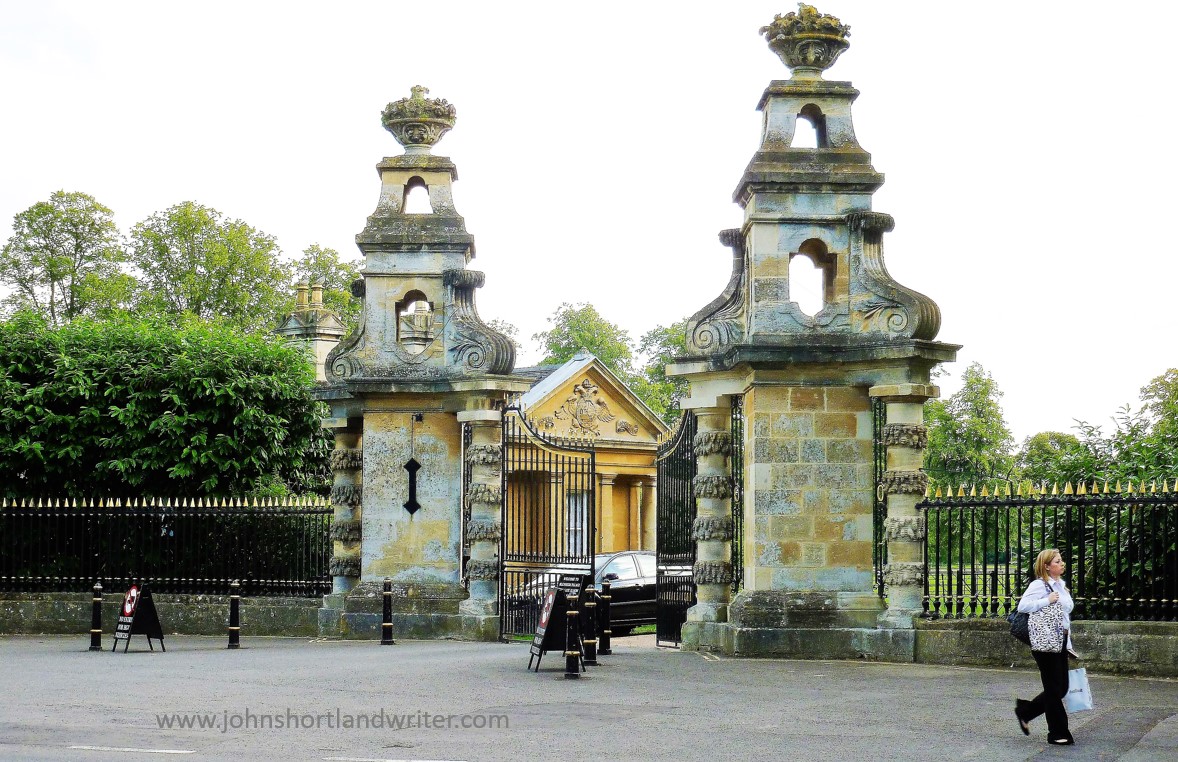
The gate by which visitors enter is grand enough but…
…it doesn’t match the splendour of the ‘town’ gate

The town has several hotels and makes a good base to explore further afield; Oxford with its universities is only 15 miles away and there are numerous villages and National Trust properties and gardens to visit within the area.  For keen hikers two long-distance trails, the Wychwood Way (36 miles) and Shakespeare’s Way (146 miles) pass through the town and, as in most of England, numerous public footpaths criss-cross the countryside where you can roam freely. Walking is one of the best ways to see the Cotswolds and it is great exercise too. All the footpaths connect with one another so you can easily take shorter walks but, if you have the time, it is possible to walk from one end of England to the other!
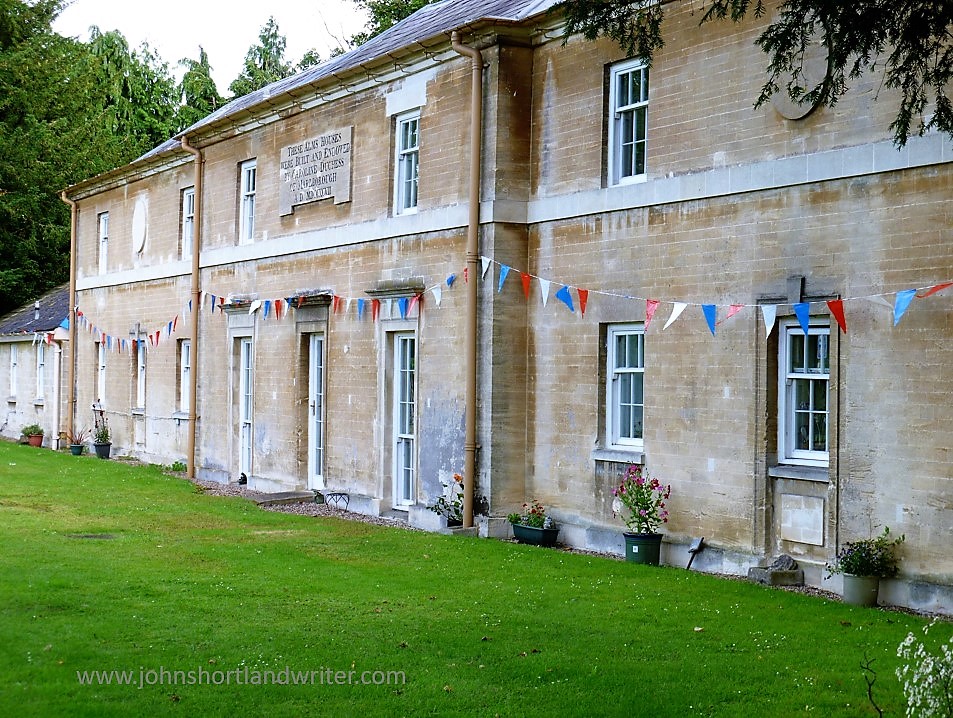
The almshouses in Woodstock built in 1798

***********************************
[If you would like specific details of any aspect of staying locally and/or walking routes, places to visit, etc please feel free to contact me and I will do my best to answer your queries]

Sources: 
Wikipedia The Long Distance Walkers Association  Cotswolds.info                                                                                                                      The Making of the English Landscape, W G Hoskins     
                                                                                                                                                                                                                                                      

Finding Blue John

Recently I spent a long weekend in the Peak District – not really long enough to explore properly despite it being Britain’s smallest national park.  However, there was time to explore the small town of Bakewell, home of the famous and very tasty Bakewell Tart as well as a drive through the Chatsworth Estate.  The ancestral home of the Dukes of Devonshire had to be ignored on this occasion but lunch at their farm shop was well worth breaking the journey for. For photographs and a description of these places see my earlier post by clicking on the link The Peak District’s Soft Centre.  Finally reaching the area known as the High Peak (despite the name there are no mountains in the Peak District) a roadside sign pointing in the direction of Blue John led through glorious countryside.

Chatsworth (1) watermark

Chatsworth House

Blue John Mine (2) watermark

View from the Blue John mine

Blue John is a fluorite semi-precious mineral that in its raw state appears quite dull.  After drying, preparing and polishing it takes on a number of colours ranging from purplish-blue through to yellow.  Despite numerous tests and analyses the origins of the colour has not been discovered.  Blue John is also a rare stone for although similar minerals have been found elsewhere in the world there are only two known places where its unique quality can be found – and those are both in the same hillside in the Peak District.

Blue John Mine (3) watermark

Blue John in its raw state

1280px-Cliff_Blue_Vein_Bowl_-_Castleton_Visitor_Centre

    Blue John after processing – the bowl is in the Castleton (Peak District) Visitor Centre.         Copyright: Pasicles via Wikipedia

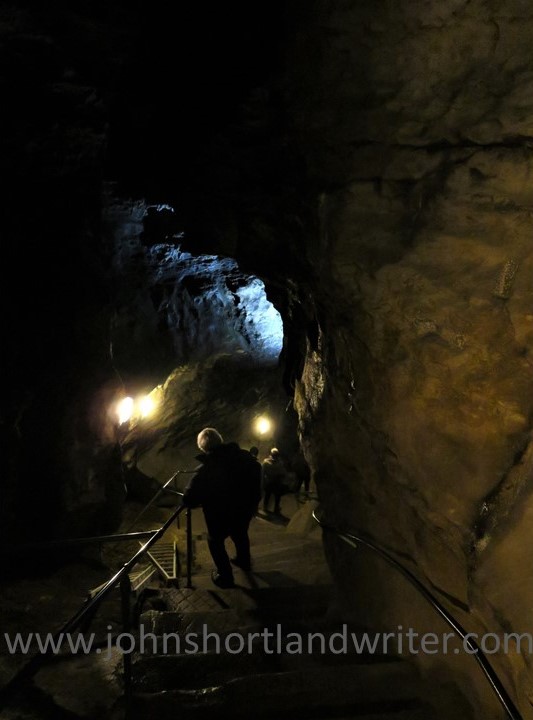
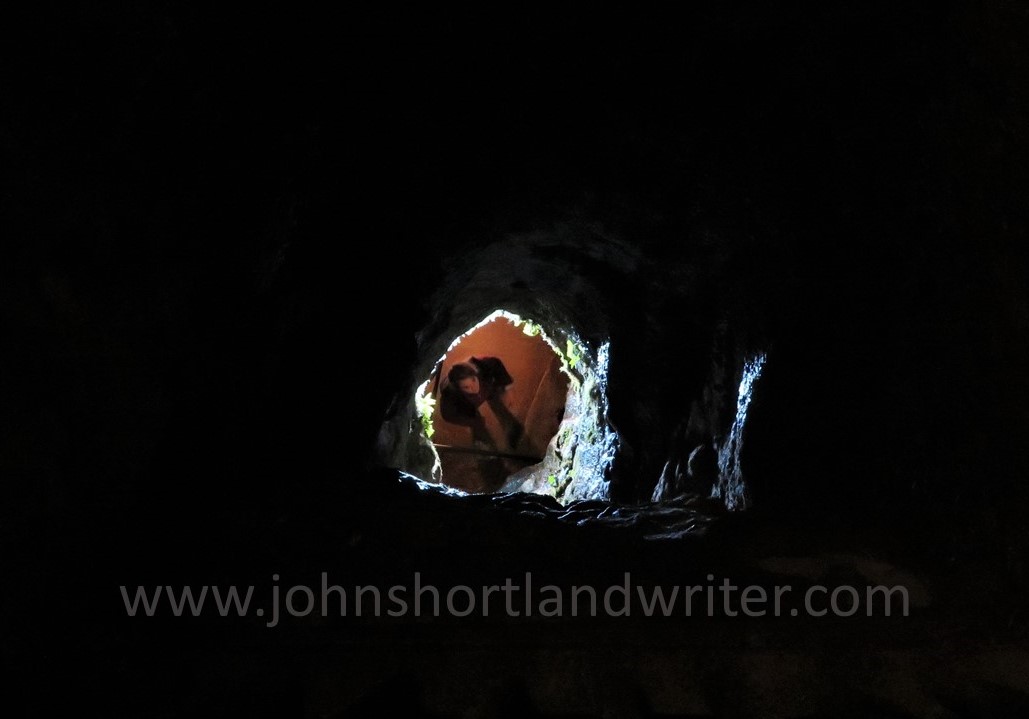
Visiting the Blue John mine is not for the faint-hearted or the short-of-breath for that matter: there are two hundred and fifty steps to descend and then, of course, you have to climb back up them to reach the surface once more.  Don’t complain, ‘though, or you may have to descend by rope as the early miners once did.  Fortunately, I only looked down it to see the visitors below.

Blue John Mine (11) watermark

The descent into the mine

Blue John Mine (4) watermark

The alternative way into the mine – being lowered by rope!

Inside the mine there are low tunnels to pass through contrasting with vast caverns with roof heights of 200 feet or more, either created by ancient rivers or by the miners themselves.  Each cavern has its own unique characteristic although it is difficult to catch it on camera.  The one below is named Lord Mulgrave’s Dining Room, a huge circular space formed by a whirlpool and so named after the dinner Lord M gave his miners there.  The thought of the cooks and food being lowered deep into the mine gives a new angle to the term ‘outdoor catering’!

Blue John Mine (5) watermark

Blue John Mine (14) watermark

Lord Mulgrave’s Dining Room

The Waterfall Cavern is colourful with the stalactite formations along one side appearing to be frozen water.  Elsewhere there are numerous fossils where marine animals have been ‘captured’ for posterity.

Blue John Mine (8) watermark

‘The Frozen Waterfall’

Blue John Mine (22) waterfall

Fossils embedded into the mine walls

Throughout the mine the colours and texture of the rock formations are extraordinary and constantly changing.  In one cavern it is easy to ‘see’ the rocky and meandering bed of the prehistoric river that formed it, the difference being that it is way, way above one’s head.  In another, a giant, triangular rock has fallen to balance on its point.

Blue John Mine (16) watermark

The overhead ‘riverbed’

Blue John Mine (12) watermark

Huge and precariously balanced

The tours, which are led by miners, for Blue John is still mined here during the winter months, last about an hour.  At the end of the tour all there is left is to climb the two hundred and fifty steps back to the surface…

Blue John Mine (19) watermark

The long climb back to the surface


For further details of the history of the Blue John Mine and visiting hours visit their website here.

To give overseas visitors a better idea of its location, the Peak District National Park is approx. 3.5 hours by car, north from London; by public transport allow 6-7 hours.  There are plenty of hotels, traditional pubs and self-catering cottages available for overnight stays.

Guiting Power, a Cotswold village

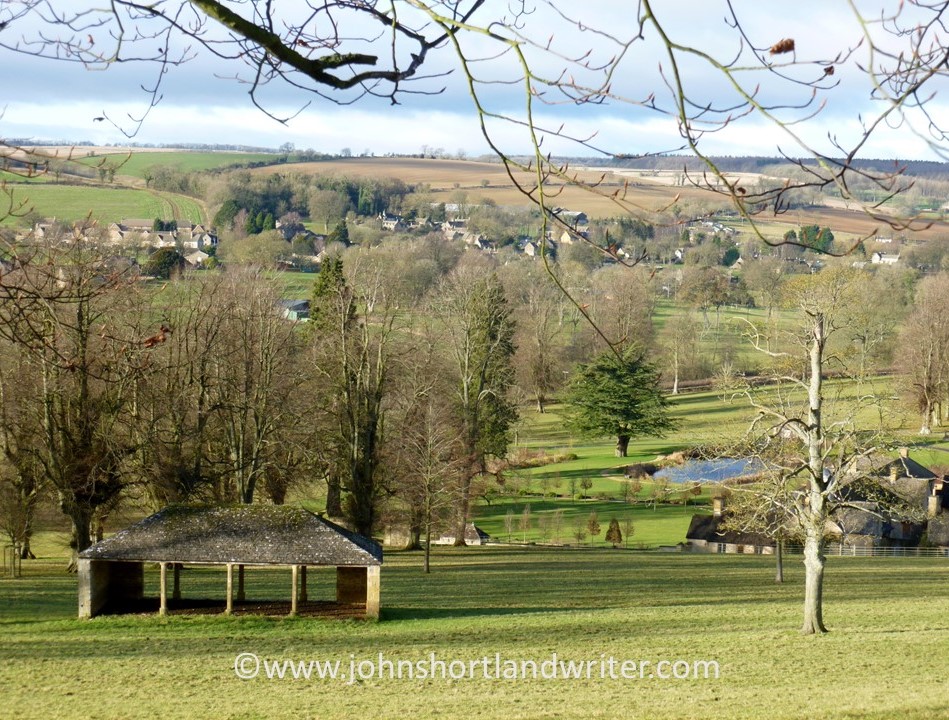
The Cotswolds (Cotswold Hills) are fortunate in having very many attractive stone built villages, protected by its AONB (Area of Outstanding Natural Beauty) designation.  One such place, and a little off the beaten track so not as well visited as some of its more famous neighbours, is Guiting Power.

guiting-power-2-copyright

A visit during the week, when most others are working, is like stepping back to a time when life was much slower and with fewer cars and people.  The village has a population of 300 and also lies on the Wardens’ Way, a fourteen mile footpath, but even during the busiest of times it is hardly bustling.  Linking with other public paths it is possible to make a circular walk centred on the village.

guiting-power-3-copyright

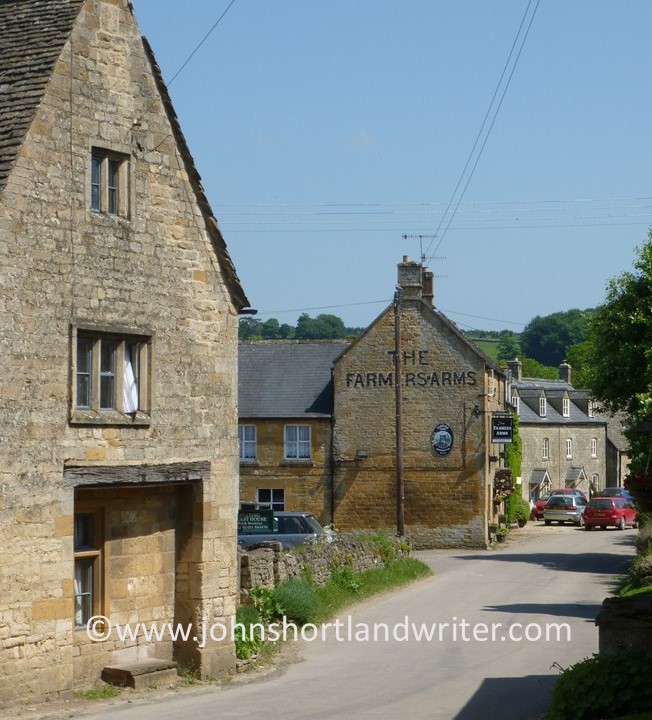
As well as for the building of modest cottages, the soft Cotswold stone is used everywhere – to enclose fields, to create stiles, churches, barns, pubs and the grand houses of the wealthy.

guiting-power-stone-stile-copyrightguiting-power-cotswold-barn-copyright

If long country walks aren’t your thing, there’s still plenty of things to do and see.  The church dates from the twelfth century and has the foundations of an earlier one nearby.  Sudeley Castle, near Winchcombe is just a few miles away.  Within the village, The Farmer’s Arms pub offers traditional beers and skittles; just outside the village The Hollow Bottom is a pub popular with the horse racing fraternity.   The Old Post Office, as well as continuing in its traditional role is also now a thriving coffee shop  For almost fifty years the village has hosted an annual music festival.  Adam Henson’s Cotswold Farm Park is also close by.
guiting-power-5-copyrightguiting-power-copyright

Useful links:
How to get there

The Wardens’ Way Footpath

The Hollow Bottom Pub with rooms

The Old Post Office

Guiting Music Festival

Sudeley Castle

Adam Henson’s Cotswold Farm Park