Creating Warmth in the Garden

Here, in the UK, we’ve been having the dreariest of winters with what seems weeks and weeks of mild temperatures, heavy overcast skies and incessant rain.  There have been a few cold, bright days but these have been rare.  The view from my window as I write this is of greyness reflected in grey floodwater where our little, winding river has overflown into the field below our house.  Some days it has been so dark and gloomy that the electric lights have had to stay on.  So it seems appropriate to write now about bringing warmth into the garden especially as it is the perfect time to create a new design whether it’s a single bed or a complete redesign.
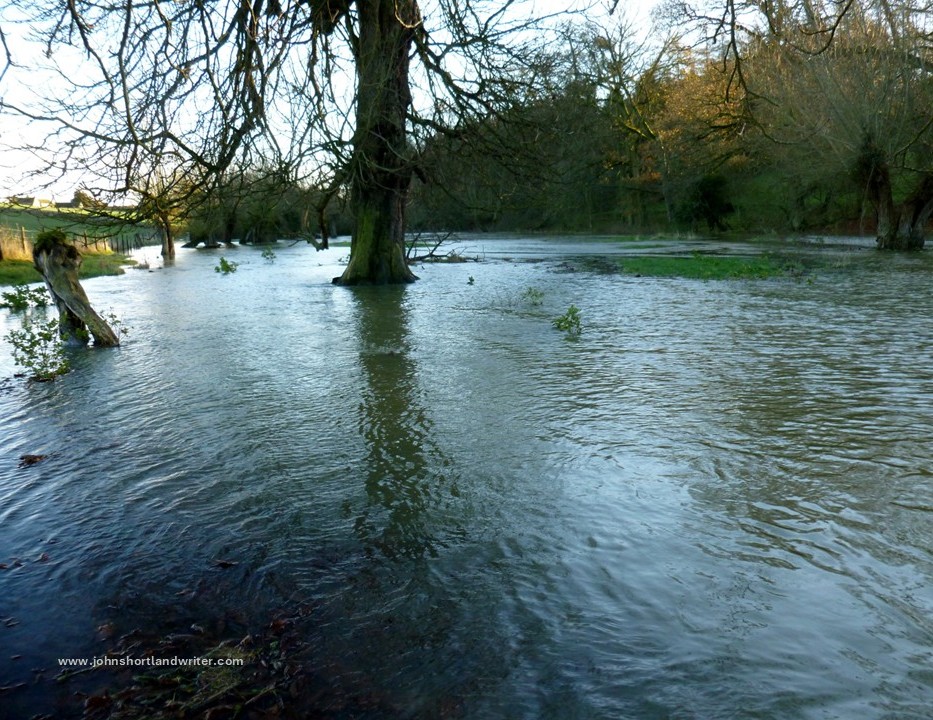
Floodwater below our house which fortunately sits high enough above it to be ok

Obviously, sun is the most important and easiest way of creating warmth and the garden may already have a patio or other seating area in the sunniest spot.  This isn’t always the most sheltered place however, and there is a world of difference between a welcome, cooling breeze on a hot day and a stronger wind that makes sitting there less comfortable.  There are a number of ways to temper the wind without having to build a solid structure which quite often can create issues with turbulence elsewhere.  The simplest method is by planting, whether a hedge or more open, looser shrubs.  Trellis also works well – we’re aiming at filtering the wind rather than blocking it.  The height does not have to be great to have the desired effect.  The image below shows the early stages of screening using plants – it will also, in time, block out the unwanted view of the road behind.
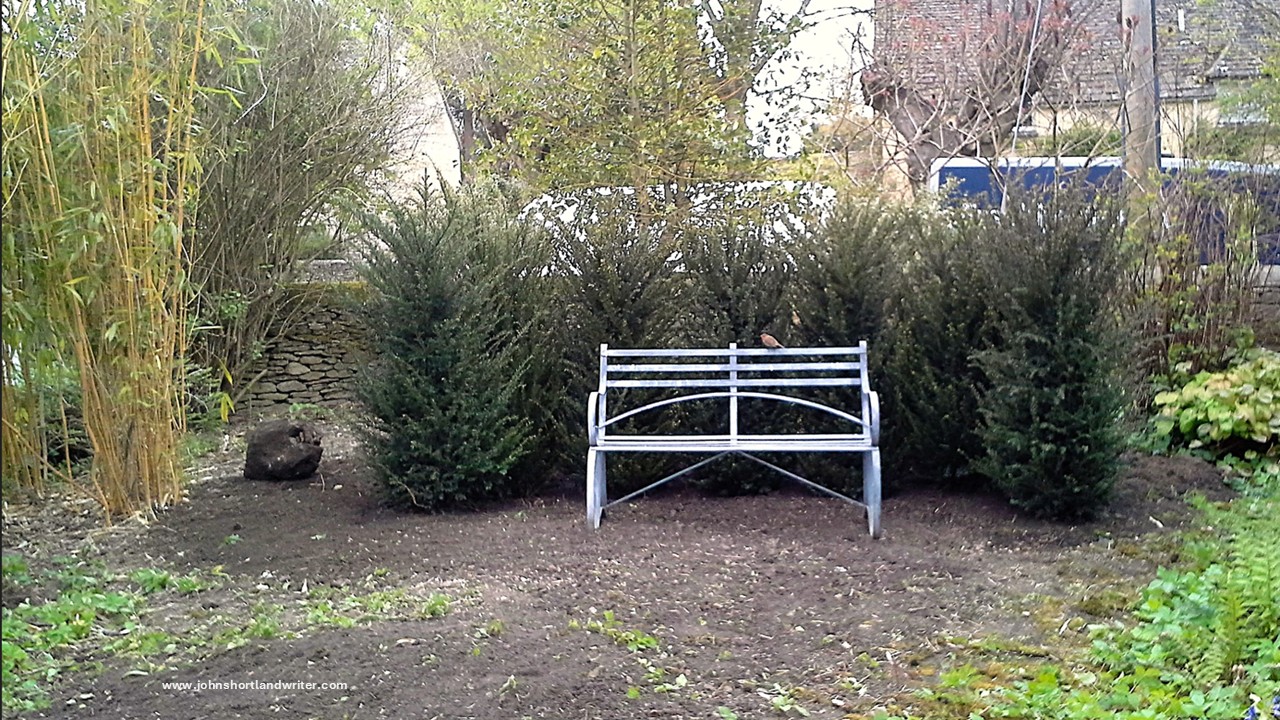
Screening around a small seating area using yew hedging which will become dense within a year. Note the bamboo to the left of the photo with its warm, golden stems

For screening, I often use (as above) yew hedging which gives a good, dark green background and only needs clipping once a year.  It can be bought at various heights and being evergreen, looks good all year round.  Bamboos, now getting rather a bad reputation for being invasive are also excellent if they can be prevented from spreading too widely.  There are some clump forming varieties which are more self-restrained.  In fact, more or less any shrub can be used to make the garden or part of it feel warmer; the secret is to use those with coloured stems or leaves, or flowers that have a hint of the exotic about them.  Bear in mind, ‘though that flowers are often fleeting.
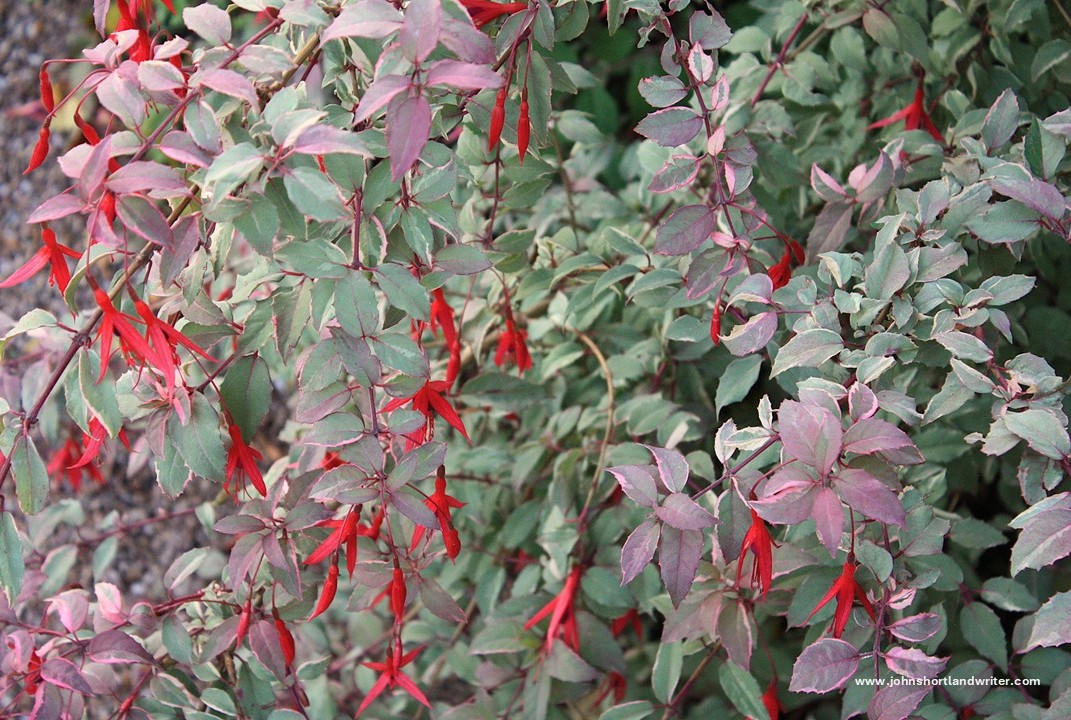
Fuchsia megallanica gracilis ‘Variegata’ : an example of a medium-sized shrub that is hardy, exotic-looking and beautiful
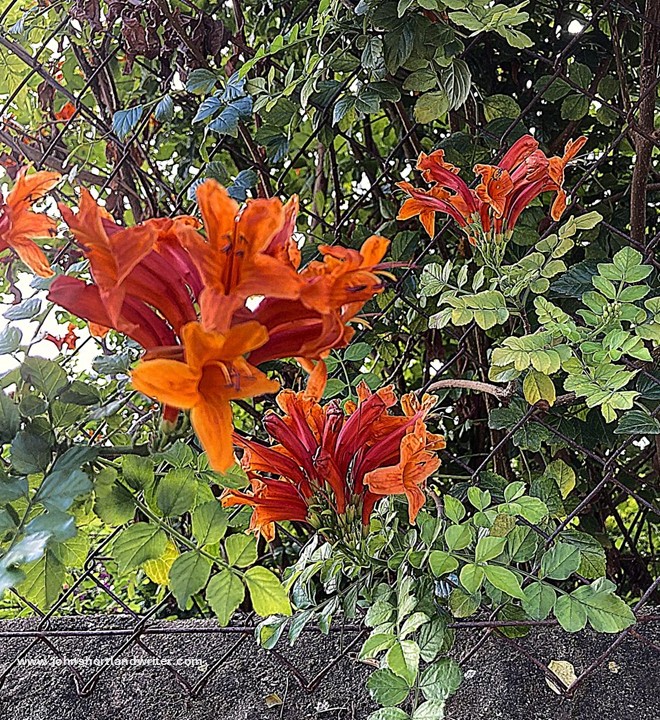
The fiery orange booms of the Trumpet Vine, here climbing through an old wire fence will bring a touch of the Mediterranean to any garden

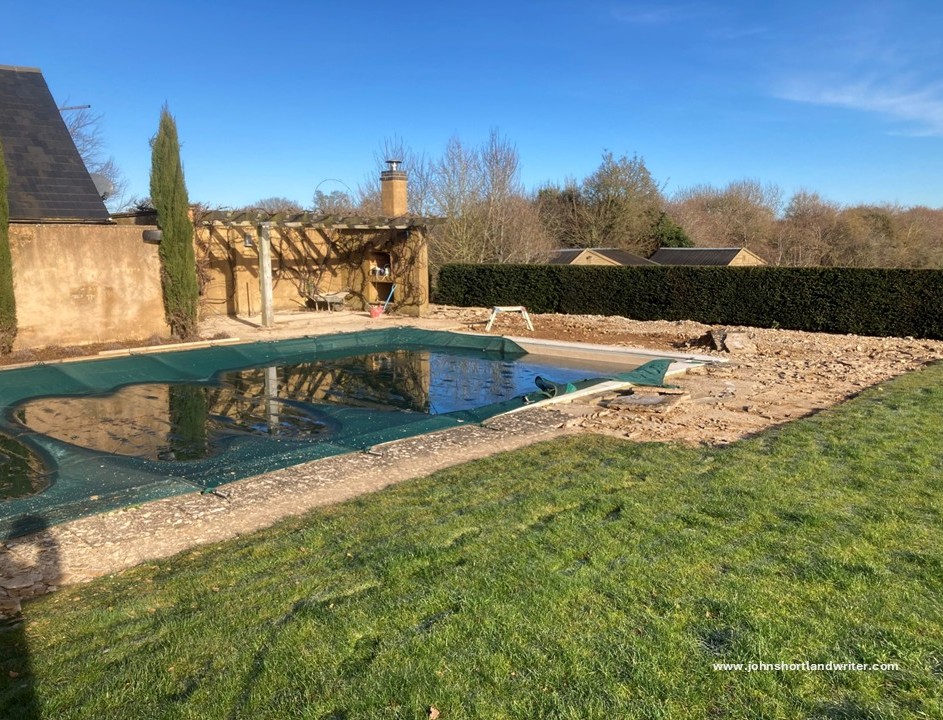
Although we’ve been talking about ways to make the garden feel physically warmer, it is through the planting of the smaller flowering plants that give the real impression of warmth and here the choice is almost limitless.  The rule is to use strong colours and to keep the softer shades to the minimum.  For the example I’m going to use here, I created this ‘hot’ garden which would be at its best during the summer months when the swimming pool is in regular use.  For cooler evenings or for entertaining there is a vine covered pergola adjacent to a built-in fireplace/barbecue.  Note the use of terracotta painted walls which immediately transports you to the Mediterranean.  In fact. Some don’t believe that the two photos below are really of a garden in one of the coldest parts of southern Britain!
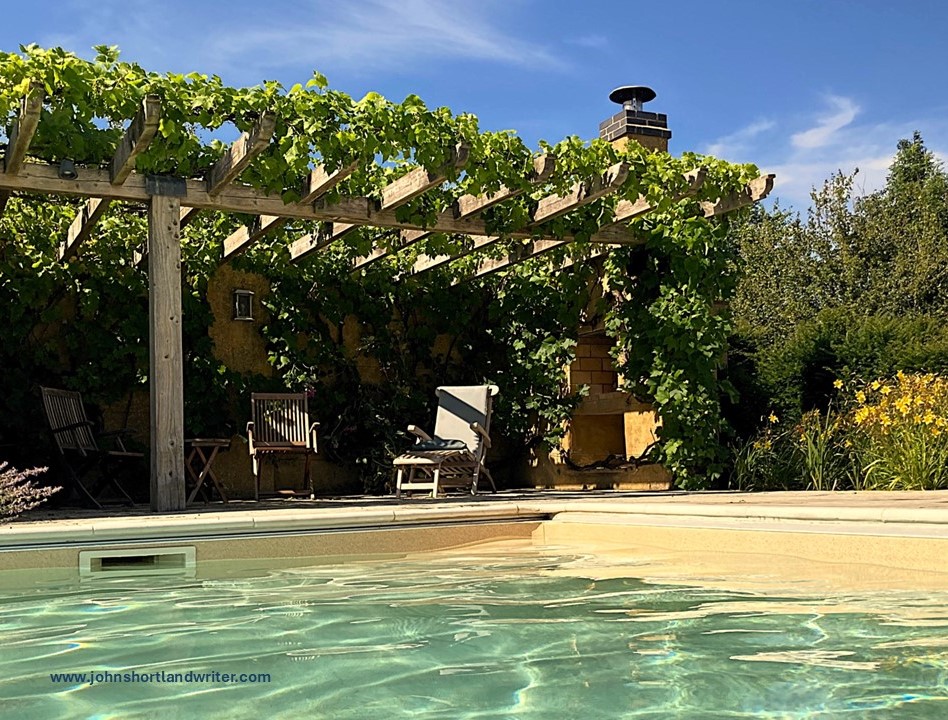
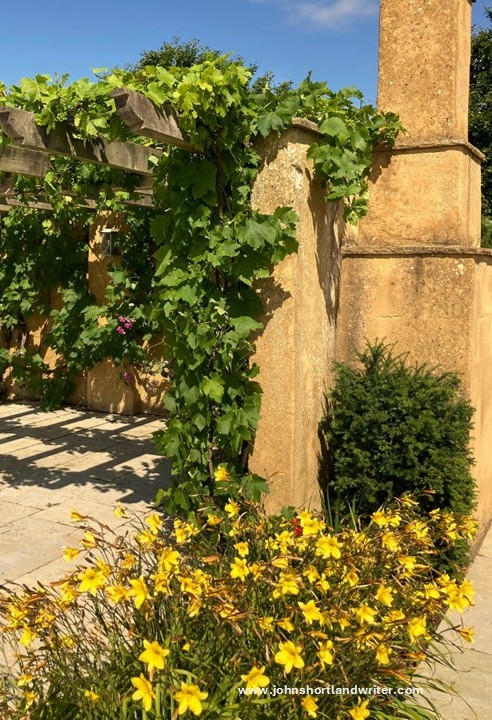
The warm tones of the pool, paving and walls transport you to a warmer climate than the realities of an English summer!
Golden day lilies blend beautifully with the walls of this outdoor fireplace and barbecue area. The grape vine hanging loosely over the beams give shade and the sense of being somewhere other than England

Nearly all of this swimming pool garden is enclosed by yew hedges for shelter and privacy; an existing wall has been coloured terracotta as mentioned above.  Shrubs have been kept to the minimum: there are four Physocarpus Lady in Red’ which has fiery new leaves which darken to burgundy as they mature.  Using the one variety helps to unify the design as well as giving some structure to the borders.  Two figs are trained against the wall and pencil-shaped Italian cypress trees also give that Mediterranean feel (see further note at the end of this blog). 
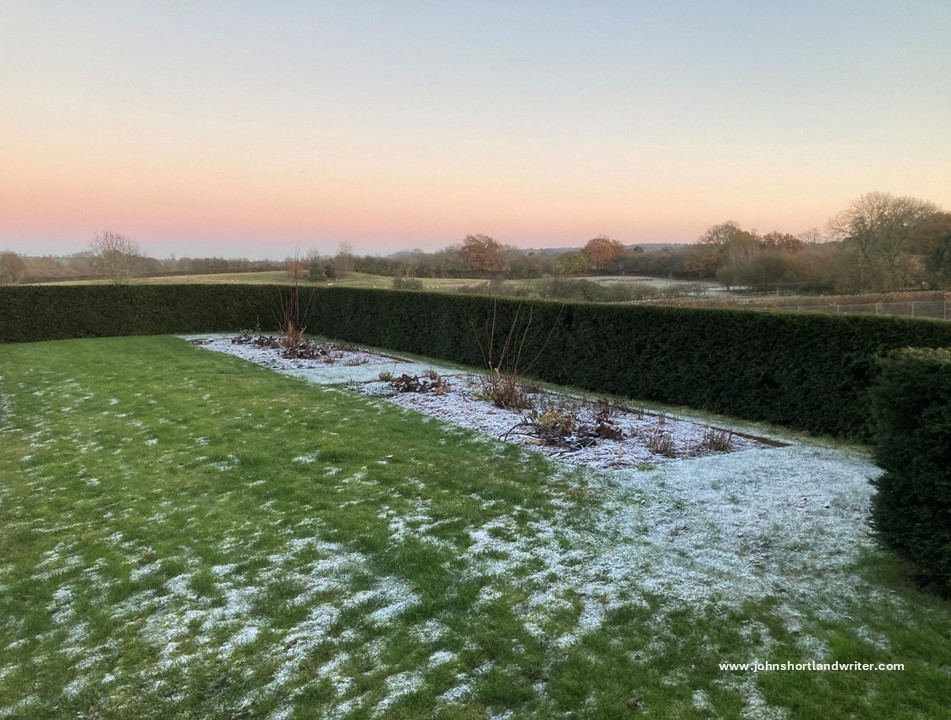
Transforming a cold garden into a hot one!
In January the garden was almost derelict, by midsummer it had been completed

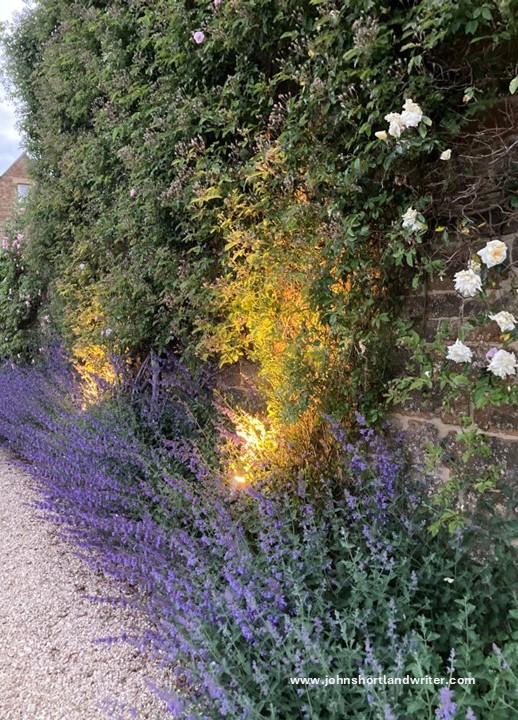
For the planting of the borders, the one against the wall only has catmint (nepeta).  This is a useful plant for it smothers weeds and is equally smothered in blue flowers which compliment its silver-grey leaves.  It is here that two of the Physocarpus are also planted to give a contrast in both height and leaf colour.  As soon as the first of the catmint flowers begin to fade it is important to then cut off every stem to ground level.  This may seem ruthless, especially as there will still be quite a lot of flower on it but within two weeks it will regrow and soon be flowering again.  If left, the first flowering stems die back and the plant looks messy.
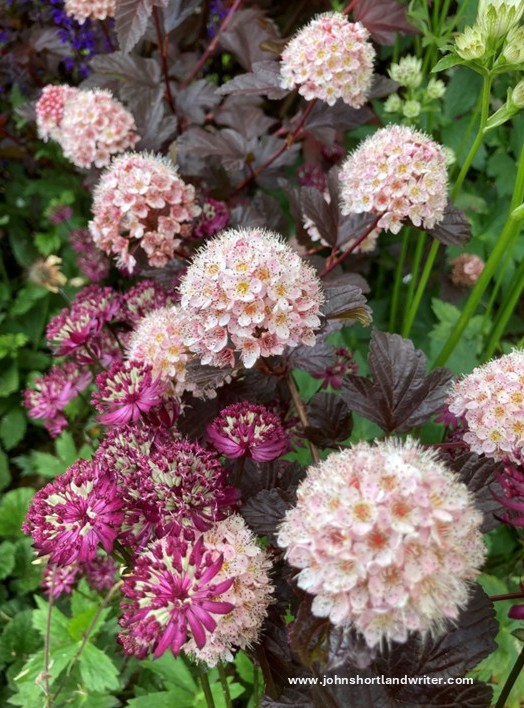
The ball-headed flowers and dark leaves of Physocarpus compliment the contrasting Astrantia ‘Claret’
Catmint (Nepeta) flowering elsewhere in the garden

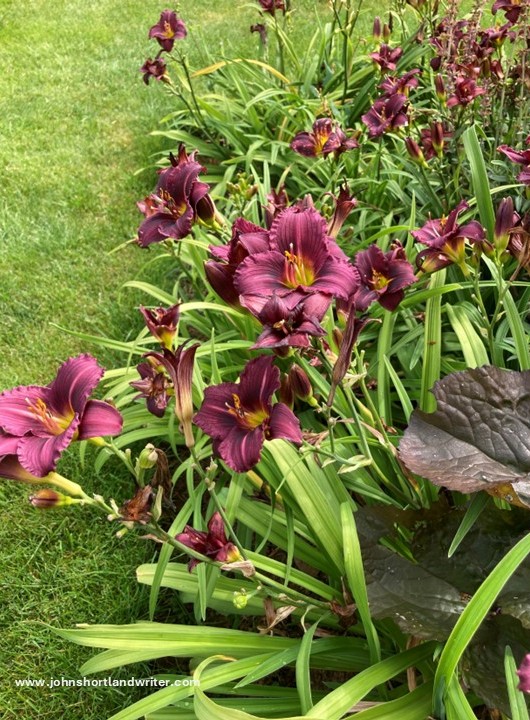
The twin borders are set back from the pool, and again Physocarpus are used as the centrepiece for height.  The burgundy theme is continued with the deep wine-coloured leaves of Ligularia, the papery flowers of Astrantia and trumpet-shaped Day Lilies (Hemerocallis).  The latter are an especially useful plant for they send out their bright green and sword-like leaves early in the spring and they never look untidy.
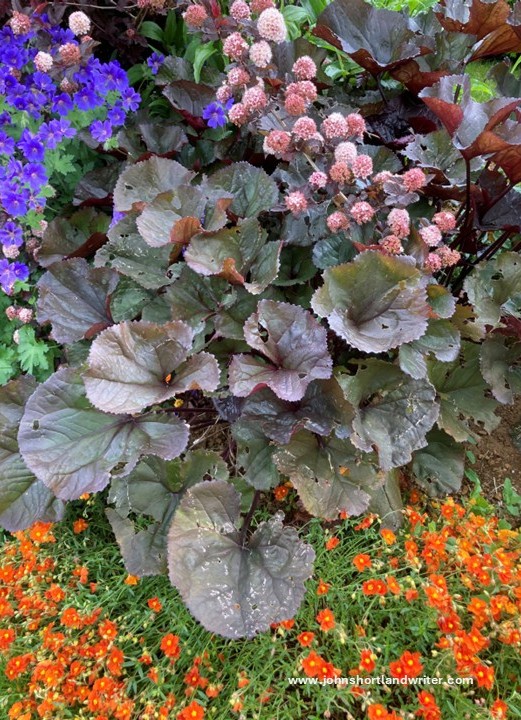
The dark leaves of Ligularia contrast with the tiny orange flowers of Helianthemum. Later the Ligularia will send up spikes of golden flowers
Day Lilies flower all si=ummer if regularly dead-headed. This one is Hemerocallis ‘Little Grapette’

For contrast, and to maintain the hot theme,  I have mostly used oranges and golden yellows, the plants chosen to give continuity of display from June to the first frosts.  These are interplanted with purple salvias and shocking pink echinacea to break the colour – not too many: just enough to emphasise how much orange/yellow there is, if that makes sense.  This part of the garden isn’t used much for the rest of the year but the displays could begin in early spring with golden daffodils, especially the exotic looking orchid varieties, followed by masses of deep-coloured tulips and wallflowers.  For the winter, the scarlet and orange stems of dogwoods would brighten the dullest of days.  My client didn’t want too many pots or planters but I did manage to squeeze in two planted with the wonderful dwarf Pittosporum ‘Tom Thumb’.  Summer pots filled with zinnias and tall spikes of fiery red or orange cannas would really compliment a garden like this, but it’s not to be.
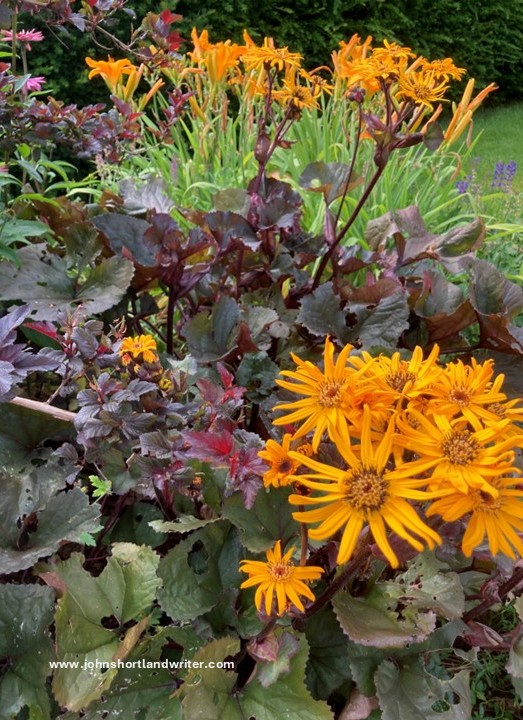
Although the same tone, the shape of the orange daisy-like flowers of the Ligularia contrast well with the trumpet-shaped Hemerocallis ‘Burning Daylight’ in the background
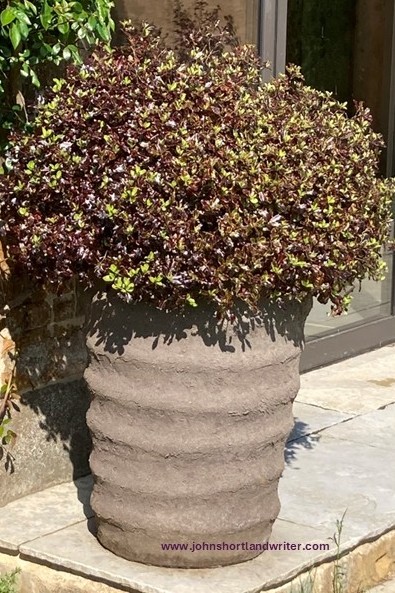
Pittisporum ‘Tom Thumb’: the new pale green leaves turn to burgundy as they age

I hope that this post may have inspired you to be bold with your choice of colour.  I’ve illustrated it with one garden devoted to this style of planting but it can be greatly scaled down to just a single bed or corner – the twin beds above only measure about 5m x 2m each.  Below is a list of the plants that I have used which is by no means, exhaustive for there are endless possibilities to choose from.
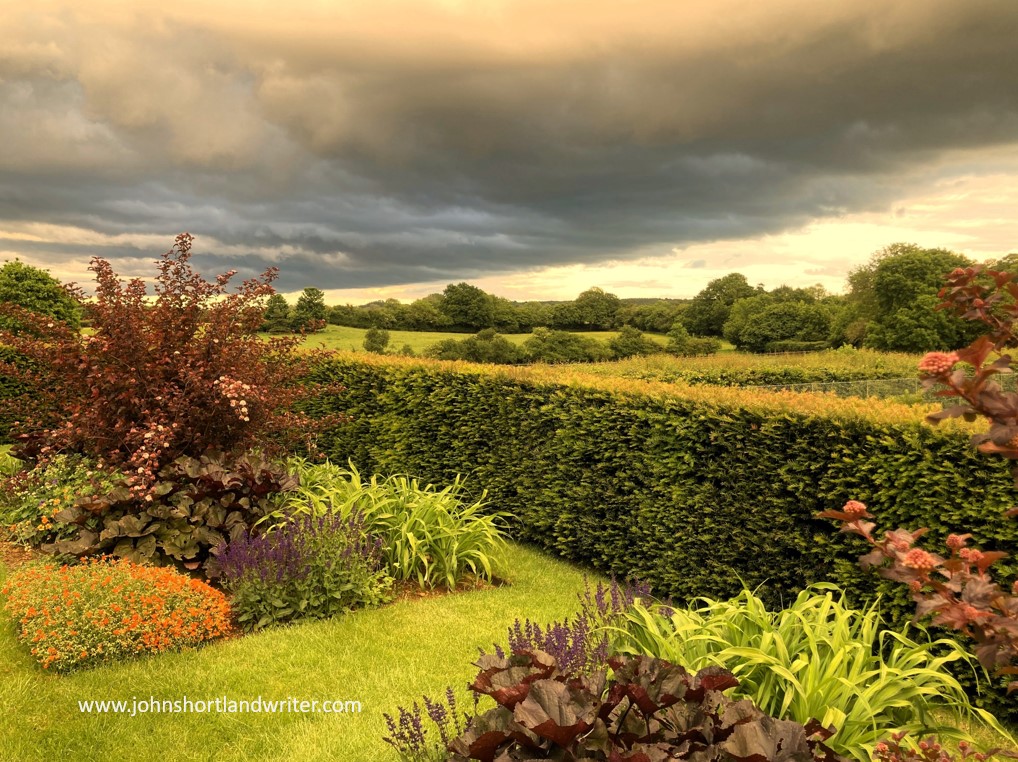
Two year on and the the twin borders glow under the dramatic evening light

Plant List
Astrantia ‘Claret’
Echinacea purpurea
Geranium x magnificum
Geum ‘Princes Juliana’
Helianthemum ‘Hennfield Brilliant’
Hemerocallis ‘Burning Daylight’
Hemerocallis ‘Little Grapette’
Ligularia ‘Desdemona’
Nepeta ‘Walker’s Low’
Physocarpus ‘Lady in Red’
Potentilla fruticosa ‘Tangerine’
Rudbeckia ‘Prairie Glow’
Salvia ‘Mainacht’

A note about the Cypress trees.
The cypress were already established and are now beginning to get too large for the space so may end up being removed. When reduced in size they tend to lose their elegant shape.  I am inclined to replace them with Irish Yew which is naturally columnar in shape and withstands pruning.  The golden-leaf cultivar would blend well with the walls as well as contrast with the dark green yew hedging.

If you’ve enjoyed this post and found it helpful and interesting don’t forget that there’s my book that reveals all sorts of gardening tips. Written in an informal, no-jargon way for the newcomer to gardening but also for those with more experience. If you’re not that enthusiastic about your own garden or have little time to devote to it then this is the book for you! Available from bookstores and/or Amazon.
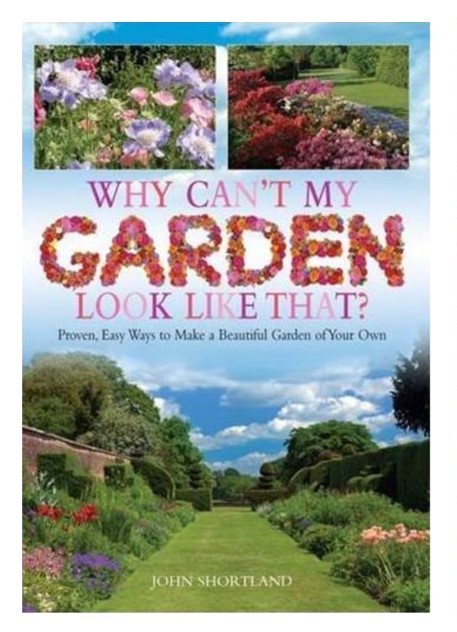
With a foreword by Josceline Dimbleby

Happy Gardening!

Going Round in Circles

Designing your own garden is, I think, far trickier than designing someone else’s. One of the problems is that emotion gets in the way. I’m not suggesting that there shouldn’t be passion in design but far too often one is tempted to hang onto things that have no place in the new design, whether it is a plant or a pot – or in this example, far too many pots!Garden Makeover 3a copyright

The garden shown here was quite a good size but difficult for it was on a gentle slope and there was need for a central path to lead to sheds at the far, and lower, end. To avoid splitting the garden in half, large circular stepping stones had been randomly placed but the result was a confusing mish-mash of shapes and plants. The only place the eye focused on was the rotary washing line!Garden Makeover 1c copyright

You don’t need to be a great artist to design a garden. A simple method is to take photographs, turn them into black and white (for colour confuses the eye) and pencil sketch over them. Here, we were quite keen to improve on the circular theme.
The final result was a series of circles, each with a low retaining wall and a step down to allow for the change in level. Trellis was used to screen the sheds. Although the hard landscaping took up more of the garden than before, the remaining planting area was far more useful and could be crammed with plants. The little walls made perfect low seats.Garden Makeover 2c copyrightGarden Makeover 1b copyright

And what happened to all the pots? Most of these were discarded in favour of a large, custom-made, L-shaped timber box. This gave a better space for planting as well as making a feature in its own right. Water-retaining gel crystals were added to the planting soil reducing the need for regular watering.Garden Makeover 3d copyright

You can find more ideas on all aspects of easy, trouble-free design, plants and gardening techniques in my book, Why Can’t My Garden Look Like That?  To take a peek inside the covers click on the link here.

BOOK COVER

A Host of Golden Daffodils

If you want to see, as Wordsworth did, a ‘host of golden daffodils…beside the lake, beneath the trees, fluttering and dancing in the breeze,’ in your own garden now is the time to plant them. What’s more, you don’t need a lake or rolling acres to have a spectacular show. The secret is to plant them in quantity and with a little thought on position.

Daffodils (2)    copyright

Daffodils (Narcissus) are incredibly easy to grow for every full sized bulb that you buy already has next spring’s flower formed within it. All you have to do is pop them in the ground as soon as possible after purchase and nature does the rest.Daffodils (2)   copyright

A general rule is to plant any bulb twice the depth of its height: so if your bulb is two inches high, your planting hole needs to be four inches deep. When they are tucked safely below ground at that level the bulbs aren’t so likely to get damaged when weeding. To get the ‘host’ look don’t plant singly or in tiny groups of twos and threes. Think big, think twenty-five, fifty or even a hundred or more. This may sound an expensive option but daffodils are readily available in bulk mail order and many garden centres offer a ‘cram as many as you can into a bag’ deal. It is worth remembering too that the bulbs will continue to increase in quantity and flower for many years making them incredibly good value for money.

Naturalised Daffodils   copyright

Because daffodils flower early in the year, before most other plants in the border have got going, it is not necessary to plant them at the front. If they are planted further back, later their dying leaves will become hidden by spring growth. You will find that when planted too far forward, they are both unsightly and a nuisance.

Narcissus 'Salome'

Narcissus ‘Salome’

One of the best ways of growing daffodils is to grow them in grass or under trees – just as Wordsworth saw them. The simplest way to do this is to simply throw the bulbs and plant them where they fall. Some will land very close together and some further apart which makes them look as if they have been growing there forever. Make the throw gentle, a cross between underarm cricket and bowls – you’re not trying to win the Ashes. In grass, the bulbs will be easier to spot if you mow the grass as short as possible beforehand.

Naturalised Daffodils (3)   copyright

Which varieties to select is only difficult because there is almost too much choice. For naturalising I tend to select three standard varieties that flower at slightly differing times, thereby extending the flowering period. In the borders I just choose those varieties that I fancy.

Narcissus 'Chanterelle'

Narcissus ‘Chanterelle’

Although daffodils are best planted during August and September, I usually find I’m too busy with other garden tasks then. I have found they can be planted right up to December without a problem providing wintry weather hasn’t closed in. If the thought of planting large quantities sounds rather daunting remember you can always plant year after year until you’ve achieved the aimed for look.

Nine thousand daffodils!

Nine thousand daffodils!

John Shortland is the author of Why Can’t My Garden Look Like That? a jargon-free and easy to read gardening manual, available from Amazon and good bookshops.  To take a peep inside click on the image below.

BOOK COVER FROM AMAZON

A Year in Review 2013: the Second Half

July to the end of  December already is a memory and rapidly becoming a distant one at that.  Just five days into January and Christmas seems further back in the mind than it is in reality.  2014 has arrived and I am optimistically looking forward to all that it may bring.  Not that the last one was disappointing or sad in any way; just that with time flying by it is essential to make the most of every moment.  Of course, I’m very fortunate: I have my health, I have a great job, friends and family I can always rely upon and I live in a superb part of the English countryside.  Long may all those things last!

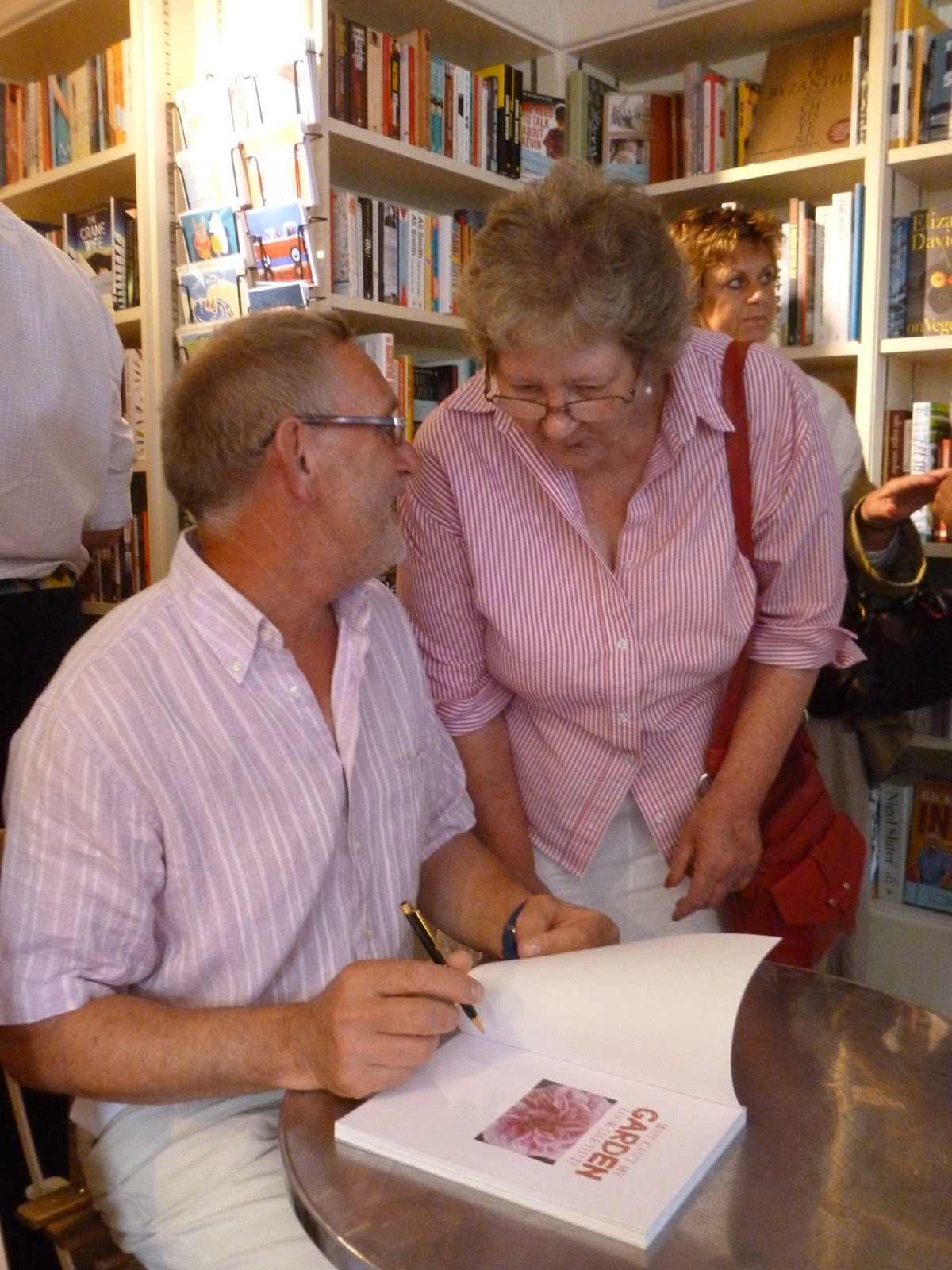
July:  The highlight of my year occurred this month.  An exciting and memorable launch of my first book to be published – a gardening book – Why Can’t My Garden Look Like That? took place in Chipping Norton’s award winning bookshop, Jaffe & Neale.  Would anyone turn up?  As it happened, very many did with people overflowing onto the street, the warm, sunny evening and the wine contributing to a street party feel to the occasion.  If you wish to find out more of the book or would like a signed copy you can find details here.

Many people are attracted to the magnificent looking but dangerous Giant Hogweed, also the subject of a post this month.  I was delighted when photographs from it were used in an educational video by the Hamilton County Soil and Water Conservation District (New York State).  Take heed of the messages if you come across the plant!

August: Travelling around the Cotswold Hills as I do every day in the course of my work you would think I would know most of what goes on there.  Nevertheless, I was surprised when I saw Tibetan flags fluttering in the breeze.  Further investigation found Alain Rouveure’s galleries and tea room.  Of course, I couldn’t leave until I’d tried out their lunch…

September:  Street fairs have been held for hundreds of years throughout England and Chipping Norton has an annual one that dates back to medieval charters.  Originally the time when livestock was sold and labour sought, these days they are purely held for pleasure.  Traffic has to be diverted around the town as the centre is blocked off by the rides and stalls.  Noisy, crowded and well lit they are great fun but I found  myself completely alone in darkness walking around it late one night.  It was an eerie experience, described here.

October:  The appearance of the secret valley was changed dramatically when the willow trees that line the banks of our little winding river were pollarded.  This dramatic ‘haircut’ is carried out only when necessary, the last time about fifteen years ago.  Suddenly, the view in the header of this blog has become wide open as every branch was removed leaving just the trunks standing.  The secret valley looks naked now but ‘new clothes’ will grow rapidly this coming spring.

November:  History isn’t just about learning dates of battles, the most interesting aspects are those that we can so easily relate to.  Yet so much of this is forgotten over time and it takes teams of dedicated people, often volunteers, to literally unearth it.  A now deserted and seemingly empty part of the Exmoor National Park was, one hundred and fifty years ago, teeming with people and was at the very forefront of Victorian technology.  It was quite extraordinary what these engineers achieved and their story featured in two posts which created much interest and comment.  They can be found by clicking here and here.

December:  The blogging year ended on a cuddly note – looking after two adorable but naughty beagle puppies.  If you are a dog lover there is nothing better than to be mauled by puppies.  If you’re not over-keen on dogs then you won’t understand the attraction!  You could try to find out, however, by clicking here.

So what’s going on in 2014?  Lots, hopefully. There is a new racehorse, more gardening, more travel, a lot more writing; it will be a busy year and how it pans out time – and this blog – will tell.

Thank you all so much for following my blog. Over one hundred thousand of you have looked at it since its inception which I find quite extraordinary and very humbling.  Please continue to do so and to tell all your blogging friends to come and pay me a visit, either on here or at my full website www.johnshortlandwriter.com .  I am also on Facebook and Twitter where daily updates can be found.  You are always very welcome to contact me with your comments or queries and I will do my best to answer them all.

Wishing you all a very happy and healthy New Year.

Add to Technorati Favorites

A Year in Review 2013: The First Six Months

As I feared, once you reach a certain age, time flies by even quicker than before and that certainly has happened in 2013.  Where has the year gone?  The only consolation is that speaking with young people, they say the same thing.  Perhaps that is a rather sad reflection of modern living for I often found that the time didn’t go by quickly enough years ago!  Despite the year having gone by rapidly, it has been a great one with some excitement along the way.

January: it is rapidly becoming a tradition that each New Year’s Day some close friends and I go off exploring.  This usually includes a museum and food.  The year before it had been London with a visit to the National Portrait Gallery followed by afternoon tea at my favourite grocers, Fortnum & Mason.  This January it was to the city of Bath with its glorious abbey church where Edgar was crowned King of England in 973AD.  The church has the most exquisite vaulting – it is hard to believe that such fine tracery can be achieved by carving stone.  Bath, which is a World Heritage Site, is famous for its Roman Baths built about a thousand years earlier and which are open to visitors.  A great place to view them from are the Pump Rooms, the imaginary setting of Sheridan’s Georgian play, The Rivals.  It was here that we had our champagne tea.

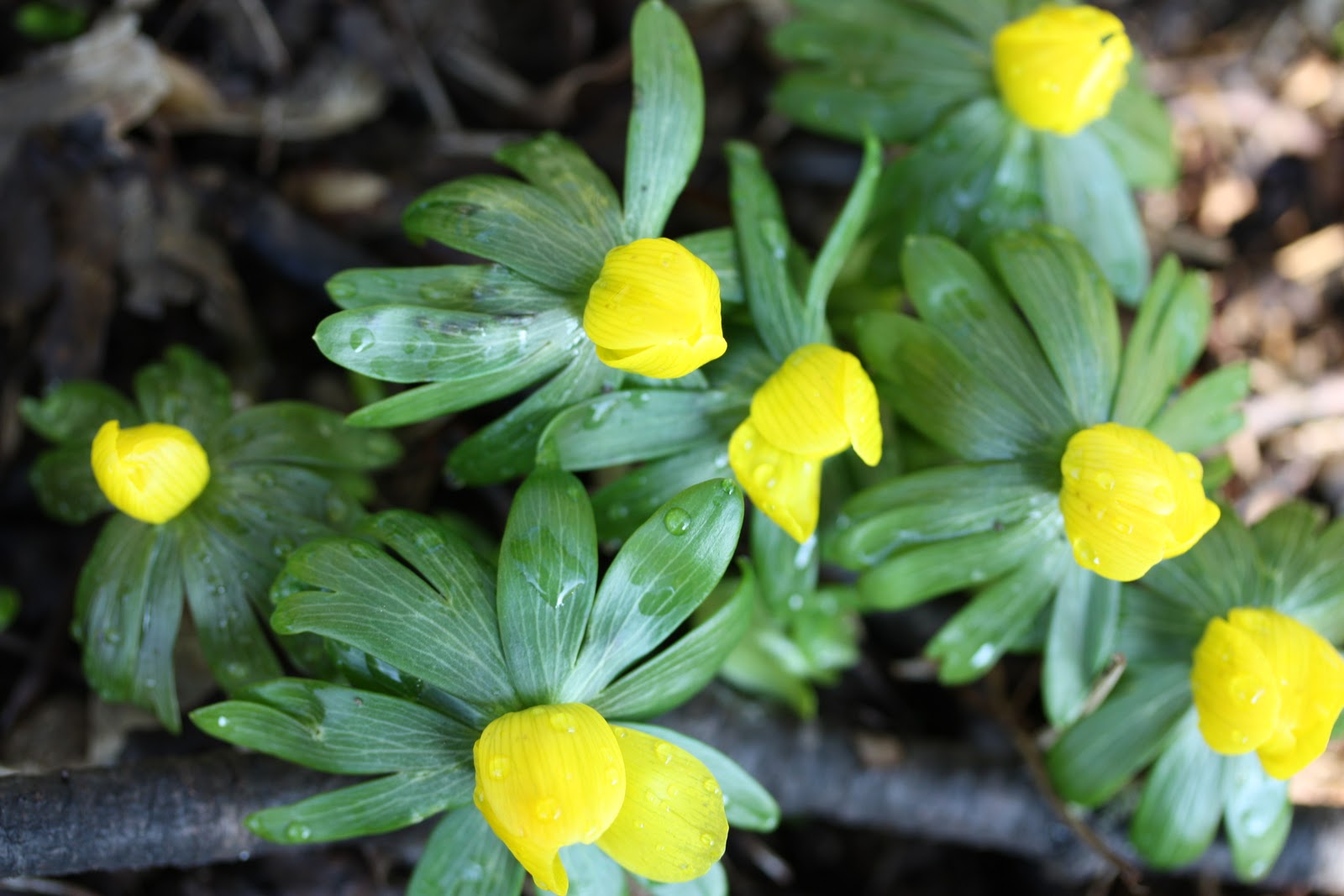
February was a mixed month weather-wise in the secret valley and one post describes the rain lashing against the windows and the trees being thrown around by a winter gale.  Despite that the winter aconites were in full flower advertising the advance of spring and the wild birds were hanging onto the feeders for dear life.  Take away the aconites and we have a carbon copy day as I write this and, although there are no signs of spring yet, we are passing the shortest day which is always encouraging.

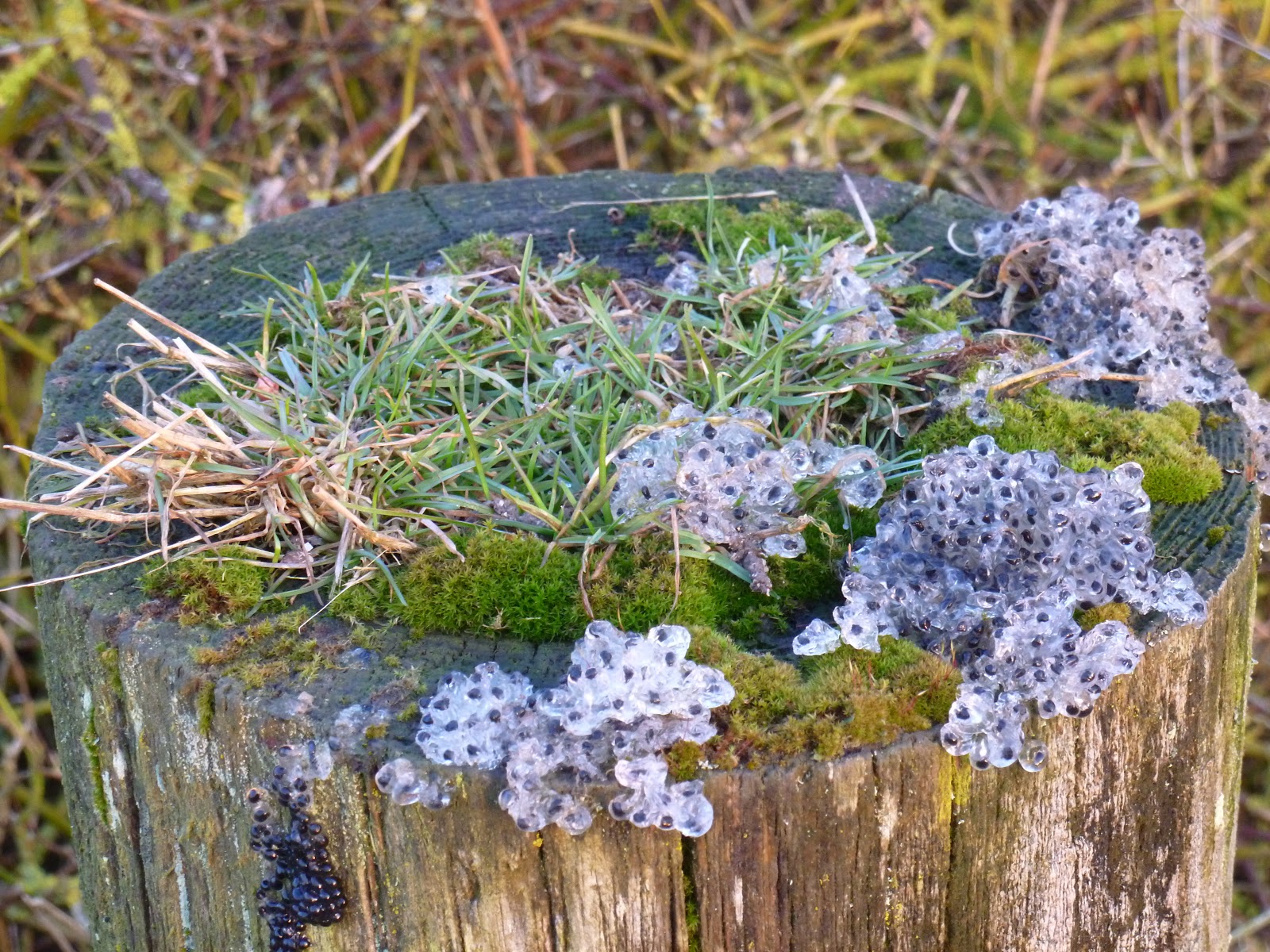
March was a strange month too with huge amounts of rain interspersed with wintry weather.  Even stranger was the affect it had upon the secret valley’s frog population.  I can only assume that it was because everything was so saturated that, instead of laying their spawn in the small lake that is visible from the cottage, they laid them instead upon the tops of nearby fence posts. They couldn’t possibly have survived there anyway but it was sad to see a few days later that they had turned black and ‘melted’ when a hard frost fell upon them.

April is the month of the Chipping Norton Literary Festival.  I have been on the committee since its inception and it has been gratifying to find that it has rapidly established a good reputation with authors, publishers and festival goers. One of the star attractions for 2013 was Sir Julian Fellowes of Downton Abbey fame.  Because it is a small festival in a small, country town the atmosphere is very relaxed and it is possible to meet the authors for book signings or just a chat as they stroll about ‘Chippy’.  This coming year the festival takes place from 24-27 April and tickets go on sale next month – check out the website for more details.

April also saw the launch of my new website www.johnshortlandwriter.com and also the start of my tweeting.  Come and join me @johnshortlandwr

May:  As I am always saying the secret valley is a magical place to live and one of the things that makes it so special is its history. Not the history of history books but the type that goes unrecorded other than by the clues it leaves behind in the landscape.  Here we have a patch of rough ground left uncultivated that is the invisible site of a Bronze Age settlement. Later, almost to within living memory, the lane was a drover’s route and, in places, the road has been abandoned to become a green track full of wild flowers and butterflies.  We still refer to one place as the ‘white gate’ even though it was removed a hundred years ago or more.  It feels special to know that the valley has been lived in and loved for over three thousand years.

It was also a very exciting time as my gardening book was published accompanied by radio and other interviews. The launch party took place a couple of months later.

June is a colourful time of year in gardens and one thing I’ve always wanted to create is an Iris border.  This is an extravagance of space that few can afford for they are only in flower for a relatively short time.  However, one of my clients liked the idea so the ‘rainbow’ border was created.  Interest is extended by daffodils and alliums for earlier colour and Japanese anemones, with large flowered clematis behind, for later on.

To read any of the posts referred to above just click on the links, coloured green.

Add to Technorati Favorites

An Exciting Evening

Fellow bloggers often comment about when they first began to write and  especially when or why they began to blog. When you come to think about it, blogging is rather an odd thing to do: you write your piece, perhaps add a few images, press the publish button and it’s out there for all the world to see.  Many of us assume that no-one will bother to read it and, after all, why should anybody be interested in our thoughts or projects?  But, again as many of us know, gradually people find us, follow us and friendships start to build.  The great majority of our followers we are never likely to meet in reality yet they share our tales and show real interest in what we are doing, whether it be family, travel, garden or whatever else we blog about.  Just occasionally, you come face to face with one and this happened last night.

Followers of this blog, whether here or on Facebook or my new website – or my Tweets –  can hardly have failed to notice that I have had my first book, “Why Can’t My Garden look Like That?” published recently (for I have been talking about virtually nothing else lately).  It has been an incredible journey with a huge and rapid learning curve; from commission to publication  it was completed in only thirteen months.  Fortunately, I had huge support and encouragement from my publishers, Constable & Robinson.  Fast forward another seven weeks to yesterday evening: the date of the official book launch.

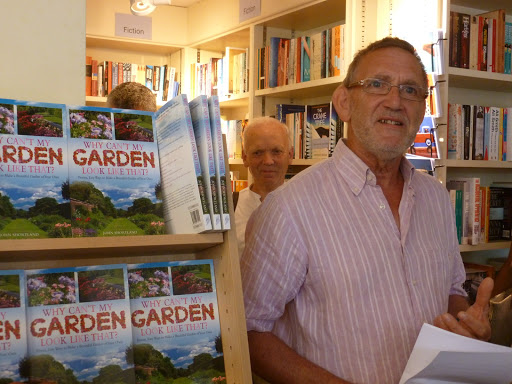
I was delighted that our local bookshop, Jaffe & Neale, hosted it for Chipping Norton is very fortunate in having such a lovely, independent and award-winning bookshop.  It couldn’t have been a better choice of location for the town was glowing golden with the heat-wave sunshine emphasising the colour of the old, Cotswold stone buildings.

With Polly Jaffe of Jaffe & Neale, who hosted the evening, and Nikki Read and Giles Lewis of publishers, Constable & Robinson

I felt remarkably relaxed at the thought of making a speech to a large number of people.  In fact, my real concern was that no-one would turn up at all!  However, over one hundred came, filling the bookshop and spilling out onto the pavement giving the whole evening a real party atmosphere which, in turn, created more interest from passers-by.

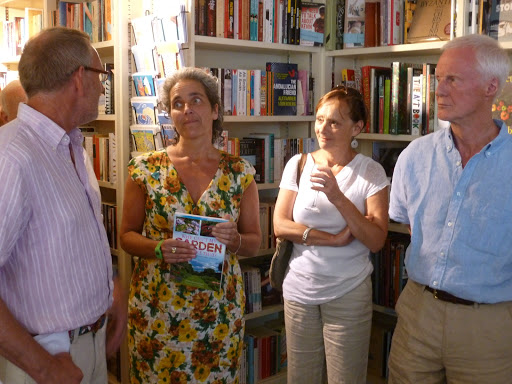
A memorable evening was made all the more so as I began to realise just how far people had travelled to be with me.  Bette Baldwin of Friends of Hoar Oak Cottage had travelled up from Devon – I had met Bette only once before on Exmoor, thanks to the power of blogging.  Several others I had not met for a very long time; thirty years or more and, of course, there were others that I’d never met before at all.  The evening came to a close with a celebratory dinner organised by friends at a local restaurant.  An exciting evening and one never to be forgotten.

Yet more excitement today as I find that my book has been reviewed and described as “brilliant” by LandLove magazine.  They are also running a competition with ten copies of my book as prizes.  You can find out more about that by clicking the link here.

Add to Technorati Favorites

An Invitation

John Shortland

invites you to celebrate the launch of

Why Can’t My Garden Look Like That?

Proven, Easy Ways to Make a Beautiful Garden of Your Own

With a foreword by Josceline Dimbleby


Monday 15thJuly

6.00 – 8.00 pm

Jaffé & Neale Bookshop

Middle Row, Chipping Norton.  OX7 5NH

If you are unable to make it on the day and would like to purchase a signed copy, please do contact me.  Payment can be arranged through Paypal and I’m happy to ship overseas.  Unsigned copies can, of course, be purchased direct through Amazon or visit my publishers, Constable & Robinson’s website by clicking here.

Add to Technorati Favorites

Being Interviewed on BBC Radio Oxford

I was a guest of Kat Orman on BBC Radio Oxford today, being interviewed about my forthcoming book, Why Can’t My Garden look Like That?, and also the career change from fashions to flowers.

One of the questions Kat asked was had I ever had a ‘Lady Chatterley’ moment.  You will have to listen to the interview to find out my response!

To listen to the programme  click here.  I am on air at 2:07:00.  The programme is only available for a few days so you’ll need to be quick…

Add to Technorati Favorites

Why Can’t My Garden Look Like That?

Why Can’t My Garden Look Like That?

Proven, Easy Ways to Create a Beautiful Garden of Your Own


by John Shortland


(Johnson of Life in the English Cotswolds)

Available now on pre-order (publication date 26th April 2013)

Click here to find out more …

Add to Technorati Favorites