At the 2011 Burghley Horse Trials – part 2

To compete at the Burghley horse trials you have to be brave, for the size of the fences are not for the faint-hearted. However, to have reached the standard that is required, riders and their horses have had to overcome fear in plenty and have the necessary skill, stamina and strength to compete at this level – not just on the cross-country course but also in dressage and showjumping disciplines. It certainly draws the crowds with over 140,000 people attending.

In part 1 of these posts on the Trials – click here for link – the photograph below was also the first photograph shown, but before the trials began. It looked a huge, solid jump (and was) but the horses cleared it with ease. It is often the smaller jumps where a tired rider or horse come unstuck. Fortunately, this year, there were no major casualties although, sadly, these do occur from time to time.


Burghley, because of its status as one of the top eventing locations, not just in Britain but worldwide, attracts the superstars of the equestrian world, from both the UK and overseas. Ollie Townend won Burghley in 2009 and was a favourite to win this year. It wasn’t to be, with one of his horses being eliminated on the cross country, the other having to retire.

Mary King, is always enthusiastically applauded whenever she appears and is supposed to be the person most young ‘horsey’ girls want to be when they grow up! Not surprising really, for she gets results and is a charming person as well. She came third on her own homebred Kings Temptress.

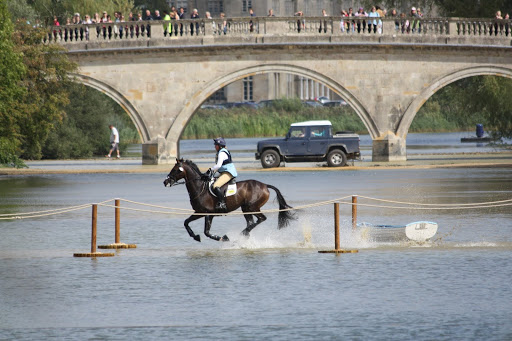
The water jumps always attract the crowds and there is nothing more they like to see than a rider get a good ducking! This year their were few such moments. Apart from small ponds to jump in and out of, the Capability Brown lake also featured as an obstacle. There can be few more magnificent views than this with Burghley House, one of the greatest Elizabethan buildings in England, in the distance.

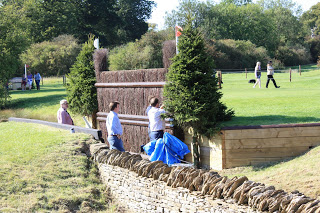
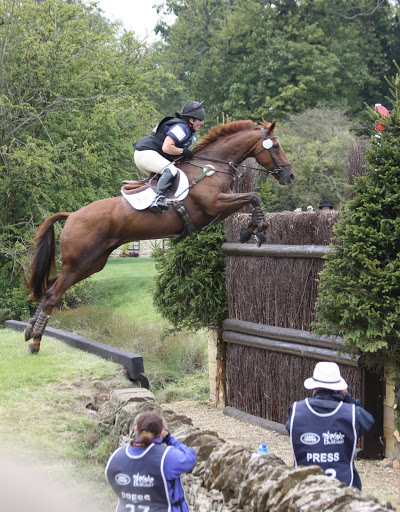
Another photograph that appeared in the first post was the one below. This image has a horse clearing what is the biggest jump on the course. To guage the height look at the press photographers being dwarfed by it ….. This jump was another that the horses took with ease – it is more of a frightener for the rider. The press and the television crews all help to create the atmosphere at Burghley which is , to my mind anyaway, the greatest horse show of them all.
Zara Phillips, daughter of the Princess Royal and grand-daughter of the Queen was another competitor here. She came in tenth place on High Kingdom.
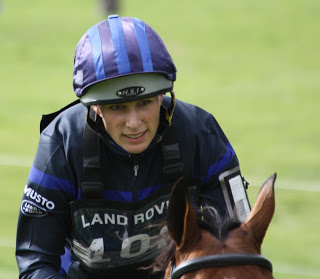
The winner – and for a record sixth time – was the popular William Fox-Pitt. Known as ‘Mr Cool’, William sits quietly on his horse, unlike some riders, and appears to have no nerves whatsoever. I wonder if that is really so!

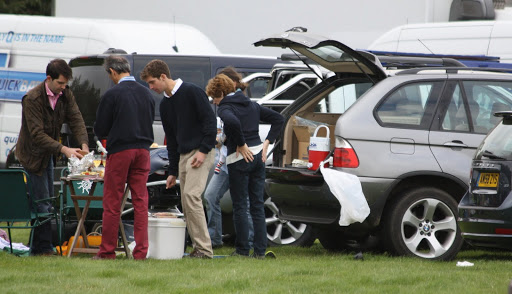
But Burghley isn’t just about horses! For many of us, Burghley and events like it, are places where we can meet up with old friends and aquaintances, a place to relax in late summer sunshine, a place to bring all the family including our dogs. It’s a place where we can shop, where we can picnic and where we can dream of one day riding a horse well enough to compete here.
Add to Technorati Favorites

At the 2011 Burghley Horse Trials – part 1

One of the highlights of my social calendar is the annual trip to Burghley for the horse trials. Although I ride and, probably immodest of me to say it, ride rather well, neither my horse, nor my skill, nor my nerve would take me to this level. As it happens, we have just got an additional new horse that has competed at Burghley in the past – as has my partner – but just the sight of some of the fences fill me with such fear we won’t be attempting it!

There is something rather special about Burghley that is quite difficult to define. The atmosphere is electric yet relaxed, a great team of people organise it, the visitors all thoroughly enjoy it and, of course, there is the splendour of the magnificent Burghley House that dominates the grounds.
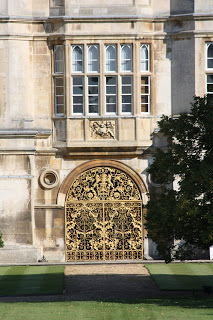
Burghley House was built in the 1500’s for the first Earl of Exeter, one of Queen Elizabeth I’s favourites. Today it is considered to be one of the finest Elizabethan houses in England and is still owned by the same family. Dominating the west front of the house and its turrets and towers, the great gilded gates were designed to catch the rays of the setting sun. These, and the huge numbers of windows, create a blaze of light on a summer’s evening , exactly the image that was required: power, wealth and fine enough to impress the Virgin Queen when she visited.

The Exeter crest is designed into the gates and, elsewhere, there is yet more gilding. The levels of craftsmanship is outstanding, not just in the architecture but down to every detail. Even the garden railings are beautifully crafted.

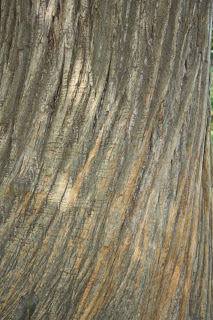
The grounds, where the horse trials take place, are also kept beautifully. A dominant feature of the parkland is the large numbers of Sweet Chestnut trees, mostly planted in avenues. Their immense girth really shows the twisted bark that is seldom seen on younger trees.

However, it is the lake and Lion Bridge that creates the focal centrepoint whether from the park or when seen from the house. These were created later than the house by Lancelot ‘Capability’ Brown (who else?!) around 1778. The lake is designed to give the impression of a winding river and features as an obstacle in the trials.
Trialling or eventing, for those unfamiliar with the sport – the word ‘horse’ is only said by those that don’t ride and is a social faux pas when used – is one of the toughest tests of endurance for both horse and rider. First there are dressage tests where the skill and accuracy of both are measured. This is followed by the most popular part of the contest (although all have their aficionados), the cross country course (link here). At a length of 6686 metres with 33 fences – the highest standing at 1.45m – it has a target time of just over 11 minutes to complete. Cross country tests the bravery, strength and stamina of both horse and rider. Finally, there is the showjumping on the last day. Here, the test is for stamina, accuracy and skill. This year, William Fox-Pitt won Burghley for the sixth time, a record, which made a very successful end to Burghley’s 50th anniversary.

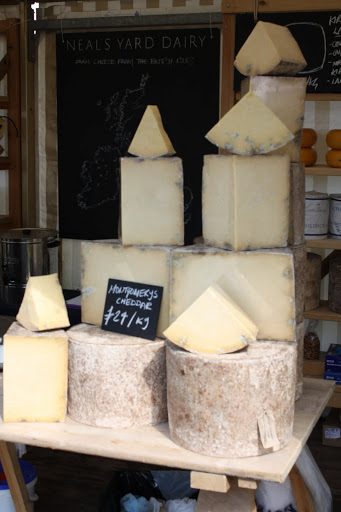
If you are not horse crazy – and the majority of the thousands of people that come here are – there are other things to occupy your time. Socialising is important, catching up with people that you may see only here, and shopping is even more so. There are over five hundred shops to visit on the site selling everything from clothes to furniture, to paintings and sculpture and, of course, lots of horse related products. The food halls are important too: my favourite was the Neil’s Yard cheese shop with its amazing displays of English cheeses. They tasted good too!

For those of you that have never been here, do give it a try, especially at this time. The house and gardens are open to the public all year and, from time to time, concerts are performed here. Burghley House should be on every persons agenda to visit at leat once. If you need convincing, follow this link to their website.

The next post will concentrate more on the cross country course and will even have some ‘horsey’ photos!

Gardening With Weeds

Much has been written about creating wild flower meadows in recent years. Many gardening magazines infer that somehow you must be lacking in something if you don’t rush out there and then and rip up your precious lawn to create the daisy and orchid studded turf depicted in medieval tapestries. There is much to be said for doing this (and I’ve done a few in my time too). However, the reason why most of us don’t do it is purely down to lack of space and time, and also most of us still like to see a reasonably weed free patch of green grass at the centre of our gardens. Now don’t get me wrong, anything that reduces the amount of chemicals used and encourages wildlife has got to be a good thing and our gardens, collectively, could – and should – make one vast nature reserve.

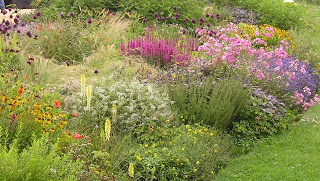
But why restrict yourself to wild flowers in grass? Very few articles suggest using them in herbaceous borders, or amongst shrubs, but I have been planting them like this for some years now and the results can be terrific. This flower border in the photo was taken 14 months after planting and looks very much like a traditional, English flower border. But there are some differences and those are the wild flowers intermingling with the more usual garden plants.


Purple Loosetrife, Lythrum salicifolium, grows wild in boggy places and by stream edges so seems an unlikely candidate for the border. I have found it to be a great choice which copes well with ordinary soil conditions. In the hot, dry summer we have had this year they have only grown to about half their normal height of 3-4ft but their cerise colour and longevity have still made them a worthy addition. In the photograph above they are the bright pink ‘blob’ in the centre, growing separately to the surrounding plants.

Here they are being grown as a companion to a bright pink ground cover rose, a combination that I’m not so keen on (even though I did plant them myself). They are a bit too strident and close in colour for my taste but others have stopped and admired them so there they remain.

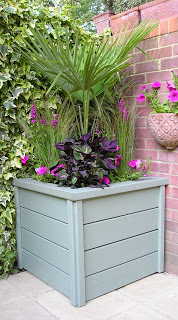
I have also experimented growing them in containers where, of course, you can easily give them the moister conditions they would naturally prefer. Here, their colour makes them quite an exotic addition to the matching colour petunias, the purple leafed coleus and tropical looking (but hardy) palm.

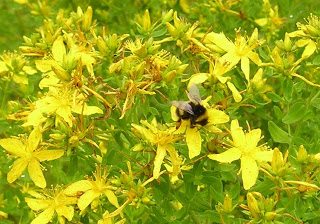
Another reason for growing wild flowers is that, of course, they are great attractants of the local insects. A clump of the herbaceous St John’s Wort, this one is Perfoliate St John’s Wort, Hypericum perfoliatum, always are covered, when in flower, with bees and other beneficial, pollinating insects. The flowers are miniature versions of the shrubby Hypericum ‘Hidcote’ and all the better for being small. In the wild, they grow (as many wild flowers do) quite happily amongst grass and other plants. In the garden, I find they combine well with Wormwood, the tall, shrubby Artemisia.

.

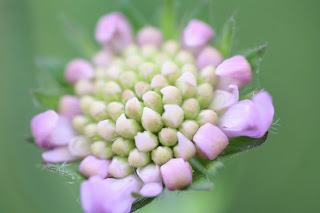
The pale blue flowers of the Field Scabious, Knautia arvensis, continue for months on end and combine well with most other colours. Growing them in the garden gives you the opportunity to notice them in detail. In the wild, it is less likely that you would see how the outer petals of the flower uncurl before the inner ones. Grow them with exotic looking Icelandic poppies or, like here, with tall, purple, Salvia.


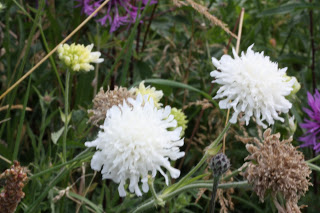
Wild flowers often are generous with their flowering, not only in the quantity of blooms and their exuberance. Sometimes, they offer a ‘sport’. The most common variant from the norm is white and this pure white version of scabious was a delightful bonus. I like the way the buds start off a creamy colour.


Recently, I have tried growing Lady’d Bedstraw, Galium verum. It is working quite well and the rather acid yellow looks good with lavender. In fact, this flower is all the better for propping itself up against its neighbours as it is a bit inclined (in an unlady-like way) to sprawl, otherwise.


One word of caution about introducing wild flowers into the garden: sometimes, they like garden conditions just too much. If in doubt, plant a small number of plants in an area where you can control them should they take off. I didn’t do this with one of my childhood favourites, Toadflax. It took me three years of painful weeding to extract the final pieces from more delicate plants. I have gone back to admiring it where it belongs – along roadside verges and on waste ground.


And one final plea: please grow and enjoy our native, wild flowers but do source them from a reputable nursery. Apart from being illegal to dig or uproot a plant in the wild, as gardeners we are supposed to conserve plants ……

Add to Technorati Favorites

Fields of Red

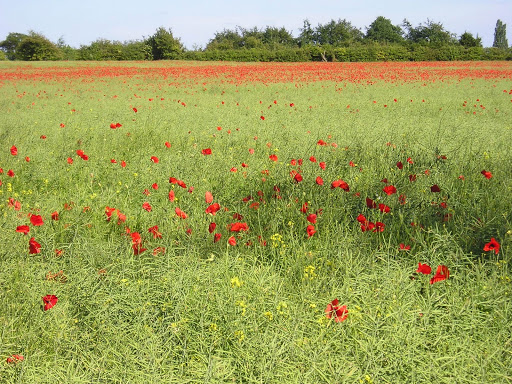
Everyone seems to love poppies. It doesn’t matter if they are the delicate crepes of the Icelandic or big and blousy Oriental poppies – even ‘though the latter so often lie sprawling across the ground, flattened by the weather or their own weight. But most loved of all are the wild scarlet poppies that create a violent red gash across acres of wheatfields.


Despite being forever linked with the trauma and sadness of the Great War, poppies refuse to lower our spirits. Perhaps they even comforted and uplifted the tortured bodies and minds of the survivors of the battlefields. The famous lines from In Flanders Field have immortalised poppies in poetry but thirty years earlier that great (but now almost unknown) British naturalist, Richard Jefferies, was eulogising “proud poppies, lords of the July fields….no abundance of them can ever make them commonplace….”. How right he was.


Even the odd, single flower, struggling in a bit of dirt at the side of some waste ground, brings joy and admiration but it is, en masse, when the sight of thousands of them in flower in a cornfield stops you in your tracks and, for a moment, loses you in a heady delirium of colour.

When the steep, wild flower filled grass banks that make the ‘walls’ of the secret valley have given way to the flatter, arable lands and the lush water meadows and meandering river lie far below, the fields become larger and hidden by high hedgerows. The character of the secret valley is much changed up here: those unfamiliar with it would not know of its existance it is so concealed. The old field names reflect this – lower down the names end with the words ‘banks’, ‘close’, ‘grounds’, ‘meadows’, now they all end with the word ‘downs’ and you could be forgiven thinking that you were on vast rolling downland, for the eye leaps over the valley to more cornfields beyond. And, a few days ago, I climbed the old, timber stile that pierces the hedgerow to walk in the field known as’17 Acre Downs’ to be greeted by the lords of the July fields.

However it was not the sight of crimson stretching as far as the woodland in the distance that stopped me in my tracks for there, at my feet, was a single, pure white poppy. Just one amongst tens of thousands of scarlet.

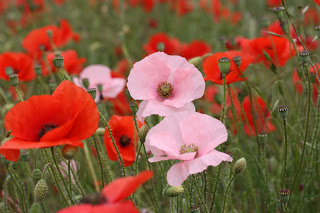
Walking further I was stopped once again, this time by some pale pink blooms, not many, just about twenty. The sight was enchanting and magical. Why here? Why so few?

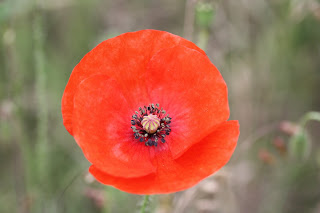
Once you look closely at a poppy in flower you realise just how spectacular it is. En masse, your mind is blown by the quantity and you stop seeing them as individuals. Now, with my senses heightened I realised that a field of red poppies are made up of numerous variations even though pink and white are very rare finds. The photographs below show just a few of these: crimped, streaky, waxy, single petalled, multi petalled, plain buttoned, black cross buttoned, the variations seemed endless.

It isn’t just the flower that deserves this close inspection. For the seedhead is also quite lovely. Its capsule, before ripened, the palest green with a black and cream striped lid, a black collar, encircles its tall, upright stem, covered with soft bristles. Once ripe it takes on the same golden hue of the corn crop it has invaded. Will these poppies breed true and will there be pink or white ones next year? Who knows, for the next day the field had been mown and, if not for the photographic record, could have been dismissed as a pure figment of imagination.

Add to Technorati Favorites

A Very English Day Out


Last Sunday turned out to be a glorious day after twenty four hours of much needed rain. Thank goodness it did for a friend had organised that most English of traditions – a posh picnic on the lawns of a large country house, followed by a concert in the music room.


And so we found ourselves eating smoked salmon sandwiches, coronation chicken, salads, ending with strawberries and cream, all washed down with an endless supply of champagne. But our friend didn’t just do us proud with the picnic, she had invited an eclectic mix of guests. There was an art historian, an art restorer, an explorer, a porcelain restorer, myself a garden designer amongst others. And we were international as well, for amongst the guests was an American, a Persian, myself part Polish – but the pure bred Brits did outnumber us….


Boarstall, where the concert took place, is a fourteenth century moated gatehouse. Of course, a building with such a long history has seen many changes and events, a major one being during the (English) Civil War when it was besieged for ten weeks. Damaged by cannon fire, ( the bricked up ‘patches’ can still be seen), upon its surrender the main part of the house, church and village were all destroyed by the victorious Parliamentarians. The mansion and the church were rebuilt but only the latter remains, the house being demolished once again in 1778. Since that time the tower has remained virtually unchanged. Now owned by the National Trust, it is lived in by tenants who organise the concerts.

We had come to hear a young soprano, Luci Briginshaw, sing arias from the great operas, accompanied by Peter McMullin on the piano. Luci’s story is rather like an opera plot in itself – a nice one fortunately rather than one where everyone gets murdered or dies of consumption! Busking in Covent Garden market, Luci was heard singing and invited to perform at Boarstall.

The music room at Boarstall is on the top floor of the tower and is reached by ancient, spiral stone staircases. Light and airy, it holds about 100 people so makes an intimate space where you can really relate to the performers and fellow audience. Luci’s singing was delightful, a pure clear voice, she obviously will – or deserves to – go far. Not just a wonderful coloratura soprano, for her encore, she accompanied herself on the piano singing a great blues number.

After the concert, Luci joined us all with a tour of the tower (how cross I was that, by then, I’d taken the camera back to the car) followed by afternoon tea, where she proved that she had a great personality off stage as well as on.

You will find a link to Luci’s website here, for Luci should be heard far and wide. And if, by a remote chance, Luci you should read this post, thank you for a memorable day out. Can’t wait to hear you again. Bravo!

Mothers Always Know Best (Sometimes)

From early childhood my parents taught my sister and I the skills to be self-sufficent. From my father we were both taught how to grow and harvest things from the garden which ultimately led to me earning my living from gardening. My sister became a skilled plantswoman and, although she has never earnt money from it, now opens her garden to the public each year raising many hundreds of pounds for charity.

My mother was much more interested in being indoors running the home. She was always at her happiest when unexpected visitors arrived and were persuaded to stay for dinner. Somehow, from the depths of her larder (which was always bulging) she would rustle up enough food to feed the proverbial army. Just before she died two years ago, I asked her why she had been so ‘progressive’ teaching me, a boy in the 1950’s, to sew buttons and name tapes, amongst other things, on clothing. She looked somewhat surprised and puzzled at the question and, to my disillusionment, told me it was because she had hated doing them herself. Mothers!

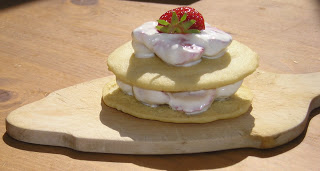
That was not the case when it came to cooking and the three of us loved to bake and baste together so, that by the time I reached my teens, I was able to cook a complete meal from start to finish. At one of my mother’s dinner parties I remembered an amazing stack of ultra thin shortbreads, with layers of clotted cream and rasberries between each one. A final decoration of raspberries and icing sugar on top left an unshakeable image of culinary delight in my mind and one that I had intended to recreate for years.

More disappointment when Mother told me that I’d imagined it, that she’d never made anything like it and it would be impossible to create wafer like, plate sized shortbreads – if only because it would be impossible to lift or cut them without them breaking. I was determined to prove her wrong and, every so often, she would give me that look that mothers do when I told her of my latest failed attempt.

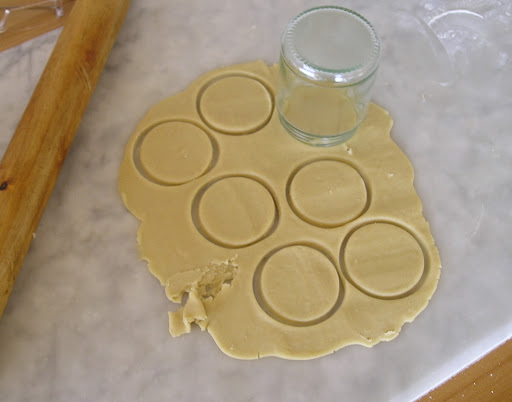
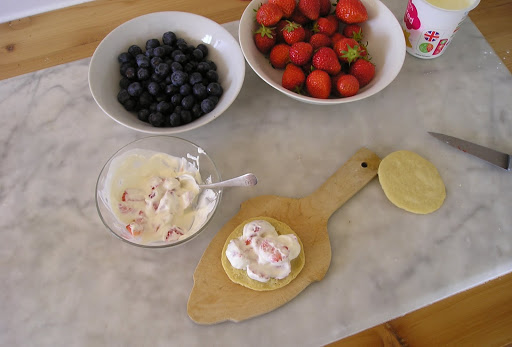
The photographs illustrate the procedure for my ‘wafer stack’


Finally, yesterday, I achieved success, albeit they were much smaller than planned. Now they are individual sized portions but perhaps better for that.

Here is the recipe, which couldn’t be simpler:

4oz butter

2oz icing sugar

6 oz plain flour

pinch of salt

*Put all ingredients into a food processor and whizz until the mix forms a soft ball

*If you just want to make ‘ordinary’ shortbread then press into a flat tin or on a baking sheet with the back of a fork

*Bake for 15 minutes at 180C until firm and only just beginning to colour

*Remove from oven and immediately cut into pieces but don’t remove from baking sheet until completely cool

If you want to try my stack the process is a bit different and a little more time consuming:

*Make as before but instead of pressing down the mixture, roll out as thinly as possible. This won’t be thin enough!

*Cut out rounds – I used a jam jar as I found that if the circles were anything larger they were impossible to lift without them breaking up (Mother did know best!)

*Place on a baking sheet and don’t worry if the rounds are now an odd shape. Flatten with fingers into a round shape making as thin as possible I made 24 altogether from the quantities of ingredients above

*Bake for 5 minutes only at 180C, leave to cool on sheet before lifting

For the filling, use any fruit you fancy. Here, I have used blueberries and strawberries.
Cut up into pieces and mix with a thick cream – I used sour cream (smetena). Decorate with a ‘clean’ piece of fruit

Good luck and let me know if you manage to make them plate size. Somehow, I feel that you won’t and in this case, Mother does know best! I like to think she has been watching my final attempt with an amused smile and rather cross that she is unable to try the end result…..

PS I promise that the next post will be the latest news on the puppies!

Add to Technorati Favorites

Sun, Drought, Frost: at last, Rain…..

.
It has been difficult to remember, sometimes, that it is still only spring time. After the unusually early, bitter and snowy winter weather we experienced, 2011 came in cold but dry. It remained so until the end of March when, wham!, summer arrived.
.

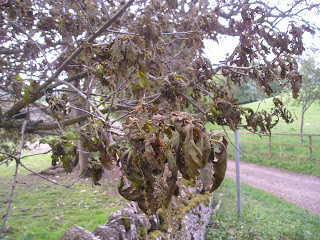
With temperatures soaring into the mid 80’s, many plants struggled to open their buds (and the ash trees still haven’t done so properly). I had planned to write about this battle but became – as you may well know – rather obsessed with puppies ….
.
.
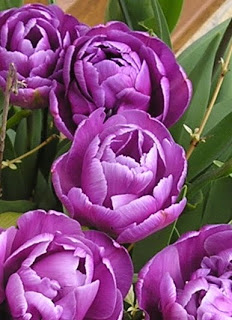
However, many plants did rather better than normal. Tulips, especially the fragile doubles, were better than ever with no rain to spoil their petals, as have been the paeonies. Perfume has wafted about the garden in the warm evening air – can there be anything more lovely on both eyes and nose than this paeony and wisteria combination?
.

.
.
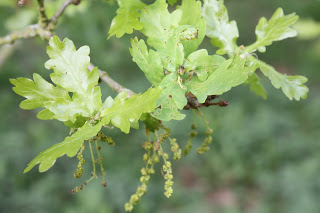
The trees, later than has been usual for many years, finally started to come into leaf. Now the countryside is awash with May, cherry and Horse Chestnut blossom. It is all quite stunning. Or was.
.
.
Out of nowhere, on Monday night, we had frost. The first for over five weeks, this was no slight touch of cold but one that turned the secret valley into a white valley of death. Well, I admit, that is rather an exaggeration but, I imagine it is due to the very hot temperatures immediately before, some plants – and especially the trees – have been decimated. One moment their new leaves hurt the eyes with their iradescent green, the next they are brown and shrivelled. Some, depending on how the cold air lay, have come through unscathed whilst their neighbour has been hit badly. Will they recover? I expect so but, possibly, too late to help the insects and birds that rely on the food source at this very moment. Time will tell.
.
. .
.
Just when our feelings were at their most depressed, the weather gave us another surprise. Rain. The first for many weeks, we have been desperate for it. The ground has been cracking, the river getting low, plants wilting and, worst of all, the farm crops not growing. In places, the young corn has started to go yellow. And when we least expected to get any, we awoke to the sound of rain on the windows. Our only neighbour, the farmer whose corn was suffering, and I were standing in the field below our homes, getting soaked and almost hugging each other with joy. It gave me just the slightest awareness of how people in countries that really suffer from prolonged droughts must feel. And it also made me aware of this rather primitive reaction of wanting to literally dance in the rain when it first arrives.
.
. The old mortar in the garden is beginning to fill once again!
.
The paeonies have been ‘knocked for six’ but, who cares? Apparantly, we have only had 1.5mm of rain during March and April compared with the 40-50mm in an average year. Let it rain for days now to restore the balance. But – as a gardener speaking – please only at night and only fall gently……
.

.
.
.
.

Add to Technorati Favorites

Shh! Don’t Tell the Nursery Man!

In my last post I discussed a new-to-me variety of Ribes, Ribes laurifolium. In it, I mentioned that it was unlike those I have seen elsewhere. That is, I have since discovered is because it isn’t a Ribes at all! It had been wrongly labelled in the nursery where I bought it. It isn’t even related to the flowering currants for, despite its currant like flowers, it is part of the rose family. . Oemleria cerasiformis, also known as the Oso Berry or Oregon Plum comes, as the name suggests, from North America. It is fully hardy, deciduous, prefers semi shade (ideally planted by good luck in my garden) and grows to about 2.5m. The great scent is agreed upon but described as smelling of almonds. It also describes it as a ‘mildly’ suckering shrub and mine is already sending out a new growth about 30cms from the base of the plant. I am more than delighted for it to do this. . . Apparantly, the native Indians chew the twigs and leaves as an aphrodisiac which will make (when it grows bigger) pruning possibly less of a chore ;-). Being monoecious, berries are only formed if both male and female plants are grown together. . I’m delighted to find out its true name, if only to clear up the confusion of laurifolium. And it also proves one of the great delights of gardening – it is an adventure where, however much knowledge you might have, the potential for learning and discovery never end. . Grow it if you can find it …… . . . . . Add to Technorati Favorites

Shh! Don’t Tell The Weather Man!

I hardly dare mention it but I think Spring is finally coming to the Cotswolds. After I wrote about it back in February, the man from the Met Office sent us cold again. Hard frosts put spring on hold. To be fair, as I also wrote, the Cotswolds may be one of the most beautiful places to live in the south of England but the hills are also one of the coldest. Our spring is always two or three weeks later than places even as close as Oxford or Gloucester.
.

.
Early spring sunshine comes to the ancient Cotswold town of Burford
.

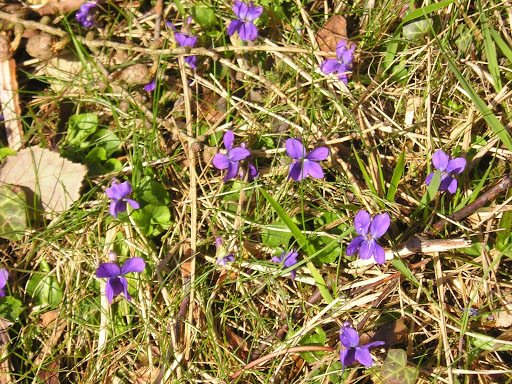
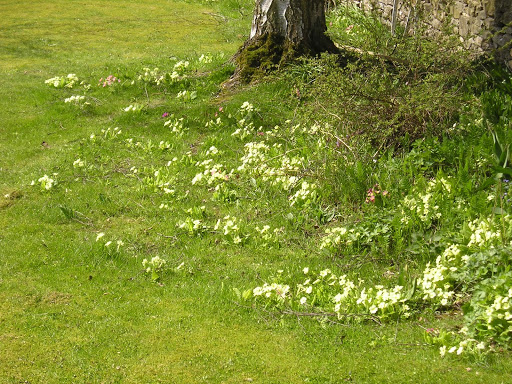
The past few weeks have been unusually dry which has meant that tidying up the garden – or, in my case, gardens: my own as well as clients – has progressed rather well. A nice drop of warm rain now would work a treat and not interfere with time schedules. At last, in the secret valley, leaves are unfurling properly, daffodils are blooming and the lone primrose has been joined by many more as well as purple and white violets.
.

.

.

Wherever I have lived, there has always been one hawthorn that opens its leaves days before the rest, even when planted as a hedgerow. I’ve often wondered if this is a genetic thing which means, I presume, that it could be cloned to have a whole group of early leafing ones. Or is it a combination of warmth and soil conditions in that particular spot? When I retire and have more time (a contradiction as the two never happen according to friends who are trying it) I will take cuttings and carry out a controlled experiment. It will give me the opportunity to blog about it if I am still able to sit in front of a computer!

.

.
I wonder if I could get a whole hedge of early flowering hawthorn? It will be another six weeks or more before they will be in bloom in the secret valley.
.

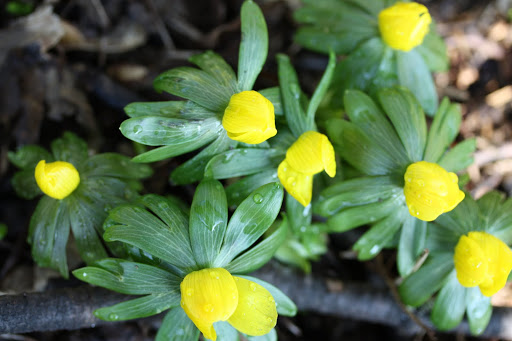
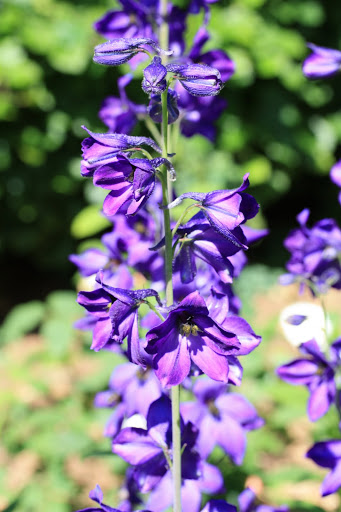
The snowdrops and aconites have now finished flowering. The little ruff of green leaves are all that is left of the latter. They look so similar to the taller herbaceous aconites or Monkhoods whose green ruffs are also poking through the ground now. They are all part of the buttercup family so are related but so unalike one another at their flowering time. I love the tall purple spires of the Monkshoods in mid to late summer: not as delicate as delphiniums, another favourite, but at least slugs don’t eat them and they don’t need staking, a real plus.

.

.

.

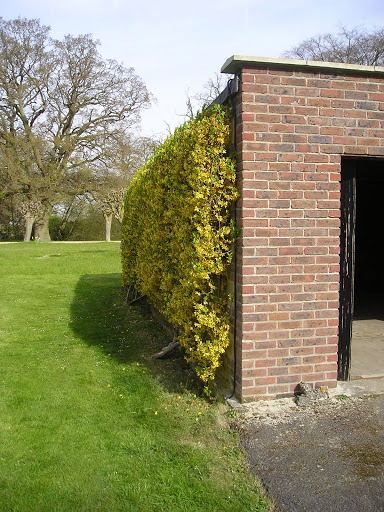
Forsythia is in full bloom. These I enjoy in other gardens but never plant them in my own unless the garden is huge and they can be planted a long way off. They show up from quite a distance and when seen too close, are too strident for my taste. The non flowering shrub later in the summer is a coarse affair too, dull and not warranting the space unless livened up by a clematis or other climbing plant. In the photo below it is grown as a wall shrub and it works well in disguising this unattractive garage. Despite being cut hard back to the wall each year in early summer it is always smothered in bloom by March.

.

The same applies to the common flowering currant. The standard pink is a wishy-washy thing and the deeper coloured, named varieties such as King Edward VIII, is as strong in colour as the forsythia – a plant to be enjoyed in other gardens. For those of you that thought the currants were always pink (although there are white flowered versions) and smelt of cat’s pee – and I include myself in this category for many years – there are three others that are well worth making space for.
.
.

Ribes odoratum, has pale yellow flowers and is beautifully scented. It is a bit of an untidy shrub in my experience, suckering freely but not a nuisance. It grows in happy neglect in a hedgerow – an ideal spot for it to do its own thing – and is really only noticed by the spicy fragrance as you wander past.
.
Ribes lauriflolium is a new plant to me. Unlike the others which all originate from the States, this currant is found in the wild in China. Looking at descriptions on the internet I wonder if they are correct or if there is a lot of variation in the stock, which is possible. I bought mine described as white, evergreen and not too hardy. It has survived -16C this winter, has been deciduous (perhaps it keeps its leaves in milder winters, I rather hope not) and is white flowered. Others are described as yellow and growing to only 1 ft – mine is already 3ft but that may be because it is tucked behind our dry stone wall. The one thing they all agree on and I can confirm is the exquisite scent of lilies of the valley. Do try to grow one if you can find it.

.

.
I have since discovered that this isn’t a ribes at all! See my next post to reveal all!!
.
My final choice of flowering currant is another favourite, Ribes speciosum. It is reminiscent in bloom of fuchsia and, like them, are pollinated in their native environment by humming birds. Hailing from California, in UK gardens it requires shelter and grows best against a warm wall where it can be trained on wires or left free growing. This photo was taken in the botanical gardens in Dublin on a glorious spring day.
.
.

Warmth, blue sky and sunshine. The clocks go forward an hour this weekend giving us more evening daylight. I’m almost feeling optimistic about the days to come – something a gardener should never be!
.
.
.
.
Add to Technorati Favorites

Two Updates……..

.
First Update – Ancestors!
.
Regular readers of this blog may recall my post about discovering not only my great (and also great-great) grandparents graves but also finding that the church that they had been instrumental in building still there and thriving. Great-great grandpa Wright had also been Deacon at one time.
.

.
To recap, I did not have time to visit the interior of the church and vowed to return. How pleased I was that I did. Members of the congregation were so friendly and welcoming and interested in my connection. It was Harvest Festival, always a joyful time and the service was delightful. How surreal it was to sit there – in a church interior that, miraculously, had remained virtually unaltered since the day it was built in the mid 1800’s, worshipping in the place of my ancestors. Their presence felt very strong and I think they would have approved that I, not a very religious man (although I like to think quite a spiritual and good one) and now the ‘elder’ of the family, had returned. I was so pleased that my first steps inside the building had been to join others in prayer.

.
. .
Since then, I have returned once again, this time with a friend, to hear an organ recital. It was a joy to see the church filled with so many people. As a cousin, who works with the poor in Afghanistan, said “God is holding you in the palm of His hand, you never know when He will release you”. By coincidence – or perhaps not – the opening hymn was ‘To God Be The Glory’, a hymn sung a few weeks earlier at the last of my aunt’s funeral. A deeply religious woman, her greatest wish was that I might have the same depth of faith as she. How heartly I sang although I doubt if my aunt would consider me yet saved!
.
.

On my last visit, I also found the house where my grandmother had been raised. Overlooking the River Thames, our great river that runs, 30 miles downstream, through London it was just a few yards from the paper mill that my ancestors owned before the Second World War. All was sold long before I was born – a pity, it would be amazing to live there now!
.

. .

.
Second Update: She-Dog!
.

.
After delays for one reason and another, the precious She-Dog may be in pup. She has met a handsome lurcher of similar colouring – not the original choice but just as dashing – and spent a few days away on extended honeymoon. Fingers crossed, I may finally become a father. Watch this space!
.
.
.
.
Add to Technorati Favorites