So another year has gone by and I find that one of the benefits of ageing (yes, there are some!) is being aware that time is running out. I say it is a benefit for I don’t find the thought at all depressing, instead it gives an urgency to achieve what I can whilst I can. There is so much more to do, to see and to learn in what time is left. It is possible that I may live to be a hundred for many of my family have lived well-into their nineties and beyond but even allowing for that, it still doesn’t give me too many years to waste.
Time waits fir no man – or woman!!
One of my ancestors, Richard Beauchamp died at the age of 57, which although not a great age by modern standards probably wasn’t too bad for someone dying in 1439. He had a busy and well-documented life but perhaps his biggest achievement was carried out after his death. In his will he left various bequests, the largest portion to the Collegiate Church of St Mary in the town of Warwick for the building of a chapel. Upon its completion his body was transferred there to lie beneath his splendid gilt-bronze effigy. The effigy, along with the chapel’s medieval stained glass and other decorations are considered to be the finest in Europe. In March, I finally visited the tomb where both he and his parents lie, a remarkably emotional moment perhaps because nothing had prepared me for the chapel’s magnificence. To judge for yourself, click on the link here which will take you to numerous photographs as well as the story of my ancestral grandparent’s lives.
Richard Beauchamp, my ancestral grandfather lying in the splendour of the chapel he commissioned for the benefit of his souldetail of the tomb of Richard Beauchamp dating from the 1400s
Spring arrives late in our part of the Cotswolds for the secret valley, although very beautiful, nestles in a ‘frost hollow’. As a result, the bluebells that flower at the foot of the ancient hedgerow than borders our lane are always a couple of weeks later than in many other places. However, when they do bloom, the intensity of their colour never fails to delight. Pretty as they are, they are nothing compared to the bluebell woods of the Cotswolds and the Chilterns, the range of chalk hills where I was raised and lived until I moved here twenty-five years ago. In May, when the bluebells had reached their peak of flowering, I wrote a blog In Praise of Bluebells. Apart from photos of the bluebell woods (including one of me as a much younger man with my two Scottish Deerhounds), I explored the bluebell in history and poetry, link here.
the magnificence of a bluebell wood in MayOccasionally, a white or even a pink bluebell appears
In June, on my Facebook page, I had a casual discussion with a follower about mentors and mentoring. She asked me if I’d ever had any mentors and my answer was ‘yes’: two couples, both of whom came from very different backgrounds to one another as well as my own. She wanted to know more and so I promised to write a blog about them, a post which would honour their contribution to my life and demonstrate the great enrichment such mentors can give. Mentors – part 1 (link here) tells of my chance meeting at the age of sixteen with Dick and Lorna French, who farmed on Exmoor, a National Park in England’s West Country. The farm is very isolated, and the post explores how I ended up living with them after turning up one day unannounced on their doorstep. Regular visitors to my blog or Facebook/Instagram pages will know what a love they imparted on me for this wild and rugged landscape, a place I still visit very frequently. The blog has numerous photos including some of me from early childhood to that gangly sixteen-year-old that Lorna and Dick first knew.
My first mentors: Dick & Lorna French of Brendon Barton, ExmoorExmoor National Park: Aged 16, I suddenly found myself living and working in remote countryside
Find out about my other pair of mentors, Cyril and Pamela Heber Percy, who came from privileged upper-class families in 2025: Part Two (yet to be written but coming shortly!). The blog will also explore what happened in the last few months of 2025
Eighteen months ago I was contacted by a gallery in Cheltenham about their researching an artist for they had acquired four watercolours of London street scenes painted during a ten-year period from 1885. They were by Edward Angell Roberts who had lived with Mary Ann Shortland, an ancestral cousin of mine. Although they described themselves as husband and wife in official documents, Edward was already married to the exotically named Josephine Bartolozzi Vestry Anderson.
NewStreet, Spring Gardens Edward Angell Roberts, 1885
Edward was born in Kennington in the English county of Surrey in1836. His father was a tea merchant and aspiring gentleman which presumably he became for by the age of fifteen, Edward was being educated at Christ Church Hospital, a school for sons of clergy and gentlemen. It was a good springboard for Edward for in 1855 he was promoted to Deputy-assistant to the Commissary of the Inland Revenue before proceeding to becoming Clerk to the War Office. In his spare time, he painted.
Old Wooden Houses, The Strand Edward Angell Roberts, 1887
The four watercolours show great artistic detail of places within a stone’s throw of the War Office, in London’s Pall Mall. They are New Street, Spring Gardens (1885), Old Wooden Houses, The Strand (1887), Garden House, Clements Inn (1895) and Pump Court, Temple (1895). They have since been sold at auction to a buyer in the United States.
Garden House, Clements Inn Edward Angell Roberts, 1897
Edward had married Josephine in 1858 and the census, three years later shows them living apart. Whether that was a temporary separation is not known for shortly after they had two children, a girl in 1864 who died in infancy and a boy in 1866. However, by 1871 he was living with Mary Ann and Josephine and the son disappear from record. It is thought that they may have moved to Ireland for the son reappears in the English 1901 census return and claimed to have spent time there. As for Edward and Mary Ann, they never married (or had children) for in his will, Edward leaves his estate to Mary Ann Shortland, spinster.
Pump Court, Temple Edward Angell Roberts, 1897
I began to wonder if we had other artists in the family for several of my cousins, my sister and my father were all artistic, I always felt that the skill had passed me by until some kind person exclaimed that through my career as a garden designer, I paint with flowers, a description I rather hold onto. It is true that there are some similarities for a new garden is a blank canvas waiting to be given a backwash of green and then daubed with the colour shapes and textures of flowers. Below is a rather poor quality photo of one of my early designs inspired by a Japanese Imari plate which was, I suppose, quite any arty approach to take!!
Garden design inspired by Japanese Imari Plate John Shortland, 1999
Another ancestral cousin painted and illustrated books on the town of Rye. Marian Eleanor Granville Bradley was the granddaughter of the Dean of Westminster Abbey, George Granville Bradley. Mostly remembered for her line drawings, occasionally they or paintings of hers are available for sale at auction. An only child, born in the United States, she returned to England sometime during the 1880s. She never married and died in 1951. Her pencil sketches of Rye appear very simple at first sight and, like Edward Angell Roberts, belie the attention to detail that is executed. Interestingly, a couple of her close relatives are described as ‘oil and colour merchants’ so it seems that art provided a living for my family in more ways than one…
Ship and Anchor, Rye Marion Eleanor Granville Bradley,1920
And finally, there is Uncle Les – not my uncle at all but (yet another) cousin of my father and, in the convention of the time, known to me as Uncle. I only met Les the once for he died quite suddenly when I was young. However, I did get to know his widow well, so it came as rather a surprise when I was sent this little pen and ink drawing of (I think) a house in Kingston-upon-Thames many years after her death.
Edwardian House Arthur Leslie Shortland, 1935
A few lines on Josephine. With a name like hers, curiosity got the better of me and so enquiries were made and she turned out, as hoped, to be ‘interesting’. She was a close relative of Madame Vestris, a famous, if not infamous actress, contralto opera singer and theatre manager. Madame Vestris probably deserves a full article of her own!
Madame Vestris, c1831 [Wikipedia]
Family history research is always uncovering something fascinating, puzzling or new – I wonder what it will turn up next?
With thanks to Andy Shield of Brave Fine Art , Cheltenham www.bravefineart.com }for sending me copies of the four paintings
“Culbone, Oare and Stoke Pero – places where no priest will go-o” says the old Exmoor rhyme about three of the moor’s remotest churches. That’s not totally surprising for they must be some of the most isolated in England and all involve considerable effort to reach even with today’s modern transport. Or, perhaps, it was because of their association with witches, bandits and lepers that made them reluctant to go. In his book, Exmoor Memories, A(rthur) G(ranville) Bradley writing of his time spent on Exmoor in the 1860s, tells of how the parson of Simonsbath church wouldn’t stay on the moor during the winter, leaving his parishioners to spiritually fend for themselves. With no roads at that time crossing the moor, one can hardly blame him.
even today, Exmoor is a wild and rugged place
I recently visited Culbone church which can still only be reached on foot. Whichever of the two routes you take, a very steep climb is involved but the effort is well worthwhile when you finally get there. The deep wooded combe opens up just enough to allow room for the church and two houses. It is a very tranquil spot and, resting there in an attempt to recover breath, it did feel very spiritual too – perhaps because records show that it has been a place of worship and meditation for over sixteen hundred years. The present church was mentioned in the Domesday Book so is just a mere one thousand years old!
Culbone has been a place of worship & silent contemplation for over sixteen hundred yearsthe private box pews where only the gentry would sit
Claiming to be the smallest parish church in England – it is only 35 foot x 11 foot in size – it can seat about thirty on its hard, wooden pews. It also has a small box pew where the family of Ashley Combe House once sat. Like many of the buildings that must have once populated the area, Ashley Combe House has long since disappeared. Entering the church through its thirteenth-century porch two things are immediately noticeable: first that it is still lit by gas and secondly, the ancient, stone font, now also well over a thousand years old.
the church is still let by gaslampthe one thousand year old font – how many baptisms has it seen?
Despite the hardship in reaching the church and its very few houses, it is still very much a living church with services held there fortnightly. However, the priest, perhaps mindful of the old rhyme or the lepers that once roamed the woods lives elsewhere. To visit Culbone it is possible to park the car by the sea at Porlock Weir and climb 400 feet to reach it or, as we did, park at the top and walk down. If that sounds the easy option, remember there is still the steep climb back! Either way you’ll be rewarded with breathtaking sea views and the chance to glimpse a way of life (and worship) now almost totally past.
the church is hidden in a deep, wooded combePorlock Weir
Oare church, these days is by far the easiest of the three churches to reach for it is just a short drive down a narrow lane from the A38 Porlock-Lynmouth coastal road. Famed for its association with Lorna Doone, the novel by R D Blackmore, Lorna was shot at the altar on her wedding day by the wicked outlaw Carver Doone. A pretty, riverside walk through the stronghold of the Doones, the Doone Valley, is possible from nearby Malmsmead where there is camping as well as an art gallery and coffee shop named the Buttery. Overlooking the picturesque bridge and ford, it also serves great food and is well worth a visit.
Oare church is easily approached by a narrow lanethe bridge and ford at Malmsmead
Compared with the church at Culbone, Oare is a relative newcomer having been built in the 1400s and then partially rebuilt four hundred years later. Inside, it is light and airy with memorials to Blackmore and also to the Snow family who feature in the novel. Blackmore tended to use local family names and traditions in his writing and mixing fact with fiction. Ridd is another local name; its variation Red is recorded on many of the gravestones at Culbone. For those not too familiar with the tale of Lorna Doone, or to see photos of the Doone Valley take a look at my earlier blogs, The Story of Lorna Doone – just a myth? and A Walk in the Doone Valley.
the interior of Oare church is very light and airythe window through which Carver Doone shot Lorna on her wedding dayas she stood at the altar
There are wonderful, albeit rather long, walks to Stoke Pero church from Horner Woods (car park at Webber’s Post or in the village of Horner), taking in the ‘four corners of Horner’ and distant views of Dunkery Beacon, the highest point of Exmoor. It is well worth the effort for apart from the views there is a good chance, providing you walk quietly, of spotting red deer, the largest of our wild deer and for which Exmoor is now one of its few remaining strongholds. There is plentiful wildlife to be seen along the river too – Dippers and Kingfishers and with Buzzards soaring overhead. You may even be lucky enough to see Red Kites or even White-tailed Sea Eagles which are becoming ever-more frequent visitors to the area.
Dunkery Beacon from Webber’s Postwild red deer hind with its calf half-hidden in the deep woodland
It is possible to drive to Stoke Pero although the lanes are long, winding and narrow. The road even passes through a working farmyard which confuses many, especially visitors from overseas who find our narrow lanes scary enough at the best of times! If you choose to reach the church this way you will fully understand why a priest might not want to be bothered to travel there. Below is an Ordnance Survey map showing the three churches; I would strongly advise to carry a paper, rather than digital, version of the map for phone signals can be a bit erratic in such remote countryside.
the three churches – a good map and equally good boots are essential if travelling by foot
We’ve had lepers and bandits with our previous two churches which only leaves witches as a possible reason (other than the journey) why Stoke Pero might have been clergy-less. Look closely at the old oak door and scratched into its surface are a series of lines: witches marks. ‘Apotropaic’ marks to give them their correct name are symbols carved into buildings to ward off witches and protect people from evil spirits. They are usually found wherever there is a point of entry such as doors, windows or chimneys and usually date back many centuries when belief of the supernatural was commonplace. It is not known when the marks at Stoke Pero were made or what they mean but they may well have literally put the fear of God into any visiting priest.
witches marks – apotropaic marks – on the church door at Stoke Pero
The church at Stoke Pero lays claim to being the highest on Exmoor for it stands, isolated at over 1000 feet above sea level. Although much of the building is only a couple of hundred years old, the church tower dates from the 1200s, as does a list of the rectors which rather belies the story of lack of clergy. Like Culbone, an earlier church here is mentioned in the Domesday Book and, also like Culbone, services are held here lit by candles or gas lamps.
old sign staking its claim as highest church!Stoke Pero church sits high on a bank
I blogged about Stoke Pero over fifteen years ago (link here) and mentioned how simple its interior is with its whitewashed walls, the only colour being the splash of red from the altar cloth. Revisiting recently, unsurprisingly the place hasn’t changed, and the barrel roof is as spectacular as ever. However, this time I noticed other things too such as the delicate ferns growing inside the window of the ancient bell tower and the contrast between the rough-hewn stone windows and the smooth white plasterwork.
the magnificent barrel roof of Stoke Pero churchferns grow in the cool shade found inside the ancient bell tower
If you have the opportunity to visit Exmoor, now protected by its National Park status, there is much to see – but only if your pleasure comes from the joy of being in wild, open places for it remains remarkably uncommercialised. It has much to offer apart from the moorland (spectacular at this time of years smothered in purple heather) for it has the sea, rugged cliffs, fast-running boulder-strewn rivers and the unspoilt little towns of Porlock, Lynton and Lynmouth. It is a walker and nature lovers paradise.
the heather moorland tumbles away to the seaLynmouth
Regular readers of my blog will know of my love of Exmoor which I discovered now nearly sixty years ago. They may even recall how through a chance meeting it changed the direction of my life, giving me an outdoor career as well as many Exmoor friends. More remarkably, I have found numerous family references to the moor, unknown at the time, for A G Bradley was my grandmother’s cousin and other family members lived and are buried at Luccombe, a village not too far from Stoke Pero. An uncle was involved with the rebuilding of Lynmouth after the devastating floods and loss of life in 1952 and a few years prior to that my parents honeymooned on the moor. A small world indeed and one in a small way I have been privileged to be part of.
my first night spent on Exmoor – many, many years ago!old postcard of the cottage in Luccombe where my ancestors lived in the early 1900s
Just occasionally nothing prepares you for a visual and emotional onslaught however much you might have read or seen images of it. I had been planning my first visit to Warwick for a few years. Perhaps it is because it is so close to home – about an hour’s drive north from my part of the Cotswolds – that it had taken me so long to actually go there for, when a place is on your doorstep, you feel you can go at any time and so put it off for another day. As it happened, I finally arrived in the town on the first warm, sunny day of spring when the ancient black and white timbered buildings really stood out against the blue sky.
Warwick is even older than those medieval buildings for it has been inhabited since the 5th century. However, it came to prominence when William the Conqueror built Warwick Castle in AD1068. Today, it is possible to visit the castle and even stay there but this was not the purpose of my visit. I had come to see a later building – the Collegiate Chapel of St Mary, most of which is only a mere three hundred years old. A great fire had swept through the town in 1694 destroying much of it as well as the greater part of the original church. Miraculously, the fire was extinguished saving the chancel and the Beauchamp Chapel built during the 14th and 15th centuries. The crypt is all that is left of an even earlier church built over 900 years ago.
The Collegiate Church of St Mary, WarwickThe 900 year-old crypt – all that is left from the earlier church
I had only been standing in the church a few moments when the organ began to play; the timing could not have been better for it set the mood for the whole visit. Lovely as it was, I moved on quite quickly to the chancel dominated by the tomb and effigies of Thomas Beauchamp and Katherine Mortimer. Both died within a few months of one another in 1369 and their effigies are unusual for they lie there holding hands, signifying not just their undying love but also their equal status for Katherine had brought land and wealth to the marriage. The chancel is also unique for its light and graceful ‘skeleton rib’ vaulted roof simply adorned with the Beauchamp coat of arms clasped by angels.
The tomb of Thomas Beauchamp & Katherine Mortimer who died in 1369 – my ancestral grandparentsThe ‘skeleton rib’ vaulting & Beauchamp crest held by an angel
From the chancel it is possible to glimpse into the Beauchamp Chapel where Thomas’ grandson Richard’s tomb stands. I purposely avoided doing so for I wanted to enter the chapel and to see it for the first time in its full glory. As I mentioned in this blog post’s opening sentence, I was completely unprepared for the visual feast that stood before me. The colour, the light, the opulence, the sun-kissed, bronzed effigy of Richard lying there centre stage was pure theatre – just the effect Richard had planned when he left detailed instructions for the building of the chapel all those centuries earlier. With the organ still playing behind me, I stood in the entrance transfixed, feeling slightly silly for being so moved before descending the steps to explore further. I had finally come to see the burial place of my ancestral grandfather.
Richard’s dramatic tomb lying in the Beauchamp Chapel
A short (but necessary!) history of Richard’s life: Richard Beauchamp was born in England in early 1382, the son of the 12th Earl of Warwick. His godfather was King Richard II although within a very few years Richard’s father, also a Thomas, had fallen out of favour and imprisoned in the Tower of London for treason. Fortunately for him at least, the King was deposed and replaced on the throne by Henry IV; Thomas was released and his titles and land restored. During the King’s coronation in 1399, Richard was knighted and later succeeded to the title of 13th Earl of Warwick at his father’s death in 1401. When Henry V succeeded to the throne in 1413 Richard became one of the new King’s most trusted advisers and given responsibility for the education of his young son, later to become Henry VI. Richard then spent much of his time in France, part of which had been annexed during the Hundred Years War and he died there in Rouen on 30th April 1439.
Richard’s armour is captured in fine detailThe bear and the griffin are Beauchamp heraldic emblems
Richard’s body was brought back to England and buried in a temporary grave in the church, for in his Will of 1437 he leaves detailed instructions for the construction of the new chapel to house his tomb. No expense was to be spared for he wanted it to become one of the finest in England, in which he more than succeeded. The creation of the chapel as one complete and new entity, using only the finest materials and highest quality craftsmanship makes it unique – all the more so, for its surviving almost unscathed by the later Reformation, attempted destruction during the Civil War, as well as the great fire. He was finally laid to rest there in 1475.
The Great Fire of 1694 stopped behind the chapel wall destroying the lower part of the wall paintings
The tomb is, of course, the central feature of the chapel as well as its purpose. Richard lies on an intricately carved and highly coloured marble chest set with fourteen gilded ‘weepers’, namely his children and their spouses. There had been a dispute after Richard’s death within the family over inheritance for Richard had been married twice with children from each. It was Ann that finally inherited the title and estates, a daughter from the second marriage (my ancestor was Eleanor, the second daughter from the first marriage) and so it was she that oversaw the completion of the chapel. Richard’s effigy is of a younger man, his eyes open, his hands outreaching, and dressed in full armour, showing the world that he is ready to enter the Kingdom of Heaven. He gazes upon the stained glass that confirms this story.
Richard’s daughters, some of the fourteen ‘weepers’ that surround the tombAnn, who became the 16th Countess of Warwick in thoughtful pose
The stained glass is another miracle of survival for it is mostly complete. During the English Civil War (mid-1600s) many of the country’s churches and religious icons were damaged or destroyed with the Protestant dogma that followed. The Beauchamp Chapel’s glass was spared much of this with only its lower parts damaged. Although it cannot be seen in my photograph, it was hastily repaired – perhaps a little too hastily for Richard’s head and hands were replaced with those of a woman. The imagery depicts saints and angels in glowing colours, produced at huge expense. Musicians are shown with their instruments and a banner of sheet music runs across the entire window. The notations can be clearly seen and, as instructed by Richard, this is sung in the chapel each September with prayers said for his soul, a practice of huge significance in medieval times. There is a short YouTube video of the choir singing this original music in the chapel, as well as a brief history of the windows which can be found here.
Richard, reborn, raises his arms towards HeavenSection of the East Window surrounded by statues of saints
Within the chapel are many other delights although none overshadow Richard. Tombs of his descendants, the Dudleys (through his eldest daughter Margaret), were placed there. They are resplendent in their own right but do not form a part of this blog. Even the prayer stalls, quite modest compared to other features of the chapel deserve close attention with their heraldic emblems carved into their timbers; they are fine in quality as well as detail. They can more briefly be shown by photos but deserve inclusion.
The tomb of Robert Dudley and Lettice KnollysBeautifully carved prayer stalls, now almost 600 years old
My family connection to the Beauchamps. When you travel back through so many centuries from the present day you are bound to uncover many ancestral grandparents. The problem is the discovering of them for in most families, as in the rest of mine, they lived very ordinary lives that were not well recorded if at all. Just occasionally, it is possible to find one that has risen to fame and this is the case with my paternal grandmother’s family. Granny Shortland’s relatives had been well-known up to the early-1900s for they held high positions within the Church of England and Government. A friend of Tennyson, the Reverend George Bradley had risen to become the Dean of Westminster Abbey. His brothers and sisters had also risen to fame in their spheres of work. These connections, known as ‘gateway ancestors’ enabled the research to progress relatively easily through time to Thomas Bradley – my 8th great-grandfather – who had been Chaplain to King Charles I and later, after the restoration of the monarchy, Charles II. From there the connections to the Beauchamps and even further back are well-researched by historians. It had always been whispered that Granny Shortland had married ‘beneath herself’ – now I know the reasons why!
Granny Nellie Shortland c 1945
Visiting: The Collegiate Church of St Mary and The Beauchamp Chapel is open to visitors free of charge. Guided tours (which are well worth doing) are available at a modest cost, as is a climb to the top of the tower to view the town and beyond. Details can be found on their website here.
Warwick Castle is impressive and a popular attraction. It was the home of the Beauchamps but was built in the 11th century by command of William the Conqueror. It is possible to stay in the castle for short breaks. More details can be found here
There is a useful website (click here) if you are planning a visit to Warwick, which is situated a few miles south of the city of Birmingham and north-west of London.
In Part 1 of my review I began by saying words to the effect of life is for living – and when you become older there’s even less time to waste! The result of following my own advice is that part 2 of the review is a couple of weeks late in being published. than I would have liked
Keeping active was also part of the theme of a couple of my blog posts last year, specifically about England’s network of public footpaths. Although we Brits just accept them as part of our historic right to walk across privately-owned land, it seems that for a great part of the world, this would not be an option. My American friends and readers in particular find it hard to comprehend that we can walk across someone else’s property at will (assuming a public footpath crosses it) without confrontation. Many of our footpaths link villages and farms and so, on occasion, you may find yourself walking through someone’s garden or farmyard. The history behind the right to walk and what you can and can’t do was discussed in November’s post which can be found by clicking the link here.
Walking on designated footpaths across privately-owned land is a basic right in England and Wales
A few month’s earlier in August, I wrote of a walk that I had taken across fields, through woods and down country lanes back to my home in the secret valley. It was a lovely walk with the first signs of autumn colouring the trees and hedgerows which were laden with wild fruits and berries. After the noise and bustle of harvest, the fields were quiet and I met no-one for much of the walk. I prefer it that way for it is then, walking in silence, that you are likely to come across the wild birds and animals that also share this space, To follow the route that I took and to see the beautiful creatures I encountered click here.
When walking quietly you come across the wild creatures that live there
I have lived in the country all my life and my father was very much the epitome of the ‘English country gent’. My mother remained a ‘townie’ all her life (she had been brought up in the West End of London) and we both teased her mercilessly about her lack of knowledge of country ways. When she met and married my father it must have come as quite a culture shock to find herself living in a small, close-knit community where everyone knew one another and one another’s business. Neither of my parents were walkers but as a child they would drive my sister and I out to Turville Heath. Over time the heath became my place of refuge whenever I was in need of comfort or in need of re-charging the batteries. It would also be the place for summer walks, playing cricket and picnics. Of equal importance as the heath itself was the car journey out to it – past miniature farm and other magic moments that we children couldn’t get enough of. Click October’s link here to find out more.
My father, very much the country gent despite not liking guns!
Looking back even further in time, I explored the lives of ancestral aunts, uncles and cousins. They had been born, married and died in a village very close to the where I had been raised for our family have lived in the area for at least five hundred years. Discovering their stories had been quite a revelation – for my 3rd great-grandaunt had been about to marry in the local church when she gave birth to a child. The repercussion of this – for the child was obviously not that of the grooms – was far-reaching. Devastated Thomas cancelled the wedding and did something rather surprising shortly afterward, as told in September’s blog post. What happened to disgraced Ann? And what happened to poor Henry, the baby boy, who lived with the stigma of his birth? Was it this that took him down the path of self-destruction and a young death many thousands of miles from home in ….. – well, you’ll need to click on the link to find out what, when and where!
The village church where Thomas & Ann were to wed in 1809
So, what will 2025 bring, I wonder? World politics seems to be on the news with constant and often seemingly bizarre twists and turns unsettling many of us. I’m quite good at not getting too worked up about things that I have no control over. Fortunately, I live and work in stunningly beautiful countryside and my interest in family history has taught me that life carries on regardless of turmoil all around us. I shall continue to write about my adventures (if that isn’t too strong a word to describe them). I also have a couple of writing projects to see to, and of course, there are my garden projects too. In dues course, they may appear on these pages. As with all my blogs, there are lots of photos to view so why not take a look and please do comment as appropriate.
As we enter the new year it’s always a good time to reflect on the past twelve months as well as to look forward to what 2025 may bring. For me, 2024 has been a busy year. I remember many years ago an ‘old boy’ telling me that when you reach the age of sixty, life is downhill all the way. I was in my thirties at the time and so believed him. I’m now in my early seventies and I can’t say that I agree with his pessimism. Funnily enough, he lived well into his nineties and, for most of that time, enjoyed rude health so he proved himself wrong too! The only way to tackle ageing, I’ve decided, is to embrace its positive aspects – no mortgage, wisdom (ha-ha!) and more time to do the things that matter to you. Of course, good health is important and maintaining balance and staying active helps no end. One of the reasons why I’ve not retired completely.
John Shortland, summer 2024
Tewkesbury, a town in Gloucestershire on the River Severn – the UK’s longest river – is just a few miles from the edge of the Cotswolds. It’s an ancient town that I have driven through dozens of times but early in the year I made the effort to actually stop and explore its narrow streets and abbey church. I hadn’t realised that when entering the church I would be staring at a suspended globe which, when standing 211 metres away from it, is the exact size and view of Planet Earth you would see if standing on the moon. When I first saw it ‘suitable’ music was being played but it was only after that had stopped that I found the exhibit strangely moving as it rotated slowly in total silence. That’s another thing I’ve noticed as I’ve grown older – how much I enjoy silence! The church is well worth visiting for it is now almost one thousand years since it was built and is one of the finest examples of early Norman architecture in Britain. Unable to visit? Then click on the link here to see lots of photos.
The abbey church looms over the ancient houses and narrow streets of TewkesburyPlanet Earth, mysteriously beautiful
In March, we travelled north to the county of Yorkshire to watch a friend take part in the oldest horse race in the country. The Kiplingcotes Derby has been run annually since 1519. Tradition sys that if it ever stops taking place it will never happen again so all through the Covid restrictions only one horse took part! For this race, the 505th, dozens of riders took part for it is a horse race like no other: no finely maintained racecourse but a series of roads, lanes, field margins and tracks, a real test of endurance for both horse and rider. Our friend, who had never raced before was taking part to raise money in support of the local hospice. She reached the finishing post in good time and raised over ten thousand pounds in memory of a close friend. The race has one other completely bizarre quirk which makes it unique in the world of horse racing – to find out what that is you’ll need to click on this link here!
The oldest, continuously-run horse race in the UKSafely past the winning post!
Later, in early summer we returned to Yorkshire for a week’s holiday spent in the pretty village of Austwick. We had planned to spend our time walking for it is excellent hiking country. However, my partner was nursing a broken foot and, later, during a hill walk on my own there, I hurt my knee badly so we were both hobbling about instead (what was I saying about staying active?!) There is always a positive outcome to everything, I find, and so we explored by car instead where we discovered the Courtyard Dairy. To misquote Paul Whitehouse, “if you like cheese, you’ll like these” for we’d stumbled across one of the top, award-winning artisan cheese makers in the country. With a restaurant, small museum, ice-cream and wine shops as well as a huge selection of cheeses, we were in our element. For lots of photos of the trip – and not just of blocks of cheese, click here.
The Courtyard Dairy – one of England’s finest artisan cheese shopsThere are beautiful walks around the Yorkshire village of Austwick
I have been very fortunate in not just living in a beautiful part of the country but also being able to make my living from being in the midst of it. However, that hasn’t always been the case for before I embarked on my horticultural career I spent twenty years in the world of retail fashions. When I left school I spent some months on a sheep farm on Exmoor – the remote, hill country, now a National Park, in the West Country. That short time farming changed my life for I met some wonderful and inspirational people there who left me with a yearning for the outdoor life, However, I was dragged away by my parents to work in the small department store which had been central to my family for the best part of a hundred years. Fortunately, I had a happy time there but the desire to be spending my days outdoors never left me. This spring it was thirty years since I sold the business to follow my dream and so it seemed a good time to reflect on those retailing years.
How the family store began in 1904The family store in 1994 when it was sold
A few months later the blog post (link here) had developed into a full-blown illustrated talk to over seventy people followed by press interviews and a printed history of the store which had been started by my great-grandfather. I am delighted that the story of the family’s endeavour has now been recorded for posterity. By complete coincidence, I was also contacted by Exmoor Magazine and my memories of farming at Brendon Barton have been included in an article on Dick and Lorna French who were the couple who welcomed me into their lives – and changing mine by doing so.
Recorded for posterity – the history of my family’s department store
At the age of 42 I took myself off to study landscape and estate management for two years at agricultural college. It was a huge gamble and one that fortunately came off for I found employment as Head Gardener to the European Youth Parliament, an educational charity that brought teenagers from all over Europe to debate world affairs. With some Polish blood in me I liked the idea of being part of the organisation. Next, and still in England, I spent some happy years working for a delightful Swedish family – even after my role as Head Gardener had ended I maintained contact with them as Consultant overseeing projects such as the creation of a lake and an arboretum. My next move was to the Cotswolds to manage an historic garden, Kiddington Hall, designed by the architect who had created the Houses of Parliament. It was after that, that I decided to go freelance which culminated in the career in designing and creating gardens as well as the commission to write the gardening book.
The historic gardens at Kiddington Hall
Little did I think, when I began college that my career would include a stint at the Chelsea Flower Show, Channel 4 Television, creating a new literary festival and a study tour of Hungary. My latest – and final – garden project has been the most exciting to date. How fortunate have I been?! As before, the press picked up on the thirty year career change and a double-page spread in the Bucks Free Press newspaper followed. To read more about the gardens I’ve created, or just to enjoy the photos, click on the link here.
How time flies by. I know that’s a bit of a cliché to open with but, even so, it hardly seems possible that thirty years could have passed since that early spring day in 1994 when I locked the door of Shortlands clothing and footwear store for the very last time, and wondering where my career would go to next. I was in my early forties and knew that I would have to do something to earn my keep and pay the mortgage but what? It was a time of great sadness, not just for me and my family but also for our loyal staff some of whom had been with us for many years. Thirty years on it seems time to write the shop’s story to celebrate it having been at the centre of community life for the best part of a hundred years.
Shortlands in the 1990s
The shop that was to become Shortlands began with my great-grandfather, William Bradby Langston, who had already established shops in Marlow High Street and in nearby Lane End. He was quite entrepreneurial, something he and his brothers inherited from their mother. Poor Sophia, widowed in 1863 at the age of 34 with five children under the age of 13 and a baby due at any time needed to provide for herself and her family. She set up a shop in her front living room which later expanded to become Langstons Department Store in Reading, Berkshire. As well as those already mentioned, she and her sons between them also had shops in Boscombe (Hampshire) and Ilford (Essex). Unsurprisingly, she is remembered as being rather a force to be reckoned with – you can read her life story, Rebel in the Family, by clicking here.
The first generations of retailers l to r: My great-great grandmother Sophia Langston (nee Bradby); my great-grandfather William Bradby Langston; my grandfather Arthur Shortland
William opened his ‘Boot and Shoe Warehouse’ in Marlow in 1884 at the age of 22. Seven years later he opened another, opposite the first, specialising in boating and tennis shoes as well as other sporting footwear. When a newly built parade of shops became available in Bourne End in 1899 he established what was to become Shortlands. At first the shop was tiny but by 1904 he had expanded to sell not just shoes but also mens and boys clothing. Four years later William’s daughter, Nellie, married Arthur Shortland who had come to Marlow to work for William a few years earlier. The newly married couple came to Bourne End and by 1915 Arthur was listed as the owner in Kelly’s Directory.
Langstons – the Bourne End branch c1910
The shop continued to prosper and during the 1920s the adjoining shop was purchased and ladies clothing and footwear as well as carpets, haberdashery, dress fabrics and knitting wools, soft furnishings, household linens and luggage were added to create Bourne End’s own department store. The 1920s photo below shows my grandfather Arthur using the steam (clothes) press although it was a (much hated!) task given to my father Hedley as soon as he returned from school.
Langstons, now expanded and with my grandfather’s name on the fascia 1920sMy grandfather, Arthur Shortland using the steam press,1920s
With the outset of WW2 my father joined the army and it was left to the older generation, including my great-aunt Edith Shortland, to run the business. Both the Langstons and the Shortlands were deeply religious and scrupulous in the way they behaved towards others. My mother would tell the story of how when some silk stockings arrived (which were rationed and in short supply) she rather assumed that she would have a pair. She was told quite firmly that her name would go on the bottom of the list like anyone else – she never did get her stockings. Aunt Edie was quite diminutive but with a voice that belied her stature. One day she spotted a lady conceal some goods inside her coat. “Jesus saw you do that” came a thundering voice from nowhere; the woman screamed, dropped the goods and her shopping and was last seen running down the street fearing the wrath of God was upon her! After the war, my father returned to the business along with his brother Jack, later to be joined by their cousin Maurice Phipps.
A retailing family : four generations
During the 1960s the shop expanded again. The garden and old shoe repair workshops at the rear of the property were built over and a new shopfront installed. Made of aluminium, it was considerably ahead of its time and was featured in several design magazines both here and on the Continent. By the late 1970s both my father and my uncle Jack had died and soon after the shop was due for another major refit. The interior, as well as the fascia, was modernised and the displays became more open and accessible to customers. Until that time stock was kept hidden away in drawers and boxes – if you wanted to buy something it was necessary to ask and an assistant would show what was available. Personal service, nowadays a rarity, was the norm back then. How times have changed! To make space for the improved selection of clothing, all of the other departments closed and the shop concentrated on mens and womens fashions and footwear for all the family. The toiletries and gift department was retained; the soaps and potpourri helping to make the shop always smell rather nice!
The ‘new and modern’ shopfront in 1969 featured in design magazinesof the time – by the 1990s it was looking tired and old-fashionedBy the 1990s the displays were brighter and (to use 2020s speak) more ‘on trend’
I suppose it was because the shop was ‘always there’ that we have no photographs of the shop interior through the decades which is rather sad. Fortunately, I did take a few in the early 1990s and these will probably trigger some memories for local people. The 1990s brought new challenges for the business with recession and changing shopping habits sounding the death knell for businesses like ours. I had joined the firm in 1971 and my business partner, John Pheby had begun even earlier, as a lad, working for the family. It was a hard but inevitable decision that we decided to close and were fortunate to find a buyer almost immediately. They converted the property to three shops and the accommodation and stockrooms above to flats. Since that time Bourne End has changed quite considerably and most of the old shop names (and several of the buildings too) have disappeared. I believe that there must be photos of the interior held by local people somewhere – it would be wonderful to see them. I seem to recall Jean Peasley taking photos during our last few days…
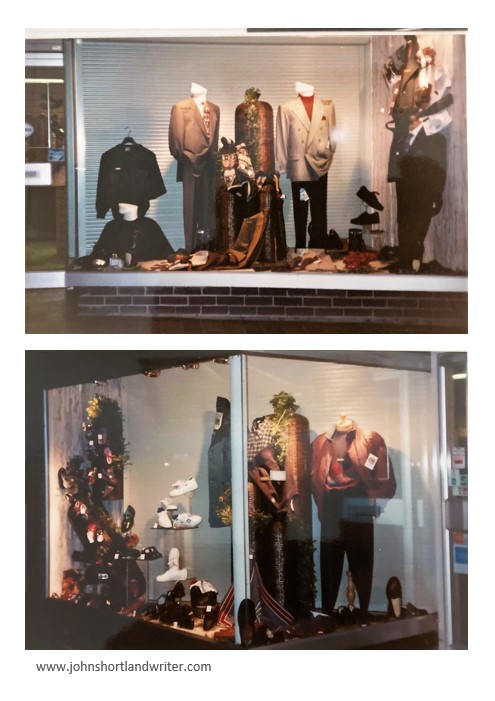
Menswear Department, 1990a small section of theLadies Fashions Department1990
So, what happened to our employees? In the early days of my tenure there was Ivy Taplin (Akela to us cubs of the late 50s!), Yvonne Ludgate, June Charlton (later to become June Billinghurst), Cissy Hyde, Mrs Faulkner, Liz Hill and Diana Spokes. Later, Pauline Harvey, Marjorie Kane, Wendy Manley, David and Marian Bratter, Diane Douneen, Kath Bowdrey, Iris Halstead and Cissy Vickers. I’m afraid I can’t remember the names of them all but some of those listed will be familiar to Bourne End locals – please don’t be offended if I have left you out, you were all valued! The younger generation I purposely have not named but they aren’t forgotten either – I still keep in touch with several of them thanks to social media. It was thanks to a succession of great staff through the years that the business was so successful. It seems appropriate to thank our loyal customers too – I can still picture many of them and the frequent kind comments that I still receive on social media shows that they haven’t forgotten Shortlands either which, after all this time, is rather humbling as well as very special.
Ladies Shoe Department display 1990
And what have I been doing the past thirty years? Retailing had been a passion for my family for generations but I decided to follow another of the Shortland passions and forge a new and very different career – you’ll have to wait a short while for part two to find out what but the photo below may give a clue!
Part Two of this blog focussing on the last thirty years is now published and can be found by clicking on the link here
I think it would be fair to say that the chances of my viewing Earth from the Moon is so improbable that I have never even considered it. That changed when, with an hour to spare en route elsewhere, I decided to explore the Abbey Church of Tewkesbury, little knowing that I would leave having had an out-of-space experience.
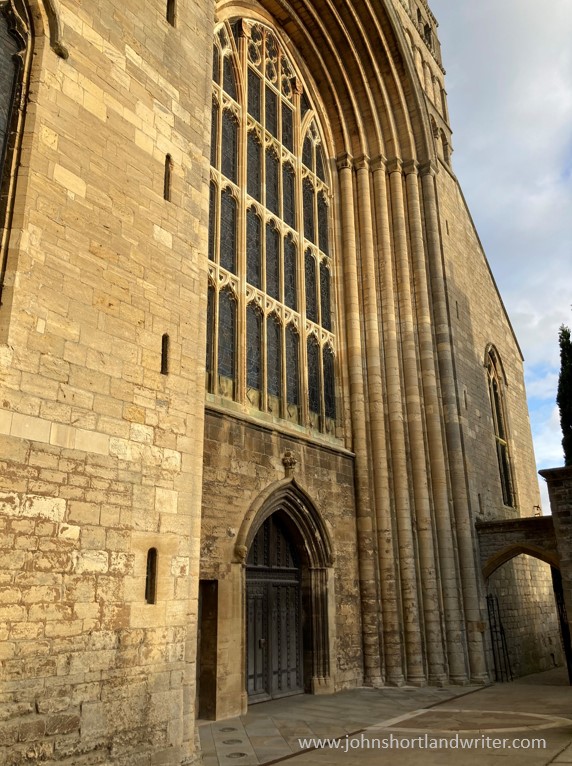
Tewkesbury Abbey
The name Tewkesbury Abbey, as it is usually called, is really a misnomer for the church has been the Parish Church of the Gloucestershire town of Tewkesbury for centuries. When, in 1087, Robert Fitzhamon was gifted Tewkesbury by his cousin William the Conqueror, there had already been a monastery on the site for four hundred years. However, in 1102 the building of the present church commenced, its stone coming from Caen in Normandy, France and floated up the River Severn which passes just yards from the door. For the next four hundred years, as part of the Benedictine monastery, it really was Tewkesbury Abbey.
Ancient buildings line the streets that lead to Tewkesbury Abbey
I’ve driven through Tewkesbury dozens of times. It’s an interesting town with some beautiful old buildings and I’d always intended to stop and explore. With limited time, the town would have to wait for another day. I entered the Abbey church expecting to be overawed by it for it for several reasons: it is now almost a thousand years old, it is one of the finest Norman buildings in England, it has the largest Romanesque cross-tower in Europe and contains more medieval monuments than any other church apart from Westminster Abbey in London. I hadn’t however expected to be be confronted, upon entering, by a large, hanging globe – our Planet Earth.
Planet Earth as seen from the Moon
Rotating slowly, the seven metre diameter Earth sculpture is as seen from the Moon. As Luke Jerram, who created this Gaia exhibit states, “man has been gazing at the moon for Millenia but it was only in 1972, with the Apollo 17 mission, that man was able to see our planet floating through space – a sight that changed our perception of Earth forever.” When standing 211 metres away from the globe, viewers see the Earth to scale, exactly as it was viewed from the Moon.
The Abbey, of course, has many wonders of its own to be viewed. For me, an unexpected delight was the chantry chapel built as a memorial to Isabella, Countess of Warwick and her two husbands, Richard Beauchamp, Earl of Worcester and, later, (another) Richard Beauchamp, Earl of Warwick. Erected in 1430, Isabella’s first husband was killed during the Battle of Mieux and she died in 1439. It was her second husband, the Earl of Warwick, that excited me the most. For his first marriage to Elizabeth de Berkeley (who died in 1422) is part of a long line that I can trace back to in my family tree: Richard and Elizabeth were my 15x great-grandparents. Over the generations, the women in my ancestry have often been rebellious and married against their parent’s wishes (see A Rebel in the Family for an example) – hence the fact that I am just a plain old commoner! Grandfather Richard commissioned another, more splendid brass tomb for himself in Warwick – another place on my list of ‘must visits’.
The Beauchamp Chantry ChapelBronze effigy of Richard Beauchamp who died in 1439 [Wikipedia: Robin Stevenson]
So what caused the Abbey Church to become just a Parish Church? It was, of course, due to the desire of Henry VIII to divorce and remarry brought about his separation from the Church of Rome. His subsequent Dissolution of the Monasteries swept away the buildings and created the spectacular ruins that we find dotted around the English countryside today. A similar fate would have happened to the church in Tewkesbury if it had not been for the argument, fortunately won, that to demolish the church would leave town without a place of worship. How fortunate for us today, for the architecture, history and splendour of the building makes it an almost unique example of early Norman ecclesiastical buildings.
The tall Norman arch is unmatched for size in England
Tewkesbury, as has been stated, is built along the banks of the River Severn, England’s longest river which is subject to tidal bores and rapid changes in it’s flow height. As a result, the town is often flooded. Despite being built so close to the river, the floodwaters have only entered the church on two occasions, in 1760 and, more recently, in 2007. It is often shown in news features totally surrounded by the flood waters.
Modern stained glass at Tewkesbury Abbey
The Gaia exhibit has now ended at Tewkesbury. It is being shown as an ongoing exhibition in the UK at UCL, London; International Centre for Life, Newcastle; Dynamic Earth, Scotland. In Ireland: Trinity College, Dublin. In Canada: Canadian Museum of Nature, Ontario. American readers have the opportunity of seeing it in the USA at Houston Museum of Natural Sciences 12-28 April 2024.
Educator, economist, suffragist and founder of the National Council for the Unmarried Mother & Child (later to become known as the charity, Gingerbread).
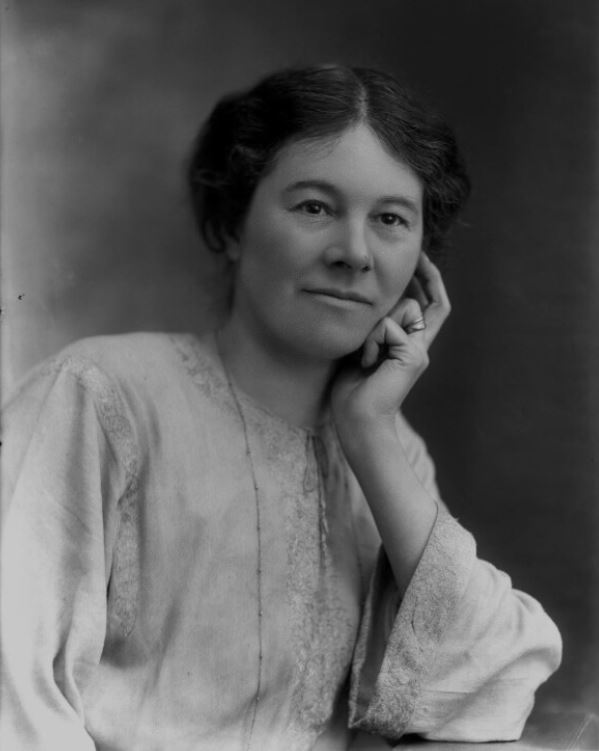
Lettice Fisher, the eldest daughter of Sir Courtney Peregrine Ilbert came from a political family. Born 14th June 1875 in London, her father was responsible for the drafting of parliamentary bills and was later to become Clerk to the House of Commons. Her mother, Jessie, was a daughter of the Reverend Charles Bradley and her great-grandfather, another Reverend Charles Bradley was instrumental in the abolition of slavery. At the time of Lady Ilbert’s death in 1924, she was described as “one of the most remarkable political women of her time.” It was to this background of politics and campaigning that the young Lettice grew up.
Lettice Ilbert (image: Wikipedia)
Educated in London and at Somerville College, Oxford, Lettice later returned to Oxford in 1902 to teach history at St Hugh’s College. Whilst at Oxford she also taught economics to women and became an active suffragist. For two years from 1916 she was Chair of the National Union of Women’s Suffrage Societies.
It was during WW1 that Lettice became involved with the women munition workers of Sheffield. Disturbed by the increase in wartime illegitimacy, the difficulties and prejudices the women faced, as well as the higher death rates of their babies, she founded in 1918 the National Council for the Unmarried Mother & Child. Campaigning for the reform of the discriminatory Bastardy Acts and Affiliation Orders Acts, the council gave advice and assistance to single mothers. Lettice remained in her role as first chair of the council until 1950. Much later in its history the council merged to become known as the charity, Gingerbread.
Lettice Ilbert married Herbert Albert Laurens Fisher (known as HAL Fisher), her Oxford tutor in early July 1899. They had one daughter, Mary – later Mary Bennett – who became principal of St Hilda’s College, Oxford. After HAL’s untimely death in 1940, Lettice moved from Oxford to Thursley, Surrey where she died from heart failure in 1956. Her ashes are interred at New College, Oxford where HAL had been warden for many years until the time of his death.
The theme of this year’s United Nations International Women’s Day is “Women in leadership: achieving an equal future in a Covid-19 world.” I’m not qualified to write about current matters but I am quite certain that Lettice Fisher embraced the qualities that are still needed today. One hundred years ago, Lettice Fisher found that the terrible aftermaths of World War and the ‘flu epidemic which caused even greater deaths and hardship, only hardened her resolve to tackle women’s rights, prejudice and injustice. Sadly, in many places in the world, these issues are still very much outstanding.
Why my interest in Lettice Fisher? Lettice Fisher (nee Ilbert) is an ancestral cousin through our mutual descent of the Bradley family.
Sometimes I get asked the question why do I write. The answer is usually just because I always have. Recently I’ve given more thought to it and I think that perhaps it is because (apart from having something to say) I like the way words look as much as the way they sound when arranged on a page. You can almost play games with them, juggling the written and the spoken so that both the emphasis and flow change. Nowhere is that more pronounced than with poetry.
Alfred, Lord Tennyson, Poet Laureate[photo credit: Wikipedia]
To be honest, I struggle a bit with poetry. I feel I ought to like it more. There are some that I love because they remind me of childhood although having to learn and recite, The Lady of Shallott didn’t excite me at the time. Having to read a poem at the front of the class must have destroyed any potential to love poetry for many a generation of children. I adore some of Christina Rosetti’s poems but mostly poetry is for me rather like jazz or wine – I know what I like and, sometimes, I discover a new one that is to my taste.
this beautiful angel statue is in the Glasnevin Cemetery, Dublin, Ireland
The quote in the photo is from Tennyson’s Maud. Of course, I knew the old song, Come Into The Garden, Maud that quickly rose to popularity as a parlour song. Because of this I assumed, like so many others, that Maud must be a love poem. Certainly, my quote above which comes earlier in the poem would make you think so.
a classic rendition of Come Into the Garden, Maud dating from 1940
Maud is one of Tennyson’s epic poems; a tale of hatred, infatuation, of death and destruction and the decline into insanity and, later, of war. The poem certainly wasn’t loved by the public when it was first published in 1855. So why do I find it so fascinating?
transcription of letter from Tennyson to George Granville Bradley1855
Many readers of my blog share an interest in genealogy and family history. I have been researching mine for many years and have shared some of my ‘finds’ and stories here. One such discovery was the long friendship between Tennyson and my ancestral cousin, George Granville Bradley. Bradley was first the Headmaster of both Rugby and Marlborough Schools before becoming the Dean of Westminster Abbey. Both he and Tennyson shared a love of geology, then in its early days of understanding. They would roam the hills of the Isle of Wight together where they both lived geologising and reciting poetry. The discovery of correspondence between them on the merits of Maud and how it may be altered before publication both excited and intrigued me. Here was one of Britain’s greatest poets, a Poet Laureate, seeking advice from a cousin of mine! I purchased an old copy of Tennyson to read it with a renewed interest and the rest – as they say – is (family) history.
George Granville Bradley with his family at Marlborough School about 1860 [photo credit: Ancestry]













 Life in the English Cotswolds