In Praise of Bluebells

Can there be a more delightful spot to linger than a bluebell wood in spring?  The intensity of their colour when seen growing in their tens of thousands would hurt the eyes if not offset by the citrus green of the beech trees they favour growing under.  With early morning sunlight filtering through the branches to strike the woodland floor below, both leaves of beech and ‘bell shimmer and sparkle in the clear light.  As the forest warms the bluebells release their scent but not the heavy, redolent perfume that one might expect. Instead, a fragrance so soft and gentle that for a moment it seems to come from elsewhere; all too quickly it melts away, dispersed by the increasing heat.

Bluebells are one of the key indicator plants of ancient woodland, a term that refers to woodland that pre-dates AD1600, for their bulbs prefer to remain undisturbed where they can slowly establish huge colonies.   Here, in the secret valley where they grow in hedge banks, they can be used to trace the line of an equally ancient drove road for it is thought that the hedgerows and trees that line it are remnants of Wychwood Forest.  Over centuries, the boundaries of the Forest have shrunk as fields were created and the trees cleared for arable land or pasture.  By leaving the field edges untouched the early farmers saved themselves both time and labour and in doing so preserved the bluebells that give me so much pleasure each spring.  The drove road – primarily used for herding livestock long distances to market – passes our little stone-built cottage before diverting across open country.  It is still used as a public right of way.

Bluebells line the old drove road that passes my house

Unsurprisingly for a plant that has been around from time immemorial, the bluebell has numerous regional names – Common Bluebell, English Bluebell, Fairy Bell, Wild Hyacinth to name a few.  Perhaps the best has to be Granfer Giggles.  In Scotland they are known as harebells although to an Englishman harebell would be a completely different plant that grows later in the summer when the bluebells have long ended.  Even the Latin name which is supposed to prevent confusion has changed over time – it is now known as Hyacinthoides non-scripta.  I much prefer the earlier name of Endymion non-sciptus, it sounds more attractive as well as having a romantic Greek legend attached to it.  Illegal to dig up plants from the wild, bluebells are sometimes offered for sale from cultivated stock under either of these names.

Occasionally you may find a white, or even a pink bluebell

For such a well-loved plant – it has been voted England’s unofficial national flower – bluebells do not seem to feature much in poetry.  They are frequently mentioned by name but no-one, as far as I can tell, seems to have written poems specifically about the plant.  Perhaps it is because they are such a common sight and have none of the delicacy of the wild rose, the scent of the honeysuckle or the diminuity of wild thyme. Shakespeare, who seems to have written about absolutely everything (including thyme), only mentions it once: “the azur’d harebell” in Cymbeline.  The Brontë sisters both wrote of bluebells but I’m not sure they weren’t describing later flowering harebells. Emily’s description “waves in summer air”, and Ann talks of a single flower and of its trembling.  Bluebells are quite a stiff flower that don’t wave or tremble that readily whereas Campanula harebells fit the description nicely. I can’t recall even my beloved Richard Jefferies, the Victorian naturalist, waxing lyrical over them as he did over so many other things.  I may be wrong about this for I can hardly call myself a Jefferies’ scholar, more an enthusiast. However, Cicely Mary Baker created a delightful illustration of the flower in her set of Flower Fairies published in 1923 where she describes the bluebell as the king of flowers.

The less-common Harebell – Campanula rotundifolia
It flowers later in the summer and in more open places

It is to the Georgians that I have turned to illustrate our love of bluebells for I have found frequent references to them in old newspapers and periodicals not just in published poetry but also in their fashions.  This description of the sumptuous gown worn by the Princess of Wales when attending the King’s Birthday in 1795 is worth reproducing here: “A gown of superb, embroidered crepe imitating the rays of the sun and intertwined with embroidered white lilies.  Over which a cape of Venetian net embroidered with laurels and Diana’s (presumably the Goddess) crescent”.  Finally, there was another over-cape “embroidered with bluebells (yes!) and held in place by rich cords and tassels”.  As if this wasn’t splendid enough there was “a long train of silver gauze bordered in purple and silver”.  Having spent twenty years in the world of fashion (before I switched careers to horticulture) this has sent me into overdrive!  Sadly, I haven’t found any illustrations for this ensemble but I do have photos of the ‘draft’ for equally exquisite embroidery designed by Norman Hartnell for a robe for Queen Elizabeth II.

Embroidery design by Norman Hartnell for Queen Elizabeth II

Even earlier, in 1786, Mrs Charlotte Smith was publishing her sonnets.  A remarkable woman for the age, she left an unhappy and violent marriage and campaigned for women’s rights and the abolition of slavery.  She wrote fiction and poetry to financially support herself and her children.  This sonnet reminds me so much of my youth where I roamed the bluebell beechwoods of the Chiltern Hills, for which they are renowned.

“Ah, Hills belov’d!  where once a happy child,
Your beechen shades, your turf, your flowers among,
I wove your bluebells into garlands wild,
And woke your echoes with my artless song.
Ah! Hills, belov’d! your turf, your flowers remain;
But can they peace to this fad’ breast restore?
For one poor moment soothe the sense of pain,
And teach a breaking heart to throb no more?

I’m glad to say that my heart is no longer breaking so perhaps the bluebells worked their magic!

A very old photo (hence the strange colour!) of me and my two deerhounds in a Chilterns beechwood at bluebell time

.
.
.

Yorkshire Cheese

Over the many years of writing this blog I have rarely posted reviews of products or of venues.  From time to time such requests are made and turned down as that sort of writing has never been my intention.  The few that I have written have been chosen solely on their merit – it is usually because I have come away with that ‘wow’ feeling.  And so it is with this one for, as others will testify, cheese is certainly, or can be, able to give it.

Judging cheese at the Great Yorkshire Show

My partner and I had chosen to spend a week in the Yorkshire Dales, a National Park with spectacular scenery.  Austwick is a classic north of England village – solid stone-built cottages, a church, a village green, a couple of village shops and for us, a great base for some wonderful walks over what can be challenging terrain.  As it happened, it turned out to be a little too challenging as my partner is recovering from a broken foot – the cross-country walks will have to wait for another visit.  Instead, we decided to explore the area mostly by car with a few short, gentle walks thrown in as ‘therapy’. 

The Yorkshire Dales at Austwick

On our first outing, we had only driven two miles before we saw a sign marked The Courtyard Dairy.  Not expecting too much other than an ice cream (they do those too), we were blown away by what we saw. The Courtyard Dairy – trading from a converted barn – is a family run affair and there is little doubt upon entering that they are certainly having a love affair with cheese.  There are cheeses of every colour, size and consistency everywhere you look.  I suppose we shouldn’t have been surprised for the fields we’d passed were full of black and white milking cattle and, of course, as every Wallace & Gromit fan knows, Wensleydale (just a few miles up the road) is famous for its cheese.  There is even a black and white – plus a few extra colours – cow to greet you as you walk into the Dairy yard.

The Courtyard Dairy

The people that run the Dairy couldn’t have been more friendly and were quick to correct us (nicely!) when we said we were staying at Austwick and pronouncing it in the typical Southern way, Oorstwick.  “Oh, you mean Austwick – Aust as in Australia.”  It reminded us of a time some years ago when we were up north and asked a local policeman how we reached the village of Oertop.  It took some time before he realised that the person who had given us directions had said, when translated into southern speak, “over the top” which had meant we needed to take the road that went over the hill. 

Friendly staff and a great selection at The Courtyard Dairy

As with all good cheese shops, we were able to taste the cheeses before deciding which ones to buy and, needless to say, came away with a classic cheeseboard: a couple of hard cheeses, a soft cheese, a blue cheese and a goat cheese.  Of course, no cheese should be unaccompanied without wine and across the courtyard there is a wine shop with a tremendous selection.  A bottle of Bordeaux was suggested as the perfect partner for the hard cheeses.

Every shelf is crammed with cheese

Behind the cheese shop the Swinscoe family have created a small museum telling the story of cheesemaking in the Dales.  The old equipment used is on display as well as boards explaining the family’s connection to the Dales, to cheese making and to farming.  For me, I found the recipe notes dating from 1912 and written by Great Granny Mary Reid of especial interest for I have a few recipes similarly handed down from my Polish great-grandmother Rachel.  She died in Poland before my mother was born and these precious mementos seem to give life back to these people of long ago that would otherwise be unknown. 

Artefacts at the Dairy Museum
Great-Granny Reid’s cheesemaking notes, 1912

Neither great-grandmother had, to my knowledge, a recipe for pizzas using local cheeses but if you fancy one these are also available in the restaurant attached to the Dairy.  All in all, a great visit and well worth making a special trip for.  However, if you are unable to find an excuse for a few days in Yorkshire an online order service and a cheese club are available.  I think there’s a very good chance that I shall be joining!

Not a picture but the view from the museum window!


The Courtyard Dairy is situated on the A65 Kirkby Lonsdale to Settle road, and about 2 miles south-east of Austwick

The Courtyard Dairy website

It is not surprising that I was so delighted to have discovered this place for it has received many accolades before: Cheesemonger of the Year in the World Cheese Awards, visits from King Charles III as Prince of Wales, Nadiya Hussein to mention just a few…

.

2015: A Year in Review July-December

Oh dear!  Not a good start to the year!  January has whizzed by at such an incredible rate that this review may not be completed before midnight strikes and February arrives.
Has the month gone by more quickly because, with the exceptionally mild weather we have been having this winter and all the spring flowers in bloom weeks early, that it feels as if this review was (and should have been) written weeks earlier?

Crocus (2)   copyright

Working on the premise ‘better late than never’ here it is now.

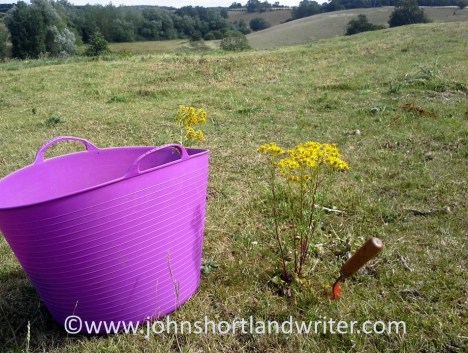
July: As a plantsman I’m very aware that some of the most beautiful blooms can disguise the more ominous aspects of a plants nature.  Ragwort, a common weed of grassland and waste areas has cheery, bright yellow daisy-like flowers yet hides toxins that can be fatal to horses and cattle.   Control is usually carried out by hand pulling for poisoning the plant with weedkillers makes them even ore attractive to animals as they graze the dying foliage.  However, pulling the plants put humans at risk as the sap is absorbed through the skin to damage the liver.

Always remove the pulled plants from the field

In Ragwort: A Curse or a Blessing?  I looked at the controversy surrounding this plant for it has its benefits and uses too.  Should you destroy it before it destroys you?  Click here to find out.

Ragwort and horses - not a good combination

August: A different quandary was discussed in the post A Quiche or a Quad Bike?  It isn’t often that you visit a restaurant that sells quad bikes.  Or was it a quad bike showroom that sells the most delicious home-baked quiches?  Either way, there was a dilemma: which did I want to have the most?  Click here!

001   copyright

August is also the perfect month for planting daffodil bulbs – also toxic, by the way, although no-one would ever suggest banishing them from our gardens.  Remembering Wordsworth’s immortal words on the subject, this post (click here) looked at how to create drifts of colour that look as if they have been growing there since the poet’s days.

Naturalised Daffodils   copyright

September: back on Exmoor, my spiritual home and, to my prejudiced mind at least, England’s most beautiful National Park for another visit.  The tiny village of Exford lies at its centre.  Exford’s church pre-dates the Norman Conquest of 1066 and the post (click here) looks at its Celtic origin.

Exford - St Mary Magdalene   copyright

October: travelling again, this time to the south of France.  Staying in the foothills of the Pyrenees it would have been easy to write about the magnificent mountain views, the gentle Blonde Aquitaine cattle or the fine dining in every wayside café.

Blonde d'Aquitaine   copyright

However, it was on the drive home that we discovered the village of Aurignac and marvelled at its silent streets and historic houses that appeared untouched by modern living.  It was only later that I discovered it was hiding an even more ancient secret – it was the place where man’s first footsteps in Europe over 40,000 years earlier took place.

Aurignac (2) copyright

Even if you’re not too interested in pre-history it is well worth clicking here to look at the photographs on the post  of this enchanting place.

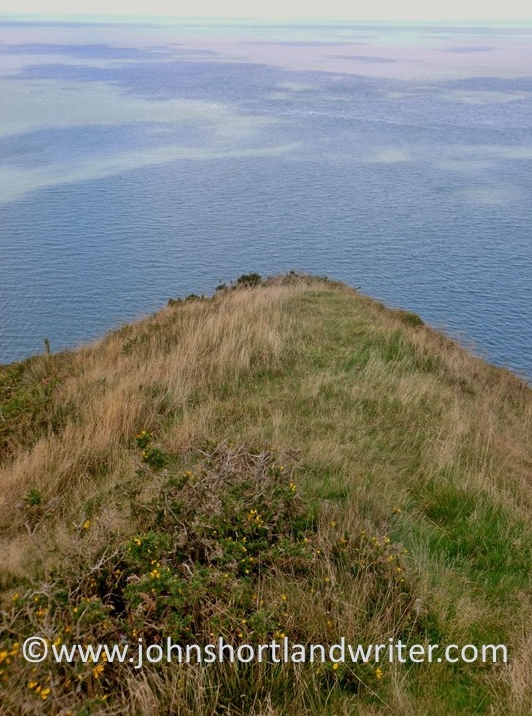
Wind Hill (10) copyright

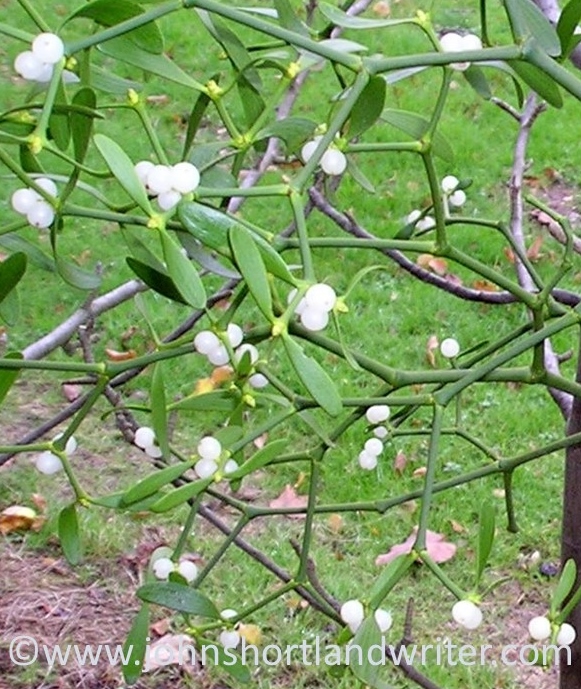
December:  It wouldn’t be Christmas without a bunch of mistletoe hanging somewhere in the house to catch visitors for the traditional kiss.  This month’s post (click here) looks at the tradition which is now spreading worldwide.  It also explains how to grow your very own mistletoe plants so that you never have to be unloved in the years to come.

Mistletoe (7)  copyright

A rather belated Happy New Year to you all!