Since the start of writing myLife in the English Cotswolds blog, now over fifteen years ago, overseas readers have repeatedly commented on our network of public footpaths. Mostly it is one of surprise that we can seemingly wander at will over privately owned land and clear any obstruction that may be blocking our way. In this post I hope to clarify what this civil right, now enshrined in law, is all about.
A footpath crossing privately-owned land in the Cotswolds
Many of our footpaths are ancient in origin dating back 5000 years or more. Of course, in those days, these paths were the main highways across a wild and untamed land. Even in the relatively recent past much of the road system was a dusty, uncomfortable route to take in summer and not any better later in the year when winter rain turned them into a muddy quagmire. Over many centuries the network of paths was created, usually by local people on foot or horseback taking the most direct and dry route to work or market. This is one of the reasons why paths often pass through farmsteads and gardens.
This public footpath passes close to Lower Dornford Farmhouse
Today, the public footpaths of England and Wales (Scotland has a different system) are much loved and well-used, mostly for recreational purposes. There are several organisations and charities (see list below) that help to protect the paths and walker’s rights to use them for there are several threats, such as land development for roads and houses, as well as the occasional, unscrupulous landowner. Landowners seem to fall into two categories: those that maintain the paths to allow ease of access and those that allow the paths to fall into disrepair for it is the landowner that is responsible for the path’s maintenance. A well-maintained path is clearly defined across the landscape, its gates and stiles giving ease of access whilst remaining stockproof. By statute, where a path crosses a road, the local council must signpost it.
This farmer has mown a strip through his crop to define the footpathWhere a path meets a road it must be clearly marked
After many years of campaigning, England created its first long-distance path, the Pennine Way, in 1965. It is 268 miles in length and runs down the spine of northern England passing through spectacular countryside. Today, there are many of these long-distance paths as well as shorter, circular paths. However, with a good Ordnance Survey map (paper or app) it is possible to create your own route whether it be for an hour’s stroll or for much longer. In 2010 the Slow Ways network linking various paths and lanes, villages and towns, across the whole country was created, one of the few benefits to have arisen from the Covid-19 lockdown when walking alone was one of the few permitted activities. The routes listed are all tried and tested by local people who walk them regularly.
The rugged landscape at Jacob’s Ladder, part of the Pennine Way long-distance pathOrdnance Survey map shows the public rights of way (the solid red line is a main road, the solid yellow line, a country lane [Copyright Ordnance Survey]
In the Ordnance Survey map illustrated above the footpaths are clearly defined using red dashes. The short dashes show footpaths (walkers only) whereas bridlepaths (walkers, horses and bicycles) have long dashes. The broken short-long dashes mark those tracks that can be used by horse-drawn vehicles (“restricted byway”). Some paths have signs along their routes showing not just the route but also the path’s category.
As mentioned, paths frequently cross farmland or other enclosed land. A way through a fenced or walled area must be maintained at all times. Below are illustrations of some of the different types of barriers you may come across although none must prevent you from continuing along your route. If it’s a route for horses the rider must be able to open the gate without dismounting.
Wooden gate to pass through easily or wooden stile to scramble overNot all stone wall are so tricky to get over!
Visitors to England often spend far too much time in the major cities or tourist hot-spots (the Cotswolds have lots of those!) returning home not realising that they have missed the opportunity to see parts of the country that never feature in the travel magazines – the homes and villages, the woodlands and old drover’s tracks that can be found all over the country. You may choose to walk alone but when you do meet someone, they are often local and happy to exchange greetings and share a few minutes in dialogue.
Bibury – one of the most visited villages in the Cotswolds. To see it like this you need to arrive soon after dawn!Get away from the crowds by exploring the peace and quiet of the English countryside
Not everyone, of course, feels comfortable walking by themselves, especially in an area unknown to them. Fortunately, there are a lot of local groups or larger organisations such as the Ramblers Association that will welcome you on a regular or one-off basis. Occasionally you may even find an individual who’ll be happy to share with a visitor a favourite walk or place – I’ve done it myself and made some good friends along the way. That is one of the best things about walking, the walks can be short or long, easy or arduous, solitary or in company but it is the interesting conversations you have, the beautiful scenery you pass through, and the wildlife you encounter that make such a memorable experience. Why not give it a try?
Walk quietly and you’ll be surprised who accompanies you!
Useful Links click on the organisations below to visit their webpage
‘We’re off to the heath!” Such excitement whenever my father made this announcement. It happened perhaps just three or four times a year and when it did it was always a special day. Almost seventy years of summer sun – for we only ever went there when the sun was shining – have passed and the memory of those innocent days still bring joy. Much later the heath became my place of refuge when sadness threatened to overwhelm me; under the great tree that had witnessed my journey into adulthood, its shade restored and healed me.
Many summers have passed since I last sought the shade of the great tree
Going to the heath involved ritual. The ritual included packing the picnic that my mother had been busy making; the ‘paste’ and cheese sandwiches, rock cakes that required the currants to be removed before being eaten (“no, mummy, they look like eyes”) and the steel Thermos flasks of scalding hot water for tea. No tea bags in those days so teapot, loose tea and strainer were all added to the basket along with the rug for sitting on. The rug fascinated me for it was of coarse wool and a faded khaki in colour but, most of all, it had my father’s name written on it in capitals: SHORTLAND H A 174445, the numbers being those from his army days. The blanket, he would tell us, had seen the Holy Land, Tripoli, the Pyramids of Egypt and the ancient ruins of Rome. Being spared the horrors he’d witnessed during World War 2, it seemed to us as if the rug had magical qualities, perhaps it was the carpet that would one day take us to these far-off places as well. Of equal importance to the outing was the cricket bat, ball and stumps, all to be placed in the boot of the cream Consul car – but only after I’d been lifted out of it for my jumping into the boot was all part of the ritual too.
Being packed into the car boot was all part of the ritual in 1955!These days, picnics are taken in a lot more comfort…
Driving along the narrow country lanes my sister and I, noses pressed hard against the car window, would comment on every house made of flint, or with a thatched roof, that we passed for we knew the journey so well. “Oooh, I so wished we lived there…” After a few miles the car would begin to slow and we eagerly awaited the moment it would stop and we could all clamber out. Hoisting me onto his shoulders so that I could see over the high hedge, we would look down onto the ‘model farm’. How I loved it for it looked so much like my toy farm at home with its cows, sheep and horses enclosed by beautifully painted white wooden rails. Of course, it wasn’t really the miniature farm that my father claimed it to be but set in a deep and steep-sided valley gave it the illusion of being on a much-reduced scale. One day, I’m not sure how or why, we visited the old farmhouse with its ancient, beamed ceilings. In one room the main beam was much split with age into which coins had been hammered. It only added to my sense of awe as the farmer showed me the oldest coins, some of which dated back three hundred years or more. He also showed me the one he’d placed with the ‘new’ queen’s head on it, the first he’d seen, for Elizabeth the Second had only come to the throne in the year of my birth.
Everything about the farm seemed to be in miniature….
Our next stop would be for a stroll around the village of Fingest. The church fascinated me for it had beautiful, honey-colour rendered walls quite unlike the other churches in the area. Its other unique feature was its bifurcated tower which to childish eyes looked as if it was splitting in half. Best of all, inside the church, was a ladder, so tall that I was sure it must be Jacob’s ladder that I’d learnt about in Sunday School. I never saw any angels climbing it but I was convinced that if I was allowed to do so I would reach Heaven. In adulthood, I would live in the village for a short while although by then, it was the excellent inn where they served great ale and delicious suppers that I eagerly sought after a long day at work.
The church at FingestJacob’s Ladder – was heaven just beyond the top rung?
Fingest’s neighbouring village of Turville would only be visited on our way back from the heath, my parents stopping off at The Bull & Butcher. In those days, children were not allowed in pubs and so we were left outside to explore its two streets and to clamber up the steep hill to the windmill. How carefree those far-off days now seem when small children could be left to freely wander without fear. The village now is famed for it being the village of the film ‘Goodnight, Mr Tom’, the windmill featured in Chitty Chitty Bang Bang and the church in the Vicar of Dibley. After I moved from Fingest, I had the pleasure of living within a couple of miles of the windmill (and so close to the heath) for eighteen years.
Time stands still in the ancient village of TurvilleThe windmill stands high above Turville village
The lanes beyond Fingest become narrower and more enclosed by hedgerow and woodland as you approach the heath, all of which adds to the excitement of finally arriving at its wide-open expanse. The car parked, out we would spill while mother busied herself with the picnic and my father set up the cricket. We only had one wicket and so the match didn’t consist of ‘runs’ – our reward was in actually managing to hit the ball at all and the praise we would receive for our skill. Perhaps this is why the heath holds such affectionate memories for, back in the fifties, fathers didn’t interact hugely with their children – mine was too busy working or tending the garden to make trips out a regular occurrence and my mother, like most women, was unable to drive. Finally, we would hear mother calling us for tea and after devouring everything in sight we would lie back on the short turf replete and happy. On one occasion my mother had packed roasted chicken legs, a rare treat for chicken was, in those days, a luxury meat. Before we had the chance to try them, our little mongrel dog Tammy had snatched them away and into the bracken to eat out-of-sight. Chicken never again appeared on picnics.
My father in 1963 – a tie was required even for casual dress in those days…
Soon we would be up and eager to explore. The heath was beautifully unkempt; the rabbits cropped short the wide grass rides allowing the bracken and scrub to grow elsewhere, untouched so it seemed by man. Along the western edge of the heath an ancient avenue of lime trees grew, their limbs now left to grow in a haphazard, twisted way. From time to time one of these great boughs would fall to the ground there to gently lie and rot and return to the soil. By summer, the bracken would have grown tall enough to obscure them from view. We knew where to find them and would crawl alongside beneath a green tunnel of fern fronds. Tiny, pale toadstools grew from moist fissures in the bark, beetle scurried away from our disturbance and here we learned about nature., much of which seemed magical to young eyes Later, as I learned patience, I would sit quietly to watch for wildlife: a wren chattering away as it searched for insects, the occasional slow-worm hunting for slugs and not as slow as its name suggests. Once I was rewarded by a family of stoats moving like a sinuous string of sausages as they followed one another each holding the tail of the one in front in its mouth. Such excitement!
Casual wear for ladies in 1963: my mother out for a picnic in the country
Magic played an important part in our young lives for everything we didn’t understand surely had to be caused by magic? We saw regular proof of this in our painting books for they had the word ‘magic’ written across the front cover. A blank page of paper would be transformed into a colourful picture by just brushing with water from the empty paste jars. The paste jars held the exact amount of water required for ‘art’ without too much risk of spills. In those days of necessity, although the word recycling hadn’t been invented, everything – paper, string, milk and other bottles – were all carefully saved or returned for re-use. Plastic wrapping and the throw-away society was still to come.
Evidence of magic could be easily found within these pages!
Further proof of the magical world around us came one day when exploring a new part of the heath. We’d always thought that one dark, wooded corner looked rather forbidding but like all small boys, I knew better. Venturing deep inside it, with every twig snapping under my feet making me jump, I came across a small, black pond besides which stood an old hollowed oak. I squeezed inside the trunk to look up expecting to see sky. Instead, there was darkness followed by much scrabbling and hissing as dust and twigs dropped onto my head. Running as fast as I could I found my sister to tell her all about it. Unbelieving, she and I returned and this time it was she who was hissed at. Scared witless, we ran back to our parents. Just an old barn owl we’d disturbed my father had said. But we knew better, we’d found the door to the magic kingdom of elves and goblins. How lucky were we that the door hadn’t snapped shut with us inside, never to return, as described in the numerous books that we had read. Utter nonsense we were told. That, we realised, was the trouble with grown-ups: they didn’t believe and that was why the magic was hidden from them. *
I have to admit that it probably was a Barn owl that scared us
From time to time, I still return to the heath although I now live many miles from there. Whenever I do, I am struck at how small this ‘giant’ area to children’s eyes actually is. The difficult stage of my life, where the old tree supported me through despair, have long passed and the memory of it does not overshadow the pleasure that revisiting brings. Despite being a grown-up, I can still feel its magic. I’m not alone in this for recently I read Hugh Thomson’s book, The Green Road Into The Trees, in which he crosses southern England on foot. He too, feels the need to return to this very same heath in search of healing and finds it. He believes that the mysteries of the Ancient World are not as far away from us as we tend to think for our mixed Celtic, Saxon and Viking heritage shapes not just the British landscape but also our souls. Perhaps that’s where the magic comes from?
I wonder when Henry started going ‘off the rails.’ Was it down to his parentage? Perhaps living in the small, Thames-side village of Medmenham, where everyone knew one another and so would have known the story behind his birth, may have been a factor. Or was this considered too shameful to be ever spoken of openly again. Whatever, the cause, by 1838 he already had a string of petty offences under his belt when once again he found himself standing in front of the Buckinghamshire Assizes for larceny.
The River Thames near Medmenham
Poor Henry’s troubles really began before he was even born. His mother, Ann Chown, planned to marry local lad Thomas Burridge in the village church in the May of 1809 but on the 14th, halfway through the Banns being called, Thomas had them cancelled. He had discovered that Ann was pregnant with Henry, the father being another village boy, Elias Nibbs. Ann had very nearly got away with her deception for Henry had been born and baptised by 4th June. Ann and Elias never married nor, it seems, lived together, for within a short time they had both married others.
The village church at Medmenham
Henry couldn’t have been a clever thief for, on the 4th April 1838, he was sentenced to six months imprisonment with hard labour for the theft of an axe and mattock from William Chown, his uncle, and a billhook from John Rockall, his stepfather. He was even less clever when he tried his hand at burglary again despite travelling four miles to the local town of Marlow for his crime. This time he stole a shovel, the property of William Brangwin and so, within weeks of being freed from jail, in November he was back before the bench once again.
Standing before the magistrate, Squire Robert Hammond, Henry heard how the shovel was readily identified by Brangwin’s initials being burnt into the handle. Richard Ayres testified that he had been using it on the day of the theft and Thomas Wright, the local pawnbroker told how Henry (using the alias Beaver) pawned it for one shilling – 5p in modern coinage. Hammond was not prepared to give Henry another chance. For this crime he was sentenced to seven years transportation to Australia. It would be interesting to know how the family and villagers reacted to the sentence. Perhaps it was relief for most but more likely, for his mother Ann, it was harrowing.
Henry was taken from prison on 13th May 1839 to Sheerness, a port east of London, where he boarded Convict Ship Parkfield. There were already one hundred prisoners aboard and now it was filled to capacity with the addition of one hundred and forty more men. A military guard of over thirty kept order and six women and nine children also boarded – as this was a male convict ship, one assumes they were planning to join loved ones or just hoping to seek a better life. The voyage was better than normal; with no storms the sea remained calm. When they arrived at Port Jackson, New South Wales, on 1st September, the ship’s Surgeon, Alexander Neill was commended for the cleanliness of the ship and the health of the men for there had been no deaths. Interestingly, in his Journal he mentions that he had rejected one prisoner with scurvy: “one of the worst cases I’ve ever seen and him, not yet at sea.” The convicts were taken ashore to Hyde Park Barracks for processing. We hear nothing more of Henry until the 29th May 1840 – a simple entry in the register: Henry Chown, drowned, Sydney. No further details were given.
Details of Henry’s, and others, crimes listed in the 1838 Register
What became of Ann, Thomas Burridge and Elias Nibbs? Ann married John Rockall in 1811 and had nine children, dying in 1872, aged 85. Elias married in 1813 and had one known child, Richard, before he disappears from the scene. Interestingly, a Richard Nibbs was also transported on the same ship as Henry – were they half-brothers in crime? And Thomas Burridge? He obviously recovered from the upset for within eight months he had married Ann’s younger sister Mary. They had seven children before Mary died in 1828. He later married again and fathered three more children. For such a small place, Medmenham, had its fair share of scandal and excitement!
Henry Chown – drowned. The last entry in the Convict Deaths Register
I have been researching my family history for many years and have uncovered all sorts of stories. There seems to be a disproportionate number of ancestors that had illustrious careers, reaching both fame and wealth. How very exciting to find, at last, a real black sheep in the family!
Henry Chown, my ancestral 1st cousin born 9th May 1809 Medmenham, Buckinghamshire, England died 29th May 1840 Sydney, New South Wales, Australia, aged 31
Sources:
The National Archive British Newspaper Archive Wikipedia Convict Records, Australia Ancestry UK
Both my partner and I like walking but, more often than not, we walk alone. Somehow it just works out like that and there is no doubt about it, that when you walk without company you do see and hear so much more. It isn’t that we chatter away non-stop – we’ve been together for far too long for that!! It’s just that with no-one to speak to, or alongside, one becomes far more aware of all that’s around you. And with only the sound from one pair of walking boots the wild creatures are less aware or concerned of your presence.
Walking quietly it’s possible to get quite close to wildlife
Usually, from necessity, our walks are circular – either back to the car or back to the house if we’ve started from home. Recently I cadged a lift to Duns Tew, just outside the Cotswolds but still in Oxfordshire and not that far from home and the secret valley. The village is an interesting mix of houses and makes use of their local ironstone as well as the Cotswold limestone. I find it fascinating knowing that I live on the edge of two quite different rock formations, 0ne literally as hard as iron and the other, soft and easily worked. The photo below shows the pretty church built of yellow ironstone and banded with paler limestone – a familiar pattern in the locality.
The thousand year-old Church of St Mary Magdalen, Duns Tew
The houses vary in style and age as well as building materials. Some have thatched roofs; others slate and some stone tiles. The traditional village pub has a stone tile roof made from Cotswold stone split into thin tiles. Just to confuse the unknowing, these tiles are known locally as slates even though they are not made of slate! The craft of making these roof tiles is centuries old – they have even been found by archaeologists when excavating Roman villas (of which there are quite a few in the Cotswolds) which means the manufacture of them has remained unchanged for the best part of two thousand years. The pub also has a drystone garden wall, also made from Cotswold stone for which it is so ideal and makes such a memorable feature of the Cotswold Hills.
Village houses: contrasting style and stonework. The thatched house was built in the early 1600s. There are a number of these old signposts still standing locallyThe village pub: this dates from the late 1600s. Note the stone ‘slate’ roof
One of the great things about walking in England is that we have a huge network of public footpaths, many of which date back to pre-history. Now that I realise (thanks to my overseas readers) that being able to walk across privately-owned land by right is almost unique I intend to write specifically about them at a later date. Suffice to say here, is that it is possible to walk from one end of the country to the other over thousands of miles of paths that must not, by ancient law, be obstructed. This path is beautifully maintained by the owner. Just outside the village, partly hidden in undergrowth, were the remains of old pony carts.
A well-maintained public right of way that is also a driveway to the owner’s houseHalf-hidden at the back of a semi-derelict shed
The path opened onto cornfields, the wheat harvested and the remaining stubble giving a real autumnal look to the countryside. The hedgerow is also offering its autumnal fruits for the picking – crab apples, elderberries and blackberries; the sloes although looking good won’t be ready to collect until after the first frosts. The squirrels have taken all the hazelnuts (you have to be quick to get them before they do – but already the embryo catkins, the male flowers, are beginning to appear. It will be early February before they show the familiar ‘lamb’s tails’ that release clouds of yellow pollen with the slightest breeze.
The path is now gras covered passes ‘twixt hedgerow and cornfieldCrab apples, blackberries, elderberries. Tiny catkins are just forming amongst the blackberries
Although the path, now a wider track, looks obstructed here, the farmer/landowner has to leave the gate unlocked so that people on foot or on horseback can pass. Crossing the lane it returns to being a path, this time skirting a large wood. Now hidden by high hedgerows in the spring when the leaves are all bare, the woodland floor is carpeted with bluebells. In the centre of the field is a stand of mature oaks. Why were they left there? For me, they always have a mystical look about them; stepping into their midst the atmosphere changes as if its centuries old story is being told to those that might listen. Perhaps it’s just my imagination but the fancy is palpable.
As this is a public right of way, one of the gates must be kept unlocked by lawThe copse in the middle of the field – was it once a sacred site?
Once again the path changes character. Now a track crossing a small stream, the movement of a young coot searching for food catches my eye and we watch one another for a while before it decides that food is far more important than me. At such close range I see it snatch a small water beetle before it disappears into the undergrowth. For a while the path becomes woodland again and then opens up onto a concrete track. The concrete is all that remains of a WW2 airfield, far inland to be out of the range of German bombers. I stop to listen and am met with silence. How different the scene would have been eighty years ago.
The baby coot carried on about its business…The old wartime concrete paths make easy walking
Finally back home. Being an Englishman through and through (if you ignore the foreign bits of me!) I sit on the old stone bench in the garden with a refreshing cup of tea and lean back against the walls of our own stone-built house built 170 years ago. Looking out beyond the garden I can’t help feeling how privileged I am to be seeing the best views of the whole walk!
Over the many years of writing this blog I have rarely posted reviews of products or of venues. From time to time such requests are made and turned down as that sort of writing has never been my intention. The few that I have written have been chosen solely on their merit – it is usually because I have come away with that ‘wow’ feeling. And so it is with this one for, as others will testify, cheese is certainly, or can be, able to give it.
Judging cheese at the Great Yorkshire Show
My partner and I had chosen to spend a week in the Yorkshire Dales, a National Park with spectacular scenery. Austwick is a classic north of England village – solid stone-built cottages, a church, a village green, a couple of village shops and for us, a great base for some wonderful walks over what can be challenging terrain. As it happened, it turned out to be a little too challenging as my partner is recovering from a broken foot – the cross-country walks will have to wait for another visit. Instead, we decided to explore the area mostly by car with a few short, gentle walks thrown in as ‘therapy’.
The Yorkshire Dales at Austwick
On our first outing, we had only driven two miles before we saw a sign marked The Courtyard Dairy. Not expecting too much other than an ice cream (they do those too), we were blown away by what we saw. The Courtyard Dairy – trading from a converted barn – is a family run affair and there is little doubt upon entering that they are certainly having a love affair with cheese. There are cheeses of every colour, size and consistency everywhere you look. I suppose we shouldn’t have been surprised for the fields we’d passed were full of black and white milking cattle and, of course, as every Wallace & Gromit fan knows, Wensleydale (just a few miles up the road) is famous for its cheese. There is even a black and white – plus a few extra colours – cow to greet you as you walk into the Dairy yard.
The Courtyard Dairy
The people that run the Dairy couldn’t have been more friendly and were quick to correct us (nicely!) when we said we were staying at Austwick and pronouncing it in the typical Southern way, Oorstwick. “Oh, you mean Austwick – Aust as in Australia.” It reminded us of a time some years ago when we were up north and asked a local policeman how we reached the village of Oertop. It took some time before he realised that the person who had given us directions had said, when translated into southern speak, “over the top” which had meant we needed to take the road that went over the hill.
Friendly staff and a great selection at The Courtyard Dairy
As with all good cheese shops, we were able to taste the cheeses before deciding which ones to buy and, needless to say, came away with a classic cheeseboard: a couple of hard cheeses, a soft cheese, a blue cheese and a goat cheese. Of course, no cheese should be unaccompanied without wine and across the courtyard there is a wine shop with a tremendous selection. A bottle of Bordeaux was suggested as the perfect partner for the hard cheeses.
Every shelf is crammed with cheese
Behind the cheese shop the Swinscoe family have created a small museum telling the story of cheesemaking in the Dales. The old equipment used is on display as well as boards explaining the family’s connection to the Dales, to cheese making and to farming. For me, I found the recipe notes dating from 1912 and written by Great Granny Mary Reid of especial interest for I have a few recipes similarly handed down from my Polish great-grandmother Rachel. She died in Poland before my mother was born and these precious mementos seem to give life back to these people of long ago that would otherwise be unknown.
Artefacts at the Dairy MuseumGreat-Granny Reid’s cheesemaking notes, 1912
Neither great-grandmother had, to my knowledge, a recipe for pizzas using local cheeses but if you fancy one these are also available in the restaurant attached to the Dairy. All in all, a great visit and well worth making a special trip for. However, if you are unable to find an excuse for a few days in Yorkshire an online order service and a cheese club are available. I think there’s a very good chance that I shall be joining!
Not a picture but the view from the museum window!
The Courtyard Dairy is situated on the A65 Kirkby Lonsdale to Settle road, and about 2 miles south-east of Austwick
It is not surprising that I was so delighted to have discovered this place for it has received many accolades before: Cheesemonger of the Year in the World Cheese Awards, visits from King Charles III as Prince of Wales, Nadiya Hussein to mention just a few…
Earlier I wrote about the sadness felt within my family, as well as the wider community, at the closure of our small department store that bore the family name, Shortlands. It had spanned the generations for almost one hundred years, firstly as Langstons – my great-grandfather’s surname, and then, after one of his sales assistants married the boss’s daughter, renamed Arthur Shortland. Clever chap, my grandad! Later still, during my tenure, the ‘Arthur’ was dropped. I locked the doors for the final time thirty years ago this spring. Last month seemed an appropriate time to celebrate its history and tell the story, not just of our family connection, but also of the incredible people that worked there over the decades. It can be read in Part One by clicking on the link here. I found the response to that blog incredible with so many people contacting me through my website or social media. It was lovely, as well as humbling, to hear their memories and to know that Shortlands had not been forgotten after such a length of time. Although I gave a hint in the blog, I was also asked what have I been doing since 1994. In this post, Part Two, I bring the story up to the present date.
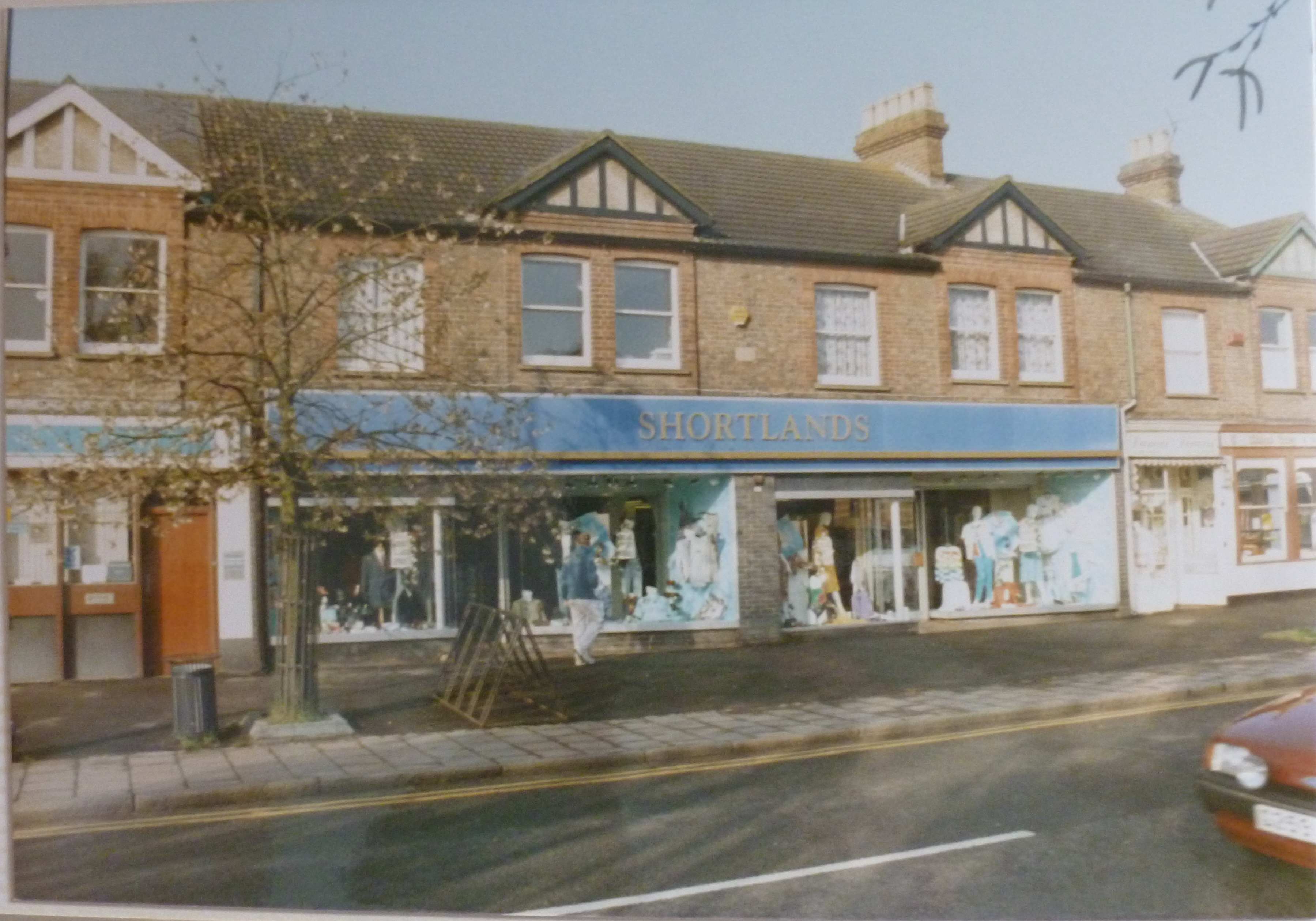
Shortlands Department Store 1994
A reaction tomy choice of careersthat I receive quite regularly is one of surprise. Surprise that I once worked in the world of fashion, and wearing a suit and tie each day, or surprise that I am now working outdoors and wearing jeans and a t-shirt – although, I do have to look smarter on occasion [laughs]. When my retail career of twenty-five years ended, I was in my early forties and my future looked uncertain. I toyed with various career plans, none of which appealed very much. Unsure of what to do next, I decided to take a night class at our local agricultural college, Hall Place at Burchett’s Green. Little did I realise, on the evening of my enrolment, that I would soon be working at the Chelsea Flower Show, working on a gardening series for Channel 4 television or travelling to Hungary, only recently free from Russian occupation, on a horticultural study tour.
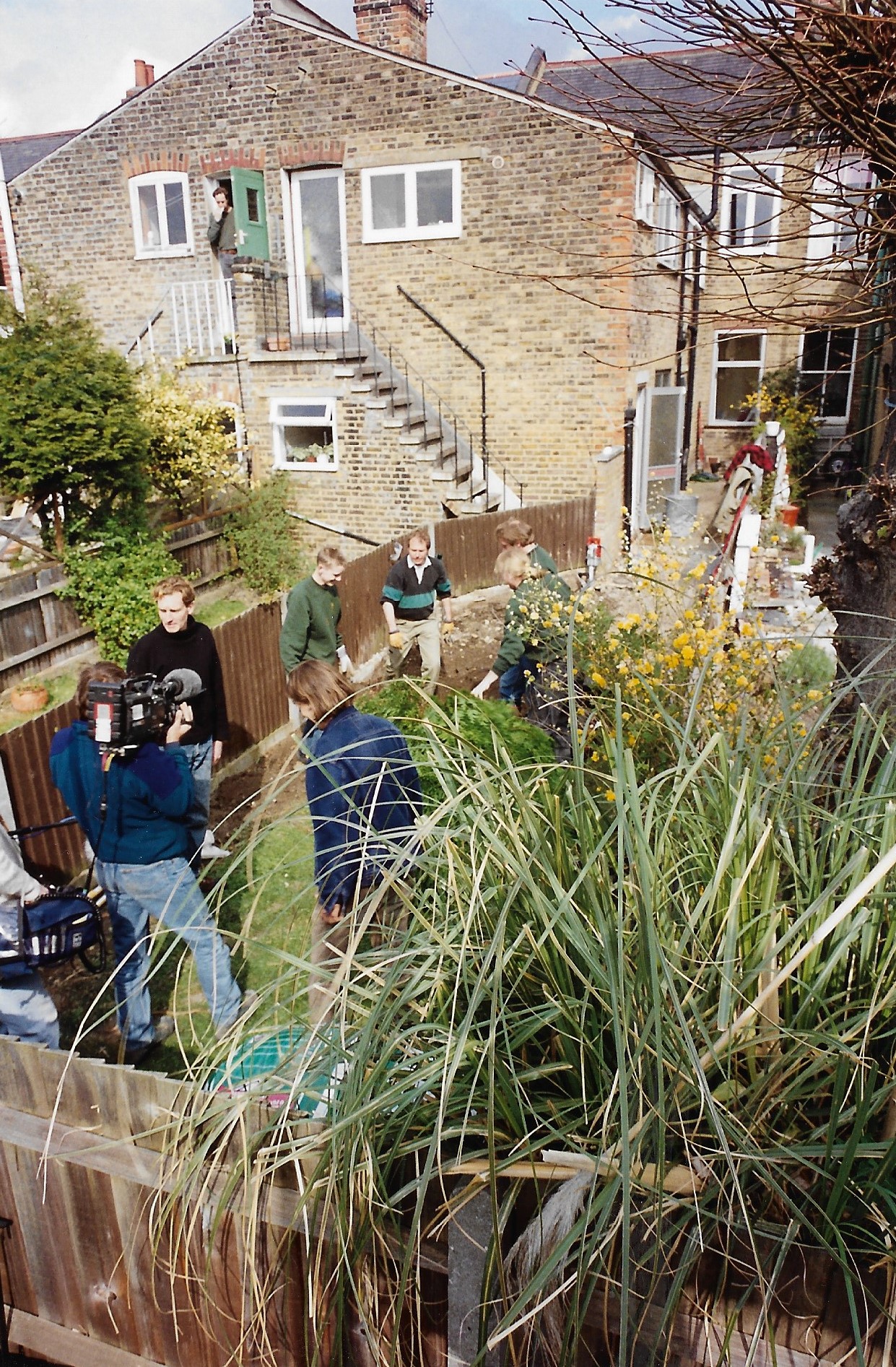
Filming with Channel 4 Television
My visit to Hall Place had ended not with a night class but a two-year, full-time crammer course in Horticulture where I studied Landscape & Estate Management. Gardening had been the major hobby across the Shortland family for generations; I was the first in modern times to try and make a career of it. Knowing I still had a mortgage to pay, and therefore failure wasn’t an option, I studied hard in a way that I had never managed in my school days and came away with a good qualification. By then, I knew that I wanted to run gardens for large country estates. I had the good fortune to be offered, during my training, a work placement with the Getty family, then the wealthiest in the world. Their Head Gardener, Andrew Banbury, gave me various tasks and projects to carry out, frequently pushing me beyond my comfort zone. I have a lot to be grateful to Andrew for. When it was time for me to leave, I stepped straight into the role of managing gardens for a Swedish family who, again, were keen for me to develop further skills as well as their garden. Over the next few years, I had the opportunity to develop an arboretum, create a lake and, best of all, to manage and develop a one-acre walled kitchen garden.
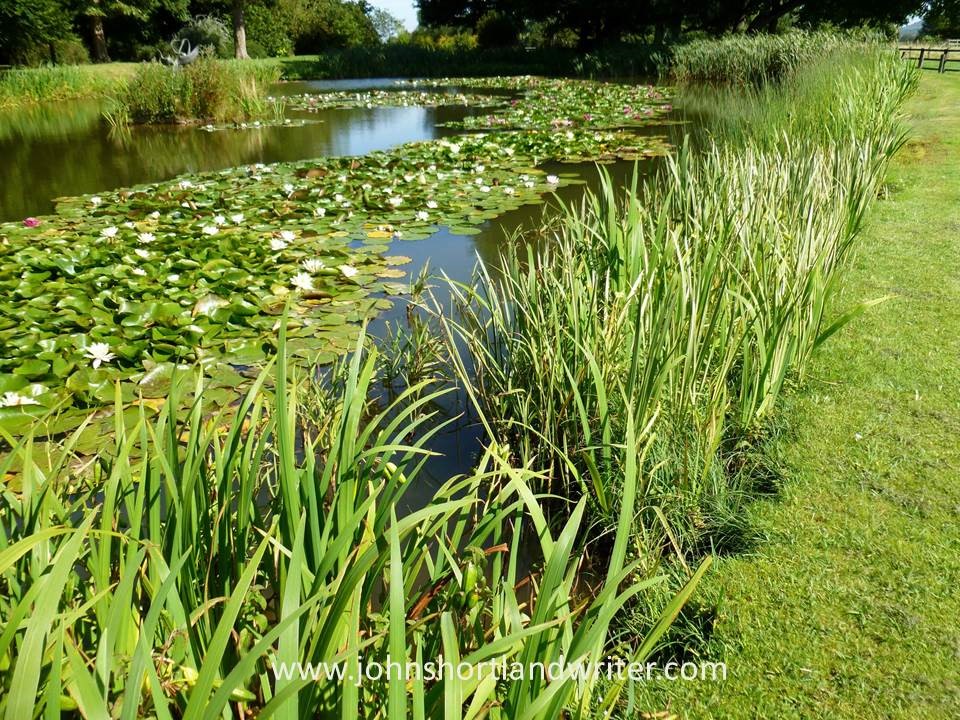
The new lake two years after construction
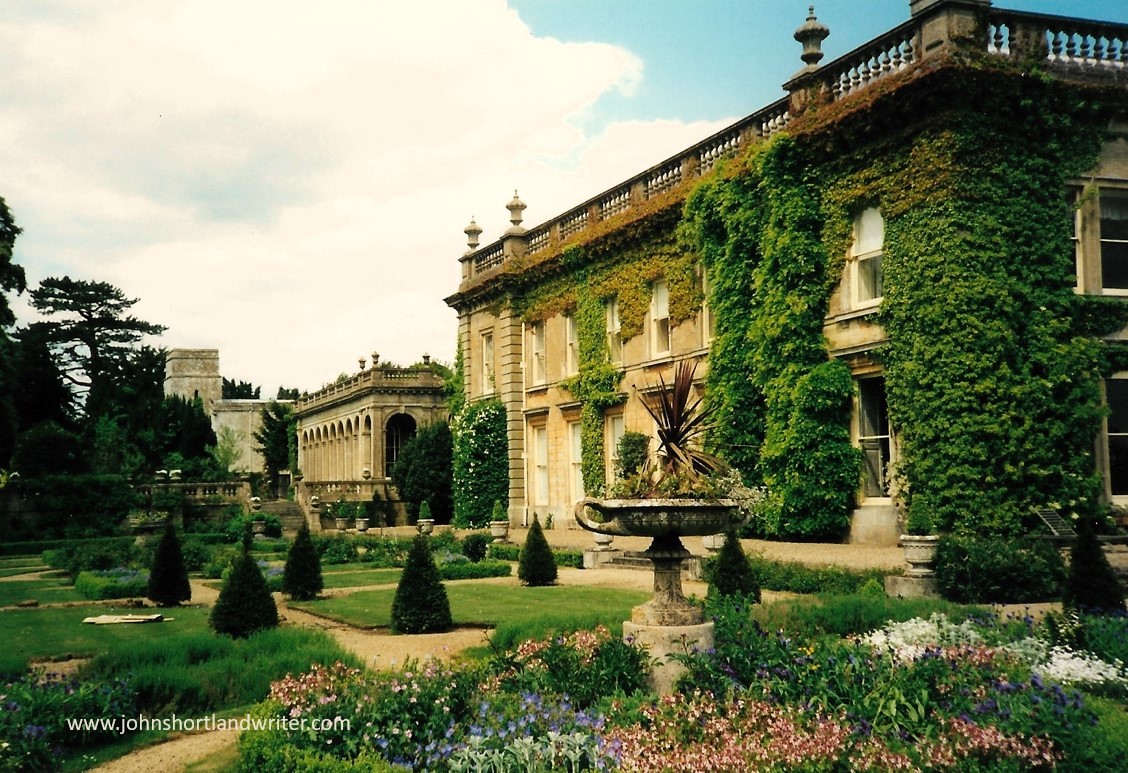
The Millennium saw a change once again for I left the Chilterns and the area I had known all my life and moved to the Cotswolds, there to manage an historic, Italianate Garden, Kiddington Hall. This had new challenges but, although I enjoyed it enormously, the call of working for myself once again beckoned. In 2005 I set up a design and landscaping business which, I am glad to say, flourished; now I have virtually retired.
Kiddington Hall
One of my last projects had been designing and overseeing a garden that has many elements to it: a 50 metre ha-ha, a cottage garden, formal lawns, terraces, topiary, wildflower meadows and kitchen garden, most of which have been created from scratch. As I watched the garden come to shape, with all the hard work being carried out by the owner’s own team of builders and gardeners, how grateful I was that I could now ‘pull the age card’ and let others do the physical tasks!
A section of the terraced rose gardenThe Rose Terrace a few months earlier
When I moved to the Cotswolds in 2001, for the first time in my life I was no longer ‘a local’ and knew no-one. Hearing that Oxfordshire was one of the few counties without a Gardens Trust and that one was being formed, I volunteered and for several years organised talks and visits to gardens which introduced me to many new people. One, hearing of my attempts at writing suggested I joined the local writers group. Feeling very out-of-place I did and before long the talk of ‘doing something big’ with books came about. From those very casual thoughts I found myself part of a small team that created the Chipping Norton Literary Festival. My title of Author, Agent and Publisher Liaison brought me into contact with many people in the literary world and soon I was commissioned by one to write a book on gardening. Three years later it was me being interviewed and giving talks on stage and the radio, a surreal experience.
Being interviewed at the Chipping Norton Literary Festival
Looking back over the past thirty years Irealise just what a chance I took with my career choice and how fortunate I was for it to have ended well. It has taken me on the most incredible of journeys and given me the opportunity to meet/work with some very special people and places. It has had both tearful and joyful moments – it has also had bizarre and funny ones too: being invited to play in a ‘friendly’ cricket match only to find myself bowled out for two by the Captain of South Africa, or sharing an ice cream with American model, and ex-wife of Mick Jagger, Jerry Hall, these being just two of them. As with the shop, it has been a mix of celebration and sadness. I am so grateful that I have had the privilege of two careers both of which I can look back on with pleasure and a certain degree of pride.
How time flies by. I know that’s a bit of a cliché to open with but, even so, it hardly seems possible that thirty years could have passed since that early spring day in 1994 when I locked the door of Shortlands clothing and footwear store for the very last time, and wondering where my career would go to next. I was in my early forties and knew that I would have to do something to earn my keep and pay the mortgage but what? It was a time of great sadness, not just for me and my family but also for our loyal staff some of whom had been with us for many years. Thirty years on it seems time to write the shop’s story to celebrate it having been at the centre of community life for the best part of a hundred years.
Shortlands in the 1990s
The shop that was to become Shortlands began with my great-grandfather, William Bradby Langston, who had already established shops in Marlow High Street and in nearby Lane End. He was quite entrepreneurial, something he and his brothers inherited from their mother. Poor Sophia, widowed in 1863 at the age of 34 with five children under the age of 13 and a baby due at any time needed to provide for herself and her family. She set up a shop in her front living room which later expanded to become Langstons Department Store in Reading, Berkshire. As well as those already mentioned, she and her sons between them also had shops in Boscombe (Hampshire) and Ilford (Essex). Unsurprisingly, she is remembered as being rather a force to be reckoned with – you can read her life story, Rebel in the Family, by clicking here.
The first generations of retailers l to r: My great-great grandmother Sophia Langston (nee Bradby); my great-grandfather William Bradby Langston; my grandfather Arthur Shortland
William opened his ‘Boot and Shoe Warehouse’ in Marlow in 1884 at the age of 22. Seven years later he opened another, opposite the first, specialising in boating and tennis shoes as well as other sporting footwear. When a newly built parade of shops became available in Bourne End in 1899 he established what was to become Shortlands. At first the shop was tiny but by 1904 he had expanded to sell not just shoes but also mens and boys clothing. Four years later William’s daughter, Nellie, married Arthur Shortland who had come to Marlow to work for William a few years earlier. The newly married couple came to Bourne End and by 1915 Arthur was listed as the owner in Kelly’s Directory.
Langstons – the Bourne End branch c1910
The shop continued to prosper and during the 1920s the adjoining shop was purchased and ladies clothing and footwear as well as carpets, haberdashery, dress fabrics and knitting wools, soft furnishings, household linens and luggage were added to create Bourne End’s own department store. The 1920s photo below shows my grandfather Arthur using the steam (clothes) press although it was a (much hated!) task given to my father Hedley as soon as he returned from school.
Langstons, now expanded and with my grandfather’s name on the fascia 1920sMy grandfather, Arthur Shortland using the steam press,1920s
With the outset of WW2 my father joined the army and it was left to the older generation, including my great-aunt Edith Shortland, to run the business. Both the Langstons and the Shortlands were deeply religious and scrupulous in the way they behaved towards others. My mother would tell the story of how when some silk stockings arrived (which were rationed and in short supply) she rather assumed that she would have a pair. She was told quite firmly that her name would go on the bottom of the list like anyone else – she never did get her stockings. Aunt Edie was quite diminutive but with a voice that belied her stature. One day she spotted a lady conceal some goods inside her coat. “Jesus saw you do that” came a thundering voice from nowhere; the woman screamed, dropped the goods and her shopping and was last seen running down the street fearing the wrath of God was upon her! After the war, my father returned to the business along with his brother Jack, later to be joined by their cousin Maurice Phipps.
A retailing family : four generations
During the 1960s the shop expanded again. The garden and old shoe repair workshops at the rear of the property were built over and a new shopfront installed. Made of aluminium, it was considerably ahead of its time and was featured in several design magazines both here and on the Continent. By the late 1970s both my father and my uncle Jack had died and soon after the shop was due for another major refit. The interior, as well as the fascia, was modernised and the displays became more open and accessible to customers. Until that time stock was kept hidden away in drawers and boxes – if you wanted to buy something it was necessary to ask and an assistant would show what was available. Personal service, nowadays a rarity, was the norm back then. How times have changed! To make space for the improved selection of clothing, all of the other departments closed and the shop concentrated on mens and womens fashions and footwear for all the family. The toiletries and gift department was retained; the soaps and potpourri helping to make the shop always smell rather nice!
The ‘new and modern’ shopfront in 1969 featured in design magazinesof the time – by the 1990s it was looking tired and old-fashionedBy the 1990s the displays were brighter and (to use 2020s speak) more ‘on trend’
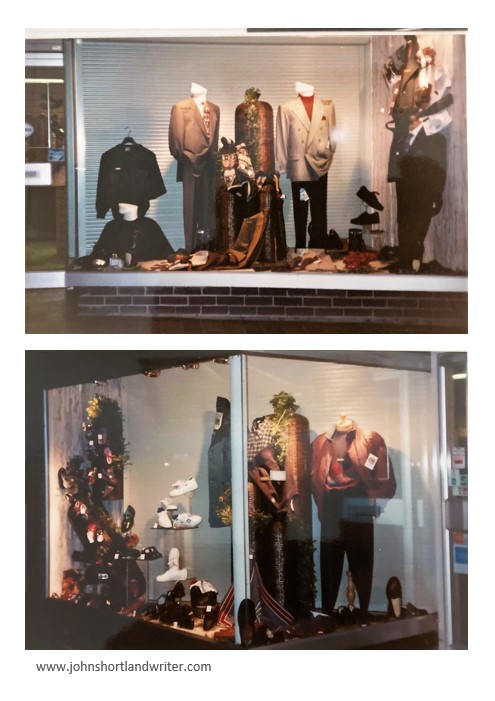
I suppose it was because the shop was ‘always there’ that we have no photographs of the shop interior through the decades which is rather sad. Fortunately, I did take a few in the early 1990s and these will probably trigger some memories for local people. The 1990s brought new challenges for the business with recession and changing shopping habits sounding the death knell for businesses like ours. I had joined the firm in 1971 and my business partner, John Pheby had begun even earlier, as a lad, working for the family. It was a hard but inevitable decision that we decided to close and were fortunate to find a buyer almost immediately. They converted the property to three shops and the accommodation and stockrooms above to flats. Since that time Bourne End has changed quite considerably and most of the old shop names (and several of the buildings too) have disappeared. I believe that there must be photos of the interior held by local people somewhere – it would be wonderful to see them. I seem to recall Jean Peasley taking photos during our last few days…
Menswear Department, 1990a small section of theLadies Fashions Department1990
So, what happened to our employees? In the early days of my tenure there was Ivy Taplin (Akela to us cubs of the late 50s!), Yvonne Ludgate, June Charlton (later to become June Billinghurst), Cissy Hyde, Mrs Faulkner, Liz Hill and Diana Spokes. Later, Pauline Harvey, Marjorie Kane, Wendy Manley, David and Marian Bratter, Diane Douneen, Kath Bowdrey, Iris Halstead and Cissy Vickers. I’m afraid I can’t remember the names of them all but some of those listed will be familiar to Bourne End locals – please don’t be offended if I have left you out, you were all valued! The younger generation I purposely have not named but they aren’t forgotten either – I still keep in touch with several of them thanks to social media. It was thanks to a succession of great staff through the years that the business was so successful. It seems appropriate to thank our loyal customers too – I can still picture many of them and the frequent kind comments that I still receive on social media shows that they haven’t forgotten Shortlands either which, after all this time, is rather humbling as well as very special.
Ladies Shoe Department display 1990
And what have I been doing the past thirty years? Retailing had been a passion for my family for generations but I decided to follow another of the Shortland passions and forge a new and very different career – you’ll have to wait a short while for part two to find out what but the photo below may give a clue!
Part Two of this blog focussing on the last thirty years is now published and can be found by clicking on the link here
I have just returned home from a 48-hour trip up north to Yorkshire. I felt a bit reckless travelling so far, only to discover that ‘up north’ isn’t as far away as we southerners always believe. We may have got that wrong but the famed warm Yorkshire welcome is as true as ever. The reason for my visit was to watch the oldest horse race in the English sporting calendar.
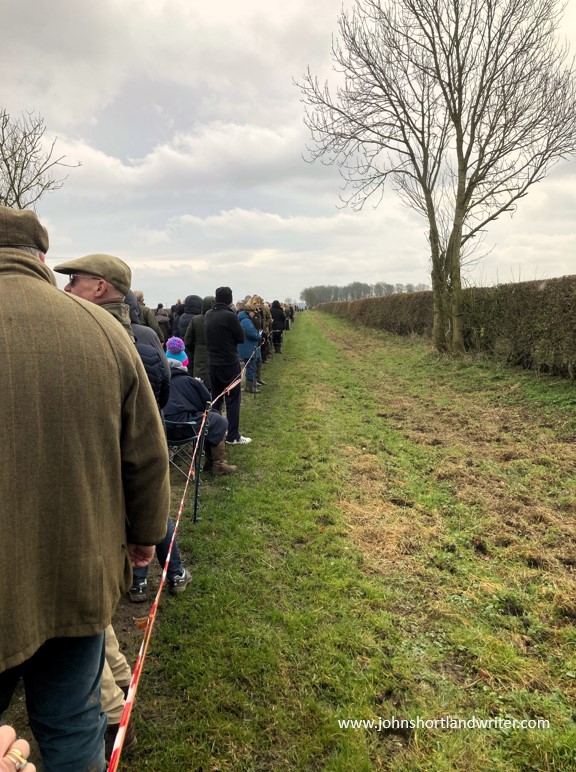
Taking place on the third Thursday in March (when the weather can be very variable), tradition says that if for any reason it is cancelled it will never be run again. To ensure its continuity during Covid restrictions one horse took part; in the harsh winter of 1947 again one horse took part, its jockey sometimes having to dismount to clear a path through the snowdrifts. This year, although the weather has been exceptionally wet, the race took place with nineteen entries and a large supporting crowd. It was the 505th race for It has been run since 1519.
Crowds line the unconventional racecourse
Like all traditions the race has its quirks. Perhaps the strangest being that the race begins at the finish post. From there the competitors walk the 4+ miles to the starting point where they turn around and go hell-for-leather back to the finish. Although the winner receives a trophy and the cache of being first, it is coming second that is the most contested place for the runner-up receives all the prize money – now that is quirky! As with ‘normal’ races, placing bets on favoured horses or jockeys adds to the day’s excitement.
Everyone wants to come in second!
We had travelled to the race to watch our good friend, Carole Johnston, compete. Not only had Carole never raced before she was also not riding a racehorse but a lovely Irish cob that had until recently belonged to her friend, Kate Jeffery. Kate had loaned the horse to Carole when she found that she had been diagnosed with cancer. Sadly, Kate’s treatment was not successful and Carole decided to ride her horse, Lorna, at the Derby to raise funds for the local St Leonard’s Hospice in Kate’s memory.
Carole Johnston and Lorna – ready for the off
As word spread of Carole’s intention and bravery – for she suffers from back and balance issues – so the fund-raising gathered pace. Newspaper interviews and television appearances followed and, on the day, both were present to speak to her before and after the race. As if training for the race and competing wasn’t enough, Carole who is an excellent baker, opened the home she shares with her partner Ollie Heywood to all for much-needed warming soup, cake and pudding. More than seventy people joined them after the race and generously adding more to the funds already raised.
Television and the press have been following Carole’s progressCarole and Lorna being cheered on to the Finish post
Carole always said that taking part in the race was all about Kate and her horse, Lorna. The course is difficult for it takes place not on a conventional racecourse but along muddy and often rutted lanes, tracks and field margins. Carole’s intention was solely to reach the finish line with both her and Lorna in one piece. As it happened, she did manage this, and in some style, as can be seen from the photos, both thoroughly enjoyed themselves. To date, many thousands of pounds has been raised for the hospice in Kate’s memory but more is always welcome. If you are able to add to the funds and help to take it over £10,000, Carole, the hospice and Kate’s husband, Chris will be more than grateful. Click on the link here to donate.
Carole crossing the FinishCarole’s friend,Kate Jeffery













 Life in the English Cotswolds