A Cotswold Tale for Halloween

The popularity of Halloween in the UK as a fun festival is always considered to be a relatively recent American import.  Nothing could be farther from the truth for it was only with the influx of Scottish and Irish immigrants to the USA during the 1800s that it became a major holiday there.  Halloween’s origins date back to pagan times but it was the Christian calendar that fixed the date for All Saints/Hallows Day as November 1st, (Halloween = Hallows Eve). The traditions that became attached to that, of which there are many, will have to wait another year to be written about.  This blog post is about the Witches associated with Rollright and Long Compton, our very own and tragically real Cotswold story of the Neolithic stone circle and village that lies just a few miles from our home in the secret valley.

Newspaper headlines from 1875
A section of the Kings Men stone circle at the Rollright Stones

The Rollright Stones, prehistoric standing stones dating back almost six thousand years (making them a thousand years older than Stonehenge) consist of a stone circle, and a separate group of three upright stones, plus one large, solitary stone.   Local tradition has it said that the circle known as The King’s Men, The Whispering Knights – the cluster of three upright stones, and the King Stone – the large, solitary stone were all turned to stone by a witch, Mother Shipton.  As early as the 1600s the rhyme (see below) was printed telling of how Mother Shipton challenged the King to take seven steps forward to view the village of Long Compton in the valley below.  He moved forwards but failing to see it the witch turned him, his army and his scheming knights into stone.  All seems too far-fetched and unbelievable?  Then read on…

The Whispering Knights, turned to stone by witch Mother Shipton. They are a thousand years older than Stonehenge
The King Stone stands alone on the hill, still hoping to glimpse the village of Long Compton


In the autumn of 1875 80-year-old Ann Tennant left her home in the village of Long Compton to walk the few hundred yards to the bakers to purchase some bread for her husband’s tea.  It was just like any other day until she met her neighbour’s son, James Heywood.  For many years he had accused her and others in the village of witchcraft, blaming them for various deaths of both people and livestock.  He believed that their evil-eye had prevented him from completing his work in the fields.  He also claimed that they had got inside his drinking water and that was the way they were able to get inside his body and control him.  Meeting her that afternoon on the path he took his opportunity and stabbed her multiple times in the legs with his pitchfork before giving her a blow to the head and stabbing her again.  All this time, Heywood’s father stood nearby not attempting to stop him for he was also convinced there were many witches in the area.

The 17th century lychgate leading to the churchyard where Ann Tennant is buried

It was local farmer James Taylor, hearing her cries, who disarmed James and poor Ann was carried home to die from shock and loss of blood some hours later.  At the inquest, Taylor and a fifteen-year-old lad who had also witnessed the murder gave evidence.  Held in the village pub, The Red Lion, they told of the scene they had witnessed.  Ann’s husband spoke next telling of how the boy’s parents had always said witches wouldn’t leave their son alone.  He also told of how a limb from a tree had fallen onto the boy, leaving him with a scar, and that, too, was blamed on witchcraft.  When Ann’s daughter gave evidence Heywood shouted out, “she’s one as well.  I can name them all and will kill them all.”  Later, at his trial at Warwick Assizes, he was acquitted on grounds of insanity and sentenced to life in Broadmoor mental asylum where he died in 1890.

The Red Lion pub at Long Compton where the inquest into Ann Tennant’s killing took place

You would be forgiven to think that witchcraft and superstition died out with the death of poor Ann Tennant.  Move forward to 1945 – so within living memory for some – to the village of Lower Quinton, some fifteen miles away from Long Compton.   Farm labourer Charles Walton failed to return home from work.  His body was found later that day: his neck had been slashed using his bladed hedging tool and he had been stabbed and pinned to the ground by his pitchfork.  Some reports state that a cross had been cut into his chest.  Several days later a black dog was found hanging from a tree near to the murder scene.

Hedging tools like the ones used by Charles Walton. It was the long-handled slasher on the left
that was used in his killing

It was not until twenty-five years later that Chief Inspector Fabian of Scotland Yard who had led the investigation spoke openly of links to witchcraft.  Apart from warning others not to take part in it he also told of how, when searching the area, he saw a large black dog run past him.  When he mentioned it to a farm lad the boy had turned pale and ran away.   Fabian also told how when questioning local people about the murder, he’d been told that some years earlier a headless black dog had been seen by Charles Walton on nine consecutive days – the following day Walton’s sister died.  Perhaps it was this and his keeping of toads as pets that made some wonder about witches.  However, it was only after Fabian’s public statement that links between Walton’s murder and Elizabeth Tennant’s, all those years earlier, were made.

Handwritten witness account of the murder of Ann Tennent [source: Rachel Cortese-Healey]

So, this is my tale for Halloween.  There is no need for fiction when we live in an area where the belief is still widespread, although rarely openly talked about.  The mystery sightings of black dogs have changed to sightings of large, black cats – are they two of the same?  I visited the Rollright Stones this week and there on one of the stones of the Whispering Knights an offering of thorny, berried hawthorn twigs had been placed.  I’m just glad that a headless, black dog didn’t cross my path.  Do I believe in it all?  Let’s put it this way, I shan’t be venturing anywhere near the Stones on All Hallow’s Eve.

Offerings laid on the Whispering Knights – but are they pagan or witchy?

“…as Long Compton thou cannot see, King of England thou shall not be
Rise up stone to stand alone for thee and thy men shall hoar stone be…”


With special thanks to Rachel Cortese-Healey for permission to reproduce her copy of the handwritten witness account of Ann Tennant’s murder.  Ann is Rachel’s 4x great-grandmother

Sources:
British Newspaper Archive
Wikipedia
Ancestry UK

A Good Walk Home

Both my partner and I like walking but, more often than not, we walk alone.  Somehow it just works out like that and there is no doubt about it, that when you walk without company you do see and hear so much more.  It isn’t that we chatter away non-stop – we’ve been together for  far too long for that!!  It’s just that with no-one to speak to, or alongside, one becomes far more aware of all that’s around you.  And with only the sound from one pair of walking boots the wild creatures are less aware or concerned of your presence.

Walking quietly it’s possible to get quite close to wildlife

Usually, from necessity, our walks are circular – either back to the car or back to the house if we’ve started from home.  Recently I cadged a lift to Duns Tew, just outside the Cotswolds but still in Oxfordshire and not that far from home and the secret valley.  The village is an interesting mix of houses and makes use of their local ironstone as well as the Cotswold limestone.  I find it fascinating knowing that I live on the edge of two quite different rock formations, 0ne literally as hard as iron and the other, soft and easily worked.  The photo below shows the pretty church built of yellow ironstone and banded with paler limestone – a familiar pattern in the locality.

The thousand year-old Church of St Mary Magdalen, Duns Tew

The houses vary in style and age as well as building materials.  Some have thatched roofs; others slate and some stone tiles.  The traditional village pub has a stone tile roof made from Cotswold stone split into thin tiles.  Just to confuse the unknowing, these tiles are known locally as slates even though they are not made of slate!  The craft of making these roof tiles is centuries old – they have even been found by archaeologists when excavating Roman villas (of which there are quite a few in the Cotswolds) which means the manufacture of them has remained unchanged for the best part of two thousand years.  The pub also has a drystone garden wall, also made from Cotswold stone for which it is so ideal and makes such a memorable feature of the Cotswold Hills.

Village houses: contrasting style and stonework. The thatched house was built in the early 1600s. There are a number of these old signposts still standing locally
The village pub: this dates from the late 1600s. Note the stone ‘slate’ roof

One of the great things about walking in England is that we have a huge network of public footpaths, many of which date back to pre-history.  Now that I realise (thanks to my overseas readers) that being able to walk across privately-owned land by right is almost unique I intend to write specifically about them at a later date.  Suffice to say here, is that it is possible to walk from one end of the country to the other over thousands of miles of paths that must not, by ancient law, be obstructed.  This path is beautifully maintained by the owner. Just outside the village, partly hidden in undergrowth, were the remains of old pony carts.

A well-maintained public right of way that is also a driveway to the owner’s house
Half-hidden at the back of a semi-derelict shed

The path opened onto cornfields, the wheat harvested and the remaining stubble giving a real autumnal look to the countryside.  The hedgerow is also offering its autumnal fruits for the picking – crab apples, elderberries and blackberries; the sloes although looking good won’t be ready to collect until after the first frosts.  The squirrels have taken all the hazelnuts (you have to be quick to get them before they do – but already the embryo catkins, the male flowers, are beginning to appear.  It will be early February before they show the familiar ‘lamb’s tails’ that release clouds of yellow pollen with the slightest breeze.

The path is now gras covered passes ‘twixt hedgerow and cornfield
Crab apples, blackberries, elderberries. Tiny catkins are just forming amongst the blackberries

Although the path, now a wider track, looks obstructed here, the farmer/landowner has to leave the gate unlocked so that people on foot or on horseback can pass.  Crossing the lane it returns to being a path, this time skirting a large wood.  Now hidden by high hedgerows in the spring when the leaves are all bare, the woodland floor is carpeted with bluebells.  In the centre of the field is a stand of mature oaks.  Why were they left there?  For me, they always have a mystical look about them; stepping into their midst the atmosphere changes as if its centuries old story is being told to those that might listen.  Perhaps it’s just my imagination but the fancy is palpable.

As this is a public right of way, one of the gates must be kept unlocked by law
The copse in the middle of the fieldwas it once a sacred site?

Once again the path changes character.  Now a track crossing a small stream, the movement of a young coot searching for food catches my eye and we watch one another for a while before it decides that food is far more important than me.  At such close range I see it snatch a small water beetle before it disappears into the undergrowth.  For a while the path becomes woodland again and then opens up onto a concrete track.  The concrete is all that remains of a WW2 airfield, far inland to be out of the range of German bombers.  I stop to listen and am met with silence.  How different the scene would have been eighty years ago.

The baby coot carried on about its business…
The old wartime concrete paths make easy walking

Finally back home.  Being an Englishman through and through (if you ignore the foreign bits of me!) I sit on the old stone bench in the garden with a refreshing cup of tea and lean back against the walls of our own stone-built house built 170 years ago.  Looking out beyond the garden I can’t help feeling how privileged I am to be seeing the best views of the whole walk!

Not too bad a view from home!

.

.

.

Woodstock and Blenheim Palace

Woodstock, a small town in the Oxfordshire Cotswolds, has a long history.  The Domesday Book, a survey of England & Wales completed in 1086, describes it as a Royal Forest – a hunting preserve for nobility.  Fifty years later the area was enclosed by a high wall, a shooting lodge built, and exotic animals, lions and leopards kept within. Just short of a century later, in 1179, King Henry II built Woodstock Palace and granted a Royal Charter that established a market on its boundary.  From thereon, the town developed and prospered.  The palace witnessed several important moments in English history including the imprisonment of the then Princess Elizabeth who became Queen Elizabeth the First, and later, it sheltered King James I who had fled London during a plague.  By 1653 the Palace had been destroyed by the Roundheads (Parliamentarians) during the English Civil War.

The original palace at Woodstock built by Henry II in 1179 [Source:Wikipedia]

The ruins of the palace and its parkland were gifted by the nation to the 1st Duke of Marlborough in recognition of his military triumphs that climaxed with the Battle of Blenheim in 1704.  Blenheim Palace, for which Woodstock is now justly famed and visited annually by thousands from all over the world, was built in its place and, with over 180 rooms, it is one of the largest privately-owned houses in England.  The birthplace (in 1874) and ancestral home of wartime leader, Sir Winston Churchill, the splendour and history of the Palace was recognised as an UNESCO World Heritage Site in 1987.

Blenheim Palace, one of the largest private houses in England

With mixed financial fortunes over the centuries, the Palace has seen many changes both internally and externally.  The parkland was much altered by the eighteenth-century landscape architect, Capability Brown.  The River Glyme that runs through the park was dammed and the Great Lake formed, in the process part-drowning the enormous bridge designed by Vanbrugh.  Incidentally, the river is the same one as the little winding river that flows in ‘our (now not so secret!) secret valley’ and used in the header of this blog.

The dammed tiny River Glyme created the Great Lake at Blenheim Palace…
…in the process, the huge bridge designed by Vanbrugh was partly submerged

Despite the centuries that have passed, the town still clusters outside the entrance to Blenheim Palace.  Being so small (only 3,500 people live here), it is a great place to explore on foot – something that is missed by most visitors to the Palace who, if they enter the town at all, stay within the two shop-lined streets at its centre.  Behind these lie the church and quaint, timbered houses.

Ancient houses overhang the narrow streets of Woodstock
All the old house and cottages differ from one another in appearance

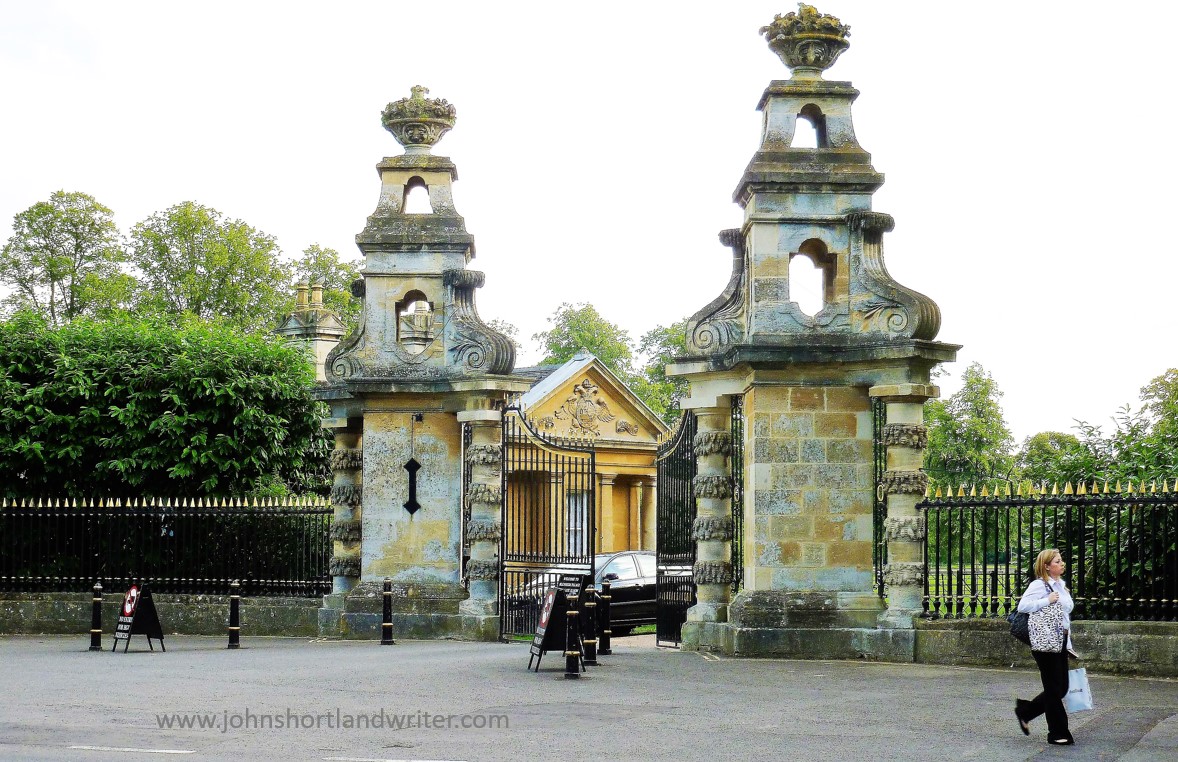
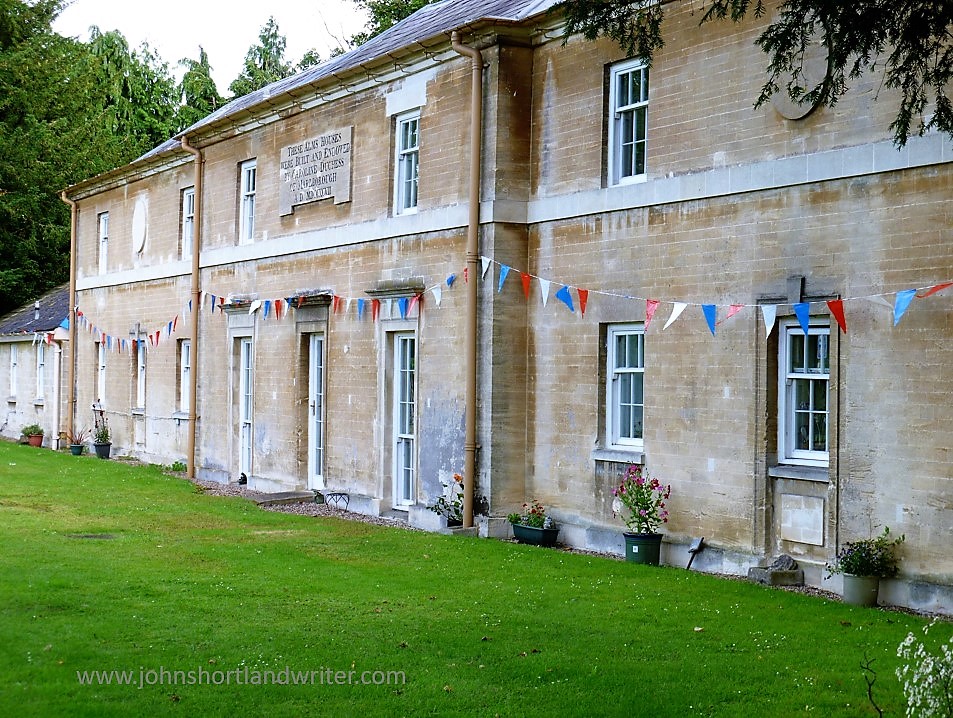
Of course, it is the Palace that dominates Woodstock despite being barely visible from outside the Park.  The entrance that cars and coaches enter by, is splendid enough, but doesn’t match the grandeur of the town gate.  Just past the ‘tourist’ entrance (and so rarely noticed) are the splendid almshouses built in 1798 by Catherine, Duchess of Marlborough.  A visit to the Woodstock Museum should be on everyone’s agenda too; it contains a dinosaur garden to keep the children happy.

The gate by which visitors enter is grand enough but…
…it doesn’t match the splendour of the ‘town’ gate

The town has several hotels and makes a good base to explore further afield; Oxford with its universities is only 15 miles away and there are numerous villages and National Trust properties and gardens to visit within the area.  For keen hikers two long-distance trails, the Wychwood Way (36 miles) and Shakespeare’s Way (146 miles) pass through the town and, as in most of England, numerous public footpaths criss-cross the countryside where you can roam freely. Walking is one of the best ways to see the Cotswolds and it is great exercise too. All the footpaths connect with one another so you can easily take shorter walks but, if you have the time, it is possible to walk from one end of England to the other!

The almshouses in Woodstock built in 1798

***********************************
[If you would like specific details of any aspect of staying locally and/or walking routes, places to visit, etc please feel free to contact me and I will do my best to answer your queries]

Sources: 
Wikipedia The Long Distance Walkers Association  Cotswolds.info                                                                                                                      The Making of the English Landscape, W G Hoskins     
                                                                                                                                                                                                                                                      

A Hurricane in a Teacup

With much of Britain recovering from the effects of three storms – Dudley, Eunice and Franklin – within ten days and Storm Gladys about to arrive, it seems appropriate to have some up-to-date thoughts on the time when we England experienced a hurricane. Or did we experience one? After the ridicule that poor Michael Fish, the weatherman, had to endure after he proclaimed in 1987 that “Britain doesn’t have hurricanes” only for the nation to wake up to find itself flattened, the forecasters have avoided using the ‘H’ word. Instead we have storms that are now named in the same way as hurricanes. Even more recently still, we are told we have ‘red alert’ storms. So, were these latest storms hurricanes or in reality were they, as my late father would have said, “just a bit of a blow?”

I wrote the thoughts below many years ago when pondering on the English Hurricane and the later 1990 storm. That wasn’t officially a hurricane either but did far more damage – hurricane-like damage, in fact. The only thing that this and these latest storms prove is that the debate hasn’t moved on very much over the intervening years…

The dangerous work of reconnecting electricity continues through the night

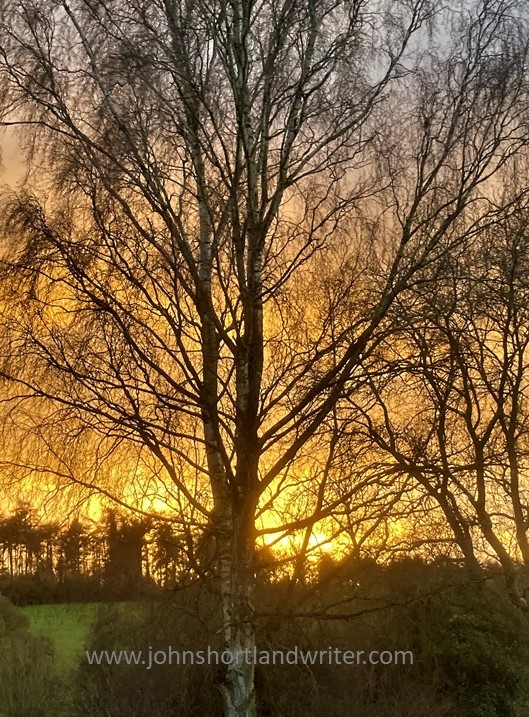
English people constantly talk about weather. It’s in our makeup, our genes – we can’t possibly walk past someone, even a total stranger, without saying something about it. We can’t help it, no matter how much we realise that the person isn’t that interested (or, for that matter, even if they don’t speak English, when we madly gesticulate skywards). We rattle on about too much rain, too little rain, too much sun, no sun, cold for the time of year, how warm it is. So, in the spirit of being a true Englishman, despite my part-Polish ancestry, I’m just going to mention that we had a fantastic sunset in the secret valley a couple of days ago.

I think the reason we may behave like this is because English weather is nearly always gentle. The landscape that makes up England is beautiful and can be dramatic but not in the way of so many other countries. Take the USA, for example. Where’s our Grand Canyon, our towering redwoods, our Rocky Mountains, our Great Plains and our Niagara Falls? We have them in miniature and, perhaps, that is just as well as we are such a small country. And likewise, our weather: we have heatwaves, we have floods, we have blizzards. But they are rarely anything truly spectacular (except to those poor people affected by them, of course). And so when we were told by the weather men in 1987 that reports of a hurricane were completely exaggerated, we believed them totally. And despite the fact that much of the country was hit hard by it when it arrived, my part of the Chiltern Hills where I lived at the time was not much affected, even though it is one of the most wooded parts of the country.

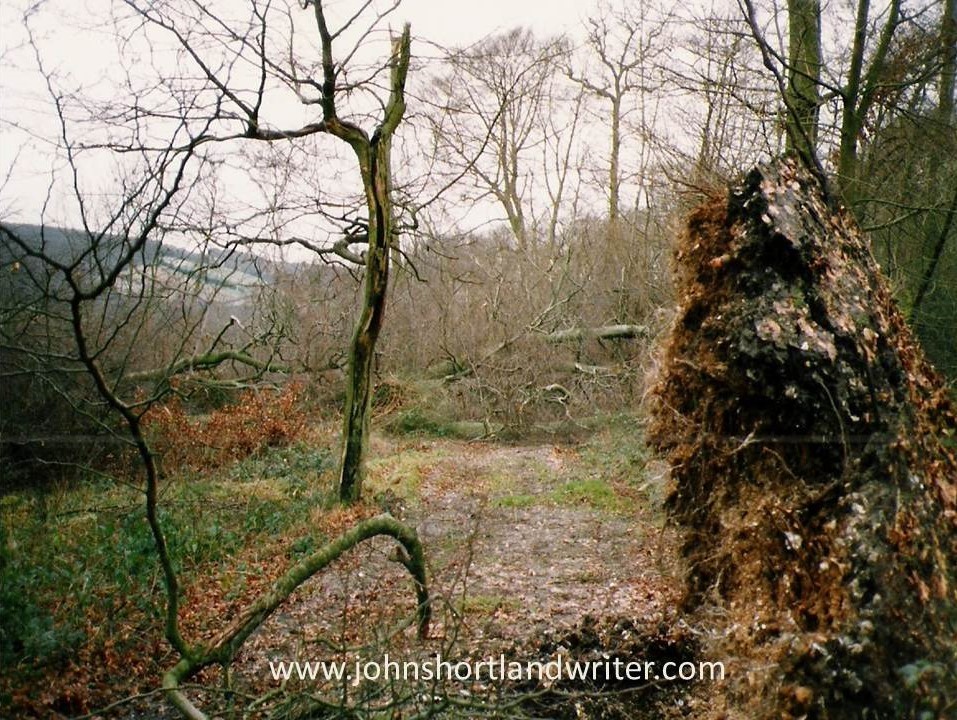
The night in January 1990 was different. This time we had winds, whilst not as severe as three years earlier, which created total havoc with the already weakened root systems of the trees. Great swathes of the magnificent beech woods that are the very heart and soul of the Chilterns were flattened in a couple of hours. I lived at that time in the middle of one of these woodlands and am frequently reminded that, as the rest of the world cowered in their beds and the trees came crashing down all around our house, I woke up to say “a bit windy out there” before falling asleep again. As dawn broke the true damage to the landscape (but fortunately not our home) could be seen.

It is now over thirty years since that storm and the woodands have been transformed. Those of us that remember the 200 year old beech know that the majority are gone and, in their place, are new trees of mixed species. It will be many years before the magnificence of the woods return but they are healing. This photo below is taken from the same spot as the one above. Some of the biggest old stumps have been left, too difficult to move – time has hardly changed their appearance apart from their ‘roof’ of mosses.

One of the unforeseen benefits of the hurricane is the increased amount of light reaching the woodland floor, for beech trees cast a dense shade where little can grow, other than where the canopy is lightest. Apart from the view to the valley below, which was unseen before, many wild flowers are better now than ever. Roll on April when we can see the blue carpet of tens of thousands of bluebells disappearing into the distance.

Oh! And I nearly forgot to say, the weather today is a mix of sunshine, cold winds, rain and sleet. Don’t forget to tell the next person you meet!

.

.

Courting Ravens

Before Storm Alex hit us this weekend, bringing with it over a month’s worth of rain in less than 24 hours, the weather had been exceptionally benign.  For several days the skies were clear, the sun shone and there was just enough of a cool breeze to remind you that autumn has arrived and revving up to take us into winter.  In short, it was perfect conditions for walking and, so it seems, also for courting.

The secret valley in the Cotswolds

No, I haven’t committed to a new relationship for I’m quite happy with my old one!  I’m referring to our local pair of ravens, recently joined by several others.  They have taken up residence in the shelter belt of conifers, mixed softwoods and brash that stand sentinel on the ridge.  From there they have a commanding view of the full length of the secret valley.  On my walks, they have been chattering noisily to one another in their croaky, almost primeval sounding voice.

First signs of autumn in the secret valley

Whenever I hear the sound of a raven, I’m transported back to Exmoor for it was there, as a sixteen-year old, that I saw my first one.  In those days (the 1960s) ravens were rarities only found in the remotest and wildest parts of the British Isles, taking refuge there after decades of persecution had exterminated them from kinder landscapes.  I was resting on the heather moorland high above Farley Water, a narrow and very beautiful river valley inhabited only by sheep and the wild Exmoor ponies and red deer.  Watching a black bird flying lazily along the valley far below me it suddenly body rolled and flew on its back for a few yards before righting itself to fly on until out of sight. 

Farley Water, Exmoor National Park in 1968 – not that it’s changed at all since then!

These body rolls, along with a wide range of acrobatic swoops and dives, are indicative of courting displays, usually seen in spring.  I’m sure my lone raven in Farley Water was doing it for pure pleasure, or perhaps it was practicing them just to ensure it got it right in order to impress the gals when they appeared!  Ravens do, in fact, pair for life and can live for ten years in the wild, sometimes as long as fifteen or more.  This longevity, as well as the millennia they have been on Planet Earth, has given rise to many myths and traditions.  Here in the UK, there is a long-held belief that if the ravens that live at the Tower of London should ever leave, both the Crown and Britain will fall to a foreign invader.  They are cared for and protected by the Royal Ravenmaster of the Yeoman Warders.  A much older belief common to the Abrahamic religions is that the raven was the first creature to be released from Noah’s Ark.

Ravens are now very much more common in the UK, having reclaimed much of their former territory and it is estimated that there is now well over 7,000 breeding pairs.  They are also one of the most widespread of bird species being found throughout the Northern Hemisphere.  It has recently been discovered, however, that when ravens colonised America those on the California coast became isolated – probably due to an Ice Age.  As a result, they have evolved into a distinct race genetically, whereas the other US birds are more closely related genetically to the birds of Europe and Asia.

Chris Skaife, Ravenmaster in front of Traitor’s Gate, Tower of London [photo credit: DebashisM]

So how do you recognise a raven from any other black crow?  Well, firstly, it’s size.  It is enormous in comparison.  Secondly, it’s voice which is quite distinctive once you’ve learnt to recognise it.  The raven is, however, a great mimic of other sounds:  twice I have been confused by the sound of a fencepost being knocked into the ground with a heavy mallet and by a small terrier dog yapping from high up in the top of a tall Scot’s Pine tree!  It’s tail, if it should fly overhead, is also another way of telling it apart for it is quite diamond shaped in appearance.  Finally – and not one I have seen mentioned in bird books – the wings make a distinct flapping noise much in the same way as a swan’s does.  Good luck with your raven spotting and don’t be alarmed by all the stories of them being birds of ill omen.  If you see one, it will make your day.

Raven at the Tower of London [photo credit: Drow male]
Depiction of ravens at the Tower of London 1883 [Source: Wikipedia]

A Thunderbolt and a Broken Cross

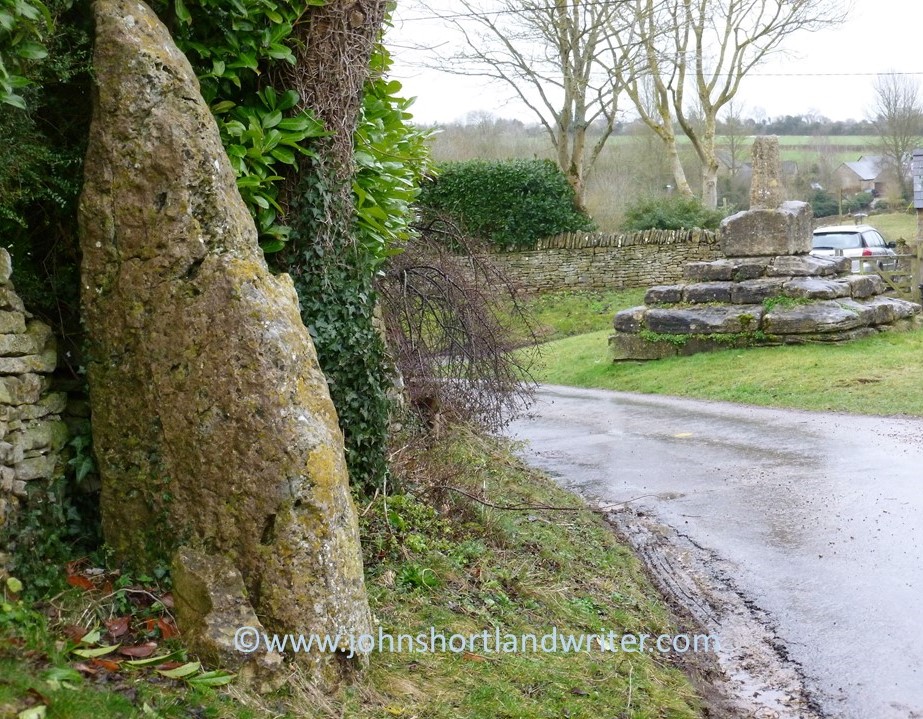
For so tiny a place, the Cotswold village of Taston, or more accurately ‘hamlet’, has more than it’s fair share of interesting features.  None can be so dramatic – in the most understated of ways – than the lump of rock hurled in rage by the Norse God, Thor and now wedged between the roadside and a wall.Taston (1) copyright

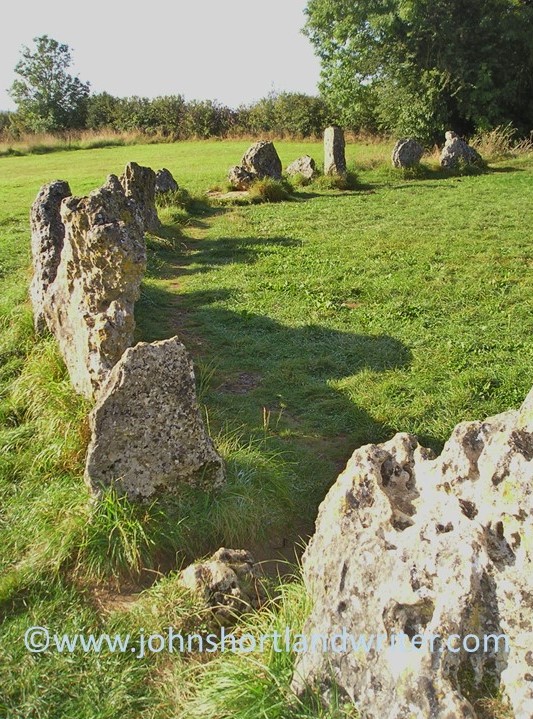
The Thorstone (from which the village’s name is derived) is one of a number of standing stones that litter this part of the Cotswolds.  They range in size from the extensive Rollright Stone Circle to the single unnamed stone that can be found in the town centre of Chipping Norton.Rollright Stones (5) copyrightChipping Norton Stone copyright

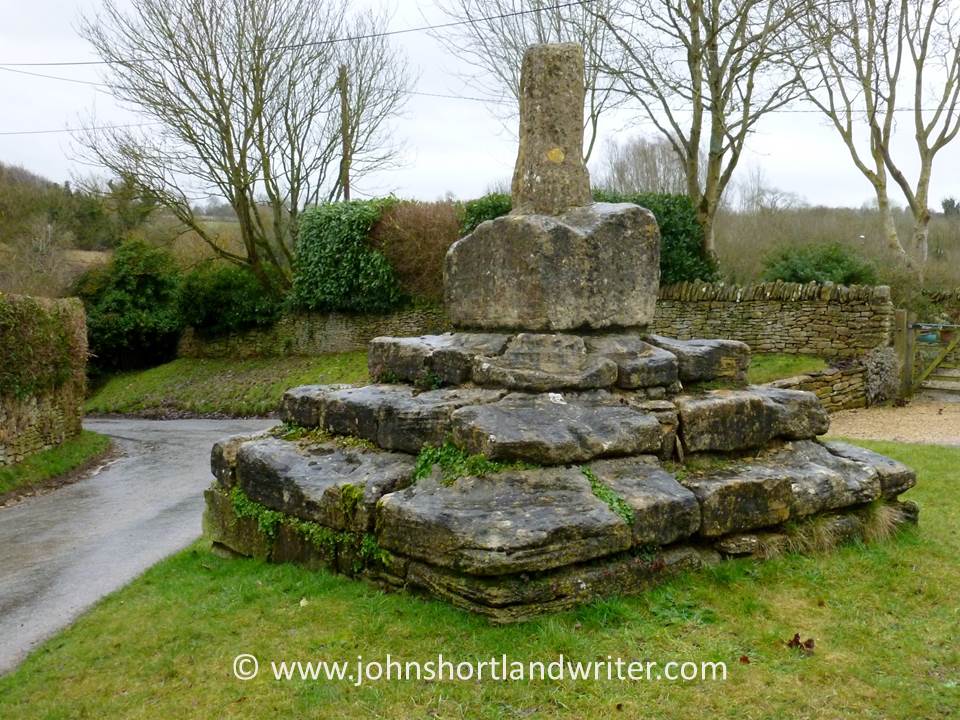
Close to the Thorstone are the remains of a medieval preaching cross.  Many were destroyed during the Puritans time of Cromwell (mid 1600s) but their base, as here, still remain.Taston - Broken Cross copyright

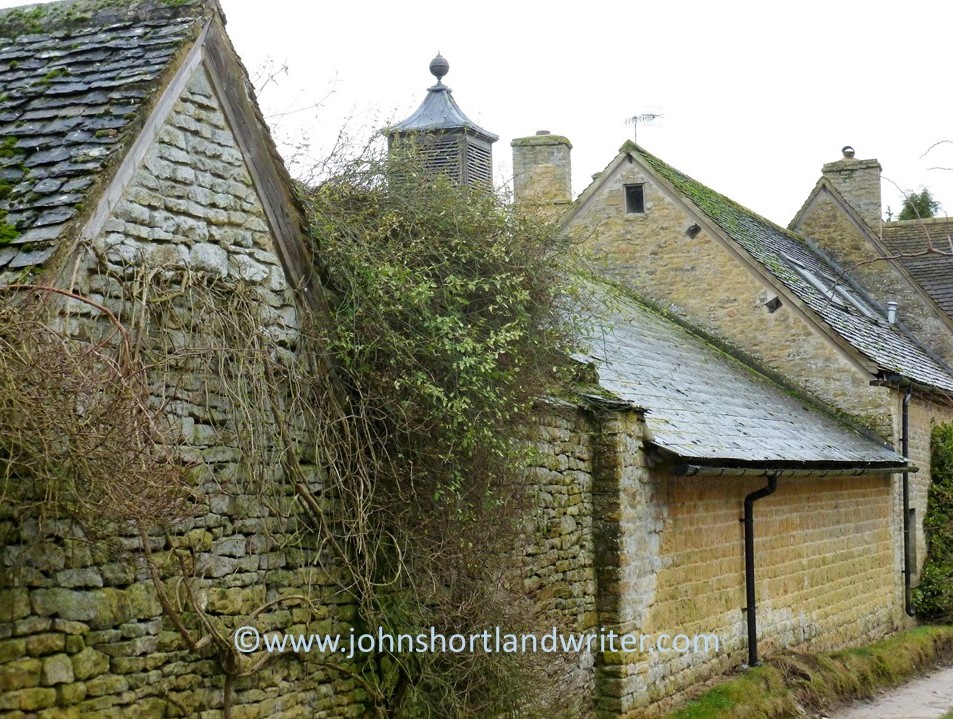
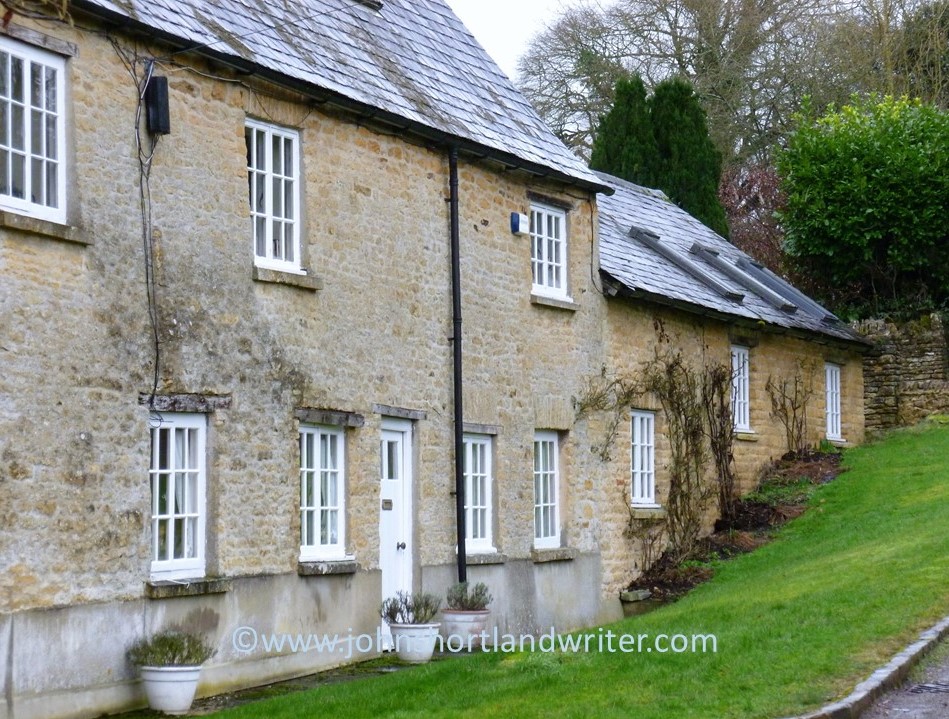
Ancient stone houses, many of them listed by English Heritage, line the three narrow streets of Taston.  Exploring on foot is the best way to see them and to absorb the villages tranquil atmosphere.  It is highly unlikely that you will meet others doing the same! Taston (2) copyrightTaston (4) copyright

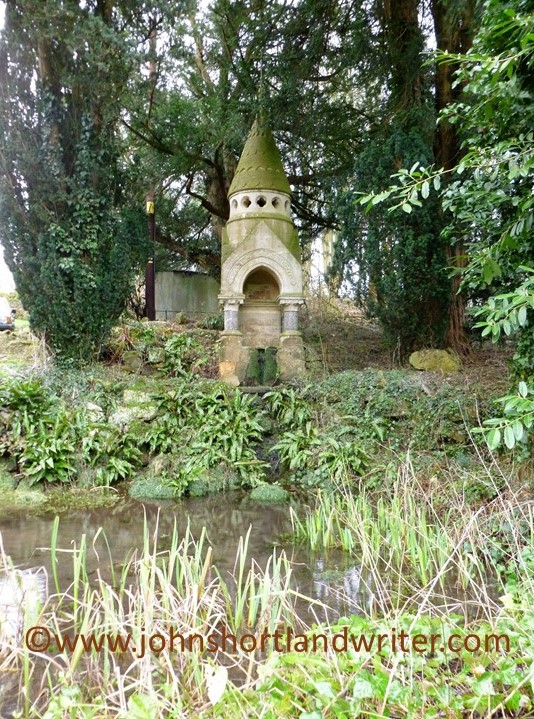
It is on foot, that you will find, tucked away beneath the trees, the memorial fountain to Henrietta, Viscountess Dillon.  Built in 1862 of limestone, granite and pink sandstone, it has the words In Memorium in a decorative arched band beneath its spire.Taston (5) copyright

Taston lies 4 miles southeast of Chipping Norton and 1.5 miles north of Charlbury.