Hide That Ugly Wall

We nearly all have one – or, at least, if we haven’t, we have an unwanted view that needs disguising.  Now is the perfect time to deal with it for, if you decide to plant some screening, the soil is moist and still retains some stored summer warmth.  Wait until spring – which you can do – and you run the risk of summer drought and the need for more careful and regular watering.  In the perfect conditions of late autumn/early winter the plant’s roots begin to establish even if you’re unaware of anything happening above ground.

However difficult the position, there is almost always a way to enhance an ugly wall

There are several questions to ask before rushing to the garden centre.  The first is to decide which way the wall faces for the amount of sunlight hitting it will influence the choice of plant – more about that later.  Other factors to consider are will the plants need to be tied into place with strings and wire, and will they need regular maintenance to keep them looking nice and within bounds?  If you’re already beginning to think this sounds like too much hard work or is too complicated, don’t despair – there’s a list of planting options below.  Still baulking at the thought?  An alternative question is, would some sort of decorative screen do the job instead?

A decorative screen masks this unwanted view

One more option to consider is planting in front of the wall, rather than against it.  If there’s room a low maintenance shrub border might be possible.  If space is really tight, then one or two well-chosen plants may work just as well.  For example, trees trained to grow flat against a wall are readily available and can make a statement without hiding the wall completely. Some shrubs will also do this; they are a much cheaper option and usually grow quite rapidly.  In the photo below forsythia, an unusual choice, has been grown against an ugly garage constructed from concrete blocks.  Although it loses its leaves in the winter its dense network of twigs continues to disguise the wall.  For a few weeks in the spring, it looks both exotic and stunning.

Flowering forsythia suddenly looks exotic grown against this ugly garage wall
The Judas Tree (Cercis) flowers on bare wood, its leaves will appear shortly. It has been fan-trained to remain flat against the wall
If space allows, a low maintenance shrub border can work well

For most people, the decision made is to grow a plant that will climb as well as cover the wall.  The plants available can be broken down into two groups – the true climbers (that will need wires on the wall for support), or the ‘clingers’.  These attach themselves to the wall by little sucker-like pads or by hair-like roots.  With the latter it is essential that the wall is in good condition although it is rare for serious damage to happen.  Both types can be sub-divided into deciduous (lose their leaves in winter) or evergreen.  I have found that the majority of clingers benefit from having some wall ties when first establishing to keep them in close contact to the wall.  Once they start climbing they’ll cling without help.

The climbing hydrangea clings to the wall by tiny hair-like roots
Honeysuckle is an example of a climber that needs wires to support it

One option often recommended, is to fix trellis to a wall and it does sound like a quick fix.  My experience is that the plants weave through it – which is, of course, the idea – but that makes for difficult pruning when it is required for it can be tricky to work out which stems need removing and even trickier to disentangle them.  Worse still, trellis has a tendency to rot or break after some years, usually just when the climber has reached its prime.  Replacing it involves cutting the plant back very hard or replacing it along with the trellis.  However, decorative trellis may be an alternative form of wall disguise to consider with, perhaps, just a large pot of plants standing in front of it.

Trellis helps mask this unwanted view. By creating a focal point of the attractive tree, the trellis becomes a feature in its own right and so no plants are being grown on it

Wires are normally very straight forward to fit providing it is done before planting.  I prefer to use a screw-in ‘eye’ rather than the hammer-in ‘vine eyes’ that are the traditional method of fixing.  All that is needed is a drill and a rawlplug and some very basic handyman skills.  The wires should be fitted horizontally and there is no need to create a network of wires heading off in all directions.  The golden rule is to stretch the wire taut and make the plant grow to the wire, don’t add random wires that follow the growth.  Stems should always be tied to the wire rather than pushed behind it and use ties that will stretch or perish in time otherwise they will become strangled as they grow.  It is all much easier in practice – writing down every step makes it sound more difficult than it really is!

A well-trained rose growing on supporting wires. I have enhanced these for clarity they want to be stretched horizontally and spaced about 18″ (45cms) apart
This poor plant has been strangled by its tie; all the upper growth has died

When it comes to planting, whatever the type of plant it is, make a generous planting hole and mix a good quality compost in with the soil.  Often the ground by a wall is dry and full of builder’s rubble or compacted so having a good planting medium around the new plant will set it off on a good start.  At planting, keep the base of the plant at least a foot (30cms) away from the wall if there’s room.  That way it will receive more water when it rains.  One major cause of failure is planting too deep – make sure that the soil is at the same level as the top of the compost that the plant is growing in.  Standing the plant pot in water for a few hours before planting is a good idea too so that the plant is well-watered before it is disturbed – and, if you’re a real beginner to gardening, don’t forget to remove the plant from its pot keeping its soil intact around it.

Solanum crispum (blue) & Clematis montana (white) hiding a garden shed

A list of plant suggestions:
E=evergreen, CL=clinger, N=will cope with north facing wall, Sh=shrub, T=tree

Large walls:
Carpinus (Hornbeam) – N, T, buy pleached or ready shaped
Cercis- T, more tricky to find and you may have to train it yourself but lovely flowers in pink or white and good autumn leaf colour – see photo
Clematis montana – clip back the growth immediately after flowering to keep tidy and within bounds
Ficus (Fig) – N (but won’t fruit), if you like Figs to eat, Ficus is worth considering
Fremontodendron – E, Sh, colourful yellow saucer-like blooms
Garrya – N, Sh, dark green leaves with long green catkins in late winter
Hedera (Ivy) – Cl, E, N, easy to keep under control and provides late nectar sauce for bees and other insects.  Make sure that wall mortar is sound before planting
Hydrangea petiolaris – Cl, Sh, prune after flowering if necessary
Jasminum (Jasmine) – both evergreen and deciduous types are available with scented flowers.  The evergreen (sold as Trachelospermum) needs a warm wall for best results
Magnolia grandiflora – E,Sh, for a high, warm wall.  They need lots of space to thrive
Parthenocissus (Virginia Creeper) – Cl, magnificent autumn color
Prunus lusitanica (Portuguese Laurel) – E, Sh, T, can be grown as a shrub or purchased as a trained tree (see photo)
Solanum crispum – blue or white clusters of flowers.  Vigorous but easily pruned
Vines – prune in winter if necessary
Wisteria – prune twice yearly, midsummer and midwinter

Medium walls:
Actinidia kolomikta – Sh, pretty multi-cloloured leaves best when avoiding strong sunshine
Azara – E, Sh, for a warm wall
Berberis – E, N, Sh, very spiny branches are a good reason for not growing it!  Magnificent red or yellow berries in autumn, much loved by birds
Campsis (Trumpet Vine) – orange trumpet flowers and attractive leaves for a sunny wall
Ceonothus – E, Sh,  smothered in powder-blue flowers during summer
Chaenomoles – E, Sh, white or pink flowers in late winter/early spring
Clematis – plenty of varieties to choose from including evergreen ones – check labels for size as some can require a lot of space
Forsythia – Sh, prune after flowering which takes place in early spring – see photo
Jasminum nudiflorum (Winter Jasmine) – N, Sh, flowers throughout winter
Osmanthus – E, Sh, early-flowering, scented – clip immediately after flowering ends to keep flat against wall
Rhamnus ‘Argenteovariegata’ – E, Sh, variegated foliage, prune to keep flat against wall in spring

Low Walls:
Daphne – E, Sh, very scented flowers but very slow growing
Euonymus – E, N, Sh, Cl, can be grown a sa shrub or clipped flat against a wall, some are self-clinging
Fuschia – Sh, varying heights, the smaller-flowered varieties are more suited for growing against walls
Helianthemum – E,Sh, very low growing but smothered in flowers through summer, clip after flowers to keep tidy
Lavender – E, Sh,likes sunshine for best flowering
Nandina – E, N, Sh – trouble-free, needs no  pruning
Perovskia (Russian Sage) – Sh, silvery foliage and blue spires of flowers from mid-summer.  I’ve grown it successfully on a shady wall although not usually recommend for this.  Prune back by half in late autumn and then again in early spring to keep bushy
Potentilla – E, Sh, bushy long-flowering plants in varying colours

I recommend looking up these plants on Google to see more detail.  Also, there are many roses that can be considered including some that are fine for north walls.  Apples, pears and plums fruit well when grown against walls of any aspect, as do apricots and peaches if the wall is warm and sunny enough.

For similar information on how to make both your garden and gardening more pleasurable, why not take a look at my book Why Can’t My Garden Look Like That? It’s written for newbie gardeners as well as those with more experience and covers everything from design to planting and maintenance.  In it, I reveal some of the secrets that I used when Head Gardener to large, country estates with gardens open to the public, where the garden had to look great all the time.  All written in an informal, no-nonsense approach.  Makes a great gift and is available from bookshops and, of course, Amazon.


Thirty Years On – Sadness & Celebration (part one)

How time flies by.  I know that’s a bit of a cliché to open with but, even so, it hardly seems possible that thirty years could have passed since that early spring day in 1994 when I locked the door of Shortlands clothing and footwear store for the very last time, and wondering where my career would go to next.  I was in my early forties and knew that I would have to do something to earn my keep and pay the mortgage but what?  It was a time of great sadness, not just for me and my family but also for our loyal staff some of whom had been with us for many years.  Thirty years on it seems time to write the shop’s story to celebrate it having been at the centre of community life for the best part of a hundred years.

Shortlands in the 1990s

The shop that was to become Shortlands began with my great-grandfather, William Bradby Langston, who had already established shops in Marlow High Street and in nearby Lane End. He was quite entrepreneurial, something he and his brothers inherited from their mother.  Poor Sophia, widowed in 1863 at the age of 34 with five children under the age of 13 and a baby due at any time needed to provide for herself and her family.  She set up a shop in her front living room which later expanded to become Langstons Department Store in Reading, Berkshire.  As well as those already mentioned, she and her sons between them also had shops in Boscombe (Hampshire) and Ilford (Essex).  Unsurprisingly, she is remembered as being rather a force to be reckoned with – you can read her life story, Rebel in the Family, by clicking here.

The first generations of retailers
l to r: My great-great grandmother Sophia Langston (nee Bradby); my great-grandfather William Bradby Langston; my grandfather Arthur Shortland

William opened his ‘Boot and Shoe Warehouse’ in Marlow in 1884 at the age of 22.  Seven years later he opened another, opposite the first, specialising in boating and tennis shoes as well as other sporting footwear.  When a newly built parade of shops became available in Bourne End in 1899 he established what was to become Shortlands.  At first the shop was tiny but by 1904 he had expanded to sell not just shoes but also mens and boys clothing.   Four years later William’s daughter, Nellie, married Arthur Shortland who had come to Marlow to work for William a few years earlier.  The newly married couple came to Bourne End and by 1915 Arthur was listed as the owner in Kelly’s Directory.

Langstons – the Bourne End branch c1910

The shop continued to prosper and during the 1920s the adjoining shop was purchased and ladies clothing and footwear as well as carpets, haberdashery, dress fabrics and knitting wools, soft furnishings, household linens and luggage were added to create Bourne End’s own department store.  The 1920s photo below shows my grandfather Arthur using the steam (clothes) press although it was a (much hated!) task given to my father Hedley as soon as he returned from school.

Langstons, now expanded and with my grandfather’s name on the fascia 1920s

My grandfather, Arthur Shortland using the steam press,1920s

With the outset of WW2 my father joined the army and it was left to the older generation, including my great-aunt Edith Shortland, to run the business.  Both the Langstons and the Shortlands were deeply religious and scrupulous in the way they behaved towards others.  My mother would tell the story of how when some silk stockings arrived (which were rationed and in short supply) she rather assumed that she would have a pair. She was told quite firmly that her name would go on the bottom of the list like anyone else – she never did get her stockings.  Aunt Edie was quite diminutive but with a voice that belied her stature.  One day she spotted a lady conceal some goods inside her coat.  “Jesus saw you do that” came a thundering voice from nowhere; the woman screamed, dropped the goods and her shopping and was last seen running down the street fearing the wrath of God was upon her!  After the war, my father returned to the business along with his brother Jack, later to be joined by their cousin Maurice Phipps.

A retailing family : four generations

During the 1960s the shop expanded again.  The garden and old shoe repair workshops at the rear of the property were built over and a new shopfront installed.  Made of aluminium, it was considerably ahead of its time and was featured in several design magazines both here and on the Continent.  By the late 1970s both my father and my uncle Jack had died and soon after the shop was due for another major refit.  The interior, as well as the fascia, was modernised and the displays became more open and accessible to customers.  Until that time stock was kept hidden away in drawers and boxes – if you wanted to buy something it was necessary to ask and an assistant would show what was available.  Personal service, nowadays a rarity, was the norm back then.  How times have changed!  To make space for the improved selection of clothing, all of the other departments closed and the shop concentrated on mens and womens fashions and footwear for all the family.  The toiletries and gift department was retained; the soaps and potpourri helping to make the shop always smell rather nice!

The ‘new and modern’ shopfront in 1969 featured in design magazines of the timeby the 1990s it was looking tired and old-fashioned
By the 1990s the displays were brighter and (to use 2020s speak) more ‘on trend’

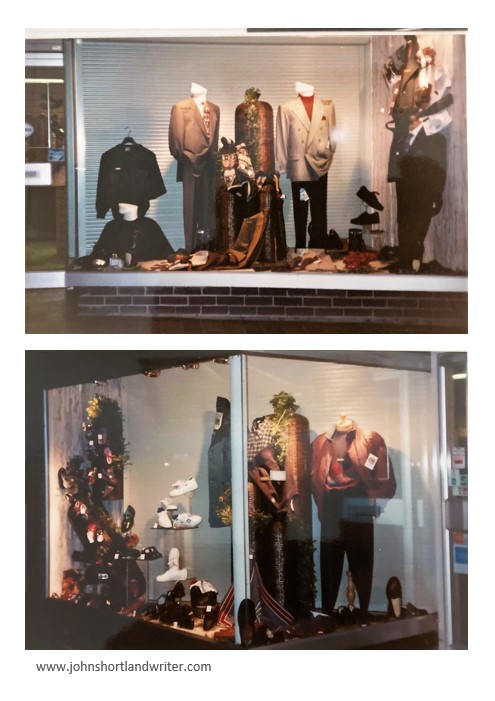
I suppose it was because the shop was ‘always there’ that we have no photographs of the shop interior through the decades which is rather sad.  Fortunately, I did take a few in the early 1990s and these will probably trigger some memories for local people.  The 1990s brought new challenges for the business with recession and changing shopping habits sounding the death knell for businesses like ours.  I had joined the firm in 1971 and my business partner, John Pheby had begun even earlier, as a lad, working for the family.  It was a hard but inevitable decision that we decided to close and were fortunate to find a buyer almost immediately.  They converted the property to three shops and the accommodation and stockrooms above to flats.  Since that time Bourne End has changed quite considerably and most of the old shop names (and several of the buildings too) have disappeared.   I believe that there must be photos of the interior held by local people somewhere – it would be wonderful to see them.  I seem to recall Jean Peasley taking photos during our last few days…

Menswear Department, 1990
a small section of the Ladies Fashions Department 1990

So, what happened to our employees?  In the early days of my tenure there was Ivy Taplin (Akela to us cubs of the late 50s!), Yvonne Ludgate, June Charlton (later to become June Billinghurst), Cissy Hyde, Mrs Faulkner, Liz Hill and Diana Spokes.  Later, Pauline Harvey, Marjorie Kane, Wendy Manley, David and Marian Bratter, Diane Douneen, Kath Bowdrey, Iris Halstead and Cissy Vickers. I’m afraid I can’t remember the names of them all but some of those listed will be familiar to Bourne End locals – please don’t be offended if I have left you out, you were all valued!  The younger generation I purposely have not named but they aren’t forgotten either – I still keep in touch with several of them thanks to social media.  It was thanks to a succession of great staff through the years that the business was so successful.  It seems appropriate to thank our loyal customers too – I can still picture many of them and the frequent kind comments that I still receive on social media shows that they haven’t forgotten Shortlands either which, after all this time, is rather humbling as well as very special.

Ladies Shoe Department display 1990

And what have I been doing the past thirty years?  Retailing had been a passion for my family for generations but I decided to follow another of the Shortland passions and forge a new and very different career – you’ll have to wait a short while for part two to find out what but the photo below may give a clue!


Part Two of this blog focussing on the last thirty years is now published and can be found by clicking on the link here

The Arts & Crafts Splendour of Rodmarton Manor

In 1906 Claud, the youngest son of politician Sir Michael Biddulph, commissioned a house to be built on land gifted by his father.  The commission was given to Ernest Barnsley who specialised in design and building in the Arts & Crafts style.   In the spirit of the movement, all materials had to be sourced locally and hand-crafted with no machinery used.  Claud stated that the house should have the feel of “a cottage in the country”, somewhat of an understatement by the time the building was completed in 1929.

Rodmarton Manor seen from one of the ‘garden rooms’

The house, which has a total of seventy-four rooms, was built as three angled sections with a sweeping driveway and circular lawn to the front courtyard.  The family lived in one wing, servants in another (now converted into flats) and the central section was to be used as a community space where local villagers could meet and learn skills and craftsmanship.  In this way, the Biddulphs were instrumental in maintaining age-old traditions that were in danger of dying out. 

Rodmarton Manor

The mansion, still family owned and open to the public, retains much of its original furniture and furnishings.  Listed as a Grade 1 building by Historic England it has been described as “the single best example of the Arts & Crafts movement”.  On the day of my visit the house was closed but I was able to explore the gardens which are also listed and have been created in the same style.

Old stone urns and troughs frame the entrance

Close to the house, the gardens consist of a series of room-like areas enclosed by stone walls and hedges.  Lichen encrusted pots, urns and troughs, along with precisely clipped topiary give a timeless feel to the garden and also ensures that there is plenty of interest during the winter months. The aptly named Long Garden comes as a surprise after visiting other areas, for although very much of the style, it is relatively narrow in width.  A flagstone path emphasises its 75-metre length and leads to a delightful pavilion, a small pool and a seating area.  Divided by clipped yew hedges and bordered by densely planted herbaceous borders it was, for me, the highlight of the garden. 

The Long Garden at Rodmarton Manor in June
The Pavilion at the far end of the Long Garden

It was disappointing not being able to see the craftsmanship of the interior of the house.  However, the exterior of the building revealed many surprises.  What I liked most of all was the exquisite detail of the rainwater downpipes proving once and for all that even when something is utilitarian it can still also be beautiful.

Even the practical is made to look beautiful exquisite detail of the rainwater downpipes
Every downpipe detail differs

Rodmarton Hall is situated midway between the Cotswold towns of Cirencester and Tetbury and is open to the public throughout the summer months on selected days.  There are additional garden open days in February to view the snowdrops of which there are over 150 varieties.  To find out more click on the link here

A Secret Garden

I have noticed that even those that don’t show the slightest interest in things horticultural love exploring walled gardens, especially if they are overgrown and forgotten.  Perhaps it stirs memories of the children’s novel by Frances Hodgson Burnett published in 1911 in which she shows that when something unloved is cherished and cared for it can become beautiful and healthy, be it a plant or the human spirit.

Houghton_AC85_B9345_911s_-_Secret_Garden,_1911_-_cover

Photo Credit: AC85 B9345 911s, Houghton Library, Harvard University

I have been fortunate over the years in caring for a number of walled gardens in different stages of development yet, regardless of their state, there is something magical in placing the key in the lock and pushing open the door – as nasty, little Mary Lennox discovered in the novel.  As she returned the garden to its former glory so, she too, grew into a loving and loveable child.

Garden Border (4) watermark

Perhaps even more so than the plants and trees within, the beauty of a walled garden comes from the walls themselves.  The brickwork over time has mellowed and seems to release the warmth of a hundred or more summers, even on the greyest of days.  Search the walls and they reveal secrets – a date scratched into a stone, old lead labels revealing the varieties of long-disappeared fruit trees or, occasionally, the name of a much-loved pet buried at its feet.

Walled Garden watermark

The walls in this deserted garden date back to the late 17th/early 18th centuries

Old Plant Tag watermark

Recorded for posterity: the trees may have disappeared but the record of the varieties remain

One of the most rewarding to explore yet emptiest of walled gardens has to be that of Dunmore Park.  The house no longer stands but the garden walls remain crowned by that most eccentric of British garden room follies, the Pineapple.  Here the walls are hollow, fires were lit at its feet and the walls warmed to promote early growth.  Sliding stone blocks could be opened to release the smoke which, filling the garden at night helped to keep frosts at bay.  Clever, those early gardeners.

The Pineapple (11) watermarkThe Pineapple (31) watermarkThe Pineapple (34) watermark

Walled gardens when not open to visitors are more often a place of silence, the only sound to accompany the gardener is that of birdsong and the hum of insects.  It can be a place where your mind can be free from the everyday cares of the outside world.  It can also be a place where your design ideas can run riot either in your head or, if lucky enough, in reality.  The images below show before and after photos of a border I created many years ago, the idea for the colour palette coming from an Imari plate belonging to the owner of the garden.  The border is living proof of an imagination run riot!

Blue & White Border - before watermarkImari Plate   watermark.jpgBlue & White Border - after watermark

Thinking Outside the Box(wood)

Over the years I must have hand clipped many miles of box (in the USA, boxwood) hedging and once the knack is mastered it can be quite therapeutic.  The main rule to follow is to remember that it has to be precise for there is nothing worse than a straight, level hedge that is clipped unevenly.  It irritates the eye as much as a picture hanging crookedly on a wall.

Box Hedge Clipping (2) watermark

Patience and plenty of time are key factors in ensuring straight lines

I can’t say that I feel quite the same about topiary.  I can admire the craftsmanship that goes into producing weird and wonderful shapes but it is so easy, in a lapse of concentration to, say, cut the ear off a teddy bear or the beak off a peacock.  As a consequence, I find it rather stressful.  Cloud topiary is far more forgiving but, again, it doesn’t really “do it for me.”

Box Cloud Topiary watermark

You need even more patience to clip topiary

Perhaps the most rewarding design I have created was turning four rather scruffy and unbalanced squares of box into simple but elegant cubes.  Yes, it was topiary but to misquote Star Trek “it’s topiary Jim, but…”  To begin with, I was faced by the four squares each with a rather ugly and thorny shrub rose growing out of their centres.  A consequence of this design was that the box couldn’t be clipped properly and neither could the rose be properly pruned.

Box Hedge Clipping watermark

The original design with roses always looked scruffy

To create the design the roses had first to be removed leaving a gaping hole in the centre of each square.  Fortunately, I had some reasonably tall box plants elsewhere in the garden that I could dig up and replant.  I soon discovered that it was impossible to plant them properly without damaging the existing plants.  My gamble of just standing them on the earth and then throwing topsoil over them to trickle through the branches paid off.  The soil covered the roots and probably much of the lower branches too*.  Given a good watering, the plants thrived.  Before trimming  all the outer edges needed to be marked with string lines for accuracy in cutting.

Box Hedge - Copy watermark

Without strings for guidance clipping the box into perfect cubes would be almost impossible

I thought about all sorts of fancy designs for the tops of the cubes and, as is so often the case with design, I decided that simplicity was the key to a satisfactory outcome.  Two cubes would have a raised circle and two a raised square.  It was essential that these weren’t too high – I didn’t want them to look like a combination of wedding cakes and pimples!  I found that it was impossible to mark these designs out and so they were created without guidelines, relying on my eye to tell me where and what to clip.  By their second year of clipping they looked as if they had been there for ever.

Box hedge Clipping (10) Year 2 watermark

The design will look just as good in winter when highlighted by frost or snow

Box is such a versatile plant to use and it is well worth experimenting with them.  Below are three photos of how I have used them: the first is the classic edging to a border; the second to bring focus to a set of garden steps; the third a mini-parterre to link two levels in a garden.  Your garden doesn’t need to be huge or grand to use box in these ways – the parterre was suitably small scale for a tiny town garden.  Have a go at creating your own box design – and if creating a topiary peacock is your thing, that’s fine with me – just don’t aske me to clip it!

Apricot & Blue watermark

The classic use for box – fronting a border

Box Topiary watermark

Giving focus to garden steps

Box Parterre watermark

Mini-parterre for a tiny garden


*This is also a good and easy way to create plenty of new plants for the buried stems will often send out roots.  When they do they can be severed from the parent plant to be grown on elsewhere.

Going Round in Circles

Designing your own garden is, I think, far trickier than designing someone else’s. One of the problems is that emotion gets in the way. I’m not suggesting that there shouldn’t be passion in design but far too often one is tempted to hang onto things that have no place in the new design, whether it is a plant or a pot – or in this example, far too many pots!Garden Makeover 3a copyright

The garden shown here was quite a good size but difficult for it was on a gentle slope and there was need for a central path to lead to sheds at the far, and lower, end. To avoid splitting the garden in half, large circular stepping stones had been randomly placed but the result was a confusing mish-mash of shapes and plants. The only place the eye focused on was the rotary washing line!Garden Makeover 1c copyright

You don’t need to be a great artist to design a garden. A simple method is to take photographs, turn them into black and white (for colour confuses the eye) and pencil sketch over them. Here, we were quite keen to improve on the circular theme.
The final result was a series of circles, each with a low retaining wall and a step down to allow for the change in level. Trellis was used to screen the sheds. Although the hard landscaping took up more of the garden than before, the remaining planting area was far more useful and could be crammed with plants. The little walls made perfect low seats.Garden Makeover 2c copyrightGarden Makeover 1b copyright

And what happened to all the pots? Most of these were discarded in favour of a large, custom-made, L-shaped timber box. This gave a better space for planting as well as making a feature in its own right. Water-retaining gel crystals were added to the planting soil reducing the need for regular watering.Garden Makeover 3d copyright

You can find more ideas on all aspects of easy, trouble-free design, plants and gardening techniques in my book, Why Can’t My Garden Look Like That?  To take a peek inside the covers click on the link here.

BOOK COVER