Creating Warmth in the Garden

Here, in the UK, we’ve been having the dreariest of winters with what seems weeks and weeks of mild temperatures, heavy overcast skies and incessant rain.  There have been a few cold, bright days but these have been rare.  The view from my window as I write this is of greyness reflected in grey floodwater where our little, winding river has overflown into the field below our house.  Some days it has been so dark and gloomy that the electric lights have had to stay on.  So it seems appropriate to write now about bringing warmth into the garden especially as it is the perfect time to create a new design whether it’s a single bed or a complete redesign.

Floodwater below our house which fortunately sits high enough above it to be ok

Obviously, sun is the most important and easiest way of creating warmth and the garden may already have a patio or other seating area in the sunniest spot.  This isn’t always the most sheltered place however, and there is a world of difference between a welcome, cooling breeze on a hot day and a stronger wind that makes sitting there less comfortable.  There are a number of ways to temper the wind without having to build a solid structure which quite often can create issues with turbulence elsewhere.  The simplest method is by planting, whether a hedge or more open, looser shrubs.  Trellis also works well – we’re aiming at filtering the wind rather than blocking it.  The height does not have to be great to have the desired effect.  The image below shows the early stages of screening using plants – it will also, in time, block out the unwanted view of the road behind.
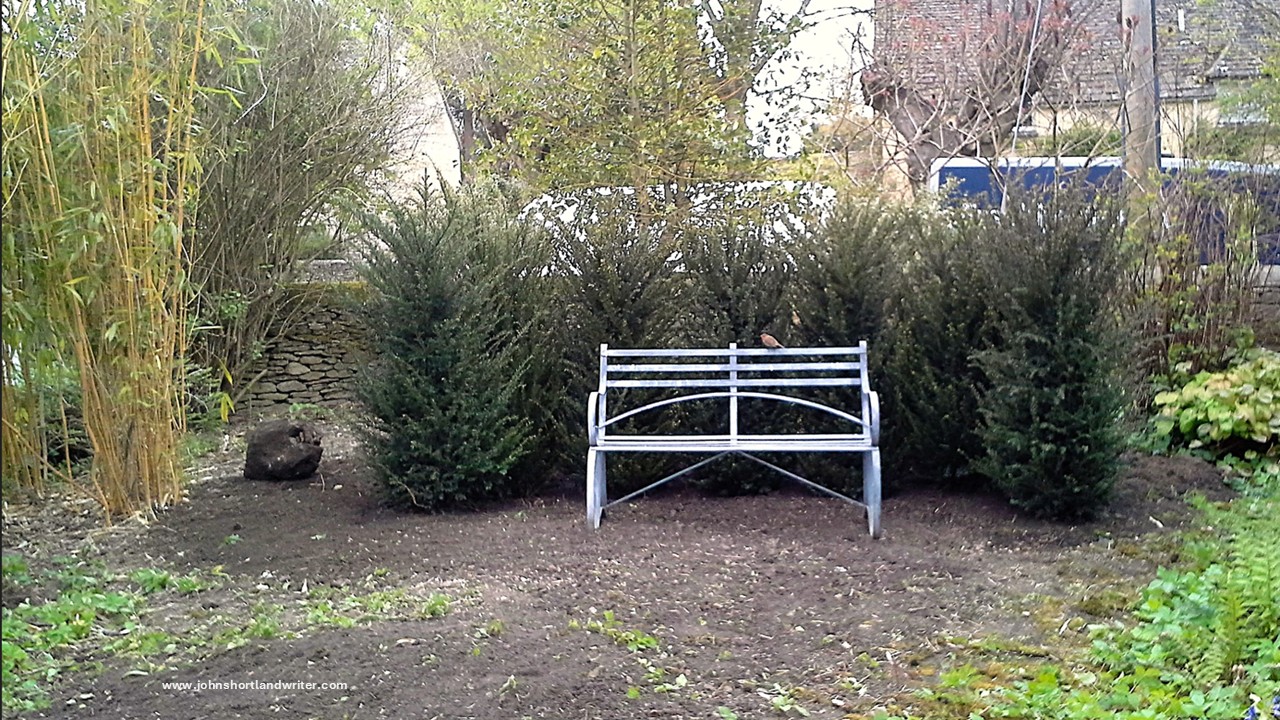
Screening around a small seating area using yew hedging which will become dense within a year. Note the bamboo to the left of the photo with its warm, golden stems

For screening, I often use (as above) yew hedging which gives a good, dark green background and only needs clipping once a year.  It can be bought at various heights and being evergreen, looks good all year round.  Bamboos, now getting rather a bad reputation for being invasive are also excellent if they can be prevented from spreading too widely.  There are some clump forming varieties which are more self-restrained.  In fact, more or less any shrub can be used to make the garden or part of it feel warmer; the secret is to use those with coloured stems or leaves, or flowers that have a hint of the exotic about them.  Bear in mind, ‘though that flowers are often fleeting.
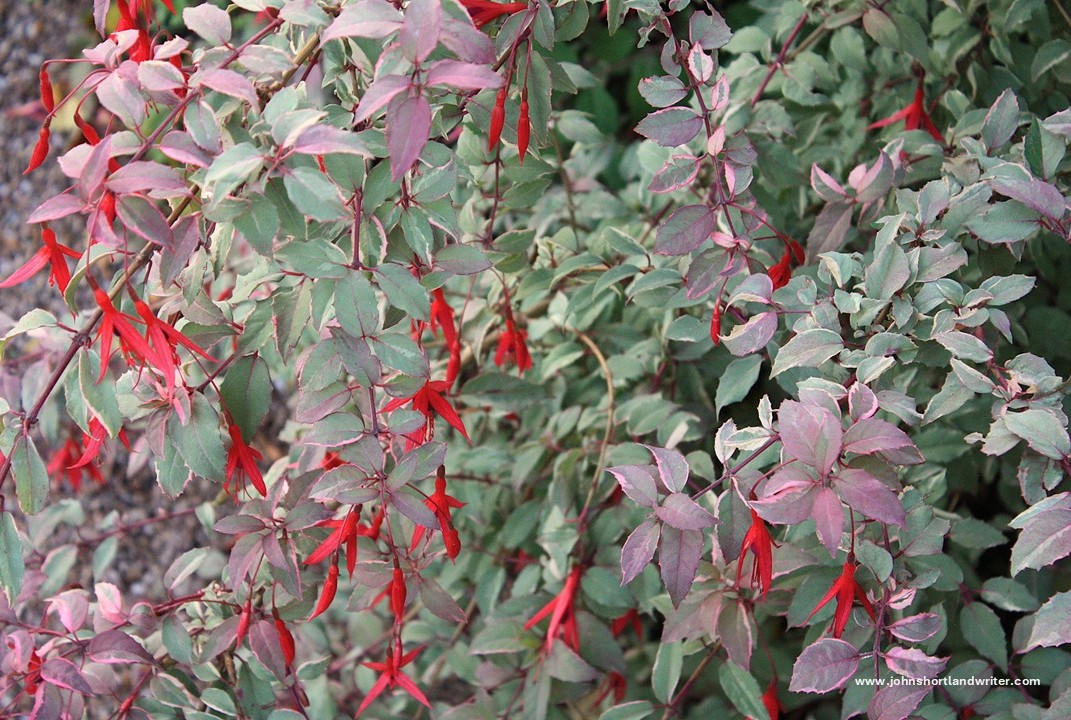
Fuchsia megallanica gracilis ‘Variegata’ : an example of a medium-sized shrub that is hardy, exotic-looking and beautiful
The fiery orange booms of the Trumpet Vine, here climbing through an old wire fence will bring a touch of the Mediterranean to any garden

Although we’ve been talking about ways to make the garden feel physically warmer, it is through the planting of the smaller flowering plants that give the real impression of warmth and here the choice is almost limitless.  The rule is to use strong colours and to keep the softer shades to the minimum.  For the example I’m going to use here, I created this ‘hot’ garden which would be at its best during the summer months when the swimming pool is in regular use.  For cooler evenings or for entertaining there is a vine covered pergola adjacent to a built-in fireplace/barbecue.  Note the use of terracotta painted walls which immediately transports you to the Mediterranean.  In fact. Some don’t believe that the two photos below are really of a garden in one of the coldest parts of southern Britain!
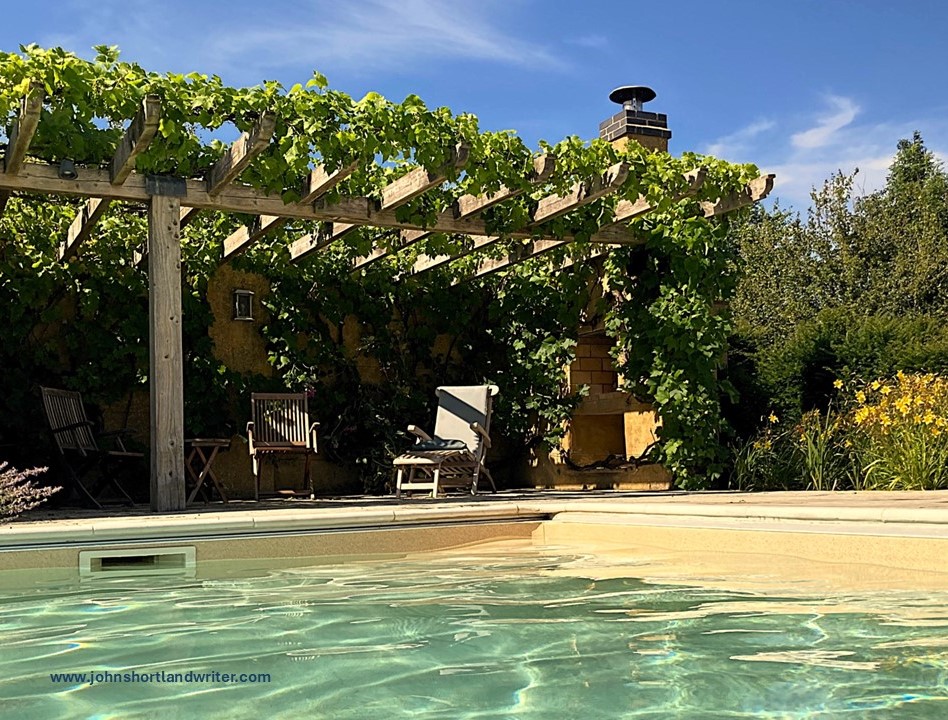
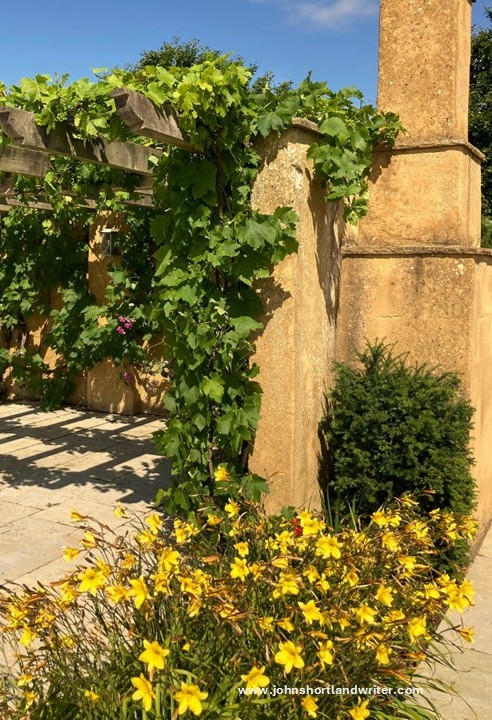
The warm tones of the pool, paving and walls transport you to a warmer climate than the realities of an English summer!
Golden day lilies blend beautifully with the walls of this outdoor fireplace and barbecue area. The grape vine hanging loosely over the beams give shade and the sense of being somewhere other than England

Nearly all of this swimming pool garden is enclosed by yew hedges for shelter and privacy; an existing wall has been coloured terracotta as mentioned above.  Shrubs have been kept to the minimum: there are four Physocarpus Lady in Red’ which has fiery new leaves which darken to burgundy as they mature.  Using the one variety helps to unify the design as well as giving some structure to the borders.  Two figs are trained against the wall and pencil-shaped Italian cypress trees also give that Mediterranean feel (see further note at the end of this blog). 

Transforming a cold garden into a hot one!
In January the garden was almost derelict, by midsummer it had been completed

For the planting of the borders, the one against the wall only has catmint (nepeta).  This is a useful plant for it smothers weeds and is equally smothered in blue flowers which compliment its silver-grey leaves.  It is here that two of the Physocarpus are also planted to give a contrast in both height and leaf colour.  As soon as the first of the catmint flowers begin to fade it is important to then cut off every stem to ground level.  This may seem ruthless, especially as there will still be quite a lot of flower on it but within two weeks it will regrow and soon be flowering again.  If left, the first flowering stems die back and the plant looks messy.
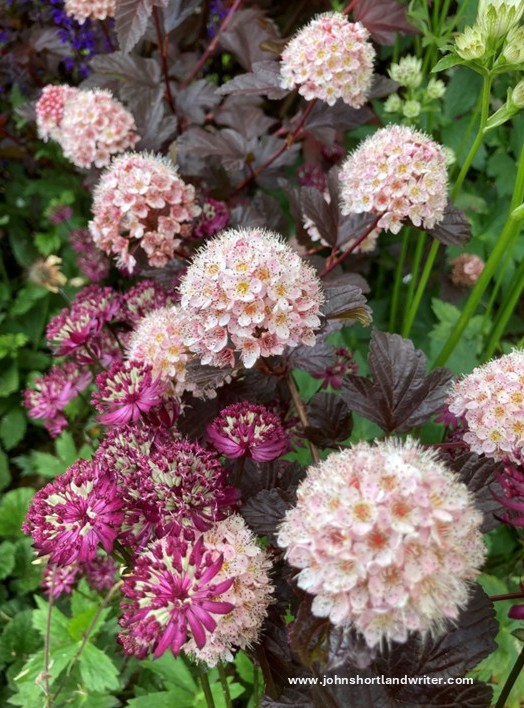
The ball-headed flowers and dark leaves of Physocarpus compliment the contrasting Astrantia ‘Claret’
Catmint (Nepeta) flowering elsewhere in the garden

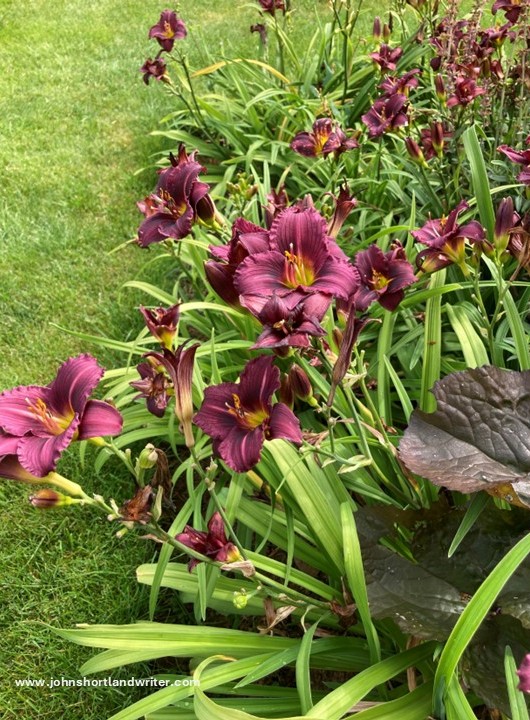
The twin borders are set back from the pool, and again Physocarpus are used as the centrepiece for height.  The burgundy theme is continued with the deep wine-coloured leaves of Ligularia, the papery flowers of Astrantia and trumpet-shaped Day Lilies (Hemerocallis).  The latter are an especially useful plant for they send out their bright green and sword-like leaves early in the spring and they never look untidy.
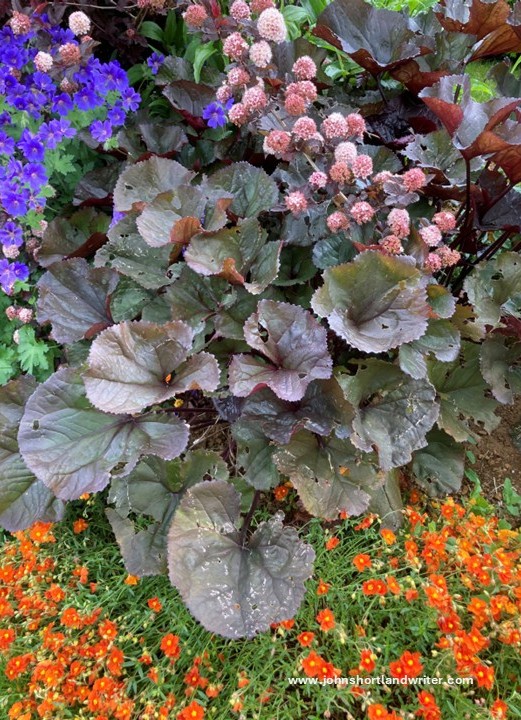
The dark leaves of Ligularia contrast with the tiny orange flowers of Helianthemum. Later the Ligularia will send up spikes of golden flowers
Day Lilies flower all si=ummer if regularly dead-headed. This one is Hemerocallis ‘Little Grapette’

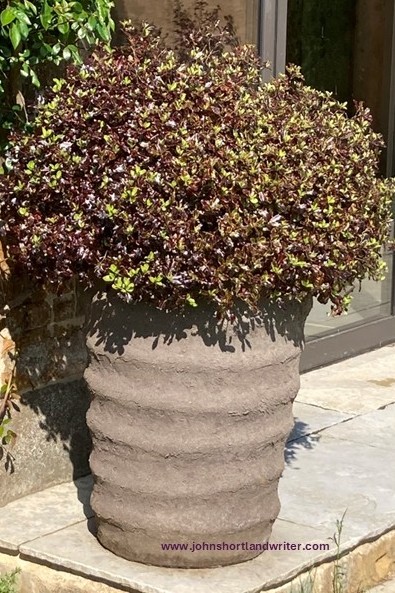
For contrast, and to maintain the hot theme,  I have mostly used oranges and golden yellows, the plants chosen to give continuity of display from June to the first frosts.  These are interplanted with purple salvias and shocking pink echinacea to break the colour – not too many: just enough to emphasise how much orange/yellow there is, if that makes sense.  This part of the garden isn’t used much for the rest of the year but the displays could begin in early spring with golden daffodils, especially the exotic looking orchid varieties, followed by masses of deep-coloured tulips and wallflowers.  For the winter, the scarlet and orange stems of dogwoods would brighten the dullest of days.  My client didn’t want too many pots or planters but I did manage to squeeze in two planted with the wonderful dwarf Pittosporum ‘Tom Thumb’.  Summer pots filled with zinnias and tall spikes of fiery red or orange cannas would really compliment a garden like this, but it’s not to be.

Although the same tone, the shape of the orange daisy-like flowers of the Ligularia contrast well with the trumpet-shaped Hemerocallis ‘Burning Daylight’ in the background
Pittisporum ‘Tom Thumb’: the new pale green leaves turn to burgundy as they age

I hope that this post may have inspired you to be bold with your choice of colour.  I’ve illustrated it with one garden devoted to this style of planting but it can be greatly scaled down to just a single bed or corner – the twin beds above only measure about 5m x 2m each.  Below is a list of the plants that I have used which is by no means, exhaustive for there are endless possibilities to choose from.
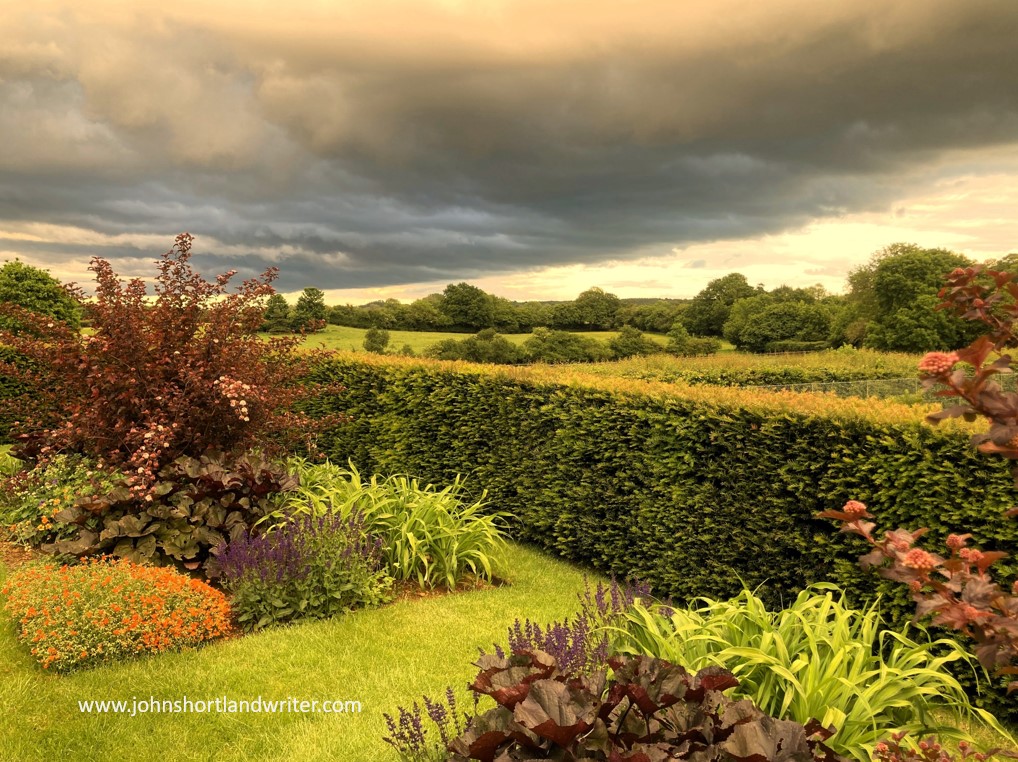
Two year on and the the twin borders glow under the dramatic evening light

Plant List
Astrantia ‘Claret’
Echinacea purpurea
Geranium x magnificum
Geum ‘Princes Juliana’
Helianthemum ‘Hennfield Brilliant’
Hemerocallis ‘Burning Daylight’
Hemerocallis ‘Little Grapette’
Ligularia ‘Desdemona’
Nepeta ‘Walker’s Low’
Physocarpus ‘Lady in Red’
Potentilla fruticosa ‘Tangerine’
Rudbeckia ‘Prairie Glow’
Salvia ‘Mainacht’

A note about the Cypress trees.
The cypress were already established and are now beginning to get too large for the space so may end up being removed. When reduced in size they tend to lose their elegant shape.  I am inclined to replace them with Irish Yew which is naturally columnar in shape and withstands pruning.  The golden-leaf cultivar would blend well with the walls as well as contrast with the dark green yew hedging.

If you’ve enjoyed this post and found it helpful and interesting don’t forget that there’s my book that reveals all sorts of gardening tips. Written in an informal, no-jargon way for the newcomer to gardening but also for those with more experience. If you’re not that enthusiastic about your own garden or have little time to devote to it then this is the book for you! Available from bookstores and/or Amazon.

With a foreword by Josceline Dimbleby

Happy Gardening!
2021: A Year in Review – part 1

With restrictions on movement and socialising for much of the year, 2021 was definitely the year to remember times past, be it visits to favourite haunts or thinking about friends and family. As it was in the real world so it was in the blogging world.

In January my memories took me across the sea to Ireland and a visit to Clonegal, in Co. Carlow. Ireland is a beautiful country with an ancient history. The visit to Huntington Castle, very much still a family home, was very worthwhile as the building itself was interesting, and the gardens, perhaps because they weren’t ornate, relaxing to walk around. A visit to the cellars is a must for it is now a Temple dedicated to Isis. The Fellowship of Isis, started by members of the family, was recognised as a world faith in 1993. I found the ornate decoration rather too theatrical for my taste, reminding me of a scene from an Agatha Christie novel. Take a look at the post by clicking on the link here and tell me what you think.

Huntington Castle in the south of |reland

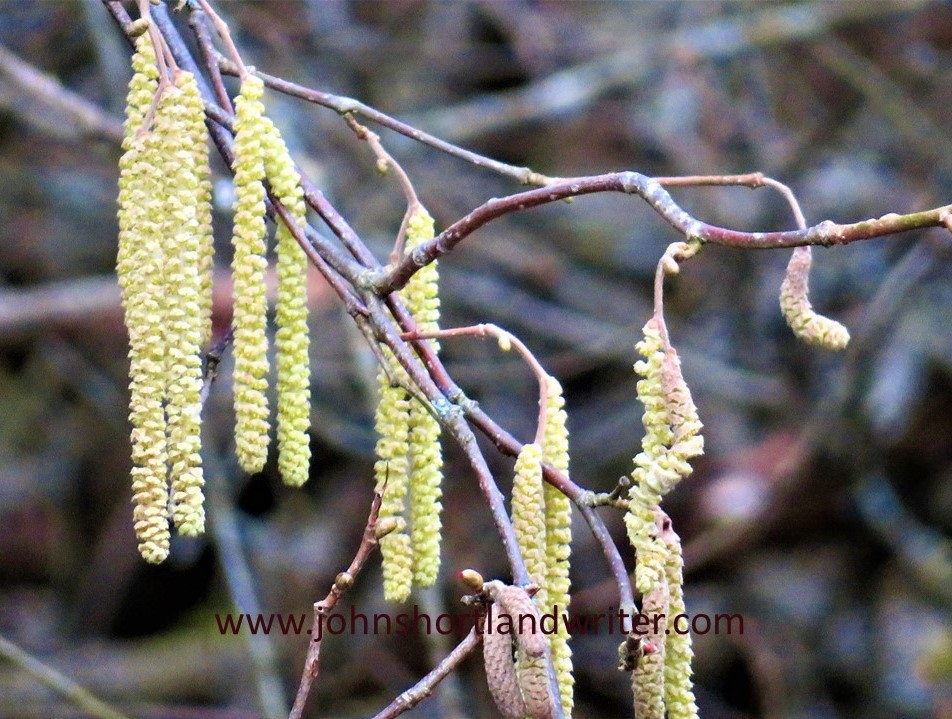
By February the earliest signs of the forthcoming spring are beginning to show. In the garden snowdrops and aconites are in full flower; in favoured spots early daffodils are starting to bloom. In the hedgerows hazel catkins hang in clusters shedding clouds of their golden pollen in the slightest breeze. Hazel, a native shrub, is also a useful one to grow in the garden. It’s pliable stems can be used in a myriad of ways – cut as pea-sticks, or growing into intriguing living tunnels. February’s blog post concentrated on these uses and looked at the ancient art of coppicing – a method of extending the life of the plant and providing plentiful cover for wild birds, animals and flowers. Described as an art, it is however, a very simple technique. Click on the link here to find out more.

Catkins or Lamb’s Tails – harbingers of Spring

International Women’s Day occurs in March and I focused on the life of Lettice Fisher, the founder of the National Council for the Unmarried Mother & Child in 1918. Later, the charity changed its name to Gingerbread. A suffragette and economist, Lettice was also a cousin of my father and so family history came to the fore in this post (link here). Later in the year, the focus turned to her husband, H A L Fisher and his story but for March Lettice was the rightful star of the show.

Lettice Fisher, an ancestral cousin

In April, I was able to visit friends for a long weekend, a real treat after all the restrictions. I took the opportunity to go for a long walk in beautiful countryside. Rutland is England’s smallest county and was also the home of the poverty-stricken ‘peasant poet’ John Clare born in 1793. The walk took me past the old lime kiln where he worked and the village where he was raised – his poem The Ruins of Pickworth can be read in the blog post (link here) and there are lots of photos of the ruins as well as views along the paths and byways I walked. Several hours later, when I returned to my friend’s home, I was especially thrilled to have seen a group of wild fallow deer which included amongst them, a rare white hart,

The ruins at Pickworth were familiar to John Clare, the Peasant Poet

By May, spring is well and truly established and plants in the garden are flourishing. Everything is growing so fast that it can become overwhelming and with so many tasks to carry out, early supporting with canes and twigs can easily be forgotten until it is too late. Although this can’t be done to every tall plant in the garden, the Chelsea Chop is a drastic but very successful method of treating herbaceous plants so that they don’t need staking at all. The biggest hurdle to overcome with this technique is finding the courage to actually do it! By clicking on the link here you will find a step-by-step guide. Even if you don’t do it to many plants, I would highly recommend that you do it to the Ice Plant, Sedum spectabile which always collapses just as it comes into flower – once you have, you’ll wonder why you’ve never done it before.

Sedum, the Ice Plant – the perfect candidate for the Chelsea Chop

For June, it was back out into the countryside to check the state of a venerable old ash tree. Ash Dieback is a serious, recently imported disease that threatens to eradicate one of the most important trees in the British landscape. Younger trees in our parts of the Cotswolds are already showing signs of it, some much more severely than others. The farm where we keep our horses has one ancient tree that has stood sentinel over the adjoining fields for centuries (lots of pictures on the link here). It’s trunk is hollow and owls and bats roost within it; it must have seen generations of them leave its shelter at night. Likewise, it must have sheltered in the day many a farm labourer seeking shade during hot, summer harvests. It will be a sad day when it dies and we just have to hope that it may show some resistance to this new disease. I, all too well, remember as a child when a similar fate overtook elm trees and changed the English landscape forever. Let’s pray that it doesn’t come to that.

We ride past an ancient ash tree most days

If it sounds as if this review is ending on a sad note, don’t despair – July to December will be following shortly and there’s plenty of posts on an upbeat note there. My family’s fascinating exploits feature in some of them. Covid restrictions have given me plenty of time to root out the old stories of them – to be honest, I never knew what an interesting and, sometimes, brave bunch they are!!

The Chelsea Chop

Despite its name, the Chelsea Chop isn’t the latest trend in hair styling although trimming the unruly and the straggly certainly is involved. It is a very simple and straightforward method of cutting back herbaceous* plants which, for some reason, terrifies even the most confident of gardeners.

Sedums (foreground) growing at Lytes Cary Manor

The only skills required are courage and the knowledge of exactly when to carry out the chop. The latter is simple to calculate and is hinted at by the title of the deed – the week of the Chelsea Flower Show or thereabouts. This year, there have been two hiccups in using this rule: firstly, the show has been moved to autumn because of Covid restrictions and secondly, because spring has been so slow in coming that plants are behind with their growth. As a general rule of thumb, the time for cutting is around the third week of May.

The flat flowerheads of sedum are made up of hundreds of tiny star-like florets

Beloved by bees and butterflies, Sedum – also known as Ice Plants on account of their fleshy, cool-to-the-touch leaves – are the ideal candidate for the chop and one of the most satisfying to do. Inevitably, when left to their own devices, the large, flat flowerheads are too weighty for their stems and they topple over to sprawl across the ground and spoiling an otherwise impressive display.

Sedum, the Ice Plant, frequently collapses & looks ugly just as it flowers

To make the chop all that has to be done is to cut through every growing stem, thereby reducing the plant’s overall height by half to one-third. Clear away the prunings (which can be added to the compost heap) so as not to attract slugs. There, I told you it was simple!

Sedum given the chop. Don’t forget to pick up all the prunings!

Although the method sounds and looks drastic the plants quickly recover and make new growth. The end result will be a plant that doesn’t collapse and doesn’t require staking. Admittedly, the flowerheads will be smaller than before but they produce so many more than they would have done left unpruned that the effect is in no way diminished.

Numerous flowerheads appearing on the now tight growth of Sedum two months after the Chelsea Chop

This simple pruning technique can be used on a number of other plants too in exactly the same way. The taller achillea, phlox, campanula, asters (michaelmas daisies) and rudbeckias are all good candidates. I have heard of its use on echinacea (cone flower), penstemon and helenium but, in my experience, these are trouble-free plants anyway, so why bother? The secret to good, stress-free gardening practice is to find the balance of what suits you and what suits the plant. The Chelsea Chop on sedum in May prevents an awful lot of stress later in the year!

top left – clockwise: achillea, campanula, aster, rudbeckia. They can all be given the Chelsea Chop

*herbaceous – a non-woody plant that dies back and becomes dormant in winter to regrow each spring

Discovering the Five Senses in Lockdown

It sometimes takes a crisis to make us re-evaluate what is of importance in our lives and the present one of Coronavirus/Corvid-19 surely has to be the greatest that we will collectively face. Now, several weeks into lockdown we have all been developing new patterns to our daily regime, one of which may well be taking more exercise. Never before have we placed so much value on fresh air and being able to walk freely whether it be in our parks, gardens or open countryside.

Marlow watermark

                           Riverside path, Higginson Park, Marlow (before social distancing).                                 The river is the River Thames in Buckinghamshire

Living where I do in the Cotswolds surrounded by fields and with woodlands and the river close by it is relatively easy for me to enjoy the open space. For others able to take advantage of their enforced free time, it may involve a longer walk and I have certainly noticed an increase in the numbers of walkers and cyclists here in the valley. I have also noticed that for many of them one aspect of their lives hasn’t changed: as they walk their eyes are glued to the screen of their mobiles and headphones are clamped to their ears, seemingly unaware of their surroundings. It has made me think all the more of our five senses and how we use (or should use) each one of them when out exercising.

Nr Fingest copyright

Cycling in the Chiltern Hills

SIGHT For those of us blessed with the gift of vision, perhaps sight is the most important sense we use and perhaps the one we most take for granted.  Without it, it is still possible to enjoy one’s surroundings for the other senses become heightened but I doubt if anyone would deny the pleasure of seeing the beauty that surrounds us on our daily walks. Even within cities there is much nature to be enjoyed although I admit that sometimes it has to be sought with more vigour and awareness.

Viola watermark

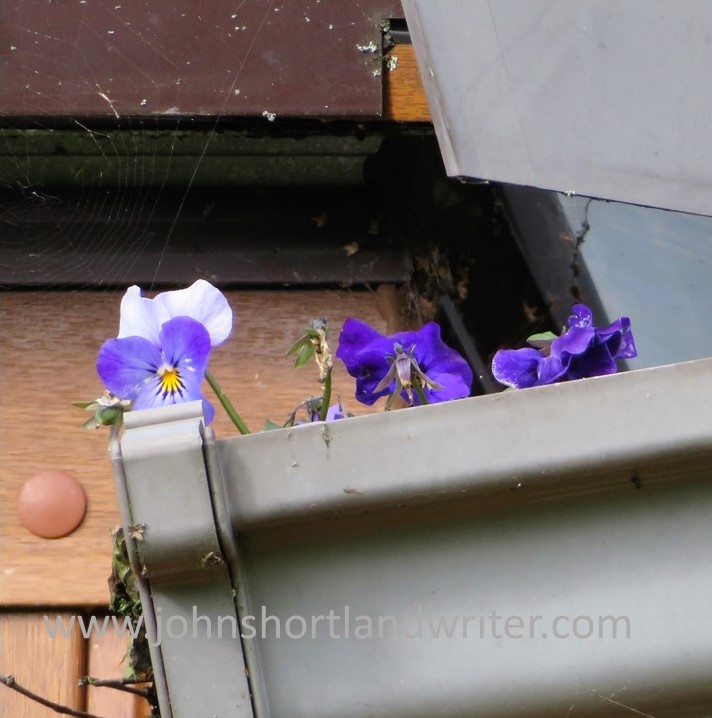
Look everywhere – self-sown violas peep out from overhead guttering!

At this time of year, more than any other season, there is much to see. Tight leaf buds unfurl into an explosion of vivid green foliage, iridescent wherever sunlight filters through; young ducklings tumbling into the park pond to take their first swim. But it isn’t just the natural world to be seen anew, there are other things too. Although it had been there for more than a hundred and forty years (and I’d walked past it very day for twenty) the date scratched into the stone on this wall had gone unnoticed.

Date stone watermark

Who scratched this date into the old stone wall and why?

HEARING Along with sight the second most important sense we use on our daily amble. Apart from the glory of birdsong there are other sounds that bombard us when out walking. The wind flurry that makes the catkins tremble and shed their pollen, the stronger breeze that make the twigs and branches clatter gently against one another. Then there’s the rustle in the undergrowth. Stop and wait silently and with patience you may be rewarded by the sight of a little field mouse going about its daily chores or a rabbit venturing out to feed.

Field Mouse watermark

patience was rewarded when this little field mouse ventured into the open

Altamont Gardens (8) watermark

… and also this rabbit

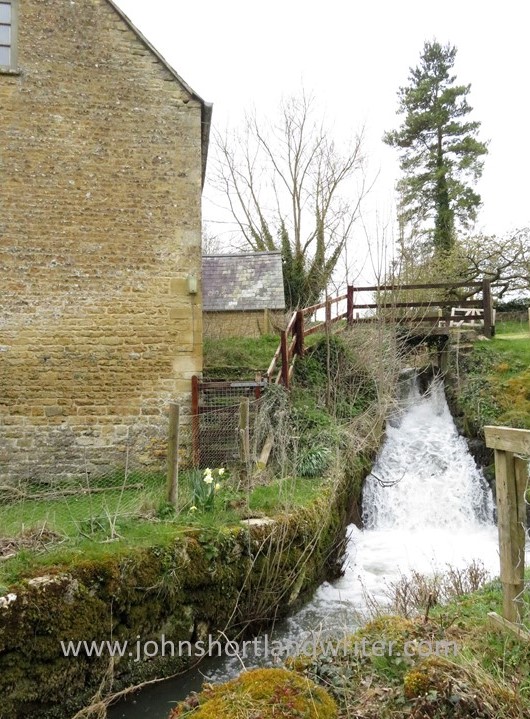
The sound of the river alters constantly. The smooth, barely audible glide of the water changes to a tinkling of soft musical sounds, its flow interrupted by a fallen branch. A few yards further downstream they rise to a crescendo as they crash and tumble over the old millrace before returning to silence as the flow stills in the calm of the millpond.

Radford Mill (1) watermark

The old millrace 

Radford Mill watermark

the calm of the millpond

TOUCH   In the present crisis we are sensibly being discouraged from touching things unnecessarily. Out on walks perhaps care may be advisable when opening gates or climbing stiles but, if you do, take a moment to think about what you feel. Heed the cold steel of the metal five-bar gate and the way it slowly warms beneath your hand; feel the rough timbers of a stile worn smooth from much use over the years. Of less concern health-wise – and all the more pleasurable for that – become aware of the softness of new horse chestnut leaves; later in the year they will become as harsh as sandpaper. Run your fingers across the twisted, grooved bark of the sweet chestnut tree and stroke the furry softness of the aptly named ‘Lamb’s Ears’, the favourite garden herbaceous plant Stachys byzantina.

Sweet Chestnut 4 watermark

The deeply grooved bark of the Sweet Chestnut tree

Stachys byzantina  Lamb’s Ears

SMELL   The scent of spring is everywhere at the moment and to be delighted in. However, the sense of smell is also a powerful trigger of long-forgotten memories. In a few weeks’ time the sweet scent of drying hay in the meadows may recall childhood farm holidays but for now there is the unique smell of new-mown lawns. Both start off as freshly cut grass yet their scent is so surprisingly different. Likewise, compare the subtly differing fragrance of apple and cherry blossom, both in their full-blown glory right now.

Drying hay before baling

The smell of freshly-mown grass…

Without even leaving home, squeeze the leaves of the herbs on the kitchen sill and notice their variation in scent, their colours and textures too. Early morn in the woodland, especially after warm rain, the delicate perfume of bluebells quickly disappears as the sun becomes stronger. Half-close your eyes and glory in their colour, in the silence and in their perfume and leave all cares behind you – if only for a while.

discover the different textures & scents of herbs

The vivid greens & blues of an English beechwood in spring

In town, the scents are also there just waiting to be noticed. Rain falling on roads and pavements or scorched by hot sun both produce delightfully tarry smells, one mild, the other strong. In the formal beds of the local park flowering bulbs stand in regimental rows; each have a unique scent which rises in the air to mingle with the vanilla fragrance of wallflowers. The wallflowers, their dull green foliage barely noticeable throughout the winter, now shout out the arrival of spring through the colours of their flowers of brick red, orange and yellow.

Tulips & wallflowers – a favourite park bedding combination

TASTE   In shaded places where the soil stays moist you may be greeted – even before you arrive – by the pungent scent of wild garlic. A prolific carpeter of the woodland floor its leaves and flowers make a useful ingredient to spring salads. Wild garlic or Ramsons to give it it’s country name, is fickle where it will grow. In some places that would seem suitable, not a single plant can be found. A less common member of the onion family to be found in the wild are the chives of our gardens, they grow along road edges and field boundaries locally. It is thought that they were spread by the old drovers of centuries ago so that they could harvest them along the way to liven up a bland meal. There is no doubting its identification, disturb the tubular green leaves and the familiar scent is immediately released.

Ramsons grow in damp, shaded places

It is not only the onion family that can be nibbled en route. Richard Mabey in his book Food for Free, published many years before foraging became a ‘craze’, suggests nibbling on the half-open buds of hawthorn. Many a country child has done so over countless generations and perhaps that is how they got their old name of Bread and Cheese. To me, they only have a slightly nutty taste and texture.

Hawthorn leaf buds are not really worth eating!

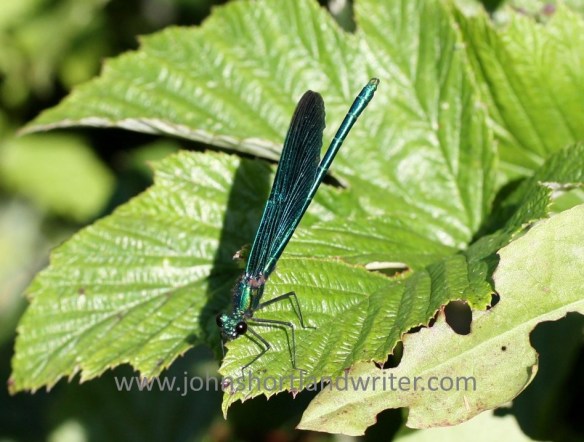
As a boy, brought up close to the River Thames, the hollow stems of the common reed were a regular source of pleasure for the soft pithy centre could be drawn out by pulling the stems through clenched teeth. Close to my present home there is also a small reedbed. These tall reeds have something to offer every one of the other senses too: sight – the pleasure of watching petrol-blue damsel-flies sunbathing on the stems; hearing – as they sway and rustle with the slightest breeze; touch – the coarseness of the leaves, a contrast to their smooth stems; smell – those of the river as it seeps around the roots, a heady mix of wet mud and wet greenery.

Only the male of the Beautiful Demoiselle damsel-fly has petrol-blue wings & body

So, within the bounds and restraints of the Covid-19 advice when out on your daily exercise, remove the earphones, place the phone in your pocket and use, really use, every one of your senses. Not only will you notice more, you will wonder how you never managed to notice them before. Stay safe, stay alert and take this unique opportunity to discover a new world on your doorstep.

Finally, one word of warning. Only try tasting wild plants if you are confident they have been identified correctly. If you decide to forage, do so responsibly and only pick a few leaves at a time. Make sure that all plants for consumption are free of pesticides and other contaminants, especially those growing in or near water.