The Heath

‘We’re off to the heath!” Such excitement whenever my father made this announcement.  It happened perhaps just three or four times a year and when it did it was always a special day.  Almost seventy years of summer sun – for we only ever went there when the sun was shining – have passed and the memory of those innocent days still bring joy.  Much later the heath became my place of refuge when sadness threatened to overwhelm me; under the great tree that had witnessed my journey into adulthood, its shade restored and healed me. 

Many summers have passed since I last sought the shade of the great tree

Going to the heath involved ritual.  The ritual included packing the picnic that my mother had been busy making; the ‘paste’ and cheese sandwiches, rock cakes that required the currants to be removed before being eaten (“no, mummy, they look like eyes”) and the steel Thermos flasks of scalding hot water for tea.  No tea bags in those days so teapot, loose tea and strainer were all added to the basket along with the rug for sitting on.  The rug fascinated me for it was of coarse wool and a faded khaki in colour but, most of all, it had my father’s name written on it in capitals:  SHORTLAND H A 174445, the numbers being those from his army days.  The blanket, he would tell us, had seen the Holy Land, Tripoli, the Pyramids of Egypt and the ancient ruins of Rome.  Being spared the horrors he’d witnessed during World War 2, it seemed to us as if the rug had magical qualities, perhaps it was the carpet that would one day take us to these far-off places as well.  Of equal importance to the outing was the cricket bat, ball and stumps, all to be placed in the boot of the cream Consul car – but only after I’d been lifted out of it for my jumping into the boot was all part of the ritual too.

Being packed into the car boot was all part of the ritual in 1955!
These days, picnics are taken in a lot more comfort…

Driving along the narrow country lanes my sister and I, noses pressed hard against the car window, would comment on every house made of flint, or with a thatched roof, that we passed for we knew the journey so well.  “Oooh, I so wished we lived there…”  After a few miles the car would begin to slow and we eagerly awaited the moment it would stop and we could all clamber out.  Hoisting me onto his shoulders so that I could see over the high hedge, we would look down onto the ‘model farm’.  How I loved it for it looked so much like my toy farm at home with its cows, sheep and horses enclosed by beautifully painted white wooden rails.  Of course, it wasn’t really the miniature farm that my father claimed it to be but set in a deep and steep-sided valley gave it the illusion of being on a much-reduced scale.  One day, I’m not sure how or why, we visited the old farmhouse with its ancient, beamed ceilings.  In one room the main beam was much split with age into which coins had been hammered.  It only added to my sense of awe as the farmer showed me the oldest coins, some of which dated back three hundred years or more.  He also showed me the one he’d placed with the ‘new’ queen’s head on it, the first he’d seen, for Elizabeth the Second had only come to the throne in the year of my birth.

Everything about the farm seemed to be in miniature….

Our next stop would be for a stroll around the village of Fingest.  The church fascinated me for it had beautiful, honey-colour rendered walls quite unlike the other churches in the area.  Its other unique feature was its bifurcated tower which to childish eyes looked as if it was splitting in half.  Best of all, inside the church, was a ladder, so tall that I was sure it must be Jacob’s ladder that I’d learnt about in Sunday School.  I never saw any angels climbing it but I was convinced that if I was allowed to do so I would reach Heaven. In adulthood, I would live in the village for a short while although by then, it was the excellent inn where they served great ale and delicious suppers that I eagerly sought after a long day at work.

The church at Fingest
Jacob’s Ladder – was heaven just beyond the top rung?

Fingest’s neighbouring village of Turville would only be visited on our way back from the heath, my parents stopping off at The Bull & Butcher.  In those days, children were not allowed in pubs and so we were left outside to explore its two streets and to clamber up the steep hill to the windmill.  How carefree those far-off days now seem when small children could be left to freely wander without fear.  The village now is famed for it being the village of the film ‘Goodnight, Mr Tom’, the windmill featured in Chitty Chitty Bang Bang and the church in the Vicar of Dibley.  After I moved from Fingest, I had the pleasure of living within a couple of miles of the windmill (and so close to the heath) for eighteen years.

Time stands still in the ancient village of Turville
The windmill stands high above Turville village

The lanes beyond Fingest become narrower and more enclosed by hedgerow and woodland as you approach the heath, all of which adds to the excitement of finally arriving at its wide-open expanse.  The car parked, out we would spill while mother busied herself with the picnic and my father set up the cricket.  We only had one wicket and so the match didn’t consist of ‘runs’ – our reward was in actually managing to hit the ball at all and the praise we would receive for our skill.  Perhaps this is why the heath holds such affectionate memories for, back in the fifties, fathers didn’t interact hugely with their children – mine was too busy working or tending the garden to make trips out a regular occurrence and my mother, like most women, was unable to drive.  Finally, we would hear mother calling us for tea and after devouring everything in sight we would lie back on the short turf replete and happy.  On one occasion my mother had packed roasted chicken legs, a rare treat for chicken was, in those days, a luxury meat.  Before we had the chance to try them, our little mongrel dog Tammy had snatched them away and into the bracken to eat out-of-sight.  Chicken never again appeared on picnics.

My father in 1963 – a tie was required even for casual dress in those days…

Soon we would be up and eager to explore.  The heath was beautifully unkempt; the rabbits cropped short the wide grass rides allowing the bracken and scrub to grow elsewhere, untouched so it seemed by man.  Along the western edge of the heath an ancient avenue of lime trees grew, their limbs now left to grow in a haphazard, twisted way.  From time to time one of these great boughs would fall to the ground there to gently lie and rot and return to the soil.  By summer, the bracken would have grown tall enough to obscure them from view. We knew where to find them and would crawl alongside beneath a green tunnel of fern fronds.  Tiny, pale toadstools grew from moist fissures in the bark, beetle scurried away from our disturbance and here we learned about nature., much of which seemed magical to young eyes  Later, as I learned patience, I would sit quietly to watch for wildlife: a wren chattering away as it searched for insects, the occasional slow-worm hunting for slugs and not as slow as its name suggests.  Once I was rewarded by a family of stoats moving like a sinuous string of sausages as they followed one another each holding the tail of the one in front in its mouth.  Such excitement!

Casual wear for ladies in 1963: my mother out for a picnic in the country

Magic played an important part in our young lives for everything we didn’t understand surely had to be caused by magic?  We saw regular proof of this in our painting books for they had the word ‘magic’ written across the front cover.  A blank page of paper would be transformed into a colourful picture by just brushing with water from the empty paste jars. The paste jars held the exact amount of water required for ‘art’ without too much risk of spills. In those days of necessity, although the word recycling hadn’t been invented, everything – paper, string, milk and other bottles – were all carefully saved or returned for re-use.  Plastic wrapping and the throw-away society was still to come. 

Evidence of magic could be easily found within these pages!

Further proof of the magical world around us came one day when exploring a new part of the heath.  We’d always thought that one dark, wooded corner looked rather forbidding but like all small boys, I knew better.  Venturing deep inside it, with every twig snapping under my feet making me jump, I came across a small, black pond besides which stood an old hollowed oak.  I squeezed inside the trunk to look up expecting to see sky.  Instead, there was darkness followed by much scrabbling and hissing as dust and twigs dropped onto my head.  Running as fast as I could I found my sister to tell her all about it.  Unbelieving, she and I returned and this time it was she who was hissed at.  Scared witless, we ran back to our parents.  Just an old barn owl we’d disturbed my father had said.  But we knew better, we’d found the door to the magic kingdom of elves and goblins.  How lucky were we that the door hadn’t snapped shut with us inside, never to return, as described in the numerous books that we had read.  Utter nonsense we were told.  That, we realised, was the trouble with grown-ups: they didn’t believe and that was why the magic was hidden from them.
                                                                                     *

I have to admit that it probably was a Barn owl that scared us

From time to time, I still return to the heath although I now live many miles from there. Whenever I do, I am struck at how small this ‘giant’ area to children’s eyes actually is. The difficult stage of my life, where the old tree supported me through despair, have long passed and the memory of it does not overshadow the pleasure that revisiting brings. Despite being a grown-up, I can still feel its magic.  I’m not alone in this for recently I read Hugh Thomson’s book, The Green Road Into The Trees, in which he crosses southern England on foot.  He too, feels the need to return to this very same heath in search of healing and finds it.  He believes that the mysteries of the Ancient World are not as far away from us as we tend to think for our mixed Celtic, Saxon and Viking heritage shapes not just the British landscape but also our souls.  Perhaps that’s where the magic comes from?

Here, Take It, and Don’t Cry [Nadir Un Vayn Nisht]

The evening of Sunday 8th February 1942 saw an elite group of actors, writers and singers come together to celebrate the work of their friend and colleague, Jakub Obarzanek, then at the height of his fame as an editor, comic writer and satirist.  Within months all of them would be dead, shot or gassed in the concentration camps of Poland, executed because of their Jewish heritage or political comment, or both.

Invitation for the evening performance celebrating the work of Jakub Obarzanek, 1942

Jakub was born on 15th January 1891, probably in the city of Lodz where he lived for much of his life.   The first son born to Samuel & Gitla, and into a comfortably off family, he would have been expected to follow in his father’s footsteps and work in the family business as a wholesale cloth merchant.  However, Jakub had always wanted to write and in 1918 he published his first pieces of work – humorous songs and verses in the Lodzier Togblat, one of the premier Polish Jewish newspapers.

Jakub Obarzanek standing left with three workmates, 1930s

Writing always in Yiddish, and under the pen name ‘Ob-nek’, Jakub very quickly developed a following amongst his readers and soon joined the permanent staff, editing and writing for the Friday edition.  As his talent develops, he begins writing sketches satirising everyday Jewish Street life which, again is eagerly read by a public wanting more.  During this time, he also begins collaborating with various revue theatres writing witty sketches, songs and monologues. All was going well until 1939 when the Germans invaded Poland, arriving in Lodz on September 8th.

Najer Folksblat newspaper, one of the publications Josef wrote for

One of the first moves the Gestapo made was to arrest Jewish writers and intelligentsia and Jakub along with others was taken to Radogoszcz, a factory now being used as a prison.  It had no baths or kitchens.  Almost immediately the killings began with the intelligentsia taken into nearby woods and shot.  For reasons unknown, Jakub was freed in early 1940, possibly because a ransom of 150 marks would permit prisoners to be relocated to the Lodz Ghetto. However, sometime during 1940 he had made his way – or perhaps been taken – to Warsaw.  Here, confined in the Ghetto he continues with his writing, helps to create a new revue theatre and providing them with material.  The last we hear of Jakub is the evening performance celebrating his work.

The Radogoszcz factory where Jakub was imprisoned and now a museum [Wikipedia]

It is not known whether Jakub was present for the performance.  My feeling is probably not.  What we do know is that he was once again arrested and was finally executed during April 1943. Married to Mala, Jakub had a daughter, name sadly unknown, and two sons, Moshe and Simon.  Mala and the girl perished in the death camps.  Whether they died alongside Jakub is also unknown, or even if they were with him after he moved to Warsaw.  Both Moshe and Simon survived the concentration camps but were very badly traumatised by their childhood suffering.  They ended their days in Israel but I have little knowledge of whether they were able to lead a full and fulfilling life. 

Translated description of the invitation, 1942

The performers at the celebration of Jakub’s work were, as mentioned celebrated artists of their day.

Zymra Zeligfeld – a famous singer of Yiddish folk songs – murdered in Treblinka Death Camp, 1942   
Chana Lerner – actress and wife of Dawid Zajderman, tenor – murdered together 3rd November 1943, Majdanek Death Camp
Symche Fostel – comic actor of International renown – murdered in Pontiatowa Death Camp, 1943     
Jack Lewi – actor of International renown & close friend of Franz Kafka – murdered in Treblinka Death Camp, 1942                                            

A(jzyk)  Samberg – famous Jewish actor – murdered in Poniatowa Death Camp 1943    Prof (Icchak) Zaks – founded the Internationally renowned, 120-strong Icchak Zaks Chorus; researcher and translator of opera into Yiddish, and music teacher – murdered in Treblinka Death Camp, 1942   

l-r: Zymra Zeligfeld, Chana Lerner, Symche Fostel (centre), Icchak Zaks
all had been executed by the end of 1943 [Wikipedia]

Jakub, as has been shown, was a popular man, much admired by his friends and colleagues; he must have been a brave man too and not only with his satirical writing and working knowing that he was unlikely to survive the war.  Earlier, just prior to WW1, my grandfather, Harry Obarzanek, Jakub’s younger brother had been living in England when he was conscripted into the Russian army (Poland at that time was part-under Russian control).  Now in army camp in Ukraine, he wrote to Jakub telling of his anxiety of being away from his wife for three years.  Jakub arrived bringing false papers, civilian clothes and a ticket to England and helped Harry abscond whilst on duty.  If they had been caught both would have been shot.  If it hadn’t been for my great-uncle Jakub’s help, perhaps my own family would have suffered the same terrible fate as Jakub’s. A humbling thought. I hope that with my writing, I have given Jakub the voice that was so very nearly lost, and that it is an adequate tribute to our brave and witty family hero. 

Brothers: my grandfather, Harry (left) & my great-uncle Jakub Obarzanek

How appropriate it seems that I am able to write about Jakub’s life and publish it on the 80th anniversary of his death. A very special thanks to Chaya Bercovici who saw my initial Facebook plea for information relating to Jakub and, by some miracle, remembered hearing of my grandfather’s escape from Poland. Is it too fanciful that Jakub, knowing of this, might have said, “Nadir un vayn nisht”, “Here, take it, and don’t cry”, the words used as the title to his tribute evening?

.

How To Grow Tomatoes With Little Effort

It may seem odd writing about growing tomatoes at the time you should be harvesting them but it is often the case that when you see a plant growing somewhere that is the time you wish you knew how to grow them.  As regular readers of my garden articles will know, although I love gardening I also like to achieve great results with the minimum of effort and tomatoes are not an exception!  Effortless gardening doesn’t mean bad horticultural practice for you can hardly expect great results from shoddy workmanship wherever your interest lies.  All the photographs below demonstrate that it is possible to have superb tomatoes without devoting every spare moment to growing them.

Tomato 'Moneymaker' watermark

Perfect tomatoes can be grown quite easily using my method

As is often the case, I discovered this easy way to grow tomatoes out of necessity: a client wanted them but they only visited their country house irregularly and I could only devote one day a week to maintaining their grounds.  That left about fifteen minutes a week for the tomatoes.   This method, by the way, only works for plants grown in containers.  Although they were grown in a greenhouse there is no reason why the same method could not be used for growing in pots outdoors although they are more at the mercy of the usually variable British summer weather (not variable this year, 2018!).

Tomato 'Golden Sweet' watermark

Tomato ‘Golden Sweet’

All garden plants, whether grown in containers or in the garden border require good growing conditions and this starts with getting the soil or potting compost right.  Tomatoes are greedy feeders and books and articles always advise feeding the plants on a regular basis as soon as the first flowers show signs of turning into fruit.  That is far too time consuming for my fifteen-minute rule!  Instead, use a quality compost.  I used Carr’s potting compost which is made from composted farmyard manure; although not the cheapest it is well worth paying the extra cost for the results that are obtained.  There are, of course, other manufacturers that do something similar which, I daresay, will achieve similar results.  To this compost I mix in several handfuls of horticultural grit and double the recommended amount of water-retaining granules – these swell upon contact with water, and release it gradually thereby reducing the necessity for regular watering.

Tomato 'Cherrola' F1 watermark

Tomato ‘Cherrola’

Tomatoes are easy to grow from seed, sowing in gentle heat in February and there is a huge choice of variety.  For ease and speed, I purchased young plants from a garden centre once I had no concern of late frosts killing them.  The pots were filled to within a couple of inches of the brim with the compost mix which I had pre-moistened.  As a guide, the compost should feel damp but you shouldn’t be able to squeeze water out of it.  Plant three tomatoes in a 20/25 litre plant pot placing a sturdy cane by each plant.  Stand the pot on a watering saucer or tray and water well.  Gardening rules state that tomatoes don’t like standing in water but I found that by using the saucers I could leave them with a good supply to last them the week.  By the time of my next visit, the compost and tray were dry but the plants unaffected by either the standing water or the drought.

Tomato 'Tigerella' watermark

‘Tigerella’, an heirloom variety of tomato with striped fruits

Tomatoes grow in two different ways depending upon the variety – bush or cordon.  With bush tomatoes you just leave them to grow as they will; with cordons it is recommended that you remove side shoots and tie the plant upright onto the cane.  Although the latter method sounds time consuming and fiddly it is a simple and quick task once it’s been mastered.  The secret is to remove any shoots that grow out of the union of the leaf stalk with the main stem – if done early enough they snap off with the fingers.  If you leave them they will need to be cut out with a knife or scissors.  Although it is possible to leave them in situ I find that the plants become very congested and difficult to manage which, in the longer term, means they are more time consuming to deal with.

Tomato 'Sungold' watermark

Tomato ‘Sungold’ – note how the plant has been ‘stopped’ when it had grown as tall as I wanted it to be.

And that’s it!  Just tie the plants to the cane as they grow and give them a really thorough watering once a week from the top of the compost until the saucer begins to overflow.  There’s no time-consuming feeding for the compost will provide all the necessary nutrients. And because the plants are growing strongly and healthily you are far less likely to be bothered by pests or diseases.  All the tomatoes in the photographs received no chemicals or other additives; all we had to do was to eat them.  If you’ve never tasted a home-grown tomato eaten the moment it is plucked from the vine then you’re in for a real treat!

Tomato Big Boy 1979 watermark

A photograph from 1979!  Tomato ‘Big Boy’, a beefsteak variety living up to it’s name!

A Forgotten Building in a Deserted Village

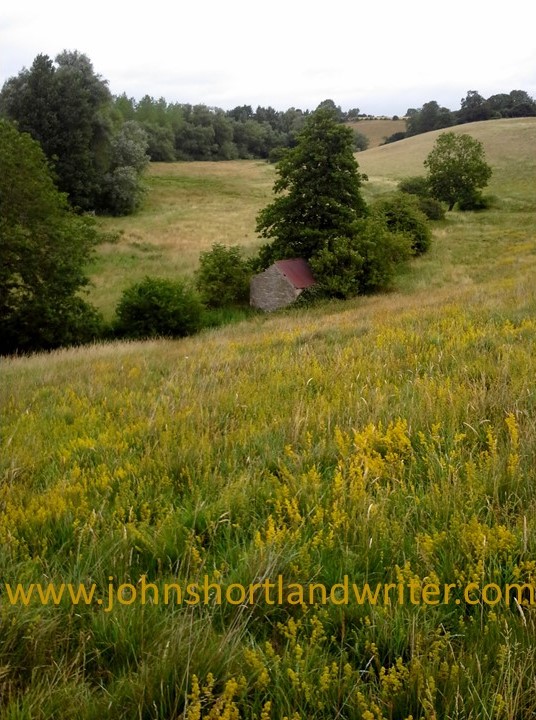
Tucked away in the fold of the wildflower banks where our horses graze is a small building that rarely gets a second glance if it is noticed at all. Semi-derelict and difficult to reach, its appearance offers no clues of its historic importance – important only to the history of the farm upon whose land it was built. Further up the valley the landscape offers some hints of its past use: a dried-up watercourse that only shows up after heavy rain; an old, crumbling pack-bridge that seems to lead nowhere.  It is only when the building is explored does its purpose become realised.Dornford Old Pump House watermarkDornford Old Pump House (21) watermark

The farm and its associated barns today seem isolated and remote by south of England standards, set high on the hill and away from roads. However, during the early medieval period it was a thriving community which had disappeared by late medieval times possibly due to the Black Death. By 1700 only a farm was left standing. In 1800 this was replaced by the present buildings although the 350+ year old dovecote and stable block both remain from those early days. All are now protected and their architectural features recorded. I can find no such protection or detail of the little pump house – for that is what this is – out of sight in the valley below. Yet it is a little gem!

Dornford 5 watermark

The seventeenth century stable block lies empty

Dornford Old Pump House (20) watermark

Arched entrance to the old pump house

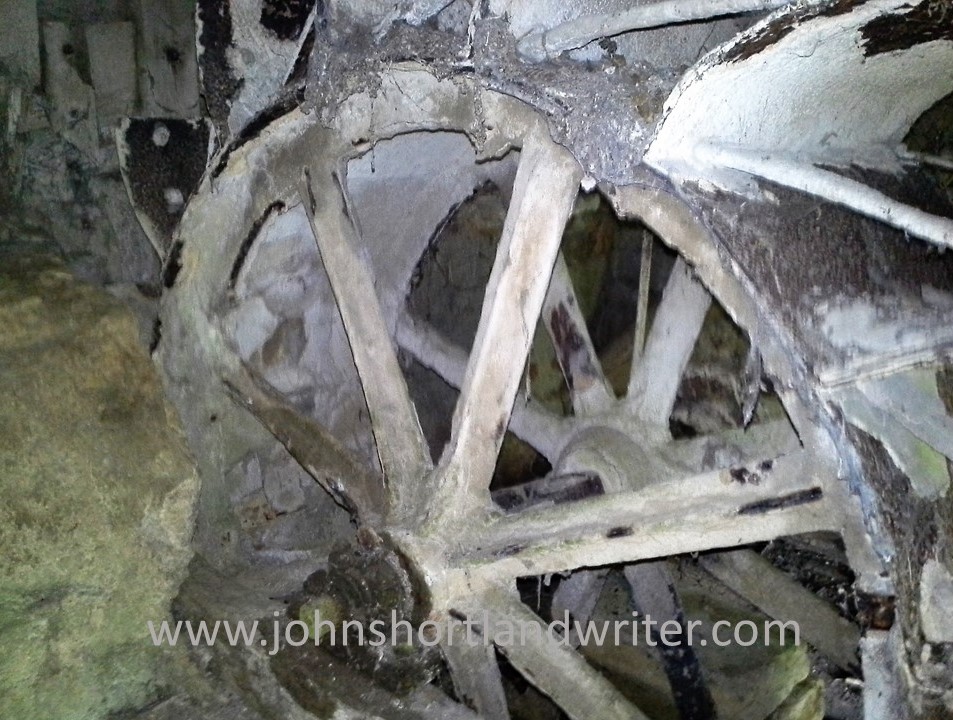
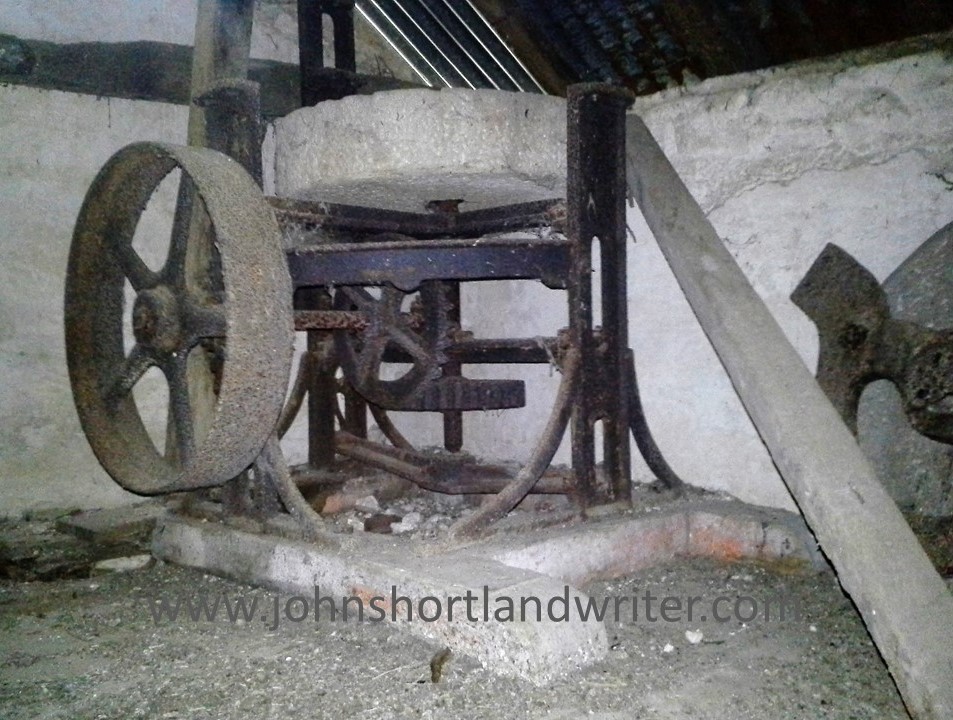
Probably built at the same time as the new farmhouse, the pump house would most likely have provided power for the barns as well as pumping water. What is fascinating about the building is that it still has its paddle wheel and much of its mechanism in place.

Dornford Old Pump House (9) watermark

The wheel – made from iron – is still in place

Dornford Old Pump House (16) watermark

Some parts of the building look as if they were deserted yesterday

Visiting the site isn’t for the faint-hearted. At this time of year, it is necessary to fight a way through chest height stinging nettles and to crawl through narrow and low passageways. Once inside, however, the architectural detail is delightful with its chamfered chambers and arched entrance and exit. Like all deserted places it is important to be vigilant at all times and not just in case of falling masonry. It’s just as important to keep an eye on what’s happening at ground level – this old well shaft, its cover rotten, waits to trap the unwary.

Dornford Old Pump House (5) watermark

Tall weeds almost totally hide the entrance to the building

Dornford Old Pump House (2) watermark

The well shaft with its rotten cover