So another year has gone by and I find that one of the benefits of ageing (yes, there are some!) is being aware that time is running out. I say it is a benefit for I don’t find the thought at all depressing, instead it gives an urgency to achieve what I can whilst I can. There is so much more to do, to see and to learn in what time is left. It is possible that I may live to be a hundred for many of my family have lived well-into their nineties and beyond but even allowing for that, it still doesn’t give me too many years to waste.
Time waits fir no man – or woman!!
One of my ancestors, Richard Beauchamp died at the age of 57, which although not a great age by modern standards probably wasn’t too bad for someone dying in 1439. He had a busy and well-documented life but perhaps his biggest achievement was carried out after his death. In his will he left various bequests, the largest portion to the Collegiate Church of St Mary in the town of Warwick for the building of a chapel. Upon its completion his body was transferred there to lie beneath his splendid gilt-bronze effigy. The effigy, along with the chapel’s medieval stained glass and other decorations are considered to be the finest in Europe. In March, I finally visited the tomb where both he and his parents lie, a remarkably emotional moment perhaps because nothing had prepared me for the chapel’s magnificence. To judge for yourself, click on the link here which will take you to numerous photographs as well as the story of my ancestral grandparent’s lives.
Richard Beauchamp, my ancestral grandfather lying in the splendour of the chapel he commissioned for the benefit of his souldetail of the tomb of Richard Beauchamp dating from the 1400s
Spring arrives late in our part of the Cotswolds for the secret valley, although very beautiful, nestles in a ‘frost hollow’. As a result, the bluebells that flower at the foot of the ancient hedgerow than borders our lane are always a couple of weeks later than in many other places. However, when they do bloom, the intensity of their colour never fails to delight. Pretty as they are, they are nothing compared to the bluebell woods of the Cotswolds and the Chilterns, the range of chalk hills where I was raised and lived until I moved here twenty-five years ago. In May, when the bluebells had reached their peak of flowering, I wrote a blog In Praise of Bluebells. Apart from photos of the bluebell woods (including one of me as a much younger man with my two Scottish Deerhounds), I explored the bluebell in history and poetry, link here.
the magnificence of a bluebell wood in MayOccasionally, a white or even a pink bluebell appears
In June, on my Facebook page, I had a casual discussion with a follower about mentors and mentoring. She asked me if I’d ever had any mentors and my answer was ‘yes’: two couples, both of whom came from very different backgrounds to one another as well as my own. She wanted to know more and so I promised to write a blog about them, a post which would honour their contribution to my life and demonstrate the great enrichment such mentors can give. Mentors – part 1 (link here) tells of my chance meeting at the age of sixteen with Dick and Lorna French, who farmed on Exmoor, a National Park in England’s West Country. The farm is very isolated, and the post explores how I ended up living with them after turning up one day unannounced on their doorstep. Regular visitors to my blog or Facebook/Instagram pages will know what a love they imparted on me for this wild and rugged landscape, a place I still visit very frequently. The blog has numerous photos including some of me from early childhood to that gangly sixteen-year-old that Lorna and Dick first knew.
My first mentors: Dick & Lorna French of Brendon Barton, ExmoorExmoor National Park: Aged 16, I suddenly found myself living and working in remote countryside
Find out about my other pair of mentors, Cyril and Pamela Heber Percy, who came from privileged upper-class families in 2025: Part Two (yet to be written but coming shortly!). The blog will also explore what happened in the last few months of 2025
Mentor. There are dozens of words to choose from when looking for an alternative description of someone who takes on this role: life coach, guide, adviser, confidante, counsellor, influencer to name just a few. One thing that is certain is that the four people who played such an important role in shaping my life would not recognise any of these terms, not even the word mentor. And to be honest, it is only with the benefit of hindsight that I recognise them as being mentors at all.
If I had to choose just one word, I think it would beguide for that seems to describe what they were during their lifetimes. It is only since they’ve been gone – for sadly, they have all been dead for more than twenty years – that I actually think of them even as that for their influence was subtle. They would almost certainly find the description laughable for there was never any conscious effort to take on that role. It was one that had come about by chance meetings leading to friendship, respect and love.
Despite the angelic appearance I wasn’t an easy child!
I was not an easy child – I know that statement is hard to believe now (laughs). A streak of rebellion has run through our family for generations and although I wasn’t outwardly rebellious, I sometimes made life difficult for those around me. From the age of fourteen I found school a waste of my time for I had wanted to study sciences and school insisted I did languages instead. I’m sure they were probably right for studying French and English had come easily to me whereas I’d struggled with even General Science. To me that was irrelevant for I had desperately wanted to learn botany and biology. Instead, I now found myself sitting in German classes seething inwardly and resenting every moment of having to learn the difference between der, das and dem or liebe and Lieber. I began playing truant and found that if I left school after the lunchtime register had been taken nobody seemed to notice and I could walk the three hours back home through the woods and fields where I could practice my botanising. I finally stormed out of school halfway through my ‘O-level’ exams before sitting the dreaded German but not before I’d sat French and English. I passed both with flying colours but my parents were furious.
Me in my element!
More out of desperation, my parents agreed that I could take my bicycle and tent on the train to Exeter and cycle and camp across Dartmoor for two weeks. It would be my first solo holiday and, I imagine, they agreed in the hope that it would make me appreciate just how fortunate I was to have been given the chance of a good and expensive private education. I arrived in Exeter in blazing sunshine and armed with maps and far too much self-confidence started my journey westwards. In those days, with no mobile phones or credit cards to monitor my progress, my parents provided me with stamps and cash so that I could send them a postcard at the end of each day. I reached Okehampton, a small market town on the fringe of the Dartmoor National Park in a sweat and seeing from my map that I wasn’t that far from the sea instead decided to cycle northwards to Westward Ho, a beach resort on the North Devon coast.
I had reached the sea
Refreshed from an early morning swim in the sea (I’d arrived there at 2.00 in the morning) I looked again at the map and now decided to travel eastwards to a different national park, Exmoor. I’d read the novel Lorna Doone at school and had loved it and the thought of exploring the rugged and isolated places where she had met and married John Ridd, only then to be shot at the altar of Oare church, filled my imagination. Little did I know then that soon I would be meeting a real-life Lorna Ridd who with her farmer husband would welcome me into their lives.
Oare Church – where Lorna Doone was shot at the altar on her wedding day
Three days later, having cycled over some tough and exhausting hilly roads I ended up at Brendon Barton, a remote farm perched high on the edge of the open moorland. It was coming towards the end of my fortnight away and so I knew that I could only stay there for one or two days before the long bike ride back south to Exeter and home. Venturing into the farmyard I could hear sounds coming from inside the barn where Dick French, the farmer, was working with sheep. I asked if I could camp in one of his fields but he didn’t look up and instead replied, “be a good lad and bring those last two sheep in here.” I had never been near a sheep before and so spent the next half an hour running around the yard in circles before finally managing to herd them inside. I was out of breath, sweating and covered in sheep shit but I found a contentment in my success that I’d not experienced before. Years later, Dick and I would laugh about that first encounter. I used to say that I should have just got back on my bike and cycled away to which he would respond with, “when I saw you wouldn’t give up, I knew that you’d do!”
I cycled over Exmoor’s remote, hilly roadsPreparing for a good night’s sleep, Brendon Barton 1968
By my second day on the farm I had helped bring in the cows and Dick had taught me how to hand milk them. Hearing I could ride, he suggested that I took Star, one of their horses up onto the moor to have a look around The heather was in flower and its deep purple carpet continued to the sea. Beyond, the coastline of Wales could be seen in the hazy far-distance. I ventured into a deep combe before crossing a stream and climbing up a ridge. There I spotted a deserted farm cottage* half-hidden by beech trees. I stood entranced by the beauty of my surroundings and its all-encompassing silence. I felt I had found my true home and with no consideration for my parent’s concern, I decided never to leave. I sent them a postcard saying that I’d missed my train home. I remained purposely vague as to my whereabouts, just saying that I’d kept back enough money to buy a new railway ticket.
The heather clad hills of Exmoor reach to the seaHalf-hidden amongst the trees stood a deserted farm cottage
A week later I was having my meals in the farmhouse enjoying the banter amongst the farm lads and hearing the discussions about the tasks that needed to be done around the farm. By the time harvest came round, my tent had been ditched and I was sleeping in the house in a comfortable bed, receiving a small wage and spending evenings in the village pub with new-found friends. Dick had said that it would be his wife Lorna (Ridd had been her maiden name) who would decide whether I could stay or not. She was such a hard-working woman and one more person to care for might be one too many. Her approach had been that one more would make no difference and so she looked after me while I spent long days working at Dick’s side, listening to his tales and learning about their way of life. Asked about my parents, they seemed content enough with my explanation that I was spending extended time away having just left school (the term gap year hadn’t been invented then!).
Brendon Barton 1968 – I soon moved into the farmhouse and a comfortable bedHarvest was still carried out the old-fashioned way
Months passed and the harder I worked the more I knew an Exmoor outdoor life was for me. However, it came to an abrupt end when one day I walked into the kitchen to find my parents sitting there telling me it was time to return home. I was devastated and asked Dick why he hadn’t told me they were coming. “I knew you’d hide up on the moor,” he’d replied – and he was right! Although I was pleased to see my parents I pleaded with them to let me stay. Dick, in the first of his subtle acts of persuasion that I can recall, asked me to help him look at a horse in the barn. There was no horse, instead we sat and talked about our time together before he reminded me that my home was with my parents and, in time, running our family business. Don’t forget, he’d said, there’s a room here always available so why not come down for lambing next spring. To ensure that I did he added, “You’d be doing me a great favour, I could do with your help.”
The barn in 1968 where I had my first taste of farmingI returned for lambing in 1969
Lorna, too, had her subtle ways of persuasion. “Your parents have said that you can come here for Christmas if you’d like to. We’ll be on our own and some young company would be good. It’ll be just the three of us.” She’d also boxed up the bantam chicks that I’d been caring for so that “you can carry on farming at home.” After that first Christmas I visited them both for many years, helping on the farm whenever I could, and exchanging letters and phone calls. They were always my first port of call when I was having difficulties, feeling down or just wanting to celebrate with them. Life hill-farming is hard, the weather often unmerciful and the hours long but there are also the pleasures of being part of a small tight-knit community that will help one another whatever the reason. Leading by example, they instilled in me a love of farming and hard work, a sense of duty, generosity of spirit and kindness. I will leave it to others to decide whether they succeeded or not! From them, I also acquired an even deeper love for being outdoors regardless of the weather and especially in remote, wild landscapes. Little did I know then that these skills would be put to the test when, aged forty, I began my career change to follow my outdoor dream, or that Exmoor would still play such an important part of my life today.
The bantam chicks that Lorna sent back home with me, 1968
Dick and Lorna French died just before the Millenium and the farm was sold to another local farming family, some of whom I’ve now known for almost sixty years. Because of that, I still on occasion visit Brendon Barton and sit in the kitchen drinking tea to discuss farming and, of course, putting the world to rights. A bonus is that Maria, the new ‘Lorna’ has been creating an extensive garden around the farmhouse, so we have gardening in common too, as well as a lifetime of shared memories. It would be another fifteen years and then as a man, before I would meet my other mentor couple. Cyril Heber Percy and his wife Pamela’s lives were worlds apart from Dick and Lorna’s but there were some similarities too. Part 2 tells their story.
Lorna & Dick French
Have you had a mentor or mentored someone? What does it take for someone to become a mentor? Our parents have probably the greatest influence on our lives so why does a mentor s role take on such importance? Let’s hear your story either in the comments below or, if you prefer, by using the Get in Touch tab at the top of this page. Thanks to Diane Highton for posing the question that triggered this blog!
* The deserted cottage still stands in splendid isolation hidden away behind the trees, albeit now as a ruin. It has a fascinating history and has been the subject of much research in recent years. Take a look at the website devoted to the story of Hoar Oak Cottage
How time flies by. I know that’s a bit of a cliché to open with but, even so, it hardly seems possible that thirty years could have passed since that early spring day in 1994 when I locked the door of Shortlands clothing and footwear store for the very last time, and wondering where my career would go to next. I was in my early forties and knew that I would have to do something to earn my keep and pay the mortgage but what? It was a time of great sadness, not just for me and my family but also for our loyal staff some of whom had been with us for many years. Thirty years on it seems time to write the shop’s story to celebrate it having been at the centre of community life for the best part of a hundred years.
Shortlands in the 1990s
The shop that was to become Shortlands began with my great-grandfather, William Bradby Langston, who had already established shops in Marlow High Street and in nearby Lane End. He was quite entrepreneurial, something he and his brothers inherited from their mother. Poor Sophia, widowed in 1863 at the age of 34 with five children under the age of 13 and a baby due at any time needed to provide for herself and her family. She set up a shop in her front living room which later expanded to become Langstons Department Store in Reading, Berkshire. As well as those already mentioned, she and her sons between them also had shops in Boscombe (Hampshire) and Ilford (Essex). Unsurprisingly, she is remembered as being rather a force to be reckoned with – you can read her life story, Rebel in the Family, by clicking here.
The first generations of retailers l to r: My great-great grandmother Sophia Langston (nee Bradby); my great-grandfather William Bradby Langston; my grandfather Arthur Shortland
William opened his ‘Boot and Shoe Warehouse’ in Marlow in 1884 at the age of 22. Seven years later he opened another, opposite the first, specialising in boating and tennis shoes as well as other sporting footwear. When a newly built parade of shops became available in Bourne End in 1899 he established what was to become Shortlands. At first the shop was tiny but by 1904 he had expanded to sell not just shoes but also mens and boys clothing. Four years later William’s daughter, Nellie, married Arthur Shortland who had come to Marlow to work for William a few years earlier. The newly married couple came to Bourne End and by 1915 Arthur was listed as the owner in Kelly’s Directory.
Langstons – the Bourne End branch c1910
The shop continued to prosper and during the 1920s the adjoining shop was purchased and ladies clothing and footwear as well as carpets, haberdashery, dress fabrics and knitting wools, soft furnishings, household linens and luggage were added to create Bourne End’s own department store. The 1920s photo below shows my grandfather Arthur using the steam (clothes) press although it was a (much hated!) task given to my father Hedley as soon as he returned from school.
Langstons, now expanded and with my grandfather’s name on the fascia 1920sMy grandfather, Arthur Shortland using the steam press,1920s
With the outset of WW2 my father joined the army and it was left to the older generation, including my great-aunt Edith Shortland, to run the business. Both the Langstons and the Shortlands were deeply religious and scrupulous in the way they behaved towards others. My mother would tell the story of how when some silk stockings arrived (which were rationed and in short supply) she rather assumed that she would have a pair. She was told quite firmly that her name would go on the bottom of the list like anyone else – she never did get her stockings. Aunt Edie was quite diminutive but with a voice that belied her stature. One day she spotted a lady conceal some goods inside her coat. “Jesus saw you do that” came a thundering voice from nowhere; the woman screamed, dropped the goods and her shopping and was last seen running down the street fearing the wrath of God was upon her! After the war, my father returned to the business along with his brother Jack, later to be joined by their cousin Maurice Phipps.
A retailing family : four generations
During the 1960s the shop expanded again. The garden and old shoe repair workshops at the rear of the property were built over and a new shopfront installed. Made of aluminium, it was considerably ahead of its time and was featured in several design magazines both here and on the Continent. By the late 1970s both my father and my uncle Jack had died and soon after the shop was due for another major refit. The interior, as well as the fascia, was modernised and the displays became more open and accessible to customers. Until that time stock was kept hidden away in drawers and boxes – if you wanted to buy something it was necessary to ask and an assistant would show what was available. Personal service, nowadays a rarity, was the norm back then. How times have changed! To make space for the improved selection of clothing, all of the other departments closed and the shop concentrated on mens and womens fashions and footwear for all the family. The toiletries and gift department was retained; the soaps and potpourri helping to make the shop always smell rather nice!
The ‘new and modern’ shopfront in 1969 featured in design magazinesof the time – by the 1990s it was looking tired and old-fashionedBy the 1990s the displays were brighter and (to use 2020s speak) more ‘on trend’
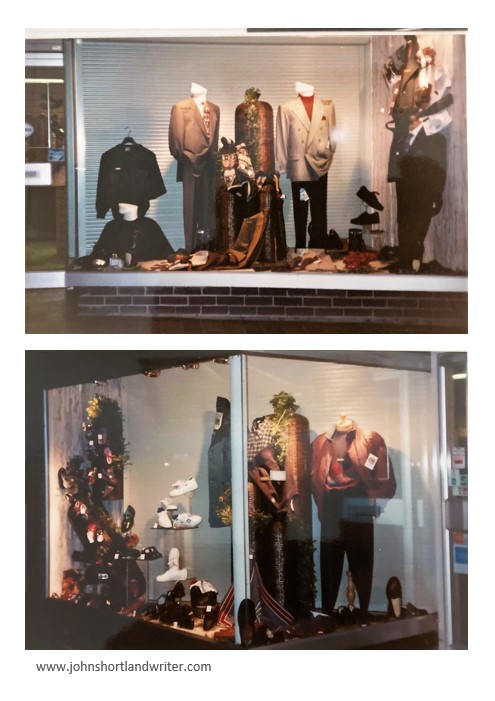
I suppose it was because the shop was ‘always there’ that we have no photographs of the shop interior through the decades which is rather sad. Fortunately, I did take a few in the early 1990s and these will probably trigger some memories for local people. The 1990s brought new challenges for the business with recession and changing shopping habits sounding the death knell for businesses like ours. I had joined the firm in 1971 and my business partner, John Pheby had begun even earlier, as a lad, working for the family. It was a hard but inevitable decision that we decided to close and were fortunate to find a buyer almost immediately. They converted the property to three shops and the accommodation and stockrooms above to flats. Since that time Bourne End has changed quite considerably and most of the old shop names (and several of the buildings too) have disappeared. I believe that there must be photos of the interior held by local people somewhere – it would be wonderful to see them. I seem to recall Jean Peasley taking photos during our last few days…
Menswear Department, 1990a small section of theLadies Fashions Department1990
So, what happened to our employees? In the early days of my tenure there was Ivy Taplin (Akela to us cubs of the late 50s!), Yvonne Ludgate, June Charlton (later to become June Billinghurst), Cissy Hyde, Mrs Faulkner, Liz Hill and Diana Spokes. Later, Pauline Harvey, Marjorie Kane, Wendy Manley, David and Marian Bratter, Diane Douneen, Kath Bowdrey, Iris Halstead and Cissy Vickers. I’m afraid I can’t remember the names of them all but some of those listed will be familiar to Bourne End locals – please don’t be offended if I have left you out, you were all valued! The younger generation I purposely have not named but they aren’t forgotten either – I still keep in touch with several of them thanks to social media. It was thanks to a succession of great staff through the years that the business was so successful. It seems appropriate to thank our loyal customers too – I can still picture many of them and the frequent kind comments that I still receive on social media shows that they haven’t forgotten Shortlands either which, after all this time, is rather humbling as well as very special.
Ladies Shoe Department display 1990
And what have I been doing the past thirty years? Retailing had been a passion for my family for generations but I decided to follow another of the Shortland passions and forge a new and very different career – you’ll have to wait a short while for part two to find out what but the photo below may give a clue!
Part Two of this blog focussing on the last thirty years is now published and can be found by clicking on the link here
Sometimes I get asked the question why do I write. The answer is usually just because I always have. Recently I’ve given more thought to it and I think that perhaps it is because (apart from having something to say) I like the way words look as much as the way they sound when arranged on a page. You can almost play games with them, juggling the written and the spoken so that both the emphasis and flow change. Nowhere is that more pronounced than with poetry.
Alfred, Lord Tennyson, Poet Laureate[photo credit: Wikipedia]
To be honest, I struggle a bit with poetry. I feel I ought to like it more. There are some that I love because they remind me of childhood although having to learn and recite, The Lady of Shallott didn’t excite me at the time. Having to read a poem at the front of the class must have destroyed any potential to love poetry for many a generation of children. I adore some of Christina Rosetti’s poems but mostly poetry is for me rather like jazz or wine – I know what I like and, sometimes, I discover a new one that is to my taste.
this beautiful angel statue is in the Glasnevin Cemetery, Dublin, Ireland
The quote in the photo is from Tennyson’s Maud. Of course, I knew the old song, Come Into The Garden, Maud that quickly rose to popularity as a parlour song. Because of this I assumed, like so many others, that Maud must be a love poem. Certainly, my quote above which comes earlier in the poem would make you think so.
a classic rendition of Come Into the Garden, Maud dating from 1940
Maud is one of Tennyson’s epic poems; a tale of hatred, infatuation, of death and destruction and the decline into insanity and, later, of war. The poem certainly wasn’t loved by the public when it was first published in 1855. So why do I find it so fascinating?
transcription of letter from Tennyson to George Granville Bradley1855
Many readers of my blog share an interest in genealogy and family history. I have been researching mine for many years and have shared some of my ‘finds’ and stories here. One such discovery was the long friendship between Tennyson and my ancestral cousin, George Granville Bradley. Bradley was first the Headmaster of both Rugby and Marlborough Schools before becoming the Dean of Westminster Abbey. Both he and Tennyson shared a love of geology, then in its early days of understanding. They would roam the hills of the Isle of Wight together where they both lived geologising and reciting poetry. The discovery of correspondence between them on the merits of Maud and how it may be altered before publication both excited and intrigued me. Here was one of Britain’s greatest poets, a Poet Laureate, seeking advice from a cousin of mine! I purchased an old copy of Tennyson to read it with a renewed interest and the rest – as they say – is (family) history.
George Granville Bradley with his family at Marlborough School about 1860 [photo credit: Ancestry]
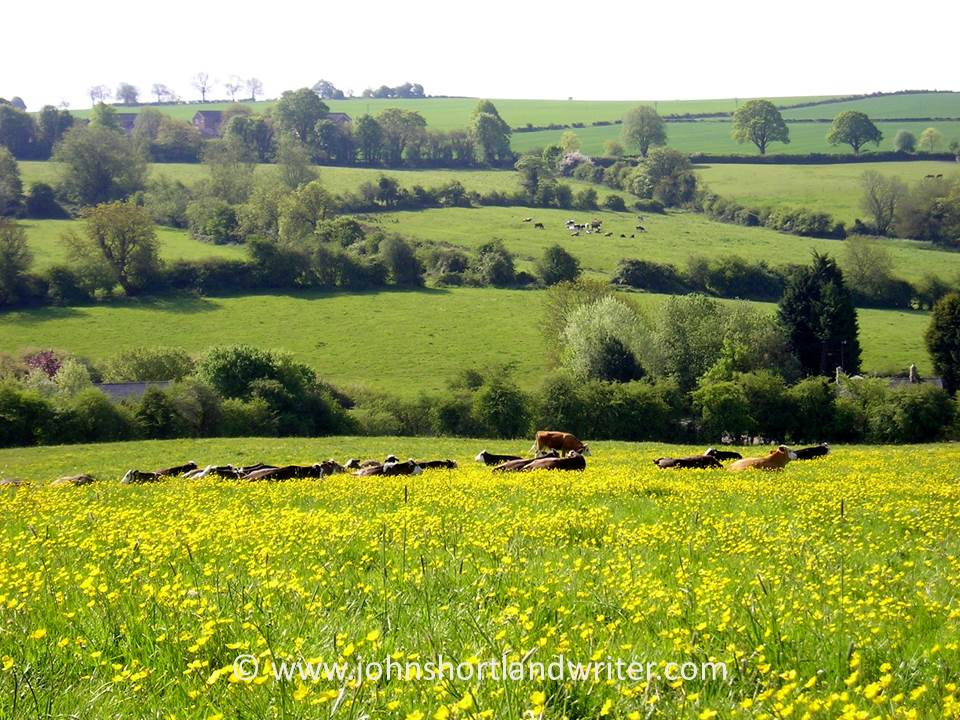
So another year is almost over and it certainly has been a busy one for me. Living and working in the spectacular Cotswold countryside, a classified area of Outstanding Natural Beauty (AONB) is a great treat and one of which I never tire. It’s also nice to go off exploring other places so 2014 found me in other parts of the UK and Ireland too. One of the first places I visited, however, was only twenty miles down the road but light years apart in reality!
typical Cotswold countryside
Like many people that live close to tourist attractions I don’t often visit the ones on my doorstep but last January found me walking the streets of Oxford. I hadn’t come to explore the colleges but the covered market which dates back more than two hundred years. The history of the market and the building is fascinating and is well worth making the time to visit – especially if you like a bargain. To read more about it and to see other photos click here.
One of the fathers of ecological writing died tragically young and in February I matched quotations from his work to images I had taken (to see them, click here). My favourite was noticed by the Society that bears his name and reprinted in their journal. I felt very honoured!
Wild and rugged scenery is often best appreciated over cake and coffee and at Watersmeet in Exmoor National Park you can do just that. Two rivers collide spectacularly besides the Victorian fishing lodge that is now owned by the National Trust and run as a café. March found me walking through beautiful scenery as well as indulging myself and the link to this remote but very accessible place is here.
Dublin, the capital city of Ireland is a favourite place of mine and in April I visited the Casino Marino, one of the most impressive and perfect neo-classical buildings in Europe. Everything about it was designed to deceive so although you only see one window on each side you actually have – well, click here to find out what plus all the other deceptions the Georgian architect managed to fit in.
Planting trees is a long term project for they rarely mature during the life of the planter. Of all the hundreds I have done in my professional life none has given me as much pleasure as this particular one. I have waited for years for it to flower and in May it did so for the first time. I felt quite emotional – it was a case of finding a handkerchief. Take a look by clicking the link here.
The Cotswolds are world renowned for their ‘chocolate box’ village scenes and Lower Slaughter must be one of the contenders. Despite its name it is a beautiful and tranquil place to visit for it has everything from crystal clear trout streams to olde-world stone cottages to a mill complete with working water wheel. If you choose the right time to explore you can have the place to yourself. To learn more click the June link here.









 Life in the English Cotswolds