Hide That Ugly Wall

We nearly all have one – or, at least, if we haven’t, we have an unwanted view that needs disguising.  Now is the perfect time to deal with it for, if you decide to plant some screening, the soil is moist and still retains some stored summer warmth.  Wait until spring – which you can do – and you run the risk of summer drought and the need for more careful and regular watering.  In the perfect conditions of late autumn/early winter the plant’s roots begin to establish even if you’re unaware of anything happening above ground.

However difficult the position, there is almost always a way to enhance an ugly wall

There are several questions to ask before rushing to the garden centre.  The first is to decide which way the wall faces for the amount of sunlight hitting it will influence the choice of plant – more about that later.  Other factors to consider are will the plants need to be tied into place with strings and wire, and will they need regular maintenance to keep them looking nice and within bounds?  If you’re already beginning to think this sounds like too much hard work or is too complicated, don’t despair – there’s a list of planting options below.  Still baulking at the thought?  An alternative question is, would some sort of decorative screen do the job instead?

A decorative screen masks this unwanted view

One more option to consider is planting in front of the wall, rather than against it.  If there’s room a low maintenance shrub border might be possible.  If space is really tight, then one or two well-chosen plants may work just as well.  For example, trees trained to grow flat against a wall are readily available and can make a statement without hiding the wall completely. Some shrubs will also do this; they are a much cheaper option and usually grow quite rapidly.  In the photo below forsythia, an unusual choice, has been grown against an ugly garage constructed from concrete blocks.  Although it loses its leaves in the winter its dense network of twigs continues to disguise the wall.  For a few weeks in the spring, it looks both exotic and stunning.

Flowering forsythia suddenly looks exotic grown against this ugly garage wall
The Judas Tree (Cercis) flowers on bare wood, its leaves will appear shortly. It has been fan-trained to remain flat against the wall
If space allows, a low maintenance shrub border can work well

For most people, the decision made is to grow a plant that will climb as well as cover the wall.  The plants available can be broken down into two groups – the true climbers (that will need wires on the wall for support), or the ‘clingers’.  These attach themselves to the wall by little sucker-like pads or by hair-like roots.  With the latter it is essential that the wall is in good condition although it is rare for serious damage to happen.  Both types can be sub-divided into deciduous (lose their leaves in winter) or evergreen.  I have found that the majority of clingers benefit from having some wall ties when first establishing to keep them in close contact to the wall.  Once they start climbing they’ll cling without help.

The climbing hydrangea clings to the wall by tiny hair-like roots
Honeysuckle is an example of a climber that needs wires to support it

One option often recommended, is to fix trellis to a wall and it does sound like a quick fix.  My experience is that the plants weave through it – which is, of course, the idea – but that makes for difficult pruning when it is required for it can be tricky to work out which stems need removing and even trickier to disentangle them.  Worse still, trellis has a tendency to rot or break after some years, usually just when the climber has reached its prime.  Replacing it involves cutting the plant back very hard or replacing it along with the trellis.  However, decorative trellis may be an alternative form of wall disguise to consider with, perhaps, just a large pot of plants standing in front of it.

Trellis helps mask this unwanted view. By creating a focal point of the attractive tree, the trellis becomes a feature in its own right and so no plants are being grown on it

Wires are normally very straight forward to fit providing it is done before planting.  I prefer to use a screw-in ‘eye’ rather than the hammer-in ‘vine eyes’ that are the traditional method of fixing.  All that is needed is a drill and a rawlplug and some very basic handyman skills.  The wires should be fitted horizontally and there is no need to create a network of wires heading off in all directions.  The golden rule is to stretch the wire taut and make the plant grow to the wire, don’t add random wires that follow the growth.  Stems should always be tied to the wire rather than pushed behind it and use ties that will stretch or perish in time otherwise they will become strangled as they grow.  It is all much easier in practice – writing down every step makes it sound more difficult than it really is!

A well-trained rose growing on supporting wires. I have enhanced these for clarity they want to be stretched horizontally and spaced about 18″ (45cms) apart
This poor plant has been strangled by its tie; all the upper growth has died

When it comes to planting, whatever the type of plant it is, make a generous planting hole and mix a good quality compost in with the soil.  Often the ground by a wall is dry and full of builder’s rubble or compacted so having a good planting medium around the new plant will set it off on a good start.  At planting, keep the base of the plant at least a foot (30cms) away from the wall if there’s room.  That way it will receive more water when it rains.  One major cause of failure is planting too deep – make sure that the soil is at the same level as the top of the compost that the plant is growing in.  Standing the plant pot in water for a few hours before planting is a good idea too so that the plant is well-watered before it is disturbed – and, if you’re a real beginner to gardening, don’t forget to remove the plant from its pot keeping its soil intact around it.

Solanum crispum (blue) & Clematis montana (white) hiding a garden shed

A list of plant suggestions:
E=evergreen, CL=clinger, N=will cope with north facing wall, Sh=shrub, T=tree

Large walls:
Carpinus (Hornbeam) – N, T, buy pleached or ready shaped
Cercis- T, more tricky to find and you may have to train it yourself but lovely flowers in pink or white and good autumn leaf colour – see photo
Clematis montana – clip back the growth immediately after flowering to keep tidy and within bounds
Ficus (Fig) – N (but won’t fruit), if you like Figs to eat, Ficus is worth considering
Fremontodendron – E, Sh, colourful yellow saucer-like blooms
Garrya – N, Sh, dark green leaves with long green catkins in late winter
Hedera (Ivy) – Cl, E, N, easy to keep under control and provides late nectar sauce for bees and other insects.  Make sure that wall mortar is sound before planting
Hydrangea petiolaris – Cl, Sh, prune after flowering if necessary
Jasminum (Jasmine) – both evergreen and deciduous types are available with scented flowers.  The evergreen (sold as Trachelospermum) needs a warm wall for best results
Magnolia grandiflora – E,Sh, for a high, warm wall.  They need lots of space to thrive
Parthenocissus (Virginia Creeper) – Cl, magnificent autumn color
Prunus lusitanica (Portuguese Laurel) – E, Sh, T, can be grown as a shrub or purchased as a trained tree (see photo)
Solanum crispum – blue or white clusters of flowers.  Vigorous but easily pruned
Vines – prune in winter if necessary
Wisteria – prune twice yearly, midsummer and midwinter

Medium walls:
Actinidia kolomikta – Sh, pretty multi-cloloured leaves best when avoiding strong sunshine
Azara – E, Sh, for a warm wall
Berberis – E, N, Sh, very spiny branches are a good reason for not growing it!  Magnificent red or yellow berries in autumn, much loved by birds
Campsis (Trumpet Vine) – orange trumpet flowers and attractive leaves for a sunny wall
Ceonothus – E, Sh,  smothered in powder-blue flowers during summer
Chaenomoles – E, Sh, white or pink flowers in late winter/early spring
Clematis – plenty of varieties to choose from including evergreen ones – check labels for size as some can require a lot of space
Forsythia – Sh, prune after flowering which takes place in early spring – see photo
Jasminum nudiflorum (Winter Jasmine) – N, Sh, flowers throughout winter
Osmanthus – E, Sh, early-flowering, scented – clip immediately after flowering ends to keep flat against wall
Rhamnus ‘Argenteovariegata’ – E, Sh, variegated foliage, prune to keep flat against wall in spring

Low Walls:
Daphne – E, Sh, very scented flowers but very slow growing
Euonymus – E, N, Sh, Cl, can be grown a sa shrub or clipped flat against a wall, some are self-clinging
Fuschia – Sh, varying heights, the smaller-flowered varieties are more suited for growing against walls
Helianthemum – E,Sh, very low growing but smothered in flowers through summer, clip after flowers to keep tidy
Lavender – E, Sh,likes sunshine for best flowering
Nandina – E, N, Sh – trouble-free, needs no  pruning
Perovskia (Russian Sage) – Sh, silvery foliage and blue spires of flowers from mid-summer.  I’ve grown it successfully on a shady wall although not usually recommend for this.  Prune back by half in late autumn and then again in early spring to keep bushy
Potentilla – E, Sh, bushy long-flowering plants in varying colours

I recommend looking up these plants on Google to see more detail.  Also, there are many roses that can be considered including some that are fine for north walls.  Apples, pears and plums fruit well when grown against walls of any aspect, as do apricots and peaches if the wall is warm and sunny enough.

For similar information on how to make both your garden and gardening more pleasurable, why not take a look at my book Why Can’t My Garden Look Like That? It’s written for newbie gardeners as well as those with more experience and covers everything from design to planting and maintenance.  In it, I reveal some of the secrets that I used when Head Gardener to large, country estates with gardens open to the public, where the garden had to look great all the time.  All written in an informal, no-nonsense approach.  Makes a great gift and is available from bookshops and, of course, Amazon.


The Arts & Crafts Splendour of Rodmarton Manor

In 1906 Claud, the youngest son of politician Sir Michael Biddulph, commissioned a house to be built on land gifted by his father.  The commission was given to Ernest Barnsley who specialised in design and building in the Arts & Crafts style.   In the spirit of the movement, all materials had to be sourced locally and hand-crafted with no machinery used.  Claud stated that the house should have the feel of “a cottage in the country”, somewhat of an understatement by the time the building was completed in 1929.

Rodmarton Manor seen from one of the ‘garden rooms’

The house, which has a total of seventy-four rooms, was built as three angled sections with a sweeping driveway and circular lawn to the front courtyard.  The family lived in one wing, servants in another (now converted into flats) and the central section was to be used as a community space where local villagers could meet and learn skills and craftsmanship.  In this way, the Biddulphs were instrumental in maintaining age-old traditions that were in danger of dying out. 

Rodmarton Manor

The mansion, still family owned and open to the public, retains much of its original furniture and furnishings.  Listed as a Grade 1 building by Historic England it has been described as “the single best example of the Arts & Crafts movement”.  On the day of my visit the house was closed but I was able to explore the gardens which are also listed and have been created in the same style.

Old stone urns and troughs frame the entrance

Close to the house, the gardens consist of a series of room-like areas enclosed by stone walls and hedges.  Lichen encrusted pots, urns and troughs, along with precisely clipped topiary give a timeless feel to the garden and also ensures that there is plenty of interest during the winter months. The aptly named Long Garden comes as a surprise after visiting other areas, for although very much of the style, it is relatively narrow in width.  A flagstone path emphasises its 75-metre length and leads to a delightful pavilion, a small pool and a seating area.  Divided by clipped yew hedges and bordered by densely planted herbaceous borders it was, for me, the highlight of the garden. 

The Long Garden at Rodmarton Manor in June
The Pavilion at the far end of the Long Garden

It was disappointing not being able to see the craftsmanship of the interior of the house.  However, the exterior of the building revealed many surprises.  What I liked most of all was the exquisite detail of the rainwater downpipes proving once and for all that even when something is utilitarian it can still also be beautiful.

Even the practical is made to look beautiful exquisite detail of the rainwater downpipes
Every downpipe detail differs

Rodmarton Hall is situated midway between the Cotswold towns of Cirencester and Tetbury and is open to the public throughout the summer months on selected days.  There are additional garden open days in February to view the snowdrops of which there are over 150 varieties.  To find out more click on the link here

The Chelsea Chop

Despite its name, the Chelsea Chop isn’t the latest trend in hair styling although trimming the unruly and the straggly certainly is involved. It is a very simple and straightforward method of cutting back herbaceous* plants which, for some reason, terrifies even the most confident of gardeners.

Sedums (foreground) growing at Lytes Cary Manor

The only skills required are courage and the knowledge of exactly when to carry out the chop. The latter is simple to calculate and is hinted at by the title of the deed – the week of the Chelsea Flower Show or thereabouts. This year, there have been two hiccups in using this rule: firstly, the show has been moved to autumn because of Covid restrictions and secondly, because spring has been so slow in coming that plants are behind with their growth. As a general rule of thumb, the time for cutting is around the third week of May.

The flat flowerheads of sedum are made up of hundreds of tiny star-like florets

Beloved by bees and butterflies, Sedum – also known as Ice Plants on account of their fleshy, cool-to-the-touch leaves – are the ideal candidate for the chop and one of the most satisfying to do. Inevitably, when left to their own devices, the large, flat flowerheads are too weighty for their stems and they topple over to sprawl across the ground and spoiling an otherwise impressive display.

Sedum, the Ice Plant, frequently collapses & looks ugly just as it flowers

To make the chop all that has to be done is to cut through every growing stem, thereby reducing the plant’s overall height by half to one-third. Clear away the prunings (which can be added to the compost heap) so as not to attract slugs. There, I told you it was simple!

Sedum given the chop. Don’t forget to pick up all the prunings!

Although the method sounds and looks drastic the plants quickly recover and make new growth. The end result will be a plant that doesn’t collapse and doesn’t require staking. Admittedly, the flowerheads will be smaller than before but they produce so many more than they would have done left unpruned that the effect is in no way diminished.

Numerous flowerheads appearing on the now tight growth of Sedum two months after the Chelsea Chop

This simple pruning technique can be used on a number of other plants too in exactly the same way. The taller achillea, phlox, campanula, asters (michaelmas daisies) and rudbeckias are all good candidates. I have heard of its use on echinacea (cone flower), penstemon and helenium but, in my experience, these are trouble-free plants anyway, so why bother? The secret to good, stress-free gardening practice is to find the balance of what suits you and what suits the plant. The Chelsea Chop on sedum in May prevents an awful lot of stress later in the year!

top left – clockwise: achillea, campanula, aster, rudbeckia. They can all be given the Chelsea Chop

*herbaceous – a non-woody plant that dies back and becomes dormant in winter to regrow each spring

The Irish Castle Dedicated to Isis

The children’s bikes in the entrance porch casually propped against four aged-stone saintly figures tells you in an instant that a visit to Huntington Castle [see footnote] is likely to be memorable.  They also act as a reminder that this historic, four-hundred-year-old castle near Clonegal, Ireland is also very much a present-day family home.

Huntington Castle, Co. Carlow, Ireland

Built in 1625, it held a strategic position on the trade route between Dublin and Wexford but fell to the invading (English) Cromwellian army in 1650.  By the time of its capture much of the garden as seen today had been laid out.  

The oldest part of the castle viewed from the gardens
the gardens have a timeless feel about them…

As might be expected of a grand country house, the castle has its fair share of richly decorated rooms and it is possible to visit these during the summer months subject to any Covid-19 restrictions that may be in force, of course.  However, it is the basement cellars of the castle that hold the biggest surprise for it is here that you will find the Temple of Isis.  The Fellowship of Isis, founded in 1976 by members of the family was, in 1993, recognised as a world faith, the first time that the Goddess had been internationally acknowledged.   I have always considered myself to be open to alternative beliefs and cultures but, to be honest, I found the Temple and its purpose difficult to understand or appreciate.  For me, the decor and artefacts were too theatrical, almost farcical.   I half-expected Angela Lansbury’s Mrs Salome Otterbourne from the film Death on the Nile to appear from behind one of the wall hangings.  However, I am obviously wrong as there is a worldwide following of over 24,000 in a hundred countries or more.

The Temple of Isis, Huntington Castle

My real appreciation of Huntington Castle came from exploring the grounds which are quite beautiful.  For the photographer, opportunities abound for around every corner there is a vista or ancient building vying for the title of most picturesque.  The castle itself is better appreciated from the outside too, for there are numerous ‘odd’ windows and contrasts of building materials tucked away and waiting to be noticed – the result of centuries of alterations and extensions.

a mish-mash of building materials and styles gives the castle added charm
around every corner a photo opportunity!

I came away from Huntington Castle somewhat confused.  In some ways, I felt a little let down by it, in others quite uplifted.  Would I visit again?  Most definitely.  For it is its quirkiness, eccentricity, ancient trees and moss-encrusted stones that leave you slightly unsettled making the visit all the more worthwhile.

ancient tree-lined walks

For more information on visiting or even staying at Huntington Castle visit https://www.huntingtoncastle.com/

To discover more about the Fellowship of Isis follow this link by visiting
https://en.wikipedia.org/wiki/Fellowship_of_Isis

[Note: Rather confusingly Huntington Castle is also called Clonegal Castle – sometimes even in the same article or website!]

A Secret Garden

I have noticed that even those that don’t show the slightest interest in things horticultural love exploring walled gardens, especially if they are overgrown and forgotten.  Perhaps it stirs memories of the children’s novel by Frances Hodgson Burnett published in 1911 in which she shows that when something unloved is cherished and cared for it can become beautiful and healthy, be it a plant or the human spirit.

Houghton_AC85_B9345_911s_-_Secret_Garden,_1911_-_cover

Photo Credit: AC85 B9345 911s, Houghton Library, Harvard University

I have been fortunate over the years in caring for a number of walled gardens in different stages of development yet, regardless of their state, there is something magical in placing the key in the lock and pushing open the door – as nasty, little Mary Lennox discovered in the novel.  As she returned the garden to its former glory so, she too, grew into a loving and loveable child.

Garden Border (4) watermark

Perhaps even more so than the plants and trees within, the beauty of a walled garden comes from the walls themselves.  The brickwork over time has mellowed and seems to release the warmth of a hundred or more summers, even on the greyest of days.  Search the walls and they reveal secrets – a date scratched into a stone, old lead labels revealing the varieties of long-disappeared fruit trees or, occasionally, the name of a much-loved pet buried at its feet.

Walled Garden watermark

The walls in this deserted garden date back to the late 17th/early 18th centuries

Old Plant Tag watermark

Recorded for posterity: the trees may have disappeared but the record of the varieties remain

One of the most rewarding to explore yet emptiest of walled gardens has to be that of Dunmore Park.  The house no longer stands but the garden walls remain crowned by that most eccentric of British garden room follies, the Pineapple.  Here the walls are hollow, fires were lit at its feet and the walls warmed to promote early growth.  Sliding stone blocks could be opened to release the smoke which, filling the garden at night helped to keep frosts at bay.  Clever, those early gardeners.

The Pineapple (11) watermarkThe Pineapple (31) watermarkThe Pineapple (34) watermark

Walled gardens when not open to visitors are more often a place of silence, the only sound to accompany the gardener is that of birdsong and the hum of insects.  It can be a place where your mind can be free from the everyday cares of the outside world.  It can also be a place where your design ideas can run riot either in your head or, if lucky enough, in reality.  The images below show before and after photos of a border I created many years ago, the idea for the colour palette coming from an Imari plate belonging to the owner of the garden.  The border is living proof of an imagination run riot!

Blue & White Border - before watermarkImari Plate   watermark.jpgBlue & White Border - after watermark

Going Round in Circles

Designing your own garden is, I think, far trickier than designing someone else’s. One of the problems is that emotion gets in the way. I’m not suggesting that there shouldn’t be passion in design but far too often one is tempted to hang onto things that have no place in the new design, whether it is a plant or a pot – or in this example, far too many pots!Garden Makeover 3a copyright

The garden shown here was quite a good size but difficult for it was on a gentle slope and there was need for a central path to lead to sheds at the far, and lower, end. To avoid splitting the garden in half, large circular stepping stones had been randomly placed but the result was a confusing mish-mash of shapes and plants. The only place the eye focused on was the rotary washing line!Garden Makeover 1c copyright

You don’t need to be a great artist to design a garden. A simple method is to take photographs, turn them into black and white (for colour confuses the eye) and pencil sketch over them. Here, we were quite keen to improve on the circular theme.
The final result was a series of circles, each with a low retaining wall and a step down to allow for the change in level. Trellis was used to screen the sheds. Although the hard landscaping took up more of the garden than before, the remaining planting area was far more useful and could be crammed with plants. The little walls made perfect low seats.Garden Makeover 2c copyrightGarden Makeover 1b copyright

And what happened to all the pots? Most of these were discarded in favour of a large, custom-made, L-shaped timber box. This gave a better space for planting as well as making a feature in its own right. Water-retaining gel crystals were added to the planting soil reducing the need for regular watering.Garden Makeover 3d copyright

You can find more ideas on all aspects of easy, trouble-free design, plants and gardening techniques in my book, Why Can’t My Garden Look Like That?  To take a peek inside the covers click on the link here.

BOOK COVER

Fetch me a Handkerchief…

When you come to think of it, gardening is a strange hobby.  What makes people want to spend hours of their time, let alone their hard-earned cash, toiling away in the hope that something might grow?   Why get wet or too cold or too hot and far too tired just to watch your favoured plant being ravaged by pests and diseases or, just when you think all is going swimmingly, to see it being struck down by an unforeseen frost?  On bad days it hardly seems worthwhile.

Of course, the answer is because gardeners are eternal optimists.  Just because something has failed this time means, surely, that it will be a great success the next. And, generally speaking, the good results far outnumber the bad.  What can give more joy than eating, say, a juicy, full-of-flavour pear that you have nurtured knowing that it is free from pollutants and raised by your own hand?  Or, plunging your snout into the centre of a rose bush knowing that it will come out, as the saying goes, smelling of roses?

If all of this sounds slightly odd to a non-gardener, then stranger still must be the thought that many professional gardeners never see the end results of their labour.  They do a task and move onto another garden, often never to return. As a member of this strange breed a question I often get asked is what motivates me.  The answer is always the same: it is the thought of success, of planting for the future and the sheer pleasure in working alongside nature.  And, of course, some gardens we return to again and again.

And so it is with my ‘oldest’ garden: one I have worked in for twenty years, first as Head Gardener and, after I moved miles away to the secret valley, on an occasional basis doing more specialist tasks.
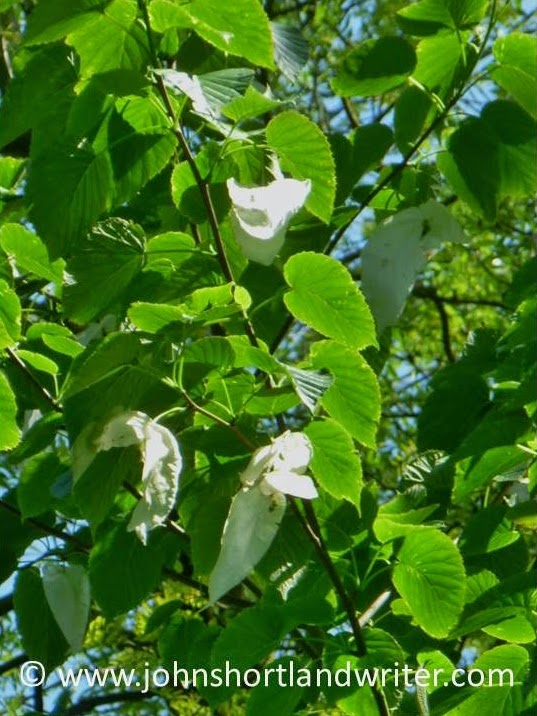
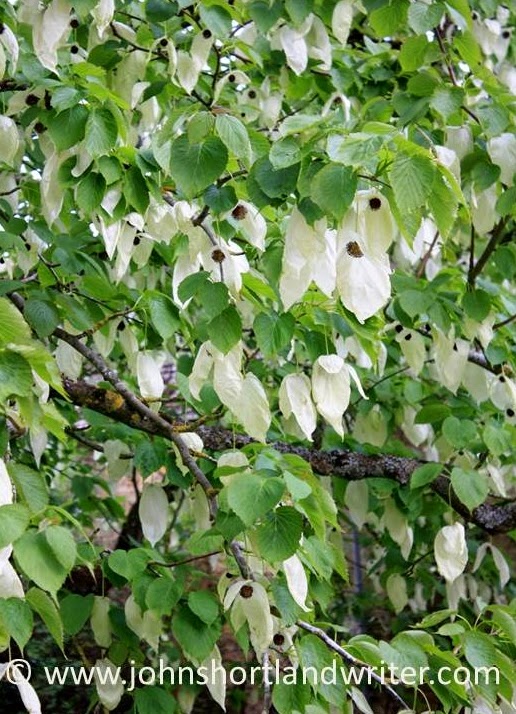
One of the last jobs I carried out was to plant that most celebrated and notorious of ornamental trees Davidia invoulcrata, the Handkerchief Tree, to announce the arrival of the new millennium.  Celebrated because of its wonderful flowers resembling a pocket handkerchief; notorious because it can take twenty years before they appear.

 Davidia originates from China and although first discovered in the mid 1800’s it was not until 1904 that the first one was to be grown in England.  If given the right conditions they grow quickly and although they aren’t fussy about soil type they do like a certain degree of shelter – mine is planted on the edge of woodland which gives protection from strong westerly gales.  They do not respond well to pruning so it is important to allow it space to grow up to 60 feet in height and 20 feet across. They are attractive in a quiet sort of way even when young for, although they lose their leaves in winter, they are of a pleasing shape and shade of green during the summer months.

Every May, I have checked the tree to ensure that it is growing well and looking healthy and wondering if I would ever see it in flower – and this year I did.  Along its uppermost branches, fluttering in the breeze were fifteen flowers, one for each year of its planting.  I stood watching them for several minutes and, as many a gardener will understand, felt quite emotional that I had been instrumental in growing something that will become more spectacular with every year that passes.  Could it be that its English name was given not just because of the resemblance to a clothing accessory but because those early growers, seeing them for the first time, reached out for their own handkerchiefs?  It is special moments like these that keep gardeners, both amateur and professional, gardening.

The flowers of Davidia are, in reality, only the round reddish centre; the white parts are bracts, leaf like structures that are often brightly coloured or in the case of Davidia, white.

A mature Davidia seen at Hidcote Manor Gardens – it will be some years before the one I planted will look like this…

Add to Technorati Favorites

A Garden Invitation

If you are disappointed or disillusioned with your garden – or just not too sure how to begin – then this may be the answer: come and join me at the Chipping Norton Literary Festival next month.

Click on the image to enlarge.

Hope to see you there!

Add to Technorati Favorites

Tibet in the Cotswolds

The Cotswolds are full of surprises; they are around every corner. Often it is a beautiful, old stone building, a dramatic view or a colourful cloudscape.  Occasionally it is something else and at the tiny village of Todenham near Moreton-in-Marsh it is the sight of tall, Tibetan flags fluttering in the breeze.

After exploring the Himalayas and Nepal in particular, Alain Rouveure, a Frenchman living in the Cotswolds, felt a real need to help the less privileged families he met there.  Am admiration of their craftsmanship and tribal art led to the creation of the Alain Rouveure Galleries some twenty-five years ago.  Today it is a thriving business whose profits are returned to the country which supplies the clothing, jewellery, gifts and rugs that make the galleries a treasure trove of colour, texture and scents.

More recently, he has set up the Alain Rouveure Nepal Relief Fund which is funding the building of schools as well as caring for the health of poor children and their families.  A relatively small amount of money goes a very long way: repainting a classroom £45, desks and benches for four students £55.  However, it isn’t just these practical issues that funding assists for, as Alain says, just knowing that there are people from far away taking an interest in their remote communities makes a huge difference not just to individuals but also to the whole village.

Surrounding the galleries are small but very lovely and tranquil gardens.  The calendula in the photographs were grown from seed given to Alain by Nepalese gardeners at Lumbini, the Buddha’s birthplace, and it is interesting to see such a disparity of size and colour all of which help to create a splendid show.

On my visit, I spent a long time trying out the numerous Tibetan singing bowls deciding which sound I liked the best.  It was something I’d always wanted to own but I hadn’t realised before then just how much they vary both in their size and their ‘ring’.  In the end I realised that it was going to be a bowl choosing me rather than the other way around.  Traditionally, the bowls are used in meditation and prayer and the sound – and the vibration from them – is mesmeric. The YouTube clip is of Tibetan bowls being played alongside Native American flutes.  The method of generating the pulsating ‘singing’ is shown at about 10:30 into the video. The combination of sounds from two cultures is fascinating and memorable especially when wild birds start to sing in the background.


The visit ended with lunch at the Himalayan coffee house where a very good home grown salad – followed by a ‘to die for’ cake – was had at very modest cost.  Recently treatment rooms have been added and there are also fund raising concerts – the next to be held is Songs and Arias with the mezzo-soprano, Cerys Jones accompanied by harpist, Tanya Houghton on Saturday 14th September, 7.30pm.

For more information about the galleries have a look at their extensive website.

Add to Technorati Favorites

The Russian Curse

Turn and run!  Nothing can stop them.  Around every river and canal their power is growing.
Stamp them out!  We must destroy them. They infiltrate each city with their thick dark warning odour*.

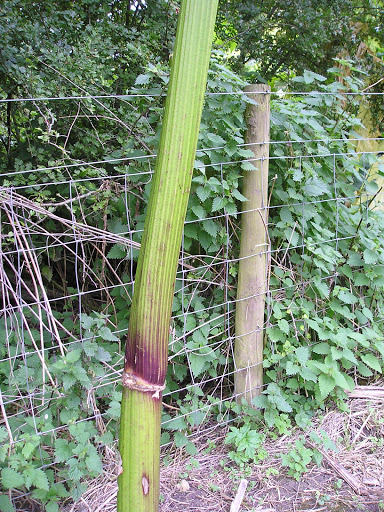
Plant hunters have over the centuries introduced many beautiful plants to our gardens but they have also brought in others that have, as they escaped from its confines, become troublesome weeds.  Japanese Knotweed, Fallopia japonica, creates problems by damaging river banks and pushing up through concrete, even entering houses; Himalayan Balsam, Impatiens glandulifera, is pretty enough with their hooked pink and white flowers but smothers native plants.  Both are difficult and costly to eradicate.  But the one that can cause the most trouble – and is undoubtedly the most impressive – is Giant Hogweed.

Long ago in the Russian hills, a Victorian explorer found the regal hogweed by a marsh … he came home to London and made a present of the hogweed to the Royal Gardens at Kew*.

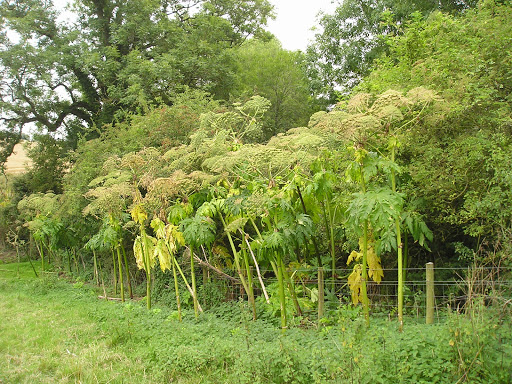
Giant Hogweed, Heracleum mantegazzianum, was introduced to Britain from the Caucasus in  Victorian times and soon became a popular addition to parks and gardens for, although similar in appearance to our native Hogweed, Heracleum sphondylium, these were giants in every way.  Huge flower heads above equally large leaves reaching way into the sky – up to twenty feet or more in exceptional specimens – were something to marvel at. A hardy perennial, the plants shot up over the course of just one summer adding to its popularity, although it can be a few years before the plant flowers after which it dies.  With  up to 100,000 seeds from each plant, it soon multiplied and before long had found its way back to the marshy land adjacent to rivers and canals as in its homeland.

I wonder how long it took the Victorian gardeners to discover the problems associated with the plant for it not only spreads rapidly, it also is extremely toxic.  Covered in sharp bristles that scratch the skin it is the sap from the plant that can cause major injury.  Skin contact with the sap when exposed to sunlight results in severe dermatitis: itching and redness develop into blisters and dark wheals.  These can last for several years.  Contact with the eyes is even more dangerous for permanent blindness can follow.

So what do you do if you find Giant Hogweed in your garden apart from turn and run?  It can be treated with weed killer and the ideal time to do this is when the plants have a large leaf area but before they flower.  It is essential not to handle the plant at any time – even when it is dead – for every part of it including its roots will injure you.  If you are tempted to carry out control yourself (and it may be wiser to call in a specialist eradication company (please, not me!)) then you must wear a complete coverall and full face and eye protection.  You also need to remember that the clothing will also be contaminated and should be destroyed.

Fortunately, Giant Hogweed is rarely encountered in gardens.  You are more likely to find it growing in waste places in the wild and it may be wise to report its presence to your local environmental agency.  Attitudes toward it vary from country to country for this is not just a British pest – it is found in many other temperate regions of the world including the USA and Canada.

Perhaps at this point, I should remind you all that the majority of garden plants are harmless enough and that gardening and plants give a huge amount of pleasure.  Happy gardening!

* The Return of the Giant Hogweed: lyrics by Genesis, 1971


Add to Technorati Favorites