An Arty Family?

Eighteen months ago I was contacted by a gallery in Cheltenham about their researching an artist for they had acquired four watercolours of London street scenes painted during a ten-year period from 1885.  They were by Edward Angell Roberts who had lived with Mary Ann Shortland, an ancestral cousin of mine.  Although they described themselves as husband and wife in official documents, Edward was already married to the exotically named Josephine Bartolozzi Vestry Anderson.

New Street, Spring Gardens
Edward Angell Roberts, 1885

Edward was born in Kennington in the English county of Surrey in1836.  His father was a tea merchant and aspiring gentleman which presumably he became for by the age of fifteen, Edward was being educated at Christ Church Hospital, a school for sons of clergy and gentlemen.  It was a good springboard for Edward for in 1855 he was promoted to Deputy-assistant to the Commissary of the Inland Revenue before proceeding to becoming Clerk to the War Office.  In his spare time, he painted.

Old Wooden Houses, The Strand
Edward Angell Roberts, 1887

The four watercolours show great artistic detail of places within a stone’s throw of the War Office, in London’s Pall Mall.  They are New Street, Spring Gardens (1885), Old Wooden Houses, The Strand (1887), Garden House, Clements Inn (1895) and Pump Court, Temple (1895). They have since been sold at auction to a buyer in the United States.

Garden House, Clements Inn
Edward Angell Roberts, 1897

Edward had married Josephine in 1858 and the census, three years later shows them living apart.  Whether that was a temporary separation is not known for shortly after they had two children, a girl in 1864 who died in infancy and a boy in 1866. However, by 1871 he was living with Mary Ann and Josephine and the son disappear from record.  It is thought that they may have moved to Ireland for the son reappears in the English 1901 census return and claimed to have spent time there.  As for Edward and Mary Ann, they never married (or had children) for in his will, Edward leaves his estate to Mary Ann Shortland, spinster.

Pump Court, Temple
Edward Angell Roberts, 1897

I began to wonder if we had other artists in the family for several of my cousins, my sister and my father were all artistic,  I always felt that the skill had passed me by until some kind person exclaimed that through my career as a garden designer,  I paint with flowers, a description I rather hold onto.  It is true that there are some similarities for a new garden is a blank canvas waiting to be given a backwash of green and then daubed with the colour shapes and textures of flowers.  Below is a rather poor quality photo of one of my early designs inspired by a Japanese Imari plate which was, I suppose, quite any arty approach to take!!

Garden design inspired by Japanese Imari Plate
John Shortland, 1999

Another ancestral cousin painted and illustrated books on the town of Rye.  Marian Eleanor Granville Bradley was the granddaughter of the Dean of Westminster Abbey, George Granville Bradley.  Mostly remembered for her line drawings, occasionally they or paintings of hers are available for sale at auction.  An only child, born in the United States, she returned to England sometime during the 1880s.  She never married and died in 1951.  Her pencil sketches of Rye appear very simple at first sight and, like Edward Angell Roberts, belie the attention to detail that is executed.  Interestingly, a couple of her close relatives are described as ‘oil and colour merchants’ so it seems that art provided a living for my family in more ways than one…

Ship and Anchor, Rye
Marion Eleanor Granville Bradley,1920

And finally, there is Uncle Les – not my uncle at all but (yet another) cousin of my father and, in the convention of the time, known to me as Uncle.  I only met Les the once for he died quite suddenly when I was young.  However, I did get to know his widow well, so it came as rather a surprise when I was sent this little pen and ink drawing of (I think) a house in Kingston-upon-Thames many years after her death. 

Edwardian House
Arthur Leslie Shortland, 1935

A few lines on Josephine.  With a name like hers, curiosity got the better of me and so enquiries were made and she turned out, as hoped, to be ‘interesting’.  She was a close relative of Madame Vestris, a famous, if not infamous actress, contralto opera singer and theatre manager.  Madame Vestris probably deserves a full article of her own!

Madame Vestris, c1831 [Wikipedia]

Family history research is always uncovering something fascinating, puzzling or new – I wonder what it will turn up next?

With thanks to Andy Shield of Brave Fine Art , Cheltenham www.bravefineart.com }for sending me copies of the four paintings

In Praise of Bluebells

Can there be a more delightful spot to linger than a bluebell wood in spring?  The intensity of their colour when seen growing in their tens of thousands would hurt the eyes if not offset by the citrus green of the beech trees they favour growing under.  With early morning sunlight filtering through the branches to strike the woodland floor below, both leaves of beech and ‘bell shimmer and sparkle in the clear light.  As the forest warms the bluebells release their scent but not the heavy, redolent perfume that one might expect. Instead, a fragrance so soft and gentle that for a moment it seems to come from elsewhere; all too quickly it melts away, dispersed by the increasing heat.

Bluebells are one of the key indicator plants of ancient woodland, a term that refers to woodland that pre-dates AD1600, for their bulbs prefer to remain undisturbed where they can slowly establish huge colonies.   Here, in the secret valley where they grow in hedge banks, they can be used to trace the line of an equally ancient drove road for it is thought that the hedgerows and trees that line it are remnants of Wychwood Forest.  Over centuries, the boundaries of the Forest have shrunk as fields were created and the trees cleared for arable land or pasture.  By leaving the field edges untouched the early farmers saved themselves both time and labour and in doing so preserved the bluebells that give me so much pleasure each spring.  The drove road – primarily used for herding livestock long distances to market – passes our little stone-built cottage before diverting across open country.  It is still used as a public right of way.

Bluebells line the old drove road that passes my house

Unsurprisingly for a plant that has been around from time immemorial, the bluebell has numerous regional names – Common Bluebell, English Bluebell, Fairy Bell, Wild Hyacinth to name a few.  Perhaps the best has to be Granfer Giggles.  In Scotland they are known as harebells although to an Englishman harebell would be a completely different plant that grows later in the summer when the bluebells have long ended.  Even the Latin name which is supposed to prevent confusion has changed over time – it is now known as Hyacinthoides non-scripta.  I much prefer the earlier name of Endymion non-sciptus, it sounds more attractive as well as having a romantic Greek legend attached to it.  Illegal to dig up plants from the wild, bluebells are sometimes offered for sale from cultivated stock under either of these names.

Occasionally you may find a white, or even a pink bluebell

For such a well-loved plant – it has been voted England’s unofficial national flower – bluebells do not seem to feature much in poetry.  They are frequently mentioned by name but no-one, as far as I can tell, seems to have written poems specifically about the plant.  Perhaps it is because they are such a common sight and have none of the delicacy of the wild rose, the scent of the honeysuckle or the diminuity of wild thyme. Shakespeare, who seems to have written about absolutely everything (including thyme), only mentions it once: “the azur’d harebell” in Cymbeline.  The Brontë sisters both wrote of bluebells but I’m not sure they weren’t describing later flowering harebells. Emily’s description “waves in summer air”, and Ann talks of a single flower and of its trembling.  Bluebells are quite a stiff flower that don’t wave or tremble that readily whereas Campanula harebells fit the description nicely. I can’t recall even my beloved Richard Jefferies, the Victorian naturalist, waxing lyrical over them as he did over so many other things.  I may be wrong about this for I can hardly call myself a Jefferies’ scholar, more an enthusiast. However, Cicely Mary Baker created a delightful illustration of the flower in her set of Flower Fairies published in 1923 where she describes the bluebell as the king of flowers.

The less-common Harebell – Campanula rotundifolia
It flowers later in the summer and in more open places

It is to the Georgians that I have turned to illustrate our love of bluebells for I have found frequent references to them in old newspapers and periodicals not just in published poetry but also in their fashions.  This description of the sumptuous gown worn by the Princess of Wales when attending the King’s Birthday in 1795 is worth reproducing here: “A gown of superb, embroidered crepe imitating the rays of the sun and intertwined with embroidered white lilies.  Over which a cape of Venetian net embroidered with laurels and Diana’s (presumably the Goddess) crescent”.  Finally, there was another over-cape “embroidered with bluebells (yes!) and held in place by rich cords and tassels”.  As if this wasn’t splendid enough there was “a long train of silver gauze bordered in purple and silver”.  Having spent twenty years in the world of fashion (before I switched careers to horticulture) this has sent me into overdrive!  Sadly, I haven’t found any illustrations for this ensemble but I do have photos of the ‘draft’ for equally exquisite embroidery designed by Norman Hartnell for a robe for Queen Elizabeth II.

Embroidery design by Norman Hartnell for Queen Elizabeth II

Even earlier, in 1786, Mrs Charlotte Smith was publishing her sonnets.  A remarkable woman for the age, she left an unhappy and violent marriage and campaigned for women’s rights and the abolition of slavery.  She wrote fiction and poetry to financially support herself and her children.  This sonnet reminds me so much of my youth where I roamed the bluebell beechwoods of the Chiltern Hills, for which they are renowned.

“Ah, Hills belov’d!  where once a happy child,
Your beechen shades, your turf, your flowers among,
I wove your bluebells into garlands wild,
And woke your echoes with my artless song.
Ah! Hills, belov’d! your turf, your flowers remain;
But can they peace to this fad’ breast restore?
For one poor moment soothe the sense of pain,
And teach a breaking heart to throb no more?

I’m glad to say that my heart is no longer breaking so perhaps the bluebells worked their magic!

A very old photo (hence the strange colour!) of me and my two deerhounds in a Chilterns beechwood at bluebell time

.
.
.

France in the Slow Lane

Everything about the compact town of Lombez oozes history and Gallic charm; its narrow streets are lined with ancient buildings. Discovering it as we did by chance confirms the principle of always taking the slow route – drive along motorways and you miss so much.

Lombez (21)   copyright

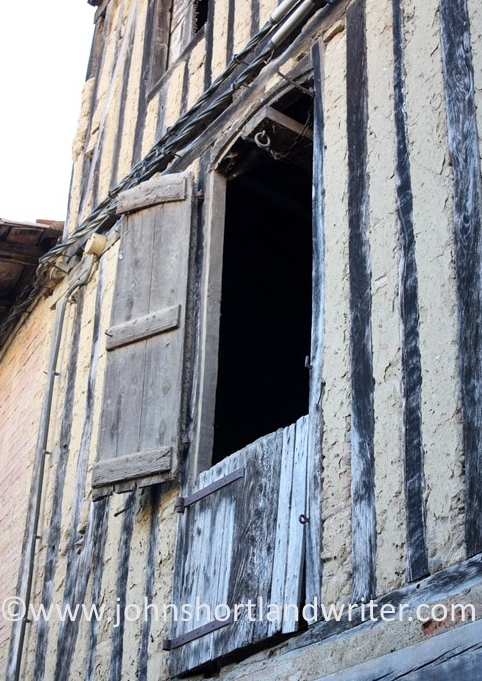
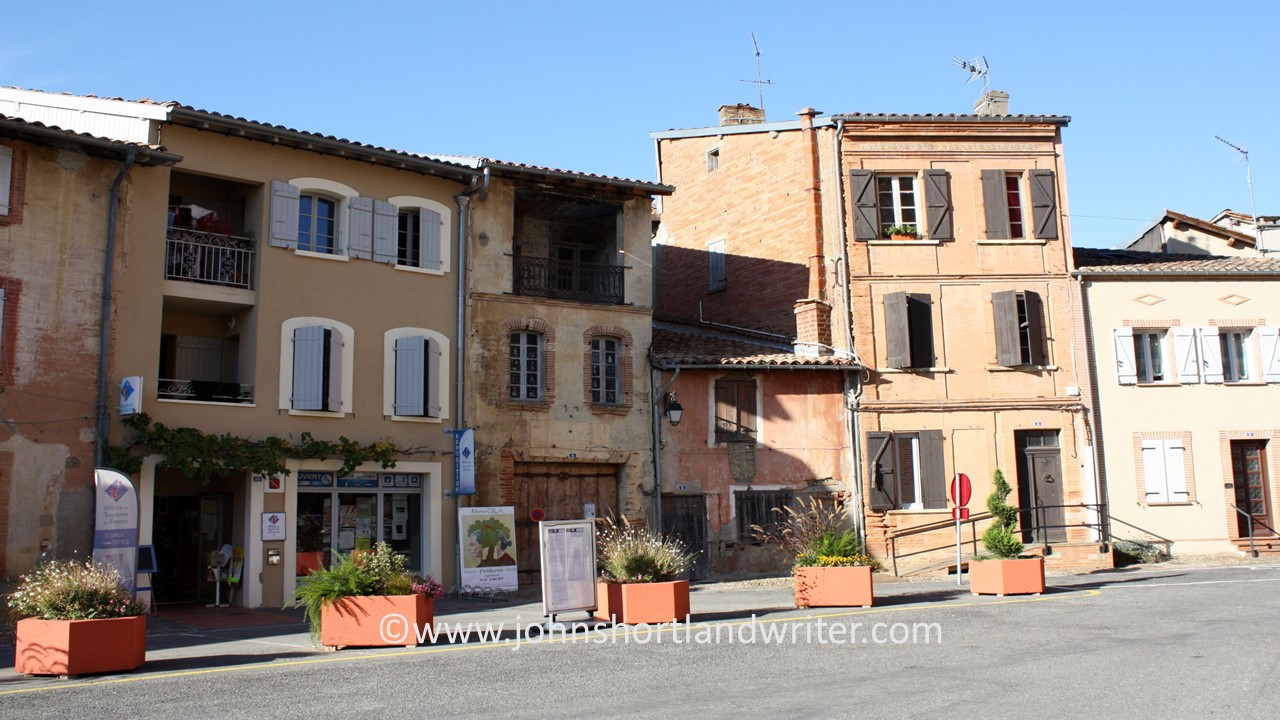
Walking through Lombez takes you back to a time when life too was slower; amongst its buildings are images that conjure up the France portrayed by the great artists – rich colours, faded paintwork, closed shutters keeping out hot sunshine.Lombez (22)   copyright.jpg

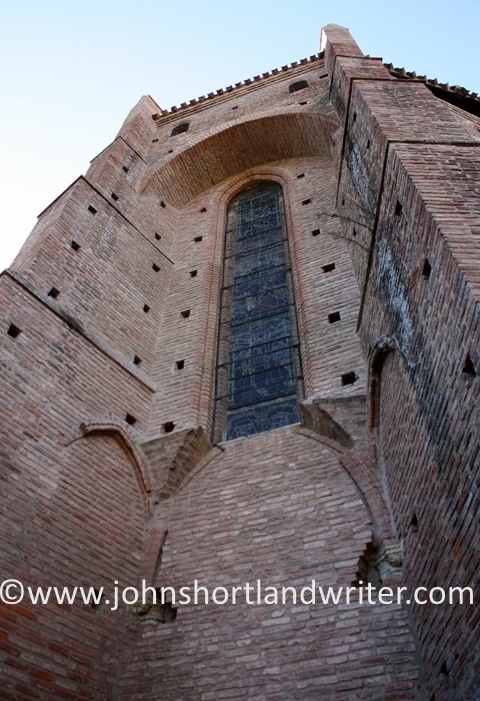
Dominating the town, the pink and white octagonal bell tower of the fourteenth century cathedral is in ornate contrast to the austere façade of the brick built body of the church. The severity of the style accentuates its height and gives no hint of its splendid interior.

Lombez (4)   copyright.jpgLombez (18)   copyright.jpg

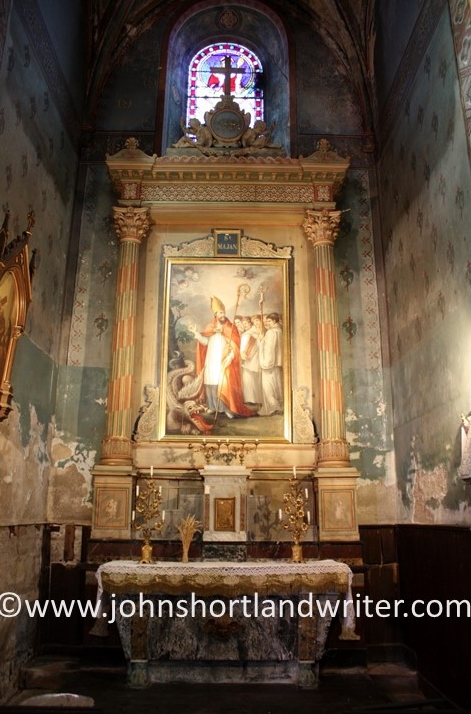
Fine stained glass, some dating back to the 1400s, marble altars, decorative carvings and statues all demand careful exploration and give good reason to linger inside away from the summer heat.

Lombez (10)   copyrightLombez (16)   copyright.jpg

The cathedral is a listed monument historique and preservation work of the exterior was being carried out during our visit. With such an ancient building, work is on-going and there are areas of the interior that still have to be restored, although they do have a special charm and serenity about them that may be lost when renovated.Lombez (11)   copyright.jpg

Stepping back outside, the sun appears to be even brighter than before and gives an excuse to find a bistro for a cold beer. Unlike the UK, where bars and coffee shops crowd the pavements to draw in the visitors, outside the cathedral there are few signs of life and very little traffic. This part of France remains true to its laid-back style and does not woo the tourist: when in Lombez behave like a native – stay calm, slow down, relax.Lombez (6)   copyright.jpg

Lombez is in the Gers region of southwest France, 55km west of Toulouse and within sight of the Pyrenees Mountains.