Visiting The Exmoor Society

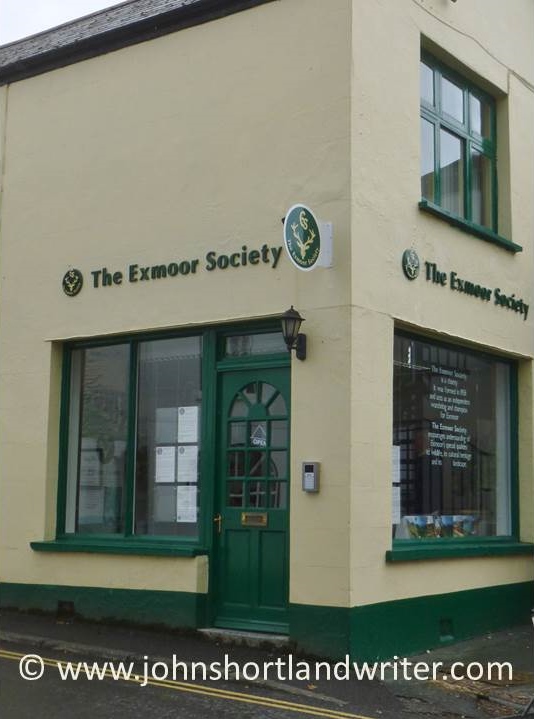
Devotees of Exmoor, a National Park in Britain’s West Country, who want to learn more of its past and wildlife will find a friendly welcome at the Exmoor Society’s new headquarters.  Closely associated with Dulverton since its inception in 1958, it has recently moved to its new location within the town centre.Exmoor Society HQ (13)   copyright
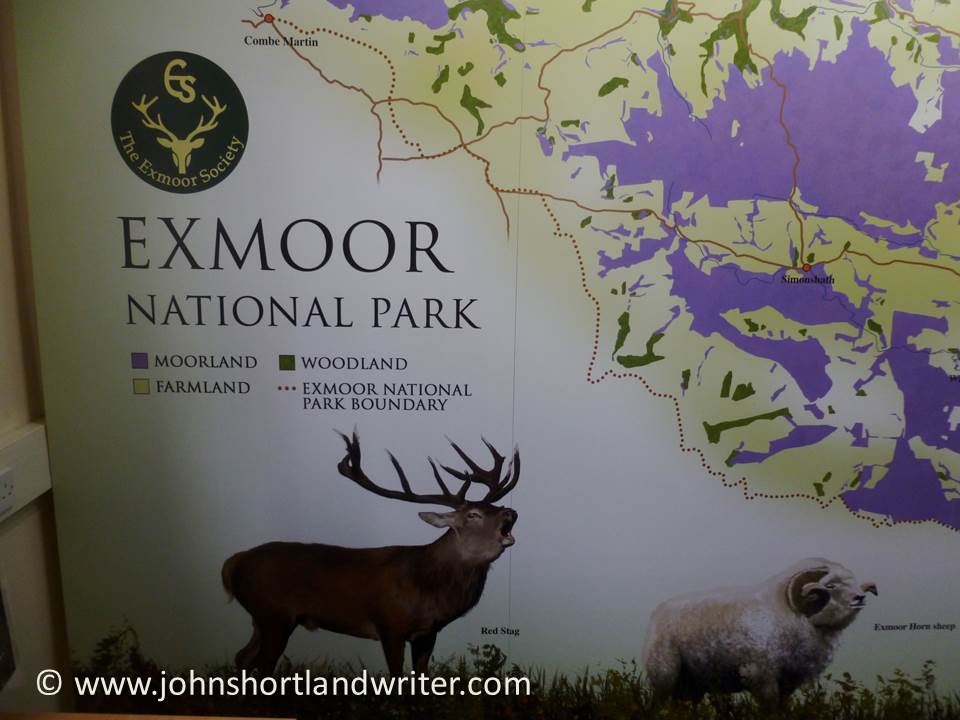
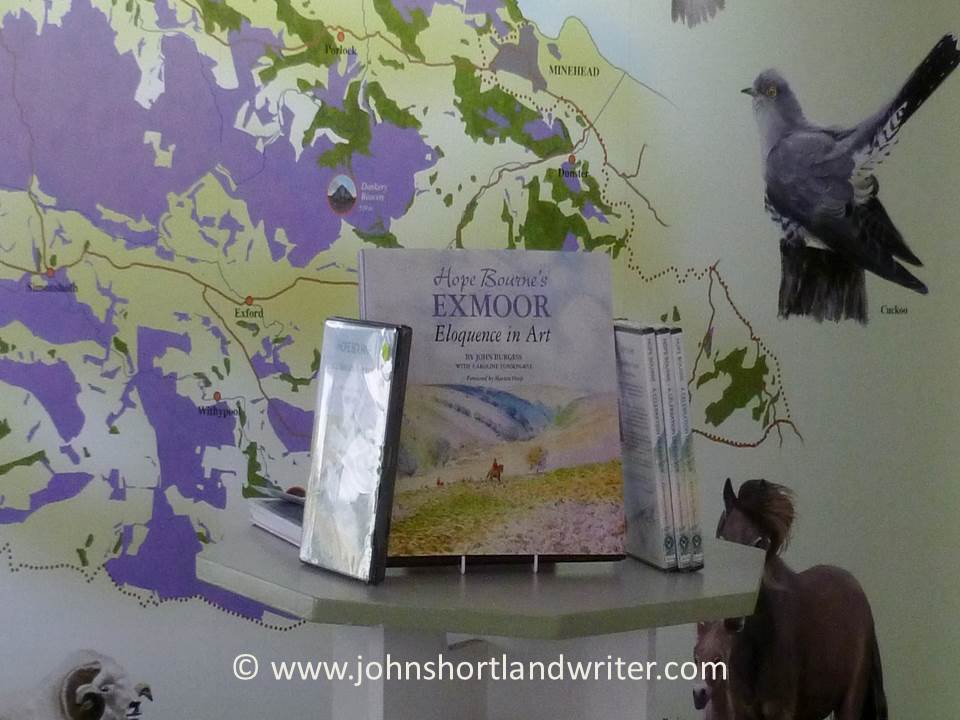
A pictorial map filling the whole of one wall draws your attention as you enter the building, beautifully illustrated with iconic Exmoor animals and birds: Red Deer, Exmoor Ponies and Buzzards to name a few.
Exmoor Society HQ (3)   copyright

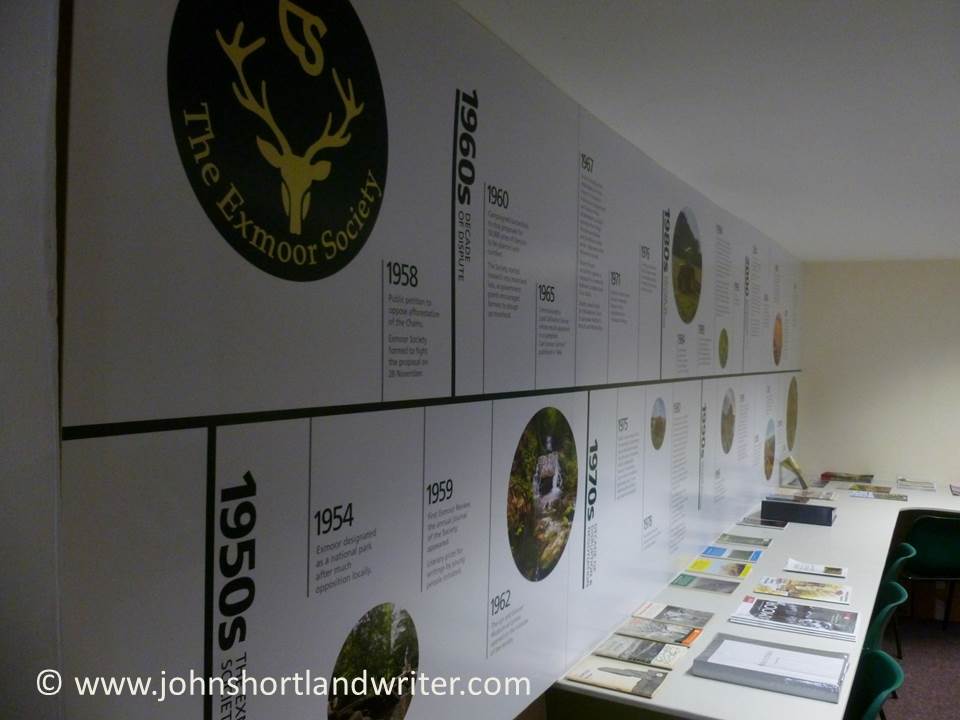
Leading from the map is a room where visitors are able to look at old copies of the Exmoor Review, published annually and other archive material.  A timeline charting the period from the 1950s to the present day stretches along a wall lined with seats and work tables and makes fascinating reading in its own right.  Exmoor Society HQ (4)   copyright
The library’ shelves are stacked with books, many rare and out of print and covering every aspect of Exmoor life.  These are a great resource not just for the serious student of Exmoor but also for those that just want to dip into the pages of one that catches the eye.  Some titles, where there are several copies, are for sale.Exmoor Society HQ (12)   copyright

With over fifty years of collected material, the Exmoor Society has a wealth of information some of which, in the past, has not been readily available to see.  In 2014 funding was acquired for an Outreach Archivist, Dr Helen Blackman, to catalogue and resolve these issues.  Her progress can be followed on Twitter @ExSocArchivist.
Exmoor Society HQ (11)   copyright

One of the greatest bequests to the society was all of the papers, drawings and paintings of Hope Bourne who became world famous for self-sufficient living in a caravan in a remote part of the moor.  Much of the material is in a fragile state but reproductions commissioned now show the beauty of her work.  The society has recently published a book showing some of her paintings, many for the very first time entitled Eloquence in Art and this can be purchased either at Dulverton or online.Exmoor Society HQ (14)   copyright
The Exmoor Society aims to reach everyone with an interest in Exmoor, including the landowners and people that live and work on the moor.  It takes its message to numerous shows and exhibitions and also leads walks throughout the year.Exford Show 2014 (9)   copyright
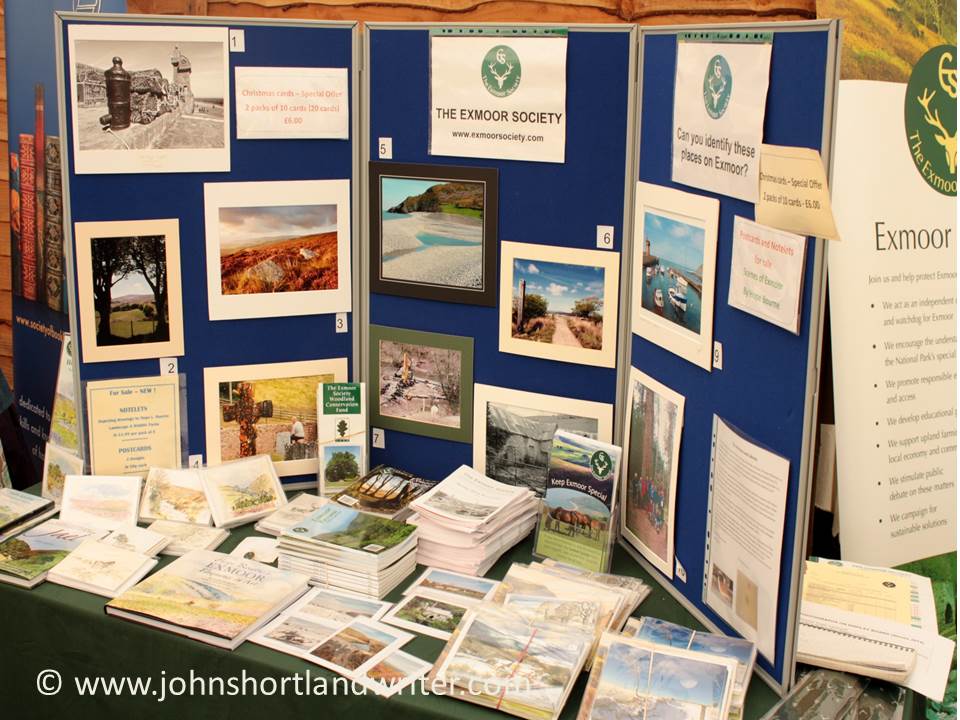
To find out more about the Exmoor Society drop into Dulverton or take a look at its website by clicking the link here.

2014 in Review: July – December

Christmas has been and gone, even the New Year is a few days old.  A time of old traditions and also some new ones – one of which is the review of the year past.  The first six months can be found by clicking here; now for the next six.

This is the time of feasting, of plenty but in days gone by the essential time of year was harvest.  Without a successful gathering of the corn life during winter would be tough for country folk. Harvest, which starts here in July, is still one of the busiest times of the farming year and despite modern machinery replacing many of the labouring jobs in many ways the task remains unchanged. As a young man I helped on what must have been one of the last farms to harvest in the ‘old way’.  Working from dawn to dusk, it was hard but we didn’t stop until we knew “all was safely gathered in”…

All is Safely Gathered In?

I tend to avoid Exmoor, England’s smallest National Park, in August for it can become quite busy with visitors (I’m selfish and don’t want to share it with others).  This year was different and I arrived in glorious sunshine, the perfect time to see the heather moorland which is in full bloom this month, a purple haze.  To keep it looking as perfect as in the image below, the moors are set alight, an ancient practice known as ‘swaling’. The resultant new growth provides food for the sheep, the wild ponies and the other wild birds and animals that roam the moor…

c4098-heather2b52b2b2bcopyright

Horses play an important part in my life and in September the Burghley Horse Trials take place.  The trials feature three elements of horsemanship: dressage, show jumping and cross-country.   It takes a brave horse and rider to tackle the latter element for the course is very testing and some of the jumps huge.  Accidents do occur, fortunately rarely seriously but when there is a problem with perhaps a fence needing repair, part of my job is to prevent other competitors from running into them. Stop That Horse! lets on what happens ‘behind the scenes’…

a7d17-cottesmore2bleap2b2b2bcopyright

The story of Lorna Doone and John Ridd, the man who saved her is a well-known and much loved tale of romance and treachery, set on 17th century Exmoor.  Many of the places and people – but not all – that feature in the book do or did exist.  In October I explored what is fact and what is myth? Click here to find out…

d95a2-badgworthy2bwater2b2b2bcopyright

There can be fewer more bizarre buildings in the world than The Pineapple in Scotland.  In November I was lucky enough to stay there and to explore the other fascinating and ruined buildings associated with it.  I also found time to travel further afield and take in the spectacular scenery around Loch Lomond…

e226c-the2bpineapple2b42b2b2bcopyright

Rummaging in a cupboard at home in December I  came across some old photographs that had been inherited many years earlier.  Noticing a signature and doing some research turned into something far more exciting than I ever could have imagined – it turned out to be ‘a great game’…

006   copyright

2015 looks to be a good year with a number of exciting projects and travel ahead giving plentiful topics for blogging.  May it be a good one for you too.   Thank you for your support and may the New Year bring you all health and happiness.

HAPPY NEW YEAR

2014 in Review: the first six months

So another year is almost over and it certainly has been a busy one for me.  Living and working in the spectacular Cotswold countryside, a classified area of Outstanding Natural Beauty (AONB) is a great treat and one of which I never tire.  It’s also nice to go off exploring other places so 2014 found me in other parts of the UK and  Ireland too.  One of the first places I visited, however, was only twenty miles down the road but light years apart in reality!

a typical Cotswold scene   copyright

typical Cotswold countryside

Like many people that live close to tourist attractions I don’t often visit the ones on my doorstep but last January found me walking the streets of Oxford.  I hadn’t come to explore the colleges but the covered market which dates back more than two hundred years.   The history of the market and the building is fascinating and is well worth making the time to visit – especially if you like a bargain.  To read more about it and to see other photos click here.

0bab1-copyrightjjj

One of the fathers of ecological writing died tragically young and in February I matched quotations from his work to images I had taken (to see them, click here).  My favourite was noticed by the Society that bears his name and reprinted in their journal.  I felt very honoured!

7d91b-hmecopyright

Wild and rugged scenery is often best appreciated over cake and coffee and at Watersmeet in Exmoor National Park you can do just that.  Two rivers collide spectacularly besides the Victorian fishing lodge that is now owned by the National Trust and run as a café. March found me walking through beautiful scenery as well as indulging myself and the link to this remote but very accessible place is here.

c6c63-watersmeet5copyright

Dublin, the capital city of Ireland is a favourite place of mine and in April I visited the Casino Marino, one of the most impressive and perfect neo-classical buildings in Europe.  Everything about it was designed to deceive so although you only see one window on each side you actually have – well, click here to find out what plus all the other deceptions the Georgian architect managed to fit in.

Casino Marino

Planting trees is a long term project for they rarely mature during the life of the planter.  Of all the hundreds I have done in my professional life none has given me as much pleasure as this particular one.  I have waited for years for it to flower and in May it did so for the first time.  I felt quite emotional – it was a case of finding a handkerchief.  Take a look by clicking the link here.

Davidia involucrata   copyright (2)

The Cotswolds are world renowned for their ‘chocolate box’ village scenes and Lower Slaughter must be one of the contenders.  Despite its name it is a beautiful and tranquil place to visit for it has everything from crystal clear trout streams to olde-world stone cottages to a mill complete with working water wheel. If you choose the right time to explore you can have the place to yourself.  To learn more click the June link here.

2d910-lowerslaughter3copyright

The Story of Lorna Doone – just a myth?

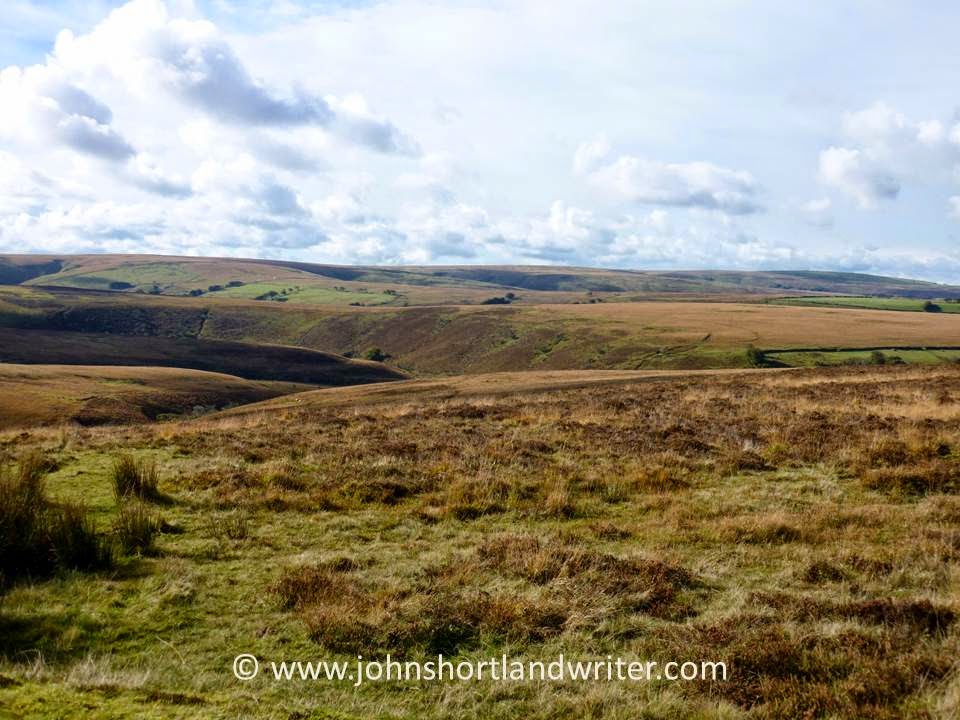
 Lorna Doone is the tale of a young boy, John Ridd, whose father is killed by Scottish outlaws – the Doones.   Exiled to a remote part of Exmoor (which is in England’s West Country and now a National Park), they rob travellers and local farms.  Living amongst them is the pretty Lorna Doone, kidnapped by them as an infant.  John enters the forbidden Doone Valley by climbing a steep and difficult waterfall, the ‘waterslide’, and meets Lorna for the first time.  Some years later he rescues her and as they marry Lorna is shot through the window of Oare church by the wicked Carver Doone.  John pursues him and after a struggle Carver perishes in a bog.  Lorna recovers from her wounds and so the story has a happy ending.

Oare Church

But is it true?  The simple answer to the question is that the answer isn’t simple.  When Richard Dodderidge Blackmore wrote his historic novel in the late 1800’s he mixed fact with fiction and local legend with the names of local people.

Blackmore placed the Doone stronghold beside Badgworthy (pronounced ‘Badgery’) Water.  There is a deserted medieval village beside a tributary in Hoccombe Combe and it is very probable that this is the site for the ruins were still visible in Blackmore’s day.  However the Waterslide is not found there but in another side valley, Lank Combe. Nowhere as sheer as described it is, however, an impressive sight with its three smooth slabs of rock especially when the river is in spate.  I like to think that he also had in mind the waterslide at Watersmeet a few miles further downstream which would be much more of a challenging climb.
The waterslide at Watersmeet
 

Because the precise location of the Doone Valley is uncertain it is no longer described as such on maps, the Ordnance Survey now describing the area more accurately as Doone Country.  A rewarding walk can be taken along the whole length of Badgworthy Water starting from Brendon Common by parking the car at Brendon Two Gates.  Here there are wide views of both the open heather moorland and also the grass moor of the Royal Forest ‘improved’ in the nineteenth century.  Badgworthy Water changes in character along its length from fast running rapids to smoother, deeper pools.

Badgworthy Water

The above walk is rugged and long but a more gentle approach is from Malmsmead with its much photographed packhorse bridge and ford that also denotes the county border between Devon and Somerset.

Malmsmead where Badgworthy Water crosses the road
 

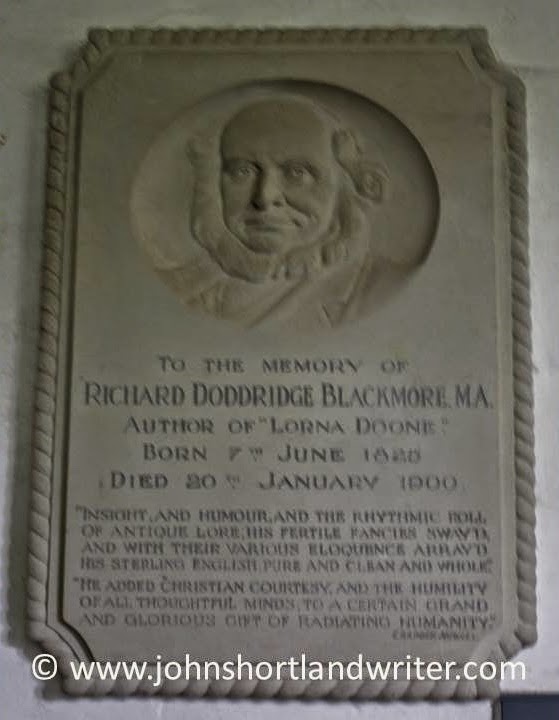
Further along the lane nestles the village of Oare and the church where Lorna and John wed.  Inside is a memorial to Blackmore, a smaller copy of the one in Exeter cathedral.  A memorial can also be seen to the Snow family who lived at Oare manor and also feature in Lorna Doone. It is recorded that as Blackmore didn’t write kindly of the Snows he was afterwards much disliked by them.  Other local characters also existed: Tom Faggus, the highwayman was – in real life – from nearby North Molton and Ridd is still a local surname. 

Oare village and church nestle in a deep combe

Is Lorna Doone a story based on truth?  That is for the reader to decide, perhaps after visiting Mother Meldrum’s cave in the Valley of Rocks, for both are mentioned in Blackmore’s book.

The Valley of Rocks

Add to Technorati Favorites

All is Safely Gathered In?

The air is heavy with the scent of harvest.  Is it the summer heat that produces the heady smell of fresh straw or the act of cutting it?  Probably a combination of both but the result gives mixed emotions for, whilst there is something very comforting about knowing that the corn is safely stored and the livestock will have plentiful winter bedding, there is also a tinge of regret for it is the first sign that autumn is rapidly approaching.

Harvest is one of the few events in the modern farming calendar which gives an insight into the ways of country life of generations ago.  These days, for most of the year, farming is a solitary occupation with a skilled tractor operator carrying out the tasks of many people.  Now the fields often seem empty, quiet places, devoid of human life or activity. Even fifty years ago there were more people working there but go back even further, say another hundred, and there would have been the sights and sounds of dozens of people working from dawn until dusk, racing against the weather.  A poor harvest then meant months of hardship and hunger for many.  Modern harvesting, albeit for a much shorter time is when the fields seem alive once more with combines, grain trucks, straw wagons and the like. 


The image below is taken from a nineteenth century farming manual belonging to my great, great-grandfather, and it demonstrates just how many people both men and women, were required for harvest. There were the mowers with their scythes, the gatherers, the bandsters who bound the sheaf together and then set them in ‘stooks’ to keep dry. Finally, the raker would clean up all fallen straw and grain for none could be afforded to be lost.  Harvesting by hand was surprisingly speedy for a skilled mower could cut over an acre of wheat in a day.  However, by the 1880’s virtually all corn was harvested by horse drawn machines.

Many attempts were made to design a harvesting machine throughout the centuries – the earliest, using oxen, is described by Pliny two thousand years ago.  The binder – as seen in the wonderful engraving also taken from g-g-grandad’s book – which cut and tied the corn into sheaves in one operation, first came into use in the 1850’s; it continued to be used for another hundred years: by 1979 when the photograph below was taken it was an eccentric rarity. 

the binder can just be seen on the middle right of the photo
 
Combine havesters are giants compared to the binders of old and when they travel through the secret valley they take up the full width of the lane with very little room to spare.  First to be cut is oilseed rape, the crop that turns vast swathes of the British countryside bright yellow in spring.  The resulting stubble, unlike that of corn, is sparse and sharp and makes for uncomfortable walking on.


Barley, oats and wheat – which in the UK are collectively referred to as ‘corn’ – then follow with each crop (and its straw) having its own requirement and characteristic.  Modern technology may have shortened the number of days it takes to bring in the harvest but the working day is just as long as it ever was for the combines work from early morning to late at night, providing the crop doesn’t become damp with dew or rain. 

Harvest has always been dependent upon the weather so it is not surprising that upon completion celebrations take place.  Although the traditional Harvest Supper is now mostly a thing of the past, the Harvest Festival church service is still one of the most popular.  On Exmoor – where I helped with harvest in my early years – and typical of a remote, tightly –knit community, every window ledge and the altar of the church would be decorated with flowers, fruit and vegetables.  Pride of place was given to the first stookof corn cut from the field. Packed with families that had been too busy to meet one another for several weeks the hymn ‘Come Ye Thankful People, Come’, written by Henry Alford in 1844 a line from which the title of this blog post is taken, and a great favourite of the farmers, was sung with gusto.

Exmoor church

Add to Technorati Favorites

Where Waters Meet

With two rushing rivers – Hoar Oak Water and the East Lyn River – merging in a series of spectacular cascades and rapids it is hardly surprising that Watersmeet is one of Exmoor’s most popular visitor’s attractions.  Its deep, wooded valley is doubly protected for not only does it lie within the heart of the National Park 340 acres were gifted to the National Trust.   Watersmeet House, now a café but originally built as a romantic fishing lodge, and with car parking nearby makes a good place to begin and end a walk.

There are numerous paths that can be taken from here and most link up to create walks of varying lengths.  They hug the valley bottom or rise steeply to the tops of the surrounding hills so it is possible for almost anyone, regardless of their ability to have an enjoyable outing.  It should be remembered that even in dry weather the paths can be quite rugged so good, solid footwear is always recommended.  A stout stick or walking poles won’t go amiss, especially if you choose the hillier paths.
 Apart from the noise and excitement of the rivers, the other awe-inspiring feature of Watersmeet is its woodland which clings to the steep, three hundred foot sides of the valley.  These are some of the best examples of ‘hanging’ woods in the country and are relics of the ancient woodland that once covered lowland Britain.  Mostly the trees are sessile oak although there are some fine specimens of beech in the better soil of the valley bottom.  There are also a number of Whitebeam species that can only be found here or in neighbouring woodlands making them of national importance.
As soon as you start walking, any crowds are soon left behind and you have the splendour of the place to yourself.  Following the East Lyn River upstream the remains of a nineteenth century lime kiln can be explored.  Lime was brought by sea from Wales to be burned before spreading onto the fields to counteract the land’s extreme acidity.  Fuel for the kilns was provided by the woodland which was coppiced and some of this timber was also sent back to Wales to be used in the iron foundries.
 Wildlife abounds; there are dippers and herons by the water’s edge, and red deer, badgers and otters can all be seen by the fortunate few.  On quieter stretches of the river the calls of raven and buzzard can be heard overhead.
After an hour or so, the tiny hamlet of Rockford appears, consisting of just a few cottages and an inn – another great excuse for a stop.  From here you can trace your route back to Watersmeet or continue along the river to the village of Brendon to make a longer, circular walk.
Watersmeet is open to the public all year round and every season has its special moments.  In the spring, the valley is lush and green; in summer the sunlight filters through the canopy to play on the water’s surface; in autumn there are the changing colours and in winter, the extraordinary beauty of the gnarled trees adorned with grey lichens come to the fore.  It needs to be visited more than just once!
 

For more information take a look at these websites:
National Trust
The Rockford Inn
Exmoor National Park

Add to Technorati Favorites

A Year in Review 2013: the Second Half

July to the end of  December already is a memory and rapidly becoming a distant one at that.  Just five days into January and Christmas seems further back in the mind than it is in reality.  2014 has arrived and I am optimistically looking forward to all that it may bring.  Not that the last one was disappointing or sad in any way; just that with time flying by it is essential to make the most of every moment.  Of course, I’m very fortunate: I have my health, I have a great job, friends and family I can always rely upon and I live in a superb part of the English countryside.  Long may all those things last!

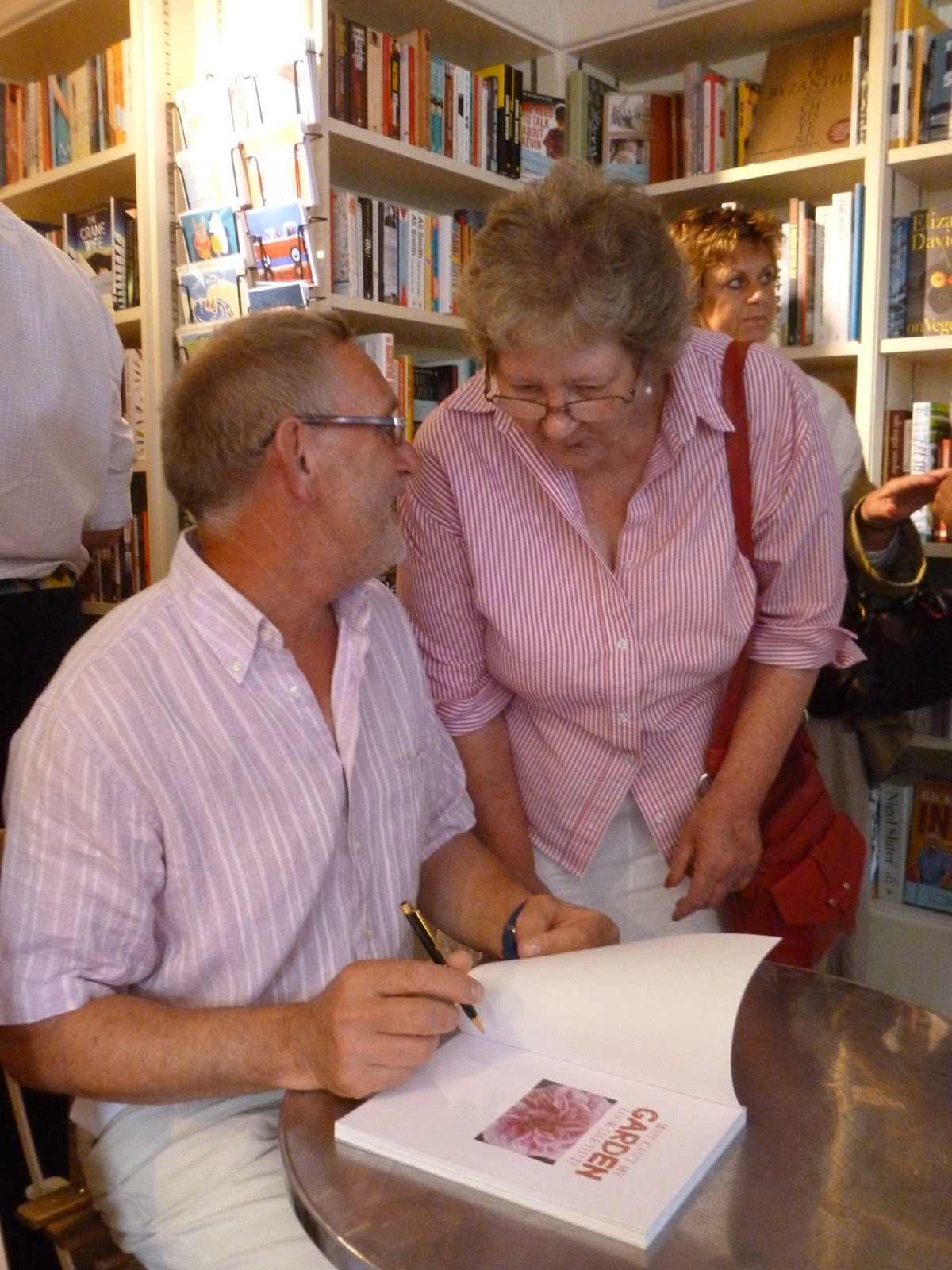
July:  The highlight of my year occurred this month.  An exciting and memorable launch of my first book to be published – a gardening book – Why Can’t My Garden Look Like That? took place in Chipping Norton’s award winning bookshop, Jaffe & Neale.  Would anyone turn up?  As it happened, very many did with people overflowing onto the street, the warm, sunny evening and the wine contributing to a street party feel to the occasion.  If you wish to find out more of the book or would like a signed copy you can find details here.

Many people are attracted to the magnificent looking but dangerous Giant Hogweed, also the subject of a post this month.  I was delighted when photographs from it were used in an educational video by the Hamilton County Soil and Water Conservation District (New York State).  Take heed of the messages if you come across the plant!

August: Travelling around the Cotswold Hills as I do every day in the course of my work you would think I would know most of what goes on there.  Nevertheless, I was surprised when I saw Tibetan flags fluttering in the breeze.  Further investigation found Alain Rouveure’s galleries and tea room.  Of course, I couldn’t leave until I’d tried out their lunch…

September:  Street fairs have been held for hundreds of years throughout England and Chipping Norton has an annual one that dates back to medieval charters.  Originally the time when livestock was sold and labour sought, these days they are purely held for pleasure.  Traffic has to be diverted around the town as the centre is blocked off by the rides and stalls.  Noisy, crowded and well lit they are great fun but I found  myself completely alone in darkness walking around it late one night.  It was an eerie experience, described here.

October:  The appearance of the secret valley was changed dramatically when the willow trees that line the banks of our little winding river were pollarded.  This dramatic ‘haircut’ is carried out only when necessary, the last time about fifteen years ago.  Suddenly, the view in the header of this blog has become wide open as every branch was removed leaving just the trunks standing.  The secret valley looks naked now but ‘new clothes’ will grow rapidly this coming spring.

November:  History isn’t just about learning dates of battles, the most interesting aspects are those that we can so easily relate to.  Yet so much of this is forgotten over time and it takes teams of dedicated people, often volunteers, to literally unearth it.  A now deserted and seemingly empty part of the Exmoor National Park was, one hundred and fifty years ago, teeming with people and was at the very forefront of Victorian technology.  It was quite extraordinary what these engineers achieved and their story featured in two posts which created much interest and comment.  They can be found by clicking here and here.

December:  The blogging year ended on a cuddly note – looking after two adorable but naughty beagle puppies.  If you are a dog lover there is nothing better than to be mauled by puppies.  If you’re not over-keen on dogs then you won’t understand the attraction!  You could try to find out, however, by clicking here.

So what’s going on in 2014?  Lots, hopefully. There is a new racehorse, more gardening, more travel, a lot more writing; it will be a busy year and how it pans out time – and this blog – will tell.

Thank you all so much for following my blog. Over one hundred thousand of you have looked at it since its inception which I find quite extraordinary and very humbling.  Please continue to do so and to tell all your blogging friends to come and pay me a visit, either on here or at my full website www.johnshortlandwriter.com .  I am also on Facebook and Twitter where daily updates can be found.  You are always very welcome to contact me with your comments or queries and I will do my best to answer them all.

Wishing you all a very happy and healthy New Year.

Add to Technorati Favorites

The Hidden History of the Brendon’s

The Brendon Hills, part of the Exmoor National Park, are less well-known than the barren moorland to its west that gives the park its name.  Here the landscape is a patchwork of lush, green fields and of woodlands bordered to the north by the sea.  It is a quiet landscape with only the sounds of birdsong and the occasional farm vehicle to disturb its peace.  It wasn’t always like this, however, for during the nineteenth century it was the centre of a great, albeit relatively short-lived, mining venture.  Today, much of this has been forgotten.

The West Somerset Mineral Railway was built to link iron ore mines with the seaport of Watchet for transportation to the steelyards of south Wales.  Much of its route can be walked and there are several ruins, some of national importance, that have been conserved.  One of the most dramatic is the Incline, where trains hauled truckloads of ore – and passengers – up a 1 in 4 steep hillside, climbing 800 feet in just over half a mile*.  I have written about this feat of Victorian engineering in an earlier post and this can be found by clicking on the link here.

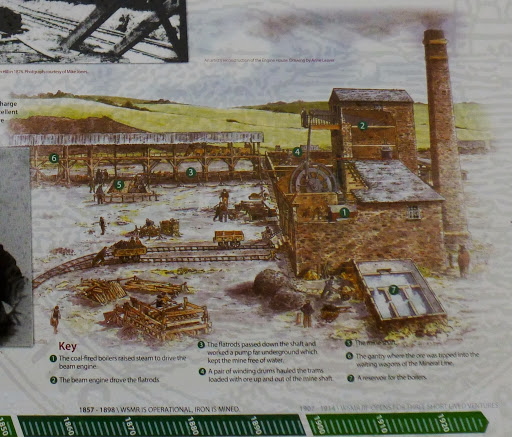
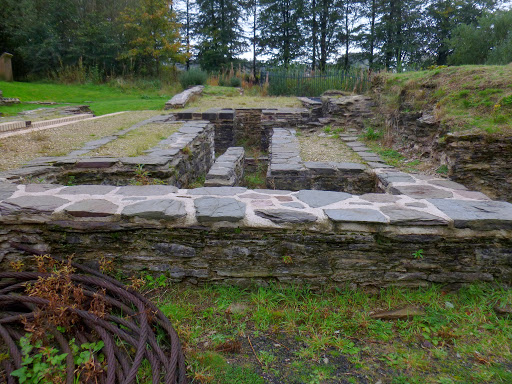
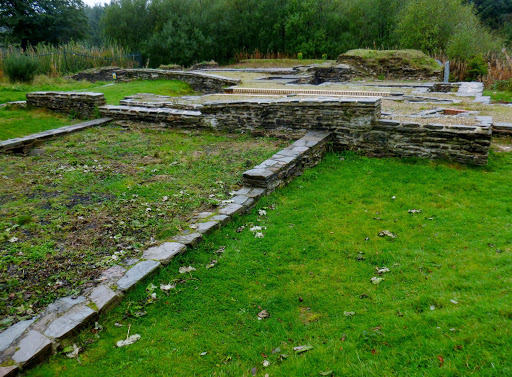
A ruin less impressive than that of the Incline but no less extraordinary in its day is the Langham Hill Engine House built in 1866.  All that remains now is the footprint of the building but a good idea of what it must have looked like and how it worked can be had from the artist’s impression by Anne Leaver shown on the nearby information board.

The engine house was created to draw the iron ore from three separate workings to the surface by sinking a new shaft at Langham Hill.  Powered by steam engines, the ore was pulled up to ground level by trams rising from a depth of up to 650 feet.  The miners who had to descend by ladder were protected from falling by a series of wooden platforms upon which the ladders rested – if they fell they would only drop the length of each ladder, reducing the risk of serious injury.  The steam engines also powered underground pumps to keep the shafts clear of water; this was filtered, stored in reservoirs and reused by the engines – an early example of recycling.  Once the ore was brought to the surface it was tipped into trucks to be carried away by the railway.

Another extraordinary feat of engineering was the aerial tramway that brought iron ore to Langham Hill in buckets from another mine over half a mile away.  A length of the steel cables, which are over four inches in thickness, can be seen coiled by the engine house.  The figures are staggering: the overhead cable was a single, endless 6700 feet length supported on wooden pylons, at times carrying the ore 300 feet above ground level and crossing a 2000 feet wide valley.  No wonder the miners called it ‘the flying machine’.

It is hard to imagine, when visiting the engine house now, the noise, bustle and industry that took place here just 150 years ago.  Two hundred miners and their families, mostly from Wales came to live and work here, yet within fifty years all mining had  ceased.  The engine house only survived for ten years: its engine and even the house itself, dismantled and reused in mines elsewhere.  The aerial tramway lasted an even shorter time being in use for only three years before new transportation technology overtook it.

Today all is silent, the site surrounded by trees and ferns.  For many years the remains of the mines remained hidden until the combined efforts of a number of individuals and groups fought to preserve them.  The West Somerset Mineral Railway Project came into being and has succeeded in doing so; it has also created a permanent exhibition housed in the museum in Watchet.  Its research of the history of the mines is available online – visit their website here.

*Nigel Cavey has through the Exmoor4All website has correctly pointed out that the iron ore would only have descended the Incline.  The trucks carried coal and lime, as well as passengers, up it.

Add to Technorati Favorites

Exmoor’s Forgotten Neighbour

Sandwiched between barren Exmoor to the west and the rugged Quantocks to their east, the Brendon Hills appear remarkably fertile with their neat, small fields testament to a rich farming tradition. Now incorporated into the Exmoor National Park it seems to be as devoid of human life as it’s more visited partner.  It has, however, a surprising past: travel back in time one hundred and fifty years and you would find yourself in a thriving community at the forefront of Industrial Revolution technology.

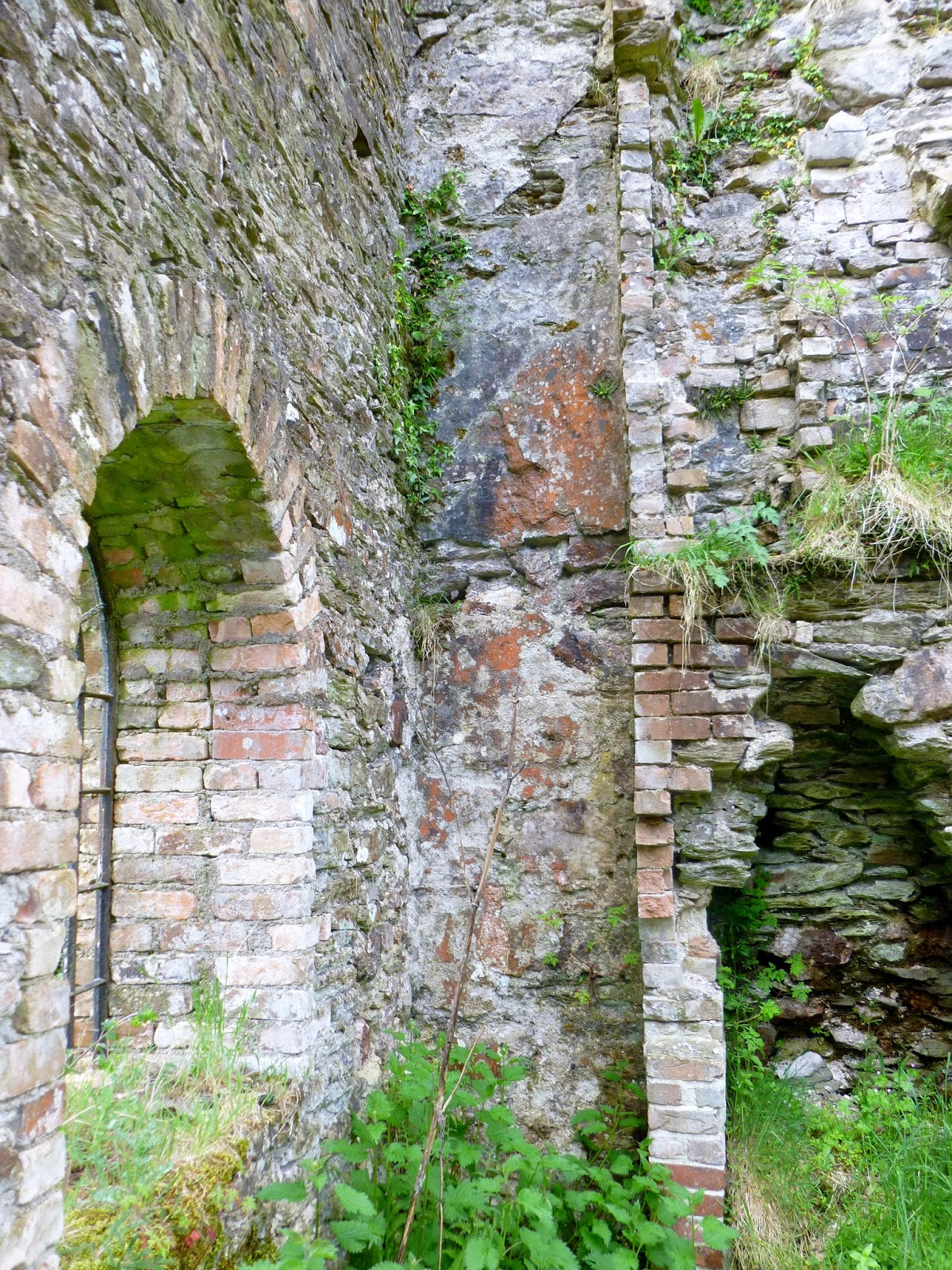
 A corner of the ruined building

For years, I had been intrigued by a ruined building close to one of the few roads that leads onto Exmoor proper.  Obviously once substantial, what could this building, miles from anywhere, have been and who lived there? There were no clues as I first approached but the  ruins, now stabilised, have had information boards giving its history placed within.  It was the site of an extraordinary Victorian venture that extracted iron ore and then transported it to the coast to ship to Wales for the steel industry.  Although, there was now just this one ruined building, in its heyday over two hundred miners and their families lived close by in houses built especially for them.

 Click on the image to enlarge the poster

The explosion of railway building in the mid 1800’s had created a huge demand for – and, consequently, a shortage of – iron ore.  Mining had taken place in the region on a very small, localised scale for many centuries but the small quantities found had never been a commercial prospect.  With the rapid rise in price and with advances in extraction the Ebbw Vale Company – Welsh steel works – developed the mines. A major problem was how to transport the ore the eleven miles from the furthest mine to the coast from where it could be shipped across the sea to Wales.  The first six miles from the port of Watchet was straightforward enough, the final six miles along the top of the Brendons, although more costly, also did not create a major problem.  It was the mile that included the climb of a 1 in 4 hillside that proved to be a challenge and a costly one at that – over ten times the amount required for the same length elsewhere and over £2 million in today’s prices.  ‘The Incline’ was completed in 1861 and took just four years to build, rising almost 800 feet in just 0.6 of a mile.

The ruins of the winding house as seen from the top of the incline

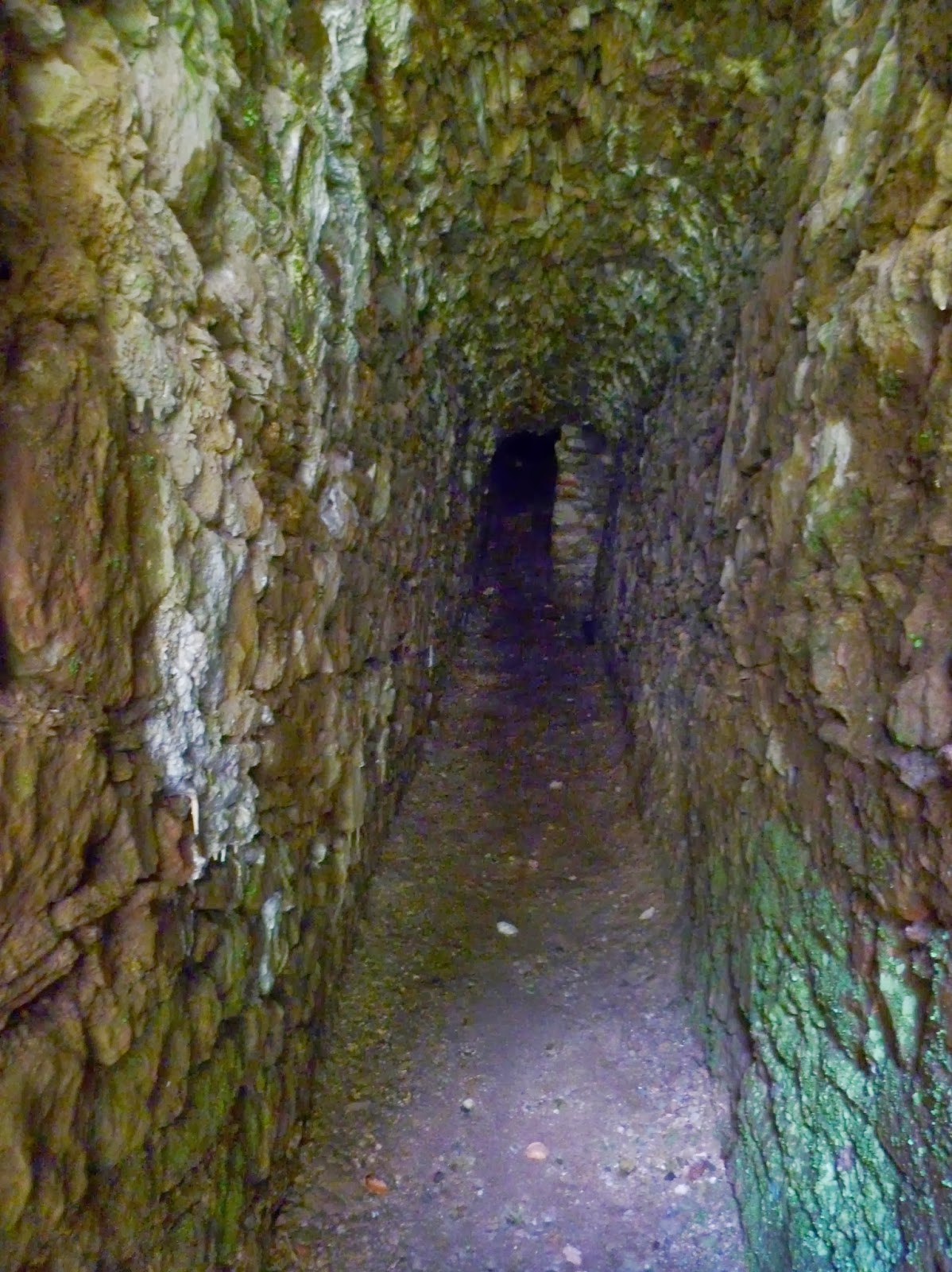
Trucks of iron ore were lowered or raised down the incline on twin rails, their steam locomotives held in place by steel cables.  The huge drums that were required to do this were housed in the ‘winding house’ with the cables travelling through stone tunnels, now the silent home of bats.  The force of gravity brought empty trucks to the top in twelve minutes as the weight of the full ones descended.   At the top of the incline the trucks passed over the roof of the winding house.  Communications between the men at the top and bottom were by semaphore.

The winding house – the trains passed over its roof

The cable tunnels

The price of iron ore and the methods of extraction continued to change rapidly and the railway never made a profit, with the mines closing just eighteen years later.  Remarkably, the railway continued to carry passengers for a further five years seated on wooden planks bolted to the tops of the iron ore trucks.  It must have been an extraordinary experience to be hauled up the incline and travelling back down couldn’t have been for the faint-hearted!

 The incline today belieing the industry and grit of the men that created it

An even more short-lived attempt to re-open the mine was thwarted by the outbreak of the Great War and in 1916 the sleepers and rails were requisitioned and the drums blown up, demolishing part of the winding house building.  A further attempt  to rebuild the winding house for agricultural use was abandoned during WWII and it was only with the help of a National Lottery grant that the buildings were recently stabilised and the incline cleared of scrub and restored.

Marker stone

For further information including many early photographs and drawings visit the West Somerset Mineral Railway website by clicking here.

Add to Technorati Favorites

An Exciting Evening

Fellow bloggers often comment about when they first began to write and  especially when or why they began to blog. When you come to think about it, blogging is rather an odd thing to do: you write your piece, perhaps add a few images, press the publish button and it’s out there for all the world to see.  Many of us assume that no-one will bother to read it and, after all, why should anybody be interested in our thoughts or projects?  But, again as many of us know, gradually people find us, follow us and friendships start to build.  The great majority of our followers we are never likely to meet in reality yet they share our tales and show real interest in what we are doing, whether it be family, travel, garden or whatever else we blog about.  Just occasionally, you come face to face with one and this happened last night.

Followers of this blog, whether here or on Facebook or my new website – or my Tweets –  can hardly have failed to notice that I have had my first book, “Why Can’t My Garden look Like That?” published recently (for I have been talking about virtually nothing else lately).  It has been an incredible journey with a huge and rapid learning curve; from commission to publication  it was completed in only thirteen months.  Fortunately, I had huge support and encouragement from my publishers, Constable & Robinson.  Fast forward another seven weeks to yesterday evening: the date of the official book launch.

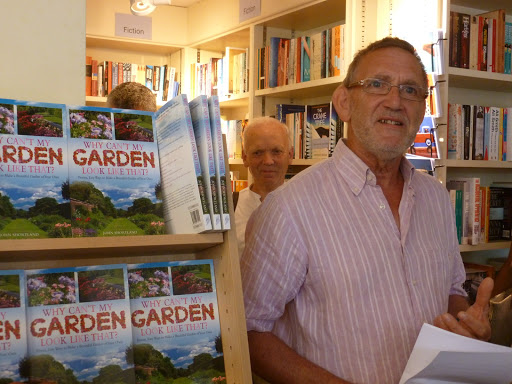
I was delighted that our local bookshop, Jaffe & Neale, hosted it for Chipping Norton is very fortunate in having such a lovely, independent and award-winning bookshop.  It couldn’t have been a better choice of location for the town was glowing golden with the heat-wave sunshine emphasising the colour of the old, Cotswold stone buildings.

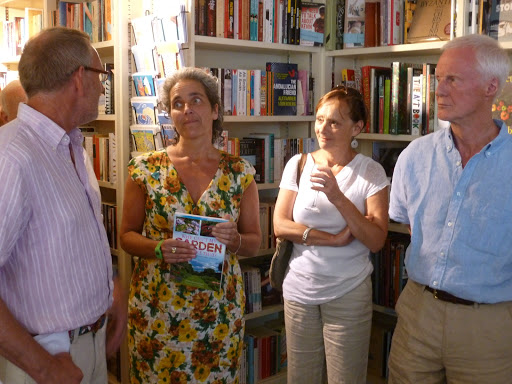
With Polly Jaffe of Jaffe & Neale, who hosted the evening, and Nikki Read and Giles Lewis of publishers, Constable & Robinson

I felt remarkably relaxed at the thought of making a speech to a large number of people.  In fact, my real concern was that no-one would turn up at all!  However, over one hundred came, filling the bookshop and spilling out onto the pavement giving the whole evening a real party atmosphere which, in turn, created more interest from passers-by.

A memorable evening was made all the more so as I began to realise just how far people had travelled to be with me.  Bette Baldwin of Friends of Hoar Oak Cottage had travelled up from Devon – I had met Bette only once before on Exmoor, thanks to the power of blogging.  Several others I had not met for a very long time; thirty years or more and, of course, there were others that I’d never met before at all.  The evening came to a close with a celebratory dinner organised by friends at a local restaurant.  An exciting evening and one never to be forgotten.

Yet more excitement today as I find that my book has been reviewed and described as “brilliant” by LandLove magazine.  They are also running a competition with ten copies of my book as prizes.  You can find out more about that by clicking the link here.

Add to Technorati Favorites