Mentors – part 2

In my earlier post on mentors, I asked the question “what makes someone a mentor” and do they realise they have actually become one. Of course, the answer will vary for there are many reasons why people do it, and equally a number of reasons why someone needs it.  My experience is that it is only with hindsight that I realise I had four mentors in my life and all would be amused at my describing them as such. 

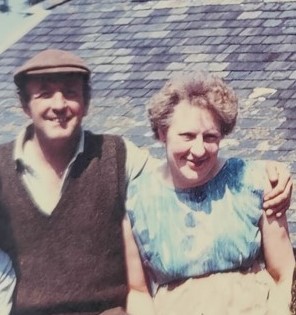
Lorna Dick French, Cyril Pamela Heber Percy

In part one I told of how I met, quite by chance, Dick and Lorna French who had a remote hill farm on Exmoor, a National Park in England’s West Country.  I was aged sixteen and, despite our age differences (essential for mentoring) a close friendship developed that lasted until their deaths many years later. [Their story can be found here] Fifteen years after that first meeting, I met another couple, Cyril and Pamela Heber Percy, and although of a very different background from Lorna and Dick, they too took on the role of mentor.

Woodlands Cottage, the Heber Percy’s home

In 1983 I had moved house to a small village in the Chilterns.  Although I consider myself a ‘Chilterns man’ I had always lived at their foot, first by the River Thames and, later, by the steep escarpment to the west.  Now I was living in one of the highest villages, surrounded by wonderful bluebell woods and prone to quite different weather than seemingly, everywhere else.  Like many hilltop villages it was a straggly affair, a mile long but with the houses scattered first one side of the road and then the other.   Our house sat opposite the common – a wide, open piece of land although by us it had been invaded by bracken and hazel scrub where Dormice could be seen climbing amongst the branches.   Wild cherries and raspberries also grew there and with a small pond that had once been the village’s only source of drinking water, it was very quiet and very lovely.     

There was a small pond amongst the cherry trees, once the village water supply
The village was surrounded by wonderful beechwoods awash with bluebells each spring

Soon after our arrival, there had been a knock on the door. Standing on the doorstep was an elderly gentleman, very upright and with a clipped moustache he looked every part the retired army colonel which he was.  With no introduction he barked, “what religion are you?”   Before I could answer, he continued, “Of no matter, we need bell ringers.  I’ll see you at practice tomorrow, 7pm.”  Of course, I didn’t go!  Our next meeting was one evening when out walking.    Hearing a lot of shouting and cursing I could see a man of similar age to me having difficulty with ‘boxing’ (loading) his horse to transport it back home.  No matter how he tried the horse refused to walk up the ramp and into the lorry.  As I drew level, the Colonel holding a whisky in his hand also appeared ready to give advice. The young man looked very dismissive at his suggestions but that changed after the Colonel took hold of the reins, jumped onto the horse’s back with an agility that belied his years and cantered away before turning and riding it straight into the lorry.  “Don’t stand any nonsense in future” was all he said as he tied the horse securely.  Turning to me, he said, “must be time for another whisky.”    Both the rider and I had learnt a valuable lesson that evening – never judge someone’s abilities by their age.

Boxing – or in this case, unboxing – a horse

The Colonel and I spent the rest of that evening in his home drinking whisky and discussing all manner of things, Pamela, his wife, joining us.  Sitting back in a comfortable armchair, I took in my surroundings, my eyes landing on a small photograph sitting on a shelf.  It was of two army officers on duty outside Buckingham Palace.   Cyril noticed my interest immediately – another thing I was to discover: he was exceptionally alert and noticed everything.  He explained that the photo had been taken many years earlier and featured in the national newspapers.  It was of him and his brother, one in the Welsh Guards the other in the Grenadier Guards acting as Colour Bearers at the Changing of Guards ceremony, the first time that two brothers had had that honour.

Changing of the Guard at Buckingham Palace 1927 [copyright British Newspaper Archive]

Over the years that followed, Cyril would tell me of his military career, of his escorting Queen Wilhelmina of the Netherlands under enemy fire during her evacuation, of dinners in England at the Palace with the King. (Pamela complained of how tedious all the formalities were!).  Of even greater interest was to learn of his Edwardian upbringing for he had been raised at Hodnet Hall, a large country estate in Shropshire.  He lived on the top floor in the nursery and each evening Nanny would bring him down to say goodnight to his parents where he would recite a poem and dutifully kiss his mother and shake his father’s hand.  Surrounded by liveried footman and other house staff, he preferred the informal company of the gardeners and gamekeepers.  Through them he developed a deep love for the natural world and keen observational skills which he passed onto me.  Walking together, he would point to a barely visible gap in a hedge and ask me if a hare, fox, badger or deer had made it.  Of course, I got it wrong but he persevered until I was able to tell the difference.

Hodnet Hall, Cyril Heber Percy’s childhood home
The Colonel taught me to recognise the different paths wild animals make (in this case, a badger)

During this time I was still working indoors in the retail fashions business but he taught me a lot about gardening too for the gardens at Hodnet were considered one of the finest in Europe.  You have to think big, he would say, immediately followed by “and you have to think small”.  To prove the point he would get me to lie down staring up at the undersides of large leaved plants, and then, on my knees, examine the different shades of green that could be found in the tiny leaves of wild thyme.  To get me to understand the wonders of the natural world he would say, “think like a child but always act like an adult”.  Years later, in my present career, I remember this advice and concentrate on elements of surprise as well as leaf texture when designing gardens.

When you look up at a plant you see a quite different world….

Pamela, also would tell me stories of her life.  Born into Irish aristocracy she had a very different upbringing to her husbands for there was the insecurity that the fight for Irish independence would bring.  There were stories of hiding in secret passageways within the house ready to escape if a violent attack took place, Fortunately, this never happened, perhaps because her mother took her social duties very seriously and would visit the poor and the sick to make sure that they never went hungry.  Pamela would accompany her mother on these visits and so from an early age saw how frugally ‘ordinary’ people lived.  It also gave her the ability to empathise with people from all walks of life and to treat them as equals.

Pamela Heber Percy

Over the years, the Heber Percy’s taught me many things, one of which was to cast a fly.  Both the Colonel and Pamela were expert salmon and trout fishers.  When I mentioned how much I enjoyed spinning for pike, Cyril had shaken his head and joked that it was very poor sport.  Venturing out onto the lawn he pointed to a fallen leaf – “that is your trout” – and he patiently watched and corrected me as I tried to get the line to drop close-by,  After I had mastered that he made life more difficult by pointing to leaves under low hanging branches and from there, to leaves floating on the surface of the swimming pool.  Unaware at the time, they gave me lessons in accuracy and perseverance as well as a useful fishing skill.

The Colonel: Cyril Heber Percy

It was a sad day when I heard that the Colonel had died.  He was buried, with full military honours at Hodnet, his childhood home.  We had always planned to visit the house and gardens together one day and now we were, although not in the way we had planned.  I felt surprise, pride and honour when I was ushered to the front of the church to sit with the family.  As the Last Post was being played from the top of the church tower I felt my lower lip tremble only for it to be controlled by hearing the Colonel’s voice whispering, “not very British!”.  Soon after his death, Pamela moved house and although not too far away, I saw less of her, and not many years after she also died.  I had lost two very dear and good friends.

Stained glass window at St Luke, Hodnet

And one final thought – I did learn how to ring the church bells!

Have you had a mentor or mentored someone?  What does it take for someone to become a mentor?  Our parents have probably the greatest influence on our lives so why does a mentor s role take on such importance? Let’s hear your story either in the comments below or, if you prefer, by using the Get in Touch tab at the top of this page.  Thanks to Diane Highton for posing the question that triggered this blog!

In Praise of Bluebells

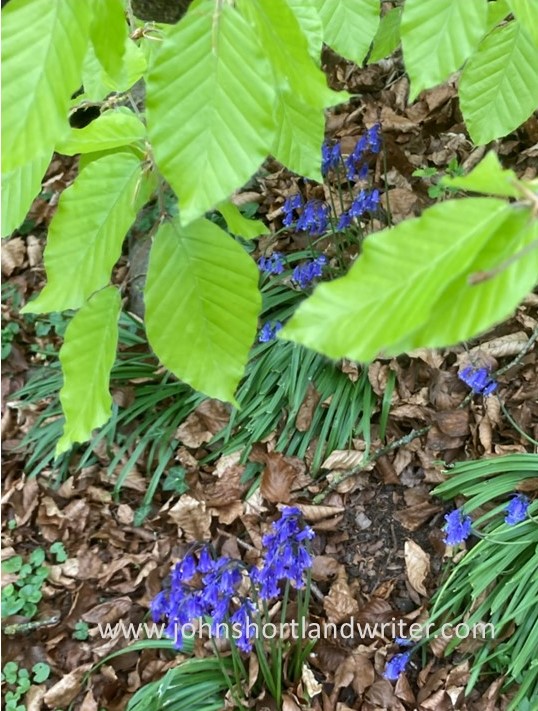
Can there be a more delightful spot to linger than a bluebell wood in spring?  The intensity of their colour when seen growing in their tens of thousands would hurt the eyes if not offset by the citrus green of the beech trees they favour growing under.  With early morning sunlight filtering through the branches to strike the woodland floor below, both leaves of beech and ‘bell shimmer and sparkle in the clear light.  As the forest warms the bluebells release their scent but not the heavy, redolent perfume that one might expect. Instead, a fragrance so soft and gentle that for a moment it seems to come from elsewhere; all too quickly it melts away, dispersed by the increasing heat.

Bluebells are one of the key indicator plants of ancient woodland, a term that refers to woodland that pre-dates AD1600, for their bulbs prefer to remain undisturbed where they can slowly establish huge colonies.   Here, in the secret valley where they grow in hedge banks, they can be used to trace the line of an equally ancient drove road for it is thought that the hedgerows and trees that line it are remnants of Wychwood Forest.  Over centuries, the boundaries of the Forest have shrunk as fields were created and the trees cleared for arable land or pasture.  By leaving the field edges untouched the early farmers saved themselves both time and labour and in doing so preserved the bluebells that give me so much pleasure each spring.  The drove road – primarily used for herding livestock long distances to market – passes our little stone-built cottage before diverting across open country.  It is still used as a public right of way.

Bluebells line the old drove road that passes my house

Unsurprisingly for a plant that has been around from time immemorial, the bluebell has numerous regional names – Common Bluebell, English Bluebell, Fairy Bell, Wild Hyacinth to name a few.  Perhaps the best has to be Granfer Giggles.  In Scotland they are known as harebells although to an Englishman harebell would be a completely different plant that grows later in the summer when the bluebells have long ended.  Even the Latin name which is supposed to prevent confusion has changed over time – it is now known as Hyacinthoides non-scripta.  I much prefer the earlier name of Endymion non-sciptus, it sounds more attractive as well as having a romantic Greek legend attached to it.  Illegal to dig up plants from the wild, bluebells are sometimes offered for sale from cultivated stock under either of these names.

Occasionally you may find a white, or even a pink bluebell

For such a well-loved plant – it has been voted England’s unofficial national flower – bluebells do not seem to feature much in poetry.  They are frequently mentioned by name but no-one, as far as I can tell, seems to have written poems specifically about the plant.  Perhaps it is because they are such a common sight and have none of the delicacy of the wild rose, the scent of the honeysuckle or the diminuity of wild thyme. Shakespeare, who seems to have written about absolutely everything (including thyme), only mentions it once: “the azur’d harebell” in Cymbeline.  The Brontë sisters both wrote of bluebells but I’m not sure they weren’t describing later flowering harebells. Emily’s description “waves in summer air”, and Ann talks of a single flower and of its trembling.  Bluebells are quite a stiff flower that don’t wave or tremble that readily whereas Campanula harebells fit the description nicely. I can’t recall even my beloved Richard Jefferies, the Victorian naturalist, waxing lyrical over them as he did over so many other things.  I may be wrong about this for I can hardly call myself a Jefferies’ scholar, more an enthusiast. However, Cicely Mary Baker created a delightful illustration of the flower in her set of Flower Fairies published in 1923 where she describes the bluebell as the king of flowers.

The less-common Harebell – Campanula rotundifolia
It flowers later in the summer and in more open places

It is to the Georgians that I have turned to illustrate our love of bluebells for I have found frequent references to them in old newspapers and periodicals not just in published poetry but also in their fashions.  This description of the sumptuous gown worn by the Princess of Wales when attending the King’s Birthday in 1795 is worth reproducing here: “A gown of superb, embroidered crepe imitating the rays of the sun and intertwined with embroidered white lilies.  Over which a cape of Venetian net embroidered with laurels and Diana’s (presumably the Goddess) crescent”.  Finally, there was another over-cape “embroidered with bluebells (yes!) and held in place by rich cords and tassels”.  As if this wasn’t splendid enough there was “a long train of silver gauze bordered in purple and silver”.  Having spent twenty years in the world of fashion (before I switched careers to horticulture) this has sent me into overdrive!  Sadly, I haven’t found any illustrations for this ensemble but I do have photos of the ‘draft’ for equally exquisite embroidery designed by Norman Hartnell for a robe for Queen Elizabeth II.

Embroidery design by Norman Hartnell for Queen Elizabeth II

Even earlier, in 1786, Mrs Charlotte Smith was publishing her sonnets.  A remarkable woman for the age, she left an unhappy and violent marriage and campaigned for women’s rights and the abolition of slavery.  She wrote fiction and poetry to financially support herself and her children.  This sonnet reminds me so much of my youth where I roamed the bluebell beechwoods of the Chiltern Hills, for which they are renowned.

“Ah, Hills belov’d!  where once a happy child,
Your beechen shades, your turf, your flowers among,
I wove your bluebells into garlands wild,
And woke your echoes with my artless song.
Ah! Hills, belov’d! your turf, your flowers remain;
But can they peace to this fad’ breast restore?
For one poor moment soothe the sense of pain,
And teach a breaking heart to throb no more?

I’m glad to say that my heart is no longer breaking so perhaps the bluebells worked their magic!

A very old photo (hence the strange colour!) of me and my two deerhounds in a Chilterns beechwood at bluebell time

.
.
.

A Walk With Dinosaurs and Romans

One of the perks of getting older is retirement or, in my case, semi-retirement.  Suddenly, I no longer need to keep checking my watch to see if I have enough time to do things without racing onto something or somewhere else.  It has given me time to re-visit some of the pleasures that I enjoyed in the past. One of these is walking.  When I was much younger I used to walk the long-distance footpaths and trails that were then just beginning to be created.  Now there are literally dozens of them to be enjoyed varying in length from a few dozen miles to several hundred.  I’m not up to the lengthy walks of my youth yet – the longest took a fortnight to complete.  At present, I’m content to be out for a few hours and, hopefully, the mileage will increase over time. 

England is criss-crossed by public footpaths and longer trails

The other day my partner and I decided to visit the Roman villa at North Leigh not far from the small, Cotswold town of Woodstock.  Unlike the Roman villa where you rarely see anyone, Woodstock is visited by thousands of international visitors every year, for it is where Blenheim Palace, a World Heritage Site, is located.  The two houses, six miles apart in distance but fifteen hundred years apart in their building, are very different.  Whereas the Palace is full of priceless treasures, all that is left of the villa are the foundations and a single mosaic floor.  At its peak in 300AD, the villa was one of the largest in Britain with suites of rooms, many mosaics and several baths.  Now it is quiet, wildflowers scramble over the walls and it is set in glorious countryside close to the River Evenlode.  With parking close-by, this was the starting point for the walk.

The Roman Villa, once busy – now a haven of peace and quiet
Wildflowers scramble over the ruins of the Roman villa

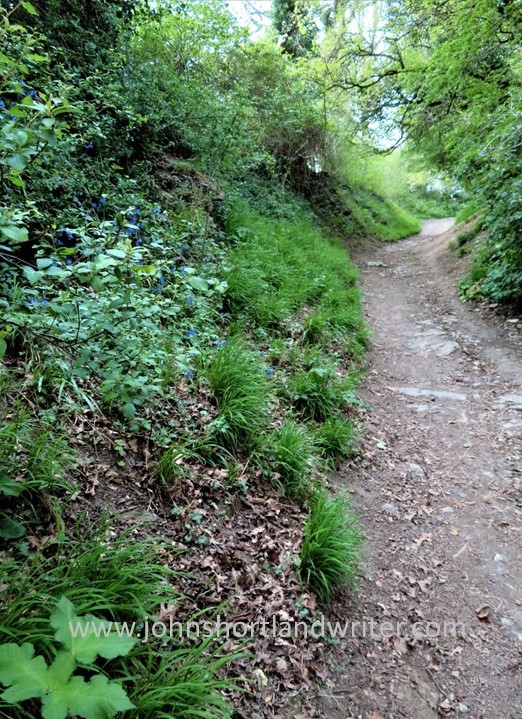
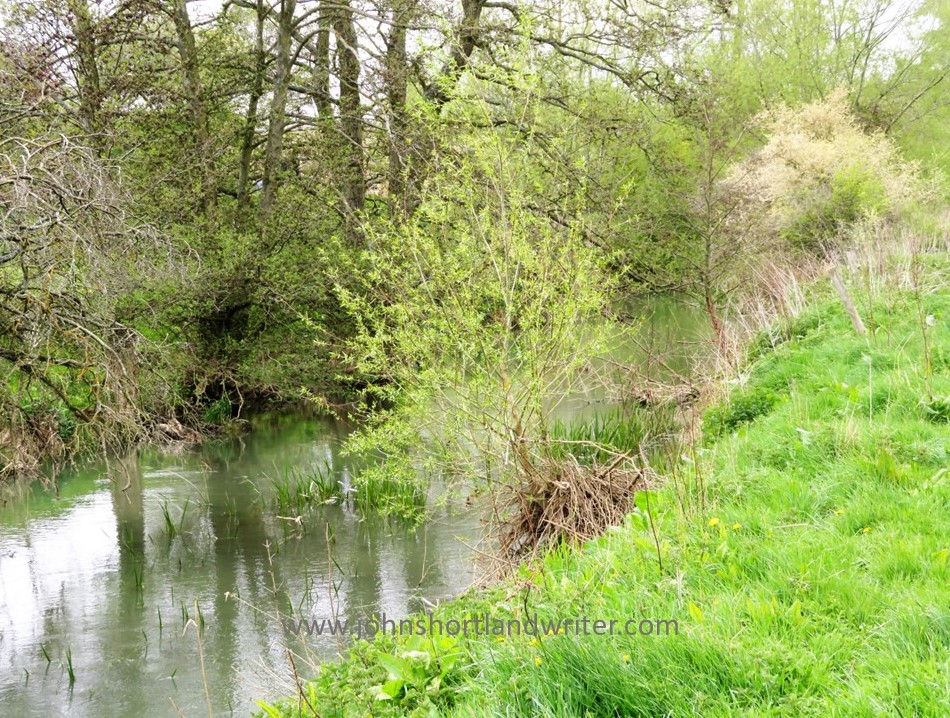
The path to the villa and those leading away from it are well maintained and marked, making the trail easy to follow.  Most of the route we took was on the network of public footpaths that criss-cross England, most of them dating from the time when all travel was either on foot or horse.  At one point, the paths joined the Oxfordshire Way, a path of 66 miles in length.  This in turn links to other long-distance paths so how long you walk for is entirely up to you!  After ten minutes or so, the Evenlode was reached and crossed.  Originally known as the Blade, its present name is relatively modern, first being recorded in use in the 1880s.  It meanders through the Cotswolds for nearly fifty miles before entering the River Thames. Crossing the river, the path turns to the west and the country changes in character with steep grassy banks rich in wildflowers rising high to our right, the river to our left.  Here we’re walking along Akeman Street, an ancient Roman road, once busy but now a quiet, grassy track.

The paths cross meadows until the river is reached

“The tender Evenlode that makes her meadows hush to hear the sound of water…”

Before long, the character of the path changes once more.  The Evenlode changes in character too for there is a wide ford – perfect for wild swimming.  Various paths meet here but we walked the steep path towards the village of Stonesfield, known locally for its history of making the stone rooftiles that are a feature of old Cotswold properties.  In pre-history, the Cotswold Hills were submerged by a warm sea and now fossils can be found quite easily; they can even be seen occasionally in the stones that have been used to build the houses.  It was in the Stonesfield loose and flaky rock that the very first dinosaur fossil to be found anywhere in the world was discovered.  Close to where it was found, a steel bench inscribed with the words of the French poet Hilaire Belloc has recently been placed – welcome indeed, after clambering up the steep path that leads from the ford to the village.

The view of the river from the ford
The rocks around the village of Stonesfield yielded the world’s first dinosaur fossil
The steel bench engraved with the words of Hilaire Belloc

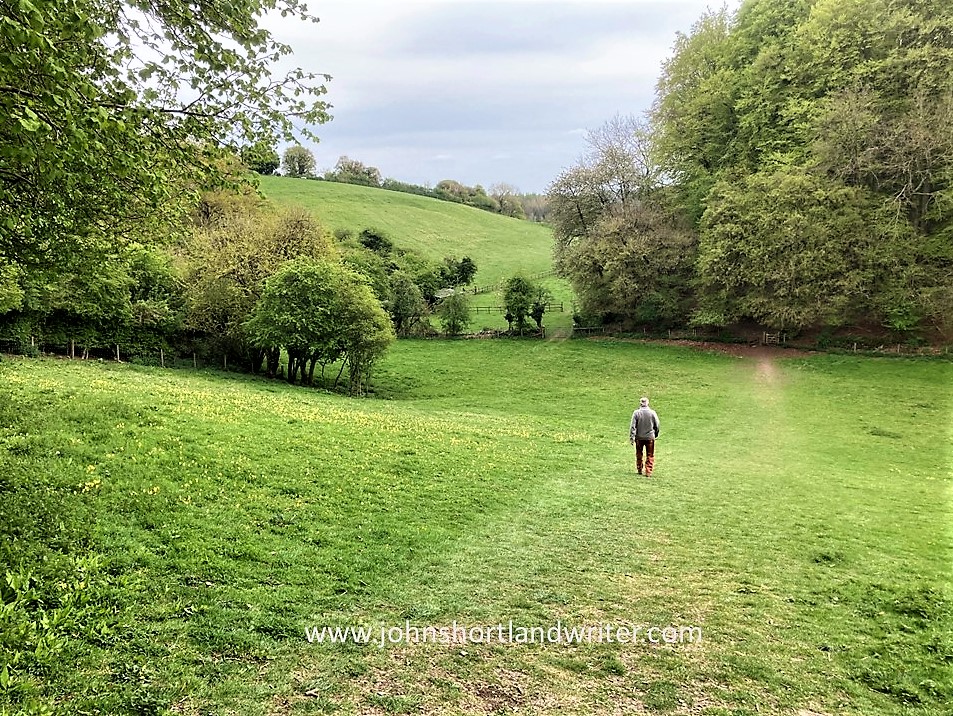
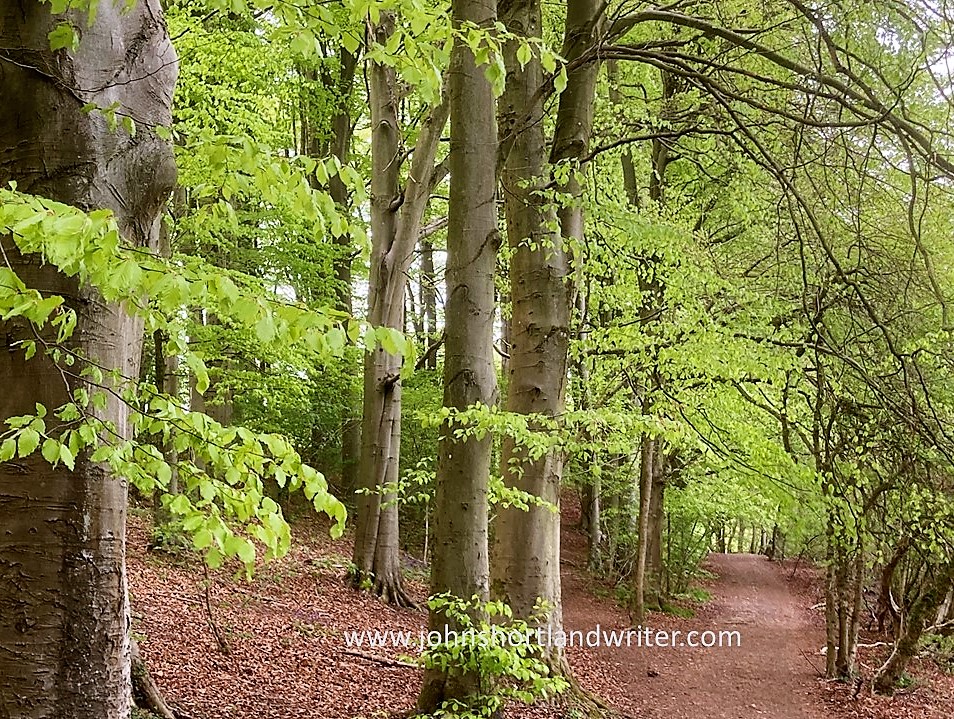
After a short walk along the edge of the village, our path left the Oxfordshire Way to descend steeply through meadows before reaching a strip of woodland, Stockey Plantation.  Although there are firs planted there, there are also many native beech trees which are, arguably, at there most glorious at this time of year.  The newly unfurled leaves are of the most intense green which, along with the deep blue of bluebells and the yellows of other spring flowers are almost too bright for the eyes to bear.

The descent to the woods becomes more gentle as it crosses the meadow
The path through the beechwood
The intense colours of the beech leaves and bluebells almost hurt the eyes

Leaving the woodland we reach the Evenlode ford once more but this time cross it – there is a footbridge, so no need to get wet – before striking off across the fields again to return by an alternative route to the Roman villa and the car beyond.  The walk probably took no more than a couple of hours and is relatively easy.  The weather, this April has been very dry.  At other times, the paths can be muddy and so sensible, walking shoes or boots are recommended.  The route we chose does have some steep hills to climb but these can be avoided for there are many paths that keep to the level ground.  An Ordnance Survey map of the area is handy to work out routes – I used the app on my phone but paper maps covering all parts of the UK are readily available. 

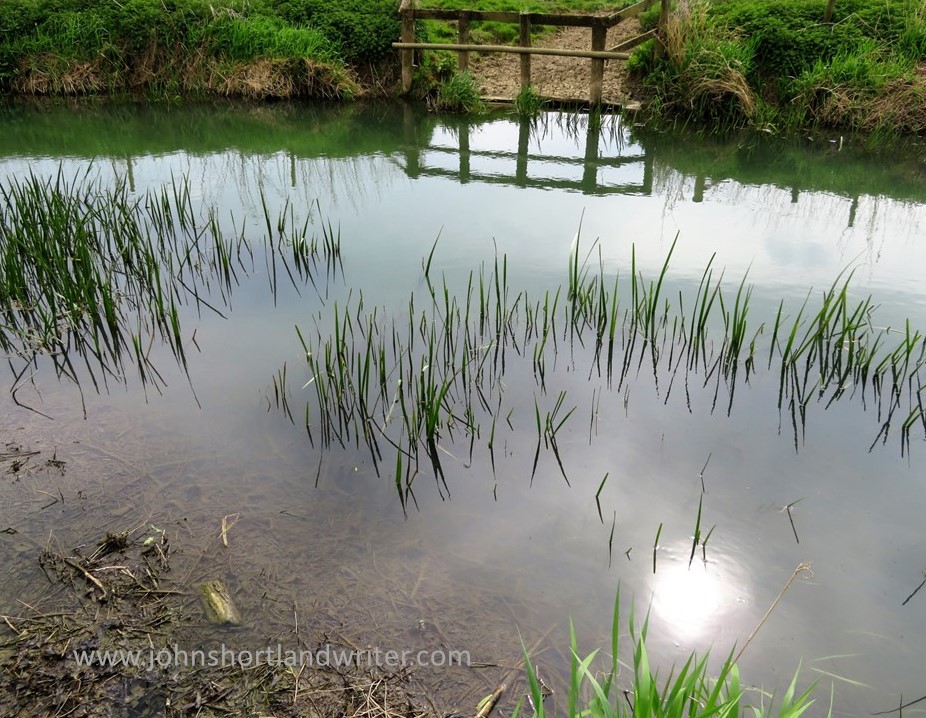
The sun seemed to shine brighter in the water than overhead
In the damper woodlands Ramsons, the wild garlic, carpeted the floor

To see more photos of the Roman villa and read of its history take a look at one of my earlier posts by clicking on the link here.

To read the full text of Hilaire Beloc’s poem of the Evenlode river click here

A Hurricane in a Teacup

With much of Britain recovering from the effects of three storms – Dudley, Eunice and Franklin – within ten days and Storm Gladys about to arrive, it seems appropriate to have some up-to-date thoughts on the time when we England experienced a hurricane. Or did we experience one? After the ridicule that poor Michael Fish, the weatherman, had to endure after he proclaimed in 1987 that “Britain doesn’t have hurricanes” only for the nation to wake up to find itself flattened, the forecasters have avoided using the ‘H’ word. Instead we have storms that are now named in the same way as hurricanes. Even more recently still, we are told we have ‘red alert’ storms. So, were these latest storms hurricanes or in reality were they, as my late father would have said, “just a bit of a blow?”

I wrote the thoughts below many years ago when pondering on the English Hurricane and the later 1990 storm. That wasn’t officially a hurricane either but did far more damage – hurricane-like damage, in fact. The only thing that this and these latest storms prove is that the debate hasn’t moved on very much over the intervening years…

The dangerous work of reconnecting electricity continues through the night

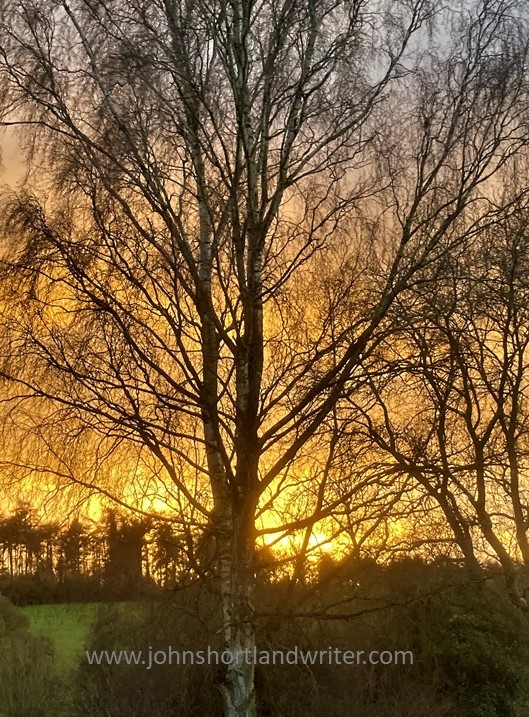
English people constantly talk about weather. It’s in our makeup, our genes – we can’t possibly walk past someone, even a total stranger, without saying something about it. We can’t help it, no matter how much we realise that the person isn’t that interested (or, for that matter, even if they don’t speak English, when we madly gesticulate skywards). We rattle on about too much rain, too little rain, too much sun, no sun, cold for the time of year, how warm it is. So, in the spirit of being a true Englishman, despite my part-Polish ancestry, I’m just going to mention that we had a fantastic sunset in the secret valley a couple of days ago.

I think the reason we may behave like this is because English weather is nearly always gentle. The landscape that makes up England is beautiful and can be dramatic but not in the way of so many other countries. Take the USA, for example. Where’s our Grand Canyon, our towering redwoods, our Rocky Mountains, our Great Plains and our Niagara Falls? We have them in miniature and, perhaps, that is just as well as we are such a small country. And likewise, our weather: we have heatwaves, we have floods, we have blizzards. But they are rarely anything truly spectacular (except to those poor people affected by them, of course). And so when we were told by the weather men in 1987 that reports of a hurricane were completely exaggerated, we believed them totally. And despite the fact that much of the country was hit hard by it when it arrived, my part of the Chiltern Hills where I lived at the time was not much affected, even though it is one of the most wooded parts of the country.

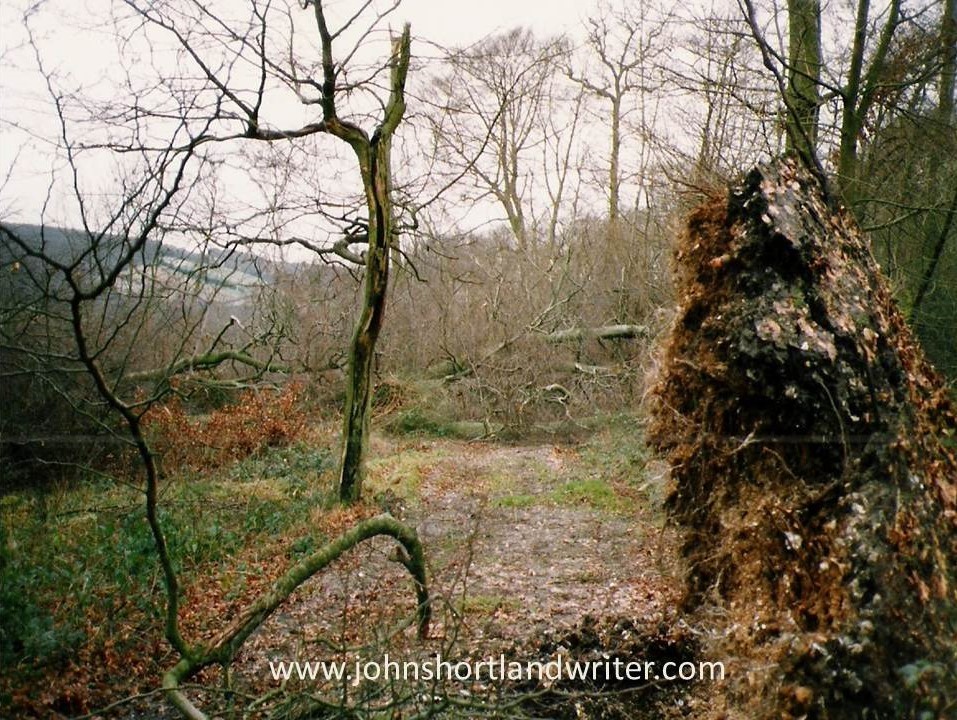
The night in January 1990 was different. This time we had winds, whilst not as severe as three years earlier, which created total havoc with the already weakened root systems of the trees. Great swathes of the magnificent beech woods that are the very heart and soul of the Chilterns were flattened in a couple of hours. I lived at that time in the middle of one of these woodlands and am frequently reminded that, as the rest of the world cowered in their beds and the trees came crashing down all around our house, I woke up to say “a bit windy out there” before falling asleep again. As dawn broke the true damage to the landscape (but fortunately not our home) could be seen.

It is now over thirty years since that storm and the woodands have been transformed. Those of us that remember the 200 year old beech know that the majority are gone and, in their place, are new trees of mixed species. It will be many years before the magnificence of the woods return but they are healing. This photo below is taken from the same spot as the one above. Some of the biggest old stumps have been left, too difficult to move – time has hardly changed their appearance apart from their ‘roof’ of mosses.

One of the unforeseen benefits of the hurricane is the increased amount of light reaching the woodland floor, for beech trees cast a dense shade where little can grow, other than where the canopy is lightest. Apart from the view to the valley below, which was unseen before, many wild flowers are better now than ever. Roll on April when we can see the blue carpet of tens of thousands of bluebells disappearing into the distance.

Oh! And I nearly forgot to say, the weather today is a mix of sunshine, cold winds, rain and sleet. Don’t forget to tell the next person you meet!

.

.

Discovering the Five Senses in Lockdown

It sometimes takes a crisis to make us re-evaluate what is of importance in our lives and the present one of Coronavirus/Corvid-19 surely has to be the greatest that we will collectively face. Now, several weeks into lockdown we have all been developing new patterns to our daily regime, one of which may well be taking more exercise. Never before have we placed so much value on fresh air and being able to walk freely whether it be in our parks, gardens or open countryside.

Marlow watermark

                           Riverside path, Higginson Park, Marlow (before social distancing).                                 The river is the River Thames in Buckinghamshire

Living where I do in the Cotswolds surrounded by fields and with woodlands and the river close by it is relatively easy for me to enjoy the open space. For others able to take advantage of their enforced free time, it may involve a longer walk and I have certainly noticed an increase in the numbers of walkers and cyclists here in the valley. I have also noticed that for many of them one aspect of their lives hasn’t changed: as they walk their eyes are glued to the screen of their mobiles and headphones are clamped to their ears, seemingly unaware of their surroundings. It has made me think all the more of our five senses and how we use (or should use) each one of them when out exercising.

Nr Fingest copyright

Cycling in the Chiltern Hills

SIGHT For those of us blessed with the gift of vision, perhaps sight is the most important sense we use and perhaps the one we most take for granted.  Without it, it is still possible to enjoy one’s surroundings for the other senses become heightened but I doubt if anyone would deny the pleasure of seeing the beauty that surrounds us on our daily walks. Even within cities there is much nature to be enjoyed although I admit that sometimes it has to be sought with more vigour and awareness.
Viola watermark

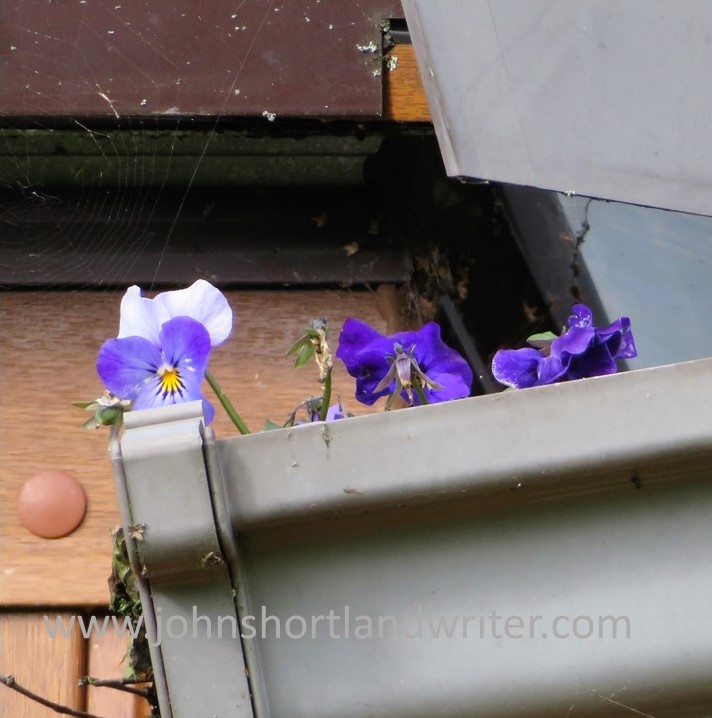
Look everywhere – self-sown violas peep out from overhead guttering!

At this time of year, more than any other season, there is much to see. Tight leaf buds unfurl into an explosion of vivid green foliage, iridescent wherever sunlight filters through; young ducklings tumbling into the park pond to take their first swim. But it isn’t just the natural world to be seen anew, there are other things too. Although it had been there for more than a hundred and forty years (and I’d walked past it very day for twenty) the date scratched into the stone on this wall had gone unnoticed.

Date stone watermark

Who scratched this date into the old stone wall and why?

HEARING Along with sight the second most important sense we use on our daily amble. Apart from the glory of birdsong there are other sounds that bombard us when out walking. The wind flurry that makes the catkins tremble and shed their pollen, the stronger breeze that make the twigs and branches clatter gently against one another. Then there’s the rustle in the undergrowth. Stop and wait silently and with patience you may be rewarded by the sight of a little field mouse going about its daily chores or a rabbit venturing out to feed.

Field Mouse watermark

patience was rewarded when this little field mouse ventured into the open

Altamont Gardens (8) watermark

… and also this rabbit

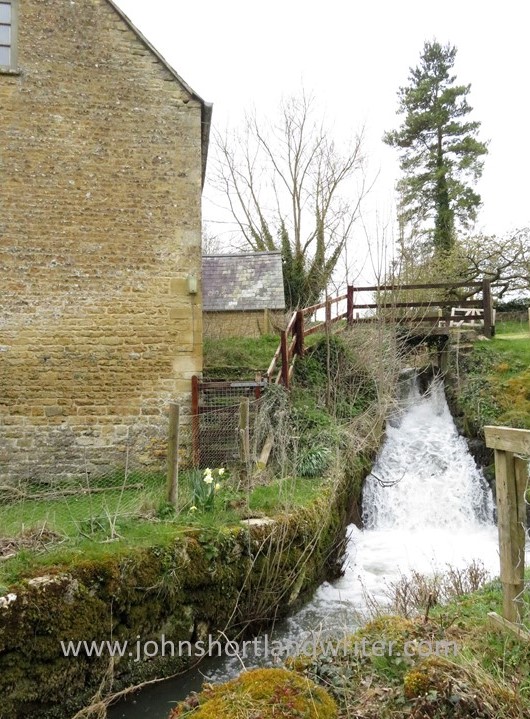
The sound of the river alters constantly. The smooth, barely audible glide of the water changes to a tinkling of soft musical sounds, its flow interrupted by a fallen branch. A few yards further downstream they rise to a crescendo as they crash and tumble over the old millrace before returning to silence as the flow stills in the calm of the millpond.
Radford Mill (1) watermark

The old millrace 

Radford Mill watermark

the calm of the millpond

TOUCH   In the present crisis we are sensibly being discouraged from touching things unnecessarily. Out on walks perhaps care may be advisable when opening gates or climbing stiles but, if you do, take a moment to think about what you feel. Heed the cold steel of the metal five-bar gate and the way it slowly warms beneath your hand; feel the rough timbers of a stile worn smooth from much use over the years. Of less concern health-wise – and all the more pleasurable for that – become aware of the softness of new horse chestnut leaves; later in the year they will become as harsh as sandpaper. Run your fingers across the twisted, grooved bark of the sweet chestnut tree and stroke the furry softness of the aptly named ‘Lamb’s Ears’, the favourite garden herbaceous plant Stachys byzantina.

Sweet Chestnut 4 watermark

The deeply grooved bark of the Sweet Chestnut tree

Stachys byzantina  Lamb’s Ears

SMELL   The scent of spring is everywhere at the moment and to be delighted in. However, the sense of smell is also a powerful trigger of long-forgotten memories. In a few weeks’ time the sweet scent of drying hay in the meadows may recall childhood farm holidays but for now there is the unique smell of new-mown lawns. Both start off as freshly cut grass yet their scent is so surprisingly different. Likewise, compare the subtly differing fragrance of apple and cherry blossom, both in their full-blown glory right now.
Drying hay before baling

The smell of freshly-mown grass…

Without even leaving home, squeeze the leaves of the herbs on the kitchen sill and notice their variation in scent, their colours and textures too. Early morn in the woodland, especially after warm rain, the delicate perfume of bluebells quickly disappears as the sun becomes stronger. Half-close your eyes and glory in their colour, in the silence and in their perfume and leave all cares behind you – if only for a while.

discover the different textures & scents of herbs

The vivid greens & blues of an English beechwood in spring

In town, the scents are also there just waiting to be noticed. Rain falling on roads and pavements or scorched by hot sun both produce delightfully tarry smells, one mild, the other strong. In the formal beds of the local park flowering bulbs stand in regimental rows; each have a unique scent which rises in the air to mingle with the vanilla fragrance of wallflowers. The wallflowers, their dull green foliage barely noticeable throughout the winter, now shout out the arrival of spring through the colours of their flowers of brick red, orange and yellow.

Tulips & wallflowers – a favourite park bedding combination

TASTE   In shaded places where the soil stays moist you may be greeted – even before you arrive – by the pungent scent of wild garlic. A prolific carpeter of the woodland floor its leaves and flowers make a useful ingredient to spring salads. Wild garlic or Ramsons to give it it’s country name, is fickle where it will grow. In some places that would seem suitable, not a single plant can be found. A less common member of the onion family to be found in the wild are the chives of our gardens, they grow along road edges and field boundaries locally. It is thought that they were spread by the old drovers of centuries ago so that they could harvest them along the way to liven up a bland meal. There is no doubting its identification, disturb the tubular green leaves and the familiar scent is immediately released.

Ramsons grow in damp, shaded places

It is not only the onion family that can be nibbled en route. Richard Mabey in his book Food for Free, published many years before foraging became a ‘craze’, suggests nibbling on the half-open buds of hawthorn. Many a country child has done so over countless generations and perhaps that is how they got their old name of Bread and Cheese. To me, they only have a slightly nutty taste and texture.

Hawthorn leaf buds are not really worth eating!

As a boy, brought up close to the River Thames, the hollow stems of the common reed were a regular source of pleasure for the soft pithy centre could be drawn out by pulling the stems through clenched teeth. Close to my present home there is also a small reedbed. These tall reeds have something to offer every one of the other senses too: sight – the pleasure of watching petrol-blue damsel-flies sunbathing on the stems; hearing – as they sway and rustle with the slightest breeze; touch – the coarseness of the leaves, a contrast to their smooth stems; smell – those of the river as it seeps around the roots, a heady mix of wet mud and wet greenery.
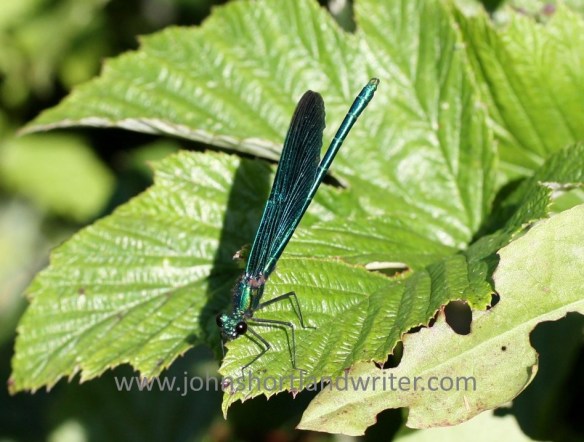
Only the male of the Beautiful Demoiselle damsel-fly has petrol-blue wings & body

So, within the bounds and restraints of the Covid-19 advice when out on your daily exercise, remove the earphones, place the phone in your pocket and use, really use, every one of your senses. Not only will you notice more, you will wonder how you never managed to notice them before. Stay safe, stay alert and take this unique opportunity to discover a new world on your doorstep.

Finally, one word of warning. Only try tasting wild plants if you are confident they have been identified correctly. If you decide to forage, do so responsibly and only pick a few leaves at a time. Make sure that all plants for consumption are free of pesticides and other contaminants, especially those growing in or near water.




The Glories of a Beechwood

Buckinghamshire, one of the so-named Shire counties, lies to the north-west of London.  A long, narrow county; the southern part is renowned for its beech woodlands.  Although greatly diminished in size over the centuries, many of them are still there, remnants of the ancient woodlands that once covered much of Britain, although the industries that they supported are long gone.

Nr Fingest 2 watermark

In the Chilterns the beechwoods can almost engulf the lanes

Straddling the Buckinghamshire/Oxfordshire borders the Chiltern Hills extend diagonally northwards into neighbouring Bedfordshire where they change character from dense woodlands to more open downland.  It is within the shadow of the southern woodlands where I was born and where I lived for the greater part of my life before moving to the secret valley in the Cotswolds.  Inspired by Enid Blyton’s The Children of Cherry Tree Farm, my childhood was spent crawling around the fields, woods and hedgerows learning as much as I could about the wild birds and animals that lived within them.john david shortland 1965 watermark

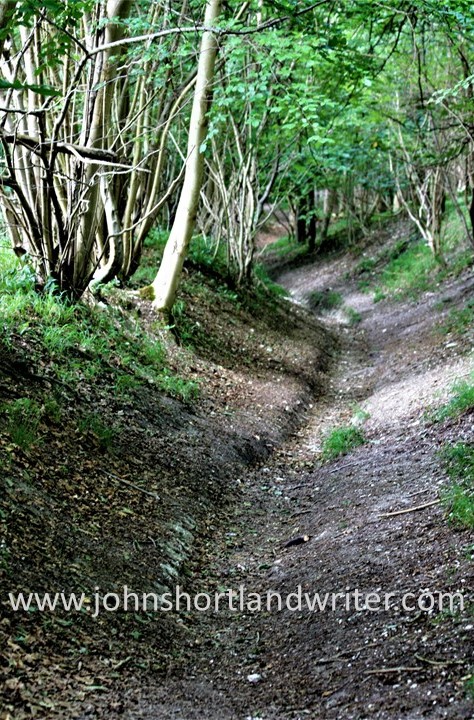
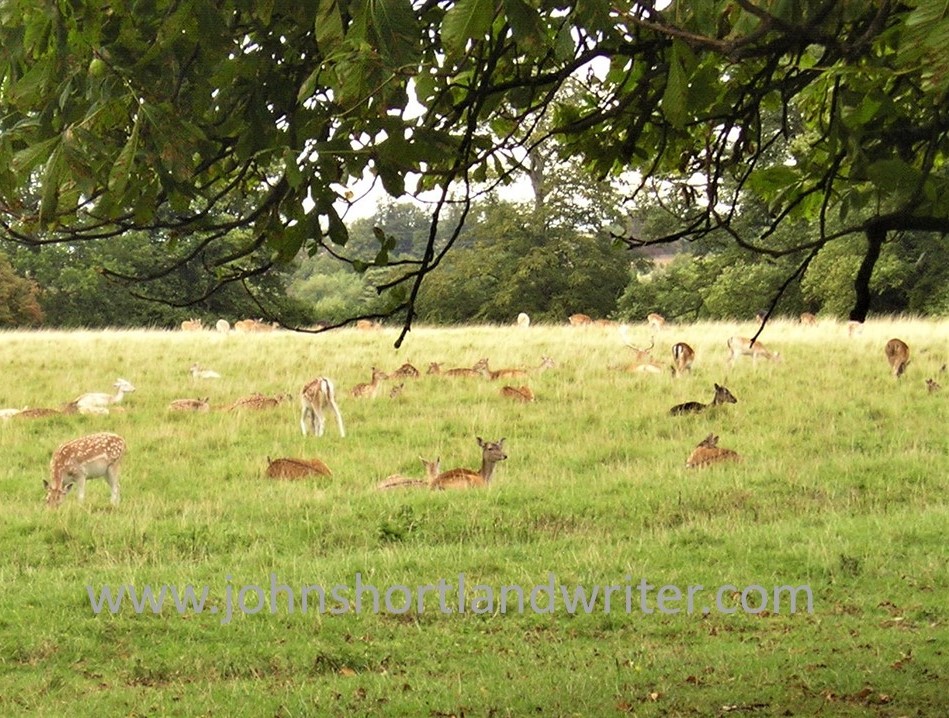
Although nowadays the woods appear mostly deserted, they are still made use of.  The old tracks and paths that were once used by the men and women that worked and lived there are trodden by walkers, and by the wildlife that remains elusive for only those that move quietly have the pleasure of seeing anything other than a glimpse of a fleeing animal.

Woodland Track (2) watermark

This centuries old track leads down into a deep valley

Fallow Deer watermark

Fallow deer can often be seen at rest in clearings if you walk quietly

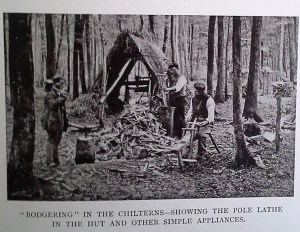
The making of chair legs to keep the flourishing furniture industry of High Wycombe, the local market town, was carried out within the woodland by men who would set up shelters there.  Known as chair-bodgers, a local dialect word originally confined to this immediate area, they were highly skilled craftsmen who could earn relatively high wages for their work.  The Second World War virtually ended the centuries old tradition, the last being Samuel Rockall who died in the early 1960s.  I had been unaware of Rockall’s life until I researched for this blog post and it seems as if we may have been related for I have Rockalls in my family tree.  In the 1851 census return one of my ancestral cousins is described as a chair turner living in the village where I spent much of my adult life.  More research required!

1851 census - Rockall

Jonathan Rockall, chair turner and ancestral cousin in the 1851 census return.  His wife, Ann, a lace maker,- another local craft

Some of my cousins?! Photo from an old book ‘English Country Life & Work’

It is, perhaps, springtime when the beech woods are most visited for the forest floor is carpeted with bluebells.  The intensity of their colour plus the iridescent green of the tree’s unfurling leaves almost hurt the eyes.  With early morning sunshine the scent is unique and difficult to describe – gentle is the best I can come up with.  As the day progresses the scent is quickly lost.Chilterns Beechwood copyright

During midsummer, the woods become visually silent: the leaves have turned a dark, leathery green and the bluebells gone to lie dormant for the rest of the year.  With autumn, the trees become alive once more with colour, this time as their leaves turn into every shade of copper, gold and brown before they drop to the ground for winter.  It is then that the smooth bark of the trees come to the fore with a silvery sheen that catches the low light of a winter’s day.  Although it may seem as if the woodlands are sleeping, in places the first bluebells are starting to poke their noses through the leaf litter.  Spring is on its way.Autumn colour watermarkIbstone 1984 watermark