The Beauchamp Chapel – a medieval masterpiece

Just occasionally nothing prepares you for a visual and emotional onslaught however much you might have read or seen images of it.  I had been planning my first visit to Warwick for a few years.  Perhaps it is because it is so close to home – about an hour’s drive north from my part of the Cotswolds – that it had taken me so long to actually go there for, when a place is on your doorstep, you feel you can go at any time and so put it off for another day.  As it happened, I finally arrived in the town on the first warm, sunny day of spring when the ancient black and white timbered buildings really stood out against the blue sky.

Warwick is even older than those medieval buildings for it has been inhabited since the 5th century.  However, it came to prominence when William the Conqueror built Warwick Castle in AD1068.  Today, it is possible to visit the castle and even stay there but this was not the purpose of my visit.  I had come to see a later building – the Collegiate Chapel of St Mary, most of which is only a mere three hundred years old.  A great fire had swept through the town in 1694 destroying much of it as well as the greater part of the original church.  Miraculously, the fire was extinguished saving the chancel and the Beauchamp Chapel built during the 14th and 15th centuries.  The crypt is all that is left of an even earlier church built over 900 years ago.

The Collegiate Church of St Mary, Warwick
The 900 year-old crypt – all that is left from the earlier church

I had only been standing in the church a few moments when the organ began to play; the timing could not have been better for it set the mood for the whole visit. Lovely as it was, I moved on quite quickly to the chancel dominated by the tomb and effigies of Thomas Beauchamp and Katherine Mortimer.  Both died within a few months of one another in 1369 and their effigies are unusual for they lie there holding hands, signifying not just their undying love but also their equal status for Katherine had brought land and wealth to the marriage.  The chancel is also unique for its light and graceful ‘skeleton rib’ vaulted roof simply adorned with the Beauchamp coat of arms clasped by angels.

The tomb of Thomas Beauchamp & Katherine Mortimer who died in 1369 – my ancestral grandparents
The ‘skeleton rib’ vaulting & Beauchamp crest held by an angel

From the chancel it is possible to glimpse into the Beauchamp Chapel where Thomas’ grandson Richard’s tomb stands.  I purposely avoided doing so for I wanted to enter the chapel and to see it for the first time in its full glory.  As I mentioned in this blog post’s opening sentence, I was completely unprepared for the visual feast that stood before me.  The colour, the light, the opulence, the sun-kissed, bronzed effigy of Richard lying there centre stage was pure theatre – just the effect Richard had planned when he left detailed instructions for the building of the chapel all those centuries earlier.  With the organ still playing behind me, I stood in the entrance transfixed, feeling slightly silly for being so moved before descending the steps to explore further. I had finally come to see the burial place of my ancestral grandfather.

Richard’s dramatic tomb lying in the Beauchamp Chapel

A short (but necessary!) history of Richard’s life: Richard Beauchamp was born in England in early 1382, the son of the 12th Earl of Warwick.  His godfather was King Richard II although within a very few years Richard’s father, also a Thomas, had fallen out of favour and imprisoned in the Tower of London for treason.  Fortunately for him at least, the King was deposed and replaced on the throne by Henry IV; Thomas was released and his titles and land restored.  During the King’s coronation in 1399, Richard was knighted and later succeeded to the title of 13th Earl of Warwick at his father’s death in 1401.  When Henry V succeeded to the throne in 1413 Richard became one of the new King’s most trusted advisers and given responsibility for the education of his young son, later to become Henry VI.  Richard then spent much of his time in France, part of which had been annexed during the Hundred Years War and he died there in Rouen on 30th April 1439. 

Richard’s armour is captured in fine detail
The bear and the griffin are Beauchamp heraldic emblems

Richard’s body was brought back to England and buried in a temporary grave in the church, for in his Will of 1437 he leaves detailed instructions for the construction of the new chapel to house his tomb.  No expense was to be spared for he wanted it to become one of the finest in England, in which he more than succeeded.  The creation of the chapel as one complete and new entity, using only the finest materials and highest quality craftsmanship makes it unique – all the more so, for its surviving almost unscathed by the later Reformation, attempted destruction during the Civil War, as well as the great fire. He was finally laid to rest there in 1475.

The Great Fire of 1694 stopped behind the chapel wall destroying the lower part of the wall paintings

The tomb is, of course, the central feature of the chapel as well as its purpose. Richard lies on an intricately carved and highly coloured marble chest set with fourteen gilded ‘weepers’, namely his children and their spouses. There had been a dispute after Richard’s death within the family over inheritance for Richard had been married twice with children from each. It was Ann that finally inherited the title and estates, a daughter from the second marriage (my ancestor was Eleanor, the second daughter from the first marriage) and so it was she that oversaw the completion of the chapel. Richard’s effigy is of a younger man, his eyes open, his hands outreaching, and dressed in full armour, showing the world that he is ready to enter the Kingdom of Heaven. He gazes upon the stained glass that confirms this story.

Richard’s daughters, some of the fourteen ‘weepers’ that surround the tomb
Ann, who became the 16th Countess of Warwick in thoughtful pose

The stained glass is another miracle of survival for it is mostly complete. During the English Civil War (mid-1600s) many of the country’s churches and religious icons were damaged or destroyed with the Protestant dogma that followed. The Beauchamp Chapel’s glass was spared much of this with only its lower parts damaged. Although it cannot be seen in my photograph, it was hastily repaired – perhaps a little too hastily for Richard’s head and hands were replaced with those of a woman. The imagery depicts saints and angels in glowing colours, produced at huge expense. Musicians are shown with their instruments and a banner of sheet music runs across the entire window. The notations can be clearly seen and, as instructed by Richard, this is sung in the chapel each September with prayers said for his soul, a practice of huge significance in medieval times. There is a short YouTube video of the choir singing this original music in the chapel, as well as a brief history of the windows which can be found here.

Richard, reborn, raises his arms towards Heaven
Section of the East Window surrounded by statues of saints

Within the chapel are many other delights although none overshadow Richard. Tombs of his descendants, the Dudleys (through his eldest daughter Margaret), were placed there. They are resplendent in their own right but do not form a part of this blog. Even the prayer stalls, quite modest compared to other features of the chapel deserve close attention with their heraldic emblems carved into their timbers; they are fine in quality as well as detail. They can more briefly be shown by photos but deserve inclusion.

The tomb of Robert Dudley and Lettice Knollys
Beautifully carved prayer stalls, now almost 600 years old

My family connection to the Beauchamps. When you travel back through so many centuries from the present day you are bound to uncover many ancestral grandparents. The problem is the discovering of them for in most families, as in the rest of mine, they lived very ordinary lives that were not well recorded if at all. Just occasionally, it is possible to find one that has risen to fame and this is the case with my paternal grandmother’s family. Granny Shortland’s relatives had been well-known up to the early-1900s for they held high positions within the Church of England and Government. A friend of Tennyson, the Reverend George Bradley had risen to become the Dean of Westminster Abbey. His brothers and sisters had also risen to fame in their spheres of work. These connections, known as ‘gateway ancestors’ enabled the research to progress relatively easily through time to Thomas Bradley – my 8th great-grandfather – who had been Chaplain to King Charles I and later, after the restoration of the monarchy, Charles II. From there the connections to the Beauchamps and even further back are well-researched by historians. It had always been whispered that Granny Shortland had married ‘beneath herself’ – now I know the reasons why!

Granny Nellie Shortland c 1945

Visiting: The Collegiate Church of St Mary and The Beauchamp Chapel is open to visitors free of charge. Guided tours (which are well worth doing) are available at a modest cost, as is a climb to the top of the tower to view the town and beyond. Details can be found on their website here.

Warwick Castle is impressive and a popular attraction. It was the home of the Beauchamps but was built in the 11th century by command of William the Conqueror. It is possible to stay in the castle for short breaks. More details can be found here

There is a useful website (click here) if you are planning a visit to Warwick, which is situated a few miles south of the city of Birmingham and north-west of London.

In Pursuit of Spooky

It’s Halloween so when can be a better time to consider what scares us and what doesn’t?  To be honest, I don’t really ‘get’ Halloween.  I don’t find any excitement in all those ghoulish faces cut into pumpkins or in the buying of fake cobwebs and skeletons.  Perhaps it’s because I don’t care for fancy dress of any kind: for me there is only a feeling of mild embarrassment on other people’s behalf as they don face paint and hideous costumes.  Quite why I should feel the need to apologise for other people’s silliness when they are obviously enjoying themselves enormously, as are those around them, goodness knows.  After all, it’s just a bit of harmless fun, isn’t it?  Possibly, but then again, possibly not.

Beneath Huntington Castle

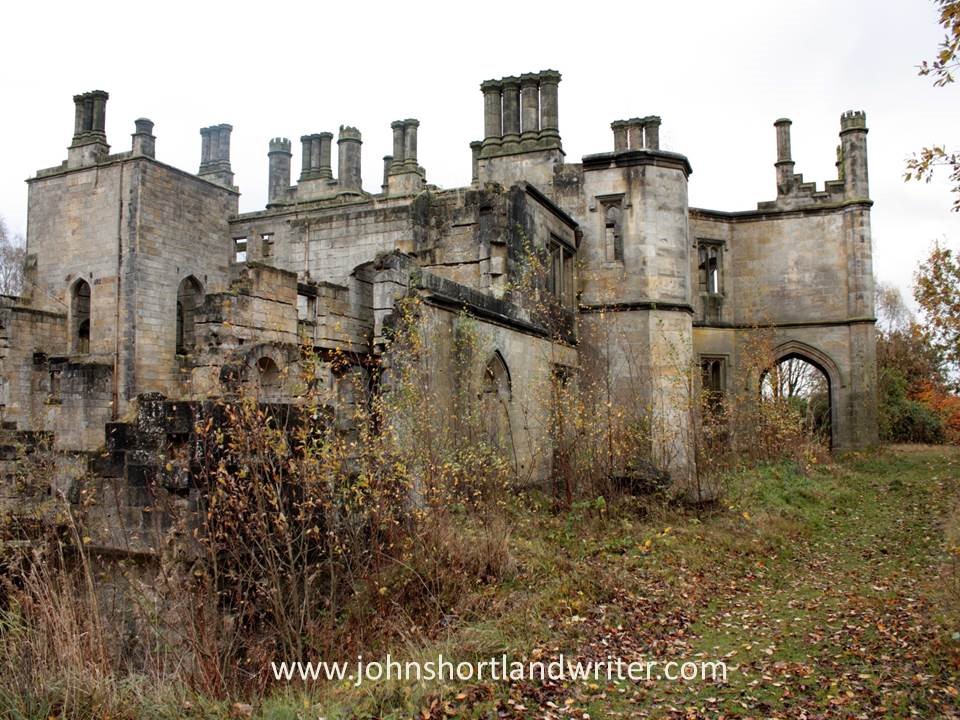
Like many teenagers, I messed around with Ouija boards without any lasting harm, but they can be a great source of trauma and anxiety for others.  It isn’t pumpkins and fancy dress that are scary, or for that matter, it isn’t the dead either, it’s the living.  And the one that’s likely to scare us the most is our living self for who knows what our minds are capable of conjuring up.  Despite my indifference to Halloween, I do like a good scary moment as much as (or perhaps even more than) the next person.  There is nothing like exploring a derelict building – especially if you can visit at dusk as I did, the old mansion in the photos below – to get the mind working overtime.

The abandoned and derelict Dunmore Park

My feeling of unease only increased when, following a maze of passageways, I found myself in the cellars.  I had forgotten my mobile phone and the only source of light I had was to trigger the flash on my camera.  Of course, that only gave the briefest moment of vision before plunging me into even greater darkness.  Extracting myself from the cellars, I made my way through derelict gardens only to find an equally ruined tower.  Pushing open the door I chose not to explore further when I realised that I was entering an empty crypt – were the coffins scattered nearby, I wondered.  It was definitely time to get back home and to the land of the living.

I just couldn’t resist entering the far door…
I found myself in total darkness
The empty crypt in the tower was just a little too creepy for me!

A few years ago I received an invitation to a house party and stay overnight in a remote, medieval manor house.  Arriving, again at dusk, and expecting to find a throng of people, instead I entered an empty and dark house.  Fortunately, the electric lights worked but as I explored the building with its stone staircases and grotesque carvings I half-wondered if I was about to star in a real-life crime drama, tricked by someone with a long-held grudge.  My imagination went into overdrive when leaning against a wall of oak panelling, it opened to reveal a secret room.  I was glad when my fellow partygoers arrived and the house became a lively and wonderful place to stay.

Just one of several staircases at medieval Wortham Manor
The grotesque carvings with eyes that seemed to follow you…
The panel opened unexpectedly to reveal a secret room

Of the various creepy experiences that I have sought out or endured (depending on the circumstance) perhaps, rather surprisingly, the ones that have unsettled me most of all have been places that are normally associated with crowds, bustle and noise.  The ferry to Ireland is a case in point and an unlikely candidate for spooky.  Somehow, I became the first person to board and as I walked along empty decks and through deserted lounges, it felt rather as if I had just discovered the Marie Celeste.  Of course, it was only a very short while before other passengers arrived but not before I’d begun to think that others must have known something that I didn’t and had decided to stay away.

The deserted ferry to Ireland was surprisingly spooky
What had happened to all the other passengers???

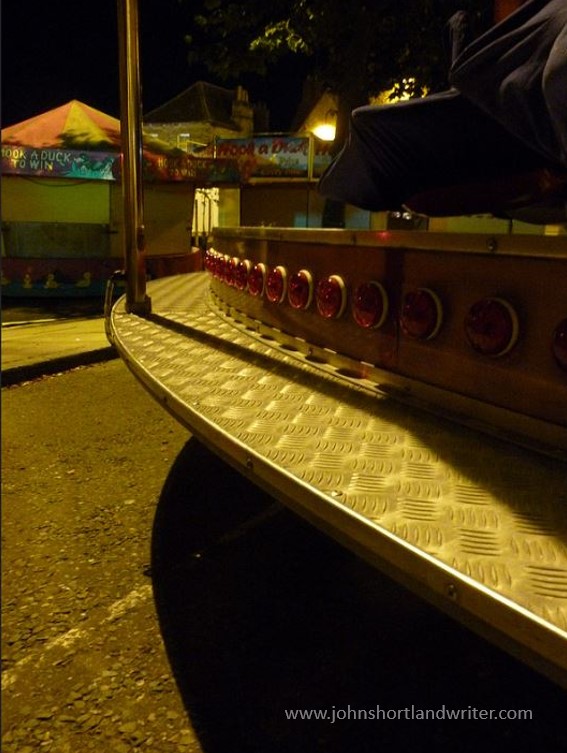
Perhaps the very creepiest place I’ve experienced was also the one I would have least expected it to be.  Walking home late one night I decided to take a short cut through the fairground which had closed a couple of hours earlier.  Associated with noise, excitement, music and flashing lights, the area was silent and deserted.  There was no danger but around each corner I expected to find someone lurking in the shadows, not helped by the ghoul I came across hanging from a scaffold behind the blacked-out House of Horrors.  Arriving back home in the darkness and silence of the secret valley I was met by the reflection of a hundred eyes watching me.  Fortunately, they were real-life sheep and thankfully, not the ghosts of countless Sunday roasts coming back to haunt me.

The deserted fairground: shadows and surprises around every corner…
That made me jump!
Being watched as I walk home late at night

So, what do you like/dislike about Halloween? What scares you the most? I will be intrigued to know!

.

.

.

The Year in Review: January – June 2016

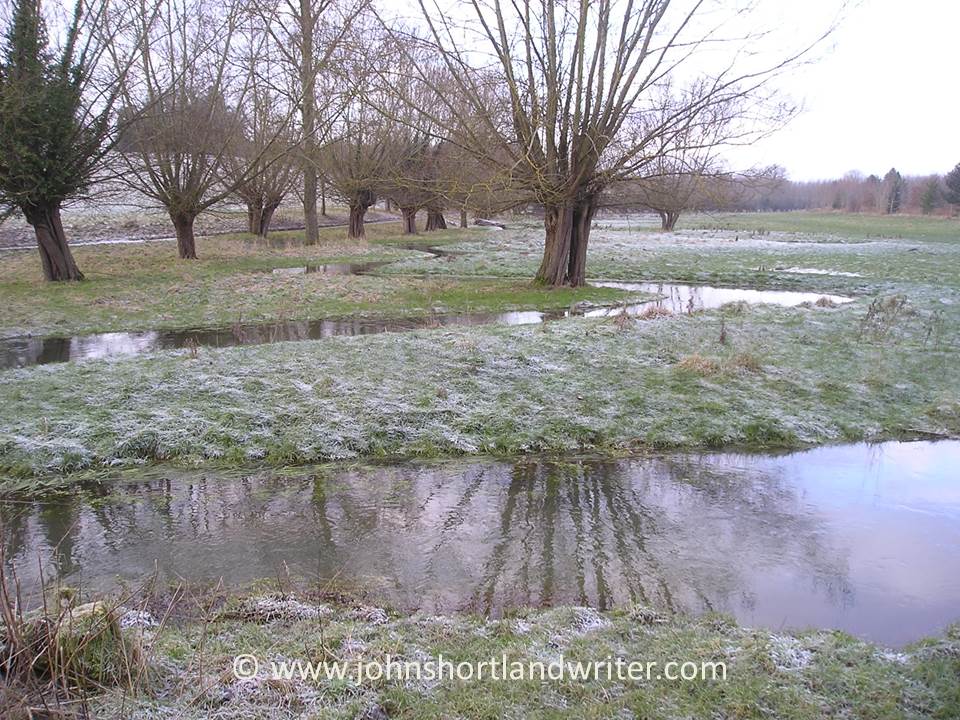
As always the year has flown by to leave us with much uncertainty and sadness in the world.  Fortunately, life in the secret valley continues pretty much the same – it is easy to find relief from everyday stresses when surrounded by unspoilt countryside.  Rarely does a day pass when I don’t count my blessings for having had a rural upbringing and the opportunity to continue to live and work in such beautiful surroundings.frost-4-copyright

However, I am no hermit and I enjoy visiting other places – even cities!  One city I loved when I visited it some years ago was Stockholm, the capital of Sweden and I began the blogging year with a post about the Skansen open air museum.  Skansen was the first tomove and preserve traditional, threatened buildings; it was founded as early as 1873.  As well as buildings it also houses a zoo, concentrating on breeding native wildlife for reintroduction schemes including the European Bison which had become extinct in the wild.  To see more of the buildings click on the link here.8  Sweden. Skansen   copyright13 Sweden.  Skansen   copyright

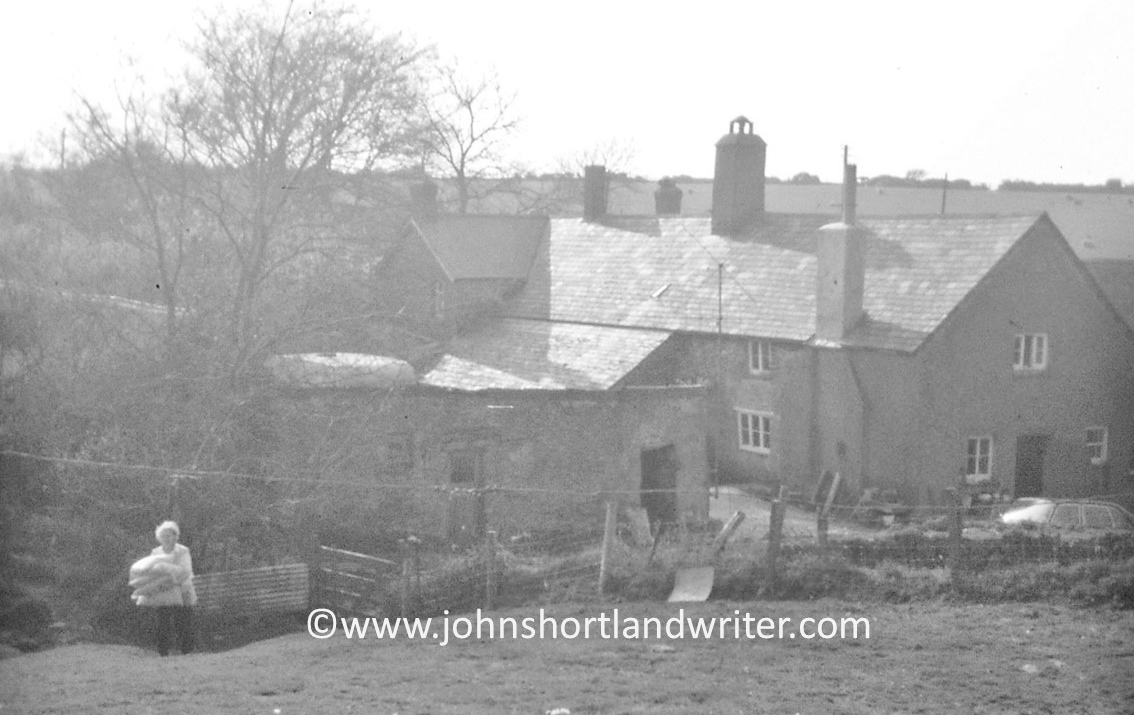
Exmoor is a second home to me and features regularly on my blog.  In March, with some misgivings – for why would I want to share such a magical place – I took readers on my favourite walk, one that wouldn’t be found in any guide book.  The walk encompasses all that is best on Exmoor: open heather moorland, deep wooded combes, rushing streams and traditional pubs.  It also passed the door of the hill farm where I turned up as a lad looking for work after leaving school.  I was taken in and cared for – and made to work hard – and, well read the story by clicking on the link here.Above Brendon Barton (2)   copyrightLil @ Brendon Barton 1968   copyright

April saw me back on the Continent (as we Brits call Europe).  This time in the south of France visiting the ancient town of Lombez.  It is far from the tourist routes and we discovered it quite by chance.  With its ancient, timbered buildings and wonderful, brick built cathedral it deserved a longer visit than we were able to give it.  An excuse for a return trip, perhaps?  In the meantime, you can visit it by clicking on this link here.Lombez (22)   copyrightLombez (4)   copyright

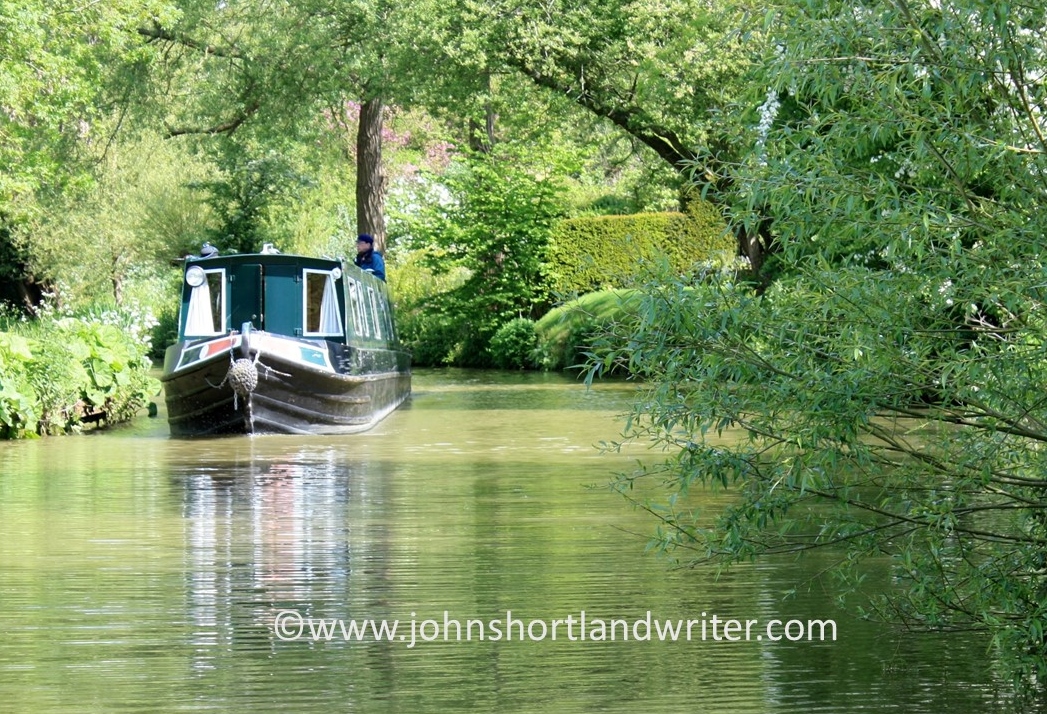
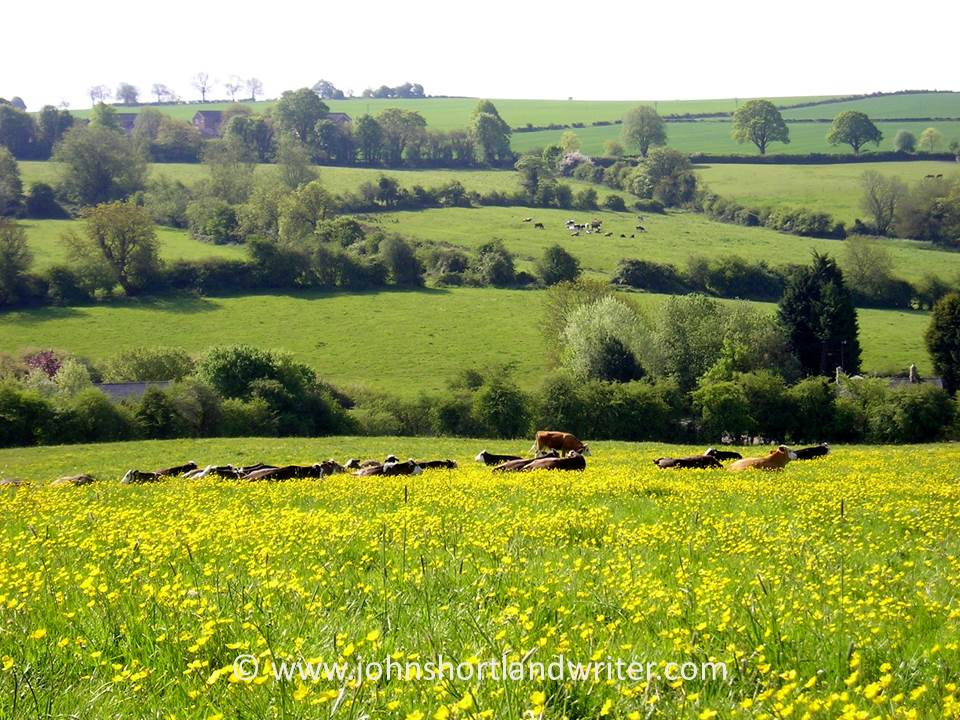
If April saw us travelling slowly through France, May saw us travel at an even slower pace – by longboat on the Oxford Canal.  Passing through traditional buttercup meadows – we were miles from the city of Oxford – and in glorious sunshine it was the perfect way to relax as well as to see the wildlife that seemed oblivious to our passing.    Click on the link here to see more.016   copyright076   copyright

Our native butterflies struggle to thrive but I have been fortunate in living in places where they prosper reasonably well.  As a gardener, (both my hobby and my profession), I probably see more than most and in June I wrote about the species that visit gardens.  See how many you can identify  in your own garden by clicking on the link here and don’t forget to record them with your local conservation trusts or online.Comma Butterfly (2)   copyright

2017 may well prove to be a year that none of us forget too easily.  Travel abroad or in the countryside – and the British countryside is second to none – always helps to refresh the spirits.  I have numerous plans for the year ahead and hope that you will be joining me month by month.  In the meantime, the review of the second half of this year will follow shortly and don’t forget that images of the Cotswolds and other places I visit are updated regularly on my Facebook page and on Flickr.  You can also find me on Twitter @johnshortlandwra typical Cotswold scene   copyright


A Day on the Oxford Canal

There’s nothing like messing about in boats on a warm, late spring day…

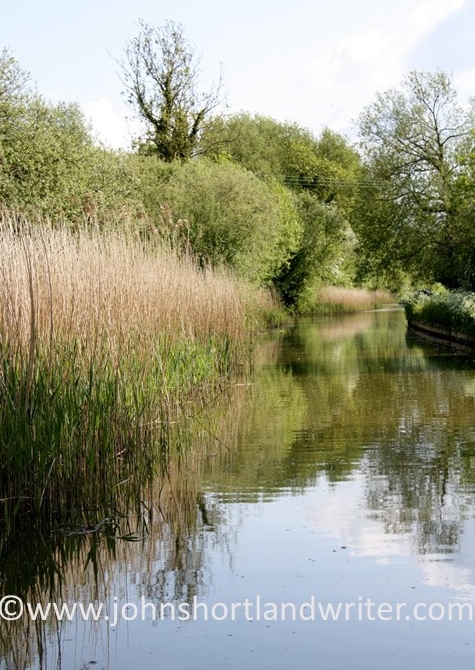
The building of the Oxford Canal was first brought into action with the passing of an Act of Parliament in 1769.  Beset with difficulties – mostly financial – its total 78 mile length wasn’t completed until 1790.  Linking the industrial Midlands region of England with the south of the country, the cost-cutting that was required has allowed the canal to claim it is one of the most scenic.   This is partly due to the canal following the contours of the land giving the canal numerous bends, rather than the more usual (and more expensive) building method of cutting a straight line through the landscape.

003   copyright

Although the northern section from its start at Coventry to Napton was straightened in the 1820s, the southern section to its end at Oxford where it enters the River Thames (giving access to London) remained unchanged.

016   copyright

Once completed the canal became one of the busiest and most profitable in England and, unlike many others, prospered even after the coming of the railways.  Barges carrying coal to London were still plying their trade as late as the early 1960s.  Today, the railway rules and often follows the same route.

058   copyright

However, the Oxford Canal is still one of the busiest waterways in the country, only now with leisure traffic.  On the day of our attempt at barging it was pleasantly quiet and we shared the canal with few others. The only hint of an industrial past was the working barges of the Canal & River Trust, the charity responsible for maintaining the two thousand miles of waterways in England and Wales.

025   copyright


Travelling at a speed slower than walking pace isn’t for everyone – I found it a little frustrating – but it does give ample opportunity to admire the scenery, buildings and wildlife.  The tithe barn at Upper Heyford, built around 1400AD, is magnificent.  More images of the barn, which is privately owned, can be seen by clicking here.


130   copyright

076   copyright

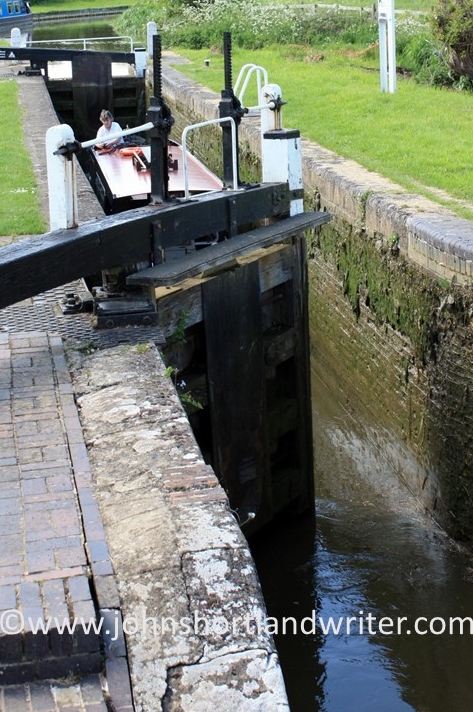
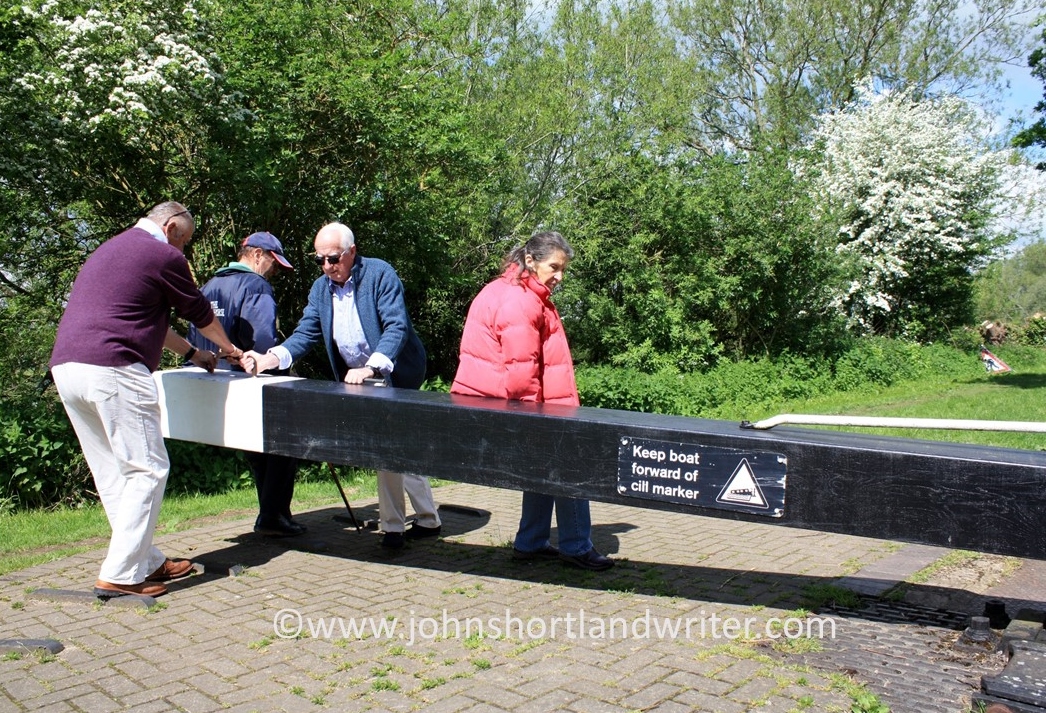
One of the cost-cutting methods used in construction was to incorporate a section of the River Cherwell into the canal.  The problem that this created with variable water flow is still an issue today.  Another saving more readily visible are the locks: fewer in number and deeper, many have single gates instead of the more usual two.

096   copyright

023   copyright

Manoeuvring such a large boat is a surprisingly quick skill to master but there are always other, more savvy boat people around that are happy to assist or advise when needed.  Our boat was hired from the yard at Little Heyford and we travelled north, meeting up with friends for a bankside picnic before returning to the marina.

101   copyright

A daytrip – or perhaps a longer holiday on a barge – is definitely to be recommended even though I found the pace a little too slow.  The next time I am on one I shall remember the words of Pooh, that wisest of bears:  “Rivers know this: there is no hurry.  We shall get there one day.”

133   copyright

Click on any of the photos to enlarge

Links:

The Oxford Canal – a more detailed history

The Canal & River Trust

Boat Hire – Lower Heyford