The Beauchamp Chapel – a medieval masterpiece

Just occasionally nothing prepares you for a visual and emotional onslaught however much you might have read or seen images of it.  I had been planning my first visit to Warwick for a few years.  Perhaps it is because it is so close to home – about an hour’s drive north from my part of the Cotswolds – that it had taken me so long to actually go there for, when a place is on your doorstep, you feel you can go at any time and so put it off for another day.  As it happened, I finally arrived in the town on the first warm, sunny day of spring when the ancient black and white timbered buildings really stood out against the blue sky.

Warwick is even older than those medieval buildings for it has been inhabited since the 5th century.  However, it came to prominence when William the Conqueror built Warwick Castle in AD1068.  Today, it is possible to visit the castle and even stay there but this was not the purpose of my visit.  I had come to see a later building – the Collegiate Chapel of St Mary, most of which is only a mere three hundred years old.  A great fire had swept through the town in 1694 destroying much of it as well as the greater part of the original church.  Miraculously, the fire was extinguished saving the chancel and the Beauchamp Chapel built during the 14th and 15th centuries.  The crypt is all that is left of an even earlier church built over 900 years ago.

The Collegiate Church of St Mary, Warwick
The 900 year-old crypt – all that is left from the earlier church

I had only been standing in the church a few moments when the organ began to play; the timing could not have been better for it set the mood for the whole visit. Lovely as it was, I moved on quite quickly to the chancel dominated by the tomb and effigies of Thomas Beauchamp and Katherine Mortimer.  Both died within a few months of one another in 1369 and their effigies are unusual for they lie there holding hands, signifying not just their undying love but also their equal status for Katherine had brought land and wealth to the marriage.  The chancel is also unique for its light and graceful ‘skeleton rib’ vaulted roof simply adorned with the Beauchamp coat of arms clasped by angels.

The tomb of Thomas Beauchamp & Katherine Mortimer who died in 1369 – my ancestral grandparents
The ‘skeleton rib’ vaulting & Beauchamp crest held by an angel

From the chancel it is possible to glimpse into the Beauchamp Chapel where Thomas’ grandson Richard’s tomb stands.  I purposely avoided doing so for I wanted to enter the chapel and to see it for the first time in its full glory.  As I mentioned in this blog post’s opening sentence, I was completely unprepared for the visual feast that stood before me.  The colour, the light, the opulence, the sun-kissed, bronzed effigy of Richard lying there centre stage was pure theatre – just the effect Richard had planned when he left detailed instructions for the building of the chapel all those centuries earlier.  With the organ still playing behind me, I stood in the entrance transfixed, feeling slightly silly for being so moved before descending the steps to explore further. I had finally come to see the burial place of my ancestral grandfather.

Richard’s dramatic tomb lying in the Beauchamp Chapel

A short (but necessary!) history of Richard’s life: Richard Beauchamp was born in England in early 1382, the son of the 12th Earl of Warwick.  His godfather was King Richard II although within a very few years Richard’s father, also a Thomas, had fallen out of favour and imprisoned in the Tower of London for treason.  Fortunately for him at least, the King was deposed and replaced on the throne by Henry IV; Thomas was released and his titles and land restored.  During the King’s coronation in 1399, Richard was knighted and later succeeded to the title of 13th Earl of Warwick at his father’s death in 1401.  When Henry V succeeded to the throne in 1413 Richard became one of the new King’s most trusted advisers and given responsibility for the education of his young son, later to become Henry VI.  Richard then spent much of his time in France, part of which had been annexed during the Hundred Years War and he died there in Rouen on 30th April 1439. 

Richard’s armour is captured in fine detail
The bear and the griffin are Beauchamp heraldic emblems

Richard’s body was brought back to England and buried in a temporary grave in the church, for in his Will of 1437 he leaves detailed instructions for the construction of the new chapel to house his tomb.  No expense was to be spared for he wanted it to become one of the finest in England, in which he more than succeeded.  The creation of the chapel as one complete and new entity, using only the finest materials and highest quality craftsmanship makes it unique – all the more so, for its surviving almost unscathed by the later Reformation, attempted destruction during the Civil War, as well as the great fire. He was finally laid to rest there in 1475.

The Great Fire of 1694 stopped behind the chapel wall destroying the lower part of the wall paintings

The tomb is, of course, the central feature of the chapel as well as its purpose. Richard lies on an intricately carved and highly coloured marble chest set with fourteen gilded ‘weepers’, namely his children and their spouses. There had been a dispute after Richard’s death within the family over inheritance for Richard had been married twice with children from each. It was Ann that finally inherited the title and estates, a daughter from the second marriage (my ancestor was Eleanor, the second daughter from the first marriage) and so it was she that oversaw the completion of the chapel. Richard’s effigy is of a younger man, his eyes open, his hands outreaching, and dressed in full armour, showing the world that he is ready to enter the Kingdom of Heaven. He gazes upon the stained glass that confirms this story.

Richard’s daughters, some of the fourteen ‘weepers’ that surround the tomb
Ann, who became the 16th Countess of Warwick in thoughtful pose

The stained glass is another miracle of survival for it is mostly complete. During the English Civil War (mid-1600s) many of the country’s churches and religious icons were damaged or destroyed with the Protestant dogma that followed. The Beauchamp Chapel’s glass was spared much of this with only its lower parts damaged. Although it cannot be seen in my photograph, it was hastily repaired – perhaps a little too hastily for Richard’s head and hands were replaced with those of a woman. The imagery depicts saints and angels in glowing colours, produced at huge expense. Musicians are shown with their instruments and a banner of sheet music runs across the entire window. The notations can be clearly seen and, as instructed by Richard, this is sung in the chapel each September with prayers said for his soul, a practice of huge significance in medieval times. There is a short YouTube video of the choir singing this original music in the chapel, as well as a brief history of the windows which can be found here.

Richard, reborn, raises his arms towards Heaven
Section of the East Window surrounded by statues of saints

Within the chapel are many other delights although none overshadow Richard. Tombs of his descendants, the Dudleys (through his eldest daughter Margaret), were placed there. They are resplendent in their own right but do not form a part of this blog. Even the prayer stalls, quite modest compared to other features of the chapel deserve close attention with their heraldic emblems carved into their timbers; they are fine in quality as well as detail. They can more briefly be shown by photos but deserve inclusion.

The tomb of Robert Dudley and Lettice Knollys
Beautifully carved prayer stalls, now almost 600 years old

My family connection to the Beauchamps. When you travel back through so many centuries from the present day you are bound to uncover many ancestral grandparents. The problem is the discovering of them for in most families, as in the rest of mine, they lived very ordinary lives that were not well recorded if at all. Just occasionally, it is possible to find one that has risen to fame and this is the case with my paternal grandmother’s family. Granny Shortland’s relatives had been well-known up to the early-1900s for they held high positions within the Church of England and Government. A friend of Tennyson, the Reverend George Bradley had risen to become the Dean of Westminster Abbey. His brothers and sisters had also risen to fame in their spheres of work. These connections, known as ‘gateway ancestors’ enabled the research to progress relatively easily through time to Thomas Bradley – my 8th great-grandfather – who had been Chaplain to King Charles I and later, after the restoration of the monarchy, Charles II. From there the connections to the Beauchamps and even further back are well-researched by historians. It had always been whispered that Granny Shortland had married ‘beneath herself’ – now I know the reasons why!

Granny Nellie Shortland c 1945

Visiting: The Collegiate Church of St Mary and The Beauchamp Chapel is open to visitors free of charge. Guided tours (which are well worth doing) are available at a modest cost, as is a climb to the top of the tower to view the town and beyond. Details can be found on their website here.

Warwick Castle is impressive and a popular attraction. It was the home of the Beauchamps but was built in the 11th century by command of William the Conqueror. It is possible to stay in the castle for short breaks. More details can be found here

There is a useful website (click here) if you are planning a visit to Warwick, which is situated a few miles south of the city of Birmingham and north-west of London.

A Celtic Church on Exmoor

Exford lays claim to the title of ‘Capital of Exmoor’ owing to its central location (one assumes) in Exmoor National Park. It certainly has more facilities than most others of similar size – a village green, a post office, two shops and a garage, although the days when it sold petrol pumped by hand have long passed.Exford - St Mary Magdalene   copyright

The church of St Mary Magdalene pre-dates the Norman Conquest of 1066 and, unlike much of England, originates from the Celtic tradition brought from Wales or possibly Ireland. Centuries ago, much of Exmoor’s trade and travel links were by sea, the Welsh coast being only a few miles across the Bristol Channel; journeys overland were fraught with difficulty and danger.

Exford - St Mary Magdalene (13)   copyright

During the twelfth century mass was said by monks from Neath Abbey, giving another Welsh connection. As a Celtic church it was dedicated to St Salvyn although at an unknown later date it was rededicated to St Mary Magdalene. The east window depicts St Salvyn with St George and St Francis.

St Salvyn depicted in the left panel of the east window

St Salvyn depicted in the left panel of the east window

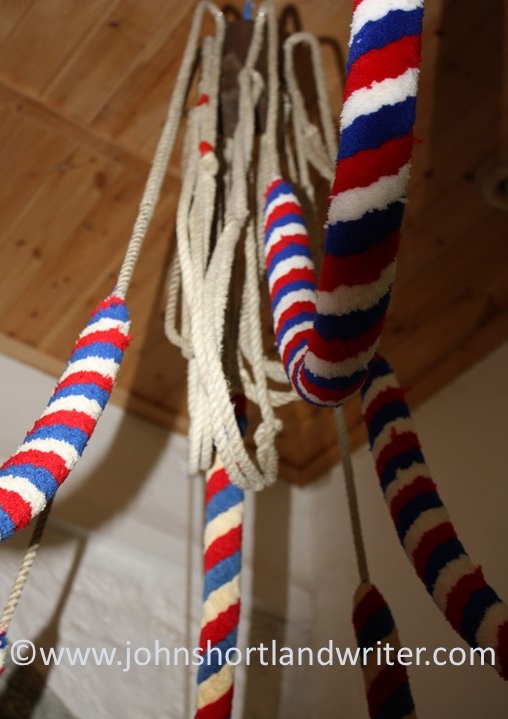
Despite its ancient origins the earliest part of the church still standing – the tower – only dates from the mid-1400s. It has a fine set of bells. The south aisle was built around 1532.

Exford - St Mary Magdalene (5)   copyright

The exquisitely carved rood screen dates from the fifteenth century and has a rather remarkable recent history. Discarded when the church of St Audries at nearby Watchet was rebuilt, it was rediscovered in the early 1900s in pieces in an old hay barn. It was beautifully restored and placed in Exford.

Exford - St Mary Magdalene (4)   copyright

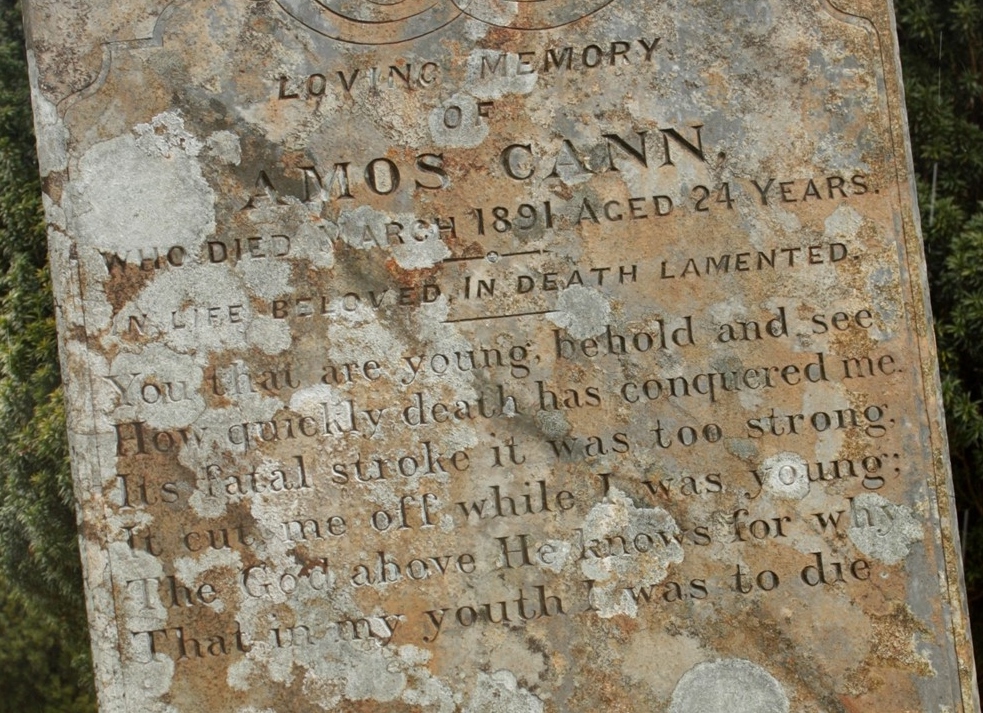
Close to the entrance gate of the churchyard stands the memorial to Amos Cann, a young man who froze to death walking home one night in the extreme winter of 1891. His body was found some three weeks later.

click on image to enlarge

click on image to enlarge

All is Safely Gathered In?

The air is heavy with the scent of harvest.  Is it the summer heat that produces the heady smell of fresh straw or the act of cutting it?  Probably a combination of both but the result gives mixed emotions for, whilst there is something very comforting about knowing that the corn is safely stored and the livestock will have plentiful winter bedding, there is also a tinge of regret for it is the first sign that autumn is rapidly approaching.

Harvest is one of the few events in the modern farming calendar which gives an insight into the ways of country life of generations ago.  These days, for most of the year, farming is a solitary occupation with a skilled tractor operator carrying out the tasks of many people.  Now the fields often seem empty, quiet places, devoid of human life or activity. Even fifty years ago there were more people working there but go back even further, say another hundred, and there would have been the sights and sounds of dozens of people working from dawn until dusk, racing against the weather.  A poor harvest then meant months of hardship and hunger for many.  Modern harvesting, albeit for a much shorter time is when the fields seem alive once more with combines, grain trucks, straw wagons and the like. 


The image below is taken from a nineteenth century farming manual belonging to my great, great-grandfather, and it demonstrates just how many people both men and women, were required for harvest. There were the mowers with their scythes, the gatherers, the bandsters who bound the sheaf together and then set them in ‘stooks’ to keep dry. Finally, the raker would clean up all fallen straw and grain for none could be afforded to be lost.  Harvesting by hand was surprisingly speedy for a skilled mower could cut over an acre of wheat in a day.  However, by the 1880’s virtually all corn was harvested by horse drawn machines.

Many attempts were made to design a harvesting machine throughout the centuries – the earliest, using oxen, is described by Pliny two thousand years ago.  The binder – as seen in the wonderful engraving also taken from g-g-grandad’s book – which cut and tied the corn into sheaves in one operation, first came into use in the 1850’s; it continued to be used for another hundred years: by 1979 when the photograph below was taken it was an eccentric rarity. 

the binder can just be seen on the middle right of the photo
 
Combine havesters are giants compared to the binders of old and when they travel through the secret valley they take up the full width of the lane with very little room to spare.  First to be cut is oilseed rape, the crop that turns vast swathes of the British countryside bright yellow in spring.  The resulting stubble, unlike that of corn, is sparse and sharp and makes for uncomfortable walking on.


Barley, oats and wheat – which in the UK are collectively referred to as ‘corn’ – then follow with each crop (and its straw) having its own requirement and characteristic.  Modern technology may have shortened the number of days it takes to bring in the harvest but the working day is just as long as it ever was for the combines work from early morning to late at night, providing the crop doesn’t become damp with dew or rain. 

Harvest has always been dependent upon the weather so it is not surprising that upon completion celebrations take place.  Although the traditional Harvest Supper is now mostly a thing of the past, the Harvest Festival church service is still one of the most popular.  On Exmoor – where I helped with harvest in my early years – and typical of a remote, tightly –knit community, every window ledge and the altar of the church would be decorated with flowers, fruit and vegetables.  Pride of place was given to the first stookof corn cut from the field. Packed with families that had been too busy to meet one another for several weeks the hymn ‘Come Ye Thankful People, Come’, written by Henry Alford in 1844 a line from which the title of this blog post is taken, and a great favourite of the farmers, was sung with gusto.

Exmoor church

Add to Technorati Favorites

Don’t Be Put Off By Its Name…

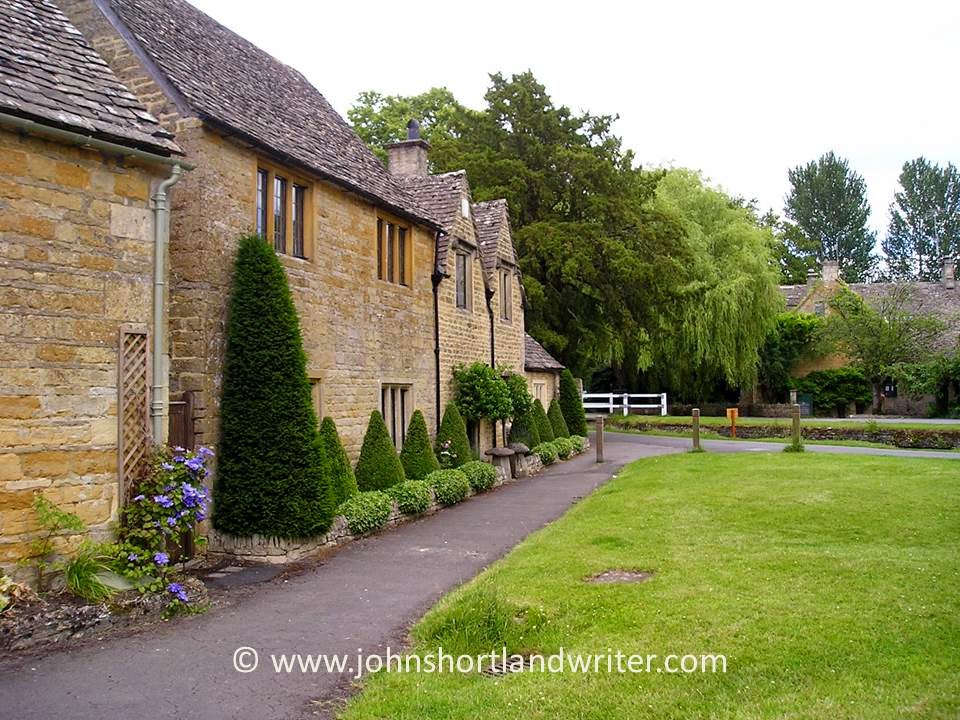
Slaughter may not sound the most promising of names but Lower Slaughter situated in the heart of the Cotswold Hills is one of the prettiest and most unspoilt villages you can visit.  Its unusual name is a derivation of the Old English word ‘slough’ meaning muddy patch but, if it was many years ago, it is certainly not one now.  In fact, three years ago it was described in a poll as having ‘the most romantic street in Britain’.

Although there is some more recent housing discreetly tucked away most of the buildings date from the mid sixteenth to mid-seventeenth centuries.  Its origins are even older  for it was well established even before being recorded in the Domesday Book; this means that it has been continuously inhabited for over a thousand years.

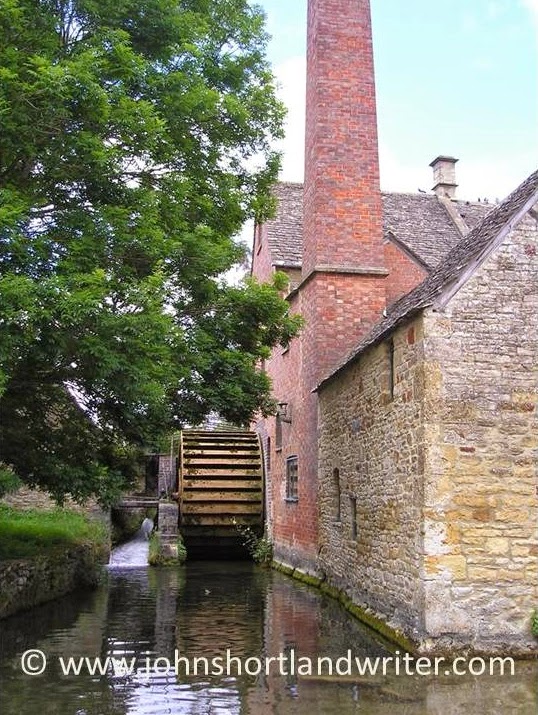
Many of the oldest houses cluster around the the River Eye which, although shallow, is powerful enough to feed the undershot waterwheeel of the mill.  This building, which now houses a small museum, is made from red brick – an unusual building material in this area – and was working as recently as the the late 1950’s.  It is a comparatively modern building having been built in the 1800’s although a mill was recorded on the site in 1086.  The tall chimney was built to give the mill additional steam power.
A similar tale can be told of the picturesque church with its tall spire which also dates from the ninteenth century.  There are a few traces of the original building within it: an arcade of four bays dating back to the early 1200’s.  The lichen encrusted gravestones in the churchyard also belie their age for burial rights were only granted in 1770 – before then villagers were buried in nearby Bourton-on-the-Water.


The countryside surrounding Lower Slaughter, and also the village itself, may not appear to have changed much in centuries but there is no doubt that they are very much ‘tidier’ than they once were.  An old Pathe News clip shows the banks of the Eye overgrown – there probably wasn’t the same enthusiasm for cutting its grassy banks when it has to be done by scythe.  Another change the film shows is the ‘locals’ sitting on the benches: nowadays, many of the houses are owned by the wealthy as weekend retreats and those exploring its lanes are visitors. 


Lower Slaughter, despite its obvious attraction, has done very little to encourage tourism.  It is still possible to sit there or cross its little stone footbridges or paddle in the ford and be transported back to a time when life ran at a much slower pace.  It makes a very refreshing place for visitors to recharge the batteries after the crowds of its larger neighbours, Bourton and Stow-on-the-Wold or, for us lucky enough to live in the Cotswolds, to do the same after a hard day’s labour. 
 
Lower Slaughter is just 2½ miles north of Bourton-on-the-Water and 3 miles west of Stow-on-the-Wold.  The Old Mill sells great ice cream!
To see the Pathe News Clip from1939 click here

Add to Technorati Favorites

Richard Jefferies – His Passion Lives On

Great artists such as Gainsborough, Turner and Reubens speak to us down the centuries through their work as do poets but how many people still read the great – or the lesser – writers from years past?  The Bible is still read regularly by some, Shakespeare’s more famous lines are often quoted and we all think we know Bronte and Dickens whereas, in reality, most of us know the characters only as interpreted through television and film.  However, authors from past centuries still  have much to offer whether it be for historical background, research or, simply, pleasure.

I have always lived in the country and my fascination with the natural world began at a very early age.  My kindergarten class was taken on a nature walk and, as our teacher showed us the magical things to be found along the way, I became hooked and wanted to know more.  There are many excellent wildlife manuals and handbooks, new and old, that give detailed descriptions more often than not, in a rather dry, analytical way.  Wouldn’t it be wonderful if there was someone who could give all this information in great detail; who would notice the minutiae of everyday things, whether a flower, a wild creature or even of man, himself?  In the late nineteenth century there was one such person, now forgotten by most, and his name is Richard Jefferies – most definitely not a poet but there is poetry in his words.

Jefferies, born in 1848, in a Wiltshire (England) farmhouse suffered ill-health and subsequent poverty for much of his life.  From a young age he had enjoyed solitude and wandering about the countryside and here he developed a fascination for the Iron Age hill fort on nearby Liddington Hill and the wildlife that could be found there.  Employment as a reporter, initially with a local newspaper, developed his writing skills and his literary work began to be published, first as a series of essays and later in book form, from 1874.  He died from tuberculosis in 1887.  His books vary from collections of nature notes and the countrymen he encountered on his travels to novels, including one, After London, which would now be described as post-apocalyptical.  In it he describes how nature has taken over the now vanished city with its few surviving inhabitants returning to the lifestyle of many centuries before.  Jefferies still has his devotees, myself included, and he deserves better recognition.  The remainder of this post is my demonstration of how his words are of relevance to everyone today, especially those who are passionate about the wonders of nature – not the awe-inspiring world famous creatures or places but the everyday ones, found all around us, that should be equally awe-inspiring.

Nothing sums up my feelings towards the natural world better than these words of his.  They almost seem to have been written to illustrate this photograph of myself aged four with my father.

“So it seemed to me as a boy, sweet and new like this each morning; and now after the years they have passed, and the lines they have worn in the forehead, the summer mead shines as bright and fresh as when my foot first touched the grass…”      
The Open Air, 1885

“Next he stepped into the current, which, though shallow, looked strong enough to sweep him away. The water checked against him rose to the white mark on his breast. He waded up the rapid, every now and then thrusting his head completely under the water; sometimes he was up to his neck, sometimes not so deep; now and then getting on a stone…”                                                                 The Water Colley (Dipper), The Life of the Fields, 1884
“In the evening of a fine day the mists may be seen from hence as they rise in the meadows … beginning first over the brooks, a long white winding vapour marking their course, next extending over the moist places and hollows.”    
Wild Life in a Southern County, 1879
“Sometimes through these narrow slits (of cloud), long beams of light fall aslant upon the distant fields of the vale.  They resemble, only on a greatly lengthened scale, the beams that may be seen in churches of a sunny afternoon, falling from the upper windows on the tiled floor of the chancel, and made visible by motes in the air.  So through such slits in the cloudy roof of the sky the rays of the sun shoot downwards, made visible on their passage by the moisture or the motes of the atmosphere… the labourers say that the sun is sucking up water there.”   
Wild Life in a Southern County, 1879
“It is midsummer, and midsummer, like a bride, is decked in white. On the high-reaching briars
white June roses; white flowers on the lowly brambles; broad white umbels of elder in the corner,  and white cornels blooming under the elm; honeysuckle hanging creamy white coronals round the ash boughs; white meadow-sweet flowering on the shore of the ditch; white clover, too, beside the gateway. As spring is azure and purple, so midsummer is white, and autumn golden. Thus the coming out of the wheat into ear is marked and welcomed with the purest colour.”
Nature Near London,  1883
“…and finally is lost in the vast marshes which cover the site of the ancient London…  There exhales from this oozy mass so fatal a vapour that no animal can endure it. The black water bears a greenish-brown floating scum, which for ever bubbles up from the putrid mud of the bottom. When the wind collects the miasma, and, as it were, presses it together, it becomes visible as a low cloud which hangs over the place. The cloud does not advance beyond the limit of the marsh, seeming to stay there by some constant attraction; and well it is for us that it does not, since at such times when the vapour is thickest, the very wildfowl leave the reeds, and fly from the poison. There are no fishes, neither can eels exist in the mud, nor even newts. It is dead.”      
After London, 1885
“…the heat pours down by day as if an invisible lens in the atmosphere focussed the sun’s rays.
Strong woody knapweed endures it, so does toadflax and pale blue scabious, and wild mignonette…”                                       
Pageant of Summer, 1884
“Nature is a miniature painter and handles a delicate brush, the tip of which touches the tiniest
spot and leaves something living. The park has indeed its larger lines, its broad open sweep,
and gradual slope, to which the eye accustomed to small inclosures requires time to adjust
itself. These left to themselves are beautiful; they are the surface of the earth, which is always true
to itself and needs no banks nor artificial hollows. The earth is right and the tree is right: trim
either and all is wrong.”                                                 
Field & Hedgerow, 1889
 
Fortunately, much of his work is still readily available as books and, often, as free e-books.  The Richard Jefferies Society promotes his writing and holds regular meetings.  Visit their website by clicking the link here.  The farmhouse where Richard Jefferies grew up is now a museum dedicated to his life and work and well worth visiting.  Click here for details.
Add to Technorati Favorites

An Ancient Craft – Flint Knapping

The very earliest tools known to man were made of flint or antler and in the Chiltern Hills, where I was brought up and lived for most of my life, it wasn’t that unusual to dig up stone scrapers or even an occasional arrowhead, perhaps 4000 years old or more.  One scraper that I found many years ago is shaped perfectly to fit between the thumb and forefinger and still has an edge so sharp that it cuts card. 

To create these tools, the flints had to be chiselled or ‘knapped’, a technique that requires hitting the stone at an oblique angle with another hard object – such as another stone – to make it flake.  With the coming of the Iron Age, the need for stone tools was no longer required but the skill did not die out and even today there is a requirement for the finished material.

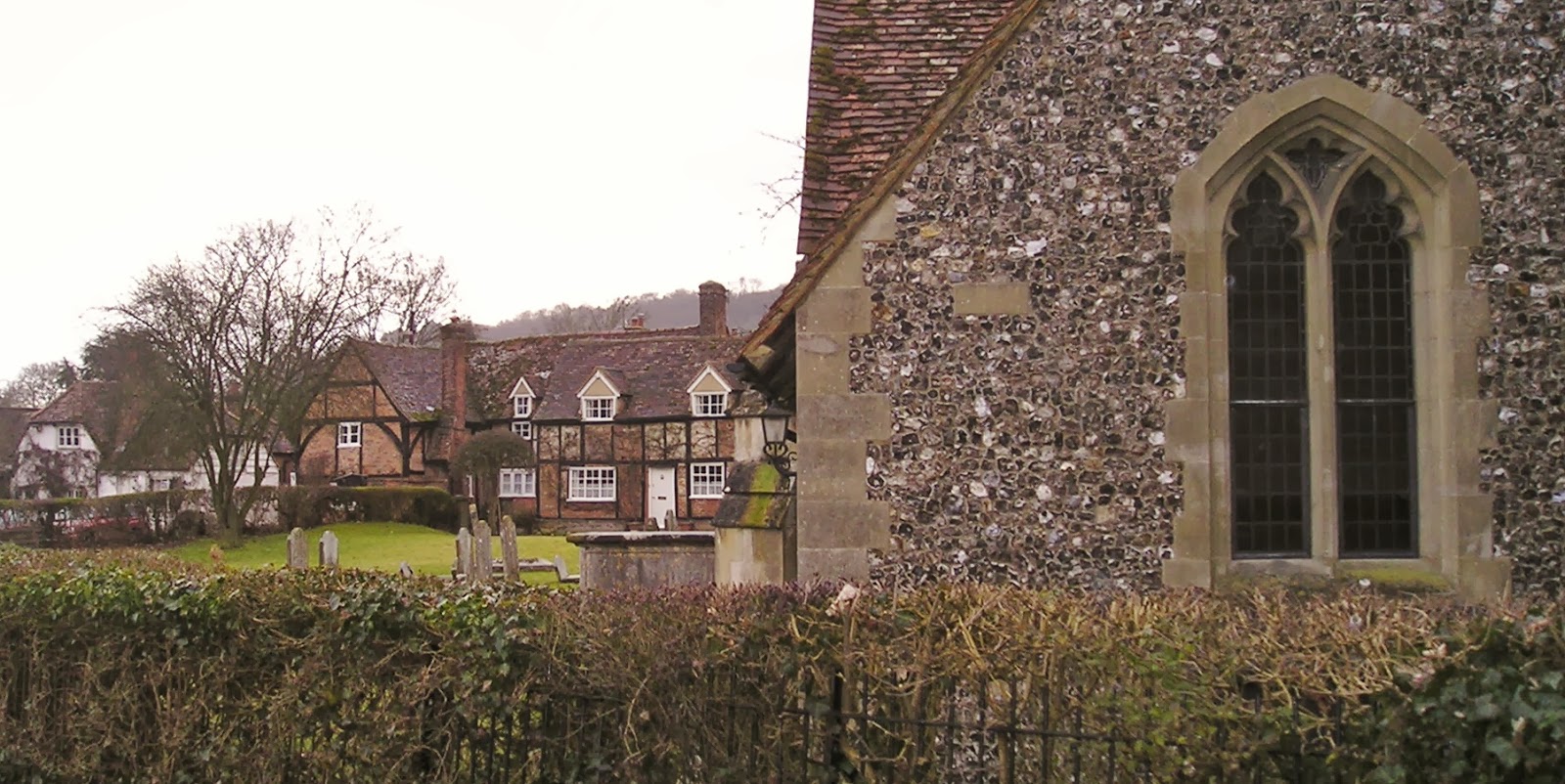
Flint, a type of quartz, is extremely hard and durable and, being found in quantity in the chalk hills of the Chilterns, was the natural material for housing there.  All types of properties used it from the humblest cottage to larger homes and churches.

One of the finest flint built villages can be found at Turville.  If the two photos below look familiar this is because they feature in the comedy television series, The Vicar of Dibley with actress Dawn French, playing the part of the Revd. Geraldine Grainger.  The village also featured in the 1998 film Goodnight Mr Tom, starring John Thaw.  The church dates back to the twelfth century.


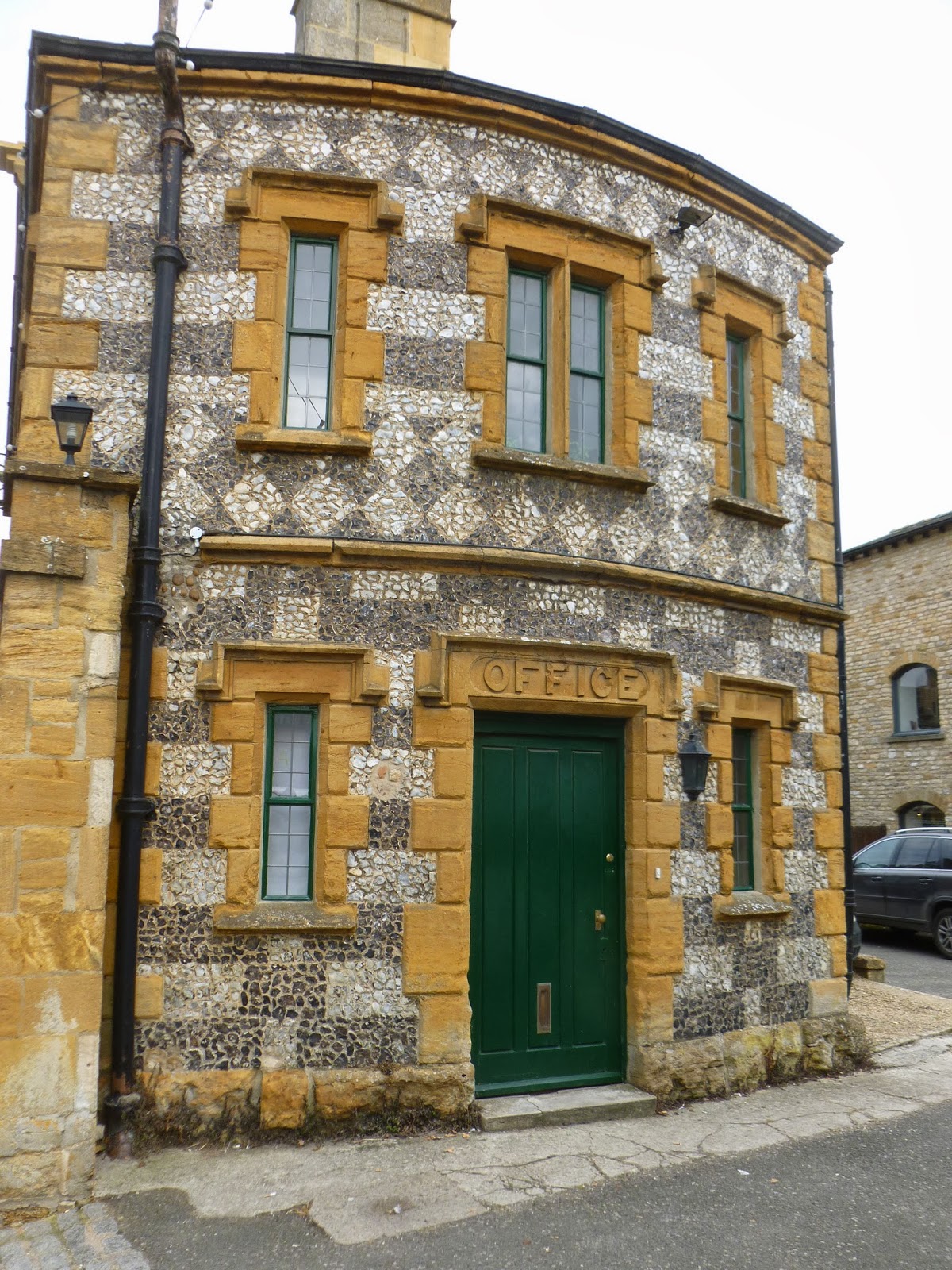
In the hills of the Cotswolds, the honey coloured limestone is the premier building material for almost everything but is especially well-known  for its use in the dry stone field walls and village houses.  At Stow-on-the-Wold in the centre of the region is the building below, once the office of the local brewery.  It is rare to find flint used in the area and, as can be seen, it has been used decoratively, something that is not found to my knowledge in the Chilterns.

Although all of these images show properties that date back at least 150 years or more, flint continues to be occasionally used in modern housing and was even used as embankment supports on the M40 motorway when it was widened in the Chilterns a few years ago.  As found throughout the centuries, when digging through the chalk, it proves to be the cheapest and most readily sourced building stone.

To find out more about flint knapping or to book a course to learn the art visit www.flintknapping.co.uk .  It is worth looking at just to hear the magical sound of primitive flutes made from elder  tree stems.


Add to Technorati Favorites

The Finest Stone Town in England

How often, when watching epics on the big screen or television, have you admired the scenery or buildings and wondered where they are or even if they exist in reality?   Those of you that have done this when watching Middlemarch or Pride and Prejudice can be reassured that, indeed, they do for they were filmed in the Lincolnshire town of Stamford, often described as the finest stone town in England.

Stamford has an ancient history.  The Romans constructed Ermine Street which passes through it only to be then pursued by Queen Boudica; almost a thousand years later it was the turn of the Anglo-Saxons against the Danish invaders.  The conquering Normans built a castle (to be demolished four hundred years later) but it was during the Middle Ages that Stamford really flourished due to the wool trade.  However, apart from its five medieval churches, the majority of the town’s buildings date from the seventeenth and eighteenth centuries.  In the late 1960’s, it became Britain’s first conservation area and is now designated an area of outstanding architectural interest.  It is due to this early protection that has earned the town its accolade, seconded by the Sunday Times (national) newspaper describing it as the best place to live in the country.

Close to the bridge which crosses the River Welland  stands the church of St. Martin’s, built around 1150 and completely rebuilt three hundred years later.  It contains some fine memorials to the Cecil family, the earliest dating from 1598, and also medieval stained glass brought from a neighbouring village in the 1700’s.


For those interested in church timber, St. Martin’s has finely detailed box pews and a carved lectern.  It also has the more contemporary (1947) carved head of Christ – Consummatum Est by Alberdi – representing the moment of his death; an anti-war protest.


William Cecil, the first Lord Burghley, was chief advisor, Secretary of State and Lord High Treasurer to Queen Elizabeth I.  It was he who built Burghley House, considered to be the finest of its age and open to the public.  It is still lived in by descendants of the family and also home to the International Horse Trials held in the Park each September.  I have written of these before and these posts can be found by clicking on the link here.

More of my images of Stamford and Burghley can be found on Flickr by clicking on the link here.

Refs:
http://www.stamford.co.uk/index.shtml
http://en.wikipedia.org/wiki/Stamford,_Lincolnshire
http://www.stamfordchurches.co.uk/
http://en.wikipedia.org/wiki/William_Cecil,_1st_Baron_Burghley
Add to Technorati Favorites

Chipping Norton – One Week To Go!


Chipping Norton, one of the gateway towns of the Cotswolds often gets overlooked on the tourist trail.  It is not surprising in some ways for many of the region’s towns and villages look as if they have come straight off the lid of a chocolate box – all golden, mellow stone crouched under a heavy hat of deep thatch, devoid of much of twenty-first century life.  Chipping Norton – or Chippy as it is affectionately known by the locals – is different: a bustling, working town full of people going about their everyday lives , whether shopping or working.

Look beyond the modern shop fronts and traffic and you find a gem of a town; raise your eyes for every building has a different façade and, yes, they too are built from Cotswold stone.  Explore the side streets and you find almshouses and a magnificent church and both the 16th century Guildhall and the Town Hall are as glorious a building as you will see anywhere.  Bliss Mill,  a former tweed mill now converted to flats, is surrounded by common land that reaches into the heart of the town.

Chippy is a busy place socially too and for a small town with a population of only 6000 there is always something taking place.  Perhaps one of the most ambitious of recent events is the Chipping Norton Literary Festival (ChipLitFest), the first of which was held last year to great acclaim.  This year it is bigger than ever and starts in just seven days time on the 18th April and continuing throughout the weekend.


Because the town is so small, the festival is held in numerous venues.  It is fortunate to have an award winning theatre to stage larger events and an award winning bookshop, Jaffe & Neale, that holds workshops – and sells the most delicious coffee and cakes.  It seems everyone is involved in one way or another: the Chequers pub, the Blue Boar Inn, the Crown & Cushion Hotel, the Vintage Sports Car Club, the local churches, the library; even the shoe shop is hosting a children’s event.  Incidentally, there are free things going on for youngsters all weekend and the festivals designated charity this year is Storybook Dads, which connects prisoners with their families through books and reading.

So who is coming to the festival? There is an amazing choice of eighty authors so there is bound to be someone to interest everybody.  Sir Julian Fellowes of Downton Abbey fame will be there; Fern Britton will be talking about her latest book – and perhaps her experience in Strictly Come Dancing.  For detective novel buffs, Mark Billingham will be discussing murder with Val McDermid, Stuart MacBride and Martyn Waites.  Did you see the film We Need to Talk About Kevin?  Author Lionel Shriver will be discussing her new book, Big Brother, which tackles the subject of obesity.  For foodies, Xanthe Clay, Henrietta Green and William Sitwell ask “are we a nation of food fashionistas?”

Prue Leith – one of our Festival patrons

Two events that especially appeal to me are Ursula Buchan’s talk ‘How England’s Gardeners Fought the Second World War’ and the Extreme Travel team of Nick Bullock and Jason Lewis discuss their adventures with Sue Cook.  Jason, incidentally, has just been recognised by the Guinness Book of Records as the first person to circumnavigate the world using only human power and described by the Daily Mail as “the most remarkable adventurer in the world today.”

Sue Cook, another of our Patrons

One of the especial pleasures of coming to the festival is that because both the town and the venues are small, you are able to be close to the authors, to chat with them and to get them to sign your books.  You can also meet me (!) for, as Facebook followers of this blog know, I am part of the organising committee.  ChipLitFest also has a Facebook page or follow them on Twitter.

Tickets for all of these events are selling fast and for more information about them and the other authors and host of workshops visit the festival’s website by clicking here.

I look forward to seeing you at the Chipping Norton Literary Festival, 18th-21st April – do come and say ‘hello’.

all photos, apart from Bliss Mill, from the ChipLitFest website

Add to Technorati Favorites

A Visit to Bath Abbey

There has been a church on the site of Bath Abbey for over a thousand years but the present Abbey Church is relatively new by British ecclesiastical standards.  Building started in 1499 but it was not until the early 1600’s that it was completed.  This was due to Henry VIII’s dissolution of the monasteries in 1539 and the Abbey remained as ruins until 1616 when the church was repaired; the last of the great medieval churches to be built. 

 
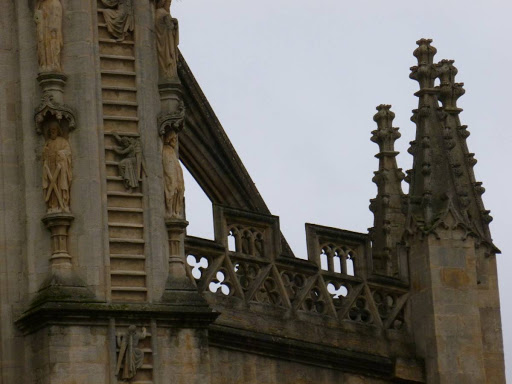
Tradition states that the Abbey Church was built after the then Bishop of Bath dreamt of angels descending – and ascending – to heaven.  It is this vision that is first seen as you enter the building carved into the stonework either side of the West Front.  The great flying buttresses were added in the mid 1830’s to strengthen the building after cracks appeared in the tower; at the same time the pinnacles were also installed.

In late Victorian times many of Britain’s churches had their interiors radically altered and Bath Abbey was no exception.  Much was removed – the organ and screen were taken away which has created the breath-taking view down the full length of the church to the Great East Window, also fitted at this time.  Many other windows were fitted with stained glass and that of the west window was replaced.


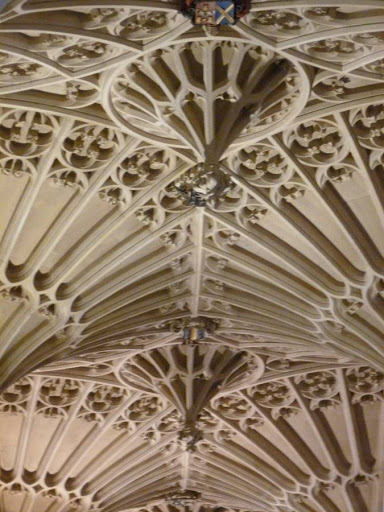
Perhaps the most striking of all of the church’s features is the stone fan vaulting: that of the nave was also created then to match the earlier ones of the chancel.  It soars to great heights with such delicacy and feeling of light that it is difficult to remember it is of stone – or imagine the many hours of craftsmanship that the stonemason’s must have carried out.


Carving of an earlier date, 1649, is the tomb of Sir William Waller’s wife, Jane.  Sir William fought against the Royalists in the English Civil War and intended to be buried with her.  He was however buried in London.
 

Much of the information for this post has been gleaned from the Abbey Church’s excellent website and pamphlets.  It is a magnificent building and well worth allowing plenty of time to visit for there is much to see.  It is, of course, in the city centre and adjacent to the ancient Roman Baths and Georgian Pump Rooms; these featured in an earlier post which can be seen by clicking here.

Add to Technorati Favorites

"The Most Beautiful English Village"

The tiny village of Bibury has long been recognised as one of the prettiest places in the Cotswolds and is much visited by tourists.  It is everything you might magine an old English village to be; so much so that some visitors, according to local gossip, not realising that it isn’t a theme park creation, walk into people’s homes to have a look around.

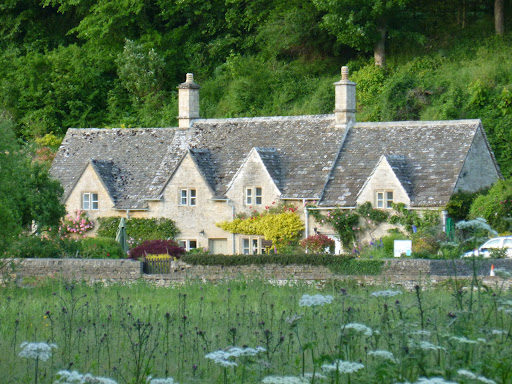
Ancient cottages in mellow Cotswold stone, a crystal clear, trout-filled river running alongside the main street, an old mill and a great pub offering food and accomodation all make Bibury “the most beautiful English village” as William Morris, the Arts and Crafts textile designer described it when he visited during the 1800’s.

The old cottages are so perfect and their setting so tranquil that they appear to have created an ethos amongst their owners: each house and garden has to be more well maintained than their neighbours.  The only weeds I saw there were across the river in the marsh and, of course, not only were they growing where they belong – in a wild setting – but there were only the most attractive ones such as Yellow Flags, the bog irises and the flat, white heads of the hogweeds.


No English village is complete without its church and pub and Bibury has both.  The church of St Mary’s dates back to the 12th century and is well worth seeking out for it is tucked away down one of Bibury’s few side streets.


If the church tries to remain hidden, no such claim can be made for The Swan, one of the landmark buildings situated on the bend where the road crosses the River Coln.  The creeper covered pub/hotel is a good place to watch the world go by although, rarely does a car go by without its occupants stopping to explore the village.  This is quite a problem for there are so many visitors and cars that to experience the tranquility of the place, or to get photographs such as those on this blog, you either need to stay overnight or to visit the village early in the day.  Looking at the online reviews for the Swan, I was amused to see that the only gripes were complaints about old furniture, no street lighting and no wifi or mobile phone signals – surely, some of the very best reasons for visiting!


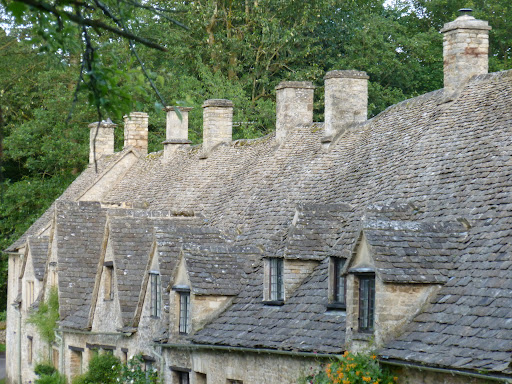
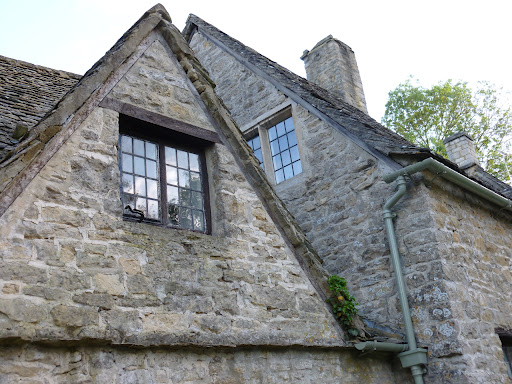
It can almost be guaranteed that every calander of the Cotswolds will have a photograph of Arlington Row – probably on it’s front cover.  Set back away from the road, it is reached by a footbridge: a terrace of former 16th century weavers cottages which, in turn, were converted from a 13th century wool store.  The importance of wool in creating the wealth of the Cotswolds and its churches, including the development of the Cotswold breed of sheep, now endangered, has been described in earlier posts on this blog (click here).  For more on the Cotswold sheep and the work of the Rare Breeds Survival Trust to preserve them, click here.
Arlington Row’s importance in history of vernacular architecture was recognised by the Royal Society of Arts in 1929 when they purchased and restored it.  A plaque, commemorating this is set into a nearby wall.

Exploring Arlington Row gives visitors an opportunity to see just how higgledy-piggledy the construction of old house are.  The old stone walls and mismatched rooflines and windows are juxtaposed seemingly at random – a modern planning departments nightmare.

Despite, the large numbers of tourists (for we all like to believe that we fall out of that category and will be the only persons there), Bibury is well worth making the effort to visit.  It is situated close to Cirencester, one of the most important Roman towns in the UK, with its wealth of history and it is also within easy reach of Oxford.  If I had to choose only one place to take a visitor to see, I think that Bibury would be highly placed on the list. 

Let me know – especially overseas readers, please – which would be the one place that epitomises old rural living in your country.

Add to Technorati Favorites