Where No Priest Will Go

“Culbone, Oare and Stoke Pero – places where no priest will go-o” says the old Exmoor rhyme about three of the moor’s remotest churches.  That’s not totally surprising for they must be some of the most isolated in England and all involve considerable effort to reach even with today’s modern transport.  Or, perhaps, it was because of their association with witches, bandits and lepers that made them reluctant to go. In his book, Exmoor Memories, A(rthur) G(ranville) Bradley writing of his time spent on Exmoor in the 1860s, tells of how the parson of Simonsbath church wouldn’t stay on the moor during the winter, leaving his parishioners to spiritually fend for themselves.  With no roads at that time crossing the moor, one can hardly blame him.

even today, Exmoor is a wild and rugged place

I recently visited Culbone church which can still only be reached on foot.  Whichever of the two routes you take, a very steep climb is involved but the effort is well worthwhile when you finally get there.  The deep wooded combe opens up just enough to allow room for the church and two houses.  It is a very tranquil spot and, resting there in an attempt to recover breath, it did feel very spiritual too – perhaps because records show that it has been a place of worship and meditation for over sixteen hundred years.  The present church was mentioned in the Domesday Book so is just a mere one thousand years old!

Culbone has been a place of worship & silent contemplation for over sixteen hundred years
the private box pews where only the gentry would sit

Claiming to be the smallest parish church in England – it is only 35 foot x 11 foot in size – it can seat about thirty on its hard, wooden pews.  It also has a small box pew where the family of Ashley Combe House once sat.  Like many of the buildings that must have once populated the area, Ashley Combe House has long since disappeared.  Entering the church through its thirteenth-century porch two things are immediately noticeable: first that it is still lit by gas and secondly, the ancient, stone font, now also well over a thousand years old.

the church is still let by gaslamp
the one thousand year old font – how many baptisms has it seen?

Despite the hardship in reaching the church and its very few houses, it is still very much a living church with services held there fortnightly.  However, the priest, perhaps mindful of the old rhyme or the lepers that once roamed the woods lives elsewhere.  To visit Culbone it is possible to park the car by the sea at Porlock Weir and climb 400 feet to reach it or, as we did, park at the top and walk down.  If that sounds the easy option, remember there is still the steep climb back!  Either way you’ll be rewarded with breathtaking sea views and the chance to glimpse a way of life (and worship) now almost totally past.

the church is hidden in a deep, wooded combe
Porlock Weir

Oare church, these days is by far the easiest of the three churches to reach for it is just a short drive down a narrow lane from the A38 Porlock-Lynmouth coastal road.  Famed for its association with Lorna Doone, the novel by R D Blackmore, Lorna was shot at the altar on her wedding day by the wicked outlaw Carver Doone.  A pretty, riverside walk through the stronghold of the Doones, the Doone Valley, is possible from nearby Malmsmead where there is camping as well as an art gallery and coffee shop named the Buttery.  Overlooking the picturesque bridge and ford, it also serves great food and is well worth a visit.

Oare church is easily approached by a narrow lane
the bridge and ford at Malmsmead

Compared with the church at Culbone, Oare is a relative newcomer having been built in the 1400s and then partially rebuilt four hundred years later.  Inside, it is light and airy with memorials to Blackmore and also to the Snow family who feature in the novel.  Blackmore tended to use local family names and traditions in his writing and mixing fact with fiction.  Ridd is another local name; its variation Red is recorded on many of the gravestones at Culbone. For those not too familiar with the tale of Lorna Doone, or to see photos of the Doone Valley take a look at my earlier blogs, The Story of Lorna Doone – just a myth? and A Walk in the Doone Valley.

the interior of Oare church is very light and airy
the window through which Carver Doone shot Lorna on her wedding day as she stood at the altar

There are wonderful, albeit rather long, walks to Stoke Pero church from Horner Woods (car park at Webber’s Post or in the village of Horner), taking in the ‘four corners of Horner’ and distant views of Dunkery Beacon, the highest point of Exmoor. It is well worth the effort for apart from the views there is a good chance, providing you walk quietly, of spotting red deer, the largest of our wild deer and for which Exmoor is now one of its few remaining strongholds.  There is plentiful wildlife to be seen along the river too – Dippers and Kingfishers and with Buzzards soaring overhead.  You may even be lucky enough to see Red Kites or even White-tailed Sea Eagles which are becoming ever-more frequent visitors to the area.

Dunkery Beacon from Webber’s Post
wild red deer hind with its calf half-hidden in the deep woodland

It is possible to drive to Stoke Pero although the lanes are long, winding and narrow.  The road even passes through a working farmyard which confuses many, especially visitors from overseas who find our narrow lanes scary enough at the best of times! If you choose to reach the church this way you will fully understand why a priest might not want to be bothered to travel there. Below is an Ordnance Survey map showing the three churches; I would strongly advise to carry a paper, rather than digital, version of the map for phone signals can be a bit erratic in such remote countryside.

the three churches – a good map and equally good boots are essential if travelling by foot

We’ve had lepers and bandits with our previous two churches which only leaves witches as a possible reason (other than the journey) why Stoke Pero might have been clergy-less.  Look closely at the old oak door and scratched into its surface are a series of lines: witches marks.  ‘Apotropaic’ marks to give them their correct name are symbols carved into buildings to ward off witches and protect people from evil spirits.  They are usually found wherever there is a point of entry such as doors, windows or chimneys and usually date back many centuries when belief of the supernatural was commonplace.  It is not known when the marks at Stoke Pero were made or what they mean but they may well have literally put the fear of God into any visiting priest.

witches marks – apotropaic marks – on the church door at Stoke Pero

The church at Stoke Pero lays claim to being the highest on Exmoor for it stands, isolated at over 1000 feet above sea level.  Although much of the building is only a couple of hundred years old, the church tower dates from the 1200s, as does a list of the rectors which rather belies the story of lack of clergy.  Like Culbone, an earlier church here is mentioned in the Domesday Book and, also like Culbone, services are held here lit by candles or gas lamps.

old sign staking its claim as highest church!
Stoke Pero church sits high on a bank

I blogged about Stoke Pero over fifteen years ago (link here) and mentioned how simple its interior is with its whitewashed walls, the only colour being the splash of red from the altar cloth.  Revisiting recently, unsurprisingly the place hasn’t changed, and the barrel roof is as spectacular as ever.  However, this time I noticed other things too such as the delicate ferns growing inside the window of the ancient bell tower and the contrast between the rough-hewn stone windows and the smooth white plasterwork.

the magnificent barrel roof of Stoke Pero church
ferns grow in the cool shade found inside the ancient bell tower

If you have the opportunity to visit Exmoor, now protected by its National Park status, there is much to see – but only if your pleasure comes from the joy of being in wild, open places for it remains remarkably uncommercialised.  It has much to offer apart from the moorland (spectacular at this time of years smothered in purple heather) for it has the sea, rugged cliffs, fast-running boulder-strewn rivers and the unspoilt little towns of Porlock, Lynton and Lynmouth. It is a walker and nature lovers paradise.

the heather moorland tumbles away to the sea
Lynmouth

Regular readers of my blog will know of my love of Exmoor which I discovered now nearly sixty years ago.  They may even recall how through a chance meeting it changed the direction of my life, giving me an outdoor career as well as many Exmoor friends.  More remarkably, I have found numerous family references to the moor, unknown at the time, for A G Bradley was my grandmother’s cousin and other family members lived and are buried at Luccombe, a village not too far from Stoke Pero.  An uncle was involved with the rebuilding of Lynmouth after the devastating floods and loss of life in 1952 and a few years prior to that my parents honeymooned on the moor.  A small world indeed and one in a small way I have been privileged to be part of.

my first night spent on Exmoor – many, many years ago!
old postcard of the cottage in Luccombe where my ancestors lived in the early 1900s

Mentors – part 2

In my earlier post on mentors, I asked the question “what makes someone a mentor” and do they realise they have actually become one. Of course, the answer will vary for there are many reasons why people do it, and equally a number of reasons why someone needs it.  My experience is that it is only with hindsight that I realise I had four mentors in my life and all would be amused at my describing them as such. 

Lorna Dick French, Cyril Pamela Heber Percy

In part one I told of how I met, quite by chance, Dick and Lorna French who had a remote hill farm on Exmoor, a National Park in England’s West Country.  I was aged sixteen and, despite our age differences (essential for mentoring) a close friendship developed that lasted until their deaths many years later. [Their story can be found here] Fifteen years after that first meeting, I met another couple, Cyril and Pamela Heber Percy, and although of a very different background from Lorna and Dick, they too took on the role of mentor.

Woodlands Cottage, the Heber Percy’s home

In 1983 I had moved house to a small village in the Chilterns.  Although I consider myself a ‘Chilterns man’ I had always lived at their foot, first by the River Thames and, later, by the steep escarpment to the west.  Now I was living in one of the highest villages, surrounded by wonderful bluebell woods and prone to quite different weather than seemingly, everywhere else.  Like many hilltop villages it was a straggly affair, a mile long but with the houses scattered first one side of the road and then the other.   Our house sat opposite the common – a wide, open piece of land although by us it had been invaded by bracken and hazel scrub where Dormice could be seen climbing amongst the branches.   Wild cherries and raspberries also grew there and with a small pond that had once been the village’s only source of drinking water, it was very quiet and very lovely.     

There was a small pond amongst the cherry trees, once the village water supply
The village was surrounded by wonderful beechwoods awash with bluebells each spring

Soon after our arrival, there had been a knock on the door. Standing on the doorstep was an elderly gentleman, very upright and with a clipped moustache he looked every part the retired army colonel which he was.  With no introduction he barked, “what religion are you?”   Before I could answer, he continued, “Of no matter, we need bell ringers.  I’ll see you at practice tomorrow, 7pm.”  Of course, I didn’t go!  Our next meeting was one evening when out walking.    Hearing a lot of shouting and cursing I could see a man of similar age to me having difficulty with ‘boxing’ (loading) his horse to transport it back home.  No matter how he tried the horse refused to walk up the ramp and into the lorry.  As I drew level, the Colonel holding a whisky in his hand also appeared ready to give advice. The young man looked very dismissive at his suggestions but that changed after the Colonel took hold of the reins, jumped onto the horse’s back with an agility that belied his years and cantered away before turning and riding it straight into the lorry.  “Don’t stand any nonsense in future” was all he said as he tied the horse securely.  Turning to me, he said, “must be time for another whisky.”    Both the rider and I had learnt a valuable lesson that evening – never judge someone’s abilities by their age.

Boxing – or in this case, unboxing – a horse

The Colonel and I spent the rest of that evening in his home drinking whisky and discussing all manner of things, Pamela, his wife, joining us.  Sitting back in a comfortable armchair, I took in my surroundings, my eyes landing on a small photograph sitting on a shelf.  It was of two army officers on duty outside Buckingham Palace.   Cyril noticed my interest immediately – another thing I was to discover: he was exceptionally alert and noticed everything.  He explained that the photo had been taken many years earlier and featured in the national newspapers.  It was of him and his brother, one in the Welsh Guards the other in the Grenadier Guards acting as Colour Bearers at the Changing of Guards ceremony, the first time that two brothers had had that honour.

Changing of the Guard at Buckingham Palace 1927 [copyright British Newspaper Archive]

Over the years that followed, Cyril would tell me of his military career, of his escorting Queen Wilhelmina of the Netherlands under enemy fire during her evacuation, of dinners in England at the Palace with the King. (Pamela complained of how tedious all the formalities were!).  Of even greater interest was to learn of his Edwardian upbringing for he had been raised at Hodnet Hall, a large country estate in Shropshire.  He lived on the top floor in the nursery and each evening Nanny would bring him down to say goodnight to his parents where he would recite a poem and dutifully kiss his mother and shake his father’s hand.  Surrounded by liveried footman and other house staff, he preferred the informal company of the gardeners and gamekeepers.  Through them he developed a deep love for the natural world and keen observational skills which he passed onto me.  Walking together, he would point to a barely visible gap in a hedge and ask me if a hare, fox, badger or deer had made it.  Of course, I got it wrong but he persevered until I was able to tell the difference.

Hodnet Hall, Cyril Heber Percy’s childhood home
The Colonel taught me to recognise the different paths wild animals make (in this case, a badger)

During this time I was still working indoors in the retail fashions business but he taught me a lot about gardening too for the gardens at Hodnet were considered one of the finest in Europe.  You have to think big, he would say, immediately followed by “and you have to think small”.  To prove the point he would get me to lie down staring up at the undersides of large leaved plants, and then, on my knees, examine the different shades of green that could be found in the tiny leaves of wild thyme.  To get me to understand the wonders of the natural world he would say, “think like a child but always act like an adult”.  Years later, in my present career, I remember this advice and concentrate on elements of surprise as well as leaf texture when designing gardens.

When you look up at a plant you see a quite different world….

Pamela, also would tell me stories of her life.  Born into Irish aristocracy she had a very different upbringing to her husbands for there was the insecurity that the fight for Irish independence would bring.  There were stories of hiding in secret passageways within the house ready to escape if a violent attack took place, Fortunately, this never happened, perhaps because her mother took her social duties very seriously and would visit the poor and the sick to make sure that they never went hungry.  Pamela would accompany her mother on these visits and so from an early age saw how frugally ‘ordinary’ people lived.  It also gave her the ability to empathise with people from all walks of life and to treat them as equals.

Pamela Heber Percy

Over the years, the Heber Percy’s taught me many things, one of which was to cast a fly.  Both the Colonel and Pamela were expert salmon and trout fishers.  When I mentioned how much I enjoyed spinning for pike, Cyril had shaken his head and joked that it was very poor sport.  Venturing out onto the lawn he pointed to a fallen leaf – “that is your trout” – and he patiently watched and corrected me as I tried to get the line to drop close-by,  After I had mastered that he made life more difficult by pointing to leaves under low hanging branches and from there, to leaves floating on the surface of the swimming pool.  Unaware at the time, they gave me lessons in accuracy and perseverance as well as a useful fishing skill.

The Colonel: Cyril Heber Percy

It was a sad day when I heard that the Colonel had died.  He was buried, with full military honours at Hodnet, his childhood home.  We had always planned to visit the house and gardens together one day and now we were, although not in the way we had planned.  I felt surprise, pride and honour when I was ushered to the front of the church to sit with the family.  As the Last Post was being played from the top of the church tower I felt my lower lip tremble only for it to be controlled by hearing the Colonel’s voice whispering, “not very British!”.  Soon after his death, Pamela moved house and although not too far away, I saw less of her, and not many years after she also died.  I had lost two very dear and good friends.

Stained glass window at St Luke, Hodnet

And one final thought – I did learn how to ring the church bells!

Have you had a mentor or mentored someone?  What does it take for someone to become a mentor?  Our parents have probably the greatest influence on our lives so why does a mentor s role take on such importance? Let’s hear your story either in the comments below or, if you prefer, by using the Get in Touch tab at the top of this page.  Thanks to Diane Highton for posing the question that triggered this blog!

Mentors – part 1

Mentor.  There are dozens of words to choose from when looking for an alternative description of someone who takes on this role: life coach, guide, adviser, confidante, counsellor, influencer to name just a few.  One thing that is certain is that the four people who played such an important role in shaping my life would not recognise any of these terms, not even the word mentor.  And to be honest, it is only with the benefit of hindsight that I recognise them as being mentors at all.

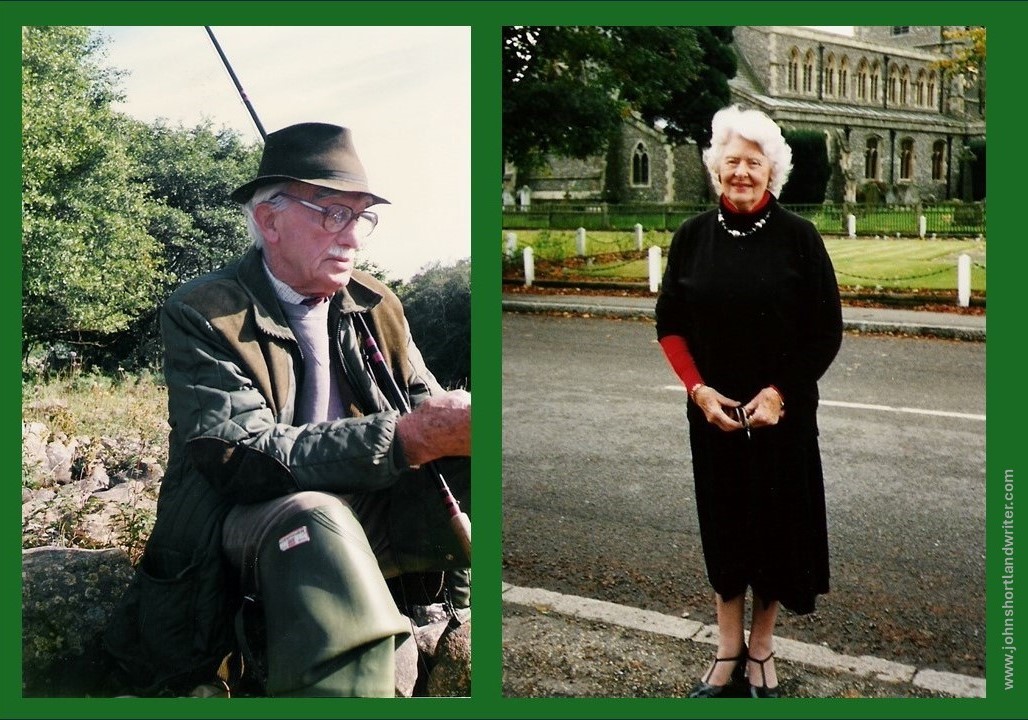
Mentors: Lorna French, Dick French, Cyril Heber Percy, Pamela Heber Percy

If I had to choose just one word, I think it would be guide for that seems to describe what they were during their lifetimes. It is only since they’ve been gone – for sadly,  they have all been dead for more than twenty years – that I actually think of them even as that for their influence was subtle.  They would almost certainly find the description laughable for there was never any conscious effort to take on that role.  It was one that had come about by chance meetings leading to friendship, respect and love.

Despite the angelic appearance I wasn’t an easy child!

I was not an easy child – I know that statement is hard to believe now (laughs).  A streak of rebellion has run through our family for generations and although I wasn’t outwardly rebellious, I sometimes made life difficult for those around me.  From the age of fourteen I found school a waste of my time for I had wanted to study sciences and school insisted I did languages instead.  I’m sure they were probably right for studying French and English had come easily to me whereas I’d struggled with even General Science.  To me that was irrelevant for I had desperately wanted to learn botany and biology.  Instead, I now found myself sitting in German classes seething inwardly and resenting every moment of having to learn the difference between der, das and dem or liebe and Lieber.  I began playing truant and found that if I left school after the lunchtime register had been taken nobody seemed to notice and  I could walk the three hours back home through the woods and fields where I could practice my botanising.  I finally stormed out of school halfway through my ‘O-level’ exams before sitting the dreaded German but not before I’d sat French and English.  I passed both with flying colours but my parents were furious.

Me in my element!

More out of desperation, my parents agreed that I could take my bicycle and tent on the train to Exeter and cycle and camp across Dartmoor for two weeks.  It would be my first solo holiday and, I imagine, they agreed in the hope that it would make me appreciate just how fortunate I was to have been given the chance of a good and expensive private education.  I arrived in Exeter in blazing sunshine and armed with maps and far too much self-confidence started my journey westwards.  In those days, with no mobile phones or credit cards to monitor my progress, my parents provided me with stamps and cash so that I could send them a postcard at the end of each day.  I reached Okehampton, a small market town on the fringe of the Dartmoor National Park in a sweat and seeing from my map that I wasn’t that far from the sea instead decided to cycle northwards to Westward Ho, a beach resort on the North Devon coast.

I had reached the sea

Refreshed from an early morning swim in the sea (I’d arrived there at 2.00 in the morning) I looked again at the map and now decided to travel eastwards to a different national park, Exmoor.  I’d read the novel Lorna Doone at school and had loved it and the thought of exploring the rugged and isolated places where she had met and married John Ridd, only then to be shot at the altar of Oare church, filled my imagination.  Little did I know then that soon I would be meeting a real-life Lorna Ridd who with her farmer husband would welcome me into their lives.

Oare Church – where Lorna Doone was shot at the altar on her wedding day

Three days later, having cycled over some tough and exhausting hilly roads I ended up at Brendon Barton, a remote farm perched high on the edge of the open moorland.  It was coming towards the end of my fortnight away and so I knew that I could only stay there for one or two days before the long bike ride back south to Exeter and home.  Venturing into the farmyard I could hear sounds coming from inside the barn where Dick French, the farmer, was working with sheep.  I asked if I could camp in one of his fields but he didn’t look up and instead replied, “be a good lad and bring those last two sheep in here.”  I had never been near a sheep before and so spent the next half an hour running around the yard in circles before finally managing to herd them inside.  I was out of breath, sweating and covered in sheep shit but I found a contentment in my success that I’d not experienced before.  Years later, Dick and I would laugh about that first encounter.  I used to say that I should have just got back on my bike and cycled away to which he would respond with, “when I saw you wouldn’t give up, I knew that you’d do!”

I cycled over Exmoor’s remote, hilly roads
Preparing for a good night’s sleep, Brendon Barton 1968

By my second day on the farm I had helped bring in the cows and Dick had  taught me how to hand milk  them.  Hearing I could ride, he suggested that I took Star, one of their horses up onto the moor to have a look around    The heather was in flower and its deep purple carpet continued to the sea.  Beyond, the coastline of Wales could be seen in the hazy far-distance.  I ventured into a deep combe before crossing a stream and climbing up a ridge.  There I spotted a deserted farm cottage* half-hidden by beech trees.  I stood entranced by the beauty of my surroundings and its all-encompassing silence.  I felt I had found my true home and with no consideration for my parent’s concern, I decided never to leave.  I sent them a postcard saying that I’d missed my train home.  I remained purposely vague as to my whereabouts, just saying that I’d kept back enough money to buy a new railway ticket.

The heather clad hills of Exmoor reach to the sea
Half-hidden amongst the trees stood a deserted farm cottage

A week later I was having my meals in the farmhouse enjoying the banter amongst the farm lads and hearing the discussions about the tasks that needed  to be done around the farm.   By the time harvest came round, my tent had been ditched and I was sleeping in the house in a comfortable bed, receiving a small wage and spending evenings in the village pub with new-found friends.  Dick had said that it would be his wife Lorna (Ridd had been her maiden name) who would decide whether I could stay or not.  She was such a hard-working woman and one more person to care for might be one too many.  Her approach had been that one more would make no difference and so she looked after me while I spent long days working at Dick’s side, listening to his tales and learning about their way of life.  Asked about my parents, they seemed content enough with my explanation that I was spending extended time away having just left school (the term gap year hadn’t been invented then!). 

Brendon Barton 1968I soon moved into the farmhouse and a comfortable bed
Harvest was still carried out the old-fashioned way

Months passed and the harder I worked the more I knew an Exmoor outdoor life was for me.  However, it came to an abrupt end when one day I walked into the kitchen to find my parents sitting there telling me it was time to return home. I was devastated and asked Dick why he hadn’t told me they were coming.  “I knew you’d hide up on the moor,” he’d replied – and he was right!  Although I was pleased to see my parents I pleaded with them to let me stay.  Dick, in the first of his subtle acts of persuasion that I can recall, asked me to help him look at a horse in the barn.  There was no horse, instead we sat and talked about our time together before he reminded me that my home was with my parents and, in time, running our family business.  Don’t forget, he’d said, there’s a room here always available so why not come down for lambing next spring.  To ensure that I did he added, “You’d be doing me a great favour, I could do with your help.”

The barn in 1968 where I had my first taste of farming
I returned for lambing in 1969

Lorna, too, had her subtle ways of persuasion.  “Your parents have said that you can come here for Christmas if you’d like to.  We’ll be on our own and some young company would be good.  It’ll be just the three of us.”  She’d also boxed up the bantam chicks that I’d been caring for so that “you can carry on farming at home.”  After that first Christmas I visited them both for many years, helping on the farm whenever I could, and exchanging letters and phone calls.  They were always my first port of call when I was having difficulties, feeling down or just wanting to celebrate with them.  Life hill-farming is hard, the weather often unmerciful and the hours long but there are also the pleasures of being part of a small tight-knit community that will help one another whatever the reason.  Leading by example, they instilled in me a love of farming and hard work, a sense of duty, generosity of spirit and kindness.  I will leave it to others to decide whether they succeeded or not!  From them, I also acquired an even deeper love for being outdoors regardless of the weather and especially in remote, wild landscapes.  Little did I know then that these skills would be put to the test when, aged forty, I began my career change to follow my outdoor dream, or that Exmoor would still play such an important part of my life today. 

The bantam chicks that Lorna sent back home with me, 1968

Dick and Lorna French died just before the Millenium and the farm was sold to another local farming family, some of whom I’ve now known for almost sixty years. Because of that, I still on occasion visit Brendon Barton and sit in the kitchen drinking tea to discuss farming and, of course, putting the world to rights.  A bonus is that Maria, the new ‘Lorna’ has been creating an extensive garden around the farmhouse, so we have gardening in common too, as well as a lifetime of shared memories.  It would be another fifteen years and then as a man, before I would meet my other mentor couple.  Cyril Heber Percy and his wife Pamela’s lives were worlds apart from Dick and Lorna’s but there were some similarities too.  Part 2 tells their story.

Lorna & Dick French

Have you had a mentor or mentored someone?  What does it take for someone to become a mentor?  Our parents have probably the greatest influence on our lives so why does a mentor s role take on such importance? Let’s hear your story either in the comments below or, if you prefer, by using the Get in Touch tab at the top of this page.  Thanks to Diane Highton for posing the question that triggered this blog!


* The deserted cottage still stands in splendid isolation hidden away behind the trees, albeit now as a ruin.  It has a fascinating history and has been the subject of much research in recent years.  Take a look at the website devoted to the story of Hoar Oak Cottage

The Beauchamp Chapel – a medieval masterpiece

Just occasionally nothing prepares you for a visual and emotional onslaught however much you might have read or seen images of it.  I had been planning my first visit to Warwick for a few years.  Perhaps it is because it is so close to home – about an hour’s drive north from my part of the Cotswolds – that it had taken me so long to actually go there for, when a place is on your doorstep, you feel you can go at any time and so put it off for another day.  As it happened, I finally arrived in the town on the first warm, sunny day of spring when the ancient black and white timbered buildings really stood out against the blue sky.

Warwick is even older than those medieval buildings for it has been inhabited since the 5th century.  However, it came to prominence when William the Conqueror built Warwick Castle in AD1068.  Today, it is possible to visit the castle and even stay there but this was not the purpose of my visit.  I had come to see a later building – the Collegiate Chapel of St Mary, most of which is only a mere three hundred years old.  A great fire had swept through the town in 1694 destroying much of it as well as the greater part of the original church.  Miraculously, the fire was extinguished saving the chancel and the Beauchamp Chapel built during the 14th and 15th centuries.  The crypt is all that is left of an even earlier church built over 900 years ago.

The Collegiate Church of St Mary, Warwick
The 900 year-old crypt – all that is left from the earlier church

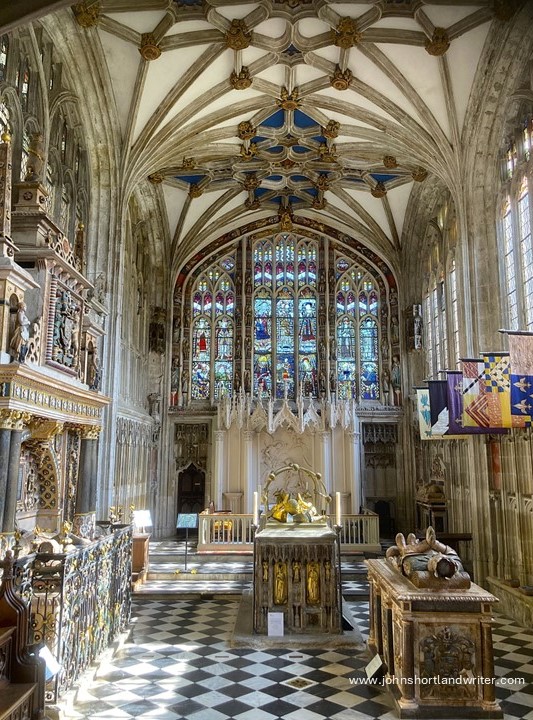
I had only been standing in the church a few moments when the organ began to play; the timing could not have been better for it set the mood for the whole visit. Lovely as it was, I moved on quite quickly to the chancel dominated by the tomb and effigies of Thomas Beauchamp and Katherine Mortimer.  Both died within a few months of one another in 1369 and their effigies are unusual for they lie there holding hands, signifying not just their undying love but also their equal status for Katherine had brought land and wealth to the marriage.  The chancel is also unique for its light and graceful ‘skeleton rib’ vaulted roof simply adorned with the Beauchamp coat of arms clasped by angels.

The tomb of Thomas Beauchamp & Katherine Mortimer who died in 1369 – my ancestral grandparents
The ‘skeleton rib’ vaulting & Beauchamp crest held by an angel

From the chancel it is possible to glimpse into the Beauchamp Chapel where Thomas’ grandson Richard’s tomb stands.  I purposely avoided doing so for I wanted to enter the chapel and to see it for the first time in its full glory.  As I mentioned in this blog post’s opening sentence, I was completely unprepared for the visual feast that stood before me.  The colour, the light, the opulence, the sun-kissed, bronzed effigy of Richard lying there centre stage was pure theatre – just the effect Richard had planned when he left detailed instructions for the building of the chapel all those centuries earlier.  With the organ still playing behind me, I stood in the entrance transfixed, feeling slightly silly for being so moved before descending the steps to explore further. I had finally come to see the burial place of my ancestral grandfather.

Richard’s dramatic tomb lying in the Beauchamp Chapel

A short (but necessary!) history of Richard’s life: Richard Beauchamp was born in England in early 1382, the son of the 12th Earl of Warwick.  His godfather was King Richard II although within a very few years Richard’s father, also a Thomas, had fallen out of favour and imprisoned in the Tower of London for treason.  Fortunately for him at least, the King was deposed and replaced on the throne by Henry IV; Thomas was released and his titles and land restored.  During the King’s coronation in 1399, Richard was knighted and later succeeded to the title of 13th Earl of Warwick at his father’s death in 1401.  When Henry V succeeded to the throne in 1413 Richard became one of the new King’s most trusted advisers and given responsibility for the education of his young son, later to become Henry VI.  Richard then spent much of his time in France, part of which had been annexed during the Hundred Years War and he died there in Rouen on 30th April 1439. 

Richard’s armour is captured in fine detail
The bear and the griffin are Beauchamp heraldic emblems

Richard’s body was brought back to England and buried in a temporary grave in the church, for in his Will of 1437 he leaves detailed instructions for the construction of the new chapel to house his tomb.  No expense was to be spared for he wanted it to become one of the finest in England, in which he more than succeeded.  The creation of the chapel as one complete and new entity, using only the finest materials and highest quality craftsmanship makes it unique – all the more so, for its surviving almost unscathed by the later Reformation, attempted destruction during the Civil War, as well as the great fire. He was finally laid to rest there in 1475.

The Great Fire of 1694 stopped behind the chapel wall destroying the lower part of the wall paintings

The tomb is, of course, the central feature of the chapel as well as its purpose. Richard lies on an intricately carved and highly coloured marble chest set with fourteen gilded ‘weepers’, namely his children and their spouses. There had been a dispute after Richard’s death within the family over inheritance for Richard had been married twice with children from each. It was Ann that finally inherited the title and estates, a daughter from the second marriage (my ancestor was Eleanor, the second daughter from the first marriage) and so it was she that oversaw the completion of the chapel. Richard’s effigy is of a younger man, his eyes open, his hands outreaching, and dressed in full armour, showing the world that he is ready to enter the Kingdom of Heaven. He gazes upon the stained glass that confirms this story.

Richard’s daughters, some of the fourteen ‘weepers’ that surround the tomb
Ann, who became the 16th Countess of Warwick in thoughtful pose

The stained glass is another miracle of survival for it is mostly complete. During the English Civil War (mid-1600s) many of the country’s churches and religious icons were damaged or destroyed with the Protestant dogma that followed. The Beauchamp Chapel’s glass was spared much of this with only its lower parts damaged. Although it cannot be seen in my photograph, it was hastily repaired – perhaps a little too hastily for Richard’s head and hands were replaced with those of a woman. The imagery depicts saints and angels in glowing colours, produced at huge expense. Musicians are shown with their instruments and a banner of sheet music runs across the entire window. The notations can be clearly seen and, as instructed by Richard, this is sung in the chapel each September with prayers said for his soul, a practice of huge significance in medieval times. There is a short YouTube video of the choir singing this original music in the chapel, as well as a brief history of the windows which can be found here.

Richard, reborn, raises his arms towards Heaven
Section of the East Window surrounded by statues of saints

Within the chapel are many other delights although none overshadow Richard. Tombs of his descendants, the Dudleys (through his eldest daughter Margaret), were placed there. They are resplendent in their own right but do not form a part of this blog. Even the prayer stalls, quite modest compared to other features of the chapel deserve close attention with their heraldic emblems carved into their timbers; they are fine in quality as well as detail. They can more briefly be shown by photos but deserve inclusion.

The tomb of Robert Dudley and Lettice Knollys
Beautifully carved prayer stalls, now almost 600 years old

My family connection to the Beauchamps. When you travel back through so many centuries from the present day you are bound to uncover many ancestral grandparents. The problem is the discovering of them for in most families, as in the rest of mine, they lived very ordinary lives that were not well recorded if at all. Just occasionally, it is possible to find one that has risen to fame and this is the case with my paternal grandmother’s family. Granny Shortland’s relatives had been well-known up to the early-1900s for they held high positions within the Church of England and Government. A friend of Tennyson, the Reverend George Bradley had risen to become the Dean of Westminster Abbey. His brothers and sisters had also risen to fame in their spheres of work. These connections, known as ‘gateway ancestors’ enabled the research to progress relatively easily through time to Thomas Bradley – my 8th great-grandfather – who had been Chaplain to King Charles I and later, after the restoration of the monarchy, Charles II. From there the connections to the Beauchamps and even further back are well-researched by historians. It had always been whispered that Granny Shortland had married ‘beneath herself’ – now I know the reasons why!

Granny Nellie Shortland c 1945

Visiting: The Collegiate Church of St Mary and The Beauchamp Chapel is open to visitors free of charge. Guided tours (which are well worth doing) are available at a modest cost, as is a climb to the top of the tower to view the town and beyond. Details can be found on their website here.

Warwick Castle is impressive and a popular attraction. It was the home of the Beauchamps but was built in the 11th century by command of William the Conqueror. It is possible to stay in the castle for short breaks. More details can be found here

There is a useful website (click here) if you are planning a visit to Warwick, which is situated a few miles south of the city of Birmingham and north-west of London.

2024: A Year in Review – part 2

In Part 1 of my review I began by saying words to the effect of life is for living – and when you become older there’s even less time to waste! The result of following my own advice is that part 2 of the review is a couple of weeks late in being published. than I would have liked

Keeping active was also part of the theme of a couple of my blog posts last year, specifically about England’s network of public footpaths. Although we Brits just accept them as part of our historic right to walk across privately-owned land, it seems that for a great part of the world, this would not be an option. My American friends and readers in particular find it hard to comprehend that we can walk across someone else’s property at will (assuming a public footpath crosses it) without confrontation. Many of our footpaths link villages and farms and so, on occasion, you may find yourself walking through someone’s garden or farmyard. The history behind the right to walk and what you can and can’t do was discussed in November’s post which can be found by clicking the link here.

Walking on designated footpaths across privately-owned land is a basic right in England and Wales

A few month’s earlier in August, I wrote of a walk that I had taken across fields, through woods and down country lanes back to my home in the secret valley. It was a lovely walk with the first signs of autumn colouring the trees and hedgerows which were laden with wild fruits and berries. After the noise and bustle of harvest, the fields were quiet and I met no-one for much of the walk. I prefer it that way for it is then, walking in silence, that you are likely to come across the wild birds and animals that also share this space, To follow the route that I took and to see the beautiful creatures I encountered click here.

When walking quietly you come across the wild creatures that live there

I have lived in the country all my life and my father was very much the epitome of the ‘English country gent’. My mother remained a ‘townie’ all her life (she had been brought up in the West End of London) and we both teased her mercilessly about her lack of knowledge of country ways. When she met and married my father it must have come as quite a culture shock to find herself living in a small, close-knit community where everyone knew one another and one another’s business. Neither of my parents were walkers but as a child they would drive my sister and I out to Turville Heath. Over time the heath became my place of refuge whenever I was in need of comfort or in need of re-charging the batteries. It would also be the place for summer walks, playing cricket and picnics. Of equal importance as the heath itself was the car journey out to it – past miniature farm and other magic moments that we children couldn’t get enough of. Click October’s link here to find out more.

My father, very much the country gent despite not liking guns!

Looking back even further in time, I explored the lives of ancestral aunts, uncles and cousins. They had been born, married and died in a village very close to the where I had been raised for our family have lived in the area for at least five hundred years. Discovering their stories had been quite a revelation – for my 3rd great-grandaunt had been about to marry in the local church when she gave birth to a child. The repercussion of this – for the child was obviously not that of the grooms – was far-reaching. Devastated Thomas cancelled the wedding and did something rather surprising shortly afterward, as told in September’s blog post. What happened to disgraced Ann? And what happened to poor Henry, the baby boy, who lived with the stigma of his birth? Was it this that took him down the path of self-destruction and a young death many thousands of miles from home in ….. – well, you’ll need to click on the link to find out what, when and where!

The village church where Thomas & Ann were to wed in 1809


So, what will 2025 bring, I wonder? World politics seems to be on the news with constant and often seemingly bizarre twists and turns unsettling many of us. I’m quite good at not getting too worked up about things that I have no control over. Fortunately, I live and work in stunningly beautiful countryside and my interest in family history has taught me that life carries on regardless of turmoil all around us. I shall continue to write about my adventures (if that isn’t too strong a word to describe them). I also have a couple of writing projects to see to, and of course, there are my garden projects too. In dues course, they may appear on these pages. As with all my blogs, there are lots of photos to view so why not take a look and please do comment as appropriate.

2024: A Year in Review – part 1

As we enter the new year it’s always a good time to reflect on the past twelve months as well as to look forward to what 2025 may bring. For me, 2024 has been a busy year. I remember many years ago an ‘old boy’ telling me that when you reach the age of sixty, life is downhill all the way. I was in my thirties at the time and so believed him. I’m now in my early seventies and I can’t say that I agree with his pessimism. Funnily enough, he lived well into his nineties and, for most of that time, enjoyed rude health so he proved himself wrong too! The only way to tackle ageing, I’ve decided, is to embrace its positive aspects – no mortgage, wisdom (ha-ha!) and more time to do the things that matter to you. Of course, good health is important and maintaining balance and staying active helps no end. One of the reasons why I’ve not retired completely.

John Shortland, summer 2024

Tewkesbury, a town in Gloucestershire on the River Severn – the UK’s longest river – is just a few miles from the edge of the Cotswolds. It’s an ancient town that I have driven through dozens of times but early in the year I made the effort to actually stop and explore its narrow streets and abbey church. I hadn’t realised that when entering the church I would be staring at a suspended globe which, when standing 211 metres away from it, is the exact size and view of Planet Earth you would see if standing on the moon. When I first saw it ‘suitable’ music was being played but it was only after that had stopped that I found the exhibit strangely moving as it rotated slowly in total silence. That’s another thing I’ve noticed as I’ve grown older – how much I enjoy silence! The church is well worth visiting for it is now almost one thousand years since it was built and is one of the finest examples of early Norman architecture in Britain. Unable to visit? Then click on the link here to see lots of photos.

The abbey church looms over the ancient houses and narrow streets of Tewkesbury
Planet Earth, mysteriously beautiful

In March, we travelled north to the county of Yorkshire to watch a friend take part in the oldest horse race in the country. The Kiplingcotes Derby has been run annually since 1519. Tradition sys that if it ever stops taking place it will never happen again so all through the Covid restrictions only one horse took part! For this race, the 505th, dozens of riders took part for it is a horse race like no other: no finely maintained racecourse but a series of roads, lanes, field margins and tracks, a real test of endurance for both horse and rider. Our friend, who had never raced before was taking part to raise money in support of the local hospice. She reached the finishing post in good time and raised over ten thousand pounds in memory of a close friend. The race has one other completely bizarre quirk which makes it unique in the world of horse racing – to find out what that is you’ll need to click on this link here!

The oldest, continuously-run horse race in the UK
Safely past the winning post!

Later, in early summer we returned to Yorkshire for a week’s holiday spent in the pretty village of Austwick. We had planned to spend our time walking for it is excellent hiking country. However, my partner was nursing a broken foot and, later, during a hill walk on my own there, I hurt my knee badly so we were both hobbling about instead (what was I saying about staying active?!) There is always a positive outcome to everything, I find, and so we explored by car instead where we discovered the Courtyard Dairy. To misquote Paul Whitehouse, “if you like cheese, you’ll like these” for we’d stumbled across one of the top, award-winning artisan cheese makers in the country. With a restaurant, small museum, ice-cream and wine shops as well as a huge selection of cheeses, we were in our element. For lots of photos of the trip – and not just of blocks of cheese, click here.

The Courtyard Dairy – one of England’s finest artisan cheese shops
There are beautiful walks around the Yorkshire village of Austwick

I have been very fortunate in not just living in a beautiful part of the country but also being able to make my living from being in the midst of it. However, that hasn’t always been the case for before I embarked on my horticultural career I spent twenty years in the world of retail fashions. When I left school I spent some months on a sheep farm on Exmoor – the remote, hill country, now a National Park, in the West Country. That short time farming changed my life for I met some wonderful and inspirational people there who left me with a yearning for the outdoor life, However, I was dragged away by my parents to work in the small department store which had been central to my family for the best part of a hundred years. Fortunately, I had a happy time there but the desire to be spending my days outdoors never left me. This spring it was thirty years since I sold the business to follow my dream and so it seemed a good time to reflect on those retailing years.

How the family store began in 1904
The family store in 1994 when it was sold

A few months later the blog post (link here) had developed into a full-blown illustrated talk to over seventy people followed by press interviews and a printed history of the store which had been started by my great-grandfather. I am delighted that the story of the family’s endeavour has now been recorded for posterity. By complete coincidence, I was also contacted by Exmoor Magazine and my memories of farming at Brendon Barton have been included in an article on Dick and Lorna French who were the couple who welcomed me into their lives – and changing mine by doing so.

Recorded for posterity – the history of my family’s department store

At the age of 42 I took myself off to study landscape and estate management for two years at agricultural college. It was a huge gamble and one that fortunately came off for I found employment as Head Gardener to the European Youth Parliament, an educational charity that brought teenagers from all over Europe to debate world affairs. With some Polish blood in me I liked the idea of being part of the organisation. Next, and still in England, I spent some happy years working for a delightful Swedish family – even after my role as Head Gardener had ended I maintained contact with them as Consultant overseeing projects such as the creation of a lake and an arboretum. My next move was to the Cotswolds to manage an historic garden, Kiddington Hall, designed by the architect who had created the Houses of Parliament. It was after that, that I decided to go freelance which culminated in the career in designing and creating gardens as well as the commission to write the gardening book.

The historic gardens at Kiddington Hall

Little did I think, when I began college that my career would include a stint at the Chelsea Flower Show, Channel 4 Television, creating a new literary festival and a study tour of Hungary. My latest – and final – garden project has been the most exciting to date. How fortunate have I been?! As before, the press picked up on the thirty year career change and a double-page spread in the Bucks Free Press newspaper followed. To read more about the gardens I’ve created, or just to enjoy the photos, click on the link here.

The newspaper article

Related links/websites

Tewkesbury Abbey Church
Gaia
The Courtyard Dairy, Settle, Yorkshire
Yorkshire Dales National Park
Exmoor Magazine
Exmoor National Park
John Shortland
Berkshire College of Agriculture
European Youth Parliament

The Heath

‘We’re off to the heath!” Such excitement whenever my father made this announcement.  It happened perhaps just three or four times a year and when it did it was always a special day.  Almost seventy years of summer sun – for we only ever went there when the sun was shining – have passed and the memory of those innocent days still bring joy.  Much later the heath became my place of refuge when sadness threatened to overwhelm me; under the great tree that had witnessed my journey into adulthood, its shade restored and healed me. 

Many summers have passed since I last sought the shade of the great tree

Going to the heath involved ritual.  The ritual included packing the picnic that my mother had been busy making; the ‘paste’ and cheese sandwiches, rock cakes that required the currants to be removed before being eaten (“no, mummy, they look like eyes”) and the steel Thermos flasks of scalding hot water for tea.  No tea bags in those days so teapot, loose tea and strainer were all added to the basket along with the rug for sitting on.  The rug fascinated me for it was of coarse wool and a faded khaki in colour but, most of all, it had my father’s name written on it in capitals:  SHORTLAND H A 174445, the numbers being those from his army days.  The blanket, he would tell us, had seen the Holy Land, Tripoli, the Pyramids of Egypt and the ancient ruins of Rome.  Being spared the horrors he’d witnessed during World War 2, it seemed to us as if the rug had magical qualities, perhaps it was the carpet that would one day take us to these far-off places as well.  Of equal importance to the outing was the cricket bat, ball and stumps, all to be placed in the boot of the cream Consul car – but only after I’d been lifted out of it for my jumping into the boot was all part of the ritual too.

Being packed into the car boot was all part of the ritual in 1955!
These days, picnics are taken in a lot more comfort…

Driving along the narrow country lanes my sister and I, noses pressed hard against the car window, would comment on every house made of flint, or with a thatched roof, that we passed for we knew the journey so well.  “Oooh, I so wished we lived there…”  After a few miles the car would begin to slow and we eagerly awaited the moment it would stop and we could all clamber out.  Hoisting me onto his shoulders so that I could see over the high hedge, we would look down onto the ‘model farm’.  How I loved it for it looked so much like my toy farm at home with its cows, sheep and horses enclosed by beautifully painted white wooden rails.  Of course, it wasn’t really the miniature farm that my father claimed it to be but set in a deep and steep-sided valley gave it the illusion of being on a much-reduced scale.  One day, I’m not sure how or why, we visited the old farmhouse with its ancient, beamed ceilings.  In one room the main beam was much split with age into which coins had been hammered.  It only added to my sense of awe as the farmer showed me the oldest coins, some of which dated back three hundred years or more.  He also showed me the one he’d placed with the ‘new’ queen’s head on it, the first he’d seen, for Elizabeth the Second had only come to the throne in the year of my birth.

Everything about the farm seemed to be in miniature….

Our next stop would be for a stroll around the village of Fingest.  The church fascinated me for it had beautiful, honey-colour rendered walls quite unlike the other churches in the area.  Its other unique feature was its bifurcated tower which to childish eyes looked as if it was splitting in half.  Best of all, inside the church, was a ladder, so tall that I was sure it must be Jacob’s ladder that I’d learnt about in Sunday School.  I never saw any angels climbing it but I was convinced that if I was allowed to do so I would reach Heaven. In adulthood, I would live in the village for a short while although by then, it was the excellent inn where they served great ale and delicious suppers that I eagerly sought after a long day at work.

The church at Fingest
Jacob’s Ladder – was heaven just beyond the top rung?

Fingest’s neighbouring village of Turville would only be visited on our way back from the heath, my parents stopping off at The Bull & Butcher.  In those days, children were not allowed in pubs and so we were left outside to explore its two streets and to clamber up the steep hill to the windmill.  How carefree those far-off days now seem when small children could be left to freely wander without fear.  The village now is famed for it being the village of the film ‘Goodnight, Mr Tom’, the windmill featured in Chitty Chitty Bang Bang and the church in the Vicar of Dibley.  After I moved from Fingest, I had the pleasure of living within a couple of miles of the windmill (and so close to the heath) for eighteen years.

Time stands still in the ancient village of Turville
The windmill stands high above Turville village

The lanes beyond Fingest become narrower and more enclosed by hedgerow and woodland as you approach the heath, all of which adds to the excitement of finally arriving at its wide-open expanse.  The car parked, out we would spill while mother busied herself with the picnic and my father set up the cricket.  We only had one wicket and so the match didn’t consist of ‘runs’ – our reward was in actually managing to hit the ball at all and the praise we would receive for our skill.  Perhaps this is why the heath holds such affectionate memories for, back in the fifties, fathers didn’t interact hugely with their children – mine was too busy working or tending the garden to make trips out a regular occurrence and my mother, like most women, was unable to drive.  Finally, we would hear mother calling us for tea and after devouring everything in sight we would lie back on the short turf replete and happy.  On one occasion my mother had packed roasted chicken legs, a rare treat for chicken was, in those days, a luxury meat.  Before we had the chance to try them, our little mongrel dog Tammy had snatched them away and into the bracken to eat out-of-sight.  Chicken never again appeared on picnics.

My father in 1963 – a tie was required even for casual dress in those days…

Soon we would be up and eager to explore.  The heath was beautifully unkempt; the rabbits cropped short the wide grass rides allowing the bracken and scrub to grow elsewhere, untouched so it seemed by man.  Along the western edge of the heath an ancient avenue of lime trees grew, their limbs now left to grow in a haphazard, twisted way.  From time to time one of these great boughs would fall to the ground there to gently lie and rot and return to the soil.  By summer, the bracken would have grown tall enough to obscure them from view. We knew where to find them and would crawl alongside beneath a green tunnel of fern fronds.  Tiny, pale toadstools grew from moist fissures in the bark, beetle scurried away from our disturbance and here we learned about nature., much of which seemed magical to young eyes  Later, as I learned patience, I would sit quietly to watch for wildlife: a wren chattering away as it searched for insects, the occasional slow-worm hunting for slugs and not as slow as its name suggests.  Once I was rewarded by a family of stoats moving like a sinuous string of sausages as they followed one another each holding the tail of the one in front in its mouth.  Such excitement!

Casual wear for ladies in 1963: my mother out for a picnic in the country

Magic played an important part in our young lives for everything we didn’t understand surely had to be caused by magic?  We saw regular proof of this in our painting books for they had the word ‘magic’ written across the front cover.  A blank page of paper would be transformed into a colourful picture by just brushing with water from the empty paste jars. The paste jars held the exact amount of water required for ‘art’ without too much risk of spills. In those days of necessity, although the word recycling hadn’t been invented, everything – paper, string, milk and other bottles – were all carefully saved or returned for re-use.  Plastic wrapping and the throw-away society was still to come. 

Evidence of magic could be easily found within these pages!

Further proof of the magical world around us came one day when exploring a new part of the heath.  We’d always thought that one dark, wooded corner looked rather forbidding but like all small boys, I knew better.  Venturing deep inside it, with every twig snapping under my feet making me jump, I came across a small, black pond besides which stood an old hollowed oak.  I squeezed inside the trunk to look up expecting to see sky.  Instead, there was darkness followed by much scrabbling and hissing as dust and twigs dropped onto my head.  Running as fast as I could I found my sister to tell her all about it.  Unbelieving, she and I returned and this time it was she who was hissed at.  Scared witless, we ran back to our parents.  Just an old barn owl we’d disturbed my father had said.  But we knew better, we’d found the door to the magic kingdom of elves and goblins.  How lucky were we that the door hadn’t snapped shut with us inside, never to return, as described in the numerous books that we had read.  Utter nonsense we were told.  That, we realised, was the trouble with grown-ups: they didn’t believe and that was why the magic was hidden from them.
                                                                                     *

I have to admit that it probably was a Barn owl that scared us

From time to time, I still return to the heath although I now live many miles from there. Whenever I do, I am struck at how small this ‘giant’ area to children’s eyes actually is. The difficult stage of my life, where the old tree supported me through despair, have long passed and the memory of it does not overshadow the pleasure that revisiting brings. Despite being a grown-up, I can still feel its magic.  I’m not alone in this for recently I read Hugh Thomson’s book, The Green Road Into The Trees, in which he crosses southern England on foot.  He too, feels the need to return to this very same heath in search of healing and finds it.  He believes that the mysteries of the Ancient World are not as far away from us as we tend to think for our mixed Celtic, Saxon and Viking heritage shapes not just the British landscape but also our souls.  Perhaps that’s where the magic comes from?

A Good Walk Home

Both my partner and I like walking but, more often than not, we walk alone.  Somehow it just works out like that and there is no doubt about it, that when you walk without company you do see and hear so much more.  It isn’t that we chatter away non-stop – we’ve been together for  far too long for that!!  It’s just that with no-one to speak to, or alongside, one becomes far more aware of all that’s around you.  And with only the sound from one pair of walking boots the wild creatures are less aware or concerned of your presence.

Walking quietly it’s possible to get quite close to wildlife

Usually, from necessity, our walks are circular – either back to the car or back to the house if we’ve started from home.  Recently I cadged a lift to Duns Tew, just outside the Cotswolds but still in Oxfordshire and not that far from home and the secret valley.  The village is an interesting mix of houses and makes use of their local ironstone as well as the Cotswold limestone.  I find it fascinating knowing that I live on the edge of two quite different rock formations, 0ne literally as hard as iron and the other, soft and easily worked.  The photo below shows the pretty church built of yellow ironstone and banded with paler limestone – a familiar pattern in the locality.

The thousand year-old Church of St Mary Magdalen, Duns Tew

The houses vary in style and age as well as building materials.  Some have thatched roofs; others slate and some stone tiles.  The traditional village pub has a stone tile roof made from Cotswold stone split into thin tiles.  Just to confuse the unknowing, these tiles are known locally as slates even though they are not made of slate!  The craft of making these roof tiles is centuries old – they have even been found by archaeologists when excavating Roman villas (of which there are quite a few in the Cotswolds) which means the manufacture of them has remained unchanged for the best part of two thousand years.  The pub also has a drystone garden wall, also made from Cotswold stone for which it is so ideal and makes such a memorable feature of the Cotswold Hills.

Village houses: contrasting style and stonework. The thatched house was built in the early 1600s. There are a number of these old signposts still standing locally
The village pub: this dates from the late 1600s. Note the stone ‘slate’ roof

One of the great things about walking in England is that we have a huge network of public footpaths, many of which date back to pre-history.  Now that I realise (thanks to my overseas readers) that being able to walk across privately-owned land by right is almost unique I intend to write specifically about them at a later date.  Suffice to say here, is that it is possible to walk from one end of the country to the other over thousands of miles of paths that must not, by ancient law, be obstructed.  This path is beautifully maintained by the owner. Just outside the village, partly hidden in undergrowth, were the remains of old pony carts.

A well-maintained public right of way that is also a driveway to the owner’s house
Half-hidden at the back of a semi-derelict shed

The path opened onto cornfields, the wheat harvested and the remaining stubble giving a real autumnal look to the countryside.  The hedgerow is also offering its autumnal fruits for the picking – crab apples, elderberries and blackberries; the sloes although looking good won’t be ready to collect until after the first frosts.  The squirrels have taken all the hazelnuts (you have to be quick to get them before they do – but already the embryo catkins, the male flowers, are beginning to appear.  It will be early February before they show the familiar ‘lamb’s tails’ that release clouds of yellow pollen with the slightest breeze.

The path is now gras covered passes ‘twixt hedgerow and cornfield
Crab apples, blackberries, elderberries. Tiny catkins are just forming amongst the blackberries

Although the path, now a wider track, looks obstructed here, the farmer/landowner has to leave the gate unlocked so that people on foot or on horseback can pass.  Crossing the lane it returns to being a path, this time skirting a large wood.  Now hidden by high hedgerows in the spring when the leaves are all bare, the woodland floor is carpeted with bluebells.  In the centre of the field is a stand of mature oaks.  Why were they left there?  For me, they always have a mystical look about them; stepping into their midst the atmosphere changes as if its centuries old story is being told to those that might listen.  Perhaps it’s just my imagination but the fancy is palpable.

As this is a public right of way, one of the gates must be kept unlocked by law
The copse in the middle of the fieldwas it once a sacred site?

Once again the path changes character.  Now a track crossing a small stream, the movement of a young coot searching for food catches my eye and we watch one another for a while before it decides that food is far more important than me.  At such close range I see it snatch a small water beetle before it disappears into the undergrowth.  For a while the path becomes woodland again and then opens up onto a concrete track.  The concrete is all that remains of a WW2 airfield, far inland to be out of the range of German bombers.  I stop to listen and am met with silence.  How different the scene would have been eighty years ago.

The baby coot carried on about its business…
The old wartime concrete paths make easy walking

Finally back home.  Being an Englishman through and through (if you ignore the foreign bits of me!) I sit on the old stone bench in the garden with a refreshing cup of tea and lean back against the walls of our own stone-built house built 170 years ago.  Looking out beyond the garden I can’t help feeling how privileged I am to be seeing the best views of the whole walk!

Not too bad a view from home!

.

.

.

Viewing Planet Earth

I think it would be fair to say that the chances of my viewing Earth from the Moon is so improbable that I have never even considered it. That changed when, with an hour to spare en route elsewhere, I decided to explore the Abbey Church of Tewkesbury, little knowing that I would leave having had an out-of-space experience.

Tewkesbury Abbey

The name Tewkesbury Abbey, as it is usually called, is really a misnomer for the church has been the Parish Church of the Gloucestershire town of Tewkesbury for centuries. When, in 1087, Robert Fitzhamon was gifted Tewkesbury by his cousin William the Conqueror, there had already been a monastery on the site for four hundred years. However, in 1102 the building of the present church commenced, its stone coming from Caen in Normandy, France and floated up the River Severn which passes just yards from the door. For the next four hundred years, as part of the Benedictine monastery, it really was Tewkesbury Abbey.

Ancient buildings line the streets that lead to Tewkesbury Abbey

I’ve driven through Tewkesbury dozens of times. It’s an interesting town with some beautiful old buildings and I’d always intended to stop and explore. With limited time, the town would have to wait for another day. I entered the Abbey church expecting to be overawed by it for it for several reasons: it is now almost a thousand years old, it is one of the finest Norman buildings in England, it has the largest Romanesque cross-tower in Europe and contains more medieval monuments than any other church apart from Westminster Abbey in London. I hadn’t however expected to be be confronted, upon entering, by a large, hanging globe – our Planet Earth.

Planet Earth as seen from the Moon

Rotating slowly, the seven metre diameter Earth sculpture is as seen from the Moon. As Luke Jerram, who created this Gaia exhibit states, “man has been gazing at the moon for Millenia but it was only in 1972, with the Apollo 17 mission, that man was able to see our planet floating through space – a sight that changed our perception of Earth forever.” When standing 211 metres away from the globe, viewers see the Earth to scale, exactly as it was viewed from the Moon.

The Abbey, of course, has many wonders of its own to be viewed. For me, an unexpected delight was the chantry chapel built as a memorial to Isabella, Countess of Warwick and her two husbands, Richard Beauchamp, Earl of Worcester and, later, (another) Richard Beauchamp, Earl of Warwick. Erected in 1430, Isabella’s first husband was killed during the Battle of Mieux and she died in 1439. It was her second husband, the Earl of Warwick, that excited me the most. For his first marriage to Elizabeth de Berkeley (who died in 1422) is part of a long line that I can trace back to in my family tree: Richard and Elizabeth were my 15x great-grandparents. Over the generations, the women in my ancestry have often been rebellious and married against their parent’s wishes (see A Rebel in the Family for an example) – hence the fact that I am just a plain old commoner! Grandfather Richard commissioned another, more splendid brass tomb for himself in Warwick – another place on my list of ‘must visits’.

The Beauchamp Chantry Chapel
Bronze effigy of Richard Beauchamp who died in 1439 [Wikipedia: Robin Stevenson]

So what caused the Abbey Church to become just a Parish Church? It was, of course, due to the desire of Henry VIII to divorce and remarry brought about his separation from the Church of Rome. His subsequent Dissolution of the Monasteries swept away the buildings and created the spectacular ruins that we find dotted around the English countryside today. A similar fate would have happened to the church in Tewkesbury if it had not been for the argument, fortunately won, that to demolish the church would leave town without a place of worship. How fortunate for us today, for the architecture, history and splendour of the building makes it an almost unique example of early Norman ecclesiastical buildings.

The tall Norman arch is unmatched for size in England

Tewkesbury, as has been stated, is built along the banks of the River Severn, England’s longest river which is subject to tidal bores and rapid changes in it’s flow height. As a result, the town is often flooded. Despite being built so close to the river, the floodwaters have only entered the church on two occasions, in 1760 and, more recently, in 2007. It is often shown in news features totally surrounded by the flood waters.

Modern stained glass at Tewkesbury Abbey

The Gaia exhibit has now ended at Tewkesbury. It is being shown as an ongoing exhibition in the UK at UCL, London; International Centre for Life, Newcastle; Dynamic Earth, Scotland. In Ireland: Trinity College, Dublin. In Canada: Canadian Museum of Nature, Ontario. American readers have the opportunity of seeing it in the USA at Houston Museum of Natural Sciences 12-28 April 2024.

To find our more about the Abbey church, its history and other topics in this blog follow the links below:
Tewkesbury Abbey
Gaia / Luke Jerram Isabel, Countess of Warwick Dissolution of the Monasteries


In The Footsteps of Clare

The days have been unseasonably dry and the nights exceptionally cold for April but day after day of unbroken sunshine has meant that it has been particularly good to be outdoors.  The warmth tempered by a gentle north-easterly has created perfect walking conditions.    However, as is so often the way, the day I chose to wander along the byways that criss-cross the border of Lincolnshire, one of England’s largest counties, and Rutland, England’s smallest, there was more cloud to be seen than for weeks.

The Ford at Aunby – where the walk begins and ends

My walk began at the ford by the tiny hamlet of Aunby, a few miles north of Stamford.  Stamford has been described as “the most perfect stone town in England” as well as being voted the best place to live.  It certainly is a beautiful place to explore with numerous, fine churches as well as a great Friday market and a wealth of independent shops.  Whereas Stamford has prospered through the centuries, Aunby suffered a dramatic decline: in the fourteenth century there were numerous houses and a church; today, apart from a few cottages, they only show as cropmarks.

A quiet seat in Stanford
Stamford Market before the crowds arrive…

Heading north-west along a grassy bridleway, the path climbs gently until a narrow lane with wide, grassy verges is reached.  One of the many roadside nature reserves in the county, the late spring meant that the only wildflowers to be seen were cowslips which grew in plentiful splendour.  Following this lane uphill  to the elaborate, black and gold entrance gates of Holywell Hall where I turned left, glimpses of the mansion could be seen through the hedgerow that lined the lane. Both the house and grounds are immaculately cared for although I admired most of all the winding path cut through a splendid swathe of dandelions in full bloom.  Considered by many a nuisance ‘weed’ to be sprayed out rather than a wildflower to be kept, dandelions are a great source of early nectar for bees and other insects as well as looking beautiful in their own right.

The entrance to Holywell Hall
Holywell Hall
The dandelion meadow at Holywell Hall

Crossing the county border into Rutland my route immediately turned left onto a forest track to take me up to Holywell Wood and into Pickworth Great Wood.  It was here that I met a local couple exercising their black Labrador dogs, the only people I saw on the whole of my eight-mile walk. They told me that the area was one of the largest woodlands locally as well as being a Site of Special Scientific Interest, designated for its geology as well as its wildlife – a fact confirmed by the NatureSpot website (click here for more information). The woodland path was lined with primroses, the trees just breaking bud and coming into leaf but, sadly, I was too early to hear the nightingales sing. 

Crossing into England’s smallest county
The path through Pickworth Great Wood

Beyond the wood, the path crossed diagonally over unseasonably dry arable land to the village of Pickworth.  It was at this point that I really felt that I was walking in Clare’s footsteps although we can safely assume that he knew most, if not all, of the paths that I would be taking that day.  John Clare, the Peasant Poet, born into poverty and distraught by the destructive changes to the countryside and its people at that time, died in 1864 in the Northampton General Lunatic Asylum.  It was at Pickworth where he laboured in the lime kiln which inspired him to write the poem The Ruins of Pickworth (click link here to read).  The lime kiln still stands although it is barely visible through a thicket of blackthorn.

No muddy boots this unseasonably dry Spring
The barely visible lime kiln where the Peasant Poet, John Clare, toiled

 Pickworth, like Aunby, is another village that has almost disappeared.  Thriving in the 1300s, it now has a population of less than a hundred.  The only sign of the old village is the crumbling stone arch of the church and various grassy mounds and ruts in the surrounding fields. The arch stands on private property but with the help of the camera, details of ornate mouldings and leaves could be seen. It is thought that the Battle of Losecote Field in 1470 fought two miles from the village may have been the cause of its depopulation.

All that remains of the old church at Pickworth is the 13th century arch
Pickworth Old Church – detail

Although the association of Pickworth with Clare is important, to visit the Church of All Saints was the main purpose for my walk.  Built in 1822 at the bequest of Joseph Armitage of Wakefield, Yorkshire, it is a rectangular, stone building of plain beauty and fine proportion.  Set high on a bank and surrounded by trees, the interior is simply lime-washed, the only colour a small amount of stained glass above the altar.

The Church of All Saints, Pickworth
The simple interior of All Saints, Pickworth
The understated beauty of the only stained glass at Pickworth, All Saints

From Pickworth, an old drove road, The Drift, leads back towards Aunby by crossing Ryall Heath.  The road, now another old track, offers pleasing views across arable land, hedgerows filled with wildflowers and the sound of skylarks showering you from high with their song. The Drift ends at the junction with the road that takes you directly back to the start of the walk (turn left here).   Although the B4116 can be quite a busy road at times there are wide grass verges to make walking feel safe.  Finally, you reach the ford at Aunby, where this walk began.  Alternatively, a few yards before the ford you can take the lane that leads to Clematis Cottage, where I stayed for the duration of this oh-so-welcome-after-lockdown short break.

Pickworth Drift, the old drover’s road leads across Ryall Heath
Pickworth Drift, an ancient drover’s road

Clematis Cottages at Lodge Farm, Aunby is a small group of buildings converted into delightful, self-catering holiday accommodation.  Richard and Kaye Griffin, friends as well as the owners, live in the farmhouse where they provide every comfort to make a stay enjoyable.  Set in extensive gardens, their aim is to be self-sufficient in vegetables, eggs and honey.  Throughout the gardens there are paths and seating areas – one of my favourites is the summerhouse overlooking the small lake, a haven for wildlife.  Although set on its own and surrounded by fields, Stamford is only six miles away and the internationally renowned Rutland Water, where you can watch rare ospreys nest and fish, ten miles away.  It’s also the perfect base for the nearby Burghley Horse Trials.  To find out more about staying in one of the cottages and their range of home-produced chutneys, preserves and honey click this link here.

A corner of the pretty gardens at Clematis Cottages, Aunby
A winding woodland path in the gardens of Clematis Cottages, Aunby
Deer are frequently seen in the fields adjacent to Clematis Cottages, Aunby

Notes:  the walk is a relatively easy and gentle route mostly along roads and tracks.  In places the paths can be uneven and/or muddy but neither should deter anyone with average health and mobility.  Although there are some inclines none are prolonged or steep.  However, as always, care should be taken and appropriate clothing and footwear worn.  It is approximately eight miles in length so allow a good three hours to complete.