Hide That Ugly Wall

We nearly all have one – or, at least, if we haven’t, we have an unwanted view that needs disguising.  Now is the perfect time to deal with it for, if you decide to plant some screening, the soil is moist and still retains some stored summer warmth.  Wait until spring – which you can do – and you run the risk of summer drought and the need for more careful and regular watering.  In the perfect conditions of late autumn/early winter the plant’s roots begin to establish even if you’re unaware of anything happening above ground.

However difficult the position, there is almost always a way to enhance an ugly wall

There are several questions to ask before rushing to the garden centre.  The first is to decide which way the wall faces for the amount of sunlight hitting it will influence the choice of plant – more about that later.  Other factors to consider are will the plants need to be tied into place with strings and wire, and will they need regular maintenance to keep them looking nice and within bounds?  If you’re already beginning to think this sounds like too much hard work or is too complicated, don’t despair – there’s a list of planting options below.  Still baulking at the thought?  An alternative question is, would some sort of decorative screen do the job instead?

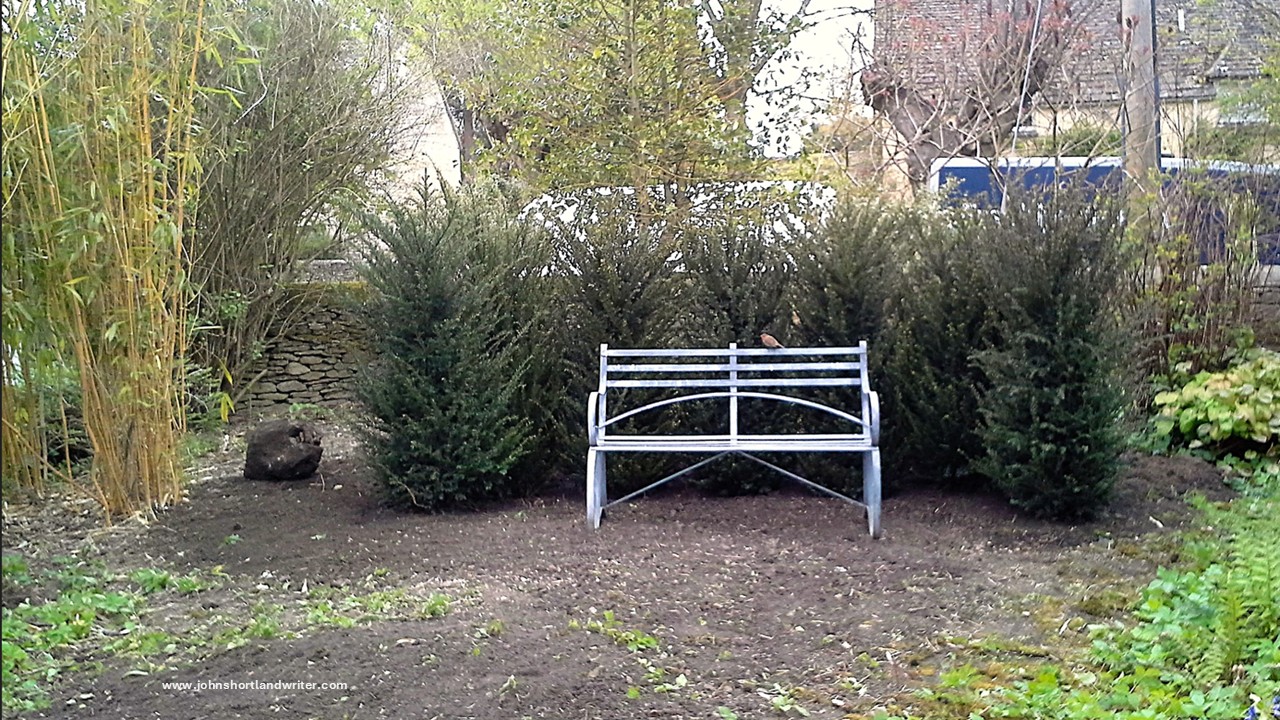
A decorative screen masks this unwanted view

One more option to consider is planting in front of the wall, rather than against it.  If there’s room a low maintenance shrub border might be possible.  If space is really tight, then one or two well-chosen plants may work just as well.  For example, trees trained to grow flat against a wall are readily available and can make a statement without hiding the wall completely. Some shrubs will also do this; they are a much cheaper option and usually grow quite rapidly.  In the photo below forsythia, an unusual choice, has been grown against an ugly garage constructed from concrete blocks.  Although it loses its leaves in the winter its dense network of twigs continues to disguise the wall.  For a few weeks in the spring, it looks both exotic and stunning.

Flowering forsythia suddenly looks exotic grown against this ugly garage wall
The Judas Tree (Cercis) flowers on bare wood, its leaves will appear shortly. It has been fan-trained to remain flat against the wall
If space allows, a low maintenance shrub border can work well

For most people, the decision made is to grow a plant that will climb as well as cover the wall.  The plants available can be broken down into two groups – the true climbers (that will need wires on the wall for support), or the ‘clingers’.  These attach themselves to the wall by little sucker-like pads or by hair-like roots.  With the latter it is essential that the wall is in good condition although it is rare for serious damage to happen.  Both types can be sub-divided into deciduous (lose their leaves in winter) or evergreen.  I have found that the majority of clingers benefit from having some wall ties when first establishing to keep them in close contact to the wall.  Once they start climbing they’ll cling without help.

The climbing hydrangea clings to the wall by tiny hair-like roots
Honeysuckle is an example of a climber that needs wires to support it

One option often recommended, is to fix trellis to a wall and it does sound like a quick fix.  My experience is that the plants weave through it – which is, of course, the idea – but that makes for difficult pruning when it is required for it can be tricky to work out which stems need removing and even trickier to disentangle them.  Worse still, trellis has a tendency to rot or break after some years, usually just when the climber has reached its prime.  Replacing it involves cutting the plant back very hard or replacing it along with the trellis.  However, decorative trellis may be an alternative form of wall disguise to consider with, perhaps, just a large pot of plants standing in front of it.

Trellis helps mask this unwanted view. By creating a focal point of the attractive tree, the trellis becomes a feature in its own right and so no plants are being grown on it

Wires are normally very straight forward to fit providing it is done before planting.  I prefer to use a screw-in ‘eye’ rather than the hammer-in ‘vine eyes’ that are the traditional method of fixing.  All that is needed is a drill and a rawlplug and some very basic handyman skills.  The wires should be fitted horizontally and there is no need to create a network of wires heading off in all directions.  The golden rule is to stretch the wire taut and make the plant grow to the wire, don’t add random wires that follow the growth.  Stems should always be tied to the wire rather than pushed behind it and use ties that will stretch or perish in time otherwise they will become strangled as they grow.  It is all much easier in practice – writing down every step makes it sound more difficult than it really is!

A well-trained rose growing on supporting wires. I have enhanced these for clarity they want to be stretched horizontally and spaced about 18″ (45cms) apart
This poor plant has been strangled by its tie; all the upper growth has died

When it comes to planting, whatever the type of plant it is, make a generous planting hole and mix a good quality compost in with the soil.  Often the ground by a wall is dry and full of builder’s rubble or compacted so having a good planting medium around the new plant will set it off on a good start.  At planting, keep the base of the plant at least a foot (30cms) away from the wall if there’s room.  That way it will receive more water when it rains.  One major cause of failure is planting too deep – make sure that the soil is at the same level as the top of the compost that the plant is growing in.  Standing the plant pot in water for a few hours before planting is a good idea too so that the plant is well-watered before it is disturbed – and, if you’re a real beginner to gardening, don’t forget to remove the plant from its pot keeping its soil intact around it.

Solanum crispum (blue) & Clematis montana (white) hiding a garden shed

A list of plant suggestions:
E=evergreen, CL=clinger, N=will cope with north facing wall, Sh=shrub, T=tree

Large walls:
Carpinus (Hornbeam) – N, T, buy pleached or ready shaped
Cercis- T, more tricky to find and you may have to train it yourself but lovely flowers in pink or white and good autumn leaf colour – see photo
Clematis montana – clip back the growth immediately after flowering to keep tidy and within bounds
Ficus (Fig) – N (but won’t fruit), if you like Figs to eat, Ficus is worth considering
Fremontodendron – E, Sh, colourful yellow saucer-like blooms
Garrya – N, Sh, dark green leaves with long green catkins in late winter
Hedera (Ivy) – Cl, E, N, easy to keep under control and provides late nectar sauce for bees and other insects.  Make sure that wall mortar is sound before planting
Hydrangea petiolaris – Cl, Sh, prune after flowering if necessary
Jasminum (Jasmine) – both evergreen and deciduous types are available with scented flowers.  The evergreen (sold as Trachelospermum) needs a warm wall for best results
Magnolia grandiflora – E,Sh, for a high, warm wall.  They need lots of space to thrive
Parthenocissus (Virginia Creeper) – Cl, magnificent autumn color
Prunus lusitanica (Portuguese Laurel) – E, Sh, T, can be grown as a shrub or purchased as a trained tree (see photo)
Solanum crispum – blue or white clusters of flowers.  Vigorous but easily pruned
Vines – prune in winter if necessary
Wisteria – prune twice yearly, midsummer and midwinter

Medium walls:
Actinidia kolomikta – Sh, pretty multi-cloloured leaves best when avoiding strong sunshine
Azara – E, Sh, for a warm wall
Berberis – E, N, Sh, very spiny branches are a good reason for not growing it!  Magnificent red or yellow berries in autumn, much loved by birds
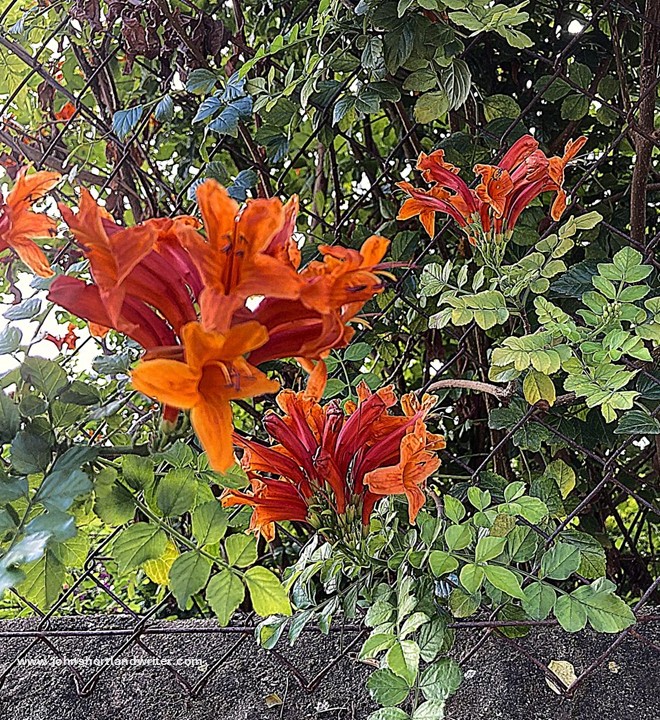
Campsis (Trumpet Vine) – orange trumpet flowers and attractive leaves for a sunny wall
Ceonothus – E, Sh,  smothered in powder-blue flowers during summer
Chaenomoles – E, Sh, white or pink flowers in late winter/early spring
Clematis – plenty of varieties to choose from including evergreen ones – check labels for size as some can require a lot of space
Forsythia – Sh, prune after flowering which takes place in early spring – see photo
Jasminum nudiflorum (Winter Jasmine) – N, Sh, flowers throughout winter
Osmanthus – E, Sh, early-flowering, scented – clip immediately after flowering ends to keep flat against wall
Rhamnus ‘Argenteovariegata’ – E, Sh, variegated foliage, prune to keep flat against wall in spring

Low Walls:
Daphne – E, Sh, very scented flowers but very slow growing
Euonymus – E, N, Sh, Cl, can be grown a sa shrub or clipped flat against a wall, some are self-clinging
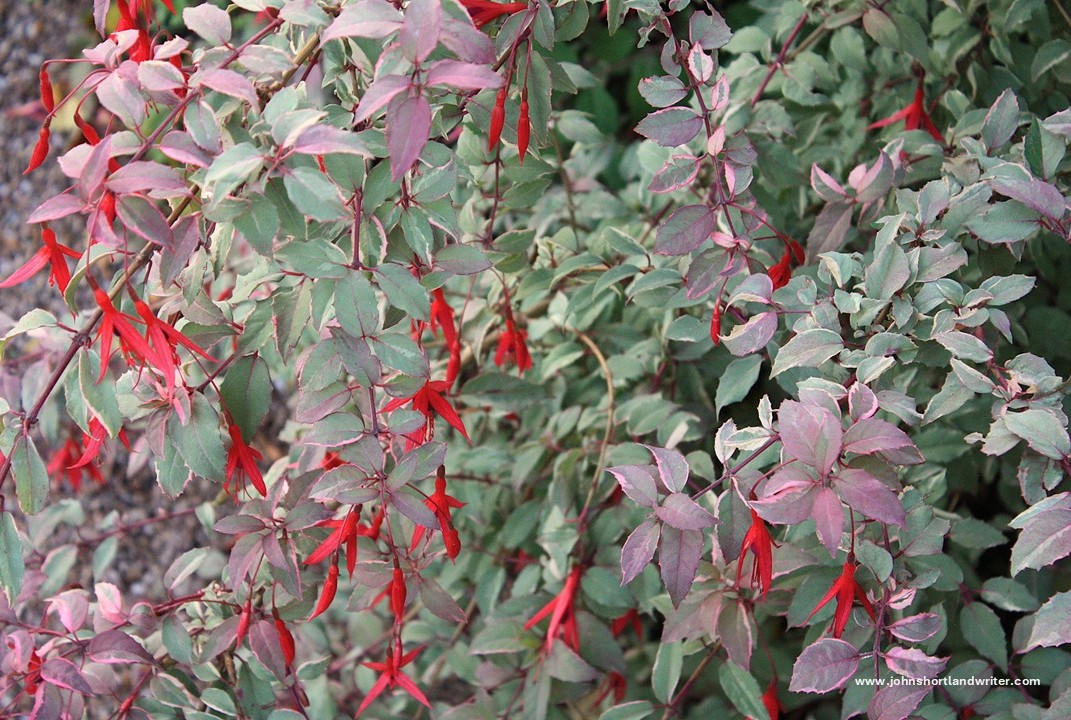
Fuschia – Sh, varying heights, the smaller-flowered varieties are more suited for growing against walls
Helianthemum – E,Sh, very low growing but smothered in flowers through summer, clip after flowers to keep tidy
Lavender – E, Sh,likes sunshine for best flowering
Nandina – E, N, Sh – trouble-free, needs no  pruning
Perovskia (Russian Sage) – Sh, silvery foliage and blue spires of flowers from mid-summer.  I’ve grown it successfully on a shady wall although not usually recommend for this.  Prune back by half in late autumn and then again in early spring to keep bushy
Potentilla – E, Sh, bushy long-flowering plants in varying colours

I recommend looking up these plants on Google to see more detail.  Also, there are many roses that can be considered including some that are fine for north walls.  Apples, pears and plums fruit well when grown against walls of any aspect, as do apricots and peaches if the wall is warm and sunny enough.

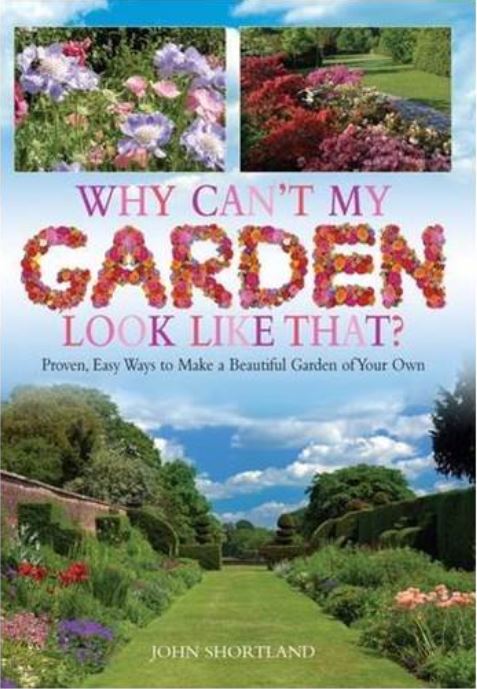
For similar information on how to make both your garden and gardening more pleasurable, why not take a look at my book Why Can’t My Garden Look Like That? It’s written for newbie gardeners as well as those with more experience and covers everything from design to planting and maintenance.  In it, I reveal some of the secrets that I used when Head Gardener to large, country estates with gardens open to the public, where the garden had to look great all the time.  All written in an informal, no-nonsense approach.  Makes a great gift and is available from bookshops and, of course, Amazon.


2024: A Year in Review – part 1

As we enter the new year it’s always a good time to reflect on the past twelve months as well as to look forward to what 2025 may bring. For me, 2024 has been a busy year. I remember many years ago an ‘old boy’ telling me that when you reach the age of sixty, life is downhill all the way. I was in my thirties at the time and so believed him. I’m now in my early seventies and I can’t say that I agree with his pessimism. Funnily enough, he lived well into his nineties and, for most of that time, enjoyed rude health so he proved himself wrong too! The only way to tackle ageing, I’ve decided, is to embrace its positive aspects – no mortgage, wisdom (ha-ha!) and more time to do the things that matter to you. Of course, good health is important and maintaining balance and staying active helps no end. One of the reasons why I’ve not retired completely.

John Shortland, summer 2024

Tewkesbury, a town in Gloucestershire on the River Severn – the UK’s longest river – is just a few miles from the edge of the Cotswolds. It’s an ancient town that I have driven through dozens of times but early in the year I made the effort to actually stop and explore its narrow streets and abbey church. I hadn’t realised that when entering the church I would be staring at a suspended globe which, when standing 211 metres away from it, is the exact size and view of Planet Earth you would see if standing on the moon. When I first saw it ‘suitable’ music was being played but it was only after that had stopped that I found the exhibit strangely moving as it rotated slowly in total silence. That’s another thing I’ve noticed as I’ve grown older – how much I enjoy silence! The church is well worth visiting for it is now almost one thousand years since it was built and is one of the finest examples of early Norman architecture in Britain. Unable to visit? Then click on the link here to see lots of photos.

The abbey church looms over the ancient houses and narrow streets of Tewkesbury
Planet Earth, mysteriously beautiful

In March, we travelled north to the county of Yorkshire to watch a friend take part in the oldest horse race in the country. The Kiplingcotes Derby has been run annually since 1519. Tradition sys that if it ever stops taking place it will never happen again so all through the Covid restrictions only one horse took part! For this race, the 505th, dozens of riders took part for it is a horse race like no other: no finely maintained racecourse but a series of roads, lanes, field margins and tracks, a real test of endurance for both horse and rider. Our friend, who had never raced before was taking part to raise money in support of the local hospice. She reached the finishing post in good time and raised over ten thousand pounds in memory of a close friend. The race has one other completely bizarre quirk which makes it unique in the world of horse racing – to find out what that is you’ll need to click on this link here!

The oldest, continuously-run horse race in the UK
Safely past the winning post!

Later, in early summer we returned to Yorkshire for a week’s holiday spent in the pretty village of Austwick. We had planned to spend our time walking for it is excellent hiking country. However, my partner was nursing a broken foot and, later, during a hill walk on my own there, I hurt my knee badly so we were both hobbling about instead (what was I saying about staying active?!) There is always a positive outcome to everything, I find, and so we explored by car instead where we discovered the Courtyard Dairy. To misquote Paul Whitehouse, “if you like cheese, you’ll like these” for we’d stumbled across one of the top, award-winning artisan cheese makers in the country. With a restaurant, small museum, ice-cream and wine shops as well as a huge selection of cheeses, we were in our element. For lots of photos of the trip – and not just of blocks of cheese, click here.

The Courtyard Dairy – one of England’s finest artisan cheese shops
There are beautiful walks around the Yorkshire village of Austwick

I have been very fortunate in not just living in a beautiful part of the country but also being able to make my living from being in the midst of it. However, that hasn’t always been the case for before I embarked on my horticultural career I spent twenty years in the world of retail fashions. When I left school I spent some months on a sheep farm on Exmoor – the remote, hill country, now a National Park, in the West Country. That short time farming changed my life for I met some wonderful and inspirational people there who left me with a yearning for the outdoor life, However, I was dragged away by my parents to work in the small department store which had been central to my family for the best part of a hundred years. Fortunately, I had a happy time there but the desire to be spending my days outdoors never left me. This spring it was thirty years since I sold the business to follow my dream and so it seemed a good time to reflect on those retailing years.

How the family store began in 1904
The family store in 1994 when it was sold

A few months later the blog post (link here) had developed into a full-blown illustrated talk to over seventy people followed by press interviews and a printed history of the store which had been started by my great-grandfather. I am delighted that the story of the family’s endeavour has now been recorded for posterity. By complete coincidence, I was also contacted by Exmoor Magazine and my memories of farming at Brendon Barton have been included in an article on Dick and Lorna French who were the couple who welcomed me into their lives – and changing mine by doing so.

Recorded for posterity – the history of my family’s department store

At the age of 42 I took myself off to study landscape and estate management for two years at agricultural college. It was a huge gamble and one that fortunately came off for I found employment as Head Gardener to the European Youth Parliament, an educational charity that brought teenagers from all over Europe to debate world affairs. With some Polish blood in me I liked the idea of being part of the organisation. Next, and still in England, I spent some happy years working for a delightful Swedish family – even after my role as Head Gardener had ended I maintained contact with them as Consultant overseeing projects such as the creation of a lake and an arboretum. My next move was to the Cotswolds to manage an historic garden, Kiddington Hall, designed by the architect who had created the Houses of Parliament. It was after that, that I decided to go freelance which culminated in the career in designing and creating gardens as well as the commission to write the gardening book.

The historic gardens at Kiddington Hall

Little did I think, when I began college that my career would include a stint at the Chelsea Flower Show, Channel 4 Television, creating a new literary festival and a study tour of Hungary. My latest – and final – garden project has been the most exciting to date. How fortunate have I been?! As before, the press picked up on the thirty year career change and a double-page spread in the Bucks Free Press newspaper followed. To read more about the gardens I’ve created, or just to enjoy the photos, click on the link here.

The newspaper article

Related links/websites

Tewkesbury Abbey Church
Gaia
The Courtyard Dairy, Settle, Yorkshire
Yorkshire Dales National Park
Exmoor Magazine
Exmoor National Park
John Shortland
Berkshire College of Agriculture
European Youth Parliament

Winter Pruning of Limes, Hazels & Dogwoods

Hard pruning takes courage and gardeners are often reluctant to carry it out for fear of harming or, even worse, killing the plant. Once it is understood that more trees and shrubs are lost through neglect than by pruning the task becomes somewhat easier. In far too many gardens woody plants are grubbed out because they have outgrown their allotted space when judicious pruning at an earlier stage of their life would have allowed them to thrive and give pleasure for many more years.

Outgrown its space? Don’t remove it, prune it!

January and February are the perfect months for carrying out coppicing and pollarding and some shrubs like willow and dogwoods, grown for the winter colour of their bark, are actually improved by the process. Coppicing and pollarding are traditional techniques that have been carried out for centuries in woods and forests to provide a plentiful supply of fuel and fencing materials. As with all procedures, jargon evolves and coppicing and pollarding are just words that describe the removal of branches back to the tree trunk (coppicing) or, in the case of pollarding, the removal of stems to ground level. Somehow, if you just say to yourself, “cut off every branch” the mystery of the process disappears and becomes less intimidating.

Willows – some newly pollarded line a riverbank

Limes (Tilia) are very beautiful when grown as full-sized trees but become far too large for most gardens. They are better planted as parkland trees in a field, if you are lucky enough to own one, where there stature and grace can be appreciated from a distance. Too often they are grown where their branches overhang driveways where they drop their sticky honeydew over vehicles and become a nuisance. Most limes are host to tens of thousands of aphids (greenfly) which feed on its sap and then secrete the unwanted waste. Somehow, the gardener’s jargon word ‘honeydew’ sounds so much nicer than ‘greenfly crap!’ If you are determined to plant a lime tree in a confined space the Caucasian Lime, Tilia x euchlora which doesn’t have this problem is the one to go for. Remember that any tree in a confined space will need its size controlled so read on to find out how to pollard it.

Limes, when mature, are beautiful but very large trees

The time to pollard a tree is winter and January, when there isn’t too much to do gardening-wise, is the perfect month. I always aim to complete by the 31st which allows time to continue into February, if need be. By the middle of that month the sap will be starting to rise within the tree so it is sensible to complete the task by then. It is very straightforward to remove the branches for which you will need secateurs for smaller twigs, loppers for larger ones and a sharp pruning saw for anything bigger still. Which tool to use when? That too is easy to know. Secateurs and loppers should cut through the stems easily – if you need to twist the tool or the stem, you should be using the saw.

By midsummer there is plenty of new growth on this old willow pollard

Common sense will tell you that if you remove all branches from a tree there will be nothing left to offer any screening. This isn’t always important and coppiced trees send out new growth very rapidly as the weather warms up. However, for privacy or a different ornamental effect more careful pruning is required. All that needs to be done is to cut back any branch or twig that has grown beyond the space you have allocated for it.

A pollarded lime allee provides drama and a focal point
This lime allee has had its side branches retained to give denser summer screening

Limes are not often grown for the colour of their winter twigs probably as they are up rather high and so less noticeable. Willows (Salix) (when coppiced, for they can also be pollarded) and dogwoods (Cornus) are very different for their bright yellow, orange or scarlet stems are very visible and a mainstay for any winter garden. They are also quite simple to prune as it is all carried out at ground level. When the plants are mature, I prefer to cut them over a three year period as this retains their overall height. Quite simply, it means that only a third of the stems are removed or, if you have plenty of shrubs, completely prune one in every three to their base. The purpose behind this pruning is not so much to control their size but to maintain the strength of colour which is at its best on younger shoots. If left, they gradually become quite dull.

The coloured stems of dogwoods

Hazels are treated very much like willows and dogwoods, although the usual purpose is purely to maintain a convenient size or to provide ‘pea sticks’ to be used for supporting summer plants as well as peas and beans. For guidance take a look at my earlier post from 2021 which can be read by clicking on the link here.

A hazel tunnel is created by partial coppicing to reduce the number of tall stems

In Need of Winter Cheer – and how to get it

With the long, dark nights now upon us (and the gloomy daily news) we could all do with a little cheer to take us forward.  It isn’t too late to take a small step towards obtaining it for there is nothing quite like flowers in the house to lift the mood.  Now is a good time to plant bulbs for indoor flowering.  The choice is surprisingly large and some can have quite exacting growth requirements but the simplest of these – that anyone can succeed with even if they don’t have green fingers – is the sweetly scented, white-flowering Narcissus Paperwhite.

The delicate looking bloom of the Paperwhite Narcissus

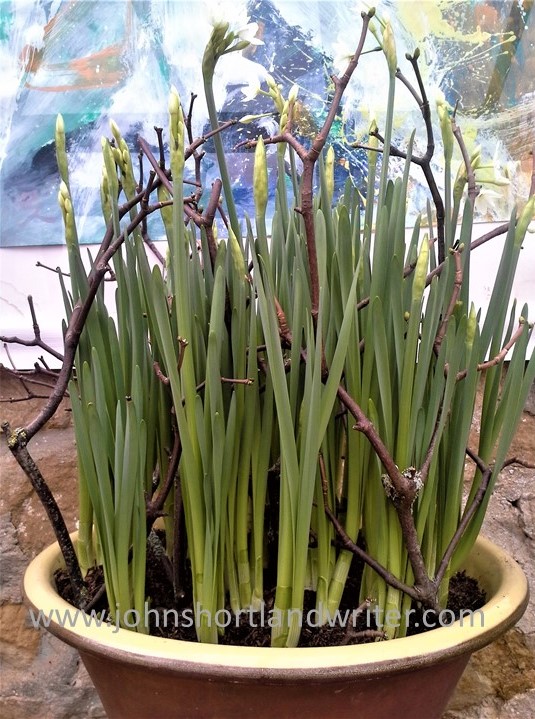
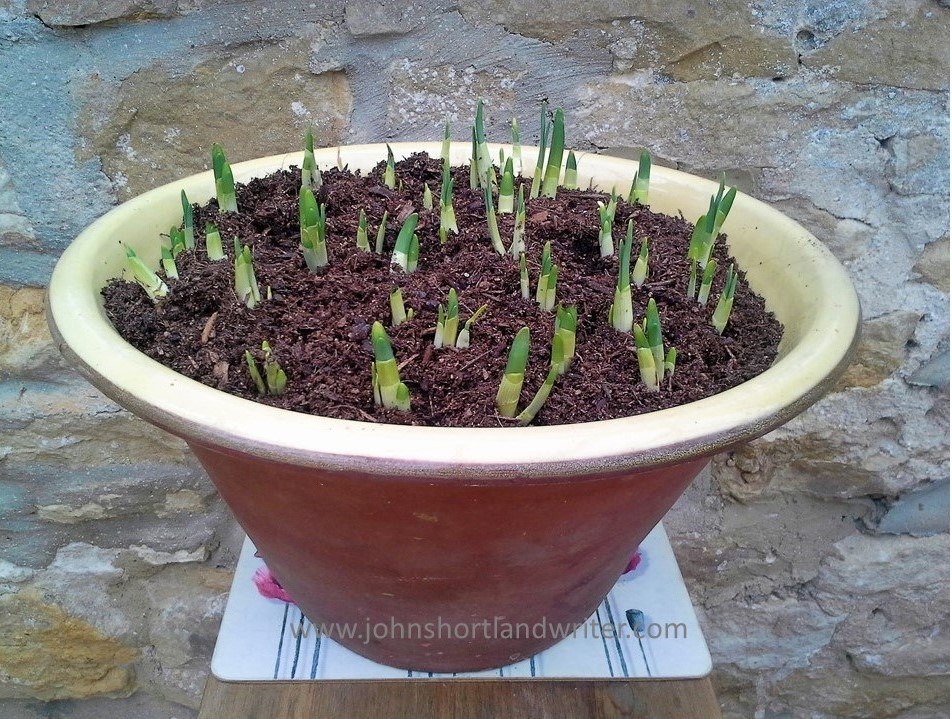
Unlike the majority of Narcissus (Daffodils) they do not require a period of complete darkness to encourage them into growth.  In fact, they do not even need to be planted for they will happily flower just anchored in a bowl or pot of gravel that is kept moist.  However, I think they are better planted in potting compost and look far more aesthetically pleasing.  I never bother with special bulb fibre that is sold for the purpose mostly because I tend to have half-open bags of compost kicking around the place that need to be used up.  If you plant the Paperwhites now and bring them straightaway into the house they can be in flower in six to eight weeks.  Those in the photos below were placed in our conservatory and, with the unanticipated warmth from a week of late autumn sunshine which accelerated their growth, have come into flower in just three weeks from planting.  So much for having them in bloom over Christmas!

Note the use of twigs to provide natural looking support

The secret to the planting is to cram as many bulbs as you can into the pot, either in a single or double layer.  If choosing the latter don’t plant directly over one another but stagger them a little so they all have freedom to grow without struggling to push past.  The bulbs in the glazed earthenware pot here were planted in a single layer all touching one another – that way I was able to squeeze in twenty-eight bulbs into a container measuring just twelve inches in diameter. 

Put as many bulbs in the pot as you can squeeze in

Paperwhites have a tendency to flop just when they look their best and the quickest way to prevent this is to push twigs into the compost.  If you do this at the time of planting or very soon after the plants grow strongly through them and look far more natural than when you try to rectify it once they have collapsed.  It is also far less fiddly than using canes and string and looks more natural too.

I have always found hyacinths far more difficult to grow well although I know plenty of people who never seem to have any trouble whatsoever.  They need to be kept in darkness until the flower bud just shows.  I have found them to be rather erratic with their growth and, in the days when I had to provide huge displays for the big country houses I worked for, I grew them in individual, small pots.  By growing more than I really required I could select those of matching height, remove them from their pots and then replant them into the display pots.  They never failed to impress and I never let on how I managed to get such a uniform display!  Far easier are the little grape hyacinths, Muscari, growing here in a glass bowl – an idea I copied after I was given them one year as a gift.

Grape Hyacinths are often sold under the name Muscari

Perhaps one of the loveliest bulbs I have planted in recent years is the miniature iris, Iris ‘Sheila Ann Germaney’ (I have spelt that right!).  Once, again, very easy to grow – just keep them in the dark until they start to grow and then bring them indoors.  After they have finished flowering they can be planted in the garden where they will flower each spring for many more years.

Iris ‘Sheila Ann Germaney’
The Iris’ beautiful markings can be more readily admired when they are indoors

Amaryllis or Hippeastrum are spectacular giants that aren’t to everyone’s taste.  I’m not too keen on them as an individual plant grown on a kitchen window sill although they will bloom there quite happily.  I prefer to use them as cut flowers and for this I tend to grow them in a greenhouse, although a light windowsill would work just as well if you have the space.  They are very straightforward, do not need to be kept in the dark and are often sold complete with pot and compost in gift boxes.  When used as I suggest, several stems placed together in a tall vase look superb.

home-grown Amaryllis used as a cut flower

I have found tulips to be less successful as indoor bulbs although the shorter types should work; I’m just not very keen on those so have never bothered to try.  However, if you have an unheated greenhouse that lies idle through the winter plant the exotic double types there.  Protected from the worst of the cold and rain they flower weeks earlier than normal and can be harvested as exceptionally beautiful cut flowers.

I find tulips for indoors are best grown as flowers for cutting

The secret to indoor bulb growing, as with all forms of gardening, is to experiment and find what works best for you.  Over the years, I have tried all sorts, some surprisingly successful and some, if not quite disasters, they certainly weren’t worth bothering with a second time.  With success, you will have an endless supply of colour and scent for your home and, of course, they make great Christmas and birthday gifts.  This last sentence also gives me the excuse to remind you all that my book Why Can’t My Garden Look Like That?  is still available from Amazon or through booksellers and also makes a great gift!  In it you will find all sorts of hints and shortcuts that I used during my years as a Head Gardener when it was essential that the displays both in the house and the garden were as good as they could be.  Happy bulb planting!

A perfect gift!

Old Yew, New Yew, Renew Yew

Although in the UK the yew tree (Taxus baccata) is often called English Yew it is, in fact, very widespread in its distribution growing throughout Europe as well as parts of Africa, Iran and Asia. It can live to a great age and there are several, mostly growing in churchyards, that are thought to be a thousand or more years old. One such tree grows in the Chiltern village that I lived in before moving to the Cotswolds; it is enormous having a girth of over 5.5 metres.  Despite being a British native that has grown naturally in the wild for thousands of years, yew woods are very rare – I can only think of two (although there must be others): one in the Chilterns behind Watlington Hill and the other in Sussex.  One of the reasons for this is that yew was the favoured timber for making longbows – by 1294 yew stocks were so depleted that imports were being sourced from mainland Europe.

yew forest

The yew forest at Kingley Vale, Sussex, England – one of the finest examples of this rare habitat in Europe [photo credit: Ben Shade]

Yew watermark

The huge girth of the ancient yew in the churchyard at Ibstone , Chiltern Hills, England

Yew is unusual in that the individual plants can be male, female or a combination of the two.   All-male trees release huge clouds of pollen whereas all-female produce none and can be identified by their glowing red berries.  It has even been known for individual trees to gradually change sex with all-male specimens becoming all-female and vice versa.  Although the pollen clouds can be extremely irritating if caught in one, in the average garden situation where mature trees are less likely to be found the pollen release is much more limited.

Swerford Park - Yew Berries(11) watermark

The glossy red flesh is the only part of yew that is non-poisonous. It’s still not advisable to eat it!

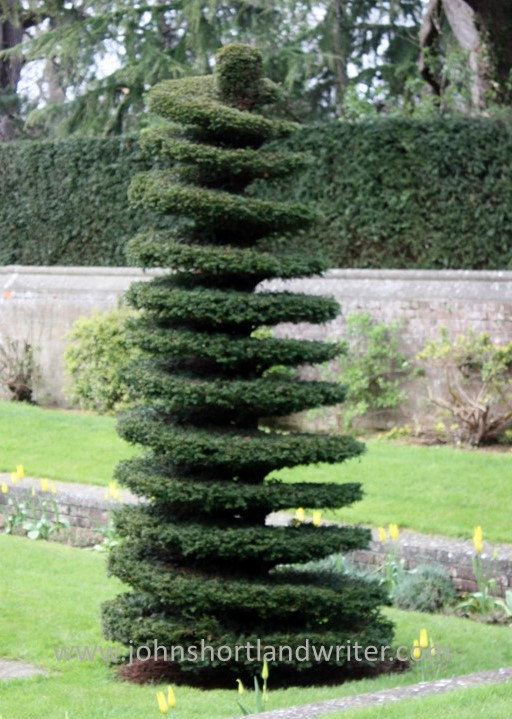
In its natural condition yew is a spreading, evergreen tree, wider than it is tall.  However, for many centuries it has been clipped and shaped into hedges and topiary for which its regular, and when treated in this way, tight growth makes it ideal.  It responds well to being kept low, say around 45cm, or can be stopped at any height required.  Likewise, it can be clipped into neat cubes, intricate spirals as well as the ubiquitous peacock beloved by stately homes.

Hidcote (6) watermark

Yew topiary at Hidcote, Cotswold Hills, England

Yew Topiary watermark

Intricate yew topiary at Farmleigh Gardens, Dublin, Ireland

One of the characteristics of yew is its ability to send out new growth from old branches and even from its trunk.  This can be readily seen when the branches are parted or the main stems are exposed.  To maintain a clean trunk these growths should be pruned away before they become established.  With hedges and trees it means they can be reduced in size as drastically as you might wish although it is important to bear in mind that a heavily pruned tree may never be restored to a thing of beauty.

Yew (2) watermark

Yews ability to regenerate from old wood means that it can be pruned as hard as you dare

If reshaping trees is a skill difficult to master, restoring overgrown or gappy yew hedging only takes courage although for best results it may take a few years to achieve perfection.  Begin this process by removing all growth back to the trunk on one side only.  The hedge will now look ugly but new growth will soon sprout and the following year or in year three the other side of the hedge can be given the same treatment.  Apart from the benefit this staggered pruning has to the health of the yew another advantage is that the screening from the unpruned side means there is no loss of privacy.  The height of the hedge can also be reduced at the same time as side two cutting 6-12 inches below its required finished height to allow for regrowth.  By year five, if not sooner, the hedge will be a manageable, healthy screen once more and will continue to be so for very many years.

Yew Hedge Regeneration watermark

The first stage in regenerating an old yew hedge

As with all plants, especially those that are long-lived, careful planting is essential to give them a good start.  Yew copes with most soil types including chalk but hates waterlogged or compacted soils.  Whatever the soil, enrich with good quality compost or well-rotted manure; if any parts are excessively damp create a low bank at least six inches high to ensure the roots establish in the marginally better drained soil.  Pot-grown yews can be planted at any time of the year providing the ground isn’t frozen; the best time is mid-autumn and spring when the soil is warmer. The optimum size for quick establishment is 2-3 feet and this size also makes planting a hedge quite economic too.  With a bigger budget larger plants may be purchased.  These in the photo below are over six feet high and create an instant hedge when planted closely together.  Because of their size they are usually ‘root-balled’ and only available during the cooler months.  The hessian and wire mesh root ball should be left intact as they quickly decay once planted although the wire collar may be released if it fits too snugly against the stem.  In windy situations they may require staking; they will certainly need careful watering for the first two years of their life.

Secret Garden (4) watermark

Rootballed yew waiting to be planted – they will make a fine, if somewhat costly, instant hedge

However you chose to use your English Yew, whether as hedging or as topiary, there is one common rule to clipping and that is accuracy for nothing looks worse than a formal hedge or piece of topiary that does not have clean, sharp lines.  The ideal time for clipping is August although spring is the time for restoration pruning.  One word of caution – all parts of yew are highly toxic if ingested.  It is essential that clippings are disposed of carefully for it can be fatal if livestock such as horses have access to them.  Yew clippings from regularly clipped hedges can be sold for use by pharmaceutical companies to make cancer treatment drugs.  In the past, when I was the Head Gardener of a large country estate with extensive yew hedging, we secured a not-inconsiderable amount of money over time which the estate donated to cancer research charities.  I believe that, for 2020, collection has been suspended but hopefully it will be resumed in future years.

Kiftsgate Court (4) watermark

A beautifully clipped yew hedge creates the perfect backdrop to any garden – Kiftsgate Court, Cotswold Hills, England


How To Grow Tomatoes With Little Effort

It may seem odd writing about growing tomatoes at the time you should be harvesting them but it is often the case that when you see a plant growing somewhere that is the time you wish you knew how to grow them.  As regular readers of my garden articles will know, although I love gardening I also like to achieve great results with the minimum of effort and tomatoes are not an exception!  Effortless gardening doesn’t mean bad horticultural practice for you can hardly expect great results from shoddy workmanship wherever your interest lies.  All the photographs below demonstrate that it is possible to have superb tomatoes without devoting every spare moment to growing them.

Tomato 'Moneymaker' watermark

Perfect tomatoes can be grown quite easily using my method

As is often the case, I discovered this easy way to grow tomatoes out of necessity: a client wanted them but they only visited their country house irregularly and I could only devote one day a week to maintaining their grounds.  That left about fifteen minutes a week for the tomatoes.   This method, by the way, only works for plants grown in containers.  Although they were grown in a greenhouse there is no reason why the same method could not be used for growing in pots outdoors although they are more at the mercy of the usually variable British summer weather (not variable this year, 2018!).

Tomato 'Golden Sweet' watermark

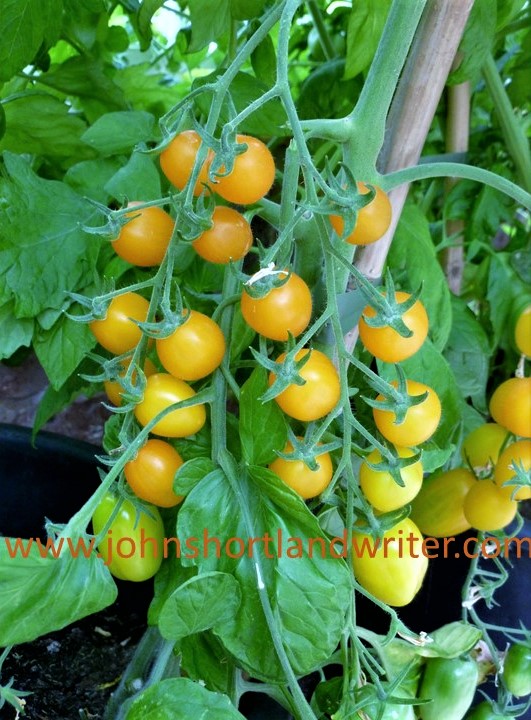
Tomato ‘Golden Sweet’

All garden plants, whether grown in containers or in the garden border require good growing conditions and this starts with getting the soil or potting compost right.  Tomatoes are greedy feeders and books and articles always advise feeding the plants on a regular basis as soon as the first flowers show signs of turning into fruit.  That is far too time consuming for my fifteen-minute rule!  Instead, use a quality compost.  I used Carr’s potting compost which is made from composted farmyard manure; although not the cheapest it is well worth paying the extra cost for the results that are obtained.  There are, of course, other manufacturers that do something similar which, I daresay, will achieve similar results.  To this compost I mix in several handfuls of horticultural grit and double the recommended amount of water-retaining granules – these swell upon contact with water, and release it gradually thereby reducing the necessity for regular watering.

Tomato 'Cherrola' F1 watermark

Tomato ‘Cherrola’

Tomatoes are easy to grow from seed, sowing in gentle heat in February and there is a huge choice of variety.  For ease and speed, I purchased young plants from a garden centre once I had no concern of late frosts killing them.  The pots were filled to within a couple of inches of the brim with the compost mix which I had pre-moistened.  As a guide, the compost should feel damp but you shouldn’t be able to squeeze water out of it.  Plant three tomatoes in a 20/25 litre plant pot placing a sturdy cane by each plant.  Stand the pot on a watering saucer or tray and water well.  Gardening rules state that tomatoes don’t like standing in water but I found that by using the saucers I could leave them with a good supply to last them the week.  By the time of my next visit, the compost and tray were dry but the plants unaffected by either the standing water or the drought.

Tomato 'Tigerella' watermark

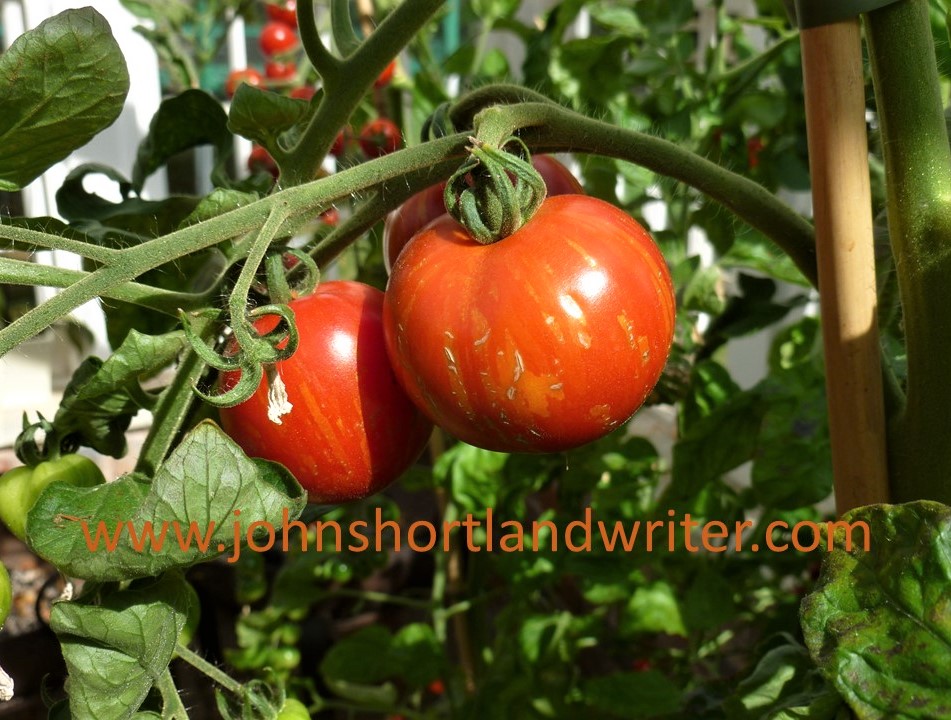
‘Tigerella’, an heirloom variety of tomato with striped fruits

Tomatoes grow in two different ways depending upon the variety – bush or cordon.  With bush tomatoes you just leave them to grow as they will; with cordons it is recommended that you remove side shoots and tie the plant upright onto the cane.  Although the latter method sounds time consuming and fiddly it is a simple and quick task once it’s been mastered.  The secret is to remove any shoots that grow out of the union of the leaf stalk with the main stem – if done early enough they snap off with the fingers.  If you leave them they will need to be cut out with a knife or scissors.  Although it is possible to leave them in situ I find that the plants become very congested and difficult to manage which, in the longer term, means they are more time consuming to deal with.

Tomato 'Sungold' watermark

Tomato ‘Sungold’ – note how the plant has been ‘stopped’ when it had grown as tall as I wanted it to be.

And that’s it!  Just tie the plants to the cane as they grow and give them a really thorough watering once a week from the top of the compost until the saucer begins to overflow.  There’s no time-consuming feeding for the compost will provide all the necessary nutrients. And because the plants are growing strongly and healthily you are far less likely to be bothered by pests or diseases.  All the tomatoes in the photographs received no chemicals or other additives; all we had to do was to eat them.  If you’ve never tasted a home-grown tomato eaten the moment it is plucked from the vine then you’re in for a real treat!

Tomato Big Boy 1979 watermark

A photograph from 1979!  Tomato ‘Big Boy’, a beefsteak variety living up to it’s name!

Thinking Outside the Box(wood)

Over the years I must have hand clipped many miles of box (in the USA, boxwood) hedging and once the knack is mastered it can be quite therapeutic.  The main rule to follow is to remember that it has to be precise for there is nothing worse than a straight, level hedge that is clipped unevenly.  It irritates the eye as much as a picture hanging crookedly on a wall.

Box Hedge Clipping (2) watermark

Patience and plenty of time are key factors in ensuring straight lines

I can’t say that I feel quite the same about topiary.  I can admire the craftsmanship that goes into producing weird and wonderful shapes but it is so easy, in a lapse of concentration to, say, cut the ear off a teddy bear or the beak off a peacock.  As a consequence, I find it rather stressful.  Cloud topiary is far more forgiving but, again, it doesn’t really “do it for me.”

Box Cloud Topiary watermark

You need even more patience to clip topiary

Perhaps the most rewarding design I have created was turning four rather scruffy and unbalanced squares of box into simple but elegant cubes.  Yes, it was topiary but to misquote Star Trek “it’s topiary Jim, but…”  To begin with, I was faced by the four squares each with a rather ugly and thorny shrub rose growing out of their centres.  A consequence of this design was that the box couldn’t be clipped properly and neither could the rose be properly pruned.

Box Hedge Clipping watermark

The original design with roses always looked scruffy

To create the design the roses had first to be removed leaving a gaping hole in the centre of each square.  Fortunately, I had some reasonably tall box plants elsewhere in the garden that I could dig up and replant.  I soon discovered that it was impossible to plant them properly without damaging the existing plants.  My gamble of just standing them on the earth and then throwing topsoil over them to trickle through the branches paid off.  The soil covered the roots and probably much of the lower branches too*.  Given a good watering, the plants thrived.  Before trimming  all the outer edges needed to be marked with string lines for accuracy in cutting.

Box Hedge - Copy watermark

Without strings for guidance clipping the box into perfect cubes would be almost impossible

I thought about all sorts of fancy designs for the tops of the cubes and, as is so often the case with design, I decided that simplicity was the key to a satisfactory outcome.  Two cubes would have a raised circle and two a raised square.  It was essential that these weren’t too high – I didn’t want them to look like a combination of wedding cakes and pimples!  I found that it was impossible to mark these designs out and so they were created without guidelines, relying on my eye to tell me where and what to clip.  By their second year of clipping they looked as if they had been there for ever.

Box hedge Clipping (10) Year 2 watermark

The design will look just as good in winter when highlighted by frost or snow

Box is such a versatile plant to use and it is well worth experimenting with them.  Below are three photos of how I have used them: the first is the classic edging to a border; the second to bring focus to a set of garden steps; the third a mini-parterre to link two levels in a garden.  Your garden doesn’t need to be huge or grand to use box in these ways – the parterre was suitably small scale for a tiny town garden.  Have a go at creating your own box design – and if creating a topiary peacock is your thing, that’s fine with me – just don’t aske me to clip it!

Apricot & Blue watermark

The classic use for box – fronting a border

Box Topiary watermark

Giving focus to garden steps

Box Parterre watermark

Mini-parterre for a tiny garden


*This is also a good and easy way to create plenty of new plants for the buried stems will often send out roots.  When they do they can be severed from the parent plant to be grown on elsewhere.

Growing Sweet Peas – the lazy person’s guide

Imagine it is mid-summer, the morning sun is warming the day and you are gathering handfuls of pretty, multi-coloured and fragrant flowers to bring back into the house.  If this sounds like a heavenly dream then read on.  The dedicated gardener will need no further encouragement to grow sweet peas but for those less keen on gardening or with little time, they are still the perfect choice.

So, even if your idea of gardening is to sit in it with a glass of chilled, white wine, there is a quick and easy way to grow sweet peas for, at this time of year, pots of young seedlings are available from garden centres.  They are usually grown in a single pot with a dozen or more plantlets crowded together.  They nearly always come as a mix of colours but it is necessary to check that they are a tall-growing and scented variety.  Avoid buying the scentless and/or dwarf types, both of which I dislike intensely – why grow these when they should be fragrant and elegant?

Sweet Peas (3) copyright

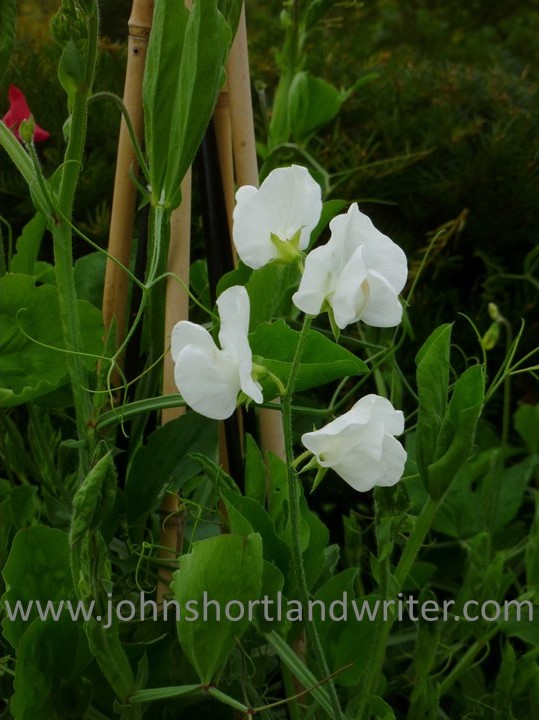
Sweet peas grown informally on a ‘wigwam’ in the garden border

If the weather is reasonable and the soil not frozen, the seedlings can be tipped out of their pot, teased gently apart and popped in the ground about six inches (15cms) apart.  It is beneficial to make sure that the soil in the pot is moist so give them a good drink an hour or so before planting.  Sweet peas, being climbers, need something to clamber up: the traditional way are hazel sticks. These are ideal for the sweet peas attach themselves readily to the rough and twiggy stems.  If hazel cannot be found, bamboo canes also work well although the young plants may need a little helping hand at first to attach themselves – use any short twigs for this just to prop them up.  The canes, which are traditionally placed into a circular ‘wigwam’, need to be about 7-8ft long so that once in the ground they are about 6ft tall.  Apart from keeping them watered in dry spells and free from slugs and snails that’s it.  They will begin to flower in June and continue (providing you pick them regularly and never allow them to set seed) until the autumn frosts.  Incidentally, they grow well up fences too providing they get adequate sunshine.

Sweet Pea copyright

For more experienced gardeners and those that want to enter the local flower show try growing them as ‘cordons’.  With this method they are grown in straight rows on bamboo canes or strings to a height of 5ft.  A place in the vegetable garden is ideal as they can be readily accessed from all angles without treading on other plants.  The spacing is again six inches apart.  For the best blooms, remove the tendrils and any side shoots as they appear, also any flower stems with less than four flower buds. With no tendrils for self-clinging it will be necessary to tie the plants to the stakes with string or by using metal rings sold especially for the purpose.  When the plants reach the top of the canes and/or the flower quality diminishes, cut the plants free of their stakes and lay them carefully along the ground. Tie in the growing tips to their nearest stake and train as before.  The plants will flourish having been given a new lease of life.

Sweet Peas copyright

These sweet peas, grown as cordons, are now ready for layering

Sweet Peas (2)

The layering process

Sweet peas are readily grown from seed, either sown in pots or the ground in March/April or in pots in October.  I prefer to start them in individual pots regardless of the time of year and to protect them from the worst of any cold weather.  The seed does have a hard coating and many gardening books advise chipping the individual seeds with a knife.  Not only is this hard work and time consuming, I have never found it to be necessary.  The seed is both plentiful and inexpensive and if a few don’t germinate does it really matter that much?

The growing and exhibiting of sweet peas reached a peak in late Victorian and Edwardian times with many specialist clubs holding shows.  With patience and luck, who knows you may become a medal winner at your local flower show?  Even if you don’t, you’ll be rewarded by a garden full of colour and a house full of scent.

Book Cover

There is lots more no-nonsense advice for gardeners in my book “Why Can’t My Garden Look Like That?”  To take a peek inside the covers, click here.

On Tulips

The story of the craze for tulips in the 17th century, Tulipomania, is well documented and oft repeated.  Suffice to say, that favoured, single tulip bulbs were selling for thousands of pounds/dollars before the tulip ‘bubble’ crashed.  Today, we are fortunate in having many hundreds of varieties in an unimaginable range of colours and forms to choose from and at remarkably low prices.Hidcote - tulips in the Old Garden copyright

Over the years, my work has taken me to gardens of all sizes and styles, from formal parterres attached to country estate houses to ‘pocket handkerchiefs’, to planting thousands in grassland to planting a score or less in pots.  It has given me the opportunity to experiment with colour as well as variety.  Below are some of my favourites.

Hidcote (11) copyright

The formal parterres of this Victorian Italianate garden (by Charles Barry, designer of the Houses of Parliament) required very restrained planting both in colour and quantity.  Here, I used the variety ‘Spring Green’, which stands well even in harsh weather conditions. After flowering, the bulbs were lifted and dried off to be replanted again later in the year.  It is always desirable to do this as it helps to prevent disease and deterioration of the bulbs.  In practice, it is often easier just to leave them and add a few additional bulbs each autumn to bulk up the numbers, especially when time is short.Kiddington Hall 2001 copyright

Also in a large estate garden but at the opposite end of the style and colour spectrum, three thousand red (‘Bing Crosby’) and white (‘Diana’) tulips were planted on a meadow bank.  Tulips when planted in grassland deteriorate very rapidly – to maintain this display new bulbs were added each year.  However, they do look very beautiful when grown this way – try the almost black tulip ‘Queen of Night’ with blue Camassia bulbs for a magical combination.Tulips bing crosby & diana in grass copyright

Even when planting smaller beds, cramming in as many bulbs as is possible between other plants makes for a beautiful display.  This stunning border was only one metre wide and four in length but there was still room to have plenty of early colour from ‘Purple Prince’ and the lighter ‘Candy Prince’.Tulips Purple Prince & Candy Prince copyright

For formal displays a bed of tulips takes a lot of beating.  They can be single coloured as in this image of pink tulips under-planted with yellow wallflowers (seen at Glasnevin Botanic Gardens in Dublin, Ireland) or mixed colours and planted so densely that no other plants were necessary or desirable (seen at Lismore Castle, Ireland).Tulips - pink copyrightTulips Lismore Castle copyright

For those of us with limited space and budgets, tulips grown in pots are ideal for we can still cram the bulbs in to give a magnificent display.  The images below show how the first layer of bulbs are placed before a second layer is planted above them.  Avoid planting directly over the first bulbs by leaving their tips showing – this will give the bulbs space to develop with much better results.  Top up the plants with potting compost and nature will do the rest; it couldn’t be simpler!  I like to use the more ‘exotic’ looking varieties in pots as the blooms, by being lifted closer to the eye, give more opportunity to admire their spectacular detail.Planting tulips copyrightPlanting tulips in pots copyright

Perhaps the easiest of all tulips to grow are the wild species* and their varieties.  Their delicacy of size belies their toughness.  If they like you, they will increase in number year after year.


Tulipa 'Peppermint Stick' copyright

Tulipa ‘Peppermint Stick’


Tulipa acuminata copyright

Tulipa acuminata

All tulips benefit from being planted as late in the year as possible, November is ideal but even if later they will still flower.  The pot grown ‘Green Eyes’ were planted mid-January this year and have just finished flowering.  They will be planted in the garden in due course to flower again next spring.

Tulip 'Green Eyes' copyright

Tulip ‘Green Eyes’


In England, tulips are flowering at their best right now: take the opportunity to visit open gardens to see which ones you like best.  Make notes of their names so that you can order the bulbs when the catalogues drop through the letter box mid-July.

*always ensure that any bulb is purchased from a reputable source and have not been gathered from the wild.

The Fortune in Your Garden

The garden in winter; not the place where many of us loiter.  Instead we race back to the house for a nice, warming cup of tea.  On the way, we catch the scent from the Mahonia bush that thrives year after year on neglect.  Hinting of lily-of-the-valley, it’s fragrant, primrose yellow sprays of flowers will continue to give pleasure until the spring, as will the white, winter-flowering honeysuckle.  We stop just long enough to pick a few sprigs of jasmine, also pale yellow, to put in a vase.  The list of so many of our favourite plants could go on and on.

jasminum-nudiflorum-copyright

Winter Jasmine, Jasminum nudiflorum

What do all these plants have in common apart from being easy to grow?  They were all collected by a dour Scotsman in the mid-nineteenth century, Robert Fortune.  Despite being garden favourites and he being heralded as one of the heroes of the Victorians his name today is all but forgotten.  Even more remarkable, his discoveries changed society’s values, values that we now take for granted.  And the cup of tea?   Before Robert Fortune’s expedition to China, tea was an expensive commodity drunk only by the privileged few; soon it was to become the everyday drink of the masses.

tea plantation copyright.jpg

Tea plantation

In 1843, having shown great ability as a plantsman, first in Edinburgh and then at Chiswick, Fortune was sent to China with the instruction to learn about the practice of using bonemeal and to collect “tea of differing qualities.”  Commissioned for twelve months with a salary of £100 plus expenses, he proved so successful that he travelled for almost twenty years.  Upon his arrival, he disliked both China and the Chinese intensely; their dislike of him (and foreigners, in general) was even greater.  They refused to tell him where to find plants.

Dicentra spectabilis   copyright.jpg

Bleeding Heart, Dicentra spectabilis, another Fortune introduction

Fortune, although rude and unsmiling, was also brave and on numerous occasions had to fend off thieves and pirates.  Confined to his cabin, ill with a fever, his boat was abandoned and he was left to face his forty attackers singlehandedly.  Firing into their midst he survived both the attack and the fever and continued to Shanghai.  There he discovered the ‘Japanese’ Anemone, Anemone japonica, growing in great profusion on disturbed graves.  Now popular in the autumn border, anyone who has tried to eradicate it knows that the brittle root breaks to regrow in even larger numbers.  The graveyard story gave us ample warning of this.

japanese-anemone-copyright

Japanese Anemone

It is for tea that Robert Fortune really deserves greater recognition.  The gardens of the tea plant, Camellia sinensis, were closely guarded by the Chinese.  On a further expedition to China and disguised as a peasant, complete with shaved head and pigtail, he succeeded in sending over 100,000 seeds and seedlings to the East India Company.  It was the foundation of an industry that would create great wealth for both individuals and Britain and reinforced the British belief in Empire.

camellia-sasanqua-peach-blossom-copyright

Apart from the ‘tea’ camellia, Robert Fortune also introduced a number of ornamental varieties

The winter-flowering Mahonia was also collected at this time.  Believed to have magical properties it was almost unobtainable; in consequence, the entire stock of Mahonia in Europe and the USA descend from just three small plants.  During Fortune’s fourth and final visit to China, Japan in 1859 opened its borders for the first time.  One of the first Europeans to enter the country he collected large numbers of plants then unknown to Europe, including many types of chrysanthemum.

Mahonia x media 'Charity'   copyright.jpg

The purple berries of Mahonia appear after flowering

Robert Fortune’s legacy didn’t stop with the plants he introduced.  The wonder his plants created when exhibited in London established the international reputation of the Horticultural Society as the centre of excellence.  As the plants began to be distributed amongst the big, country estates the gentry started to take an interest in the growing of the plants themselves, something hitherto unknown.  Soon they began to assist and then direct their garden staff, culminating in the revolutionary style of Gertrude Jekyll.  Her approach is still a major influence on garden style and practice today.  This, in turn, led to even greater demand for plants.  To meet these needs, the horticultural industry worldwide is now a multi-billion pound industry.  Amongst the thousands of plant types propagated for sale each year, Robert Fortune’s introductions are amongst the most popular and enduring.

rosa chinensis 'mutabilis' copyright.jpg

Rosa chinensis ‘Mutabilis’ whose flowers start with a deep pink bud before slowly fading to apricot

recommended reading:

A Journey to the Tea Countries of China, Robert Fortune, 1852

Life in the English Country House, M Girouard, 1979

The Plant Hunters, T Whittle, 1970

The Plant Hunters, C Lyte, 1983

and, of course, Wikipedia