In Praise of Bluebells

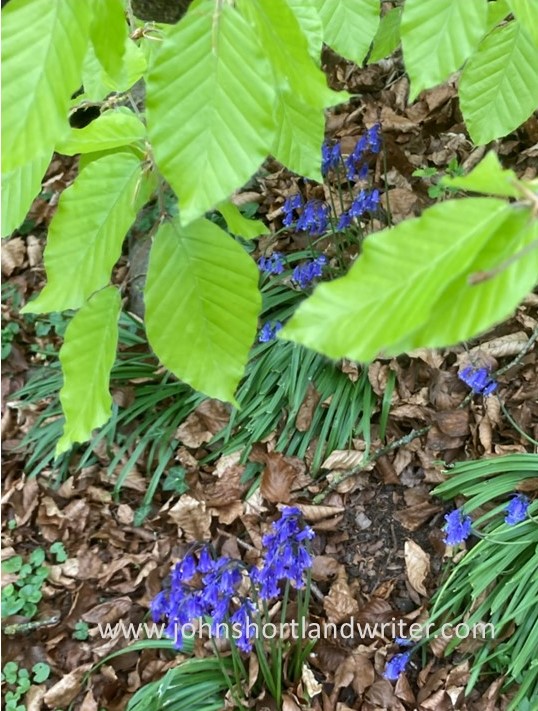
Can there be a more delightful spot to linger than a bluebell wood in spring?  The intensity of their colour when seen growing in their tens of thousands would hurt the eyes if not offset by the citrus green of the beech trees they favour growing under.  With early morning sunlight filtering through the branches to strike the woodland floor below, both leaves of beech and ‘bell shimmer and sparkle in the clear light.  As the forest warms the bluebells release their scent but not the heavy, redolent perfume that one might expect. Instead, a fragrance so soft and gentle that for a moment it seems to come from elsewhere; all too quickly it melts away, dispersed by the increasing heat.

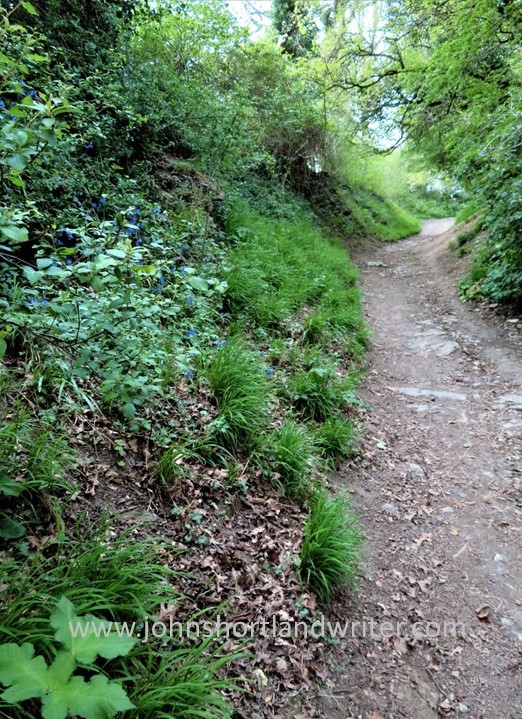
Bluebells are one of the key indicator plants of ancient woodland, a term that refers to woodland that pre-dates AD1600, for their bulbs prefer to remain undisturbed where they can slowly establish huge colonies.   Here, in the secret valley where they grow in hedge banks, they can be used to trace the line of an equally ancient drove road for it is thought that the hedgerows and trees that line it are remnants of Wychwood Forest.  Over centuries, the boundaries of the Forest have shrunk as fields were created and the trees cleared for arable land or pasture.  By leaving the field edges untouched the early farmers saved themselves both time and labour and in doing so preserved the bluebells that give me so much pleasure each spring.  The drove road – primarily used for herding livestock long distances to market – passes our little stone-built cottage before diverting across open country.  It is still used as a public right of way.

Bluebells line the old drove road that passes my house

Unsurprisingly for a plant that has been around from time immemorial, the bluebell has numerous regional names – Common Bluebell, English Bluebell, Fairy Bell, Wild Hyacinth to name a few.  Perhaps the best has to be Granfer Giggles.  In Scotland they are known as harebells although to an Englishman harebell would be a completely different plant that grows later in the summer when the bluebells have long ended.  Even the Latin name which is supposed to prevent confusion has changed over time – it is now known as Hyacinthoides non-scripta.  I much prefer the earlier name of Endymion non-sciptus, it sounds more attractive as well as having a romantic Greek legend attached to it.  Illegal to dig up plants from the wild, bluebells are sometimes offered for sale from cultivated stock under either of these names.

Occasionally you may find a white, or even a pink bluebell

For such a well-loved plant – it has been voted England’s unofficial national flower – bluebells do not seem to feature much in poetry.  They are frequently mentioned by name but no-one, as far as I can tell, seems to have written poems specifically about the plant.  Perhaps it is because they are such a common sight and have none of the delicacy of the wild rose, the scent of the honeysuckle or the diminuity of wild thyme. Shakespeare, who seems to have written about absolutely everything (including thyme), only mentions it once: “the azur’d harebell” in Cymbeline.  The Brontë sisters both wrote of bluebells but I’m not sure they weren’t describing later flowering harebells. Emily’s description “waves in summer air”, and Ann talks of a single flower and of its trembling.  Bluebells are quite a stiff flower that don’t wave or tremble that readily whereas Campanula harebells fit the description nicely. I can’t recall even my beloved Richard Jefferies, the Victorian naturalist, waxing lyrical over them as he did over so many other things.  I may be wrong about this for I can hardly call myself a Jefferies’ scholar, more an enthusiast. However, Cicely Mary Baker created a delightful illustration of the flower in her set of Flower Fairies published in 1923 where she describes the bluebell as the king of flowers.

The less-common Harebell – Campanula rotundifolia
It flowers later in the summer and in more open places

It is to the Georgians that I have turned to illustrate our love of bluebells for I have found frequent references to them in old newspapers and periodicals not just in published poetry but also in their fashions.  This description of the sumptuous gown worn by the Princess of Wales when attending the King’s Birthday in 1795 is worth reproducing here: “A gown of superb, embroidered crepe imitating the rays of the sun and intertwined with embroidered white lilies.  Over which a cape of Venetian net embroidered with laurels and Diana’s (presumably the Goddess) crescent”.  Finally, there was another over-cape “embroidered with bluebells (yes!) and held in place by rich cords and tassels”.  As if this wasn’t splendid enough there was “a long train of silver gauze bordered in purple and silver”.  Having spent twenty years in the world of fashion (before I switched careers to horticulture) this has sent me into overdrive!  Sadly, I haven’t found any illustrations for this ensemble but I do have photos of the ‘draft’ for equally exquisite embroidery designed by Norman Hartnell for a robe for Queen Elizabeth II.

Embroidery design by Norman Hartnell for Queen Elizabeth II

Even earlier, in 1786, Mrs Charlotte Smith was publishing her sonnets.  A remarkable woman for the age, she left an unhappy and violent marriage and campaigned for women’s rights and the abolition of slavery.  She wrote fiction and poetry to financially support herself and her children.  This sonnet reminds me so much of my youth where I roamed the bluebell beechwoods of the Chiltern Hills, for which they are renowned.

“Ah, Hills belov’d!  where once a happy child,
Your beechen shades, your turf, your flowers among,
I wove your bluebells into garlands wild,
And woke your echoes with my artless song.
Ah! Hills, belov’d! your turf, your flowers remain;
But can they peace to this fad’ breast restore?
For one poor moment soothe the sense of pain,
And teach a breaking heart to throb no more?

I’m glad to say that my heart is no longer breaking so perhaps the bluebells worked their magic!

A very old photo (hence the strange colour!) of me and my two deerhounds in a Chilterns beechwood at bluebell time

.
.
.

A Walk With Dinosaurs and Romans

One of the perks of getting older is retirement or, in my case, semi-retirement.  Suddenly, I no longer need to keep checking my watch to see if I have enough time to do things without racing onto something or somewhere else.  It has given me time to re-visit some of the pleasures that I enjoyed in the past. One of these is walking.  When I was much younger I used to walk the long-distance footpaths and trails that were then just beginning to be created.  Now there are literally dozens of them to be enjoyed varying in length from a few dozen miles to several hundred.  I’m not up to the lengthy walks of my youth yet – the longest took a fortnight to complete.  At present, I’m content to be out for a few hours and, hopefully, the mileage will increase over time. 

England is criss-crossed by public footpaths and longer trails

The other day my partner and I decided to visit the Roman villa at North Leigh not far from the small, Cotswold town of Woodstock.  Unlike the Roman villa where you rarely see anyone, Woodstock is visited by thousands of international visitors every year, for it is where Blenheim Palace, a World Heritage Site, is located.  The two houses, six miles apart in distance but fifteen hundred years apart in their building, are very different.  Whereas the Palace is full of priceless treasures, all that is left of the villa are the foundations and a single mosaic floor.  At its peak in 300AD, the villa was one of the largest in Britain with suites of rooms, many mosaics and several baths.  Now it is quiet, wildflowers scramble over the walls and it is set in glorious countryside close to the River Evenlode.  With parking close-by, this was the starting point for the walk.

The Roman Villa, once busy – now a haven of peace and quiet
Wildflowers scramble over the ruins of the Roman villa

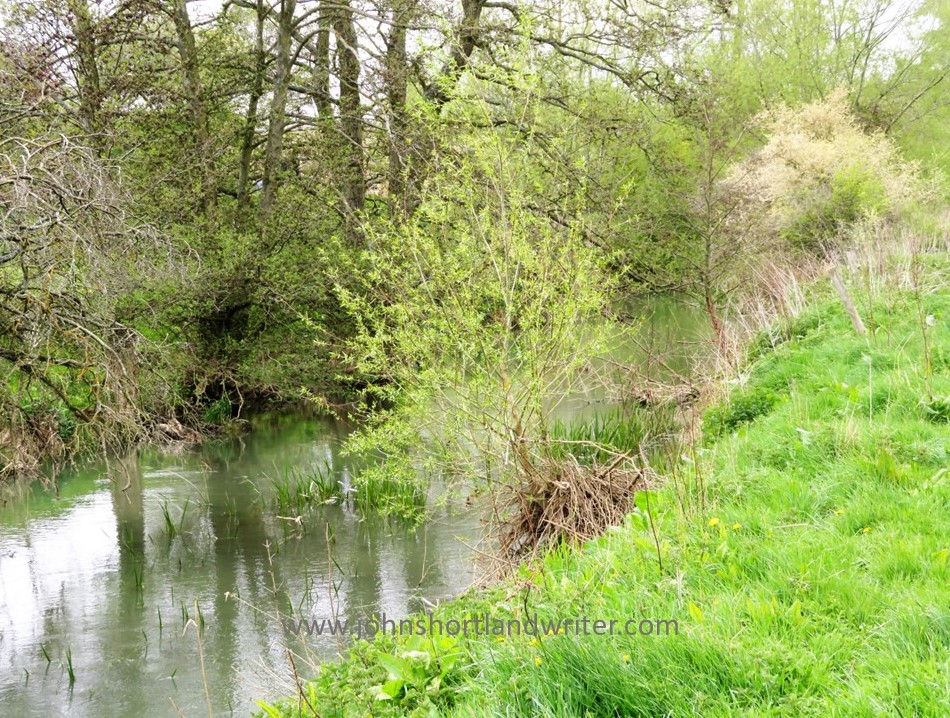
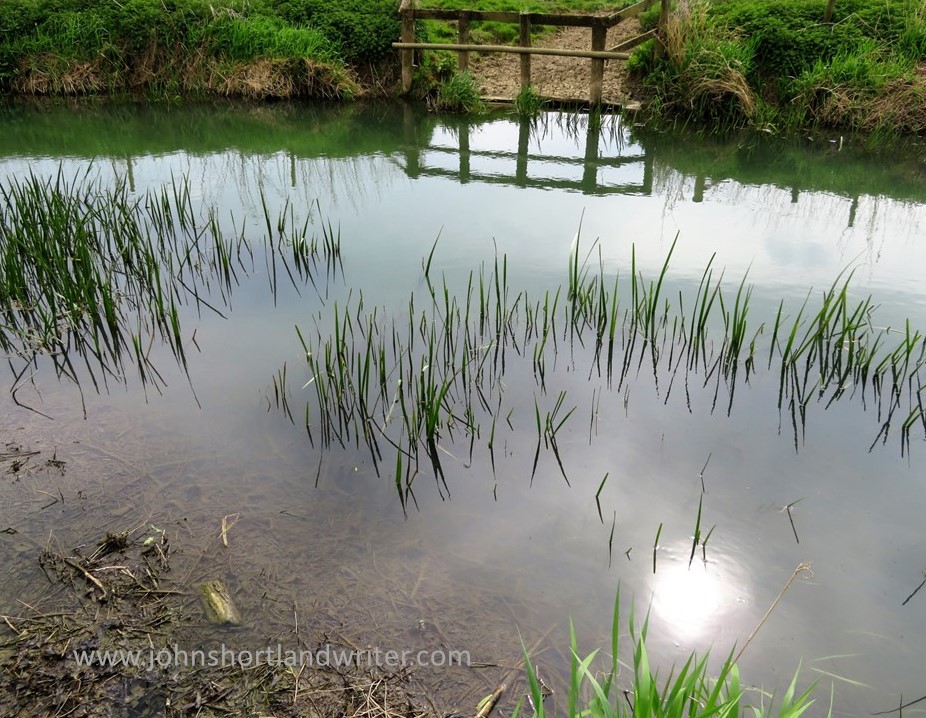
The path to the villa and those leading away from it are well maintained and marked, making the trail easy to follow.  Most of the route we took was on the network of public footpaths that criss-cross England, most of them dating from the time when all travel was either on foot or horse.  At one point, the paths joined the Oxfordshire Way, a path of 66 miles in length.  This in turn links to other long-distance paths so how long you walk for is entirely up to you!  After ten minutes or so, the Evenlode was reached and crossed.  Originally known as the Blade, its present name is relatively modern, first being recorded in use in the 1880s.  It meanders through the Cotswolds for nearly fifty miles before entering the River Thames. Crossing the river, the path turns to the west and the country changes in character with steep grassy banks rich in wildflowers rising high to our right, the river to our left.  Here we’re walking along Akeman Street, an ancient Roman road, once busy but now a quiet, grassy track.

The paths cross meadows until the river is reached

“The tender Evenlode that makes her meadows hush to hear the sound of water…”

Before long, the character of the path changes once more.  The Evenlode changes in character too for there is a wide ford – perfect for wild swimming.  Various paths meet here but we walked the steep path towards the village of Stonesfield, known locally for its history of making the stone rooftiles that are a feature of old Cotswold properties.  In pre-history, the Cotswold Hills were submerged by a warm sea and now fossils can be found quite easily; they can even be seen occasionally in the stones that have been used to build the houses.  It was in the Stonesfield loose and flaky rock that the very first dinosaur fossil to be found anywhere in the world was discovered.  Close to where it was found, a steel bench inscribed with the words of the French poet Hilaire Belloc has recently been placed – welcome indeed, after clambering up the steep path that leads from the ford to the village.

The view of the river from the ford
The rocks around the village of Stonesfield yielded the world’s first dinosaur fossil
The steel bench engraved with the words of Hilaire Belloc

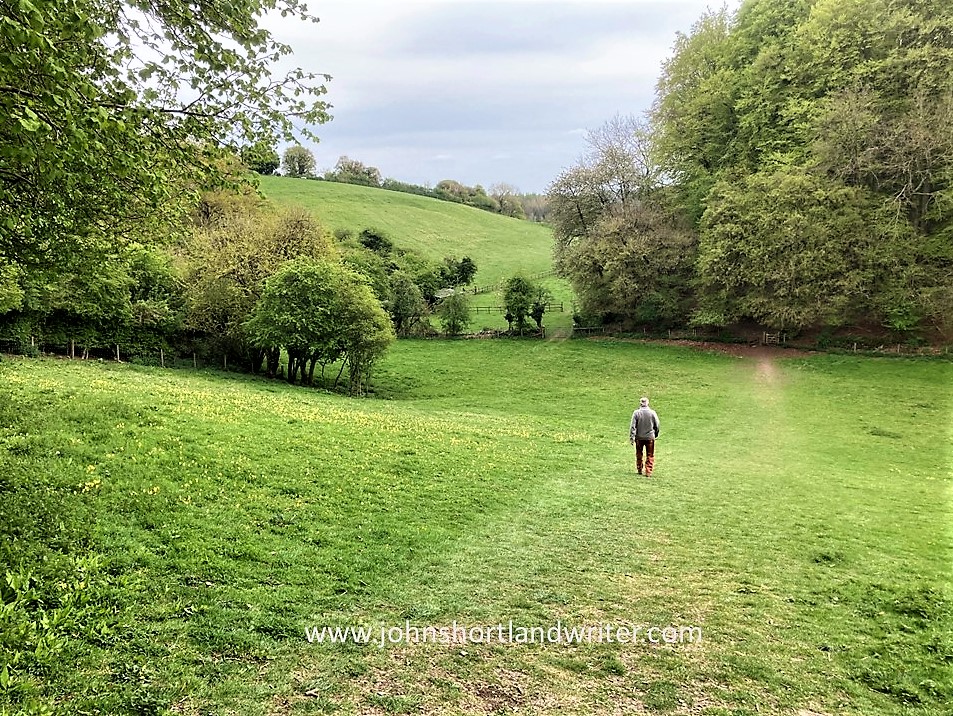
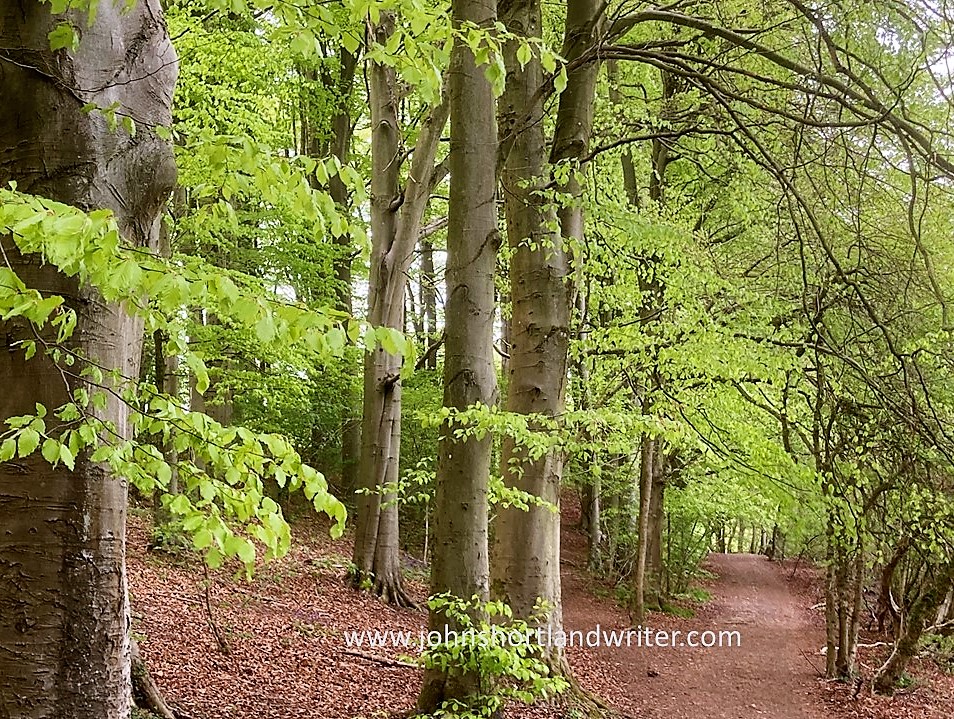
After a short walk along the edge of the village, our path left the Oxfordshire Way to descend steeply through meadows before reaching a strip of woodland, Stockey Plantation.  Although there are firs planted there, there are also many native beech trees which are, arguably, at there most glorious at this time of year.  The newly unfurled leaves are of the most intense green which, along with the deep blue of bluebells and the yellows of other spring flowers are almost too bright for the eyes to bear.

The descent to the woods becomes more gentle as it crosses the meadow
The path through the beechwood
The intense colours of the beech leaves and bluebells almost hurt the eyes

Leaving the woodland we reach the Evenlode ford once more but this time cross it – there is a footbridge, so no need to get wet – before striking off across the fields again to return by an alternative route to the Roman villa and the car beyond.  The walk probably took no more than a couple of hours and is relatively easy.  The weather, this April has been very dry.  At other times, the paths can be muddy and so sensible, walking shoes or boots are recommended.  The route we chose does have some steep hills to climb but these can be avoided for there are many paths that keep to the level ground.  An Ordnance Survey map of the area is handy to work out routes – I used the app on my phone but paper maps covering all parts of the UK are readily available. 

The sun seemed to shine brighter in the water than overhead
In the damper woodlands Ramsons, the wild garlic, carpeted the floor

To see more photos of the Roman villa and read of its history take a look at one of my earlier posts by clicking on the link here.

To read the full text of Hilaire Beloc’s poem of the Evenlode river click here

The Glories of a Beechwood

Buckinghamshire, one of the so-named Shire counties, lies to the north-west of London.  A long, narrow county; the southern part is renowned for its beech woodlands.  Although greatly diminished in size over the centuries, many of them are still there, remnants of the ancient woodlands that once covered much of Britain, although the industries that they supported are long gone.

Nr Fingest 2 watermark

In the Chilterns the beechwoods can almost engulf the lanes

Straddling the Buckinghamshire/Oxfordshire borders the Chiltern Hills extend diagonally northwards into neighbouring Bedfordshire where they change character from dense woodlands to more open downland.  It is within the shadow of the southern woodlands where I was born and where I lived for the greater part of my life before moving to the secret valley in the Cotswolds.  Inspired by Enid Blyton’s The Children of Cherry Tree Farm, my childhood was spent crawling around the fields, woods and hedgerows learning as much as I could about the wild birds and animals that lived within them.john david shortland 1965 watermark

Although nowadays the woods appear mostly deserted, they are still made use of.  The old tracks and paths that were once used by the men and women that worked and lived there are trodden by walkers, and by the wildlife that remains elusive for only those that move quietly have the pleasure of seeing anything other than a glimpse of a fleeing animal.

Woodland Track (2) watermark

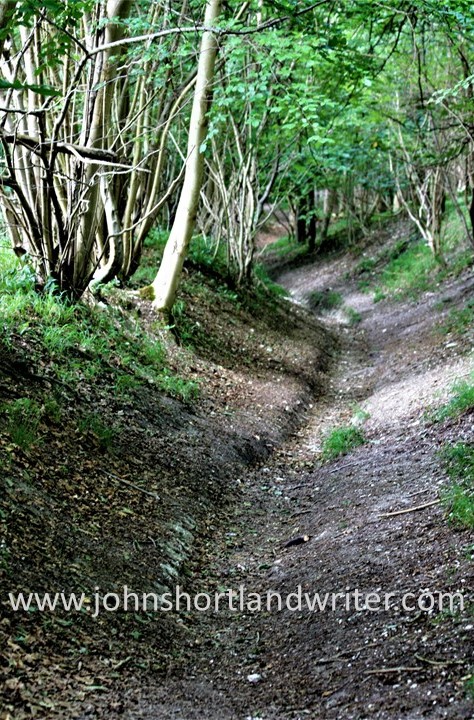
This centuries old track leads down into a deep valley

Fallow Deer watermark

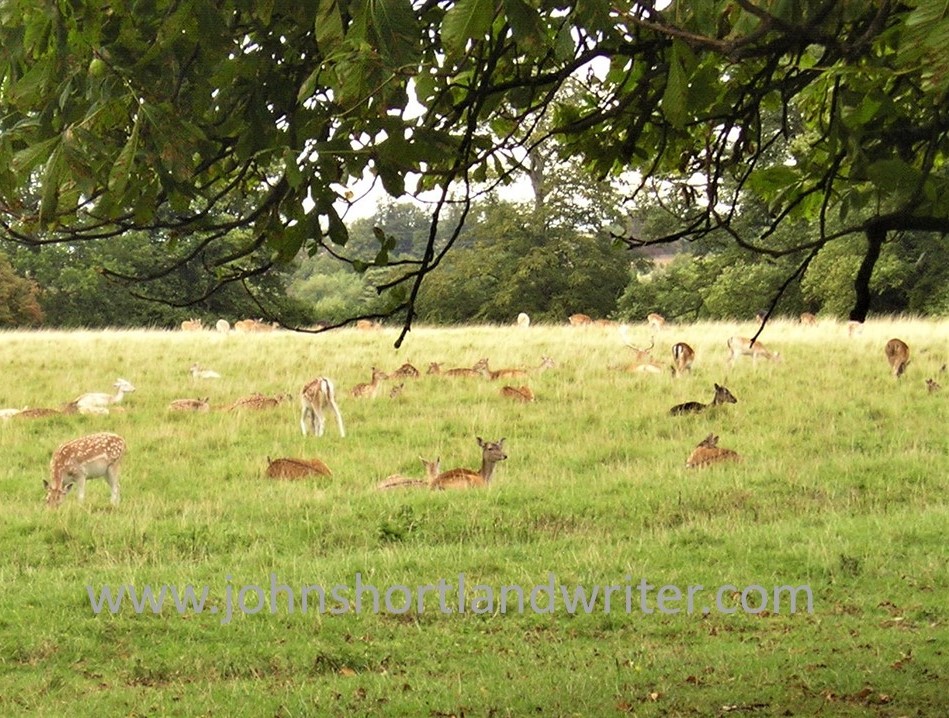
Fallow deer can often be seen at rest in clearings if you walk quietly

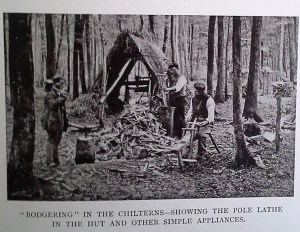
The making of chair legs to keep the flourishing furniture industry of High Wycombe, the local market town, was carried out within the woodland by men who would set up shelters there.  Known as chair-bodgers, a local dialect word originally confined to this immediate area, they were highly skilled craftsmen who could earn relatively high wages for their work.  The Second World War virtually ended the centuries old tradition, the last being Samuel Rockall who died in the early 1960s.  I had been unaware of Rockall’s life until I researched for this blog post and it seems as if we may have been related for I have Rockalls in my family tree.  In the 1851 census return one of my ancestral cousins is described as a chair turner living in the village where I spent much of my adult life.  More research required!

1851 census - Rockall

Jonathan Rockall, chair turner and ancestral cousin in the 1851 census return.  His wife, Ann, a lace maker,- another local craft

Some of my cousins?! Photo from an old book ‘English Country Life & Work’

It is, perhaps, springtime when the beech woods are most visited for the forest floor is carpeted with bluebells.  The intensity of their colour plus the iridescent green of the tree’s unfurling leaves almost hurt the eyes.  With early morning sunshine the scent is unique and difficult to describe – gentle is the best I can come up with.  As the day progresses the scent is quickly lost.Chilterns Beechwood copyright

During midsummer, the woods become visually silent: the leaves have turned a dark, leathery green and the bluebells gone to lie dormant for the rest of the year.  With autumn, the trees become alive once more with colour, this time as their leaves turn into every shade of copper, gold and brown before they drop to the ground for winter.  It is then that the smooth bark of the trees come to the fore with a silvery sheen that catches the low light of a winter’s day.  Although it may seem as if the woodlands are sleeping, in places the first bluebells are starting to poke their noses through the leaf litter.  Spring is on its way.Autumn colour watermarkIbstone 1984 watermark

A Hidden Exmoor Walk

I have misgivings about sharing this walk for it is a favourite of mine: in the 48 years that I have known it I have rarely met anyone other than those that work the land here. Do I want to encourage others to discover its beauty? I’m not sure.

This circular walk begins with the open expanses of Brendon Common but follows more sheltered winding lanes before descending through beech woodland to Rockford and the East Lyn River. A steep climb past Brendon church returns you to the moor. How long does it take? There’s no easy answer to this – allow two hours although experience tells me there are so many distractions along the way, including the Rockford Inn, that it can take much, much longer. Whether you want a quick sprint or a leisurely amble good supportive footwear is essential as is the ability to climb hefty hills.

Brendon Common (14)   copyright

Brendon Common


There is plentiful parking at Scobhill Gate, the cattle grid on the B3223 that denotes the westernmost boundary of Brendon Common. From here walks radiate across the 2000 acres of heather moorland but our route takes us over the cattle grid into farmed country and turns right by the hairpin bends at Brendon Manor Stables.

Scob Hill Gate   copyright.jpg

Scobhill Gate


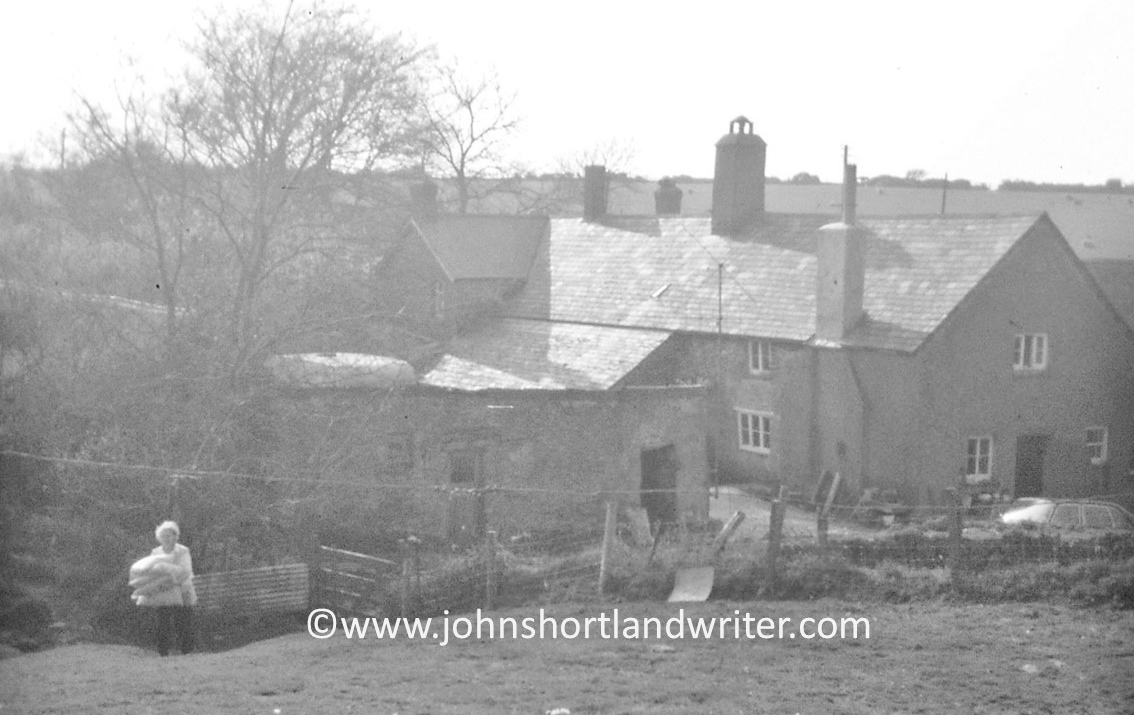
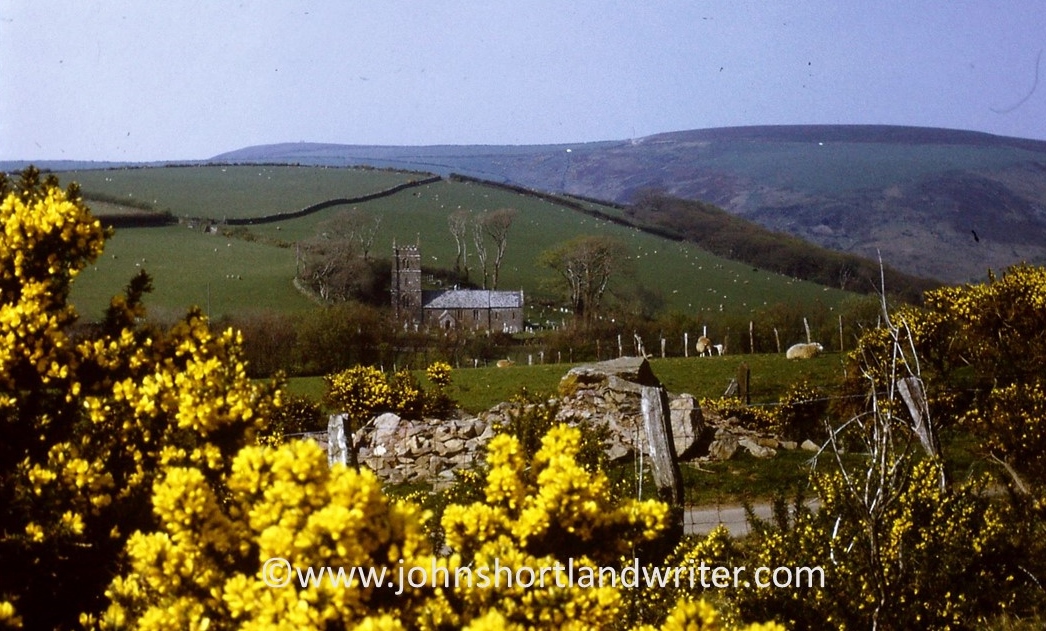
After a few hundred yards the road, which is flanked by hedges of hazel, ash, furze, bramble and bilberry (known locally as wurts), meets Gratton Lane. This is very much ‘home’ territory for me, for it is here at Brendon Barton that I arrived as a lad to work and play in 1968. Opposite the farm there are fine views of Brendon church and in the far distance Countisbury Common and the sea.

Lil @ Brendon Barton 1968   copyright

Brendon Barton 1968

Brendon Church 1968 (2)   copyright.jpg


Walking along Gratton Lane is lovely at any time of the year but is at its best in spring when the beech hedges are bursting into leaf and primroses and bluebells nestle at their feet. These banks are an ancient method of providing shelter, as well as a barrier to livestock, from the fierce gales and snowstorms that sweep in from the Atlantic. The banks stand about five feet in height, lined with stone with the beech planted above.

Above Brendon Barton (2)   copyright.jpg

Gratton Lane


Just as the lane starts to descend it enters woodland and it is here – just past the warning sign denoting the ford that crosses the road – that a footpath is taken to the left. The path follows a pretty stream as it tumbles over rocks down to join the East Lyn River. It is here that the unwary walker can also take a tumble as the path crosses outcrops of rock that become quite slippery when damp. This stream has everything a larger one would have – cascades, waterslides, ferns growing from niches – but all in miniature. Despite its diminutive size it once powered a sawmill.Waterfalls (2)   copyright.jpg

The mill has long been a ruin and is now fenced for safety but the rusting ironwork is still visible. Just beyond the old building the path joins the road. Turn left and follow the lane to the hamlet of Rockford. You are now walking in the Brendon valley with its beechwoods clinging to the steep hills high above, home to a number of rare rowan trees (Sorbus) unique to the area.  The East Lyn River is a major river; when water levels are low it is difficult to imagine its ferocity when in spate. In 1952 it destroyed bridges, houses and lives as it passed through the valley culminating in the flood disaster at Lynmouth where thirty-four people lost their lives and over one hundred houses were destroyed. The Rockford Inn is a good place to stop for a beer; they also serve cream teas. Just make sure that you put the cream on the scone before the jam in the Exmoor tradition! It is possible to extend the walk to Watersmeet (where there is a National Trust tearoom) by crossing the river.

ROCKFORD MILL   copyright.jpg

The Old Mill nr Rockford


East Lyn River (2)  copyright.jpg

East Lyn River


Once past Rockford the road starts to climb until it reaches Brendon church. The hill is a killer – it’s not called Church Steep for nothing! The church which nestles into the hill and looks out across the combes looks as if it has been there for centuries. In reality, it was moved stone by stone from nearby Cheriton in 1738. It is simply decorated inside but has some attractive stained glass. Brendon Barton, passed earlier, can be seen from the steps of the church. Follow the lane back to the farm; from there retrace the original route back to Scobhill Gate.

Brendon Church (5)   copyright.jpg

Brendon Barton (2)   copyright.jpg

Brendon Barton, view from the church


Happy walking!


Exmoor is a National Park in the southwest of England and straddles the counties of Devon and Somerset. Apart from miles of wonderful moorland walks, it also has the highest sea cliffs in England, pretty villages and spectacular wildlife including the majestic Red Deer. Native Exmoor ponies roam the open moor. Now a rare breed they remain virtually unchanged from pre-history.