Unknown's avatar

About johnshortlandwriter

John the Writer: It is as natural for me to write as it is for me to eat or drink (sometimes I forget to do both when the ink is flowing). For years I would write – then shuffle the words until satisfied - then shred it. The act of writing was enough. One day I thought that seemed just a tiny bit silly so saved them on the computer and Life in the English Cotswolds was born. That was in 2009 and to my surprise people like you came along and liked what you saw. Since then, over 180,000 of you have visited, commented and become ‘friends’. Thank you! 2012 saw the very first Chipping Norton Literary Festival take place with which I was closely involved for several years. It was there that I was approached to write my book, Why Can’t my Garden Look Like That?, published a year later by How To Books, an imprint of Constable & Robinson and now part of Little, Brown. Over the years, my blog has expanded to cover many topics ranging from travel to family history and much else. This has brought a new audience with it for which I am both delighted and grateful. John the Gardener: The earliest image of me gardening is one of me as a child of about four using – well that’s too strong a word for it – a rake. Gardening is in my blood for every member of my family have been keen amateur gardeners (I am the only one doing it for a living). Whether it was aunts, grandparents or my father, everywhere I went they were in the garden tending flowers and vegetables or in the greenhouse potting up seedlings. Indoors, around the table, the talk was all about plants. Despite that, I started off my working life (apart from a short stint on a remote Exmoor farm) in the rag trade – selling men’s and women’s fashions. All the time, the great outdoors beckoned so it was off to horticultural college as a mature student before becoming Head Gardener to several large, country estates. That was twenty years ago now and every day I realise that not only did I make a great career move but just how lucky I am. Another sideways step brought me to where I am now – designing gardens, showing others how to garden and looking after gardens. And, of course, writing about it. John the Countryman: I have lived in the country all my life. As a child I spent my time exploring the lanes, woodlands and orchards of the Chilterns, that range of glorious, chalk hills cloaked with beech trees. Each spring they become carpeted with tens of thousands of bluebells. It was here, as a small boy, that I learnt about the wild plants and animals that share our world, a magical place. In more recent times I moved to the Cotswolds – only 50 miles away yet a completely different range of hills both geologically and in character. Here, there are wide open views and skyscapes, dry stone walls and rushing streams and some of the prettiest towns and villages in Britain. I now live in a tiny stone cottage beside the winding river in the photo above, all tucked way in a secret valley. Bliss. Horses and dogs play an important part in my life too. More bliss. John the Explorer: The description is a tad exaggerated but I have had my moments. I guess that spending a night in a hostel for down and outs in the Rocky Mountains (how did I mistake it for a hotel and why didn’t I leave, I often ask myself), being stuck in a blizzard in an Indian reservation at 3 am in the morning in the far north of Canada or getting caught up in an attempted coup in Sudan probably allows me some claim to the title. Recent years have seen my exploring closer to home, in considerably more comfort and a lot less scary. Well, in principle, it is. I spend a lot of time on Exmoor, my spiritual home of over 45 years, and Ireland is another place that I visit frequently. Strangely, things still don’t always seem to go quite to plan …

The Scottish Pineapple

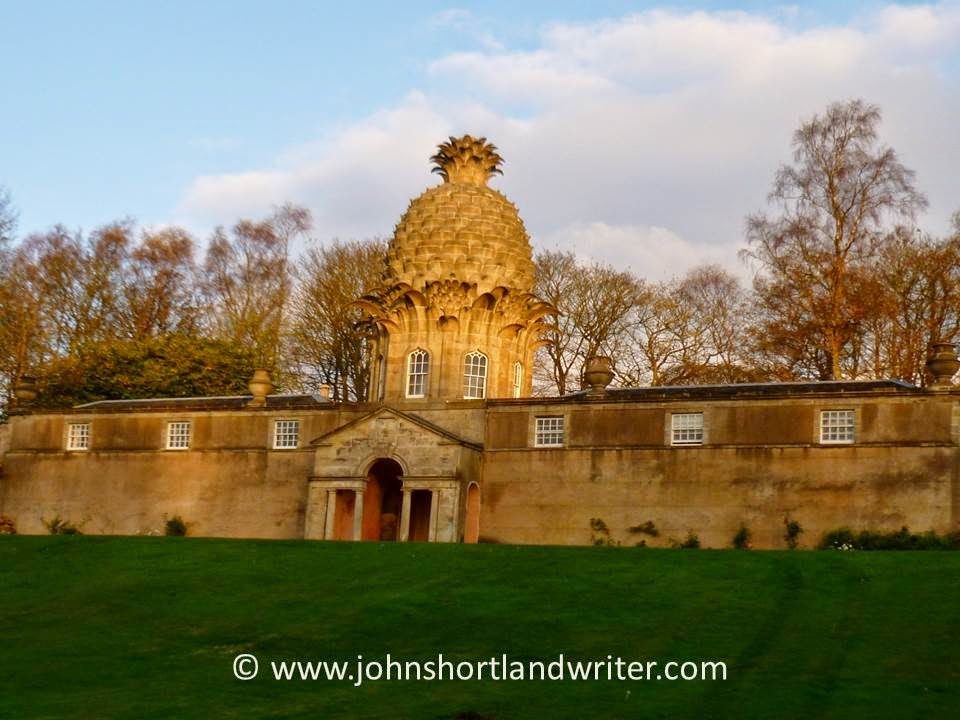
The statement “I have been living in a Pineapple” may give cause for surprise but is, in fact, quite true for I have just returned from a brief trip to Scotland.  To stay in a building that puts a smile on your face whenever you catch a glimpse of it ought to be on everyone’s ‘to do’ list – if it is, The Pineapple is the place to go.

e226c-the2bpineapple2b42b2b2bcopyright

Originally part of the Dunsmore Estate, it was gifted to the National Trust for Scotland in 1974 and leased to the Landmark Trust who undertook its restoration.  Neglected for very many years, the Pineapple proved to be in remarkably good condition for every ‘leaf’ was designed to prevent water collecting within it and damaging the stonework.  The remainder of the property was very unstable and derelict.

The Scottish Pineapple

When the two walled gardens were enclosed at Dunsmore in the mid 1700’s there was no ‘big house’ attached.  They were purely used for producing a supply of fruit, vegetables and flowers to be sent to the Earl of Dunmore’s home in Argyll. It was some years later (it is thought) that the Pineapple was added as a folly and summerhouse, probably after the Earl’s return from Virginia and the Bahamas where he was Governor.

The Scottish Pineapple

Why a pineapple?  In the eighteenth century, pineapples were a rare luxury that had become associated with wealth and hospitality.  They began to appear on pillars, railings and weather vanes and, indoors on fabrics and wall coverings.  The building of The Pineapple was, perhaps, the grandest of all grand gestures.

aa16c-the2bpineapple2b122b2b2bcopyright

Although the building is of such high quality in both its materials, cratsmanship and design it was barely recorded in contemporary writing and its designer remains unknown.  One possible reason for this is that it may have been just a little too ‘over the top’ even for flamboyant Georgian taste.  It is even quite probable that the Pineapple may have been painted. The doorway of the undercroft is a very accurate timber carving of Ionic pillars beyond which stone steps lead to the raised northern lawn.  From this lawn there is level access to the summerhouse.

78a9f-the2bpineapple2b192b2b2bcopyright

Either side of the Pineapple are two small cottages, formerly gardener’s bothys.  These have been fully restored by the Landmark Trust to create holiday accomodation with living room and kitchen in one and bedrooms in the other.  The north garden and the Pineapple room are for the private use of guests, the south lawn and gardens are open to the public.

2daaf-the2bpineapple2b92b2b2bcopyright

ba5c7-p10403322b2

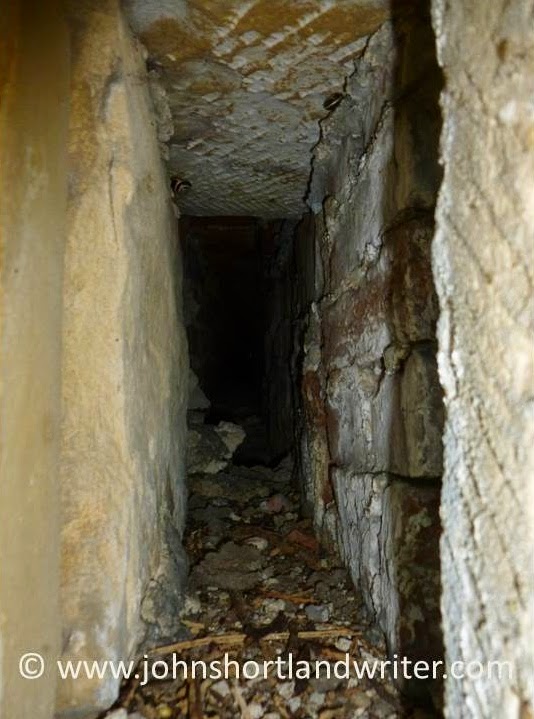
To be able to grow pineapples required specialist knowledge and skills as well as additional warmth.  Glasshouses flanked the south wall and were heated by the use of specially constructed hollow walls.  At the foot of these, fires were lit and flues within the wall drew the heat upwards, warming the brickwork.  The four decorative urns to either side of the Pineapple conceal chimneys and because of there similarity to those at Casino Marino in Dublin (to read about this extraordinary building click here), it has been suggested that the designer could be Sir William Chambers although there is no documented evidence to suggest this.   At intervals on the southern side of the walls I found sliding stones which could be removed presumably to allow the heat to escape.

a31b0-the2bpineapple2b312b2b2bcopyright

46745-the2bpineapple2b342b2b2bcopyright

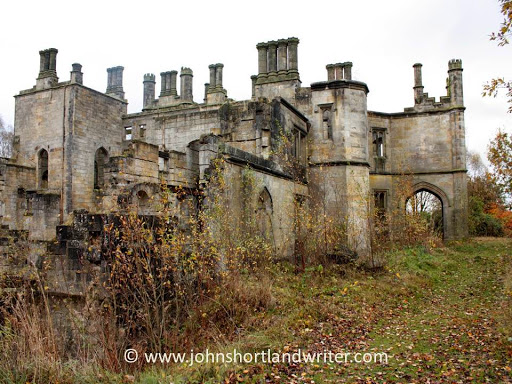
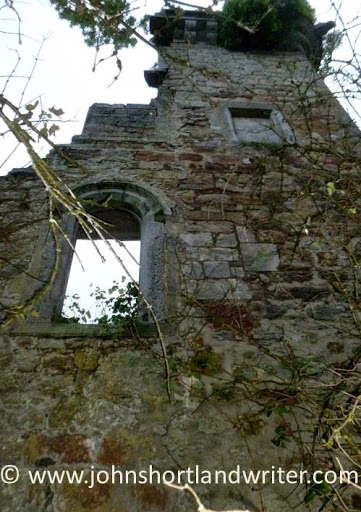
In 1820 William Wilkins, architect of the National Gallery in London, designed a house in the Tudor Gothick style.  Dunsmore Park’s glory was, however, short-lived for by 1911 the family had left although it remained occupied until 1964 after which it was abandoned.  It is now a ruin visible across the fields from the Pineapple.  Another ruin, now very unstable, and also visible from the Pineapple, is the Elphinstone Tower.  Of earlier origin, built about 1510, it became the family vault of the Dunmore family in 1836 with a church built alongside a few years later.  This was demolished in the 1960’s.  Their fascinating stories will be subjects of this blog in due course.

The Scottish Pineapple

The Scottish Pineapple

With so much history and beautiful scenery close by – Loch Lomond is only a short drive away – the Pineapple makes a great and intriguing place to use as a base for exploring the area.  The grounds are open free to the public all year but the building is at its best during the hours when you are alone to enjoy its eccentricity and splendid isolation.

The Pineapple (6)   copyright

The Pineapple at night

Links:

The Landmark Trust

The National Trust for Scotland

The Story of Lorna Doone – just a myth?

 Lorna Doone is the tale of a young boy, John Ridd, whose father is killed by Scottish outlaws – the Doones.   Exiled to a remote part of Exmoor (which is in England’s West Country and now a National Park), they rob travellers and local farms.  Living amongst them is the pretty Lorna Doone, kidnapped by them as an infant.  John enters the forbidden Doone Valley by climbing a steep and difficult waterfall, the ‘waterslide’, and meets Lorna for the first time.  Some years later he rescues her and as they marry Lorna is shot through the window of Oare church by the wicked Carver Doone.  John pursues him and after a struggle Carver perishes in a bog.  Lorna recovers from her wounds and so the story has a happy ending.

Oare Church

But is it true?  The simple answer to the question is that the answer isn’t simple.  When Richard Dodderidge Blackmore wrote his historic novel in the late 1800’s he mixed fact with fiction and local legend with the names of local people.

Blackmore placed the Doone stronghold beside Badgworthy (pronounced ‘Badgery’) Water.  There is a deserted medieval village beside a tributary in Hoccombe Combe and it is very probable that this is the site for the ruins were still visible in Blackmore’s day.  However the Waterslide is not found there but in another side valley, Lank Combe. Nowhere as sheer as described it is, however, an impressive sight with its three smooth slabs of rock especially when the river is in spate.  I like to think that he also had in mind the waterslide at Watersmeet a few miles further downstream which would be much more of a challenging climb.
The waterslide at Watersmeet
 

Because the precise location of the Doone Valley is uncertain it is no longer described as such on maps, the Ordnance Survey now describing the area more accurately as Doone Country.  A rewarding walk can be taken along the whole length of Badgworthy Water starting from Brendon Common by parking the car at Brendon Two Gates.  Here there are wide views of both the open heather moorland and also the grass moor of the Royal Forest ‘improved’ in the nineteenth century.  Badgworthy Water changes in character along its length from fast running rapids to smoother, deeper pools.

Badgworthy Water

The above walk is rugged and long but a more gentle approach is from Malmsmead with its much photographed packhorse bridge and ford that also denotes the county border between Devon and Somerset.

Malmsmead where Badgworthy Water crosses the road
 

Further along the lane nestles the village of Oare and the church where Lorna and John wed.  Inside is a memorial to Blackmore, a smaller copy of the one in Exeter cathedral.  A memorial can also be seen to the Snow family who lived at Oare manor and also feature in Lorna Doone. It is recorded that as Blackmore didn’t write kindly of the Snows he was afterwards much disliked by them.  Other local characters also existed: Tom Faggus, the highwayman was – in real life – from nearby North Molton and Ridd is still a local surname. 

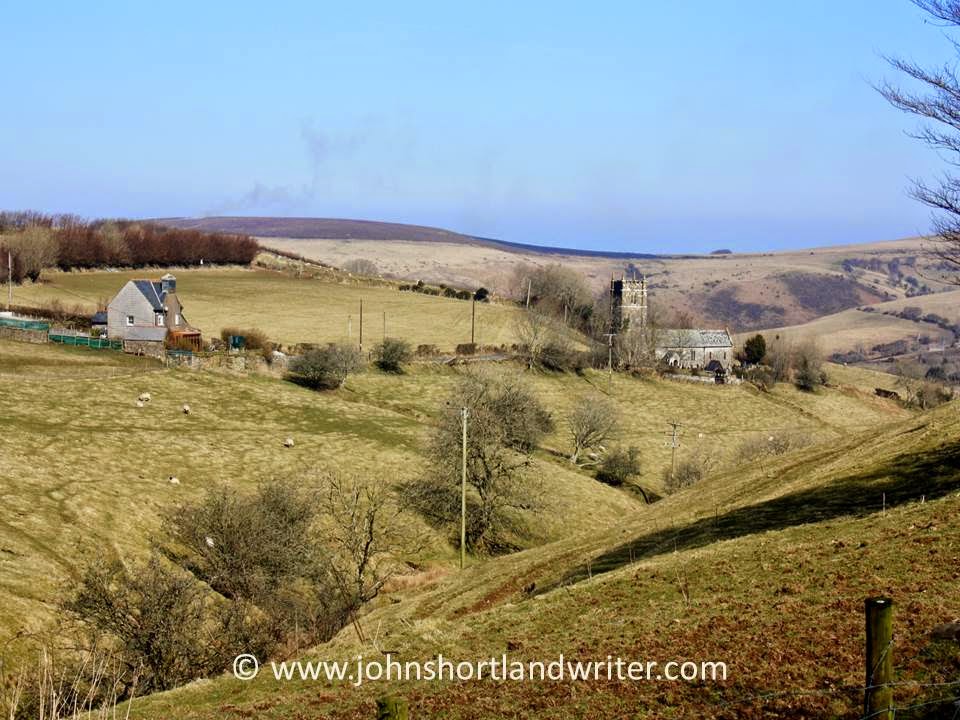
Oare village and church nestle in a deep combe

Is Lorna Doone a story based on truth?  That is for the reader to decide, perhaps after visiting Mother Meldrum’s cave in the Valley of Rocks, for both are mentioned in Blackmore’s book.

The Valley of Rocks

Add to Technorati Favorites

Respect Your Elders

Of all trees few can be held in as much contempt as our native elder, Sambucus nigra.  It grows almost anywhere and in such profusion that it is dismissed as a ‘weed’ and it is true that its habit of self-sowing and growing through treasured garden plants can be a nuisance.  Despite all of this, however, it is also one of the most useful of plants both in the wild and the shrub border.

This variegated form of Elder is very useful for brightening up a shady place
 
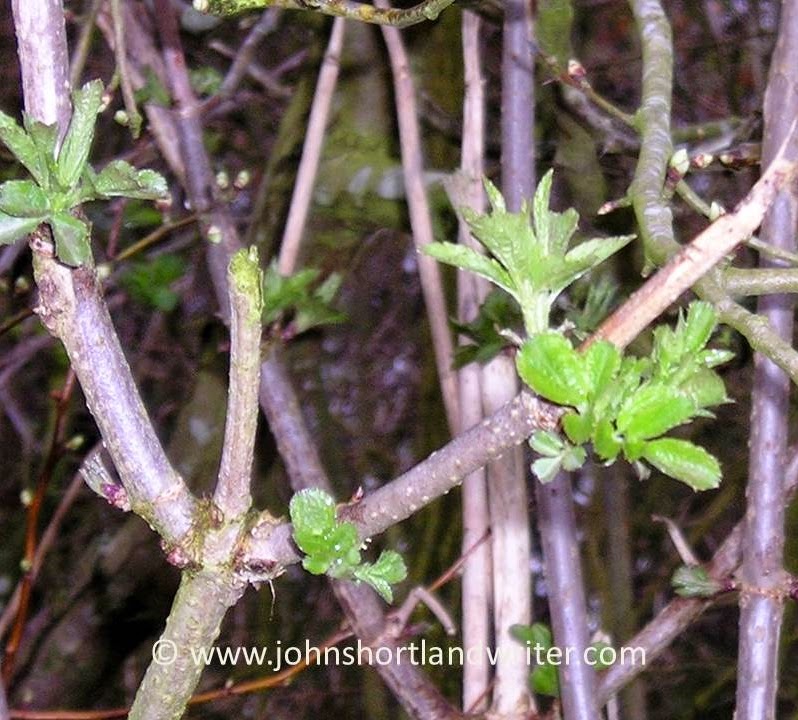
Search any hedgerow and the Elder can be found.  It is easily identified, even in mid-winter, for its bark is dull, dry and scaly, with prominent pairs of leaf buds; these are some of the earliest to open in the spring.  Young leaves can even be found during mild spells in the winter although these are replaced if damaged by frost.  Perhaps the simplest way to identify a leafless plant is to break off a stem for the centre is hollow and filled with whitish pith. Generations of country children hollow out these stems to create ‘cigarettes’ to smoke; in fact I can claim only to have smoked elder – and that stopped once a spark burnt the back of my throat!

Perhaps the glory of Elder comes in spring when the trees burst into flower. Large, flat heads (corymbs), consisting of hundreds of tiny scented flowers smother the plants and for a short while the countryside carries their pungent odour.  These have traditionally been the first crop to be harvested, their flowers steeped in water to make Elderflower cordial or ‘champagne’, these days now sold commercially. Elderflowers can be used dried in herbal teas or, when fresh, swirled in a light batter and dropped into hot oil to make delicious and unusual fritters.  Adding the flowers to stewed gooseberries or when making jam is a very old method of counterbalancing the tartness of the fruit.
Within weeks the flowers which were held upright will have faded and drooped as berries form.  Even when green, streaks of colour hint of their ripeness to come.  By late summer, the clusters have turned almost black and make a welcome addition to fruit pies or, used on their own, in jam and wine making.
The medicinal uses for Elder are equally varied.  According to the herbalist Juliette de Bairacli Levy all parts of the plant can be used: roots for kidney problems; bark against epilepsy and the leaves, when mixed with geranium and garlic, to soothe eczema and rashes.  The flowers and berries are used for relief of coughs and colds and it has also been claimed that the flowers can restore blindness.  As with all herbal treatments caution and common sense should be used – I’m not brave enough to suggest that you try any of them out!
The dark berries  of the elder – the red ones are hawthorn
For a tree with so many uses that has been part of country lore for so long it is not surprising to find it has many names.  A widespread alternative is Judas Tree for tradition states that it was the Elder that Judas Iscariot hung himself from.  It is from a derivation of the name Judas that Jew’s Ears fungus which commonly grows on elder gets its common name.


Stop That Horse!

The first week in September doesn’t just herald the start of autumn it also heralds the start of the Land Rover Burghley Horse Trials.  Held each year in the grounds of Burghley House – a magnificent, Elizabethan stately home located just outside Stamford, Lincolnshire – it attracts the top names in equestrianism.  Also known as three day eventing, the trials combine different elements of horsemanship: dressage, cross-country and show jumping which tests the strength, stamina, skill and bravery of both horse and rider.  It is a popular and unique sport with crowds of over 160,000 coming to watch.

The cross-country course is very demanding with thirty-two fences over a distance of 6500 metres (four miles) to jump, ideally under twelve minutes.  The Cottesmore Leap is one of the largest and scariest looking of the fences although the horses rarely seem fazed by it.  

 
Eventing is a high risk sport and accidents do occur.  More often than not, this is when a fence is misjudged and the rider parts company with the horse or a fence is damaged during the jump, for they are designed to fall apart to reduce the risk of injury.   So what happens when something goes wrong?  On the course there are ‘stopping points’, placed for good visibility so that the next competitor has plenty of warning to apply the brakes if there is a hold-up further on.  A red flag is waved to tell the rider to stop and the time of stopping is recorded by a steward.If the stop is likely to be short the rider will continue to ride the horse at walk to allow it to cool gently; if longer they dismount, remove the saddle  and lead the horse at walk to keep active. 
If the delay is lengthy the horse will be washed down to cool it further and the rider also given the opportunity to take a drink of water.  Although this is frustrating for the rider, competitors understand the need for total safety to both themselves and their horse. 
Once the all-clear is given the horse is remounted and gently exercised to warm up its muscles before resuming the competition.  When the rider is satisfied the horse is ready the timing is restarted as they canter past the yellow marker post so that no competitor is disadvantaged.

Like all large events, sporting or otherwise, contingency plans are in place for all types of emergencies and spectators are rarely aware of these ‘behind the scenes’ procedures even when, as in this case, they happen on full view. Over many years the stopping point has proven its worth, and it is an interesting place to watch, for it shows a top performance horse go through the stages of change from full competitive action to rest and back again.The Land Rover Burghley Horse Trials 2014 take place from 4th – 7th September; visit the website for more details by clicking here.

For daily updates from Life in the English Cotswolds click here
Join me on Twitter @johnshortlandwr click here

Add to Technorati Favorites

Purple Haze

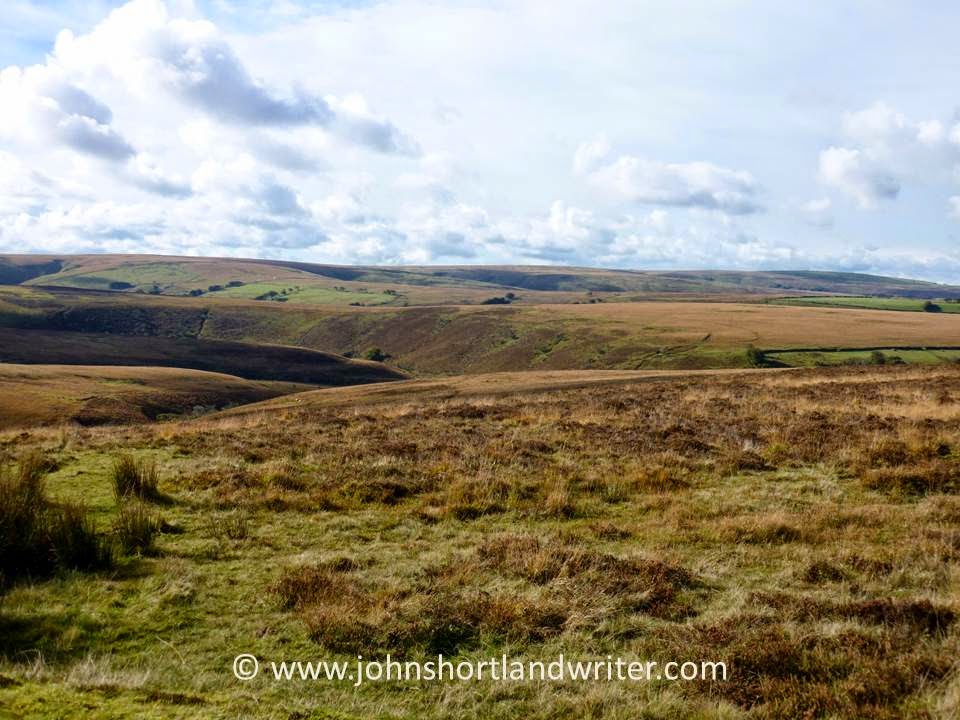
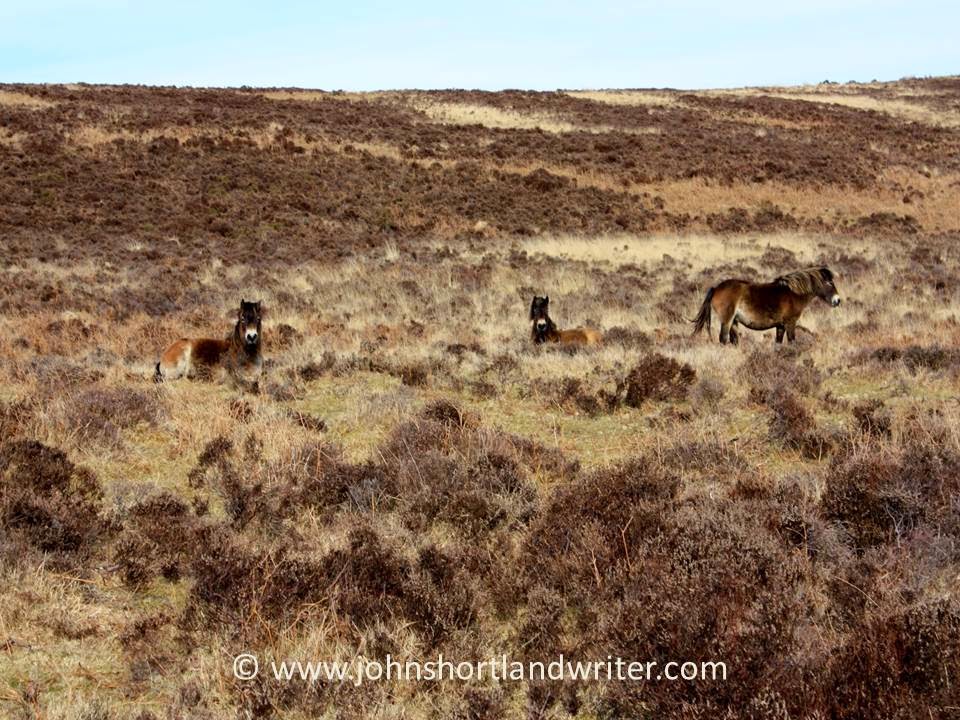
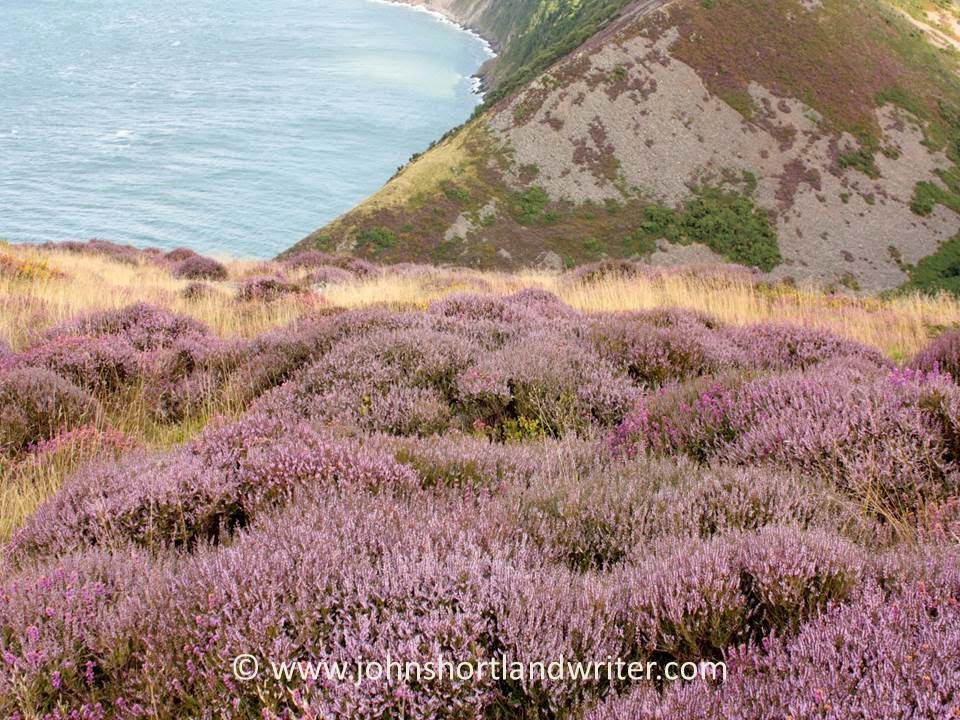
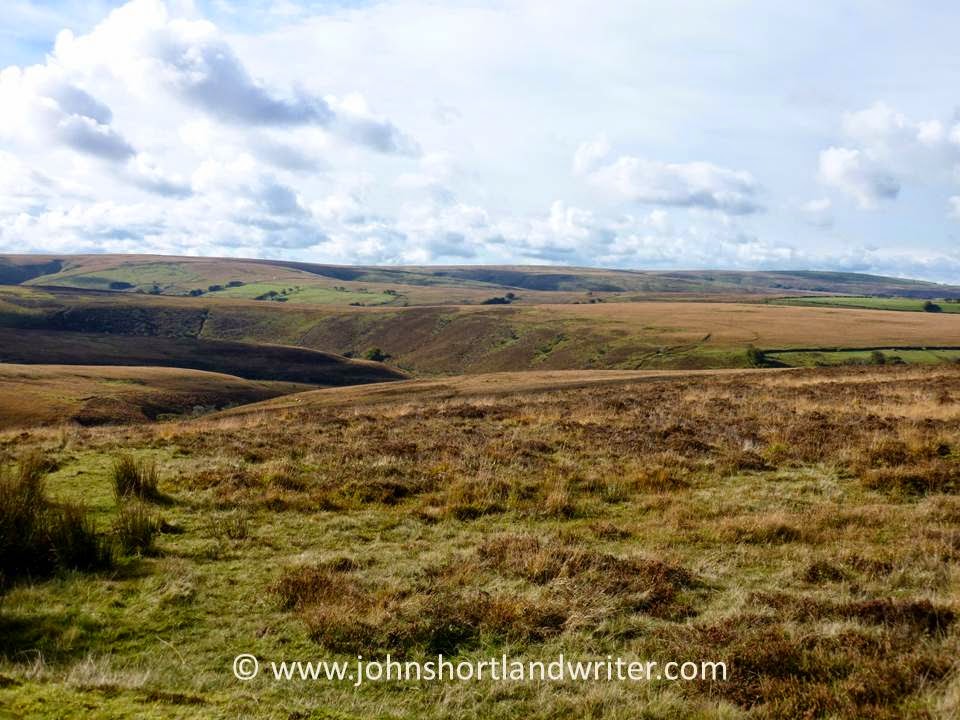
Ask those that know Exmoor – England’s smallest National Park – to conjure up just one image of it and you would get a number of different answers.  For some it is the wild ponies, others the rushing streams but mostly the answer would be the sea or the moorland.  On Exmoor you are never very far from either.

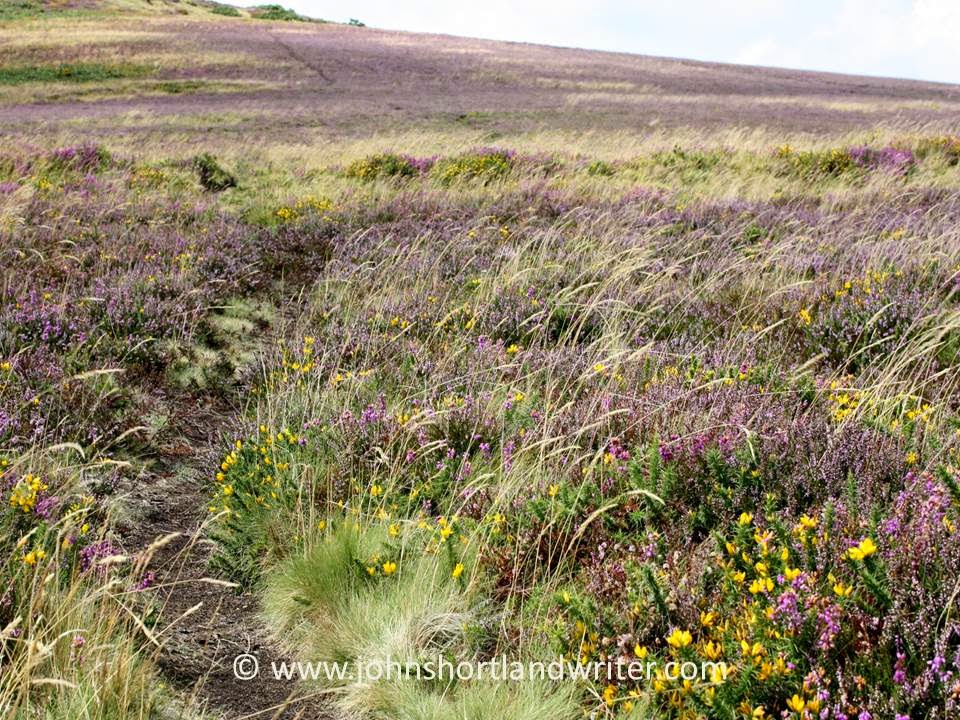
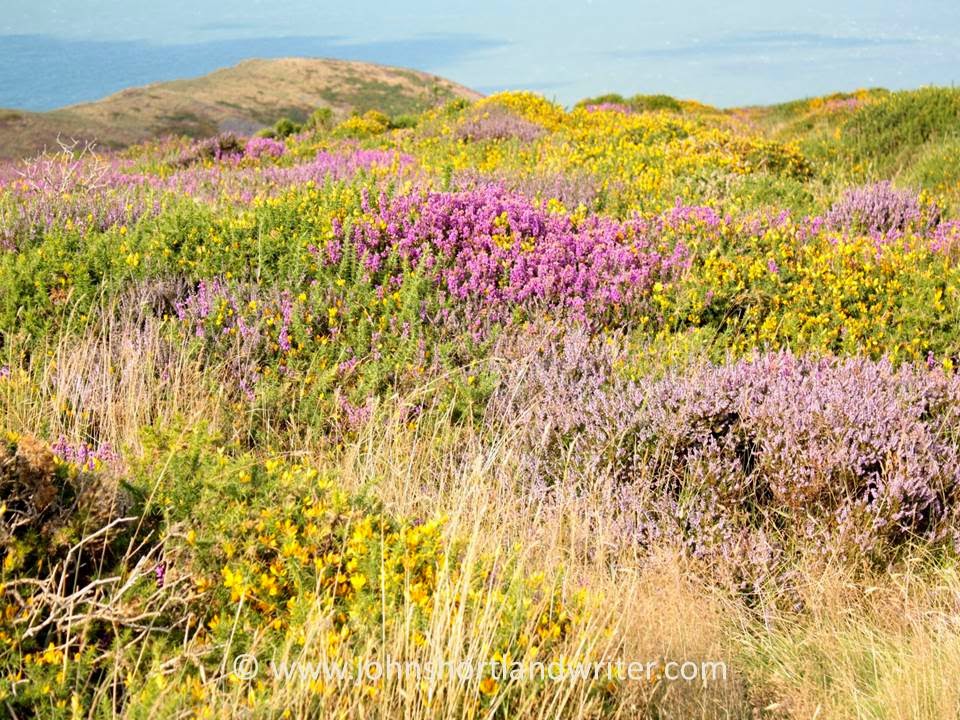
At this time of year the moors are, perhaps, at their very best: awash with a purple haze of heather in bloom, speckled with the yellow flowers of furze – the local dialect word for gorse.  During the cooler months, however, the heather looks very different, drab browns and greens giving no hint of the glory to come.

The heather is an important resource for animals whether it is food for the ponies, sheep or cattle that roam the open spaces or the deer.  In the past – they died out in 1969 – black grouse fed here too, the record of their existence recorded in place names such as Heath Poult Cross, heath poult being the dialect word for the grouse. For other birds that nest close to the ground the heather protects them with its cover.
Although at a glance the heather all looks the same, there are three types, quite easily distingushable when in flower.  Cross-leaved Heath (Erica tetralix) has paler flower clusters at the top of the stems; Bell Heather (Erica cinerea) is a rich crimson-purple in flower whereas the true Heather or Ling (Calluna vulgaris) is softer both in colouring and appearance.  Together, they blend to create a colour mix of shadow and light.
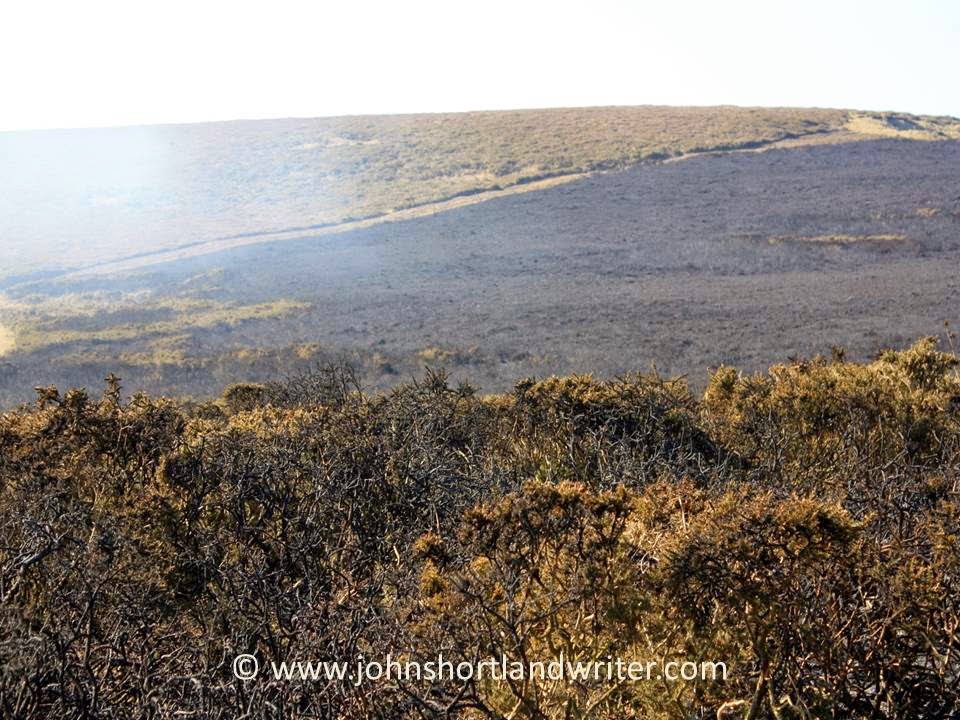
To keep the heather moorland in good order, controlled burning is carried out once the plants have become old and woody, an ancient method called swaling.  Only selected areas are burned, usually on a five to ten year cycle between October and early April.   
The fires are watched carefully, not just to prevent their spreading to other areas but to ensure that the rootstock is not damaged from which the new, tender shoots soon grow.  The burning of the moor is both exciting and interesting to watch for the smoke can be seen for many miles.  It is difficult to imagine when the stems are blackened and charred that life will ever return. The photograph below shows the regrowth after four years.

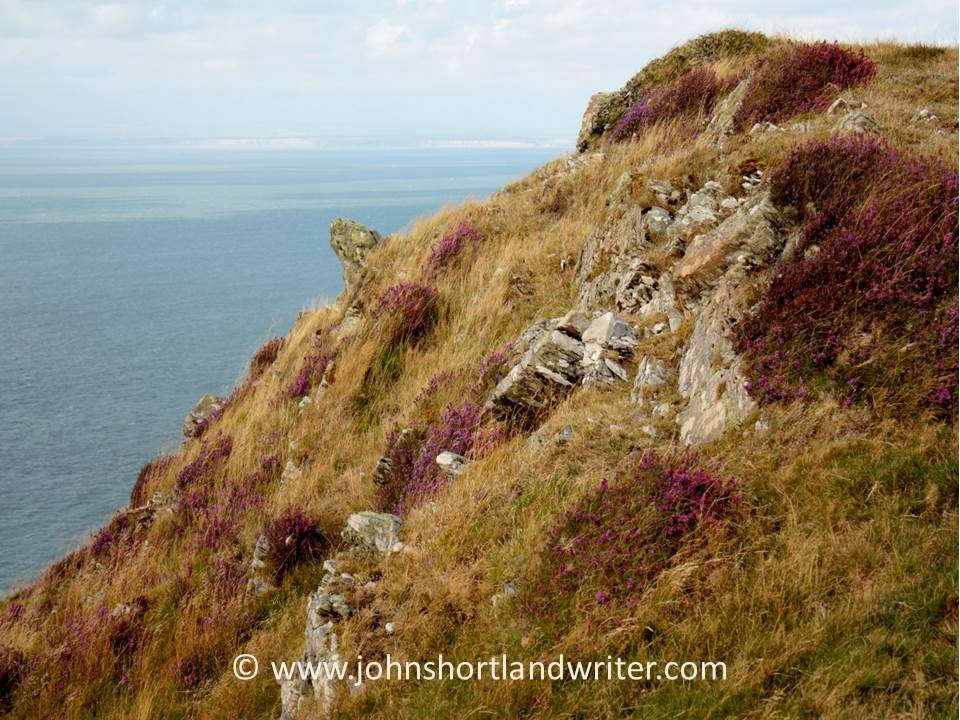
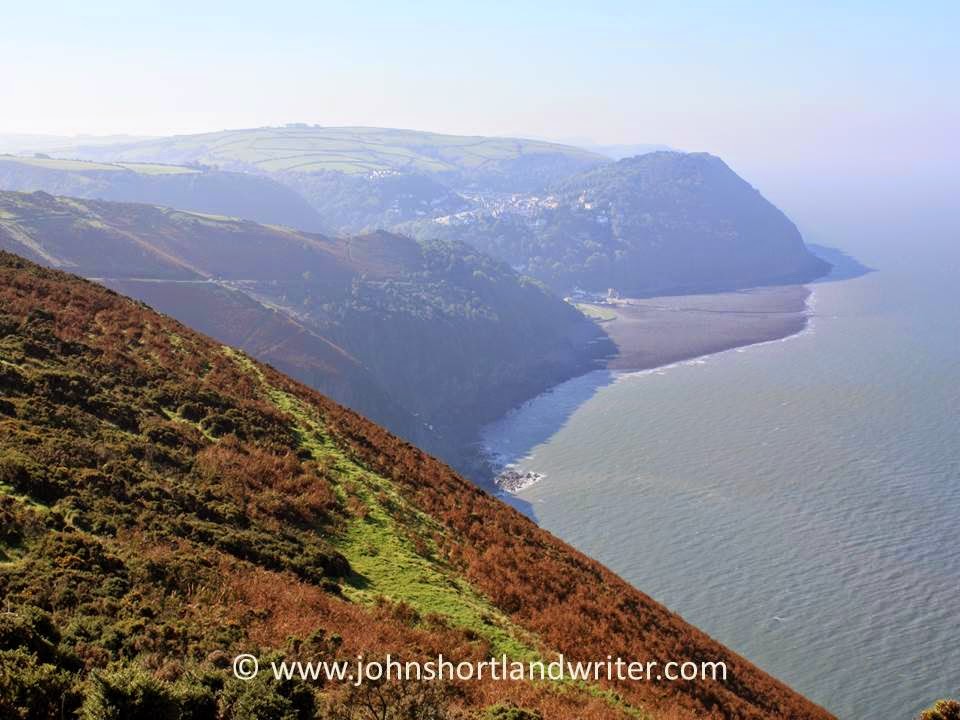
Exmoor has the highest cliffs in England and these are made even more dramatic by the moorland which extends to their edge, the heather even clinging to the steep sides as they tumble to the sea, caring little for the salt-laden winds that continually buffet them.  On a sunny day in August the combination of blue sea, purple heather, yellow gorse and blue sky, combined with Exmoor’s splendid views, is a sight rarely forgotten.

Add to Technorati Favorites

All is Safely Gathered In?

The air is heavy with the scent of harvest.  Is it the summer heat that produces the heady smell of fresh straw or the act of cutting it?  Probably a combination of both but the result gives mixed emotions for, whilst there is something very comforting about knowing that the corn is safely stored and the livestock will have plentiful winter bedding, there is also a tinge of regret for it is the first sign that autumn is rapidly approaching.

Harvest is one of the few events in the modern farming calendar which gives an insight into the ways of country life of generations ago.  These days, for most of the year, farming is a solitary occupation with a skilled tractor operator carrying out the tasks of many people.  Now the fields often seem empty, quiet places, devoid of human life or activity. Even fifty years ago there were more people working there but go back even further, say another hundred, and there would have been the sights and sounds of dozens of people working from dawn until dusk, racing against the weather.  A poor harvest then meant months of hardship and hunger for many.  Modern harvesting, albeit for a much shorter time is when the fields seem alive once more with combines, grain trucks, straw wagons and the like. 


The image below is taken from a nineteenth century farming manual belonging to my great, great-grandfather, and it demonstrates just how many people both men and women, were required for harvest. There were the mowers with their scythes, the gatherers, the bandsters who bound the sheaf together and then set them in ‘stooks’ to keep dry. Finally, the raker would clean up all fallen straw and grain for none could be afforded to be lost.  Harvesting by hand was surprisingly speedy for a skilled mower could cut over an acre of wheat in a day.  However, by the 1880’s virtually all corn was harvested by horse drawn machines.

Many attempts were made to design a harvesting machine throughout the centuries – the earliest, using oxen, is described by Pliny two thousand years ago.  The binder – as seen in the wonderful engraving also taken from g-g-grandad’s book – which cut and tied the corn into sheaves in one operation, first came into use in the 1850’s; it continued to be used for another hundred years: by 1979 when the photograph below was taken it was an eccentric rarity. 

the binder can just be seen on the middle right of the photo
 
Combine havesters are giants compared to the binders of old and when they travel through the secret valley they take up the full width of the lane with very little room to spare.  First to be cut is oilseed rape, the crop that turns vast swathes of the British countryside bright yellow in spring.  The resulting stubble, unlike that of corn, is sparse and sharp and makes for uncomfortable walking on.


Barley, oats and wheat – which in the UK are collectively referred to as ‘corn’ – then follow with each crop (and its straw) having its own requirement and characteristic.  Modern technology may have shortened the number of days it takes to bring in the harvest but the working day is just as long as it ever was for the combines work from early morning to late at night, providing the crop doesn’t become damp with dew or rain. 

Harvest has always been dependent upon the weather so it is not surprising that upon completion celebrations take place.  Although the traditional Harvest Supper is now mostly a thing of the past, the Harvest Festival church service is still one of the most popular.  On Exmoor – where I helped with harvest in my early years – and typical of a remote, tightly –knit community, every window ledge and the altar of the church would be decorated with flowers, fruit and vegetables.  Pride of place was given to the first stookof corn cut from the field. Packed with families that had been too busy to meet one another for several weeks the hymn ‘Come Ye Thankful People, Come’, written by Henry Alford in 1844 a line from which the title of this blog post is taken, and a great favourite of the farmers, was sung with gusto.

Exmoor church

Add to Technorati Favorites

The Dog with the Poorly Paw

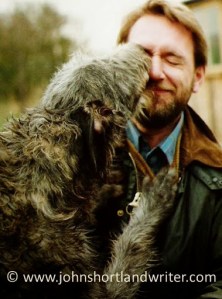
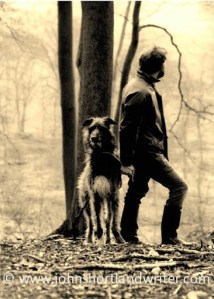
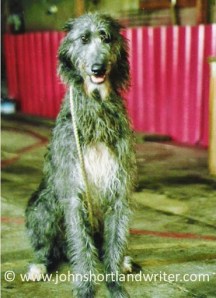
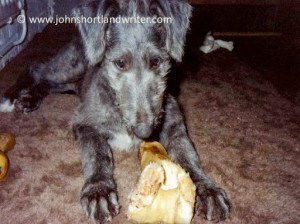
Deerhounds are the gentle giants of the canine world: despite their size and, to some people, fierce looks (never fathomed that one out!) they are docile, kind and trustworthy.
Sometimes known as Scottish Deerhounds, they are one of the oldest and least changed of breeds.  Scenes depicting hunting with dogs almost identical in appearance to them can be found on ancient pottery or manuscripts and because they have never become a ‘fashionable’ breed the excesses of inbreeding for the showring has not occurred.
  Deerhounds are not for the faint-hearted!
Similar in bone structure to the greyhound, this is most obvious when the dog is wet and its wiry, long coat clings to its body.  Although not as fast on the flat, over difficult ground it can easily outrun them.  It is also slightly larger reaching 32” in big males and can weigh up to 50kgs.  There is little variation in colour, blue-grey being the most prized but in earlier times there were a variety of colours, now all lost.
     the dog with the poorly paw
Tarff, my first deerhound and named after a Scottish loch, proved to be a near disaster.  Soon after he arrived and playing in the garden, he knocked his leg.  After a moment’s yelping it was forgotten by both him and me until his paw started to turn outwards; he had damaged the leg’s growth plate, resulting in the bones growing at different rates.  By the time of his first operation his paw faced backwards; treatment and further operations made it gradually turn again towards the front.  It never quite made it and as a result he was instantly recognisable by his 45 degree turned out foot.  Once strong and hardened it really made no difference to his mobility. 


unruly teenager

Having been told that he was unlikely to survive the operations and during that time was to have no exercise he was spoilt unmercilessly.  Proving the pessimists wrong, he became the deerhound from hell – an unruly and totally undisciplined teenager. An uncontrollable dog with the weight, power and speed of a deerhound can be lethal and a rigorous training regime had to start, carried out in short and frequent bursts.  He excelled himself and became a great companion for several years.

the ‘butter wouldn’t melt in my mouth’ look
It is always heartbreaking when a much loved pet dies, regardless of its age but sadly, as is common with the other giant breeds, deerhounds are not long lived.  Tarff died at just seven years old although others that followed lived to thirteen, a great age for a deerhound.
  just twelve weeks old, the ‘greyness’ comes later

Would I recommend a deerhound?  Probably not, despite their many good traits: they are docile, kind and trustworthy and have no agression in them.  They are also quite silent which can be an advantage – but not if you are looking for a guard dog.  However, they need frequent, although not especially lengthy, excercising and it is essential that they have free running.  Being sighthounds, they are great chasers which can be an issue, especially in suburban areas.  Mine have all proved to be great pets but I doubt if I shall have more despite having unlimited access to open countryside from the back door.   These days I am content to pet other people’s deerhounds assuming the dog allows it for this is another of their odd traits: a deerhound can be aloof at times.  It is the one that decides if cuddles are allowed, if not it will pretend you just don’t exist.


at rest

Links:

UK  The Deerhound Club

USA  Scottish Deerhound Club of America

Update:  I’ve just come across this great new resource for dog-loving visitors and residents of the Cotswolds alike  Dog Friendly Cotswolds

Reincarnation or Just Coincidence?

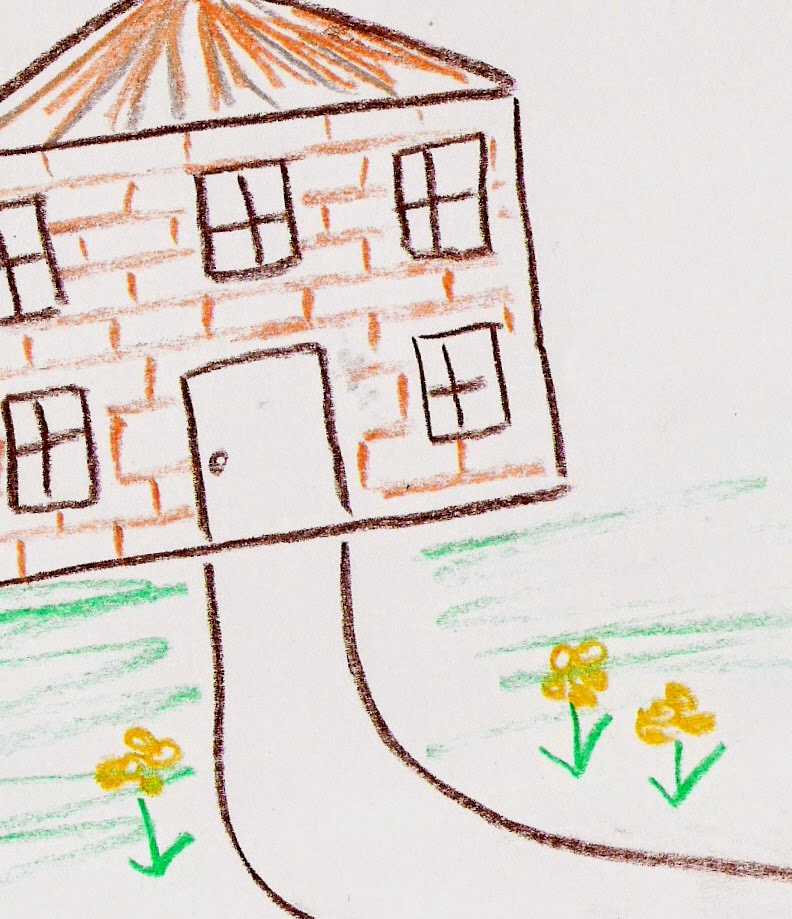
I have written about the ‘dream’ house before but recently the mystery of it took an unexpected leap forward. 

I am a small child running through the countryside when I arrive at what appears to be a derelict house.  At least I always assumed it was derelict for the two windows looked as if they had silted up and instead of being full length they were only one-third of their normal height.

The windows are at the back of the house but initially I approached it from the front.  There is a long driveway and as I run around a bend suddenly there, in front of me, is the house.  It is huge but very symmetrical – just as a small child would draw one if asked.  No sooner have I seen it than, in that typical disjointed dream way, I am around the back by the windows.

 I manage to wriggle through one of them and as I do I fall a short distance to the floor.  It is a small circular room with several doors leading off it; as I stand up I lift my head to look at the ceiling: it has stone vaulting just like an abbey might be.  And then … I wake up.  I don’t feel scared, I feel happy and warm inside as if I’ve come home after a long time away.

The dream recurs regularly from my very early childhood right through to the day in my late twenties when I awake and for some reason decide to draw the house.  No matter how hard I try, I can only draw it as a small child might but, somehow in doing so, I break the spell and I never dream of the house again.
Fast forward fifteen years and a career change to gardening for a living.  Now a trained Head Gardener I apply for a post in a village I have never heard of and arriving for my interview I proceed up a long, half mile driveway, round a bend and, yes you’ve guessed correctly, there is the house of my dream.  I am shown around the gardens and finally, at the end of the interview, approach the house from the rear.  There are the two windows…      

Having successfully got the job, part of my remit is to tend the house plants.  The room with the two windows is a small circular library with three doors leading off.  When I pluck up the courage to talk to my employer of the dream she tells me that the house was once a convent and this room is adjacent to the old chapel, now used as a dining room.  As for the vaulted ceiling she says there could be for the present plain one is false although they have no intention of changing it to find out.  I ask her what the tall obelisk at the front of the house commemorates.  She tells me it is rather a sad story: it is a memorial to the only son of the family for whom the house was being built in the early 1700’s.  He died before it could be completed and so they gave it to the nuns to live there.

I officially left the job – and I thought the house – thirteen years ago to take up a new position in the Cotswolds.  In many ways I was sad to go for I loved being there but a change had beckoned. Some months later I receive a telephone call asking me to act as a consultant on an occasional basis – is it the house that has prompted this – and I have returned regularly ever since.

Move to the present day after a gap in visits of several months where I admire the new building set in the grounds close to the house, an indoor swimming pool.  I am told that there were a number of problems in completing the work for when they started digging the builders dropped into an underground room.  Its existence had not been known of before and yes, you’ve guessed correctly, it had a stone vaulted ceiling…

Reincarnation or coincidence – I’ll leave you to decide.  I’m happy either way and if it is reincarnation I am delighted with the obelisk that has been placed in my memory.  I shan’t be asking for it to be taken down just because I’ve returned…

Add to Technorati Favorites

Don’t Be Put Off By Its Name…

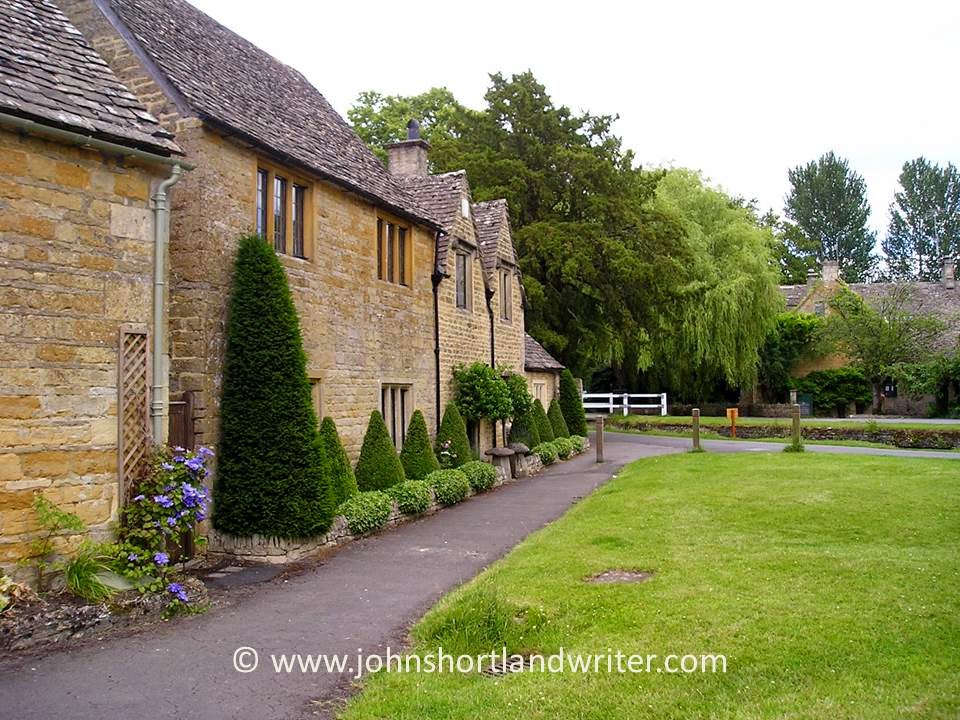
Slaughter may not sound the most promising of names but Lower Slaughter situated in the heart of the Cotswold Hills is one of the prettiest and most unspoilt villages you can visit.  Its unusual name is a derivation of the Old English word ‘slough’ meaning muddy patch but, if it was many years ago, it is certainly not one now.  In fact, three years ago it was described in a poll as having ‘the most romantic street in Britain’.

Although there is some more recent housing discreetly tucked away most of the buildings date from the mid sixteenth to mid-seventeenth centuries.  Its origins are even older  for it was well established even before being recorded in the Domesday Book; this means that it has been continuously inhabited for over a thousand years.

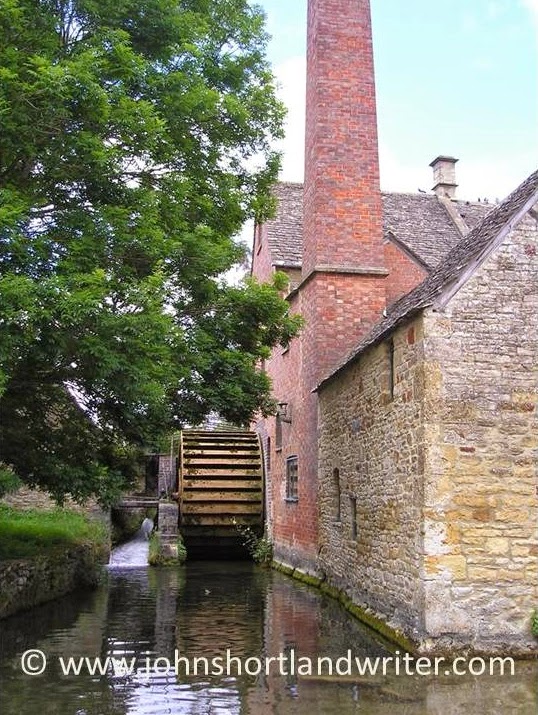
Many of the oldest houses cluster around the the River Eye which, although shallow, is powerful enough to feed the undershot waterwheeel of the mill.  This building, which now houses a small museum, is made from red brick – an unusual building material in this area – and was working as recently as the the late 1950’s.  It is a comparatively modern building having been built in the 1800’s although a mill was recorded on the site in 1086.  The tall chimney was built to give the mill additional steam power.
A similar tale can be told of the picturesque church with its tall spire which also dates from the ninteenth century.  There are a few traces of the original building within it: an arcade of four bays dating back to the early 1200’s.  The lichen encrusted gravestones in the churchyard also belie their age for burial rights were only granted in 1770 – before then villagers were buried in nearby Bourton-on-the-Water.


The countryside surrounding Lower Slaughter, and also the village itself, may not appear to have changed much in centuries but there is no doubt that they are very much ‘tidier’ than they once were.  An old Pathe News clip shows the banks of the Eye overgrown – there probably wasn’t the same enthusiasm for cutting its grassy banks when it has to be done by scythe.  Another change the film shows is the ‘locals’ sitting on the benches: nowadays, many of the houses are owned by the wealthy as weekend retreats and those exploring its lanes are visitors. 


Lower Slaughter, despite its obvious attraction, has done very little to encourage tourism.  It is still possible to sit there or cross its little stone footbridges or paddle in the ford and be transported back to a time when life ran at a much slower pace.  It makes a very refreshing place for visitors to recharge the batteries after the crowds of its larger neighbours, Bourton and Stow-on-the-Wold or, for us lucky enough to live in the Cotswolds, to do the same after a hard day’s labour. 
 
Lower Slaughter is just 2½ miles north of Bourton-on-the-Water and 3 miles west of Stow-on-the-Wold.  The Old Mill sells great ice cream!
To see the Pathe News Clip from1939 click here

Add to Technorati Favorites

Fetch me a Handkerchief…

When you come to think of it, gardening is a strange hobby.  What makes people want to spend hours of their time, let alone their hard-earned cash, toiling away in the hope that something might grow?   Why get wet or too cold or too hot and far too tired just to watch your favoured plant being ravaged by pests and diseases or, just when you think all is going swimmingly, to see it being struck down by an unforeseen frost?  On bad days it hardly seems worthwhile.

Of course, the answer is because gardeners are eternal optimists.  Just because something has failed this time means, surely, that it will be a great success the next. And, generally speaking, the good results far outnumber the bad.  What can give more joy than eating, say, a juicy, full-of-flavour pear that you have nurtured knowing that it is free from pollutants and raised by your own hand?  Or, plunging your snout into the centre of a rose bush knowing that it will come out, as the saying goes, smelling of roses?

If all of this sounds slightly odd to a non-gardener, then stranger still must be the thought that many professional gardeners never see the end results of their labour.  They do a task and move onto another garden, often never to return. As a member of this strange breed a question I often get asked is what motivates me.  The answer is always the same: it is the thought of success, of planting for the future and the sheer pleasure in working alongside nature.  And, of course, some gardens we return to again and again.

And so it is with my ‘oldest’ garden: one I have worked in for twenty years, first as Head Gardener and, after I moved miles away to the secret valley, on an occasional basis doing more specialist tasks.
One of the last jobs I carried out was to plant that most celebrated and notorious of ornamental trees Davidia invoulcrata, the Handkerchief Tree, to announce the arrival of the new millennium.  Celebrated because of its wonderful flowers resembling a pocket handkerchief; notorious because it can take twenty years before they appear.

 Davidia originates from China and although first discovered in the mid 1800’s it was not until 1904 that the first one was to be grown in England.  If given the right conditions they grow quickly and although they aren’t fussy about soil type they do like a certain degree of shelter – mine is planted on the edge of woodland which gives protection from strong westerly gales.  They do not respond well to pruning so it is important to allow it space to grow up to 60 feet in height and 20 feet across. They are attractive in a quiet sort of way even when young for, although they lose their leaves in winter, they are of a pleasing shape and shade of green during the summer months.

Every May, I have checked the tree to ensure that it is growing well and looking healthy and wondering if I would ever see it in flower – and this year I did.  Along its uppermost branches, fluttering in the breeze were fifteen flowers, one for each year of its planting.  I stood watching them for several minutes and, as many a gardener will understand, felt quite emotional that I had been instrumental in growing something that will become more spectacular with every year that passes.  Could it be that its English name was given not just because of the resemblance to a clothing accessory but because those early growers, seeing them for the first time, reached out for their own handkerchiefs?  It is special moments like these that keep gardeners, both amateur and professional, gardening.
The flowers of Davidia are, in reality, only the round reddish centre; the white parts are bracts, leaf like structures that are often brightly coloured or in the case of Davidia, white.

A mature Davidia seen at Hidcote Manor Gardens – it will be some years before the one I planted will look like this…

Add to Technorati Favorites